Design and Implementation of Universal
Access Using Smart Card Based on IoT
Bhede Snehal Vikas, Prof. M. N. Kakatkar
Post Graduate Student, Department of Electronics and Telecommunication Engineering, Sinhgad College of
Engineering, Pune, India.
Professor, Department of Electronics and Telecommunication Engineering, Sinhgad College of Engineering, Pune,
India.
ABSTRACT: As compared to paper based systems cards are more convenient and reusable. This system presents an
automated system for toll collection, ticketing in the public transport system and for traffic rule violation control which is based on user identification. This system checks where the user is then automatically identifies the user by using RFID card which is registered on server if not then it firstly registers new user on server and deducts the fare according to charges. RFID card and IoT are used to make identification of user and transaction very precise. RFID cards are distributing among the public. The unique ID in the RFID cards is stored in a database in the internet along with personal data and creates accounts for each person. By accessing this database, it is possible to identify the traveler, check his account and deduct the fare from users account. Fare calculation is done by checking rate through internet.
KEYWORDS: Internet of things (IoT), Raspberry pi, RFID, RFID Reader, USB to TTL Converter.
I. INTRODUCTION
In this fast paced world we are facing a number of traffic related problems and also lot of paper is going to west because of paper based system. To overcome these problems this system is presented which can be effectively used to solve some of them by using RFID and IoT technology. This system used in toll gate control, bus ticketing system, and in traffic rule violation control.
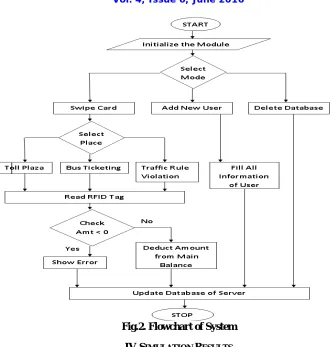
This system firstly checks whether user is at toll plaza, or user is purchasing bus ticket or he/she breaks the traffic rule. If user is at toll plaza then card ID is read by RFID reader. After reading a card it verifies user ID, if ID is already registered then it directly deduct the fare from users account as per charges on toll. But if new user is there then this system adds new user account on database by adding user name, mobile number and password. New registration of user is done by creating database on server through cloud. When this unique ID of user detected at toll, it is possible to check user account and deduct fare from users account according to the charges. If balance is null then it gives error message. Similarly it works for bus ticketing system. As it remains major source of income in India, but it faces severe malfunction and various security problems. First, there is a lot of confusion between the passengers regarding fares which lead to quarrels and corruption. The user friendly automated ticketing system suggested in this paper will not only deduct the passenger’s fare but also detect the passenger’s identification, and can be used to make the transaction and travelling very precise. Similarly if driver breaks any traffic rule then by sensing RFID card, drivers ID is detected and this ID is unique. Database is generated on internet and according to the charges fare is deducted from the drivers account. And message is sending to user to give information about transaction. RFID card is with each person and this RFID card contains person information. RFID reader will be placed with embedded controller raspberry pi in Toll Gates, Buses, and in traffic rule control.
II. SYSTEMARCHITECTUREDESIGN
All items and Internet with information sensing devices are connected by IoT as agreed protocols for information exchange and communication. Advanced cloud computing technology can analyze the data in large quantity, in order to achieve intelligent identification.
A. Block Diagram Description
Overall system architecture design is as shown in Figure1. The system is basically divided into two main parts:
Fig.1. Overall System Architecture
(1) RFID reader Unit: It checks where the user is and then if card is passed by user at toll plaza, by using RFID reader card is read. RFID reader is interfaced with Raspberry pi module as shown in fig.1.
(2) Internet of Things: All database of user is stored on cloud. So after card is read it automatically generates user database, each user as unique ID. By using this user database it deducts the fare from users account as per charges. The bill is automatically generated while the vehicle is entering in to the exit gate. If balance is null then it gives an error message. After billing SMS is send to the user.
B. Toll gate management unit
In this system raspberry pi, RFID reader, RFID Tag and DC driver motor are used. The vehicle owner is identified by the reader and bill is generated faster. By this it automate toll gates with latest RFID system. In our country the present method of toll gate control and billing is manual. It requires manpower and sometimes billing issues may arise. This proposed system firstly checks whether user is at toll plaza. Whenever the vehicle entering in to the toll gate area, the reader reads the RFID card swap by user and identifies it. Also deduct fare from users account according to toll. When fare is deducted boom bar is open to pass the vehicle. If user is at toll plaza then card ID is read by RFID reader. After reading a card it verifies user ID, if ID is already registered then it directly deduct the fare from users account as per charges on toll. But if new user is there then this system adds new user account on database by adding user name, mobile number and password. New registration of user is done by creating database on server through cloud. When this unique ID of user detected at toll, it is possible to check user account and deduct fare from users account according to the charges. If balance is null then it gives error message.
TOLL PLAZA
BUS TICKET
TRAFFIC RULE VIOLATION
USER RFID TAG
RFID READER
RASPBERRY PI3 B MODEL
RASPBERRY
PI3 B MODEL INTERNET
C. Ticket collecting unit
This proposed system firstly checks whether user is purchasing bus ticket. If user is at toll plaza then card ID is read by RFID reader. After reading a card it verifies user ID, if ID is already registered then it directly deduct the fare from users account as per charges of ticket. But if new user is there then this system adds new user account on database by adding user name, mobile number and password. New registration of user is done by creating database on server through cloud. When this unique ID of user detected at bus ticket, it is possible to check user account and deduct fare from users account according to the charges. If balance is null then it gives error message. Similarly it works for bus ticketing system. The user friendly automated ticketing system suggested in this system will not only deduct the passenger’s fare but also detect the passenger’s identification, and can be used to make the transaction and travelling very precise.
D. Traffic Rule violation control unit
This system firstly checks whether he/she breaks the traffic rule. If user brakes traffic rule then card ID is read by RFID reader. After reading a card it verifies user ID, if ID is already registered then it directly deduct the fare from users account as per charges of traffic rule. But if new user is there then this system adds new user account on database by adding user name, mobile number and password. New registration of user is done by creating database on server through cloud. When this unique ID of user detected at traffic cop, it is possible to check user account and deduct fare from users account according to the charges. If balance is null then it gives error message. If driver breaks any traffic rule then by sensing RFID card, drivers ID is detected and this ID is unique. Database is generated on internet and according to the charges fare is deducted from the drivers account.
III.DESIGNMETHODOLOGY
A. Algorithm
1) Start
2) Initialize the Port pins of RFID reader EM - 18 and GPIO of Raspberry pi
3) Read the RFID card
4) Read the card information
5) Send the Parameter on Web Browser using Ethernet
6) Stop
B. Flow Chart
Fig.2. Flowchart of System
IV.SIMULATION RESULTS
The system is divided into two modules; one part is used to sense all card reader data by interfacing RFID reader EM - 18 and other part is used to send the data on the web browser using the Raspberry Pi. The results of the proposed system are shown in below figure.
A. Experimental Setup
Figure 3 shows the experimental set up of EM – 18 Interface with Raspberry Pi.
B. GUI for RFID Card Login
Proposed system creates GUI for card login, as shown in figure 4. When card is read by RFID reader then it checks whether is registered or not. When user is already registered then it directly finds the location but if not, then registration process of user is done first. After registration of new user, database for that new user is created. It is possible by clicking on Add New User. This system also helps to delete the database which is stored on browser previously. It is possible by clicking on Delete DB.
Fig.4. RFID Card Login
C. GUI for Add New User
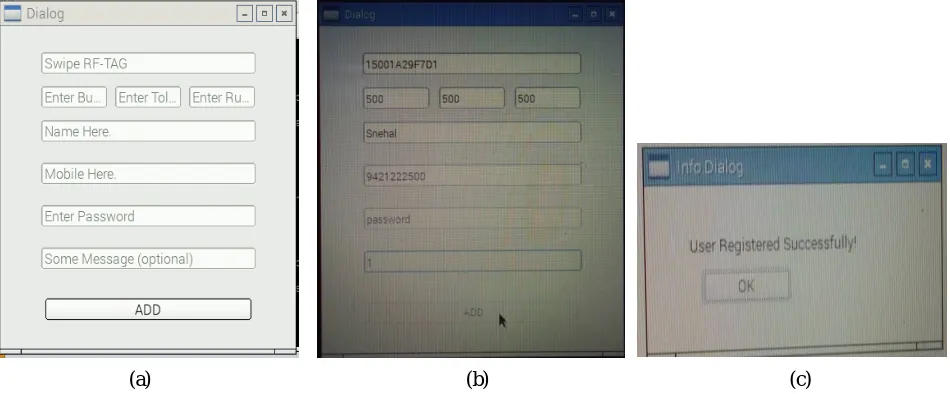
Figure 5 shows add new user window. If user is new then click on the option Add new user as shown in figure 4 and in add new user it fills the user information. After reading a card by reader it gives unique ID of that card. Each user contains unique ID. According to this unique ID information of user is saved on that ID. It contains User name, User mobile number, Password for security, Balance he/ she wants save for Bus ticketing, for Toll plaza and for traffic rule violation and also it contains block for some additional information. After filling this all information click on ADD button as shown in figure 5, it generates database of new user and adds new user on server.
(a) (b) (c)
D. GUI for Location of User
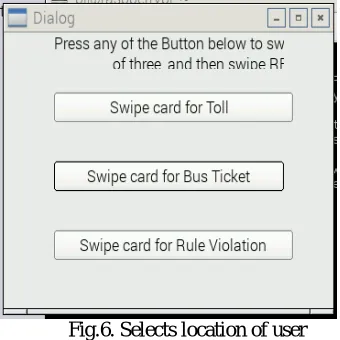
When card is read by reader system checks for user location. If user is at toll gate, then click on swipe card for toll, Similarly for Bus ticket and for Rule violation.
Fig.6. Selects location of user
After clicking on the button as shown in figure 6, system deducts amount from user balance as per Toll charges, Bus ticket and as per Traffic rule charges. Amount is cut from user balance and creats database of new balance.
E. Webpage showing Login Page for User Account
Figure 7 shows the web login page for smart card access. User gets access by entering mobile number and password which is already registered on database. Password is given for security purpose of user. Only registered user gets access of web page by entering valid password. If unknown user is trying to access the web page then account could not open. It gives warning as invalid password.
Fig.7. Login to user account on webpage. Fig.8. Webpage for smart access including user details and balance.
When user is at Toll plaza then it deducts 150 Rs. cut from users balance. When user breaks any traffic rule then 100 Rs. Cut from user balance and for Bus ticket 50 Rs. cut from user balance.
Fig.9. SMS from Twilio cloud
V. CONCLUSION
The universal access of smart card is successfully implemented on Raspberry pi 3 B using RFID reader. The implemented system gives complete solution for traffic related problems such as toll gate control, bus ticketing system and traffic rule violation control using the RFID and IoT technology. Here presented a fully automated, reliable, transparent and convenient system for billing. Database for travelers were created and accessed via internet. This is in line with the developed countries, where RFID, IoT technologies are widely used for traffic management. Keeping this in mind proposed system is presented at low cost.
REFERENCES
[1] Rudy Hermawan Karsaman, Yudo Adi Nugraha, Indonesia, “A Comparative Study On Three Electronic Toll Collection Systems in Surabaya”,
2015 International Conference on Information Technology Systems and Innovation (ICITSI) Bandung –Bali, November 16 –19, 2015
[2] S. Srinivasan Associate Professor in E.C.E P.B. College of Engineering, “An Embedded System and Rfid Solution for Transport Related Issues”,
978-1-4244-5586-7/10/2010 IEEE.
[3] KuBo Wuhan Vocational College of Software and Engineering Hubei 420305,China, “The Research of IoT Based on RFID Technology”,
2014 7th International Conference on Intelligent Computation Technology and Automation
[4] Dr.Bos Mathew Jos1, “RFID Based Bus Ticketing System ”, Vol. 4, Issue 4, April 2015
[5] A. Zanella, N. Bui, A. Castellani, L. Vangelista, M. Zorzi, “Internet of Things for Smart Cities”, IEEE Internet of Things Journal, Vol. 1, No.1,
2014, pp. 22-32.
[6] Luca Mainetti, Luigi Patrono, Maria Laura Stefanizzi, “A Smart Parking System Based on IoT Protocols and Emerging Enabling Technologies”,
Dept. of Innovation Engineering University of Salento Lecce, Italy 2015 IEEE
[7] V. Venkatakrishnan, R, Seethalakshmi, “Public Transport Ticketing And Monitoring System,” Journal of Theoretical and Applied Information
Technology, vol. 38, no. 1, pp. 31-34,2012.
[8] Varun Krishna K.G., Selvarathinam S., Roopsai V., Ram Kumar R.M., “Modified Ticketing System using Radio Frequency
Identification(RFID),” International Journal of Advanced Computer Research, vol. 3, Issue 12,pp. 92-98 , 2013.
[9] Xiaolin Jia1, Quanyuan Feng, Taihua Fan, Quanshui Lei, “RFID Technology and its applications in the Internet Of Things(IOT),” 2nd IEEE
International Conference on Consumer Electronics, Communications and Networks (CEC Net), pp. 1282-1285, 2012.
[10] Boyi Xu, and Li Da Xu, “Ubiquitous Data Accessing Method in IoT Based Information System for Emergency Medical Services” IEEE