ANTENNA ARRAY (DESIGN AT 28 GHz FOR 5G MOBILE NETWORK
BASIL JABIR SHANSHOOL
A project submitted in partial fulfilment of the requirements for the award of the degree of
Masters of Engineering (Electrical – Electronic & Telecommunication)
Faculty of Electrical Engineering University Teknologi Malaysia
iii
Specially dedicated to
My beloved Parents for their supporting, kindness and their support. Especially to spirit of my father Prof. Dr .Jabir Sanshool for what he have done for
me.
iv
ACKNOWLEDGEMENT
First and foremost, I would like to thank Allah for his blessing and guidance which has helped me through this thesis which was completed within the required time.
I would like to think my supervisor, Prof. Tharek for accepting me as his student, his supporting and advices.
I would like to think my co. Supervisor, and my friend Dr. Mohsen Khalily for supporting, advises, guidance and I wish for him long and successful life.
v ABSTRACT
vi ABSTRAK
vii TABLE OF CONTENTS
CHAPTER TITLE PAGE
DECLARATION ii
DEDICATION iii
ACKNOWLEDGEMENT iv
ABSTRACT v
ABSTRAK vi
TABLE OF CONTENTS vii
LIST OF TABLES x
LIST OF FIGURES xi
LIST OF ABBRAVATION xiii
1 INTRODUCTION 1
1.1 Introduction 1
1.2 Background 2
1.3 Problem statement 4
1.4 Objective of the work 4
1.5 Scope the Study 5
1.6 Significance of the Study 5
1.7 Organization of Thesis 5
2 LITERATURE REVIEW 7
2.1 Introduction 7
viii
2.2 Millimetre Waves 13
2.3 Antenna 15
2.4 Microstrip antenna 16
2.5 Antenna parameters 17
2.5.1 Return Loss 17
2.5.2 Bandwidth 19
2.5.3 Radiation Pattern 19 2.5.4 Gain and Directivity 20
2.5.5 Efficiency 20
2.6 Antenna array 21
2.7 Previous work 22
2.8 Summary 30
3 METHODOLOGY 31
3.1 Introduction 31
3.2 A key feature of CST MICROWAVE STUDIO 32
3.3 concept of antenna array 33
3.4 Microstrip antenna array 34
3.5 Microstrip Grid antenna array 36
3.6 Design Fabrication 42
3.7 Fabrication Process 43
3.8 Measurement Process 44
3.9 Summary 45
RESULTS AND DISCUSSION 46
4 4.1 Introduction 46
4.1.1 Single grid antenna array 46
4.1.2 The development of Microstrip antenna array 47
4.2 Simulated and Measurement Results 47
4.3 Summary 59
ix
5.1 Conclusion 60
5.2 Future work 61
x
LIST OF TABLES
TABLE NO. TITLE PAGE
3.1 Design specification 37
xi
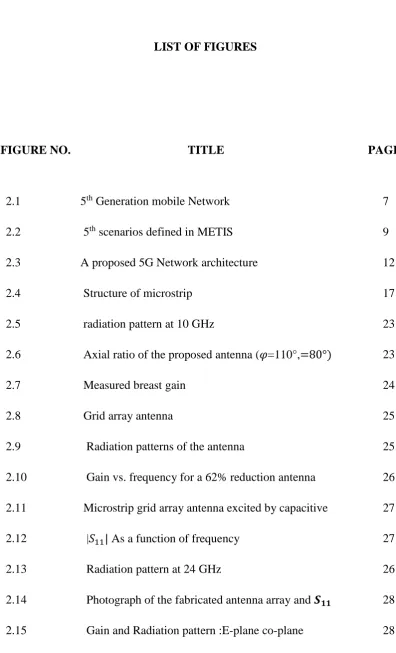
LIST OF FIGURES
FIGURE NO. TITLE PAGE
2.1
5th Generation mobile Network 7
2.2 5th scenarios defined in METIS 9
2.3 A proposed 5G Network architecture 12
2.4 Structure of microstrip 17
2.5 radiation pattern at 10 GHz 23
2.6 Axial ratio of the proposed antenna (𝜑=110°,=80°) 23
2.7 Measured breast gain 24
2.8 Grid array antenna 25
2.9 Radiation patterns of the antenna 25
2.10 Gain vs. frequency for a 62% reduction antenna 26
2.11 Microstrip grid array antenna excited by capacitive 27
2.12 |𝑆11| As a function of frequency 27
2.13 Radiation pattern at 24 GHz 26
2.14 Photograph of the fabricated antenna arrayand 𝑺𝟏𝟏 28
xii
2.16 90° linearly polarized MCAA 29
2.17 The results for the 90° linearly polarized MCAA 30
3.1 Flow chart (Work steps) 32
3.2 Calculated Results in Excel 36
3.3 The configuration of antenna array 37
3.4 Matlab flow chart 40
3.5 Number of array vs Gain for h=0.254mm 41
3.6 Number of array vs Gain for h=0.508mm 42
3.7 Network analyzer 44
4.1 The Structure of proposed antenna 47
4.2 Fabricated Design 49
4.3 Simulation and Measurement of proposed antenna 50
4.4 Efficiency 52
4.5 EXCEL data 𝑆11 52
4.6 EXCEL data Gain 53
4.7 Efficiency 53
4.8 Radiation Pattern (E-co-polarization) 54
4.9 Radiation Pattern (E-cross radiation) 55
4.10 Radiation Pattern (H-co radiation ) 56
4.11 Radiation Pattern (H-cross radiation) 57
4.12 3D plot for Phi 58
xiii
LIST OF ABBREVIATION
C - Speed of light
D - Outer probe feed diameter d - Inner probe feed diameter 𝜖𝑟 - Permittivity
𝜖𝑒 - Effective permittivity 𝑒0 - Total efficiency
𝑒𝑟 - Reflection (mismatch) 𝑒𝑐 - Conduction efficiency 𝑒𝑑 - Dielectric efficiency
𝜆0 - Free space wavelength 𝑓𝑐 - Center frequency 𝑓𝐻 - High frequency 𝑓𝑙 - Low frequency h - Thickness of substrate 𝐿𝑝 - Length of patch
𝐿𝑒𝑓𝑓 - Effective length 𝝙L - Delta Length W - Width of patch
𝑊𝑒𝑓𝑓 - Effective width
𝑊𝑝 - Width of patch
𝑊𝑠 - Width of short side 𝑊𝑙 - Width of long side
xiv 𝑉0+ - Incident voltage
𝑍𝐿 - Load impedance
𝑍𝑜 - Characteristic impedance
BW - Bandwidth
CST - Computer Simulation Technology dB - Decibel
EM - Electromagnetic UV - Ultra Violet
CHAPTER 1
INTRODUCTION
1.1 Introduction
It has been projected that in the next decade, a mobile traffic will be increased on the order of 1000 times as expected compared to what is experienced today .To meet the dramatic traffic growth, next generation mobile networks are also expected to achieve a 1,000-fold capacity increase compared to the current generation of wireless network deployment (Jangeun and Mihail, 2003). Based on the Cisco report of yearly visual network index (VNI), there are quantitative proof which show explosion of data in Wireless communication is true and will continue. This data is largely driven by smartphones, tablets, and video streaming .the most recent VNI report and forecast makes clear that an increasing approach will not be enough for demanding of the networks by 2020. In few decades, the size of data for IP handled by the networks of wireless will have incremented by more than a factor of 100: from less 3 exabytes in 2010 to more than 190 exabytes in 2018, on a speed to override 500 exabytes by 2020. So, increasing network infrastructure visualization is needed, and the need for greatly incremented energy efficiency, (Theodore et al., 2013).
2
channel towards higher frequencies where more spectrum could be accessible. Furthermore, the local multipoint distribution service (LMDS) band around 28 is a potential entrant for short range outdoor wireless communications. However, at higher frequencies, since the wavelength becomes increasingly, the antenna design challenges change from declining size and shrinking to increasing gain and enabling beam navigation. The new spectrum is mostly expected to be allocated in the super high-frequency bands (3-30GHz) as well as the extremely high frequency bands (30-300 GHz), also referred to as mm Wave bands, where the channel transmission characteristics are different from those of frequency bands below 3 GHz .This difference will require a new strategy of the air-interface and network architecture (Jangeun and Mihail, 2003)
The 28 GHz band has not been studied for mobile application and there are very few researchers actively pursuing this topic .Therefore, the need to develop antenna solutions for mobile components at these frequencies is a key enabler .Printed solutions for Ka-band are rare (Parrish, 1982)
1.2 Background
3
Generally, the design tactic is limited to the modest structures, and an engineer could prefer to use an existing design which is desired in terms of electromagnetic characteristics. Afterwards, the engineer may use approximate or exact equations to find the proper design of dimensions and parameters needed. Then a simulator program may be used to predict its performance. If the simulation results were not totally acceptable, redesigning and re-simulating of the antenna should be done by the engineer. This could be achieved by using intuition to find out that changing of parameter may enhance performance. Over time, several different antenna designs have been manufactured by the design rotation with different characteristics; however, it takes time and unlikely to yield indeed optimal results. There is a requirement for the engineer to be familiar with several different existed designs and he must have enough experience and expertise in order to reach a desired solution in a rational period of time.
4
far from those a normal human designer could have ever thought of (Derek and Edward, 1999).
1.3 Problem statement
Progress in the technology of wireless communication systems has created a strong need for the development of new antenna structures. In systems of wireless communication, microstrip planner technology is fundamentally bounded in directional antennas. A conventional antenna has the capability of producing single fixed directional radiation pattern. This is not the case which are used in reconfigurable antennas for modern wireless communication (5𝑡ℎ Generation mobile Networks). Reconfigurable antennas make it possible use of a single antenna for multiple application. Therefore, the concept of reconfigurable antenna array and characteristics of beam switching by controlling the switches at 28 GHz is proposed in the current research.
Because of increasing the attenuation for high frequency, we need to design an antenna with high gain, small size, and directive beam.
1.4 Objective of the work
The objectives of this work will be described in the following points:
I. To design and fabricate of high gain of microstrip grid antenna array capable of operating in 28 GHz for the fifth generation mobile network (mobile base station or mobile antenna).
5
1.5 Scope the Study
The main idea of work is to read and understand the suitable formula and theory in order to get the parameters which are used in designing the antenna array for 28 GHz .Moreover, solving above mentioned parameters by using EXCEL or CST micro, this can provide an interface in ACCESS .Furthermore, a new design will be simulated by using CST and fabricated a prototype to test its characteristics .Then ,by compile the simulated results with the measured ones and comparisons between them we can analyze and make a report .Antenna radiation characteristics like 𝑆11,bandwidth and
radiation pattern will be presented and discussed
1.6 Significance of the Study
This work will be useful in antenna grid for 5𝑡ℎ Generation Mobile base stations .To show the relationships between the gain and the number of array and how it can be used to design an optimum antenna with small shape and high gain (more than 12 dB) with narrow beamwidth .Antenna array will be designed for 5G application operating at 28 GHz with high gain more than 12 dB and bandwidth 1 GHz.
1.7 Organization of Thesis
This thesis consists of five chapters, which are incorporating the design, fabrication and measurement of microstrip antenna array for beam 5 generation mobile Networks .The thesis is organized as follows:
6
geometries which form the concept for microstrip antenna design are also discussed in this chapter .Also included is description of the concept of 5 generation Networks and the suggested standards for this kind of Networks also the concept of millimeter waves and microstrip antenna .finally, it included the concept of antenna array.
Chapter provides an explanation and analysis of microstrip antenna and the concept of the antenna array .It also expand the description of antenna array technology including various methodologies for achieving grid antenna array, along with the physical components used in grid antenna array.
Chapter 4 explains the results for project .simulation results are presented to demonstrate the excellent performance of the antenna design.
63
REFERENCES
Afif Osseiran, Federico Boccardi, Volker Braun, Katsutoshi Kusume, Patrick Marsch, Michal Maternia, Olav Queseth, Malte Schellmann, Hans Schotten, and Hidekazu Taoka. (2014). 'Scenarios for 5g Mobile and Wireless Communications: The Vision of the Metis Project', Communications Magazine, IEEE, 52, 26-35.
Alessandro Aldini, and Alessandro Bogliolo, 'User-Centric Networking'.
Zihao Chen, and Yue Ping Zhang. (2014). '24-Ghz Microstrip Grid Array. Antenna Excited by Capacitive Slot', in Antenna Technology and Applied. Electromagnetics (ANTEM), 2014 16th International Symposium on (IEEE) pp. 1-2.
Bing Zhang, Lin Zhang, and Yue Ping Zhang. (2011) 'Design of Low Cost Linearly-Polarized Microstrip Grid Array Antenna for 24 Ghz Doppler Sensors', in Microwave Photonics, 2011 International Topical Meeting on & Microwave Photonics Conference, 2011 Asia-Pacific, MWP/APMP (IEEE), pp. 93-96. C Rowell, SF Han, ZK Xu, G Li, and ZG Pan. (2014). 'Towards Green Soft: A 5g
Perspective', IEEE IEEE Wireless Commun. Magazine, 52.
Derek S Linden, and Edward E Altshuler. (1999). 'Evolving Wire Antennas Using Genetic Algorithms: A Review', in Evolvable Hardware, 1999. Proceedings of the First NASA/DoD Workshop on (IEEE), pp. 225-32.
Dimitrios Peroulis, Kamal Sarabandi, and Linda PB Katehi. (2005). 'Design of Reconfigurable Slot Antennas', Antennas and Propagation, IEEE Transactions on, 53, 645-54
Federal Communications Commission.(1997). 'Millimeter Wave Propagation: Spectrum Management Implications', Bulletin.
Fu-Ren Hsiao, and Kin-Lu Wong. (2004). 'Omnidirectional Planar Folded Dipole Antenna', Antennas and Propagation, IEEE Transactions on, 52, 1898-902. Ghaith Elsanosi M Mansour. (2013) 'Reconfigurable and Multi-Functional Antennas'
64
Gutierrez. (2013) 'Millimeter Wave Mobile Communications for 5g Cellular: It Will Work!', Access, IEEE, 1, 335-49.
Hervé Lebret, and Stephen Boyd. (1997). 'Antenna Array Pattern Synthesis Via Convex Optimization', Signal Processing, IEEE Transactions on, 45, 526-32. Jangeun Jun, and Mihail L Sichitiu. (2003). 'The Nominal Capacity of Wireless Mesh
Networks', Wireless Communications, IEEE, 10, 8-14.
Laszlo Kiss, Paul B Bennett, Victor N Uebele, Kenneth S Koblan, Stefanie A Kane, Brad Neagle, and Kirk Schroeder. (2003). 'High Throughput Ion-Channel Pharmacology: Planar-Array-Based Voltage Clamp', Assay and drug development technologies, 1, 127-35.
Liang Liu, Hao Wang, Xue Liu, Xing Jin, Wen Bo He, Qing Bo Wang, and Ying Chen. (2009) 'Greencloud: A New Architecture for Green Data Center', in Proceedings of the 6th international conference industry session on Autonomic computing and communications industry session (ACM), pp. 29-38.
Lin Zhang, Wenmei Zhang, and YP Zhang. (2011).'Microstrip Grid and Comb Array Antennas', Antennas and Propagation, IEEE Transactions on, 59, 4077-84
PT Parrish, TCLG Soliner, RH Mathews, HR Fetterman, CD Parker, PE Tannenwald, and AG Cardiasmenos.(1982) 'Printed Dipole-Schottky Diode Millimeter Wave Antenna Array', in 1982 Technical Symposium East (International Society for Optics and Photonics), pp. 49-52
Robert, C., Daniels and Robert, W., Heath. (2007). '60 Ghz Wireless Communications: Emerging Requirements and Design Recommendations', Vehicular
Technology Magazine, IEEE, 2, 41-50
Ryuji Kohno. (1998). 'Spatial and Temporal Communication Theory Using Adaptive Antenna Array', Personal Communications, IEEE, 5, 28-35.
Shu Sun, George R MacCartney, Mathew K Samimi, Shuai Nie, and Theodore S Rappaport. (2014) 'Millimeter Wave Multi-Beam Antenna Combining for 5g Cellular Link Improvement in New York City', in Communications (ICC),
2014 IEEE International Conference on (IEEE), pp. 5468-73.
Theodore S Rappaport, James N Murdock, and Felix Gutierrez. (2011). 'State of the Art in 60-Ghz Integrated Circuits and Systems for Wireless Communications',
Proceedings of the IEEE, 99, 1390-436.
Theodore S Rappaport, Shu Sun, Rimma Mayzus, Hang Zhao, Yaniv Azar, Kevin Wang, George N Wong, Jocelyn K Schulz, Mathew Samimi, and Felix
Toni Janevski. (2009) '5g Mobile Phone Concept', in Consumer Communications and