Plaintext Awareness in
Identity-Based Key Encapsulation
∗†Mark Manulis1 Bertram Poettering2 Douglas Stebila3
1 Department of Computing, University of Surrey, Guildford, Surrey, United Kingdom
2 Information Security Group, Royal Holloway, University of London, Egham, Surrey, United Kingdom
3 School of Electrical Engineering and Computer Science, Queensland University of Technology,
Brisbane, Queensland, Australia
January 28, 2014
Abstract
The notion ofplaintext awareness (PA) has many applications in public key cryptography: it offers unique, stand-alone security guarantees for public key encryption schemes, has been used as a sufficient condition for proving indistinguishability against adaptive chosen ciphertext attacks (IND-CCA), and can be used to construct privacy-preserving protocols such as deniable authentication. Unlike many other security notions, plaintext awareness is very fragile when it comes to differences between the random oracle and standard models; for example, many implications involvingPAin the random oracle model are not valid in the standard model and vice versa. Similarly, strategies for provingPAof schemes in one model cannot be adapted to the other model. Existing research addressesPAin detail only in the public key setting.
This paper gives the first formal exploration of plaintext awareness in the identity-based setting and, as initial work, proceeds in the random oracle model. The focus is laid mainly on identity-based key encapsulation mechanisms (IB-KEMs), for which the paper presents the first definitions of plaintext awareness, highlights the role ofPA in proof strategies of IND-CCAsecurity, and explores relationships betweenPAand other security properties.
On the practical side, our work offers the first, highly efficient, general approach for building IB-KEMs that are simultaneously plaintext-aware andIND-CCA-secure. Our con-struction is inspired by the Fujisaki-Okamoto (FO) transform, but demands weaker and more natural properties of its building blocks. This result comes from a new look at the notion of γ-uniformity that was inherent in the original FO transform. We show that for IB-KEMs (and PK-KEMs) this assumption can be replaced with a weaker computational notion, which is in fact implied by one-wayness. Finally, we give the first concrete IB-KEM scheme that is PAandIND-CCA-secure by applying our construction to a popular IB-KEM and optimizing it for better performance.
∗
This research work is part of the bilateral research project between Germany and Australia, funded jointly by the German Academic Exchange Service (DAAD) through grant Nr. 53361649 and by Australia’s Department of Innovation, Industry, Science and Research (DIISR). Mark Manulis was also supported by the German Research Foundation (DFG) through grant MA 4096. He and Bertram Poettering wish further to acknowledge support from the Center of Advanced Security Research Darmstadt (CASED) and the European Center for Security and Privacy by Design (EC SPRIDE).
†
Keywords: plaintext awareness; identity-based encryption; key encapsulation mechanism; generic transformation
1
Introduction
A modern approach to hybrid encryption is given by the KEM/DEM paradigm [Sho00,CS02, CS03, AGKS05, DGKS10], which gives a modular construction of public key encryption (PKE) and identity-based encryption (IBE) schemes. The key encapsulation mechanism (KEM) is first applied by the sender to compute the key and its encapsulation. The output key is used in the
data encapsulation mechanism (DEM) to encrypt the message. The recipient decapsulates the key and then decrypts the message. This mechanism is especially valuable for secure transmission of longer messages since the DEM part is usually based on fast, symmetric techniques.
Adaptive CCA Security and Transformations. The widely accepted security notion
for KEMs is indistinguishability against adaptive chosen ciphertext attacks (IND-CCA1) [CS03, HHK10], and diverse KEM constructions satisfying this property have been proposed in the public key (PK-KEM) [Sho00, CS02, CS03, Den03, BMW05, Kil06] and the identity-based (IB-KEM) [BFMLS08,KG09] settings. Some [Sho00,Den03,BFMLS08] are secure in the random oracle model; others [Sho00,CS02,CS03,BMW05,Kil06,KG09] in the standard model.
In general, IND-CCA-secure KEMs can trivially be obtained from any IND-CCA-secure encryption scheme by encrypting (sufficiently many) randomly chosen messages that are then used as the encapsulated key. In the random oracle model, Dent [Den03] demonstrated that IND-CCA-secure PK-KEMs can further be obtained from PKE schemes that satisfy only a weaker property of one-wayness (OW). These results were extended by Bentahar et al. [BFMLS08] to the identity-based setting. This parallels prior work on IND-CCA-secure encryption: in the random oracle model, transformations by Fujisaki and Okamoto [FO99a,FO99b] and by Okamoto and Pointcheval [OP01] offer IND-CCAsecurity for PKE schemes that are one-way and whose ciphertexts are close to uniformly distributed (so-calledγ-uniformity); similar transformations were shown by Kitagawa et al. [KYH+06,YKH+06] to apply in the identity-based setting. In the standard model,IND-CCA-secure PK-KEMs can be obtained using transformations originally proposed forIND-CCA-secure PKE schemes, e.g., by adding a “proof of well-formedness” to an IND-CPA-secure scheme [Sah99,DDN00,ES02,CS02,CS03], or by converting a weakly secure IBE scheme [CHK04,BK05, BCHK07].
Plaintext Awareness and its Role. The notion ofplaintext awareness (PA) was introduced
in the context of PKE by Bellare et al. [BR94, BDPR98, BP04], both in the random oracle model [BR94,BDPR98] and the standard model [BP04], with two variants (weaker PA1 and strongerPA2) in the standard model2. Roughly speaking, plaintext awareness demands that no ciphertext can be created without explicit knowledge of the encrypted message. From a technical perspective, this is represented by the existence of aplaintext extractor that, when run on the same inputs as the ciphertext creator, can produce the plaintext behind the ciphertext. Originally [BR94], PA was seen as a strategy for proving IND-CCA security of PKE schemes (by using plaintext awareness to answer decryption queries). It is also useful in other contexts: for example, deniable authentication and key exchange protocols [DGK06] can be built from plaintext-aware KEMs.
1ByCCAin this paper we mean adaptive chosen ciphertext attacks, often referred toCCA2. 2
Bellare et al. [BDPR98] showed that, for PKE schemes in the random oracle model, combining PAandIND-CPAimpliesIND-CCA(butPAis not implied byIND-CCAin general). In the standard model, Teranishi and Ogata [TO06] proved thatIND-CCAsecurity of PKE schemes is implied by one-wayness (OW) and PA2, and also that, surprisingly, in the random oracle model this implication fails. This serves as a hint that not all standard model results on plaintext awareness carry over to the random oracle-based setting and vice versa.
Birkett and Dent [BD08,BD11] observed that, while PAwas a useful strategy for proving IND-CCA security in the random oracle model, it was not always useful in the standard model, where somePA2proofs often assumed that the PKE schemes were alreadyIND-CCA-secure. They also developed a different proof strategy for PA2security of PKE schemes (in the KEM/DEM paradigm) by considering a weaker notion of plaintext awareness combined with a new property, “simulatability”, and used this to prove that Cramer-Shoup PK-KEM [CS03] isPAandIND-CCA -secure (see also Dent’s earlier proof [Den06]). Teranishi and Ogata [TO08] proved PA2 for Cramer-Shoup PKE using a slightly weaker (but similar) property instead of simulatability.
With respect to plaintext awareness of hybrid PK-KEM/DEM constructions, Jiang and Wang [JW10] proved that a PK-KEM that simultaneously satisfies a variant ofIND-CCAsecurity and some weaker notion of plaintext awareness combined with a one-time unforgeable DEM results in a hybrid construction that offers PA2 (for both the random oracle and standard models).
Our Focus. Existing work on plaintext awareness and its relevance for proving IND-CCA
security has been carried out for PKE and PK-KEMs. Current knowledge on plaintext awareness in the identity-based setting is very limited. To date, no definitions of plaintext awareness for IB-KEMs exist, neither in the random oracle nor in standard models. Are the techniques developed for relating plaintext awareness andIND-CCAsecurity of public key schemes applicable to the identity-based setting? Can existing transformations be applied to construct identity-based schemes that are both plaintext-aware andIND-CCA-secure?
In fact, the standard model proof strategies [BD08, TO08,BD11] for plaintext awareness of PK-KEMs, demonstrated successfully on the Cramer-Shoup scheme [CS03], do not seem to apply to current standard model IB-KEMs. For example, the prominent IND-CCA-secure standard model IB-KEM by Kiltz and Galindo [KG09], which can be seen as a pairing-based variant of the Cramer-Shoup PK-KEM, does not have the simulatability property required by Birkett and Dent [BD11] (nor the relaxation used by Teranishi and Ogata [TO08]). The lack of simulatability is due to the fact that ciphertexts output by the IB-KEM scheme from [KG09] admit publicly executable checks of their “well-formedness”. It is therefore not possible to pick different ciphertext components uniformly at random and independently of each other; this stands in contrast to the simulatable ciphertexts of the PK-KEM from [CS03] whose “well-formedness” can only be checked using parts of the private key.
The above observations motivate a separate treatment of plaintext awareness in the identity-based setting, including its connection to IND-CCA security and the construction of generic transformations.
1.1 Our Results and Techniques
Our Results. In this work we initiate the study of plaintext awareness for IB-KEMs, aiming
highly efficient IB-KEMs that are simultaneously plaintext-aware and IND-CCA-secure from ones that satisfy only the basic notion of one-wayness.
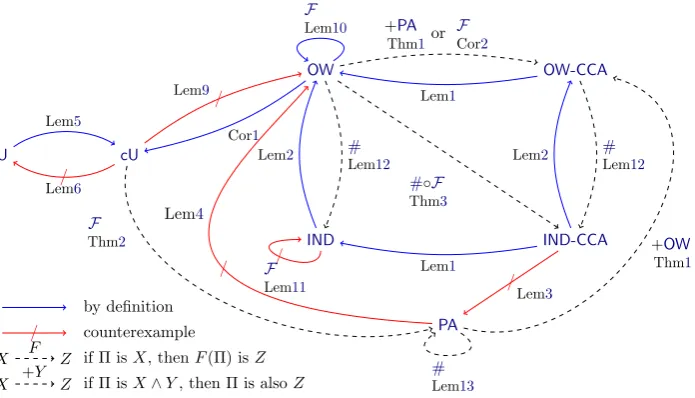
Our results, which are summarized in Figure1, are as follows:
– We provide (in Section 2) a formalization of plaintext awareness for IB-KEMs in the random oracle model and explore the relationship of this notion to other security notions, in particular observing that a scheme that is bothPAandOWis alsoOW-CCA(Section3). – We introduce in Section5 a generic transformationF on IB-KEMs, somewhat related to
the Fujisaki-Okamoto transformation [FO99b] for PKE, that transforms an OW-secure IB-KEM into one that is both OW-CCA-secure and plaintext-aware. This construction is quite efficient. Our construction has an advantage from the perspective of provable security: whereas the proof of plaintext awareness of Fujisaki-Okamoto requires that the KEM be bothOW anduniform, our constructionF eliminates the needs for uniformity. Instead, our proof relies on a new intermediate security notion,computational uniformity, introduced in Section4, which we show is actually implied byOW; hence,OW suffices for proving that our new construction yieldsPA.
– As a consequence of ourF construction, we observe a difference betweenOW,IND, and PAnotions in the standard model versus the random oracle model. Teranishi and Ogata [TO06] showed that, in the standard model,OWandPAof PKE schemes impliesIND-CCA security. For IB-KEMs in the random oracle model, we show that this does not hold. – In Section6, we describe a simple hash-based construction # that adds INDsecurity to
ourF transform (and preserves its plaintext awareness).
– Together, theF and # constructions efficiently transform anOW-secure IB-KEM into one that provides plaintext awareness and IND-CCAsecurity. As described in Section 7, some additional optimizations can be applied when these two techniques are used together. We show an application of this technique to the IB-KEMs that underlie the IBE schemes by Boneh and Franklin [BF01] and Sakai and Kasahara [SK03], to construct highly efficient IB-KEMs that are simultaneously PAand IND-CCA-secure.
SinceIND-CCAsecurity does not in general imply plaintext awareness (either in the PKE setting [BDPR98] or for IB-KEMs, as we prove), our #◦ F constructions offers the only known provable approach for constructing IB-KEMs that are simultaneously PA and IND-CCA-secure.
Finally, we show that (adaptions of) our transformations forOW-secure IB-KEMs can also be applied toOW-secure PK-KEMs. This extends work of Dent [Den03] since PK-KEMs obtained with our transformations are both plaintext-aware and IND-CCA-secure. More importantly, PK-KEMs withPA andIND-CCAsecurity readily admit construction of plaintext-aware hybrid PKE schemes based on the results from [JW10] for the KEM/DEM approach.
New Techniques. Central to our results is a novel perspective on the notion of γ-uniformity,
which was originally defined in the public key setting [FO99b] and has been extended to IBE schemes [TO08]. Existing random oracle-based transformations from OW to IND-CCA [FO99a, FO99b, OP01, TO08] explicitly required γ-uniformity for the underlying encryption scheme. We show this requirement is unnecessary for plaintext awareness (andIND-CCAsecurity) of KEMs.
U cU
OW
IND
OW-CCA
IND-CCA
PA
Lem5
/ Lem6
F Thm2
/ Lem3
Lem2 #
Lem12
Lem2 #
Lem12 Cor1
/ Lem9
Lem1 Lem1
+PA
Thm1or F Cor2
+OW
Thm1 /
F Lem11
# Lem13 #◦F Thm3 F
Lem10
/
Lem4
by definition
/ counterexample
X F Z if Π isX, thenF(Π) isZ X +Y Z if Π isX∧Y, then Π is alsoZ
Figure 1: Relationships between security notions and results of generic transformations for IB-KEMs. Solid lines (→) denote an implication between notions (e.g.,INDimpliesOW); solid lines with a cross (6→) denote a separation between notions (e.g.,IND-CCAdoes not implyPA); and dashed lines indicate that one property can be obtained either by applying a transformation (e.g.,Ftransforms anOWscheme into anOW-CCAscheme) or by satisfying two properties (e.g., a scheme that is bothOWandPAis also OW-CCA).
construction of plaintext-aware and IND-CCA-secure PK-KEMs.
1.2 Notation
Unless explicitly stated, all algorithms and adversaries throughout this paper are probabilistic and polynomial time. Let A(x;r) denote the running of Aon inputx and random coins r. We
use the notationy ←$ A(x) to denote settingy to the output ofA run on inputx with uniform randomness, andy∈A(x) denotes that yis an element of the set of outputs of Awhen run onx
with any randomness. If algorithm Aoutputs tuples, i.e. (x, y, z)←A, then partial computation of the output vector is denoted with wildcards, e.g. (·, y,·)←A, if the first and third component of the result,x and z, are neither computed nor assigned.
2
Secrecy notions and plaintext awareness of IB-KEMs
The modular concept of hybrid encryption, where asymmetric encryption schemes are constructed from two building blocks — a key encapsulation mechanism (KEM) and a data encapsulation mechanism (DEM) — was originated by [CS03] and is a popular design strategy for modern cryptosystems [KG09,KD04,Den03]. Specifically, in this paper we are interested in the identity-based variant of KEMs, although most of our results readily extend to the public key setting as well (cf. Appendix A).
Definition 1 (IB-KEM). An identity-based key encapsulation mechanism (IB-KEM) is a tuple
Π = (Setup,Extract,Encap,Decap) of algorithms with, for each k ∈ N, associated finite sets IDSp(k), CoinSp(k), CipherSp(k), andKeySp(k), where
– Setup(1k) is a master key generation algorithm which outputs a pair of strings(mpk, msk). – Extract(msk, id) is a key extraction algorithm which, on input master secret key msk and
– Encapmpk(id;r) is a key encapsulation algorithm; it takes a master public key mpk, the recipient’s identityid∈IDSp(k), and random coins r∈CoinSp(k), and outputs a cipher-text c ∈ CipherSp(k) and a key K ∈ KeySp(k). We use the notation Encapmpk(id) as
shortcut for Encapmpk(id;r) with freshly drawnr ←$ CoinSp(k).
– Decapsk(c) is a key decapsulation algorithm which takes secret keysk and a ciphertextc∈
CipherSp(k), and returns a key K∈KeySp(k) or the symbol ⊥.
IB-KEM Π is correct if for all k ∈ N, all (mpk, msk) ∈ Setup(1k), all id ∈ IDSp(k), all
sk∈Extract(msk, id), and all (c, K)∈Encapmpk(id), we have Decapsk(c) =K.
In the random oracle model, the four algorithms of an IB-KEM have access to a common set of random oracles H= (H1, . . . , Hh). This is explicitly indicated by the notationSetupH, ExtractH, EncapH, and DecapH. The query to a specific oracleH in Hon value m is denoted by H(H, m). ByH←$ Hash(k) we denote the process of picking at random an instantiation of random oracles H= (H1, . . . , Hh).
2.1 One-way security and indistinguishability
The classical secrecy notions of IB-KEMs are one-way security and key indistinguishability [BFMLS08], either with or without a decryption oracle: OW,OW-CCA, IND, andIND-CCA. The adversary’s goal inOW[-CCA] is to (fully) compute the key that corresponds to a given ciphertext
c∗ ∈CipherSp(k), while inIND[-CCA] it is sufficient to distinguish the real key from a random one, again given a ciphertextc∗. This intuition is formalized in experiments ExptOW[-CCA]and ExptIND[-CCA], in Figure2. As most results established in this paper are proven in the random oracle model, besides giving adversaryA= (A1,A2) access to a key extraction oracleOX and — in theCCA variants — a key decapsulation oracleOD, the security experiments forOW[-CCA]
and IND[-CCA] explicitly express the option ofA to make queries to hash oracleOH.
Definition 2(One-way security (OW[-CCA])). An IB-KEMΠis said to beOW- (resp.OW-CCA -) secure if, for all adversariesA= (A1,A2), the corresponding success probability is negligible
in k, where we define
SuccOW[-CCA]Π,A (k) = Pr h
ExptOW[-CCA]Π,A (k) =win
i
.
Definition 3 (Indistinguishability (IND[-CCA])). An IB-KEM Π is said to be IND- (resp.
IND-CCA-) secure if, for all adversaries A= (A1,A2), the corresponding advantage is negligible
in k, where we define
AdvtIND[-CCA]Π,A (k) = Pr
h
ExptIND[-CCA]Π,A ,0(k) = 1i
−Pr h
ExptIND[-CCA]Π,A ,1(k) = 1 i
.
Lemmas 1 and2 follow immediately from the definitions:
Lemma 1 (OW-CCA⇒OW and IND-CCA⇒ IND). Let Π be an IB-KEM. If Π is OW-CCA
-secure, then Π isOW-secure. IfΠ isIND-CCA-secure, then Π isIND-secure.
Lemma 2 (IND⇒OW and IND-CCA⇒OW-CCA). Let Π be an IB-KEM. If Π is IND-secure,
thenΠ is OW-secure. If Π is IND-CCA-secure, thenΠ is OW-CCA-secure.
2.2 Plaintext awareness
The notion of plaintext awareness, as established in the setting of public key encryption (PKE) in [BDPR98, BP04], captures the intuition that no one can generate a (valid) ciphertext c∗
ExptOWΠ,A[-CCA](k):
(a) H←$ Hash(k)
(b) (mpk, msk)←$ SetupH(1k) (c) (id∗, st)← A$ OH,OX[,OD]
1 (mpk)
– IfAqueriesOH(H, m): (a) x← H(H, m)
(b) Append (H, m, x) toHList. (c) AnswerAwithx.
– IfAqueriesOX(id): (a) sk←$ ExtractH(msk, id) (b) Append (id, sk) toXList.
(c) AnswerAwithsk.
– IfA queriesOD(id, c) (in CCA vari-ant):
(a) sk←$ ExtractH(msk, id) (b) K←DecapHsk(c)
(c) Append (id, c) toDList. (d) AnswerAwithK. (d) (c∗, K∗)←$ EncapHmpk(id∗)
(e) K0← A$ OH,OX[,OD] 2 (st, c∗)
– AnswerOH,OX,ODqueries as above. (f) If (id∗,·)∈XListreturnlose.
(g) If (id∗, c∗)∈DListreturn
lose. (h) IfK06=K∗returnlose.
(i) Returnwin.
ExptINDΠ,A[-CCA],b(k):
(a) H←$ Hash(k)
(b) (mpk, msk)←$ SetupH(1k) (c) (id∗, st)← A$ OH,OX[,OD]
1 (mpk)
– IfAqueriesOH(H, m): (a) x← H(H, m)
(b) Append (H, m, x) toHList. (c) AnswerAwithx.
– IfAqueriesOX(id): (a) sk←$ ExtractH(msk, id) (b) Append (id, sk) toXList.
(c) AnswerAwithsk.
– IfA queriesOD(id, c) (in CCA vari-ant):
(a) sk←$ ExtractH(msk, id) (b) K←DecapHsk(c)
(c) Append (id, c) toDList. (d) AnswerAwithK. (d) (c∗, K0∗)
$
←EncapHmpk(id∗)
(e) K1∗ $
←KeySp(k) (f) d← A$ OH,OX[,OD]
2 (st, c∗, Kb∗)
– AnswerOH,OX,ODqueries as above. (g) If (id∗,·)∈XListreturnlose.
(h) If (id∗, c∗)∈DListreturnlose. (i) Returnd.
Figure 2: Experiments for one-way security (OW[-CCA]) and indistinguishability (IND[-CCA]) of IB-KEMs
generally implying IND-CCA security of PKE schemes [BDPR98, BP04]. In this section, we define an analogous notion for KEMs, in the identity-based setting. In particular, we demand that, given a plaintext-aware IB-KEM, it is impossible to come up with a ciphertextc∗ without knowing the key to which it will decapsulate3.
In line with the PKE setting, we define plaintext awareness using two algorithms, the
ciphertext creator Aand the plaintext extractorK. The ciphertext creator’s task is to output a target identityid∗and a ciphertextc∗. The candidate scheme is understood to be plaintext-aware if any such algorithmAcould additionally output the key encapsulated inc∗. This is formalized via the plaintext extractorK, which receives as input the transcript of all of A’s interactions, including A’s input, all oracle queries posed byA together with corresponding answers, and the values output byA. That is,K is in the position to retrace the computations thatAperformed to generatec∗ (see also Remark4), and we expect fromK to use this knowledge to output the key encapsulated inc∗.
These ideas are formalized in Definition 4. As in [BDPR98], we explicitly regard plaintext awareness in the random oracle model. In particular, although usually unnecessary outside the secret key setting, we provide an encapsulation oracle OE that allows creation of encapsulated keys, but without the adversary seeing random oracle queries asked from within corresponding Encapinvocations. Availability of this oracle will become an important prerequisite for proving security against chosen-ciphertext attacks of plaintext-aware IB-KEMs.
Definition 4(Plaintext awareness (PA)). LetΠ be an IB-KEM andA andK be algorithms (the “ciphertext creator” and “plaintext extractor”, respectively). Consider experimentExptPAΠ,A,K from
ExptPAΠ,A,K(k):
(a) H←$ Hash(k)
(b) (mpk, msk)←$ SetupH(1k) (c) (id∗, c∗)← A$ OH,OX,OE(mpk)
– Answer OH,OX queries as in Fig-ure2.
– IfAqueriesOE(id): (a) (c,·)←$ EncapHmpk(id) (b) Append (id, c) toEList.
(c) AnswerAwithc. (d) If (id∗, c∗)∈EListreturnlose. (e) K∗←$ DecapHExtractH(msk,id∗)(c
∗)
(f) K0← K$ H(id∗, c∗, mpk,HList,XList,EList) (g) IfK∗=K0returnlose.
(h) Returnwin.
Figure 3: Plaintext awareness experimentPA for IB-KEMs. See Figure2for the definitions of HList andXList.
Figure 3 and define the awareness of Π as
AwPAΠ,A,K(k) = PrhExptPAΠ,A,K(k) =lose
i
.
An algorithm K is called a λ(k)-extractor for Πif
AwPAΠ,A,K(k)≥λ(k) ,
for every adversary A. IB-KEMΠ is plaintext awareif there exists a λ(k)-extractorK forΠ
such that λ(k) is overwhelming, that is, 1−λ(k) is negligible (in k).
The following remarks discuss rationale and some interesting properties of Definition 4.
Remark 1 (Oracle access of plaintext extractor). We emphasize a subtle difference between
plaintext awareness of PKE according to [BDPR98], and our Definition4. In [BDPR98], the plaintext extractorK is not given access to the random oracleH. This limitation is not motivated in [BDPR98], but instead back in [BR94, Section 5]: “Note we don’t give K oracle access to
H: it is required to find the plaintext corresponding to [the ciphertext] given onlyA’s view of the oracle”. However, in the KEM setting, we disagree that this restriction is reasonable and argue4 thatK should be allowed to query the same random oracles thatDecapis allowed to query,
namelyH (compare lines (e) and (f ) of experimentExptPAΠ,A,K).
Remark 2 (Success probability of plaintext extractor). For an IB-KEM to achieve plaintext
awareness according to Definition 4, we demand plaintext extractor K to have overwhelming success probability. At first sight, this seems to be a very conservative requirement, but we argue that it is indispensable. Consider the case of a plaintext extractor K whereAwPAΠ,A,K(k) is growing fast, but not overwhelmingly fast, for all A. We construct an adversary A∗ that picks a random identity id, runs polynomially many executions of (c, K)←$ Encap(id) independently of each other in parallel, and applies K on each computed ciphertext c. If any such run of K fails to correctly extract the key (and it will, according to our assumption), corresponding c is the
4Consider, for a justification, the following example (see also Lemma13for a more detailed discussion). Given an IB-KEM Π, derive from it IB-KEM Π0 such thatSetup0≡Setup,Extract0≡Extract,Encap0mpk(id)≡[(c, K)←
ciphertextc∗ output by A∗ (together with identity id). Clearly, when run onA∗, we expect K to
fail with high probability, in contradiction to assumed good performance of K. Following this intuition, it can be shown that K cannot be a λ(k)-extractor for anyλ(k)>0.
Remark 3 (Universality of plaintext extractor). Observe that plaintext extractor K, as defined in Definition 4, is a universal extractor: it does not depend on specific ciphertext creator A, but only on schemeΠ. Although this is a very strong notion of plaintext awareness, in Section 5 we see that it can be achieved even by rather efficient IB-KEMs. When leaving the random oracle model, however, it seems that the concept of universal extractability is too strong. For instance, in [BP04], the demand for a universal extractor is dropped. Instead, to achieve plaintext awareness, it suffices to have a specific plaintext extractor KA for each ciphertext creator A. Note that, in
this paper, we exploit universality of plaintext extractors, e.g. in the proof of Theorem1.
Remark 4 (Random tape of ciphertext creator). We will shortly discuss a variant ofExptPAΠ,A,K
where K gets as additional input the tape R[A] of random coins used by A to craft (id∗, c∗). While this modification would be meaningful from a modeling point of view, it is already noticed
in [BR94] that the randomness used by A is usually not needed to prove schemes to be plaintext-aware, at least in the random oracle model. As this observation holds for the IB-KEMs analyzed in this paper, we decided to stay with (stronger) Definition 4. However, in standard model, K’s knowledge of random tapeR[A]is an unavoidable prerequisite for plaintext awareness, as pointed out in [BP04].
3
Plaintext awareness and one-way security implies
OW
-
CCA
se-curity
Although being defined independently of each other, the different notions of secrecy and plaintext awareness considered in Section2are not unrelated to each other. In particular, we will establish a strong result in Theorem 1: IB-KEMs that are bothOW-secure and plaintext-aware are also OW-CCA-secure, i.e. availability of a decapsulation oracle does not threaten OW security of aware IB-KEMs. The intuition behind this implication is simple: given a plaintext-aware IB-KEM, an OW-CCA adversaryAcannot gain advantage from its decapsulation oracle, as A‘knows’ the keys of all queried ciphertexts anyway. Nonetheless, the proof of Theorem 1is technically involved as it has to cope with the fact thatOW-CCAadversaryA may query itsOD oracle polynomially many times, while plaintext extractorK is applicable only to adversaries that output exactly one ciphertext.
Taken together, the following results separate the security notionsPA andIND[-CCA], and illustrate once more the strength of the notion of plaintext awareness.
Theorem 1 (OW∧PA⇒OW-CCA). LetΠ be an IB-KEM. If Π is OW-secure and PA, thenΠ
is OW-CCA-secure.
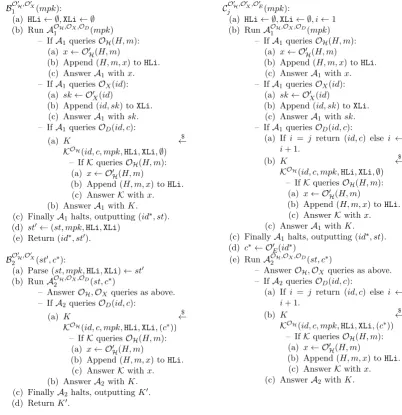
Proof. Let K be a λ(k)-extractor for Π, for an overwhelming λ(k). Let A= (A1,A2) be any adversary againstOW-CCAof Π. We construct an adversary B= (B1,B2) againstOWof Π such that B1 andB2 runA1 andA2, respectively, as subroutines. While all queries to OH andOX
oracles posed byA will just be relayed byB to its own challenger, Bwill answer decapsulation queries to OD itself, by applying plaintext extractorK on (partially) simulated A. The precise
specification of B1 and B2 is given in Figure 4 (left part).
Let qD be the total number of decapsulation queries that A will ask. For 1 ≤ j ≤ qD,
denote by (idj, cj) the arguments of the j-th OD query, and let Ej be the event that the
query is correctly answered by B, i.e. that corresponding execution of K succeeds in computing the correct decapsulation Kj of (idj, cj). We will lowerbound the probability that Ej occurs.
BOH0,OX0 1 (mpk): (a) HLi← ∅,XLi← ∅
(b) RunAOH,OX,OD
1 (mpk)
– IfA1queriesOH(H, m): (a) x← O0
H(H, m)
(b) Append (H, m, x) toHLi. (c) AnswerA1withx. – IfA1queriesOX(id):
(a) sk← O0 X(id)
(b) Append (id, sk) toXLi. (c) AnswerA1withsk. – IfA1queriesOD(id, c):
(a) K ←$
KOH(id, c, mpk,HLi,XLi,∅) – IfKqueriesOH(H, m):
(a) x← O0 H(H, m)
(b) Append (H, m, x) toHLi. (c) AnswerKwithx. (b) AnswerA1withK. (c) FinallyA1halts, outputting (id∗, st). (d) st0←(st, mpk,HLi,XLi)
(e) Return (id∗, st0).
BOH0,OX0 2 (st0, c∗):
(a) Parse (st, mpk,HLi,XLi)←st0 (b) RunAOH,OX,OD
2 (st, c∗)
– AnswerOH,OX queries as above. – IfA2queriesOD(id, c):
(a) K ←$
KOH(id, c, mpk,HLi,XLi,(c∗)) – IfKqueriesOH(H, m):
(a) x← O0H(H, m)
(b) Append (H, m, x) toHLi. (c) AnswerKwithx. (b) AnswerA2withK. (c) FinallyA2halts, outputtingK0. (d) ReturnK0.
CO0H,O0X,O0E
j (mpk):
(a) HLi← ∅,XLi← ∅, i←1 (b) RunAOH,OX,OD
1 (mpk)
– IfA1queriesOH(H, m): (a) x← O0
H(H, m)
(b) Append (H, m, x) toHLi. (c) AnswerA1withx. – IfA1queriesOX(id):
(a) sk← O0 X(id)
(b) Append (id, sk) toXLi. (c) AnswerA1withsk. – IfA1queriesOD(id, c):
(a) If i = j return (id, c) elsei ←
i+ 1.
(b) K ←$
KOH(id, c, mpk,HLi,XLi,∅) – IfKqueriesOH(H, m):
(a) x← O0 H(H, m)
(b) Append (H, m, x) toHLi. (c) AnswerKwithx. (c) AnswerA1withK. (c) FinallyA1halts, outputting (id∗, st). (d) c∗← O0
E(id∗) (e) RunAOH,OX,OD
2 (st, c∗)
– AnswerOH,OX queries as above. – IfA2queriesOD(id, c):
(a) If i = j return (id, c) elsei ←
i+ 1.
(b) K ←$
KOH(id, c, mpk,HLi,XLi,(c∗)) – IfKqueriesOH(H, m):
(a) x← O0 H(H, m)
(b) Append (H, m, x) toHLi. (c) AnswerKwithx. (c) AnswerA2withK.
Figure 4: Left: Construction ofOWadversary B= (B1,B2) from OW-CCAadversaryA= (A1,A2) and plaintext extractor K. Right: Specification of PA adversaries Cj whose transcripts match the
parameters provided byBto thej-th execution ofK.
execution. Moreover, consideringPAadversaryCj as defined in Figure4(right part), letτj0 = (id0j, c0j, mpk,HListj,XListj,EListj) be a parameter set that plaintext extractor K would receive when
run onCj, i.e. in experiment ExptPAΠ,Cj,K, initialized with the samempk and instantiation of H as B. Careful comparison of the specifications of B and Cj reveals thatτj and τj0 are equally
distributed (more precisely, if Band Cj are executed on the same random tape, then we have τj =τj0). If Kj0 denotes the decapsulation of (id0j, c0j), then also (τj, Kj) and (τj0, Kj0) obey the same distribution, and hence
Pr[Ej] = PrKH(τj) =Kj= PrKH(τj0) =Kj0
SettingE =E1∧. . .∧EqD and applying Lemma16 (AppendixC) gets us to
SuccOWΠ,B(k) ≥ Pr h
ExptOWΠ,B(k) =win∧E i
= PrhExptOWΠ,B(k) =win E
i Pr[E]
≥ PrhExptOW-CCAΠ,A (k) =win
i
·(1−qD(1−λ(k)))
= SuccOW-CCAΠ,A (k)·(1−qD(1−λ(k))) .
This concludes the proof, as 1−qD(1−λ(k)) is an overwhelming quantity.
Remark 5 (On the proving technique used in Theorem1). A substantial element in the proof
of Theorem 1 is the estimation of K’s ability to compute the correct answers to A’s OD queries. Note that for arbitrary HLi,XLi,ELi lists we cannot expect K to correctly extract keys with any reasonable probability. Indeed, in order to argue that the parameters τj provided by B are sufficient for extraction of the desired keys, we had to specify auxiliaryPAadversaries(Cj)1≤j≤qD,
and had to show that these would give raise to the same parameter sets when run in ExptPAΠ,C
j,K.
Interestingly enough, these adversaries Cj were not designed to be ever executed: it is their bare
existence that is necessary for the proof of Theorem 1 to go through.
Remark 6(OnIND∧PA⇒IND-CCA). The techniques used to prove Theorem1, thatOW∧PA⇒ OW-CCA, cannot be applied to prove theINDanalogue that INDsecurity andPA implyIND-CCA
security. The reason for this is a subtle difference between the OW notion and the IND notion that, in the IND case, renders inapplicable the proving technique we discuss in Remark 5: In experimentExptIND-CCA, the adversary obtains ciphertextc∗ and (possibly) corresponding key K∗
from the challenger, but this cannot be reflected in parameters HLi,XLi,ELithat are provided to plaintext extractor K. Hence, in a proof constructed like in Figure4, we cannot argue about K’s success probability to answer decapsulation queries of A2 correctly. In experimentExptOW-CCA, however, adversary just obtains a random ciphertext c∗ encapsulated for identity id∗. This finds its perfect correspondence inCj calling theOE oracle onid∗ (cf. line (d)in Figure 4, right part).
Basically, this also explains why we have to setELi= (c∗) when processing A2’sOD queries.
Observe that implicationIND∧PA⇒IND-CCAhas been proven in the PKE setting [BDPR98]. The difference is that, in the IND-CCA experiment of public key encryption, the adversary has
partial knowledge about the message that is encrypted in c∗: it is either m0 or m1, so adversary
can query these to its encryption oracle OE.
Although IND-CCAsecurity is considered the strongest confidentiality goal for IB-KEMs, the following lemma shows that this property is to weak to imply plaintext awareness by itself.
Lemma 3 (IND-CCA6⇒PA). Not all IND-CCA-secure IB-KEMs arePA.
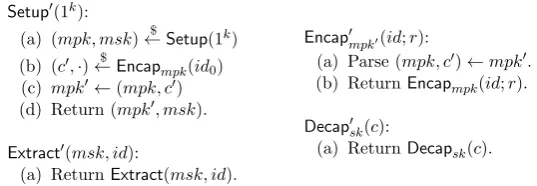
Proof. Let Π be an IND-CCA-secure IB-KEM. Consider IB-KEM Π0 that arises when modifying Π’s Setup to include into master public key mpk an encapsulation to some fixed identity
id0 ∈IDSp(k), as specified in Figure5. We will show that Π0 is not plaintext-aware, but remains to beIND-CCA-secure.
Observe that any adversary A0 against IND-CCA of Π0 can be trivially turned into an
adversary Aagainst IND-CCAof Π, by lettingA1 simulate the (c0,·)←$ Encapmpk(id0) step of
line(b) ofSetup0, and, apart from that, letting A1 andA2 runA0
1 andA02, respectively, relaying all oracle queries to the own challenger. As theIND-CCAadvantages ofA andA0 would be the same, this provesIND-CCA security of Π0.
Setup0(1k):
(a) (mpk, msk)←$ Setup(1k) (b) (c0,·)←$ Encapmpk(id0) (c) mpk0←(mpk, c0) (d) Return (mpk0, msk).
Extract0(msk, id):
(a) ReturnExtract(msk, id).
Encap0mpk0(id;r):
(a) Parse (mpk, c0)←mpk0. (b) ReturnEncapmpk(id;r).
Decap0sk(c):
(a) ReturnDecapsk(c).
Figure 5: Constructing Π0 from Π. We assume thatid0 is a fixed identity inIDSp(k), and all queries to
Horacle are relayed without modification.
KΠ0 for Π0, where λ(k) is overwhelming. Define adversary B against OW of Π as follows: B1(mpk) just outputs (id∗, st) = (id0, mpk), whileB2(st, c∗) setsmpk0 ←(mpk, c∗), computes
K ← K$ H
Π0(id0, c∗, mpk0,∅,∅,∅), and outputs K. We use the technique discussed in Remark 5 to justify that KΠ0 will succeed with high probability in revealing correct key K: consider the simple ciphertext creatorA0 for IB-KEM Π0 that, on input mpk0, parses (mpk, c∗)←mpk0 and outputs (id0, c∗). As A0 doesn’t ask any queries to its oracles, i.e. HList=XList= EList=∅, execution of KHΠ0(id0, c∗, mpk0,∅,∅,∅) will readily extract the key encapsulated inc∗ for identity
id0. More precisely, we have shown that SuccOWΠ,B(k) = AwPAΠ0,A0,K
Π0(k) ≥λ(k) ≥ 1−negl(k),
in contradiction to IND-CCA security of Π (cf. Lemmas1 and 2). This shows that Π0 is not plaintext-aware.
At the same time, plaintext awareness does not imply the basic confidentiality goal of one-wayness:
Lemma 4 (PA6⇒OW). Not all plaintext-aware IB-KEMs areOW-secure.
Proof. Consider the (correct, but insecure) IB-KEM in which Encapmpk(id;r) returns (c, K) = (r, r), i.e. keys are equal to their encapsulation. The scheme is clearly not OW-secure. However,
it is plaintext aware: an appropriate plaintext extractorK would just output the ciphertext.
4
Computational uniformity of IB-KEMs and its relation to
one-wayness
We introduce two new security notions for IB-KEMs. The first one, uniformity(U), is defined mainly for historical reasons: it is the analogue to the uniformity notion for PKE coined in [FO99b]. We will see that its (strictly weaker) variant, computational uniformity (cU), is a very natural notion of IB-KEMs, already being implied by the basic secrecy requirement of one-way security (OW, Definition 2). In Section 5, it will find its application in the analysis of our generic transformation that achieves plaintext awareness for any IB-KEM. We give a treatment of the corresponding notions for PK-KEMs in Appendix A.
Definition 5 (Uniformity (U)). Let Π be an IB-KEM with associated spaces IDSp, CoinSp,
CipherSp, andKeySp. For k∈N, H ∈Hash(k), (mpk, msk)∈SetupH(1k), id∈IDSp(k), and
c∈CipherSp(k) define
γmpkH (id, c) = Pr h
r←$ CoinSp(k); (c,·) =EncapHmpk(id;r) i
.
We say that Π is γ-uniform for a function γ :N→R≥0 if for (almost) all k∈N, H ∈Hash(k),
ExptcUΠ,A,γ(k):
(a) H←$ Hash(k)
(b) (mpk, msk)←$ SetupH(1k) (c) (id, c)← A$ OH,OX(mpk)
– AnswerOH,OX queries as in Figure2.
(d) IfγmpkH (id, c)> γ(k) returnwin.
(e) Returnlose.
Figure 6: Experiment for computational uniformity (cU) of IB-KEMs
Setup∗(1k):
(a) (mpk, msk)←$ Setup(1k) (b) h∗←ow(id∗) for
id∗←$ IDSp(k) (c) r∗←$ CoinSp(k) (d) mpk∗←(mpk, h∗, r∗)
(e) Return (mpk∗, msk).
Extract∗(msk, id):
(a) ReturnExtract(msk, id).
Encap∗mpk∗(id;r):
(a) Parse (mpk, h∗, r∗)←mpk∗. (b) Ifow(id) =h∗
returnEncapmpk(id;r∗). (c) ReturnEncapmpk(id;r).
Decap∗sk(c):
(a) ReturnDecapsk(c).
Figure 7: Constructing Π∗ from Π. We assume that all queries to H oracle are relayed without modification.
A weaker notion of uniformity is that of computational uniformity, where the adversary’s aim is to explicitly spot pairs (id, c) withγHmpk(id, c)> γ(k). This is formalized in Definition6.
Definition 6 (Computational uniformity (cU)). Let Π be an IB-KEM andA be an algorithm.
For a given function γ :N→R≥0, consider experiment ExptcUΠ,A,γ from Figure 6 and define the
success probability of A as
SucccUΠ,A,γ(k) = Pr h
ExptcUΠ,A,γ(k) =win
i
.
IB-KEM Π is said to be computationally γ-uniform if SucccUΠ,A,γ(k) is negligible in k, for all adversariesA. IB-KEM Πis simply called computationally uniform (cU)ifΠis computationally
γ-uniform for all non-negligible γ.
We note that line(d)of ExptcUΠ,A,γ(k) in Figure6is not necessarily efficient, but the experiment is still well-defined.
We now analyze the relation between uniformity and computational uniformity. While Lemma5 follows directly from the definitions, the proof of Lemma 6 is a bit more involved.
Lemma 5 (U⇒cU). Let Π be an IB-KEM and γ :N→R≥0 be a function. IfΠ is γ-uniform,
then Π is computationally γ-uniform. In particular, if Π is uniform, then Π is computationally uniform.
Lemma 6 (cU6⇒U). Letγ be any functionN→[0,1). Then not all computationallyγ-uniform IB-KEMs are γ-uniform, assuming the existence of a one-way function IDSp(k)→ {0,1}k. In
particular, if Π is computationally uniform, then Π is not necessarily uniform.
Proof. Let Π be a γ-uniform IB-KEM and letow :IDSp(k) → {0,1}k be a one-way function.
ExptcCUΠ,B,Γ(k):
(a) H←$ Hash(k)
(b) (mpk, msk)←$ SetupH(1k) (c) id← B$ OH,OX(mpk)
– AnswerOH,OX queries as in Figure2.
(d) If ΓHmpk(id)>Γ(k) returnwin. (e) Returnlose.
Figure 8: Experiment for computational collision uniformity (cCU) of IB-KEMs
Consider identity id∗ that is randomly picked in Setup∗ and observe that encapsulation for
id∗ is deterministic (line(b) of Encap∗). More precisely, we haveEncapmpk∗ ∗(id∗;r) = (c,·) for allr ∈CoinSp(k), where (c,·) =Encap∗mpk∗(id∗;r∗). It follows thatγH
mpk∗(id
∗, c) = 1> γ(k), i.e.
Π∗ is notγ-uniform.
However, Π∗ is computationally γ-uniform: Note that for all identities id∈IDSp(k) with
ow(id)6=h∗=ow(id∗) we haveγmpkH ∗(id, c) =γmpkH (id, c)≤γ(k), for allc∈CipherSp(k). Hence, a successful adversary againstcUwould have to provide id∈IDSp(k) such that ow(id) =h∗, i.e. break one-wayness ofow. This is infeasible by assumption.
Surprisingly, computational uniformity is implied by OW security and can thus be assumed for any reasonable IB-KEM. To prove this statement, we introduce a new intermediate security notion, (computational) collision uniformity (cCU), and show in Lemmas 7 and 8 that OW implies cCUand thatcCU impliescU.
We start by establishing the notion ofcollision uniformity. We only regard the computational variant, as its information-theoretical analogue is not needed in this paper. Intuitively, an IB-KEM Π is collision-uniform if collisions of ciphertexts occur rarely, i.e. if (c1, K1)←Encapmpk(id;r1) and (c2, K2) ← Encapmpk(id;r2) are run with independently drawn random coins r1, r2 ∈
CoinSp(k), then c1=c2 happens only with negligible probability.
Definition 7 (Computational collision uniformity (cCU)). Let Πbe an IB-KEM with associated spacesIDSp,CoinSp,CipherSp, andKeySp. Fork∈N,H ∈Hash(k),(mpk, msk)∈SetupH(1k), and id∈IDSp(k) define
ΓHmpk(id) = Pr h
r1, r2←$ CoinSp(k);EncapHmpk(id;r1)
= EncapHmpk(id;r2)
.
For a given function Γ :N→R≥0, consider experimentExptcCUΠ,B,Γ from Figure 8. IB-KEMΠ is
said to be computationally Γ-collision-uniform if, for all algorithms B, success probability
SucccCUΠ,B,Γ(k) = PrhExptcCUΠ,B,Γ(k) =win
i
is negligible in k. A scheme Π is simply called computationally collision-uniform (cCU) if Π is computationallyΓ-collision-uniform for all non-negligible Γ.
Similarly to what we pointed out in the context of Definition 6, line(d)of ExptcCUΠ,B,Γ(k) in Figure 8is not necessarily efficient, but the experiment is still well-defined.
The following lemma shows that computational collision uniformity is stronger than plain computational uniformity:
Lemma 7 (cCU ⇒ cU). Let Π be an IB-KEM and γ,Γ : N → R≥0 be functions such that
Γ(k) =γ2(k) for all k. If Π is computationally Γ-collision-uniform, then Π is computationally
Proof. For any k ∈ N, H ∈ Hash(k), (mpk, msk) ∈ SetupH(1k), id ∈ IDSp(k), and c ∈
CipherSp(k) we have
ΓHmpk(id) ≥Prhr1, r2 $
←CoinSp(k);EncapHmpk(id;r1) = (c,·) =EncapHmpk(id;r2)
=γmpkH (id, c)2.
Now, if adversaryA against computationalγ-uniformity manages to output a pair (id, c) such that γmpkH (id, c) > γ(k), then ΓHmpk(id) ≥γmpkH (id, c)2 > γ2(k) = Γ(k) holds as well. In other words, an adversary B against computational Γ-collision-uniformity is given by a modified adversary A that outputs only id but not c. Observe that B has at least the same success probability as A.
Remark 7 (Colliding ciphertexts imply matching keys). In the proof of Lemma 7, equality
“EncapHmpk(id;r1) = (c,·) =EncapHmpk(id;r2)” expresses that the ciphertexts output byEncapshall collide, but a requirement on the corresponding keysK is not explicitly given. Observe that it follows from correctness of IB-KEM that in case of colliding ciphertexts also keysK will match.
Remark 8 (Equivalent variants of Definitions 6and 7). When coining the notion of
computa-tional uniformity in Definition6, we allowed adversaryA to query itsOX oracle on any identity, including on the identity id output by A. In the next paragraph, we justify that this definition is equivalent to one where A is forbidden to query OX on id (but continues to be allowed to query OX on all other identities in IDSp(k)). The same observation applies to the notion of computational collision-uniformity in Definition7.
Let A be a cU adversary in accordance with Definition6. Without loss of generality we may assume that A queries id to its OX oracle. Let qX denote the total number of (distinct) OX
queries that A poses. We constructcU adversary A0 from A as follows: In a first step, A0 picks a number 1≤t≤qX at random, basically guessing the number of the OX query which A will
pose to ask OX(id). Then A0 simulates A until reaching the t-thO
X query, relaying the first t−1 queries to its own OX oracle. Let idt be the identity revealed in the t-th query. Adversary
A0 outputs idt and stops. The tightness factor appearing in the analysis of this reduction is qX. Nevertheless, this shows that the notions are asymptotically equivalent.
We prove next that one-wayness implies collision uniformity. Intuitively, if cCUsecurity of
an IB-KEM Π is not given, then anOW adversaryA could simply run (c0, K0)←$ Encapmpk(id∗) and would hit the challenge ciphertext with non-negligible probability, i.e.c0 =c∗. As matching ciphertexts imply matching keys (cf. Remark7),Acan breakOWsecurity by just outputtingK0. We formalize this idea as follows:
Lemma 8 (OW⇒cCU). Let Π be an IB-KEM. IfΠ is OW-secure, then Π is computationally
collision-uniform.
Proof. Assume that Π is not computationally collision-uniform, i.e. there exists a non-negligible Γ and a successful adversaryB against Γ-collision-uniformity. Given B, we construct an adversary A= (A1,A2) against OW of Π, as shown in Figure9. Observe thatA1 is well-defined due to Remark 8.
AO0H,O0X 1 (mpk):
(a) id∗← BOH,OX(mpk)
– RelayOH,OX queries toA1. (b) st←(mpk, id∗)
(c) Return (id∗, st).
AO0H,O0X 2 (st, c∗):
(a) Parse (mpk, id∗)←st. (b) (c0, K0)←$ EncapHmpk(id∗)
(c) Ifc06=c∗return⊥. (d) ReturnK0.
Figure 9: ConstructingOWadversaryAfrom collision-uniformity adversaryB
event that ΓHmpk(id∗)>Γ(k) occurs, we know thatB happens with probability SucccCUΠ,B,Γ(k) (cf. line (a)ofA1 and Definition 7). That is, we constructed an adversaryA against OWof Π with
SuccOWΠ,A(k) = Pr[E]≥Pr[E∧B] = Pr[E|B] Pr[B]
>Γ(k)·SuccΠcCU,B,Γ(k)>negl(k) .
In particular, Π is not OW-secure.
Taken together, Lemmas 7 and 8establish the following corollary:
Corollary 1 (OW⇒cU). Let Π be an IB-KEM. IfΠ is OW-secure, then Π is computationally
uniform.
For completeness we show that the notions OW andcUare not equivalent, i.e. thatOW is strictly stronger thancU.
Lemma 9 (cU6⇒OW). Not all computationally uniform IB-KEMs are OW-secure.
Proof. Consider the (correct, but insecure) IB-KEM in which Encapmpk(id;r) returns (c, K) = (r, r), i.e. keys are equal to their encapsulation. The scheme is clearly not OW-secure. However,
it is computationally uniform, provided that CoinSp(k) is super-polynomially large.
5
Obtaining plaintext awareness for IB-KEMs
After seeing in Sections1and3that plaintext awareness is a valuable property of (IB-)KEMs, the question arises on how this property can be achieved. For this purpose, we introduce a generic transformation F that (a) converts a computationally uniform IB-KEM into a plaintext-aware scheme, and (b) strengthens its security fromOWtoOW-CCA. Our transformationF is inspired by the Fujisaki-Okamoto (FO) approach [FO99b] for PKE schemes, but with some differences in structure and properties. Unlike [FO99b], our transformation does not achieve the highest level of security,IND-CCA, directly, but when combined with the hash transformation # in Section6, we obtainIND-CCAsecurityand plaintext awareness simultaneously.
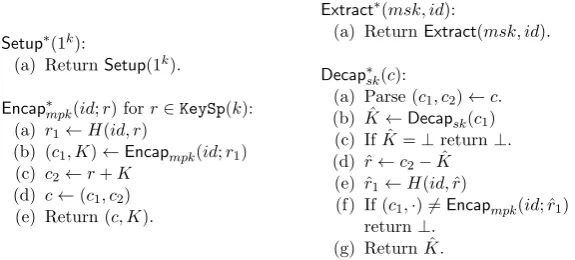
Definition 8 (TransformationF). LetΠ = (Setup,Extract,Encap,Decap) be an IB-KEM with random oracles H and associated spaces IDSp, CoinSp, CipherSp, and KeySp, where (KeySp,+)
forms a group. Let H :IDSp×KeySp→ CoinSp be a new hash function (independent of H), modeled as a random oracle in the security analysis. Then IB-KEM F(Π) = (Setup∗,Extract∗,
Encap∗,Decap∗) is specified in Figure 10, with random oracles H0 = H ∪ {H} and associated
spaces IDSp∗=IDSp, CoinSp∗=KeySp, CipherSp∗ =CipherSp×KeySp,KeySp∗ =KeySp.
It is easy to verify that, if Π is a correct IB-KEM, then so isF(Π). Observe that Definition8 viewsKeySpas a group. This is quite common in practice, as fixed-length bit strings with the XOR operation form a group. Alternatively, as detailed in Section 7.1, one can simply hash the key to a fixed-length bit string.
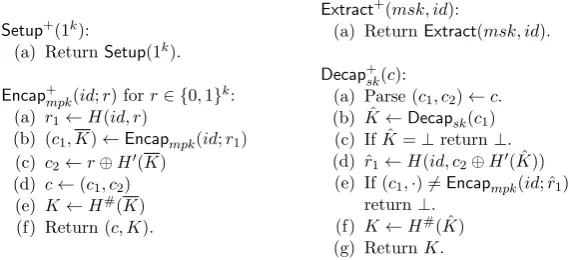
Setup∗(1k):
(a) ReturnSetup(1k).
Encap∗mpk(id;r) forr∈KeySp(k): (a) r1←H(id, r)
(b) (c1, K)←Encapmpk(id;r1) (c) c2←r+K
(d) c←(c1, c2) (e) Return (c, K).
Extract∗(msk, id):
(a) ReturnExtract(msk, id).
Decap∗sk(c):
(a) Parse (c1, c2)←c. (b) ˆK←Decapsk(c1)
(c) If ˆK=⊥return⊥. (d) ˆr←c2−Kˆ
(e) ˆr1←H(id,rˆ)
(f) If (c1,·)6=Encapmpk(id; ˆr1) return⊥.
(g) Return ˆK.
Figure 10: ConstructingF(Π) from Π. Queries to hash functions other than H are relayed without modification.
Compared to the original FO [FO99b], our transformationF has many similarities, but a few differences as well. Considering that KEMs are not fully-fledged encryption schemes and thus need not process arbitrary-length messages but rather keys from a finite key set, our construction eschews symmetric encryption (which is used for messages in hybrid encryption schemes) for a simple one-time pad of the key K, with randomness r taking the role of the pad. The latter is necessary for verifying the decapsulation. These changes lead to a proof of security for F, as we will see, under weaker and more natural assumptions as those used in [FO99b].
We can now move to our main technical result regarding theF transformation: it results in an IB-KEM that is plaintext-aware, assuming the original scheme was computationally uniform. The plaintext awareness comes from the query to the new random oracle H, i.e. the ciphertext will not decapsulate unless the intermediate value r was queried toH, in which case that same valuer can be used to derive the key.
Theorem 2 (F :cU7→PA). Let Πbe an IB-KEM. If Π is computationally uniform, then F(Π)
is plaintext-aware.
Proof. We use notation from Figure10: Π = (Setup,Extract,Encap,Decap) andF(Π) = (Setup∗,
Extract∗,Encap∗,Decap∗). Our goal is to specify a plaintext extractorK forF(Π) with awareness AwPAF(Π),A,K overwhelming for all ciphertext creatorsA. This is the case if, in ExptPAF(Π),A,K, the output ofK matches the output ofDecap∗sk∗(c∗) except for some negligible probability, where
sk∗ denotes the secret key corresponding to identity id∗ and (id∗, c∗) was output by ciphertext creator A. Consider the following plaintext extractor:
KH(id∗, c∗, mpk,HList,XList,EList): (a) Parse (c∗1, c∗2)←c∗.
(b) R ← {(r, r1) : (H,(id∗, r), r1)∈HList} (c) For each (r, r1)∈ R:
(a) (c, K)←Encapmpk(id∗;r1)
(b) If (c∗1 =c)∧(r=c∗2−K), returnK. (d) Return ⊥.
Let r∗ and r1∗ = H(id∗, r∗) be the values (ˆr, ˆr1) that occur in lines (d) and (e) of algorithm Decap∗ when executingDecap∗sk∗(c∗). By close inspection ofDecap∗ we observe that Decap∗sk∗ on inputc∗ = (c∗1, c2∗) outputs a keyK∗ (6=⊥) if and only if
(c∗1, K∗) =Encapmpk(id∗;r∗1)∧(r∗ =c∗2−K∗) . (1)
Given that it exists, this keyK∗ is unique and can be readily computed given r∗1. To analyze the effectiveness ofK, we distinguish three cases:
(1) r∗ is queried to H(id∗,·) byA, i.e. (r∗, r∗1)∈ R (cf. line (b)of K).
Decap∗sk∗ will output a key or not. If it will, thenK computes and outputs the same key. This is handled in line (c)of K.
(2) r∗ is queried to H(id∗,·) from within anOE(id∗) query.
In this case, there exists some (id∗,cˆ) ∈ EList where (ˆc,Kˆ) ← Encap∗mpk(id∗;r∗). Let ˆ
c = (ˆc1,cˆ2). Clearly, by line (f) of Decap∗, if ˆc1 6= c∗1 then Decap ∗
sk∗(c∗) will output ⊥.
Case ˆc1 =c∗1 will not occur as it would imply ˆc2 =c∗2 (cf. line(d)in Decap ∗
and recall that ˆ
K and r∗ are already fixed), but ˆc=c∗ is prohibited by line(d)of ExptPAF(Π),A,K. (3) r∗ is not queried to H(id∗,·) before reaching line (e)of ExptPAF(Π),A,K(k).
In this case, r1∗ is randomly assigned when executing Decap∗sk∗(c∗). Therefore (c∗1,·) = Encapmpk(id∗, r1∗) (cf. line (f) of Decap∗) occurs only with negligible probability, due to our assumption that Π is computationally uniform. (Otherwise, this experiment combined with A would constitute an efficient algorithm for finding, with non-negligible probability, an identityid∗ for whichγmpkH (id∗, c∗) is non-negligible.) Thus, Decap∗sk∗(c∗) will return⊥ with overwhelming probability.
We see that there is a perfect match of the decapsulation capabilities of Decap∗sk∗ and K in cases (1) and (2). In case (3),K correctly simulates the behavior ofDecap∗sk∗ with overwhelming probability. This shows that F(Π) is plaintext-aware.
Having shown that F introduces plaintext awareness, we now examine its secrecy properties, aiming to prove that F transforms any OW-secure IB-KEM into an OW-CCA-secure scheme. First we will show that F preserves OW security.
Lemma 10(F :OW7→OW). LetΠbe an IB-KEM. IfΠisOW-secure, thenF(Π)isOW-secure.
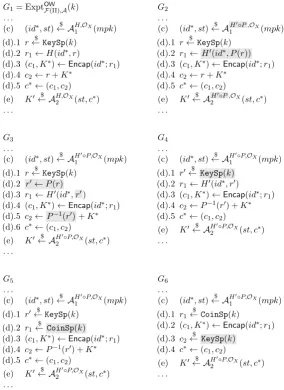
Proof. The proof in general proceeds as a sequence of games in which related values are gradually decoupled. Although the concept is straightforward, the proof requires some care.
We define a sequence of games. Game G1 will be the original OW experiment ExptOWF(Π),A(k) for F(Π). In subsequent games, we will modify how the challenger generates the challenge ciphertext to allow it to, at various stages, insert a challenge from anOWchallenger for Π. This will allow us to show that an adversary that can breakOW ofF(Π) can be used to break OWof Π. In Figure11, we specify precisely how the challenge ciphertext is generated in each game. This corresponds to line (d)in the original ExptOWF(Π),A(k) experiment defined in Figure2. For each gameGi, we defineSi to be the probability that gameGi returnswin; our goal is to bound S1. The first several games are simple rewriting steps.
Game G2. We replace random oracle H:IDSp(k)×KeySp(k)→CoinSp(k) with the compo-sition of a random function H0 :IDSp(k)×KeySp(k)→CoinSp(k) and a random permutation
P : KeySp(k) → KeySp(k), and give A oracle access to H0 ◦P which on queries of the form (id, r)∈IDSp(k)×KeySp(k) returns H0(id, P(r)). Since H0◦P has the same distribution asH,
S1 =S2.
Game G3. We rewrite the generation of the input to the hash function in terms of a separate variabler0. This is a bridging step, soS2 =S3.
Game G4. We simplify the generation of the variable r0. Since P is a permutation, this does not change the distribution, and henceS3 =S4.
Game G5. The hop from game G4 to game G5 contains the essential step of generating r1 independently from r0. This serves to decouple ciphertext componentsc1 and c2. We will show that this change cannot be detected unless Π is notOW.
Let A be an algorithm that can distinguish G4 from G5. To distinguish the two games, A needs to induce an (id∗, r0) query to H0. Since A only has access to H0 ◦P, and since P
G1= ExptOWF(Π),A(k) . . .
(c) (id∗, st)← A$ H,OX 1 (mpk) (d).1 r←$ KeySp(k)
(d).2 r1←H(id∗, r)
(d).3 (c1, K∗)←Encap(id∗;r1) (d).4 c2←r+K∗
(d).5 c∗←(c1, c2) (e) K0← A$ H,OX
2 (st, c∗) . . .
G2 . . .
(c) (id∗, st)← A$ H0◦P ,OX
1 (mpk)
(d).1 r←$ KeySp(k) (d).2 r1←H0(id∗, P(r)) (d).3 (c1, K∗)←Encap(id∗;r1) (d).4 c2←r+K∗
(d).5 c∗←(c1, c2) (e) K0← A$ H0◦P ,OX
2 (st, c∗) . . .
G3 . . .
(c) (id∗, st)← A$ H0◦P,OX
1 (mpk)
(d).1 r←$ KeySp(k) (d).2 r0←P(r) (d).3 r1←H0(id∗, r0)
(d).4 (c1, K∗)←Encap(id∗;r1) (d).5 c2←P−1(r0) +K∗ (d).6 c∗←(c1, c2) (e) K0← A$ H0◦P,OX
2 (st, c∗) . . .
G4 . . .
(c) (id∗, st)← A$ H0◦P,OX
1 (mpk)
(d).1 r0←$ KeySp(k) (d).2 r1←H0(id∗, r0)
(d).3 (c1, K∗)←Encap(id∗;r1) (d).4 c2←P−1(r0) +K∗ (d).5 c∗←(c1, c2)
(e) K0← A$ H0◦P,O X 2 (st, c∗) . . .
G5 . . .
(c) (id∗, st)← A$ H0◦P,OX
1 (mpk)
(d).1 r0←$ KeySp(k) (d).2 r1
$
←CoinSp(k)
(d).3 (c1, K∗)←Encap(id∗;r1) (d).4 c2←P−1(r0) +K∗ (d).5 c∗←(c1, c2) (e) K0← A$ H0◦P,OX
2 (st, c∗) . . .
G6 . . .
(c) (id∗, st)← A$ H0◦P,OX
1 (mpk)
(d).1 r1 $
←CoinSp(k)
(d).2 (c1, K∗)←Encap(id∗;r1) (d).3 c2
$
←KeySp(k) (d).4 c∗←(c
1, c2) (e) K0← A$ H0◦P,OX
2 (st, c∗) . . .
We now use such an A to break the OW security of Π. Let ˆc∗ be an OW challenge for Π.
Choose ˆc∗2 ←$ KeySp(k). This pair (ˆc∗,ˆc∗2) is distributed as in G5. Hence, when A is run on (ˆc∗,ˆc∗2),A will query its oracleH0◦P on (id∗,cˆ∗2−Decapsk(ˆc∗)). From the list of queries to the oracleH0◦P, pick a query (id, z) at random, constraint to id=id∗. Return ˆc∗2−z as the guess for the key that corresponds to the challenge ciphertext ˆc∗.
We have shown how to use a distinguisher A forG4 andG5 to construct an algorithmB for breaking theOW security of Π. Hence,|S4−S5| ≤qH ·SuccOWΠ,B(k), whereqH denotes the total
number of queries toH0◦P. This difference is negligible, assuming that Π is OW-secure.
Game G6. We replace c2 with a random value. In G5, r0 is independent of c1 so c2 is independent ofc1, and moreoverr0 is uniformly random, so P−1(r0) is uniform and hencec2 is uniform. In G6,c2 is clearly independent of c1 and is clearly uniform. Thus, the distributions of (c1, c2) in G5 and G6 are identical, so S5=S6.
Finally, we need to bound S6. Suppose A wins in game G6. We run A on the same environment as G6 but this time we replace ciphertext component c1 inG6 with the challenge from anOWchallenger for Π. This exactly matches the distribution inG6. Thus, Acan be used to break OW security of Π, and thus we have an algorithmBsuch thatS6 = SuccOWΠ,B(k) which is negligible, assuming Π isOW-secure.
Combining the intermediate results demonstrates that S1 = SuccOWF(Π),A(k) is negligible, assuming Π isOW-secure.
Remark 9 (Better tightness in proof of Lemma10). In Lemma 10, we saw that the F construc-tion preserves one-way-ness. The proof introduces a gap in tightness due to the random choice ofz from theqH queries to H0◦P in the analysis of the hop from G4 toG5. However, if Π is in
fact IND-secure, then we can achieve a tight reduction: in the IND experiment, B2 is given a
potential key K and can check whether that K is equal to the one output by A2, or whether K is consistent with one of the queries to H0◦P. If one of these is the case, thenB2 answers that K
is a real key, otherwiseB2 answers that K is a random value.
We can now combine the results of this section with some previous results to show that the F transformation results in an IB-KEM which is both plaintext-aware and OW-CCA-secure.
Corollary 2 (F :OW7→PA∧OW-CCA). Let Π be an IB-KEM. If Π is OW-secure, then F(Π)
is plaintext-aware andOW-CCA-secure.
Proof. Since Π is OW, then by Corollary 1it is also computationally uniform. By Theorem 2, F converts a computationally uniform scheme into a PAscheme. By Lemma 10,F preserves OW. Thus we have that F(Π) is OW and PA, by Theorem 1it is also OW-CCA.
Corollary 2 stands in contrast to the original FO transformation [FO99b], which required uniformity as a separate precondition in addition toOW; we have identified a (strictly) weaker precondition, computational uniformity, which follows fromOW security.
Given an identity id, a ciphertextc= (c1, c2), and a potential corresponding keyK, anyone can check if K does in fact correspond to c: compute ˆr ←c2−K, ˆr1 ← H(id,rˆ), and check if (c1, K) is equal to Encap∗mpk(id; ˆr1). In other words, there is a public consistency check of ciphertexts and keys. As a result,F(Π) can never be secure in the sense of an indistinguishability experiment such asINDorIND-CCA, which proves the following lemma:
Lemma 11 (F(Π) neverIND). For any IB-KEM Π, F(Π) is notIND-secure.
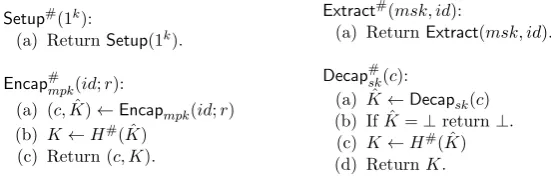
Setup#(1k):
(a) ReturnSetup(1k).
Encap#mpk(id;r):
(a) (c,Kˆ)←Encapmpk(id;r) (b) K←H#( ˆK)
(c) Return (c, K).
Extract#(msk, id):
(a) ReturnExtract(msk, id).
Decap#sk(c):
(a) ˆK←Decapsk(c) (b) If ˆK=⊥return⊥.
(c) K←H#( ˆK) (d) ReturnK.
Figure 12: Constructing #(Π) from Π. Queries to hash functions other thanH# are relayed without modification.
Remark 10 (On the implication OW∧PA⇒IND-CCAfrom [TO06]). We briefly discuss the
intuition behind the surprising implication OW∧PA⇒IND[-CCA], discovered in [TO06] in the context of public key encryption and plaintext awareness defined in the standard model [BP04]. In the proof, assuming towards contradiction that the encryption scheme is not IND-secure, the authors construct a (stateful) plaintext creator P that encrypts a random message and transmits resulting ciphertext c to PA adversary A via a series of OE queries. This ciphertext is output
byA, and obviously no plaintext extractor K can recover the encrypted message. Regarding a standard model definition of plaintext awareness for KEMs, we doubt that above implication would hold as well. The key argument is that there would be no plaintext creator P, which plays the central role in the attack scenario described above.
6
From one-way security to indistinguishability
We present now a simple transformation — hashing an IB-KEM’s key — that allows us to provably jump from OW to INDsecurity, and from OW-CCAto IND-CCA. Bear in mind that our F transform does not achieve IND(-CCA) security and so # will play an important role in achieving this property. We admit that this technique has been used earlier for the same purpose [BFMLS08,Den03]; however, we additionally prove that it preserves plaintext awareness.
Definition 9 (Transformation #). Let Π = (Setup,Extract,Encap,Decap) be an IB-KEM with random oraclesHand associated spacesIDSp,CoinSp,CipherSp, andKeySp. LetH#:KeySp→
KeySp be a new hash function (independent of H), modeled as random oracle in the security analysis. Then (hashed) IB-KEM #(Π) = (Setup#,Extract#,Encap#,Decap#) is specified in Figure12, with random oraclesH0 =H ∪{H#}and associated spacesIDSp#=IDSp,CoinSp#=
CoinSp,CipherSp#=CipherSp, and KeySp#=KeySp.
It is easy to verify that, if Π is a correct IB-KEM, then so is #(Π). The following Lemmas12 and13show that # converts arbitraryOW-secure schemes intoIND-secure schemes and preserves plaintext awareness.
Lemma 12 (# : OW[-CCA] 7→ IND[-CCA]). Let Π be an IB-KEM. If Π is OW-secure, then
#(Π)is IND-secure. Analogously, if Π is OW-CCA-secure, then #(Π)is IND-CCA-secure.
Proof. Let A# = (A# 1,A
#
2) be an IND[-CCA] adversary against #(Π). We can construct an OW[-CCA] adversary A = (A1,A2) against Π as follows: A1 executes A#1, recording and answering all queries to random oracle H#, and relaying all oracle queries to OX,OD (in the
CCAcase), and OH(H,·), forH =6 H#, to its own challenger. A1 outputs the same (id∗, st) as is output by A#1. On receiving challenge ciphertext c∗,A2 picks a random key K∗∗ and runs A#2 on input (st, c∗, K∗∗), recording and answering all queries to H# asA
LetK∗be the (real) key corresponding toc∗. LetEbe the event thatK∗is queried to theH#
oracle by A#. We have PrhExptIND[-CCA],0
#(Π),A# (k) =win
¬E
i
= PrhExptIND[-CCA]#(Π),A#,1(k) =win
¬E
i ,
and thus Pr[E]≥AdvtIND[-CCA]#(Π),A#(k) (cf. Lemma17). IfE occurs, thenK
∗ is contained in
HLiand A2 returns it with probability (at least) 1/q, whereq=|HLi|is polynomially bounded. Hence
SuccOW[-CCA]Π,A (k)≥Pr h
ExptOW[-CCA]Π,A (k) =win
E
i Pr[E]
≥AdvtIND[-CCA]#(Π),A#(k)/q .
This proves the lemma.
Lemma 13 (# : PA 7→ PA). Let Π be an IB-KEM. If Π is plaintext-aware, then #(Π) is
plaintext-aware.
Proof. Let K be a plaintext extractor for Π and let A# be aPA adversary (ciphertext creator) for #(Π). Observe that, syntactically, it is possible to run K on transcripts from A#. Let (id∗, c∗, mpk,HList,XList,EList) be a transcript of A# and K be the key output byK on that input. Since K is a plaintext extractor for Π, we have thatK =DecapHExtract(msk,id∗)(c∗) with high probability and hence
Decap#,H0
Extract#(msk,id∗)(c
∗) =H#(DecapH
Extract(msk,id∗)(c∗)) =H#(K) .
That is, the plaintext extractor K#=H#◦ K, obtained by combiningK with H#, is a valid extractor for #(Π). In particular, K# has the same success probability as K.
Observe that, in the above proof of Lemma 13, we didn’t exploit the fact that H# is a hash function (or even a random oracle). Indeed, the proof would have worked as well if the construction in Definition9 had applied on the key any other kind of deterministic function (for example, the truncation of a fixed number of bits). However, the use of a random oracle in the # construction is an essential prerequisite of the proof of Lemma 12.
We are now ready to state the central result of this paper: by combining transformation # with transformation F, we can convert any OW-secure IB-KEM into an IB-KEM that is simultaneously plaintext-aware andIND-CCA-secure.
Theorem 3 (Main result: #◦ F : OW 7→ PA∧IND-CCA). Let Π be an IB-KEM. If Π is
OW-secure, then #(F(Π)) is plaintext-aware and IND-CCA-secure.
Proof. By Corollary2, F(Π) isPA andOW-CCA-secure. By Lemma13, #(F(Π)) isPA and by Lemma12 it is further IND-CCA-secure.
This overall generic construction is powerful yet extremely efficient: encapsulation has just two additional random oracle queries, and decapsulation requires two random oracle queries and a partial encapsulation. We do not require any additional randomness or public parameters. In Section7.1 we show how to further optimize the overall transformation.
7
Plaintext-aware IB-KEMs in practice: applications and
opti-mizations
We apply our generic transformations from Sections5and6to two popular IB-KEMs5, namely to BF-IB-KEM by Boneh and Franklin [BF01], and to SK-IB-KEM by Sakai and Kasahara [SK03].
5
![Figure 2: Experiments for one-way security (OW[-CCA]) and indistinguishability (IND[-CCA]) of IB-KEMs](https://thumb-us.123doks.com/thumbv2/123dok_us/7885352.1308382/7.595.101.507.68.370/figure-experiments-security-cca-indistinguishability-ind-cca-kems.webp)