Coverage Problems in Wireless Sensor
Networks
N. Vijayarani1, Dr.A.Senthilkumar2, T. Vijayasaratha3, M. Haripriya4
Research Scholar, Department of Computer Science, Selvamm Arts and Science College (Autonomous), Namakkal, India1
Assistant Professor, Department of Computer Science, Aringnar Anna Govt, Arts College, Namakkal, India2 Department of Computer Science, Selvamm Arts and Science College (Autonomous), Namakkal, India3 M. Phil Research Scholar, Department of Computer Science, Selvamm Arts and Science College (Autonomous)
Namakkal, India4
ABSTRACT: Coverage problem is an important and fundamental issue in sensor networks, which reflects how well a sensor network is monitored or tracked by sensor. The current works on coverage problem in sensor networks. Two types of sensor coverage are investigated: area coverage and target coverage. Combining with sensor development mechanism (deterministic, statistical) and wireless sensor network properties various coverage problems have been analysed. The most representative problems in each domain and present a comprehensive review and analysis of various existed algorithms, techniques. One fundamental issue in sensor networks is the coverage problem, which reflects how well a sensor network is monitored or tracked by sensors. To formulate this problem as a decision problem, whose goal is to determine whether every point in the service area of the sensor network is covered by at least k sensors, where k is a predefined value. Wireless Sensor Networks are used to monitor a given field of interest for changes in the environment. Coverage is one of the main active research interests in WSN. Main aim to review the coverage problem. In WSN and the strategies that are used in solving coverage problem in WSN. These strategies studied are used during deployment phase of the network. Besides this we also outlined some basic design considerations in coverage of WSN. And also provide a brief summary of various coverage issues and the various approaches for coverage in Sensor network.
I. INTRODUCTION
Wireless sensor networks (WSNs) consist of a number of tiny nodes which can vary from few to thousands. These nodes are known as sensor nodes associated with battery power, having the capability of sensing, data processing and communication. In other words, WSNs are composed of individual embedded systems having ability to interact with their environment through sensors, processing information and communicating this information with their neighbours. Thus, wireless sensor networking can be viewed as an economical and promising technology that provide a number of applications in the field of military, health, environment, home and industry etc. The rapid progress of wireless communication and embedded micro-sensing MEMS(Micro Electro Mechanical Systems technologies has made wireless sensor networkspossible. Such environments may have many inexpensive wireless nodes, each capable of collecting, storing, and processing environmental information, and communicating with neighbouring nodes.
quality of service in the WSNs. For the sensor networks, coverage can be considered as a measure of quality of service. Thus, coverage and energy consumption are two main metrics in determining the network quality. The quality of service sensing component of quality of service model, deals with device calibration, environment monitoring and exposure.
Exposure can be defined as the measurement of coverage of a region in terms of detection ability for a moving target. Thus, the review presents that WSNs are facing a number of challenges due to scarce energy resources, dynamic nature of topology and a number of other network elements like number of sensor nodes deployed, method of deployment, communication and sensing ranges associated with sensor nodes, reliable communication link arrangement, energy consumption by sensor nodes etc.
II. WIRELESS SENSOR NETWORKS
Wireless sensor networks (WSN), sometimes called wireless sensor and actuator networks (WSAN), are spatially distributed autonomous sensors to monitor physical or environmental conditions, such as temperature, sound, pressure, etc. and to cooperatively pass their data through the network to a main location. The more modern networks are bi-directional, also enabling control of sensor activity. The development of wireless sensor networks was motivated by military applications such as battlefield surveillance; today such networks are used in many industrial and consumer applications, such as industrial process monitoring and control, machine health monitoring, and so on.The WSN is built of "nodes" – from a few to several hundreds or even thousands, where each node is connected to one (or sometimes several) sensors.
WSN ARCHITECTURE
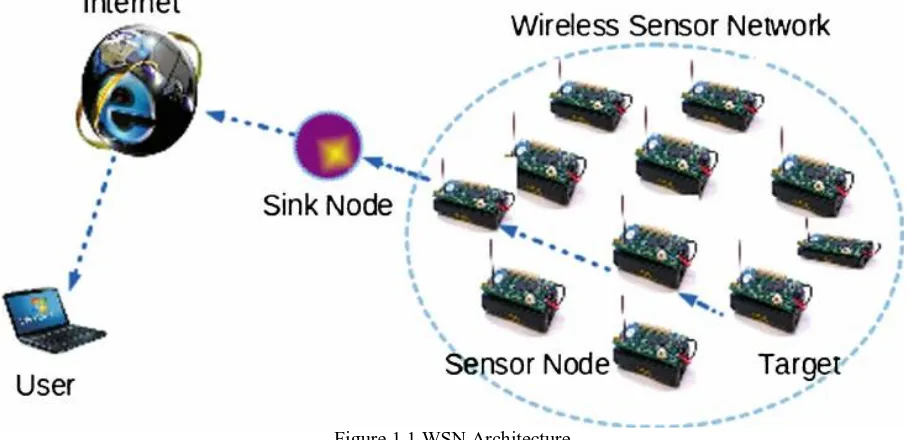
The architecture of WSN varies for a individual sensor node and the entire network. Energy efficiency, size reduction and minimum cost are the main concern for sensor node architecture. A wireless sensor node or node is also known as mote and is made up of the following four functional components: sensing unit, processing unit, transceiver, and power unit.
Figure 1.1 WSN Architecture
Sensing Unit
Processing Unit
A sensor node uses a microcontroller which performs task, processes information and controls the working of other parts in the sensor node. Since a microcontroller is characterized by its small price, ease to attach other devices, simplicity of programming, and low power utilization, they are used in sensor nodes. Memory requirements depend on application type.
Transceiver
Transceiver is used to send and receive messages wirelessly. The functionality of both transmitter and receiver are combined into a single device known as a transceiver. In WSN any node has to “converse" with other nodes. Nodes are constrained by limited energy A transceiver must provide an adequate balance between a low data rate and small energy consumption. This enables the node to live for an extended period of time. Sensor nodes generally make use of ISM band, which gives free radio, spectrum allotment and universal accessibility. Wireless transmission medium can be radio frequency (RF), optical communication (laser) and infrared. Lasers need line-of-sight for communication and are susceptible to atmospheric conditions.
Power source Energy
It required for all components of a WSN is obtained from a power supply. Since the wireless sensor node is frequently positioned in an unfriendly locality, changing the battery regularly can be expensive and problematic. The energy consumption in sensor node is required for sensing, communicating and data processing. Communication of information needs more energy than any other process. The main source of energy in sensor node is from power stored in batteries or capacitors. Present sensors are able to renew their energy from solar sources, heat differences, or pulsation etc.
OPERATING SYSTEMS FOR WSN
WSNs consist of many minute networked devices that can communicate. Operating systems are the basis of the sensor node architecture. The requirements of operating system architecture in WSNs are:
Very small trace,
Very little overhead, and,
Very small power consumption. Due to the resource constraints in WSN hardware platform, the main aim while selecting and designing operating systems for WSN is to reduce memory size and system overheads. According to and three classifications of operating system architectures are described for wireless sensor nodes. They are monolithic, modular/micro and virtual machine.
TinyOS
TinyOS is one of the first operating system specially designed for WSNs. TinyOS has a component-based structure which enables swift improvement and realization along with minimizing code size necessary due to sever memory constraints in WSNs. Component library of TinyOS allows further modification for custom application. TinyOS is an open source OS based on an event-driven programming model. Contiki. The Contiki is another operating system for WSN. Like TinyOS, its kernel is event-driven and on a perapplication basis can perform multithreading. Contiki can support IPv4 and IPv6 type of IP communication.
SOS (SOS Embedded Operating System) is an event-driven OS that follows a more dynamic position on the design field. Loadable modules support is one of the key features of SOS. LiteOS is an open source, interactive operating system designed for WSNs. LiteOS, like Unix, has tools that allows operation on one or more WSNs. Applications can be developed for nodes and can be distributed wirelessly to sensor nodes. According to and there are a total of thirty nine operating systems identified for WSNs.
TOPOLOGIES FOR WSN
In WSN the position of the nodes is known after the deployment of sensors. The topology architecture for WSN is dependent upon quantity and rate of data to be sent, transmission distance, power requirements, mobility and surroundings. Three types of network topology architecture are popularly used for wireless sensor networks. They are:
A star topology is a single-hop system. Each node connects directly to a gateway. All sensor nodes are the same and the base station serves to communicate information. Star topology is characterized by low power consumption and is restricted by the transmission distance of radio.
Cluster tree topology
Cluster tree topology divides node into groups or trees called clusters. Each group has a cluster head with one or more member nodes. This topology uses a multihop routing to transmit information from the source to the base station. Within a group a node transmits information to a upper level node higher in the tree and then to the cluster head which sends the information to a gateway. The gateway transmits the information to the next level tree until it reaches the base station. Communication cost can be reduced significantly by using cluster tree topology. Cluster topology supports in-network aggregation which increases the life span of WSNs.
Mesh topology
Mesh topologies are multi-hop systems which allow peer-to-peer communication. The base station does not interfere in the selection of path. All nodes in mesh topology choose the best dependable path amongst available path for transmission by self-connecting to several nodes. A mesh network is more dependable and extremely fault tolerant. Mesh topology consumes more power than star topology.
LIFECYCLE OF WSN
The lifecycle of a WSN can be distinguished into four stages. They are:
Planning WSNs
The planning stage is the first stage of the life cycle. This is necessary for achieving the purpose of creating a WSN. The survey of the deployment region is carried out for identification of the locations before the placement of the sensors. Deployment WSNs In the deployment stage, sensor nodes repeatedly send their connection status along with the path to the Base Station.
Monitoring WSNs
This stage is concerned with the analysis of the information provided by the network sensors.
Controlling WSNs
This stage is used for controlling the WSN by sending instructions from the Base Station. The instructions can include commands to sensors such as stop sending messages, change the frequency of message transfer or restart the entire network etc. Planning and deployment stage is usually concerned by researchers whereas the end users are more concerned in monitoring and controlling the WSN.
III. LITERATURE REVIEW
A SURVEY ON SENSOR NETWORKS I.F. AKYILDIZ, WEILIAN SU, SANKARASUBRAMANIAM, E. CAYIRCI IEEE COMMUNICATIONS, AUG 2002[1]
The authors present communication architecture for sensor networks and proceed to survey the current research pertaining to all layers of the protocol stack: Physical, Data Link, Network, Transport and Application layers. A sensor network is defined as being composed of a large number of nodes which are deployed densely in close proximity to the phenomenon to be monitored. Each of these nodes collects data and its purpose is to route this information back to a sink. The network must possess self-organizing capabilities since the positions of individual nodes are not predetermined. Cooperation among nodes is the dominant feature of this type of network, where groups of nodes cooperate to disseminate the information gathered in their vicinity to the user. Major differences between sensor and ad-hoc networks: Number of nodes can be orders of magnitude higher.
factors to be used as a guideline and as a tool to compare various protocols. After surveying the literature, this is our impression as well and we include it in the open research issues that can be explored for future work.
The design factors listed by the authors: Fault Tolerance: Individual nodes are prone to unexpected failure with a much higher probability than other types of networks. The network should sustain information dissemination in spite of failures.
Scalability
Number in the order of hundreds or thousands Protocols should be able to scale to such high degree and take advantage of the high density of such networks.
Hardware Constraints
A sensor node is comprised of many subunits (sensing, processing, communication, power, location finding system, power scavenging and mobilizer). All these units combined together must consume extremely low power and be contained within an extremely small volume.
Sensor Network Topology
Must be maintained even with very high node densities.
Environment
Nodes are operating in inaccessible locations either because of hostile environment or because they are embedded in a structure.
Power Consumption
Power conservation and power management are primary design factors.
INFORMATION GATHERING IN SENSOR NETWORKS [K. DASGUPTA, M. KUKREJA AND K. KALPAKIS] [4]
Consider a network of energy–constrained wireless nodes that are capable of sensing and communication. These nodes are to be deployed over an area to be monitored. There is a set of points or regions of interest in that area, each of which need to be sensed (covered) by at least one node. The basic operation of this network is to periodically sense, gather, and transmit the sensed information to a concentration point. Nodes are allowed to perform in–network data aggregation, whereby multiple incoming data packets at a node can be aggregated into one single outgoing packet. Since the nodes have limited energy, it is desirable to maximize the system lifetime, i.e. the number of periods (rounds) that information can be collected until the first node is drained of its energy, while ensuring that the coverage requirements are satisfied.
Since a node may cover more than one point/region of interest, we allow nodes to assume two roles, namely sensor and relay. Relay nodes aggregate and transmit data packets, while sensor nodes can also sense their vicinity and generate data packets. Since data transmission is a key energy consumer, the placement and role assignment of these nodes is critical.
SELF- ORGANIZATION OF SENSOR NETWORKS FOR EFFICIENT QUERY EXECUTION” [H. GUPTA, S. DAS AND Q. GU] [5]
Spatial query execution is an essential functionality of a sensor network, where a query gathers sensor data within a specific geographic region. Redundancy within a sensor network can be exploited to reduce the communication cost incurred in execution of such queries.
Any reduction in communication cost would result in an efficient use of the battery energy, which is very limited in sensors. One approach to reduce the communication cost of a query is to self-organize the network, in response to a query, into a topology that involves only a small subset of the sensors sufficient to process the query. The query is then executed using only the sensors in the constructed topology. Analyze algorithms for such self-organization of a sensor network to reduce energy consumption.
overhead of the algorithm. Finally, we evaluate the distributed algorithm using simulations and show that our approach results in significant communication cost reduction.
IV. RESEARCH METHODOLOGY
COVERAGE
Coverage can be defined as how well or to how much extent each point of a deployed network is under the vigilance of a sensor node. The goal of coverage problem can be defined as: whether each and every point in the targeted or interested field is within the sensing range of the deployed sensors which forms the network and answers for “how well the target is monitored or tracked by sensors”.
CONNECTIVITY
Network connectivity is an important issue for WSNs. A WSN is said to be connected if each and every node pair can directly or indirectly communicate with other nodes. The objective of a connected network is to find out a minimal subset of active nodes so that the observed data can reach to the sink stations. For a wide range of applications, it is not possible to partition the network into disjoint sets of nodes which makes the connectivity issue as a crucial issue. In WSNs, connectivity acting as a fundamental property helps in the following ways:
1. Connectivity represents the network status on the basis of network density, node deployment plans, sensing and communication ranges.
2. Connectivity provides the roadmap for development and working plan for a network such as deployment patterns, processing algorithms etc.
Network Deployment
These networks based on predefined parameters such that the shape of the network, the location of sensor node etc. are known in advance. In this type of coverage, sensor nodes are deployed in a predefined manner, however, it is impossible for many cases to deploy sensor nodes in deterministic pattern. The placement of sensor nodes for a coverage pattern is much easier than random coverage. Coverage in art gallery problem can be considered as determined Network Coverage . The study of art gallery problem comes under the computational geometry. According to this problem, the room is considered as a polygon and the guards are represented by points in the room. The goal of this problem is to ensure that every part of this room can be monitored by at least one of the guards (sensors). As the position of all the guards is specified in a predefined manner to ensure its goal, it comes under determined coverage.
Random Coverage
Random coverage is just opposite to the determined network coverage, that is, there is no predefined information available about the location of sensors and topological structure of the network. The location and topology change from time to time.
For example, in the battle field, a target can move its position in accordance with time and topological changes. Geometric method is commonly used for random deployment as it studies the problem of plane coverage. In random coverage nodes are placed very closely in order to achieve the desired coverage, as nodes are considered as stationary, while in the case of mobile nodes, mobility property is used in order to relocate the optimal location. Thus, the aim of random coverage is to maintain coverage while minimizing energy consumption [6]
NODE SENSING MODELS Binary model
In this model, a node senses a region of disk shape which has a radius ‘R’ (sensing range) and centred at ‘C’. Whether a particular target ‘T ’ is sensed or not is determined by ‘1’ or ‘0’.
Index Model
This model gives information about the chances to sense a target in the given network. The state of a target to be sensed is inversely proportional to kth power of the distance between the target and sensor node , i.e.;
Sensing chances = c/ [dis (T,C)] (1) Where k ≥ 2 and ‘c’ is a constant which is determined by network characteristics.
Probabilistic Model
The authors in have presented the probabilistic model as an extension of binary sensing model. For probabilistic model a quantity, Ruis defined such that Ru<Rswhere Rsis the radius of circular disk and an interval (Rs−Ru, Rs+ Ru)
is defined, in which the probability to detect an object is ‘p’. Based on the given probabilistic model, the sensing of a point p(x, y) by a sensor Si is given below:
C(x,y)(Si) = { , + < ( , ) − , + < ( , )< + , − > ( , )} Where a = d (Si , p) −(Rs−Ru), and ω, β are measured parameters for detection probabilities, When an object is within a certain distance from a sensor.
Target Characteristics Static Target Coverage
Static targets are the stationary targets, that is, these targets are not able to move and rigid with respect to sensing node . We can consider entrance of a Mall as an example of static target. This type of coverage works with a goal to maximize coverage and minimize redundancy of sensor nodes. This is the simplest approach which can be seen in daily life situations such as monitoring of temperature.
Dynamic Target Coverage
The Dynamic targets have ability to move and not rigid to the corresponding sensing node. A running vehicle can be represented as a dynamic target [10]. The main focus of such type coverage is the movement of the dynamic target. This is complicated as compared to the static one. This coverage is very useful for military purposes as it can be used for the purpose of battlefield surveillance.
Application Attributes Energy-Saving Coverage
Energy-Saving coverage focuses on ‘whether the energy consumption by the nodes in the network is in an efficient manner or not’ as it has a great impact on the existence of network. Because of limited resources such type of coverage is done by dividing the sensing nodes into the subsets of “active” and “sleep” nodes in different rounds. This type of coverage is done to achieve the goal of maximization of network lifetime with the preservation of energy resources.
Connectivity Coverage
Connectivity coverage answers how to handle communication requirements and degree of coverage both at the same time and thus, plays an important role in coverage control. Connectivity coverage can be further categorized as:
Active node connectivity coverage—this coverage deals with the “active” and “sleep” state of nodes in rotation. Connected path coverage—this type of coverage deals with the selection procedure of connected sensor nodes to get maximum effect.
Monitored Areas Regional Coverage
Point Coverage
Under the point coverage only a limited number of discrete objects or target points are to be monitored. In this type of coverage the sensor nodes are divided into node subsets under the stochastic distribution. Due to such type of division each subset works turn by turn which results into maximization of the network lifetime.
Barrier Coverage
Barrier coverage deals with the chance calculation of movement of objects in the targeted area. The chances or probability can be determined by movement rate of object and sensing intensities of the sensors for each and every point on the path followed by the object. On the basis of this calculation, the density of sensor nodes can be computed. It can be find out that how densely the sensor nodes should be deployed in the targeted region. Barrier coverage further can be classified as Weak k-barrier and Strong k-barrier coverage.
V. COVERAGE STRATEGIES
Coverage strategies used for solving coverage problems in wireless sensor network. The strategies are divided into three categories force base, Grid based, Computational geometry based.
Force based
Force base development a strategy rely on the sensor mobility, using virtual repulsive and attractive force the sensor force to move away or awards each other so that full coverage is achieved. Each sensor node exerts an attractive or repulsive forced is exerted. Each neighbouring sensor according to the distance between them in order to reach the target distance. A force can be described as a vector and overall force is then the result if vector addition. Following condition of force function:
Inversion relation
This is implies that the force is inversely proposal to nodes distance.
Upper bound
fmax is maximum force. This is set an upper bound on force.
Lower bound
f(dij)=0, if dij> Re ,this is indicated that only neighbour exert force. We also introduced two rules for node movement
Oscillation Check
If one node move back and forth between similar location many times, that these nodes are regarded to in oscillation states.
Stability Check
If the node moving distance of node is less than a predefined threshold for several times, then this node can be considered to have reached a stable state.
Grid based
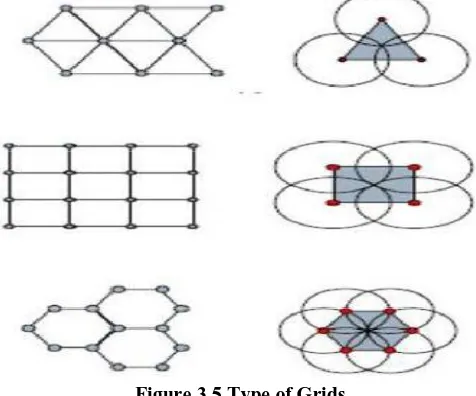
Grid points are used in two ways in wireless sensor network deployment either to measurement coverage as used in VFA or determine the sensor position. In these approach sensor will redeploy according to a predefined grid. Triangular Lattice, Square or Hexagonal grid. The triangular lattice is preferred because it requires the smallest number of sensor network density. But in sparse network large grid size is better than it will avoid overlapping of sensor sensing range therefore ensuring full utilization of their sensor capabilities. The grid can be used in robotic where robotic moves according to defined rules and deploy on sensor achieve the full coverage of area.
Computational Geometry based
Computational geometry is frequently used in wireless sensor network for coverage optimization the most frequently used computational geometry approach are a Voronoi graph and Delaunay triangulation. In Voronoi diagraph id partition of sites, in such way that point inside the polygon. Voronoi graph can be used as one of the sampling methods in determining wireless sensor network act as the sites. Voronoi diagram and Delaunay triangulation are used in to estimate the worst and best coverage.
Worst case coverage
A path where an introduced can go through with the least probability of being detected, and maximum support part.
Best case coverage
A path with the highest coverage. The work proved that a maximum breach path must lie on the edges of Voronoi diagram.
AREA COVERAGE
The area coverage problem has been well studied and a review of existing solutions for area coverage problem is described in [SSW05, Cardei06, ChenK07]. Most of works in the survey [Cardei06] and [ChenK07] were published before 2003 and 2005, respectively. The survey work in [SSW05] focuses on only constructing area-dominating sets for sensor area coverage. We present in the chapter a comprehensive and updated survey on sensor area coverage. There are various coverage problems including area coverage, k-coverage, m-connected k-coverage problems. The area coverage problem is defined as follows:
VI. CONCLUSION AND FUTURE WORK
Coverage is a wireless sensor network can be thought of as how well the wireless sensor network is able to monitor a particular field internet. The coverage strategies are authorized into three different approaches: force based, Grid based, Computational geometry based. In these papers we have attempted to overview of the work that has been done to address the coverage problem in wireless sensor network. Coverage problem in sensor networks, and classify them into two categories: sensor area coverage and target coverage.
VII. FUTURE WORK
REFERENCES
[1] I.F. Akyildiz, W. Su, Y. Sankarasubramaniam, and E. Cayirci., “A Survey on Sensor Networks,” IEEE Communication Magazine, Aug. 2002, pp. 102-114.
[2] Y. Jennifer, M. Biswanath, and G. Dipak, “Wireless sensor network survey”, Computer Networks, 2008, vol. 52, pp. 2292–2330.
[3] C.F. Huang and Y.C. Tseng, “The coverage problem in a wireless sensor network,” In ACM International Workshop on Wireless Sensor Networks and Applications (WSNA), 2003,Npp. 115–121.
[4] K. Dasgupta, M. Kukreja And K. Kalpakis “Information Gathering In Sensor Networks”,2003
[5] H.Gupta, S. Das And Q. Gu Self- Organization f Sensor Networks For Efficient Query Execution”,2003
[6] G. Xing, X. Wang, Y. Zhang, C. Lu, R. Pless, and C. Gill, “Integrated coverage and connectivity configuration for energy conservation in sensor networks,” ACM Transactions on Sensor Network, 2005, vol. 1, no. 1, pp. 36–72.
[7] A. Cerpa, and D. Estrin, “ASCENT: Adaptive Self- Configuring sEnsor Networks Topologies,” IEEE Transactions on Mobile Computing, 2004, vol. 3, no. 3, pp. 272–284.
[8] H. Zhang and J.C. Hou, “Maintaining Sensing Coverage and Connectivity in Large Sensor Networks,” Ad Hoc & Sensor Wireless Networks, 2005, vol. 1, no. 1, 89-124.
[9] S. Podurl, and G.S. Sukhatme, “Constrained coverage for mobile sensor networks,” In Proceedings of the IEEE International Conference on Robotics and Automation, 2004, pp. 165–172.