AN ELABORATE FREQUENCY OFFSET ESTIMATION FOR OFDM SYSTEMS
S.-H. Nam, J.-S. Yoon, and H.-K. Song
Department of Information and Communications Engineering uT Communication Research Institute Sejong University Seoul 143–747, Korea
Abstract—In this paper, a carrier frequency offset estimation scheme in orthogonal frequency division multiplexing is proposed. We focus on increasing the correlation of each PN sequence code repeated in one preamble. We aim at getting an efficiency like using many preambles. The proposed method can improve the performance of the system by estimating fine frequency offset. Also, the proposed method enhances reliability by maximizing the number of correlations compared with the established method in time domain.
1. INTRODUCTION
preamble can be also used for frequency offset estimation [20–23]. A preamble is used for estimating the offset of one packet itself. We can use moose Method which uses more than two preambles. In this paper, we propose that the pseudo noise (PN) sequence is repeated four times to one packet like [20]. The conventional frequency offset estimation method is compared with the proposed method.
This paper is organized as follow: In Section 2, OFDM system model and frequency offset are introduced. The proposed method is explained in Section 3. In Section 4, we explain the performance evaluation between the conventional method and the proposed method. In Section 5, we conclude about the proposed skill.
2. SYSTEM MODEL DESCRIPTION
We consider an OFDM system implemented by the inverse fast Fourier transform (IFFT) and fast Fourier transform (FFT) [24]. The N
symbols are modulated where N is the number of sub-carriers. The transmitted OFDM signal through channel is defined as
x(t) = ∞
l=−∞ N−1
k=0
Xl(k) exp(j2πfk(t−lTs)) (−TG≤t≤T), (1)
where Xl(k) at the k-th sub-carrier in the l-th symbol, means
the transmitted data symbol. fk means k-th sub-carrier. Ts and
TG mean a period of the OFDM symbol the and length of guard
interval (GI)respectively. The OFDM symbol is affected by multi-path channel. For prevention of interference between OFDM symbols, GI is interpolated between continuous packets. At this moment, the length of GI is longer than maximum delay propagation of wireless channel. ICI generated by ISI and the delay of sub-carrier can be decreased if CP can be interpolated to GI. The OFDM symbol, which is added by CP in the period of first symbol is changed to discrete signal for processing the continuous signal as follows
xl(n) = N−1
k=0
Xl(k)ej2πkn/N (−NG < n <N), (2)
where N and NG are the numbers of samples about valid data of the
OFDM symbol and CP respectively. In Eqn. (2), xl(n) excepting GI
becomes IFFT ofXl(k). Therefore,xl(n) is realized by IFFT ofXl(k).
When the frequency offset is estimated ideally, the received signal is expressed as follows:
where channel impulse response with multi-path is expressed byhl(n),
and additive white Gaussian noise (AWGN) is also expressed bywl(n).
yl(n) is can be expressed as
yl(n) = N−1
k=0
Xl(k)Hl(k)ej2πkn/N +wl(n), −NG≤n≤N. (4)
The OFDM system is very sensitive to the frequency offset. The orthogonality is destroyed when frequency offset raises in the OFDM system. The frequency offset is generated by mismatching of exact synchronization between transmitter and receiver. We define that fine frequency offset is calledδ and the signal without noise is transmitted,
Yl(k) expressed in frequency domain as follows
Yl(k) =Xl(k)Hl(k)
sinπδ NsinπδN e
jπδ(N−1)/N+I
l(k), (5)
where ICI is expressed by Il(k) that is generated by fine frequency
offset [25].
3. FREQUENCY OFFSET ESTIMATION
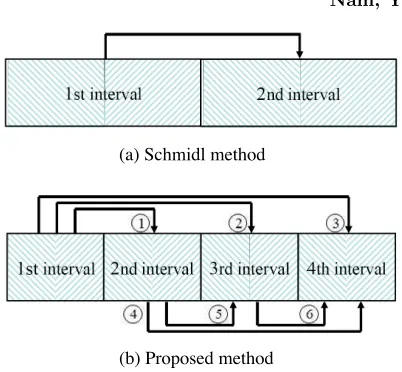
A preamble is used for frequency offset estimation. The preamble using Schmidl estimation method is expressed as a reiterated form in time domain. The fine frequency offset can be estimated by the correlation value that is obtained through the operation between first interval and second interval in Schmidl structure. The process can be written as
ˆ
δschmidl= 2×
1 2πarg
N
2−1
n=0
r∗(n)r
n+N 2
. (6)
Schmidl structure is depicted to Fig. 1(a). The preamble using proposed estimation method has the form which is reiterated with 4 times using PN sequence excepting CP interval in time domain. The proposed method is depicted to Fig. 1(b). This preamble to adapt proposed method consists of CP, first interval, second interval, third interval and fourth interval.
How to estimate fine frequency offset is the method of using the correlation between each PN sequence in the preamble. Let us consider step-by-step process,
(a) Schmidl method
(b) Proposed method
Figure 1. Comparison of structure of frequency offset estimation method.
step 2) The second interval correlate with third/fourth intervals for estimating frequency offset.
step 3)The third interval is calculated to fourth interval. step 4)Each value from step 1 to step 3is averaged.
Through above procedure, we can estimate the accurate frequency offset as
ˆ
δproposed =
1
M
L−1
s=1 L−1
l=s
L l
1 2π ×arg
N L−1
n=0
r∗
n+ (s−1)N
L
×r
n+ (s−1)N
L + N
L , (7)
M =
L−1
l=1
l, (8)
where sis the index for calculation, L is the number of intervals in a preamble andM is the number of operation of the correlation between each interval.
4. SIMULATION RESULTS AND DISCUSSIONS
MSE 0.01 0.1
0.001
0 4 8 12 16 20
Schmidl Method Proposed Method
SNR [dB]
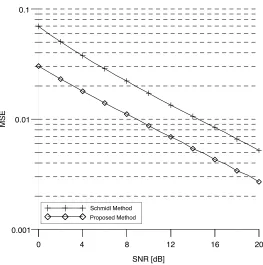
Figure 2. The estimation variance in AWGN and one path channel.
f0 = 0.01. The channel is applied to the simulation which does not
Schmidl Method Proposed Method
0.8
0.4
0
−0.4
−0.8
−0.8 −0.4 0 0.4 0.8 Frequency Offset
Estimated Frequency Of
fset
Figure 3. Comparison of estimation performance for several methods at SNR = 0 dB.
No Frequency Offset Schmidl Method Proposed Method
BER
0.01 0.1
0.001
0 2 4 6 8 10
SNR [dB]
5. CONCLUSIONS
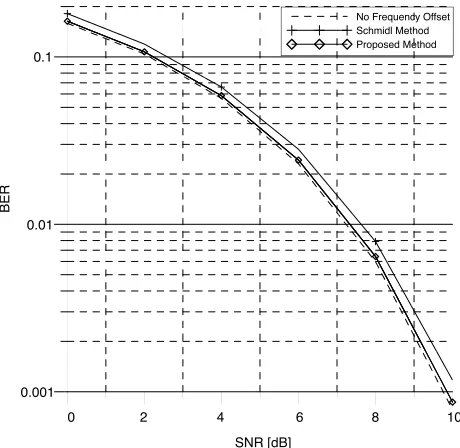
In this paper, a new method of frequency offset estimation is proposed. The proposed method provides more accurate estimation performance than conventional method. In the future, using the same structure, we adapt to coarse frequency offset estimation. Moreover, we will study the method reducing complexity to get accurate frequency offset estimation.
ACKNOWLEDGMENT
This research is supported by the MKE (Ministry of Knowledge Economy), Korea, under the ITRC (Information Technology Research Center) support program supervised by the IITA (Institute of Information Technology Assessment) and is supported by Foundation of ubiquitous computing and networking project (UCN) Project, the Ministry of Knowledge Economy(MKE) 21st Century Frontier R&D Program in Korea and a result of subproject UCN 08B3-B2-10M.
REFERENCES
1. Kamitsos, I. and N. K. Uzunoglu, “Improvement of transmission properties of multimode fibers using spread spectrum technique and a Rake receiver approach,” Progress In Electromagnetics Research, PIER 76, 413–425, 2007.
2. Shu, W. and J.-M. Song, “Complete mode spectrum of a grounded dielectric slab with double negative metamaterials,” Progress In Electromagnetics Research, PIER 65, 103–123, 2006.
3. Min, K.-S., M.-S. Kim, C.-K. Park, and M. D. Vu, “Design for PCS antenna based on WiBro-MIMO,” Progress In Electromagnetics Research Letters, Vol. 1, 77–83, 2008.
4. Abouda, A. A. and S. G. Haggman, “Effect of mutual coupling on capacity of MIMO wireless channels in high SNR scenario,”
Progress In Electromagnetics Research, PIER 65, 27–40, 2006. 5. Abouda, A. A., H. M. El-Sallabi, and S. G. Haggman, “Effect
of antenna array geometry and ULA azimuthal orientation on MIMO channel properties in urban city street grid,”Progress In Electromagnetics Research, PIER 64, 257–278, 2006.
7. Hua, J., L. Meng, Z. Xu, and D. Wang, “A new method for SNR and doppler shift estimation in wireless propagations,”Journal of Electromagnetic Waves and Applications, Vol. 21, No. 15, 2431– 2441, 2007.
8. Mouhamadou, M., P. Vaudon, and M. Rammal, “Smart antenna array patterns synthesis: Null steering and multi-user beamforming by phase control,” Progress In Electromagnetics Research, PIER 60, 95–106, 2006.
9. Van Nee, R., G. Awater, M. Morikura, H. Takanashi, M. Webster, and K. W. Halford, “New high-rate wireless LAN standards,”
IEEE Commun. Mag., Vol. 37, No. 12, 82–88, Dec. 1999.
10. Doufexi, A., S. Armour, M. Butler, A. Nix, D. Bull, J. McGeegan, and P. Karlsson, “A comparison of the HIPERLAN/2 and IEEE802.11a wireless LAN standards,” IEEE Commun. Mag., Vol. 40, No. 5, 172–180, May 2002.
11. ETSI ETS 300 401, “Radio broadcasting system: Digital audio broad-broadcasting (DAB) to mobile, portable and fixed receivers,” ETSI, Tech. Rep., Feb. 1995.
12. ETSI ETS 300 744, “Digital video broadcasting (DVB): Frame structure, channel coding and modulation for digital terrestrial television (DVBT),” ETSI, Tech. Rep., Mar. 1997.
13. Qiao, S., Z.-G. Shi, T. Jiang, and L.-X. Ran, “A new architecture of UWB radar utilizing microwave chaotic signals and chaos synchronization,” Progress In Electromagnetics Research, PIER 75, 225–237, 2007.
14. Azmi, P. and N. Tavakkoli, “Narrow-band interference suppression in CDMA spread-spectrum communication systems using pre-processing based techniques in transform-domain,” Progress In Electromagnetics Research Letters, Vol. 3, 141–150, 2008.
15. Sotiriou, A. I., P. T. Trakadas, and C. Capsalis, “Uplink carrier-to-interference improvement in a cellular telecommunication system when a six-beam switched parasitic array is implemented,”
Progress In Electromagnetics Research B, Vol. 5, 303–321, 2008. 16. Shi, Z.-G., S.-H. Hong, and K. S. Chen, “Tracking airborne targets
hidden in blind Doppler using current statistical model particle filter,”Progress In Electromagnetics Research, PIER 82, 227–240, 2008.
tracking algorithms for OFDM,” IEEE Globecom, Vol. 2, 1069– 1073, Dec. 2003.
19. Zhang, R.-T., X.-Z. Xie, and X. Wa, “A synchronization algorithm for OFDM based on training cyclic prefix,”IEEE Comm. Tech., 1–4, Nov. 2006.
20. Schmidl, T. M. and D. C. Cox, “Robust frequency and timing synchronization for OFDM,” IEEE Trans. Comm., Vol. 45, 613– 621, Dec. 1997.
21. Ogawa, Y., K. Nishio, T. Nishimura, and T. Ohgane, “Channel and frequency offset estimation for a MIMO-OFDM system,”
IEEE VTC, Vol. 2, 1523–1527, Sept. 2004.
22. Wu, Y., H. Luo, M. Ding, and C. Yan, “A novel frequency offset estimator for OFDM,”IEEE CSP, Vol. 2, 1054–1057, June 2006. 23. Lee, Y.-D., D.-H. Park, and H.-K. Song, “Improved channel estimation and Mai-robust schemes for wireless OFDMA system,”
Progress In Electromagnetics Research, PIER 81, 213–223, 2008. 24. Zhao, L., T. Cui, and W.-D. Li, “An efficient algorithm
for EM scattering by electrically large dielectric objects using MR-QEB iterative scheme and CG-FFT method,” Progress In Electromagnetics Research, PIER 67, 341–355, 2007.