Performance Analysis of Multiflux Induction Motor for Optimum
Efficiency and Power Factor Using Genetic Algorithm
#1Chithambaraiah Setty K, Ph.D Student, Asst. Professor & EEE Department BITS, ADONI.
#2Dr. M. Vel swamy, Prof, Annamalai university, Annamalai nagar.
ABSTRACT: The squirrel-cage Induction motors
(SCIMs) are widely used in most of the industrial and commercial applications because of their rugged low cost constriction. About 80% of induction motor plays a vital role to increase the economy of the developing countries. However when oversized, most of the motor operate with low efficiency and power factor (PF). The average energy consumed by a motor during its life cycle is about 40-80 times of the initial cost. It is very essentialto maintain the efficiency and PF of the motor withinthe desired levelduring variable load condition. In this paper a design optimization method is proposed where the optimal design of multi flux stator winding is shown to improve motor efficiency and PF in a wide load range is proposed using Particle Swarm Optimization (PSO) algorithm and finally to achieve optimal design parameters of SCIM which produce maximum efficiency, power factor and with less losses. The implementation of this algo-rithm is more efficient and also it can be handling effectively. The important of this work is highlighted comparing with resent research and the results are discussed.
Keywords: Efficiency, Induction Motor, Multi-Flux, Optimization, PSO, Power factor.
1. INTRODUCTION: Three phase squirrel-cage
induction motors (SCIMs) are widely used for various industrial and domestic applications such as pump drives, variable speed drives etc. More than 80% of the electrical motors are three-phase SCIMs because of low production costs, more reliability and other features. Induction motors are the main energy consuming devices in industries contributing to more than 80% of electromechanical energy consumption. Most of the large sized three-phase SCIMs operate with low efficiency [2,3] and low power factor[4], whichare the most im-portant causes of poor power factor in industrial installations. Therefore in the SCIMs design optimiza-tion with improved energy efficiency and power factor are the key issues of the
day[5,6]. The PSO optimiza-tion algorithm
considered to optimize the induction motor. For the design optimization of SCIMs, the most frequently used objective functions are the motor efficiency and power factor [5,19,20,]. Several techniques such as Genetic Algorithm, Neural Networks [21] and Fuzzy Logic have been used to solve the SCIM design problems. However, these techniques do not always guarantee the global optimal solution. They normally
provide suboptimal solution. The PSO is a modern, evolutionary, population-based, search algorithm, characterized as conceptually simple, easy to implement and computationally efficient [21, 23, 24]. PSO has also been found to be robust in solving problems featuring nonlinearity, nondifferentiability and high dimensionality. The PSO, first introduced by Kennedy and Eberhart [7] is a flexible, robust, population based stochastic search/optimization algorithm with inherent parallelism. In recent years this method has gained popularity over its competitors and is increasingly gaining acceptance for solving many optimization problems [8], due to its simplicity, superior convergence characteristics and high solution quality. ThePSO parameters are employed in this paper for solving the induction motor design optimization problem considered in terms of maximizing the efficiency and PF.Finally, the PSO algorithm has been optimized the design parameters and it was compared with conventional design methods [9, 10]. In this paper, a multiple stator winding induction motor is proposed with different possible winding connections [25, 26], which allow the mag-netizing flux to be regulated up to ten different levels. Alternatively, for the same magnetizing flux of in-duction motor can operate up to ten different voltage levels, in which both the efficiency and power factor can be maximized as a function of load. The application of the proposed design in such motors can lead to significant energy savings and efficiency [5], a power factor improvement. This novel method for multi objective design and optimization can be of great value in industry due to its flexibility, particularly, for variable load applications in which significant energy savings can be obtained by PSO based design using multi-flux level [1, 15] (multiple stator winding) problem as proposed for induction motor and obtained optimal parameters are compared with conventionally designed induction motor.
2. PROBLEM FORMULATION: The problem in
the induction motor design is to select an appropriate combination of the design variables [11] which can minimize the losses and improve the power factor of SCIMs during light loading periods, without reducing the full-load performance. The design process is
much complicated while using too many
optimization[13]. The design has some constraints, to guarantee same motor performance indices. The design optimization problem can be formulated as a general nonlinear programming problem of the standard form. Find X(X1 , X2 ,…, Xn ), such that J(X) is a maximum subject to gj (X) ≥ 0, j = 1, 2, … mand xLi ≤ xLi ≤ xUii = 1, 2, … n, where is the set of independent design variables with their lower and upper limits as xLi and xUi , for all n variables. J(X) is the objective function to be optimized and gi (X) is the constraint imposed on the design. If J is the objective function to maximize the efficiency [14,15], it depends on the design variables X = (X1 , X2 , X3… Xn ), the corresponding optimization problem can be written as: MAX ( ) Subject to ( ) 0 J X
variables which affect constraints and objective function is listed below: (a) Ampere conductors (m) – X1 (b) Ratio of stack length to pole pitch – X2 (c) Stator slot depth to width ratio – X3 (d) Stator core depth (mm) – X4 (e) Average air gap flux densities (T) – X5 (f) Stator current densities (A/mm2) – X6 (g) Rotor current densities (A/mm2 ) – X7 . The remaining parameters can be expressed in terms of these variables or may be treated as fixed for a particular design. The following factors are considered as SCIM design constraints: (a) Stator Copper Loss, (b) Rotor Copper Loss, (c) Stator Iron Loss, The design and optimization of SCIM requires a particular attention in the choice of the objective
functionthat usually concerns economic or
performance features[16,17]. In this proposed design, our main objective to improve the efficiency during light loads. The expression of objective function, in terms of the design variables are summarized in the form of different constraints as follows.
where Si and So are the inside and outside cylindrical surface area of the motor respectively. This stator temperature optimization is an important design aspect and becoming a more important com-ponent of the electric motor design process due to the push for reduced weights and costs and increased efficiency. To obtain an accurate analytical thermal model, all the important heat transfer paths must be included in the network and suitable algorithms should be used to calculate thermal resistances for such paths. This usually requires the experience of a heat transfer specialist, to use his skills and experience to construct an accurate thermal network. However, motor optimal design mathematical model
have developed genetic algorithm, which
automatically constructs an electric motor thermal network from the users inputs for motor geometry and their selection of materials and cooling coefficient. The calculations of rotor temperature rise
tem-perature rise. The cooling surface is calculated from the rotor dimension. Thus the full load rotor temper-ature rise is calculated as
θmr = c RCL r W S τ
3. DESIGN AND OPTIMIZATION
3.1. Design and Optimization of Multiple Flux Stators Winding Using PSO
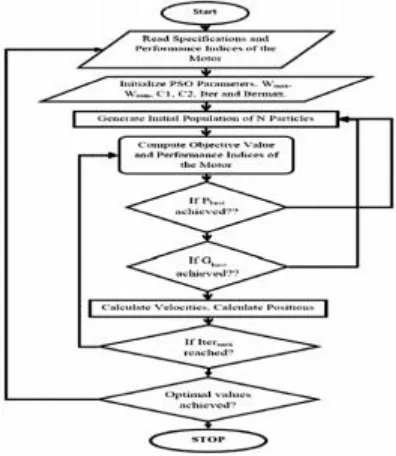
In this design, the PSO is used to find a set of design variables which ensure that the function F(X) has a minimum value and all the constraints are satisfied. The penalty-parameter-less approach is used to optimize the design. Hence the optimal design problem reduces to obtaining the design variables which correspond to the minimum value of an unconstrained function J(X). The procedure for optimal design of induction motor is as follows: (1) Read specifications and performance indices of the motor;
(2) Initialize PSO parameters such as Wmax, Wmin, C1, C2 and Itermax;
(3) Generate initial population of N particles (design variables) with random positions and velocities;
Figure 1: Flowchart for PSO Based Optimization Process
4. SIMULATION RESULTS AND DISCUSSION 4.1. Conventional Design
In Fig. 14. Shows a conventional design of Ef-ficiency as a function of percentage of load for various types of stator winding and Fig. 15 depicts a Power factor as a function of output power for various types of stator winding. The motor efficiency and factor are considered stator winding connection modes. The intersection points are identified. The YS2 is connection was not considered in those zones because it does not contribute to the improvement of the resultant motor efficiency curve.
5. CONCLUSION:
A multiple stator winding incorporating a threephase stator winding with two sets of turns is proposed, and also the connection modes are analyzed. The multiple stator winding can be used as a spare motor up to ten different nominal power levels and, in fact, it can operate as a highefficiency motor for lower power levels. If necessary, at rated frequency for the nominal power, it can be used as a multi-voltage motor and can be fed with different line-to-line voltage levels without efficiency and power factor. The described concept can be used in motors with wide load variations and with long low load operating periods, in which the magnetizing flux regulation can lead to significant energy savings and power factor, efficiency improve-ments, as it has been optimally designed by PSO ap-proach. An optimization technique based on PSO has been applied to the design of 7.5 kW three-phase induction motor. A package program that analyzes and optimizes induction motors in multi flux levels of stator windings and performance of the design has been de-veloped. Comparison of the final optimum designs is made with the existing design. Finally, it is found that optimal designs produce larger efficiency, power factor and less loss of three phase squirrel cage induction motor.
REFERENCES:
“Novel Multiflux Level, Three-Phase, Squirrel-Cage Induction Motor for Efficiency and Power Factor Maximization” IEEE Transactions on Energy Conversion, 23, No. 1, March 2008.
[2] C. Kral, A. Haumer, and C. Grabner. “Consistent Induction Motor Parameters for the Calculation of Partial Load Efficiencies”, Proceedings of the World Congress on Engineering 2009 I WCE 2009, July 1-3, 2009, London, U.K.
[3] Subramanian Manoharan,
NanjundappanDevarajan, and Subbarayan M.
Deivasahayam. “Review on Efficiency Improvement In Squirrel Cage Induction Motor by Using DCR Technology”, Journal of Electrical Engineering, 60, No. 4, 2009, pp 227-236,
[4] V.P. Sakthivel, R. Bhuvaneswari and S. Subramanian, Senior Member, IEEE, “Adaptive Particle Swarm Optimization for the Design of Three-Phase Induction Motor Considering the Active Power Loss Effect”, International Journal of Computer and Electrical Engineering, 2, No. 4, pp. 627-636,August, 2010.
[5] Thangaraj, R., T.R. Chelliah, P. Bouvry, M. Pant and A. Abraham, “Optimal Design of Induction Motor for a Spinning Machine Using Population Based Metaheuristics”, Proc. of the Inter. Conf. on
Computer Information Systems Industrial
Management Applications, 2010.
[6] Oleg Muravlev, Olga Muravleva, Eugenia Vekhter Tomsk Polytechnic University, Russia. “Energetic Parameters of Induction Motors as the Basis of Energy Saving in a Variable Speed Drive”, Electrical Power Quality and Utilisation, Journal XI, No. 2, 2005.
[7] Vadugapalayam Ponnuvel Sakthivel,
Ramachandran Bhuvaneswari, and Srikrishna
Subramanian. “Economic Design of Three-Phase Induction Motor by Particle Swarm Optimization”, Jemaa.2010.25039 Published Online May 2010. J. Electromagnetic Analysis & Applications, pp. 301-310, May 2010.
[8] K. Ranjith Kumar D. Sakthibala, Dr. S. Palaniswami. “Efficiency Optimization of Induction Motor Drive Using Soft Computing Techniques”, International Journal of Computer Applications (0975 - 8887), 3 No. 1, pp. 6-12, June 2010.
[9] William R. Finley, and Mark M. Hodowanec. “Selection of Copper vs. Aluminum Rotors for Induction Motors”, Copyright Material IEEE, Paper No. PCIC-2000-19.
[10] Andreas Binder and Keith Bradley. “Efficiency Determination Methods - Economical Consequences and Application Rules”, 25.05.2005 University of Nottingham School of Electrical and Electronic Engineering.
[11] Kentli “A Survey on Design Optimization Studies of Induction Motors During the Last Decade”, Journal of Electrical & Electronics Engineering Year-2009, 9, No. 2, pp. 969-975. [12] T.A. Lipo and D.W. Novotny University of
Wisconsin. “Induction Motor Application
Considerations for Ad-Justable Speed Drives”, August -1988.
[13] D. Ismail, K. Anayet, N. Indra, M. Dina M.M. Ahmad, and A. Rosnazri. “Design Guidelines for Recycling AC Induction Motors”, ISSN 1546-9239, American Journal of Applied Sciences 3(10) 2054-2058, 2006 Science Publications.