Reducing Energy Bills with the Application of SMS Controlled
System
Eko Akpama1 and Daniel Abara2
1
Department of Electrical/Electronic Engineering, Cross River University of Technology, CRUTECH
Calabar, Cross River State, +23487, Nigeria [email protected]
2
Department of Electrical/Electronic Engineering, Cross River University of Technology, CRUTECH
Calabar, Cross River State, +23487, Nigeria [email protected]
Abstract
The energy crisis witnessed by countries round the globe is a threat to national security, and individual nations are devising approaches to avert the crisis. Third world countries are striving hard with their low economy to solve energy problems. But, investigation has shown that So much energy is being wasted daily through ignorance and wrong use of energy consuming equipment. Energy efficiency and efficient use of energy has been advocated by stakeholders in the energy sector. It has been observed that it is easier to save 1kWh of electric power than to produce it. Research is ongoing in the area of energy savings; that is, developing an energy efficiency program either by legislation or penalty to mandate both producers and consumers to save energy. In a wider perspective, the smart grid network is the aspirations of the power producers which have numerous advantages for both the producer and the end-user of power as regards energy efficiency. SMS controlled system is designed and implemented to enhance energy savings in residential buildings. The application of this proposal has a guaranteed 30 percent of energy saving and the payback period is 12 months.
Keywords: Energy Crises, Energy Savings, Power Availability, Energy Bills, Energy Efficiency
1. Introduction
Research has shown that a typical U.S. family spends close to $1300 a year on their home’s utility bills, and most of that energy is wasted from day-to-day. Energy-efficient improvements not only make life more comfortable but can yield long-term financial benefits [1,2,3,4]. With the evolution of wireless technology and the continuous growth in the area of automation, remote control devices and appliances are increasingly being used. The application of such systems covers a wide range of areas including but not limited to heating, lighting, security and health monitoring [5]. In remote control of appliances,
there are several communication links that can be used, such as infrared, Bluetooth, etc. This paper proposes a method of reducing the energy bills in a home using an SMS remote controlled system. Short Message service is a GSM technology. This is an open, digital cellular technology for transmitting mobile voice and data services. It supports 9600 Kbps band rate for voice calls and data transfers [5]. Almost every individual today owns a mobile phone, this saves money, and time enabling users to curtail their energy usage by controlling the ON and OFF periods of their home appliances from anywhere in the world provided GSM network exists. The SMS controller system consists of a mobile phone which is interfaced to an Atmel AT89C52 microcontroller. This mobile phone plus the microcontroller serves as the SMS controller system, which is connected to the necessary appliances using a ULN2003 relay driver. The final system provides a reliable, highly flexible and very efficient way to remotely control home appliances so as to notably reduce energy bills. The energy situation in developing countries has also been investigated, so that the need for a system that focuses on reduction in energy consumption more than energy generation, will be greater appreciated.
2. Energy Situation in Developing Countries
live in poverty because they have no access to modern energy services. Almost one-third of humanity have no electricity [8].
Household energy uses in developing countries accounted for 1090 Mtoe in 2004, which is almost 10% of the primary energy demand of the world. There are differences in the level of consumption and the types of fuels used. The main use of energy for residential purposes in developing countries is for cooking, heating and lighting. Electricity is mainly used for household lighting [7]. It is thus evident that the shift to cleaner, more efficient use of energy has slowed down and even reversed. Let us consider some of the developing countries of the world and the methods that have been used to address the energy crisis in these countries.
South Africa’s energy sector had some trying moments in 2008 when about 20 percent of its electricity-generating capacity was not in operation. There were blackouts throughout major cities. The national grid almost crashed which would have denied the entire country of electricity for several days. Production in Gold and Platinum mines had to stop for 5 days so as to prevent the national grid from crashing and the date 25 January became known as Black Friday in the mining industry. South Africans quickly became abreast with load shedding – a euphemism for planned blackouts imposed by ESKOM, South Africa’s state-owned electricity company. These blackouts caused immense disruption to the economy and to everyday life. The mining sector experienced a 22.1 percent reduction in output for the quarter and one major mining company was forced to lay off 5000 workers [9].
Ghana, another developing country had faced several energy issues with the first energy crisis in 1984 caused by an unprecedented drought whose impacts were felt throughout the West African sub-region. The second and third crises occurred in 1998 and 2002 respectively and were also attributed to low rainfall in the Volta basin. The most recent crisis was in 2006 and follows closely in the heels of the last one although it has been widely attributed to the shortage of generation capacity rather than to low levels of water in the Volta basin [81.pdf]. In 2004, the residential sector in Ghana accounted for 59% of total electricity consumption whereas the industrial sector took only 39% [10]. The government of Ghana realized that there is potential in energy savings particularly in the residential sector where simple measures like the use of efficient lighting can result in a significant reduction in the country’s demand for electric power. Several energy efficiency projects have also been initiated which include power factor correction, monitoring and targeting energy
management, targeted technical services, building energy management – retrofits, energy management training and energy service development among others [10].
Nigeria is located in West Africa and is the most populated country in the African continent with over 150 million people. According to the Nigerian Energy Policy report from 2003[11], it is estimated that the population connected to the national grid is short of power supply over 60% of the time, and less than 40% of the population is even connected to the grid [11]. In summary, only 30% of the demand is available. The government of Nigeria has come out with a comprehensive roadmap for Power sector reform, which if fully implemented, is expected to address the Power supply problem in Nigeria. The reform includes the Privatization of the Power sector. Some of these reforms have brought about establishment of some power bodies like the Nigerian Electricity Regulatory Commission (NERC), the Rural Electrification Agency (REA) and the special purpose National Electricity Liability Management Company (NELMCO) [12]. It is evident from the foregoing that there are serious energy challenge facing the developing countries, hence the need for strategies to tackle this challenge via provision of alternative sources of energy, formulation of energy efficient policies and providing awareness to promote increased energy savings and consequently save energy costs, especially in the residential sector.
3. Brief Overview of SMS Technologies
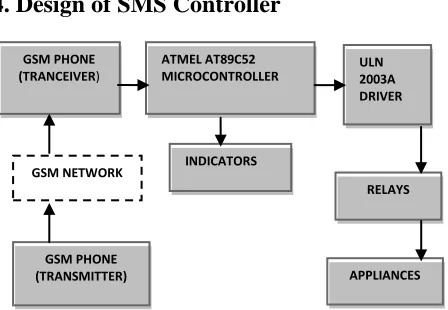
GSM PHONE (TRANCEIVER)
APPLIANCES ATMEL AT89C52
MICROCONTROLLER ULN 2003A DRIVER
INDICATORS
RELAYS
GSM PHONE (TRANSMITTER) GSM NETWORK
Fig. 1. Block diagram of SMS Controller
others [15]. The SMS controlled system proposed in this paper can be used to remotely control the appliances in a residential or household building when the user is away from home so as to save that energy which would have been wasted. This is particularly useful in developing countries where there are usually frequent (both scheduled and unscheduled) power (electricity) outages, which may occur when the user is not home.
4. Design of SMS Controller
A remote user initiates an SMS which contains the necessary commands to control the appliances. This SMS passes through the GSM wireless network and gets to the mobile phone (transceiver) attached to the microcontroller using point-to-point RS232 serial interface. The mobile phone attached to microcontroller decodes the SMS received and forwards the commands to the microcontroller. The Microcontroller is programmed using Assembly language to act on the received commands, to initiate and complete the required control action. This system can be integrated in the control of any 2-state appliance (ON or OFF appliances) in a household depending on the choice of the user. During this design, provision was made for control of four appliances but this can however be modified to accommodate more or less than four appliances to the taste and specification of the user. The designed prototype is for four appliances but due to simplicity of design, the system can be upgraded to control many appliances as desired.
4.1 AT Commands
AT Commands are instructions used in modems and similar mobile devices. The ‘AT’ means attention. An AT command is simply a string of characters preceded by the AT prefix that is sent to the mobile phone. It typically
instructs the modem (mobile phone in this case) to perform some required action [16]. AT Commands generally follow the following format:
- The command is prefixed with AT (Attention) - The command is terminated by a carriage return - The commands can be entered in uppercase or
lowercase
- The AT prefix can be in uppercase or lowercase but both the ‘A’ and ‘T’ must be in the same case These commands are generally used to request information about the current configuration or operational status of the modem or mobile phone [16]. Aside the general command sets and features as shown above, GSM modems and mobile phones support a certain group of AT commands which are specific to GSM technology, and include SMS-related commands to send SMS message (AT+CMGS), read SMS message (AT+CMGR) to name a few [16]. For this work, the commands are embedded in the Assembly language program which is burnt to the microcontroller chip.
4.2 AT89C52 Microcontroller and Sagem MyX5-2
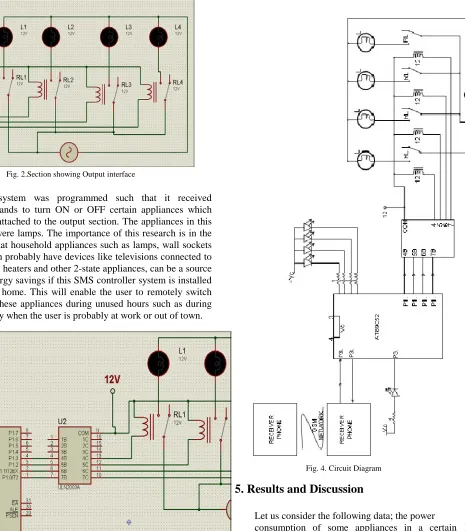
This work made use of the Atmel AT89C52 microcontroller. It is a low-power, high-performance CMOS 8-bit micro-computer with 8K bytes of flash programmable and erasable read only memory (PEROM). It was chosen because it has fast response time, it has serial communication capability which was useful in integrating the mobile phone, it has enough memory and it is cheap and relatively available. The Sagem phone used was chosen primarily because of its support for RS232 standard serial cable. Thus, any phone which supports serial point-to-point transmission can be used in the system as long as it serves the purpose. The entire system is made up of three different sections: the input interface, the feedback and control system, and the output interface.
Fig. 3.Section showing ULN2003A coupled to the Output interface
The system was programmed such that it received commands to turn ON or OFF certain appliances which were attached to the output section. The appliances in this case were lamps. The importance of this research is in the fact that household appliances such as lamps, wall sockets (which probably have devices like televisions connected to them), heaters and other 2-state appliances, can be a source of energy savings if this SMS controller system is installed in the home. This will enable the user to remotely switch OFF these appliances during unused hours such as during the day when the user is probably at work or out of town.
5. Results and Discussion
Let us consider the following data; the power consumption of some appliances in a certain 1-bedroom apartment (rented) in Calabar, Nigeria. The time duration considered is from 9am to 4pm (7 hours), when the user is away from the home. The following possibilities hold:
Fig. 2.Section showing Output interface
- The owner (user) woke in the morning when there was power outage, and left the house not turning off the appliances, and while he was away, power was restored switching these appliances ON. - The owner (user) travelled on a journey or left the
house and simply forgot to put OFF these appliances before leaving, only to remember while he was far from home.
Table 1: Power Consumption of Some appliances in a Certain 1-bedroom flat
Appliance Quantity Rating (Watts)
Total Rating (Watts)
Security lamps 1 100 100
Lounge lighting 3 60 180
Room/kitchen lighting
3 60 180
Ceiling fan (All) 2 100 200
Air conditioner 1 1492 (2 h.p.)
1492
Total 2152
From the above, the total power consumption of these appliances together is 2152Watts when switched ON. For any day that any of the above possibilities hold, these appliances would likely run for 7 hours (9am to 4pm).
Thus, we have that,
Total Wattage used consumed by appliances = 2152 Watts Max. Usage (per day) if left ON = 7 hours 2152 x 7 = 15064 Watt hour per day.
Converting this value to Kilowatts, 15064/1000 = 15.064 Kilowatt-hour of energy would have been lost for that day. In monetary terms, if we consider a country like Nigeria where the average cost of electricity is about N17.00 per KWh, we obtain the following,
Cost = N17.00 per KWh
15.064 x 17.00 = N256.09 per day.
From the above, we can see that the for the 15.064 Kilowatt hour of energy wasted, the user loses over 200 naira each day, from only these appliances. And considering a country like Nigeria where power outage has become a normal thing, there is a high probability of the same scenario happening about 10 times in a month.
Thus, N256.09 x 10 = N2560.9 per month.
5.1 Payback Period
The entire cost of implementing this design, making provision for about four appliances costs about N30, 000. If you compare this cost to the cost of electricity wasted monthly, we can estimate the period it will take to get back the cost of implementing this project in the home.
Payback period = N30, 000/N2560.0 = 11.7 months.
From the above, we can see that in about a year (12 months), the user would have gotten back the cost of implementing this SMS controller system.
6. Conclusion
It is easier and cheaper to save energy than to generate it. Consequently, this SMS controller will not only provide a comfortable means to remotely control the home, but will also provide a means by which the user can cut down his household energy bills. This research work is timely, for the fact that mostly in the developing countries; the available power is grossly inadequate. Therefore, simple switching-off power when it is not needed, has shown that, the available power could be shed by end-users at any particular period. The result of this work has shown that 30% of the supposed bills can be saved without compromise to standards and comfort.
References
[1] A. Lawal, and J. Akarakin, “Conservation of Domestic Energy in buildings: Panacea for reduction in Environmental Degradation”, in Proceedings of International Conference towards Sustainable Energy Solutions for the developing world, 2009, pp. 1-8.
[2] E. Akpama, O. Okoro, and E. Chikuni. “Energy Audit/Assessment in the Cross River University of Technology, Calabar/Nigeria”, in Proceedings of International Conference towards Sustainable Energy Solutions for the developing world, 2009, pp. 131-136. [3] E. Gudbjerg, “The Energy drops that create a River or
Energy Losses”, in Proceedings of International Conference towards Sustainable Energy Solutions for the developing world, 2009, pp. 75-81.
[4] U.S. Department of Energy (DOE). Energy Savers: Tips on Saving Energy & Money at Home, United States: Owens Corning & Honeywell, 1998. Available at
http://energyquest.ca.gov/library/documents/DOE_EnergyS avers_98.pdf
Latest Trends in Engineering and Technology (IJLTET), Vol. 3, No. 2, 2013, pp. 50-56.
[6] M. Masood, and F. Shah. “Dilemma of Third World Countries – Problems Facing Pakistan Energy Crisis A Case-in-point”, International Journal of Business and Management, Vol. 7, No. 5, 2012, pp.231-246.
[7] R. Priddle (IEA), World Energy Outlook 2006, Paris: IEA Books, 2006. Available at
http://www.worldenergyoutlook.org/media/weowebsite/200 8-1994/WEO2006.pdf
[8] Practical Action, Energy Poverty: The Hidden Crisis, Warwickshire: Practical Action Ltd., 2009. Available at http://practicalaction.org/docs/advocacy/energy_poverty_hi dden_crisis.pdf
[9] S. Dagut, and A. Bernstein, “South Africa’s Electricity Crisis”, in Centre for Development and Enterprise (CDE) Round Table, 2008, No. 10. Available at
http://dspace.cigilibrary.org/jspui/bitstream/123456789/307 69/1/South_Africas_Electricity_Crisis,_Full_Report%5B1% 5D.pdf?1
[10]A. Brew-Hammond, and F. Kemausuor, Energy Crisis in Ghana: Drought, Technology or Policy, Kumasi: Kwame Nkruma University of Science and Technology (KNUST), 2007. Available at
http://energycenter.knust.edu.gh/downloads/8/81.pdf [11]J. Kennedy-Darling, N. Hoyt, K. Murao, and A. Ross, “The
Energy Crisis of Nigeria, an Overview and Implications for the Future”, The University of Chicago, USA, 2008. Available at
http://franke.uchicago.edu/bigproblems/Energy/BP-Energy-Nigeria.pdf
[12]M. Egbula. “Nigeria’s Energy Challenges”. An interview with Prof. Abubakar S. Sambo, CEO, Energy Commission of Nigeria, 2011. Available at
http://www.westafricagateway.org/opinions/interviews/niger ias-energy-challenges
[13]V. Hachenburg, B. Holm, and J. Smith, “Data Signaling functions for Cellular mobile telephone system”, IEE Trans Vehicular Technology, Vol. 26, No. 1, 1977, pp. 82. [14]M. Siegmund, K. Matthias, and W. Malcolm, GSM and
Personal Communication Handbook, Boston: Artech House, 1998.
[15]A. Chauhan, R. Singh, S. Agrawal, S. Kapoor, and S. Sharma, “SMS Based Remote Control System”, IJCMS International Journal of Computer Science and Management Studies, Vol. 11, No. 2, 2011, pp. 19-24.
[16]A. Kliks, and P. Sroka. “On the Use of AT Commands for Controlling the mobile phone with Microcontroller - Laboratory Exercise”, Poz-nan University of Technology Academic Journals, 2007. Available at
http://www.pwt.et.put.poznan.pl/srv07/papers/PWT%20200 7_7835.pdf
Eko Akpama holds a Master of Engineering degree in Machines from the University of Nigeria Nsukka. He is currently a lecturer in the Department of Electrical/Electronics Engineering, Cross River University of Technology, Calabar, Nigeria. He is a member of the
Nigerian Society of Engineers (MNSE), the International Association of Electrical Electronics Engineers (IEEE) and a corporate member of the Council for the Regulation of the Engineering Practice in Nigeria (COREN). He has published many academic papers in globally accepted journals. He is a Ph.D. research student and his areas of interest are Electrical Machines, modeling and Control, Renewable Energy and Energy efficiency and management.