Flower Pollination Algorithm for Economic
Dispatch Problem with Prohibited Zones,
Ramp Rate Limits & Multi-Fuel Options
D.Vigneshwaran
1, R.Sivakumar
2, S.Vijayaraj
3Assistant professor, Dept. of EEE, Maha Bharathi Engineering College, Salem, Tamilnadu, India1 PG Student, Dept. of EEE, Maha Bharathi Engineering College, Salem, Tamilnadu, India2
Research scholar, Dept. of EEE, Annamalai University, Chidambaram, Tamilnadu,India3
ABSTRACT: This paper presents application of Flower pollination algorithm for solving Economic Load Dispatch
problem considering Transmission loss, Multiple fuel options, Valve point loading effect and Prohibited operating zones. Flower pollination algorithm is a nature inspired optimization algorithm motivated by the characteristics of flowering plants. Potency of the algorithm is tested on two different test cases consist of varying degree of complexity .The promising results show the quick convergence and effectiveness of the projected technique.
KEYWORDS: Economic Load Dispatch, Prohibited operating zones, Valve point loading effect, Flower Pollination
Algorithm, Transmission loss, Multi-fuel.
I.INTRODUCTION
Nowadays, the planning and operating power system is a challenging task for power engineers because of its complexity and to satisfy the demand for electric energy of the area served by the system with Continuity of service and reliability. An elite objective here is to perform the service at the lowest possible cost. The role of soft computing techniques has influenced a lot in the field of power system especially in solving optimization problems because of their reliability, speed of convergence and robustness [1]. The ELD problem, one of the different non-linear programming commitment in power system, is about minimizing the fuel cost of generating units for a specific period of operation so as to accomplish optimal generation dispatch among operating units and to satisfy the system load demand and generator operation constraints with ramp rate limits and prohibited operating zones [2]. S.K.Dash [3] was presented a new method to solve the problem of optimal generation dispatch with multiple fuel options using a Radial basis function neural network along with a heuristic rule based search algorithm and a Hopfield neural network. Dr .G. Srinivasan, et al. [4] solved economic load dispatch problem with Valve point effects and multi Fuels using particle swarm algorithm with chaotic sequences and the crossover operation to improve the global searching capability by preventing premature convergence through increased diversity of the population. Radhakrishnan Anandhakumar, et al. [5]was proposed a non-iterative direct Composite Cost Function method, to solve economic dispatches of the online units with less Computation time. Umamaheswari Krishnasamy,et al. [6] presented a Refined Teaching-Learning Based Optimization Algorithm for Dynamic Economic Dispatch of Integrated Multiple Fuel integrated with Wind Power Plants. R.Balamurugan, et al. [7] proposed a self-adaptive mechanism issued to change these control parameters during the evolution process. These control parameters are applied at the individual levels in the population to solve economic dispatch with valve point and multi fuel options. Xin-She Yang. [8] proposed the flower pollination algorithm and its characteristic with implementation of various functions for global optimization. Belkacem MAHDAD, et al [9]. proposed a improved Articificial bee colony optimization for the economic load dispatch problem of power system having thirteen and forty generating units.
pollination process in the Flower pollination algorithm. and pa is chosen as 0.6 and 0.8 for both the test cases from power system.
II.FORMULATION OF ECONOMIC LOAD DISPATCH PROBLEM
A. TOTAL COST FUNCTION
The main objective of Economic Load Dispatch in electrical power system is to reduce the overall production cost of supplying loads while satisfying constraints. The total cost function can be formulated as the following equation.
Ft= Fi Pi = N
i=1
ai N
i=1
+ biPi+ ciPi2 (1)
where Fi Pi is the cost function of ith generator and is usually expressed as a quadratic polynomial; ai, bi and ci are the
fuel cost coefficients of ith generator; N is the number of generators , Pi is the real power output of ith generator. The
Economic Load Dispatch problem minimizes Ft subject to the following constraints and effects. B. EQUALITY CONSTRAINTS
The power balance equation is given by
Pi N
i=1
= PD+ PL (2)
The transmission loss PL of system may be expressed by using B-coefficients.
PLi = Pi N
j=1 N
i=1
BijPj+ B0i Mi
j=1
Pi+ B00 (3)
where, PD is the power demand of the system. Bij, B0i, and B00 are transmission loss coefficients.
C. INEQUALITY CONSTRAINTS
The upper and the lower operating region of the generator is given by the equation
Pimin ≤ Pi≤ Pimax i ∈ N (4)
Where Pimin and Pimax are the minimum and maximum power outputs of generator i, respectively. The maximum
output power of generator is limited by thermal consideration and minimum power generation is limited by the flame instability of a boiler.
D.PROHIBITED OPERATING
The prohibited operating zones are the range of power output of a generator where the operation causes undue vibration of the turbine shaft bearing caused by opening or closing of the steam valve. This undue vibration might cause damage to the shaft and bearings. Normally operation is avoided in such regions. The feasible operating zones of unit can be described and represented as.
Pimin ≤ Pi ≤ Pi,1l
Pi.m−1u ≤ Pi ≤ Pi,ml ; m = 2,3, … ni (5)
Pi,ni
u ≤ P
i ≤ Pimax
Where m represents the number of prohibited operating zones of jthe generator in area i. Pi.m−1u is the upper limit of (m
-1)th prohibited operating zone of ith generator . Pi,ml is the lower of mth prohibited operating zone of ith generator. Total
number of prohibited operating zone of ith the generator is ni.
E.RAMP RATE LIMIT CONSTRAINT
The generator constraints due to ramp rate limits of generating units are given as: 1)As generation increases
Pi(t)− Pi(t−1) ≤ URi (6)
2)As generation decreases
Pi(t−1)− Pi(t) ≤ DRi (7)
max Pimin, Pi t−1 − DRi ≤ Pi(t) ≤ min Pimax, Pi t−1 + URi (8)
from equation (7), the limit of minimum and maximum output powers of generating units are modified as
Pimin, ramp = max Pimin, Pi t−1 − DRi 9
Pimax, ramp = min Pimax, Pi t−1 + URi (10)
Where Pi(t) is the output power of generating unit i in the time interval (t) , Pi t−1 is the output power of generating unit
i (MW) in the previous time interval (t-1), URi is the up ramp limit of generating unit i (MW/time-period) and DRi is
the down ramp limit of generating unit i (MW/time-period). the generating units will operate in three modes of operation such as steady state operation, increasing the level of the power generation and decreasing the power output.
F.VALVE-POINT EFFECTS
The generator cost function is obtained from a data point taken during “heat run” tests when input and output data are measured as the unit slowly varies through its operating region. Wire drawing effects, which occur as each steam admission valve in a turbine starts to open, produce a rippling effect on the unit curve. To consider the accurate cost curve of each generating unit, the valve point results in as each steam valve starts to open, the ripples like the cost function addressing valve-point loadings of generating units is accurately represented as
Ft= Fi( N
i=1
Pi) = ai N
i=1
+ biPi+ ciPi2+ di × sin ei× (pimin − Pi (11)
G.VALVE-POINT EFFECTS AND MULTI FUELS EFFECT
To obtain an accurate and practical economic dispatch solution, the realistic operation of the ELD problem should be considered both valve-point effects and multiple fuels. This project proposed an incorporated cost model, which combines the valve-point loadings and the fuel changes into one frame. as explained .
Fi Pi =
ai1+ bi1Pi1+ ci1Pi12+ di1 × sin ei1× (pi1min − Pi1 , for fuel 1, pimin ≤ Pi ≤ Pi1
ai2+ bi2Pi1+ ci2Pi22+ di2 × sin ei2× (pi2min − Pi2 , for fuel 2, pimin ≤ Pi ≤ Pi2
.. .
aik+ bikPik + cikPik2+ dik × sin eik × (pikmin − Pik , for fuel k, pik −1min ≤ Pi ≤
pimax
(12)
III. NATURE-INSPIRED FLOWER POLLINATION ALGORITHM
The flower reproduction is ultimately through pollination. Flower pollination is connected with the transfer of pollen, and such transfer of pollen is related with pollinators such as insects, birds, animals etc. some type of flowers depend only on specific type of insects or birds for successful pollination. Two main forms of pollination are A-biotic and biotic pollination. 90% of flowering plants are belonging to biotic pollination process. That is, the way of transferring the pollen through insects and animals. 10% of pollination takes A-biotic method, which doesn't need any pollinators. Through Wind and diffusion help pollination of such flowering plants and a good example of A-biotic pollination is Grass [10]. A good example of pollinator is Honey bees, and they have also developed the so-called flower constancy. These pollinators tend to visit exclusively only certain flower species and bypass other flower species. Such type of flower reliability may have evolutionary advantages because this will maximize the transfer of flower pollen .Such type of flower constancy may be advantageous for pollinators also , because they will be sure that nectar supply is available with their some degree of memory and minimum cost of learning, switching or exploring. Rather than focusing on some random, but potentially more satisfying on new flower species, and flower dependability may require minimum investment cost and more likely definite intake of nectar . In the world of flowering plants, pollination can be achieved by self-pollination or crosspollination. Cross-pollination means the pollination can occur from pollen of a flower of a different plant, and self-pollination is the fertilization of one flower, such as peach flowers, from pollen of the same flower or different flowers of the same plant, which often occurs when there is no dependable pollinator existing.
through pollination process. Flower pollination is connected with the relocation of pollen and such transfer of pollen is related with pollinators such as insects, birds, animals etc.
The major two pollination are A-biotic and biotic pollination. 90% of flowering plants are belonging to biotic pollination process. That is, the way of transferring the pollen through insects and animals. 10% of pollination takes Abiotic method, which doesn't need any pollinators. . Through Wind and diffusion help pollination of such flowering plants and a good example of A-biotic pollination is Grass. A very good example of pollinator is Honey bees, and they have also developed the so-called flower constancy. These pollinators tend to visit exclusively only certain flower species and bypass other flower species. Such type of flower reliability may have evolutionary advantages because this will maximize the transfer of flower pollen.
A. RULES FOR FLOWER POLLINATION ALGORITHM
1. Biotic and cross-pollination is considered as global pollination process with pollen- carrying pollinators performing Levy flights.
2. Abiotic and self-pollination are considered as local pollination.
3. Flower constancy can be considered as the reproduction probability is proportional to the similarity of two flowers involved.
4. Local pollination and global pollination is controlled by a switch probability Pa∈ [0, 1]. Due to the physical proximity and other factors such as wind, local pollination can have a significant fraction pa in the overall pollination activities.
B. MATHEMATICAL REPRESENTATION OF FLOWER POLLINATION ALGORITHM
The first rule plus flower constancy can be represented mathematically as
xit+1= Xit+ L Xit− g∗ (13)
where Xi tis the pollen i or solution vector Xi at iteration t, and g∗is the current best solution found among all solutions
at the current generation/iteration. Levy distribution is given by
L ~ λΓsin πλ
2 π
1
S1+λ , S ≫ S0 > 0 (14)
where L is the strength of the pollination should be greater than zero, Γ(λ) is the gamma function and this distribution is valid for large steps s > 0.
The local pollination can be represented as
xit+1= Xit+ ε Xjt− Xkt (15)
where, Xjtand Xkt are pollens from the different flowers of the same plant species. This essentially mimic the flower
constancy in a limited neighbourhood. Mathematically, if Xjtand Xkt comes from the same species or selected from the
same population, this become a local random walk if we draw from a uniform distribution in [0,1].
C. SWITCH PROBABILITY OR PROXIMITY PROBABILITY(PA)
Most flower pollination activities can occur at both local and global scale. In practice, adjacent flower patches or flowers in the not-so-far-away neighbourhood are more likely to be pollinated by local flower pollens that those far away. For this, we use a switch probability (Rule 4) or proximity probability pa to switch between common global pollination to intensive local pollination. in this simulation we used pa=0.6 and pa=0.8 to analyse the simulation result.
D. PSEUDO CODE OF FLOWER POLLINATION ALGORITHM (FPA)
Objective min or max f(x), x = (x1, x2, ..., xd)
Initialize a population of n flowers/pollen gametes with random solutions Find the best solution g∗ in the initial population
Define a switch probability Pa∈ [0, 1] while (t <MaxGeneration)
for i = 1 : n (all n flowers in the population) if rand < pa,
Global pollination via xit+1= Xit+ L Xit− g∗
else
Draw ε from a uniform distribution in [0,1] Randomly choose j and k among all the solutions Do local pollination via xit+1= Xit+ ε Xjt− Xkt
end if
Evaluate new solutions
If new solutions are better, update them in the population end for
Find the current best solution g∗
end while.
IV. RESULT AND DISCUSSION
In this work an IBA algorithm is applied to solve the economic dispatch for two different cases having various complexities and the potential of the algorithm is compared with change of parameter in algorithm.
Case-1. Six unit system
The flower pollination algorithm is employed to solve the economic dispatch of six system with demand 1263MW consist of a smooth quadratic cost function with generator constraints, power loss and ramp rate limits and prohibited operating zones .the simulation results are for both pa=0.6 and for 0.8 as shown in Table-1 and the converge of the cost function is shown in Fig-1 for 300 iterations. the random value change for the case-1 which controls the local and global pollination is shown in Fig-2 and the stem plot highlighted in blue is the iteration converged area.
Table 1. Simulation results for case-1 Six unit system with pa=0.6 and 0.8.
pa PG1 PG2 PG3 PG4 PG5 PG6 PL FUEL COST
($/H)
0.6 474.2689 178.9052 262.4778 134.3430 151.9643 74.0604 12.462 15459.0686
Fig-1 Iteration vs Cost curve of case-1 for pa=0.6,0.8.
So if the global pollination happening more when compared to local pollination means the probability of getting the nearer to global solution also increases. Thus pa = 0.8 is the better option for the optimization programs for the test case of six unit system considered in this paper and it is verified with the simulation results as shown in the Fig-1.
Case-2.Ten unit Multi-fuel system
In this case flower pollination algorithm is employed to solve the economic dispatch of ten unit system with demand 2700MW consist of valve-point effect and multi-fuel options.
Table 2. Simulation results for case-2, Ten unit Multi-fuel system with pa=0.6 and 0.8.
Pa=0.6 Pa=0.8
PG Fuel PG Fuel
PG1 222.1696 2 PG1 218.6132 2 2
PG2 211.1588 1 PG2 213.6700 1 1
PG3 284.1043 1 PG3 281.0460 1 1
PG4 237.9640 3 PG4 237.1560 3 3
PG5 280.4590 1 PG5 278.7166 1 1
PG6 236.0110 3 PG6 239.2130 3 3
PG7 292.0609 1 PG7 288.8331 1 1
PG8 241.3236 3 PG8 239.2070 3 3
PG9 424.5247 3 PG9 428.7830 3 3
PG10 270.2241 1 PG10 274.7532 1 1
COST($/H) 623.8687 COST($/H) 623.4456
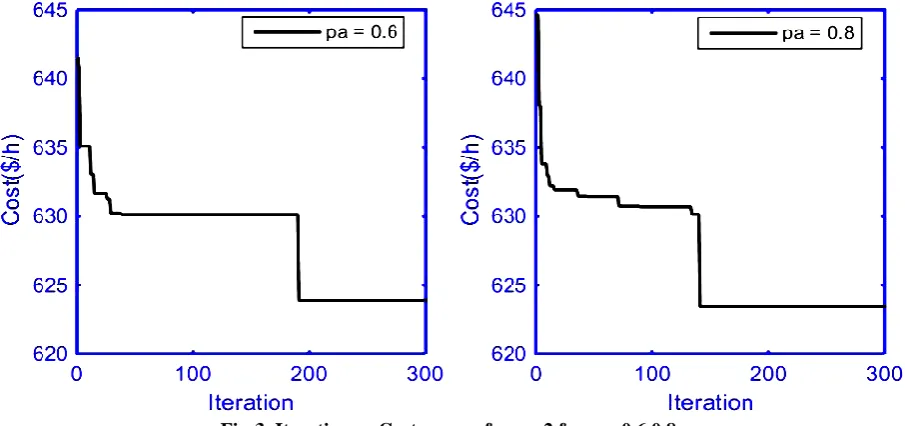
From the Table-2 it is clear that, fuel cost of the ten unit system with pa=0.8 of flower pollination algorithm is better than the fuel cost of the system with pa=0.6 considered in this paper and it is verified with the simulation results as shown in the Fig-3.
Fig-3. Iteration vs Cost curve of case-2 for pa=0.6,0.8.
Fig-4. Iteration vs Random value change of case-2 for pa=0.6,0.8.
V.CONCLUSION
In this paper, Flower pollination algorithm is applied to economic load dispatch problems with two different cases. The results obtained by this method are compared with two different pa values. The comparison shows that Flower pollination algorithm performs better when pa=0.8 and got good convergence characteristics. The Flower pollination algorithm has superior features, including quality of solution, stable convergence characteristics and good computational efficiency. Therefore, this results shows that flower pollination algorithm is a promising technique for solving complicated problems in power system.
REFERENCES
[1]. B. H. Chowdhury., and S. Rahman., “A Review of Recent Advances in Economic Dispatch”, IEEE Transactions on Power Systems , Vol.5 , pp. 1248-1259, 1990.
[2]. F. N. Lee., and A. M. Breipohl., “Reserve Constrained Economic Dispatch with Prohibited Operating Zones”, IEEE Transactions on Power Systems, Vol.8, pp. 246-254, 1993.
[3]. S.K. Dash.," An Artificial Neural Network Method For Optimal Generation Dispatch With Multiple Fuel Options", International Journal of Advanced Electrical and Electronics Engineering , Vol.2, ISSN (Print) : 2278-8948, 2013.
[4]. Dr. G. Sreenivasan.,B. Dheeraj Merin Babu., K. Srikanth.,and B. Rajesh Kiran.," Solution of ELD problem with valve point effects and multi-fuels using IPSO algorithm", International Journal of Advanced Research in Electrical, Electronics and Instrumentation Engineering, Vol.2,pp. 5629-5639, 2013.
[5]. Radhakrishnan., Anandhakumar., and Srikrishna Subramanian.," Economic Dispatch with Multiple Fuel Options Using CCF", Journal of power and energy engineering, Vol.3 , pp. 113-119, 2011.
[6]. Umamaheswari Krishnasamy., and Devarajan Nanjundappan., "A Refined Teaching-Learning Based Optimization Algorithm for Dynamic Economic Dispatch of Integrated Multiple Fuel and Wind Power Plants", Mathematical Problems in Engineering, , Article ID 956405, http://dx.doi.org/10.1155/2014/956405,2014.
[7].R.Balamurugan., and S.Subramanian., "Self-Adaptive Differential Evolution Based Power Economic Dispatch of Generators with Valve-Point Effects and Multiple Fuel Options", International Journal of Electrical, Computer, Energetic, Electronic and Communication Engineering Vol.1, pp. 535-542, 2007.
[8]. Xin-She Yang, "Flower Pollination Algorithm for Global Optimization", Unconventional Computation and Natural Computation, Lecture Notes in Computer Science, Vol. 7445, pp. 240-249,2012.
[9]. Belkacem mahdad., and Kamel Srairi., " Solving Practical Economic Dispatch Problems Using Improved Artificial Bee Colony Method", I.J. Intelligent Systems and Applications, Vol. 7, pp. 36-43,2014.
[10] Waser N.M., "Flower constancy: definition, cause and measurement". The American Naturalist, vol.127, pp. 596-603,1986.
[11] Pavlyukevich I.," Levy flights, Non-local search and simulated annealing", Journal of Computational Physics, vol.1, pp.1830–1844, 2007. [12] Z. L. Gaing., “Particle swarm optimization to solving the economic dispatch considering the generator constraints,” IEEE Trans. Power Syst., vol. 18, pp. 1187–1195, 2003.
BIOGRAPHY
D.Vigneshwaran, received his graduation in 2010 from Adhi Parasakthi Engineering college,
Melmaruvathur, Masters in 2012 from Annamalai University, Chidambaram, Presently, He is working as Assistant Professor in the Department of Electrical and Electronics Engineering, Maha Bharathi Engineering College, Tamilnadu. His fields of Interest is power system optimization .
R.Shivakumar, received his graduation in 2010 from Maha Bharathi Engineering College and also
doing Masters in Maha Bharathi Engineering College itself , His fields of Interest is power system operation and control ,Electrical Machines and Renewable Energies.
S.Vijayaraj, received his graduation in 2008 from DMI College of Engineering, Chennai, Masters in