Design and Development of Embedded based
Temperature Measurement System using
ADµC-7061 Microcontroller with MATLAB GUI
C. Sandeep Kumar Reddy
1
, K.K. Azam Khan
2
, C.Nagaraja
3
Research Scholar, Dept. of Instrumentation, Sri Krishnadevaraya University, Anantapuramu, A P, India1
Scientist, EchoMRI Corporation Pte Ltd, Singapore2
Professor, Dept. of Instrumentation, Sri Krishnadevaraya University, Anantapuramu, A P, India3
ABSTRACT: Temperature is a crucial parameter which has to be considered in all our day-to-day life. The temperature measurement plays a vital role in all kinds of industries. The importance of temperature measurement has entered into domestic purpose like measurement in kitchen- micro wave ovens, Induction heaters, refrigerators, coolers and air-conditioners where the current room temperature is said to be displayed. In ordinary cases, where the accurate temperature measurement is not required, may be met by conventional thermometers and temperature indicators. An embedded microcontroller with a good temperature sensor is said to be used in industrial and laboratory purpose. This system may be useful to measure the temperature, if it is said to be connected to a RTDs, Thermistors, Thermocouples or IC Sensors. The embedded microcontroller ADµC- 7061 and a temperature sensor PT-100 is used in the present study. The code required to the microcontroller which has to perform the operation has been developed in ARM Keil-C. The measurement GUI is written in MATLAB, which runs on PKeil-C. The linearization of the RTD has been done using curve fitting tool in MATLAB. The present work gives the knowledge to implement temperature measurement for research applications. The intention of the article is to develop the future research work in the field of temperature measurement with good accuracy to meet the standards of Industrial systems.
KEYWORDS: Temperature measurement, PT-100, ADµC - 7061 microcontroller, Keil- ARM, MATLAB.
I.INTRODUCTION
In order to measure the temperature a good temperature sensor is required. A microcontroller, with a necessary application software is used to acquire and display temperature values. Selection of all these devices depends up on the user requirements according to his knowledge in that particular area. The temperature sensor used for the measurement of temperature should detect even a small change up to a wide range. The display device used to interface the microcontroller might be a Personal Computer or Smart phone. The necessary software is like Keil-C for controller, MATLAB for PC and Java for Smart Phones.
The main objective of this article is
To deliver an outline of the Temperature Measuring System
Design and development of the experimental setup for temperature measurement
II.TEMPERATURE SENSOR
ISSN (Print) : 2320 – 3765 ISSN (Online): 2278 – 8875
I
nternational
J
ournal of
A
dvanced
R
esearch in
E
lectrical,
E
lectronics and
I
nstrumentation
E
ngineering
(An ISO 3297: 2007 Certified Organization)
Vol. 5, Issue 3, March 2016
The relationship between the RTD’s resistance and temperature in degree centigrade is earlier described by the
Callendar-Van Dusen equation,
RRTD = R0[1 + AT + BT 2
+ C(T – 100)T3], whose values are defined as follows:
R0 is a 100Ω at 0°C (PT-100) A = 3.9083 × 10⁻³
B = –5.775 × 10⁻⁷
C = 0 for T > 0°C, or C = –4.23225 × 10⁻¹² for T < 0°C.
A. Different Types of Curve Fitting tools for RTD:
The procedure for curve fitting in MATLAB is as follows.
In the present article, the PT 100 data (Resistance Vs Temperature) is placed in a spread sheet (Microsoft Excel format).
Open MATLAB, type "cftool" in command window.
The Excel file has to be placed into the Matlab working directory.
Import the data from the file and plot the XY graph.
Figure window is now displayed on the screen select <Tools> from main menu and <Basic fitting> in the sub menu.
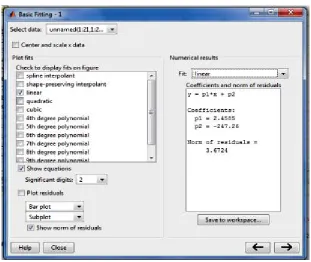
Now Basic fitting window is displayed on the screen as shown in Figure 1. Choose <check to display fits on figure>.
Select the appropriate type of fitting required. Tick the option <show equations and norms of residuals>.
The plotted graph for the selected variables may be displayed as shown in Figure 2.
Figure: 2 Graph plotted for Resistance Vs Temperature
By observing the Table 1 it is clear that the equation for curve fitting remains same for both the Temperatures <0 and the Temperatures >0 but, the coefficients and norm of residuals may varies. The table gives the values of coefficients required for different types of fitting.
Table: 1 Equations with coefficients for various types of fit
S.No
Type of Fit
Equation
1
Linear
y = p1*x + p2
Coefficients
T<0
T>0
x
p1
2.4585
2.9221
value of RTD
resistance in
ohms
p2
-247.26
-311.69
Norm of residuals
3.6724
86.305
2
Quadratic
y = p1*x^2 + p2*x +p3
Coefficients
T<0
T>0
x
p1
0.001473
0.0014418
value of RTD
resistance in
ohms
p2
2.2833
2.2074
p3
-242.94
-233.54
Norm of residuals
0.30985
6.3652
3
Cubic
y = p1*x^3 + p2*x^2 +p3*x + p4
Coefficients
T<0
T>0
x
ISSN (Print) : 2320 – 3765 ISSN (Online): 2278 – 8875
I
nternational
J
ournal of
A
dvanced
R
esearch in
E
lectrical,
E
lectronics and
I
nstrumentation
E
ngineering
(An ISO 3297: 2007 Certified Organization)
Vol. 5, Issue 3, March 2016
p3
2.2287
2.4494
ohms
p4
-242.11
-250.39
Norm of residuals
0.039382
0.60062
4
4th Degree
Polynomial
y = p1*x^4 + p2*x^3 +p3*x^2 + p4*x +p5
Coefficients
T<0
T>0
x
p1
1.86E-08
1.81E-09
value of RTD
resistance in
ohms
p2
-1.02E-05
-3.55E-07
p3
0.0028632
0.0010107
p4
2.2166
2.3579
p5
-241.98
-245.7
Norm of residuals
0.033286
0.088045
III. EMBEDDED MICROCONTROLLER ADµC 7061 MINI KIT
A. Salient Features of Eval ADµC-7061MKZ Microcontroller Board: The Microcontroller board meets the requirements of the user who wish to measure the temperature with good accuracy. The specifications of the Microcontroller board are listed below [3].
o ARM 7 RISC Microcontroller
o Dual 24 Bit Sigma -Delta Analog to Digital Converter
o 2 differential input or 5 single ended channels
o Programmable ADC output rate from (4 Hz to 8 KHz)
o Programmable current excitation source for RTD's from 200 µA to 2 mA
o Programmable gain Amplifier from 1-512 in input stage
o Communication Interfaces like SPI, UART
o on board SMD RTD for direct measurement of ambient temperature measurement
B. Algorithm: The algorithm to measure temperature, which is implemented in Keil- ARM C as follows [3].
Initialize the Microcontroller board and UART for 9600 baud.
Excite the current source IEXC0 to 400 µA (user defined ) IEXC0
Fix the gain of internal PGA value so that the desired range of measured value should not cross the full scale voltage of ADC which is 1.2 Volts. In the present work the gain is set to 16
The Resistance value of the RTD is computed, which is given by the manufacturer in an example code,
Remove the on board SMD RTD so that the external temperature sensors can be connected
Connect the two wire PT-100 to the Pin No's: 11 and 17 of the microcontroller board as shown in Figure 3
In the present measurement system the quadratic fit is implemented and the co-efficients are used to compute temperature reading.
Figure 3: Block Diagram of Embedded Microcontroller interfaced with PC for the Temperature Measurement
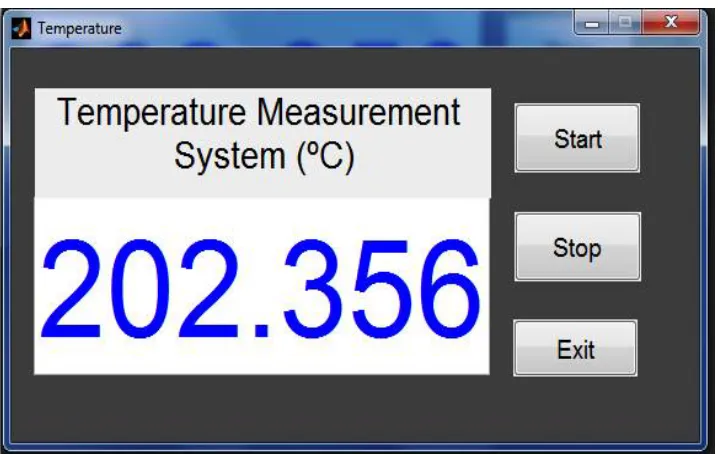
Figure 4: MATLAB GUI for Temperature Measurement System
IV. RESULTS
The Linearization of PT-100 is done by using quadratic fitting which is present in MATLAB Curve fitting tool. Equations and coefficients for various types of curve fits has been presented in a tabular column. Measurement of Temperature with 0.001 resolution is measured with the PT-100 and Embedded Microcontroller ADµC 7061 mini kit.
V. CONCLUSION
ISSN (Print) : 2320 – 3765 ISSN (Online): 2278 – 8875
I
nternational
J
ournal of
A
dvanced
R
esearch in
E
lectrical,
E
lectronics and
I
nstrumentation
E
ngineering
(An ISO 3297: 2007 Certified Organization)
Vol. 5, Issue 3, March 2016
different equations evolved by curve fitting tool in MATLAB. The strong point here is the controller have 24bit ADC, will give high accuracy and resolution for measurement. The additional inbuilt units such as PWM, GPIO, and DAC can be used to control various parameters. The hardware and software implementation provides to develop new dimensions in the field of measurement and control systems.
REFERENCES
[1]. Saidu.G, Momoh.M, Yahaya.H.N,Akpootu.O.D, Yaroko.Z.I, Fagbemi.S.A and Sifawa.A.A, "Design and Implementation of a Microcontroller Based Digital Thermometer", IOSR Journal Of Environmental Science, Toxicology And Food Technology (IOSR-JESTFT) e-ISSN: 2319- 2402,p- ISSN: 2319-2399.Volume 8, Issue 2 Ver. IV (Mar-Apr. 2014), PP 119-125 www.iosrjournals.org
[2.] Abdullah.M.F.L, Lee Mei Poh "Mobile Robot Temperature Sensing Application via Bluetooth",International Journal of Smart Home Vol. 5, No. 3, July, 2011
[3]. Rachana.L, Bhanushali, Akshada. M, Priyanka. P, Sherkhane, Rohan.S, " Multiple Sensing using ARM", " IJSRD - International Journal for Scientific Research & Development" Vol. 3, Issue 01, 2015 | ISSN (online): 2321-0613.
[4]. Pingale Vaishali S , Nikalje komal M , Chavan Snehal S, Prof. B.C.Kulkarni, " An Ethernet Based Control and Monitoring System Using ARM Processor","International Journal of Advanced Research in Electronics and Communication Engineering (IJARECE)" Volume 4, Issue 4, April 2015.
[5]. Vinod kumar Reddy. I, Amarnath.M, "Development of an Embedded System with MATLAB Based GUI for Real Time Health Monitoring", "International Journal & Magazine of Engineering, Technology, Management and Research", ISSN No: 2348-4845
BIOGRAPHY
C. Sandeep Kumar Reddy completed M.Sc Electronics and Instrumentation from Sri Krishnadevaraya University in 2009. He is pursuing Ph.D in Instrumentation. His areas of interest in Instrumentation are Scientific and Analytical Instrumentation.
Dr. K.K. Azam Khan, Scientist, EchoMRI Corporation Pte Ltd, Singapore. He completed Ph.D in Instrumentation in Sri Krishnadevaraya University. He has joined as a Development Engineer at ELICO Hyderabad, in 1992 and worked there for a period of 1 year. He has joined as a faculty member in the Department of Instrumentation as an Assistant Professor for a period of 8 years. He has joined as a faculty member Temasek Engineering School, Singapore and worked there for a period of 10 years. His areas of interest are Bio-Medical Instrumentation, Scientific and Analytical Instrumentation. He is also well versed with Embedded Microcontrollers and Programming.
![Figure 4 shows the MATLAB GUI [5] used to display the Temperature which is measured by PT-100](https://thumb-us.123doks.com/thumbv2/123dok_us/7779684.1284446/4.595.61.536.142.340/figure-shows-matlab-gui-used-display-temperature-measured.webp)