Power is calculator using distributed arithmetic and
simulated using Xilinx ISE simulator
Mrs.K.Radha
1; R.Anila
2& Dr. Murali Malijeddi
31
Associate Professor in ECE Department, Medha Institute of Science and Technology for Women 2
M-Tech ECE Department, Medha Institute of Science and Technology for Women 3
Principal and Professor in the Department of ECE in Medha Institute of Science and Technology for Women
Abstract
Discrete cosine transform (DCT) is widely used in multimedia communications such as image and video which require high volume of data transmission. An 8x8 2-D discrete cosine transform is used in image and video compression standards. DCT is a computation intensive operation. It requires a large number of adders and multipliers for direct implementation. Multipliers consume more power and hence distributed arithmetic (DA) is used to implement multiplication without multiplier so, DA acts as a multiplier. In the proposed method, VLSI architecture of 1-D DCT based distributed arithmetic (DA) is for low hardware circuit cost as well as low power consumption. The proposed 1-D DCT architecture is implemented in Xilinx ISE Simulator. With proposed 1-D DCT architecture, 2-D DCT will implement using row column decomposition technique. Results of proposed architecture with existed architecture are compared and delay and power is reduced to 50%. Further, this project can be extendable by using any other type of faster adder/multiplier in terms of area, speed and power.
Keywords:Discrete cosine transform (DCT); Distributed arithmetic (DA).
1.
Introduction
A discrete cosine transform (DCT) expresses a sequence of finitely many data points in terms of a sum of cosine functions oscillating at different frequencies. DCTs are important to
numerous applications in science and
engineering, from lossy compression of audio and images (where small high-frequency components can be discarded), to spectral methods for the numerical solution of partial differential equations. The use of cosine rather than sine functions is critical in
applications such as compression. The cosine
functions are much more efficient where as for differential equations the cosines express a particular choice of boundary conditions.
As like Fourier-related transform, DFT, discrete cosine transforms (DCTs) express a function or a signal in terms of a sum of sinusoids with different frequencies and amplitudes. And which operates on a function at a finite number of discrete data points. However, this visible difference is merely a consequence of a deeper distinction. A DCT implies different boundary conditions than the DFT or other related transforms.
digital images. Because this, fast algorithms and specific circuits for DCT have been developed. Among the methods for two-dimensional DCT, the indirect method based on row-column decomposition is the best method for hardware implementation.
The energy compaction property of the DCT is well suited for image compression since, as in most images, the energy is concentrated in the low to middle frequencies, and the human eye is more sensitive to the middle frequencies. A large majority of useful image contents change relatively slowly across images, i.e., it is unusual for intensity values to alter up and down several times in a small area, for example, within an 8 x 8 image block. Translate this into the spatial frequency domain, it says that, generally, lower spatial frequency components contain
more information than the high frequency
components which often correspond to less useful details and noises.
The Discrete Cosine Transform transforms data into a format that can be easily compressed. The characteristics of the DCT make it ideally suited for image compression algorithms. These algorithms let you minimize the amount of data needed to recreate a digitized image. Reducing digitized images into the least amount of data possible has some advantages such as Less memory required to store images, Less time may be needed to analyze images, Channel bandwidth efficiency increased when transmiting images. Performing the DCT on a digitized image creates a data array that can be compressed by data compaction algorithms. Then, data can be stored or transmitted in its compacted form. The image quality depends on the amount of quantization used in the compaction algorithm. To reproduce the original image, the data is retrieved
from memory, compacted, and an inverse DCT is performed. Some of today's most popular image data compression applications include, Teleconferencing using motion-compensated video codecs, ISDN multimedia communications including voice, video, text, and images, Video channel transmission using
commercial geosynchronous tele
communications satellites, Digital
facsimile transmission using dedicated
equipment and personal computers. Several image data compression algorithms use the DCT to remove spatial data redundancies in two-dimensional (2D) data. Images are subdivided into smaller, two-dimensional blocks. These blocks are then processed independently of the neighboring blocks. In general, the two dimensional, discrete cosine transform (2D DCT) transforms an (n x n) data array into an (n x n) result array. First the DCT transforms the columns, then it transforms the rows.
2. Related Work
2.1Existing Method (DCT in pipelined fashion):
For a 2-D data X(i, j), 0 ≤ i ≤ 7 and 0 ≤ j ≤ 7, 8x8 2-D DCT is given by
Where 0<u<7 and 0<v<7 and C(u),C(v)=1/2
for u,v=0,C(u),C(v)=1 Implementation
Considering the periodicity and the symmetry of trigonometry function, the following 8 equations can be inferred from equation (2). Then the 1-D DCT is simplied as by applying i=0 to 7 from eqn (2)
F(0) =[X(0) + X(1) + X(2) + X(3) + X(4) + X(5) + X(6) + X(7)]P
F(1)=[X(0)-X(7)]A+[X(1)-X(6)]B+[X(2)-X(5)]C + [X(3)-X(4)]D
F(2) =[X(0)- X(3)- X(4)+ X(7)]M+[X(1)-X(2)-X(5)+ X(6)]N
F(3)=[X(0)-X(7)]B+[X(1)-X(6)](-D)+[X(2)-X(5)](-A )+[X(3) -X(4)](-C) F(4) =[X(0) - X(1) -X(2) + X(3) + X(4) - X(5) - X(6) + X(7)]P
F(5) =[X(0)- X(7)]C+[X(1)- X(6)](-A)+[X(2)-X(5)] D +[X(3)- X(4)]B
F(6) =[X(0)- X(3)- X(4)+ X(7)]N+[X(1)- X(2)- X(5) + X(6)](-M)
F(7) =[X(0) -X(7)]D+[X(1)-X(6)](-C)+[X(2)-X(5)] B +[X(3)-X(4)](-A)
Where,
M=1/2 cos(π/8), N=1/2cos(3π/8), P=1/2cos(π/4),
A=1/2cos(π/16), B=1/2cos(3π/16),
C=1/2cos(5π/16), C=1/2cos(7π/16); Let us assume the equations as
a1=X(0)+X(1)+X(2)+X(3)+X(4)+X(5)+X(6)+X(
7),
a2=X(0)-X(1)-X(2)+X(3)+X(4)-X(5)-X(6)+X(7), b1=X(0)-X(7), b2=X(1)-X(6),
b3=X(2)-X(5), b4=X(3)-X(4),
c1=X(0)-X(3)-X(4)+X(7) and
c2-X(1)-X(2)-X(5)+X(6).
By implementing above equqtions in 1-D DCT equations, it becomes
F(0)=a1xP, F(4)=a2xP.
F(1)=b1xA+b2xB+b3xC+b4xD. F(3)=b1xB-b2xD-b3xA-b4xB. F(5)=b1xC-b2xA+b3xd+b4xB.
F(7)=b1xD-b2xC+b3xB-b4xA.
F(2)=c1xM+c2xN, and F(6)=c1xN-c2xM.
“Figure 1. VLSI architecture for computing of 8 point DCT in pipeline manner for computation of F(0) and F(4)”
“Figure 2. VLSI architecture for computing of 8 point DCT in pipeline manner for computation of F(1), F (3), F(5)”
Fig 4: “Figure 4. Distributed Arithmetic”.
In the fig 2,3,4 the 1D-DCT architecture is implemented in pipeline fashion ,it requires more no. of multipliers and adders so it consumes more power, area and delay will be more.
2.2. Proposed Method (DCT using Distributed Arithmetic):
Distributed arithmetic is a bit level rearrangement of a multiply accumulate to hide the multiplications. It is a powerful technique for reducing the size of a parallel hardware multiply accumulate that is well suited to FPGA designs. It can also be extended to other sum functions such as complex multiplies, fourier transforms. Distributed arithmetic (DA) is an effective method for computing inner products. It uses Look Up Tables (LUT) and accumulators instead of a multipliers.
Distributed arithmetic (DA) provides application
in Very Large Scale Integration (VLSI)
implementations of Digital Signal Processing (DSP) algorithms. Most of these applications, for example Discrete Cosine Transform (DCT) calculation, are arithmetic intensive with
multiply/accumulate (MAC) being the
predominant operation.
The advantage of DA approach is that it alerts the basic assumption of using multipliers and adders for computing the DCT.
DCT is a computational intensive operation. It requires large number of adders and multipliers for direct implementation . Multipliers consume more power and hence distributed arithmetic (DA) is used to implement multiplication without multiplier.
3. Experimental Work
3.1 Simulation Results
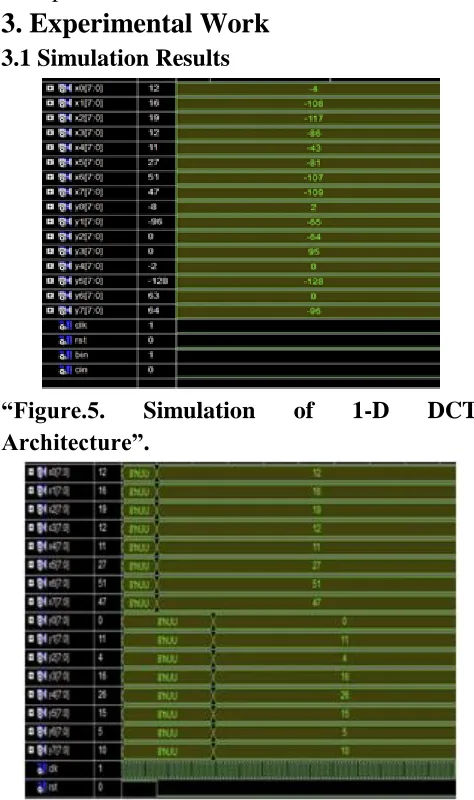
“Figure.5. Simulation of 1-D DCT
Architecture”.
“Figure 7. Simulation of 1-D DCT using DA architecture”
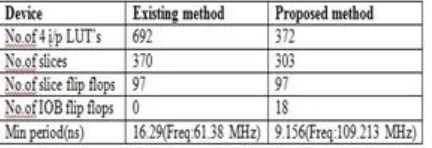
“Table 1. Device Utilization”
Table1 shows the device utilization for both existed method and proposed method. It is observed that the delay is reduced and frequency is increased in the proposed method.
Table 2 shows the power calculation for normal DCT and DA-DCT
4. Conclusion
The proposed 1-D DCT Architecture using distributed arithmetic is designed and simulated using Xilinx ISE simulator. Power is calculated and it is reduced to 50% when compared to normal DCT. Here the device utilization is compared and delay has been reduced to large extent.
5. References
[1] Vijay Kumar Sharma, K. K. Mahapatra and Umesh C. Pati,”An efficient distributed arithmetic based VLSI architecture for DCT” IEEE transaction on devices and communications 2011.
[2] T. Acharya and P. Tsai, “JPEG2000 Standard for ImageCompression:Concepts,
Algorithms and VLSI Architectures” J. Wiley & sons. NJ, 2005.
[3] Gregory K. Wallace, “The JPEG Still
Picture Compression Standard,”IEEE
Transactions on Consumer Electronics, vol.38(I), Feb. 1992.
[4] R. C. Gonzalez, R. E. Woods, “Digital Image Processing,”2nd.Ed.,Prentice Hall, 2002.
[5] F.H.P. Fitzek, M. Reisslein, “MPEG-4 and H.263 Video Traces for Network Performance Evaluation ,”IEEE Network, vol.15, no.6, pp.40-54, Nov/Dec 2001.
[6] Luciano Volcan Agostini, Ivan Saraiva Silva and Sergio Bampi,“Multiplierless and fully pipelined JPEG compression soft IP targeting FPGAs,” Microprocessors and Microsystems, vol. 31(8), 3 pp.487-497,Dec. 2007.
[10] Peng Chungan, Cao Xixin, Yu Dunshan, Zhang Xing, “A 250MHz optimized distributed architecture of 2D 8x8 DCT,” 7th International Conference on ASIC, pp. 189 -192, Oct. 2007.
[11] M. Kovac, N. Ranganathan, “JAGUAR: A Fully Pipelined VLSI Architecture for JPEG Image Compression Standard,” Proceedings of the IEEE, vol.83, no.2, pp. 247-258,Feb.1995.
[12] Yuan-Ho Chen, Tsin-Yuan Chang, Chung-Yi Li, “High Throughput DA Based DCT With High Accuracy Error-Compensated Adder Tree,” IEEE Transactions on Very Large Scale Integration (VLSI) Systems, vol. PP, issue 99, pp. 1-5, Jan 2010.
in Computational Tools for Engineering Applications, 2009, ACTEA '09, pp.320-323, 15-17 July 2009.
[14] Leila Makkaoui, Vincent Lecuire and Jean-Marie Moureaux, “Fast Zonal DCT-based image compression for Wireless Camera Sensor Networks,” 2nd International Conference on Image Processing Theory Tools and Applications (IPTA), pp. 126-129, 2010.
[15] Byoung-Il Kim and Sotirios G. Ziavras,
“Low-Power Multiplierless DCT for
Image/Video Coders,”IEEE 13th International
Symposium on Consumer Electronics, 2009. ISCE '09, pp. 133-136.
[16] C. H. Chen, B. D. Liu and J. F. Yang, “Direct Recursive Structures for Computing
Radix-r Two- Dimensional
DCT/IDCT/DST/IDST”, IEEE Transactions On Circuits And Systems,I Regular Papers , vol. 51, no. 10, October 2004.
[17] S. An C. Wang, “Recursive algorithm, architectures and FPGA implementation of the two-dimensional discrete cosine transform,” IET Image Process., vol. 2( 6), pp. 286- 294, 2008.
Authors Profile’s
Mrs.K.Radha has completed her AMIE in Electronics and Communication Engineering.She has master degree in Digital
Electronics and Communication
Systems,Gudlavalleru Engineering
College,Gudlavalleru. She is pursuing Ph.D from JNTUK,Kakinada.Her main area of interest is VLSI Design.She is presently working as an Associate Professor in ECE Department, Medha Institute of Science and Technology for Women, Khammam.She is
having 7 years of experience in teaching.
R.Anila M-Tech Medha Institute of Science and
Technology for Women, Khammam
Dr. Murali Malijeddi
Mr.mr.muralimalijeddi has completed his PhD from Andhra University Under Guidance of Prof. Dr. G.S.N Raju, Vice-Chancellor, Andhra
University in Antennas and Signal Processing .
As a Principal and Professor in the Department of ECE in Medha Institute of Science and
Technology for Women KHAMMAM,