ISSN 2286-4822 www.euacademic.org
Impact Factor: 3.4546 (UIF) DRJI Value: 5.9 (B+)
Study on Juvenile Delinquency and National
Situation in Albania
STELA FORTUZI
Doctoral Student Polytechnic University of Tirana Albania
Abstract:
Albania is a country with youth population; 1/3 of the population is at age of 1 – 18 years old. The trend of minor individuals to get involved on the criminal acts it’s an indicator of the great number of social problems. According to the existing statistics, more than 1 million minor or youth individuals are in the penitentiary institutions all around the world. A big number of relevant specialists work in this area.
The main purpose of the study is to deeply explore the juvenile delinquency and finding out the importance of alternative sentences (probation service) in the re-socialization process and the negative impact to some extend of the penitentiary regime. The desired end-result is a normal personality development of children and youth.
Key words: Juvenile justice, focus groups, social integration, delinquent juvenile
Purpose
The purpose of this questionnaire survey is to get the opinion of the convicted juvenile individuals regarding the criminal acts committed by them, their emotional and psychological status, the conditions of the premises where they are actually doing the sentence and their individual prospective after the sentence period.
Methodology
A structured questionnaire was used as an advantageous tool to get the opinions of the convicted juvenile individuals. The survey was implemented in the Kavaja Rehabilitation Institute. The survey includes 28 interviews (convicted juvenile individuals). As it were a limited number of the respondents, a face-to-face interview were applied. This low number of the convicted individuals might be considered as a disadvantageous feature of this survey.
The metodology applied is in line with the puprose of in this survey. It combines primary and secondary data. The secondary data are derived from a deep research and review of the current letirature on the petintiary system in Albania, and especially on the juvenile justice area, actual issues and conditions of the juvenile individuals and their prospective after the sentence. This literature is provided by the elctronic research, similiar studies carried out in neighbouring countries and other resources which helped in complementing the theoretical part of the study.
collection pertaining to this strategy. Using survey strategy enables the collection and analysis of quantitative data using descriptive and analytical statistics. Moreover, the data collected through this strategy can be used to suggest possible explanations about certain between variables and to create approaches of these correlations.
Methods of achieving the goal of the study vary according to the advantages and disadvantages of each. Using questionnaires as a method for collecting data in this study allows not only analyzing possible links between variables in our research, but also allows some recommendations regarding the quality of health service in the country.
According Khandwalla (1976) there is not a search method that can be considered as the best. Each of the methods used is associated with advantages and disadvantages. The choice of the method may be based on several eligible criteria. The possibility to generalize the data using the questionnaires research method is high in the case of questionnaire. As result, the use of questionnaires as a method for collecting data in this paper enables (1) the investigation of possible correlations between variables taken in the study, and (2) attempts to 'complement' previous studies have mainly used qualitative methods, such as analysis of situations. According to the Field (2005) there are many rules regarding the amount of choice, but as a general rule be 10-15 for variable response (this rule applies to both regression and factorial analysis)
measure what the applicant intends to move (Saunders et al. 2009). Content validity refers to the extent to which the questionnaire provides adequate coverage investigative questions. One way to achieve this is the use of a panel of individuals to assess the questionnaire. Concerning the validity of the criteria has to do with the ability of questions to make the right predictions. The statistical analysis of correlations can be used in this case. Tested reliability has to do with whether or not the questionnaire will produce reliable results on different time and different choices. One way to evaluate it is a measure of internal stability, such as “Cronbach alpha” calculation.
Two elements were carefully considered during the questionnaire: reliability - the questionnaire will produce reliable results on different time and different choices, and the validity of questions. To assess the validity of the content using the method of "panel of experts" who participated in drafting the questionnaire. The questions are formulated in such a way as to be understood by the respondent who would choose their alternative answer which are staggered as by Likert scale. When designing the questionnaire a special attention was given to the questions formulation which will produce valid responses in line with the main goal.
Regarding the reliability test, a way to assess that is the measurement of the internal stability calculated through Cronbach Alfa Coefficient. Based on calculations of Cronbach Alpha coefficients, they resulted to be higher than 0.7 (the allowed rate) showing sustainability of the questionnaire. Knowing that each of the questions is a variable which can take more than an answer, in the closed questions the answers alternatives were attempted to be realistic in order to obtain the necessary information.
The first section provides us with general information on juvenile offenders who participated in the survey thus providing data on age, gender, residence, education, etc.
The second section provides information about the nature of the offense committed by these juveniles. This section includes questions regarding the type of offense committed by juveniles, the motives of committing this offense, etc. The answers of these questions are affirmative or negative with Yes or No as well as and answers scaled by Likert criteria scale.
The third section provides information on the respective families: social economic background, their relationship with the family before and after the commission of the offense. In addition, this section gives information about their social life before they committed the offense; so in general, social and family environment.
The fourth section is related with the prospective for their life in the future; how do they see the future after completion of the sentence, as well as their current status. This section includes also opened questions to get their perception for the future integration. Responses to the current satisfaction levels were measured again through a Likert scale ranging from the lowest to the highest.
The survey lasted about 1 week. This includes the time to get the permission from Ministry of Justice. The interviews were of face-to-face technique in the premises of the Institute.
The interviewing was followed by the data input as well as processing and analysis of the information. The electronic program used for this purpose was SPSS 17.0 and Excel.
Findings
28 convicted juvenile individuals participated in the survey – that‟s the actual total number of convicted in juvenile penitentiary system in the country. According to Table 1 all the interviewers are males; 50% of them belong to the age of 16 - 17 years, followed by age 17-18 years with 35.7% and the rest 14.3% belong to the age of 14-15 years. 25% of juvenile offenders between the ages of 14 -15 years old have committed the offense of robbery. At the same percentage are those who have committed the offense of robbery in cooperation, manufacture and possession of unlicensed weapons and suicide. Prisoners of 16-17 years of age were mainly convicted of robbery and robbery with violence respectively by 35.7% and 28.6%. At the age of 17-18 years old, 40% of the interviewers belong to the robbery with violence, 30% robbery and 20% robbery with cooperation (Table 2 in the Annex).
Table 1: Age Distribution
Age Frequency Percentage
14-15 years 4 14.3
16-17 years 14 50.0
17-18 years 10 35.7
Total 28 100.0
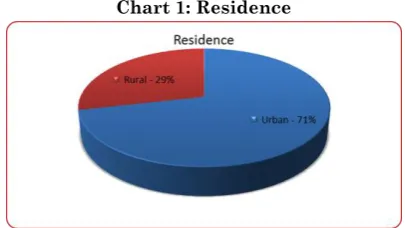
71% of them are residents in the urban area and 29% from rural areas (Chart 1).
Chart 2 indicates the place of birth. The majority of them (75%) are born in urban areas and 25% are born in rural areas. The place of birth was included in the survey as there has been a lot of internal movement of the population from rural to urban areas in the last 20 years.
Chart 2: Place of birth
Regarding the education level, Chart 3 shows that 79% of them state they have concluded the 9-year cycle of the school (mid school level), 18% have concluded the high school and only one have stated that he is graduated in a vocational school. None of the interviewers is with no school or elementary level.
Chart 3: Education level
Chart 4: Scores at school
According to Chart 5, the interviewers were sentenced for robbery as well as robbery with violence at 32% per each category. 18% were sentenced for recidivism robbery in cooperation, 7% were sentenced for manufacturing and possession of weapons and only one interviewer (7%) is sentenced for stabbing.
Chart 5: Nature of criminal offence
Table 2: Motivation of the offence Motivations Frequency Percentage Poor financial situation 8 29
Fun/Pleasure 5 17
Revenge 2 7
Not beeing aware 11 40
Other 2 7
Total 28 100
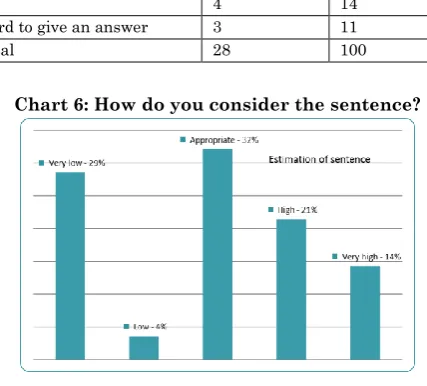
32% of interviewers said that the court gave a proper sentence for their individual offence, 29% the sentence was lower than they expected. On the other hand, 14% think that their sentence was beyond their expectations. Refer to Table 3 and Chart 6 for this issue.
Table 3: Responsibility towards the committed offence Responsibility Frequency Percentage
Yes 21 75
No 4 14
Hard to give an answer 3 11
Total 28 100
Chart 6: How do you consider the sentence?
Conclusions
their opinion is that the probation service helps the youth and minor individuals to spend more time with their families and to normally continue with respective education process. On the other hand, they think that penitentiary regime plays an important role in discouraging individuals to get involved in crime actions and thus cannot be totally replaced.
According to the specialists who work directly with the delinquent youth individuals such as those of rehabilitation centers and probation services, the penitentiary regime and probation service should co-exist considering the current situation in Albanian which lacks the specific institutional infrastructure (there is only one probation service institution in all over the country located in Tirana).
An addition reasons that justify the existence of both institutions is the insufficient information of the public about the difference between two of them. Especially the probation service is something new for Albania. Specialists who work directly with the delinquent juvenile, especially those of probation service, think that the lack of information directly influence rehabilitation and integration of delinquent juvenile in the society.
The academic representatives think that institutions can set up proper strategies through relevant specialists in order to increase capacities of the institutions to manage this phenomenon and to complete the process of rehabilitation and integration.
REFERENCES
Ajai S. Gaur & Sanjaya S. Gaur “Statistical methods for Practice and Research” (second edition), Sage Publication, 2009.
Hinkin T.R., (1995), „ A review of scale development practices in the study of organizations‟, Journal of Management, vol 21, no 5, 967-988.
Saunders M., Lewis P., Thornhill A., (2009), Research Methods for Business Students, FT-Prentice Hall, botimi i pestë. A. Field, Sage Publication 2005.
United Nations Office on Drugs and Crime Vienna, Introductory on the prevention of recidivism and the social Reintegration of offenders, Criminal Justice Handbook Series, New Work 2012 psge 6
The Constitution of the Republic of Albania, approved by Law no. 8417, dated (21/10/1998).
Law no. 7905, dated (21.3.1995) "Code of Criminal Procedure Republic of Albania ".
Law no. 7850, dated (1994) "Civil Code of the Republic of Albania ".
Ministry of justice, Statistical yearbook, (2012).
B. Berelson: Content Analysis in Communication Research (1952)