Automatic Hashtag Recommendation for Microblogs using
Topic-specific Translation Model
Zhuo ye Ding Qi Zhang X uanJ ing Huang
School of Computer Science, Fudan University, 825 Zhangheng Road, Shanghai, P.R. China {09110240024,qi_zhang,xjhuang}@fudan.edu.cn
A
BSTRACTMicroblogging services continue to grow in popularity, users publish massive instant messages every day through them. Many tweets are marked with hashtags, which usually represent groups or topics of tweets. Hashtags may provide valuable information for lots of applications, such as retrieval, opinion mining, classification, and so on. However, since hashtags should be manually annotated, only 14.6% tweets contain them (Wang et al., 2011). In this paper, we adopt topic-specific translation model(TSTM) to suggest hashtags for microblogs. It combines the advantages of both topic model and translation model. Experimental result on dataset crawled from real world microblogging service demonstrates that the proposed method can outperform some state-of-the-art methods.
T
ITLE ANDA
BSTRACT INC
HINESE基
基
基于
于
于特
特
特定
定
定话
话题
话
题
题下
下
下翻
翻
翻译
译
译模
模
模型
型
型的
的
的微
微
微博
博
博标
标
标签
签
签推
推
推荐
荐
荐
微博服务变得越来越流行,用户可以通过微博提交大量的及时信息。很多条微博被用户通 过标签标记,这些标签代表了微博的话题类别。标签可以为很多应用提供有价值的信息, 比如检索,情感分析,分类等等。微博的标签本应该由用户自行标记,然而,根据统计只
有14.6%的微博包含标签。在这篇论文中,我们提出了一种基于特定话题的翻译模型, 来
为每条微博自动推荐标签。此模型综合了话题模型和翻译模型的优点。在基于真实微博语 料的实验中,我们提出的方法超过了很多经典的方法。
K
EYWORDS:
Microblogs, Tag recommendation, Topic model.1 Introduction
Hashtags, which are usually prefixed with the symbol # in microblogging services, represent the relevance of a tweet to a particular group, or a particular topic (Kwak et al., 2010). Pop-ularity of hashtags grows concurrently with the rise and popPop-ularity of microblogging services. Many microblog posts contain a wide variety of user-defined hashtags. It has been proven to be useful for many applications, including microblog retrieval (Efron, 2010), query expan-sion (A.Bandyopadhyay et al., 2011), sentiment analysis (Davidov et al., 2010; Wang et al., 2011), and many other applications. However, not all posts are marked with hashtags. How to automatically generate or recommend hashtags has become an important research topic. The task of hashtag recommendation is to automatically generate hashtags for a given tweet. It is similar to the task of keyphrase extraction, but it has several different aspects. Keyphrases are defined as a short list of phrases to capture the main topics of a given document (Turney, 2000). Keyphrases are usually extracted from the given document. However, hashtags indicate where a tweet is about a particular topic or belong to a particular group. So words and hashtags of a tweet are usually diverse vocabularies, or even hashtags may not occur in the tweet. Take the tweet in Table 1 for instance, the word “Lion” is used in the tweet, while users annotate with the hashtag “Mac OS Lion”. That is usually refered to as avocabulary gapproblem.
Tweet
At the WWDC conference 2012, Apple introduces its new operating system release-Lion.
Annotated tags
Apple Inc, WWDC,MAC OS Lion
Table 1: An example of a tweet with annotated hashtags.
Tweet˖
Tags˖
At the WWDC conference 2012, Apple introduces its new opera!ng system release-Lion.
Apple Inc, WWDC, MAC OS Lion Word alignment
Figure 1: The basic idea of word align-ment method for suggesting hashtags.
To solve thevocabulary gapproblem, most researchers applied a statistic machine translation model to learn the word alignment probabilities(Zhou et al., 2011; Bernhard and Gurevych, 2009). Liu et al. (2011) proposed a simple word alignment method to suggest tags for book reviews and online bibliographies. In this work, tags are trigged by the important words of the resource. Figure 1 shows the basic idea of using word alignment method for tag suggestion. Due to the open access in microblogs, topics tend to be more diverse in microblogs than in formal documents. However, all the existing models did not take into account any contextual information in modeling word translation probabilities. Beyond word-level, contextual-level topical information can help word-alignment choice because sometimes translation model is vague due to their reliance solely on word-pair co-occurrence statistics. For example, the word “apple” should be translated into “Apple Inc” in the topic oftechnology, or “juice” in the topic ofdrink. Thus the idea is using topic information to facilitate word alignment choice. Based on this perspective, in this paper, we propose a topic-specific translation model(TSTM) to recommend hashtags for microblogs. This method regards hashtags and tweets asparallel
word-At the WWDC
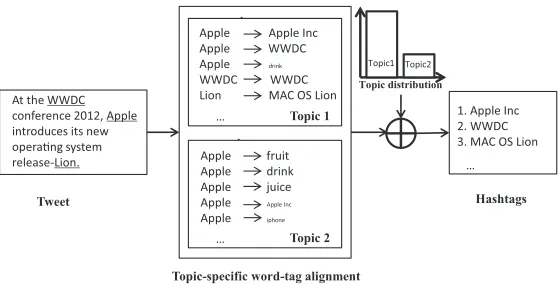
Figure 2: The basic idea of topic-specific word alignment for tag recommendation.
tag alignment probabilities and topic distribution. Figure 2 illustrates the basic idea of our model. In Figure 2, for simplicity, we suppose there are totally two topics, topic 1(information technology) and topic 2(food). We use the font size of tags to indicate the word-tag align-ment probability for each specific topic. With the topic distribution and word-tag alignalign-ment probabilities for each topic, we can compute the importance score for each candidate tag. The remainder of this paper is organized as follows: related work and state-of-the-art ap-proaches are reviewed in Section 2. The proposed approach is detailed in Section 3. Experi-mental results and analysis are described and discussed in Section 4. The last section concludes the paper.
2 Related work
Our approach relates to two research areas: tag suggestion and keyphrase extraction. In this section, we discuss them in detail.
2.1 Tag suggestion
Previous work on tag suggestion can be roughly divided into three directions, including collaborative filtering(CF) (Rendle et al., 2009; Herlocker et al., 2004), discriminative mod-els (Ohkura et al., 2006; Heymann et al., 2008), and generative modmod-els(Krestel et al., 2009; Iwata et al., 2009). Our proposal is complementary to these efforts, because microblogs differ from other media in some ways: (1) microblog posts are much shorter than traditional docu-ments. (2) topics tend to be more diverse than in formal docudocu-ments. So these methods cannot be directly applied to hashtag recommendation in microblogs.
2.2 Keyphrase extraction
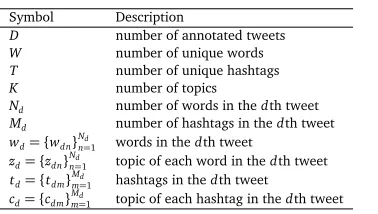
Symbol Description
D number of annotated tweets
W number of unique words
T number of unique hashtags
K number of topics
Nd number of words in thedth tweet
Md number of hashtags in thedth tweet
wd={wdn}Nn=d1 words in thedth tweet
zd={zdn}Nnd=1 topic of each word in thedth tweet td={tdm}Mm=d1 hashtags in thedth tweet
cd={cdm}Mmd=1 topic of each hashtag in thedth tweet
Table 2: Notations of our model.
¢ © z w
Figure 3: Graphical model representa-tion of our model.
most important candidates (Mihalcea and Tarau, 2004; Wan and Xiao, 2008). Supervised ap-proaches used a corpus of training data to learn a keyphrase extraction model that is able to classify candidates as keyphrases (Turney, 2003; Hulth., 2003).
3 Proposed method
3.1 Preliminaries
We assume an annotated corpus consisting ofDtweets with a word vocabulary of sizeWand a hashtag vocabulary of size T. Suppose there areK topics embedded in the corpus. The
dth tweet consists of a pair of words and assigned hashtags (wd,td), wherewd={wdn}Nn=d1 areNd words in the tweet that represent the content, andtd ={tdm}Mm=d1 areMd assigned hashtags. Our notation is summarized in Table 2. Given an unlabeled data set, the task of hashtag recommendation is to discover a list of hashtags for each tweet.
The proposed topic-specific translation model is based on the following assumptions. When a user wants to write a tweet, he first generates the content, and then generates the hashtags. When starting the content, he first chooses some topics based on the topic distribution. Then he chooses a bag of words one by one based on the word distribution for each chosen topic. During the generative process for hashtags, a topic is first chosen from topics that have pre-viously generated the content. And hashtags are chosen according to the chosen topic and important words in the content.
Formally, letθ denotes the topic distribution andϕkdenotes the word distribution for topic
k. Letηddenote the distribution of topic choice when assigning hashtags for thedth tweet and the choice probability of topickis sampled randomly from topics of content, as follows, ηdk = N
k is the number of words that are assigned to topic kin the dth tweet. And then each hashtag tdmis annotated according to topic-specific translation pos-sibility P(tdm|wd,cdm,B), where P(tdm|wd,cdm,B) =
∑Nd
n=1P(tdm|cdm,wdn,B)P(wdn|wd)and
B presents the topic-specific word alignment table between a word and a hashtag, where
Bi,j,k=P(t=tj|w=wi,z=k)is the word alignment probability between the wordwiand the hashtagtjfor topick,P(wdn|wd)indicates the importance of the word in thedth tweet, which will be described in detail in section 3.4.2 .
1. Draw topic probabilityθ∼Dirichlet(α); 2. Draw topic probabilityη∼Dirichlet(γ); 3. For each topick=1, ...,K
Draw word probabilityϕk∼Dirichlet(β) 4. For each tweetd=1, ...,D
(a) For each wordn=1, ...,Nd Draw topiczdn∼Multinomial(θd) Draw wordwdn∼Multinomial(Φzdn)
(b) For each hashtagm=1, ...,Md Draw topiccdm∼Multinomial(ηd) Draw hashtagtdm∼P(tdm|wd,cdm,B) whereα,βandγare Dirichlet distribution parameters.
Figure 3 shows a graphical model representation of the proposed model.
3.2 Learning and inference
We use collapsed Gibbs sampling(Griffiths and Steyvers, 2004) to find latent variables. The sampling probability of a latent topic for each word and hashtag in the tweet is sampled respectively. Due to the space limit, we leave out the derivation details and the sampling formulas.
After the topics of each word and hashtag become stable, we can estimate topic-specific word alignment tableBby:Bt,w,c=
Nt c,w
N(.)
c,w. whereN
t
c,wis a count of the hashtagtthat co-occurs with the wordwfor topiccin tweet-hashtag pairs.
The possibility tableBt,w,c have a potential size ofW T K, assuming the vocabulary sizes for words, hashtags and topics areW,TandK. The data sparsity poses a more serious problem in estimatingBt,w,cthan the topic-free word alignment case. To reduce the data sparsity problem, we introduce the remedy in our model. We can employ a linear interpolation with topic-free word alignment probability to avoid data sparseness:B∗
t,w,c=λBt,w,c+ (1−λ)P(t|w), where
P(t|w)is topic-free word alignment probability from the wordwand the hashtagt,λis trade-off of two probabilities. Here we explore IBM model-1 (Brown et al., 1993), which is a widely used word alignment model, to obtainP(t|w).
3.3 Tag recommendation using Topic-specific translation probabilities
3.3.1 Topic identification
Suppose given an unlabeled datasetW∗={w∗
d}Ud=1withUtweets, where thedth tweetwd∗=
{w∗
dn}nLd=1consists ofLdwords.z∗d={zdn∗ }Ln=d1denotes topics of words indth tweet andZ∗=
{z∗
d}Ud=1. we first identify topics for each tweet using the standard LDA model. The collapsed Gibbs sampling is also applied for inference. After the topics of each word become stable, we can estimate the distribution of topic choice for hashtags of thedth tweet in unlabeled data by:η∗dk= Nkd+γ
Nd (.)+γK
, whereNd
3.3.2 Tag recommendation
With topic distributionη∗and topic-specific word alignment tableB∗, we can rank hashtags
for thedth tweet in unlabeled data by computing the scores:
P(tdm∗ |wd∗,η∗d,B∗) = K
∑
c∗ dm=1
Ld
∑
n=1
P(t∗dm|c∗dm,w∗dn,B∗)P(c∗dm|η∗d)P(w∗dn|w∗d)
WhereP(w∗
dn|w∗d)indicates the importance of the words in the tweet. Here, we usedI DFto compute this importance score. According to the ranking scores, we can suggest the top-ranked hashtags for each tweet to users.
4 Experiments
4.1 Data collection and analysis
In our experiments, we use a Microblog dataset collected from Sina-Weibo1 for evaluation. Sina-Weibo is a Twitter-like microblogging system in China provided by Sina, one of the largest Chinese Internet content providers. It was launched in August, 2009 and quickly become the most popular microblogging service in China. We collected a dataset with totally10,320,768
tweets. Among them, there are551,479tweets including hashtags annotated by users. We extracted these annotated tweets for training and evaluation. Some detailed statistical infor-mation is shown in Table 3. We divided them into a training set of 446,909 tweets and a test set of 104,570 tweets. The training set is applied for building topic-specific translation model, while the test set is for evaluation. We use hashtags annotated by users as the golden set.
#tweet W T N¯w N¯t
551,479 244,027 116,958 19.97 1.24
Table 3: Statistical information of dataset.W,T, ¯Nwand ¯Ntare the vocabulary of words, the vocabulary of hashtags, the average number of words in each tweet and the average number of hashtags in each tweet respectively.
4.2 Evaluation metrics and settings
We use Precision(P), Recall(R), and F-value(F) to evaluate the performance of hashtag rec-ommendation methods. We ran topic-specific translation model with 1000 iterations of Gibbs sampling. After trying a few different numbers of topics, we empirically set the number of topics to 100. We useα=50.0/Kandβ=0.1 as (Griffiths and Steyvers, 2004) suggested. Parameterγis also set to 0.1. We use IDF to indicate the importance of a word and set smooth-ing parameterλto 0.8 which gives the best performance. The influence of smoothing to our model can be found in Section 4.5.
4.3 Comparison with other methods
In this subsection, we implement several methods for comparison, where Naive Bayes(NB) is a representative classification method, while LDA (Krestel et al., 2009) is selected to represent generative model for tag suggestion, IBM model-1 (Liu et al., 2011) is a novel translation-based model.
1http:
0.05
Figure 4: Performance comparison between NB, LDA-based, IBM1 and TSTM.
Method Precision Recall F-measure
NB 0.217 0.197 0.203
LDA 0.064 0.060 0.062
IBM1 0.271 0.241 0.249
TSTM 0.358 0.324 0.334
Table 4: Comparison results of NB, LDA-based, IBM1 and TSTM when suggesting top-1 hashtag.
In Figure 4, we show the Precision-Recall curves of NB, LDA, IBM1 and TSTM on the data set. Each point of a Precision-Recall curve represents different numbers of suggested hashtags from M=1(bottom right, with higher Precision and lower Recall) to M=5(upper left, with higher Recall but lower Precision) respectively. The closer the curve to the upper right, the better the overall performance of the method. From the Figure, we have the following observations: (1)TSTM outperforms all the baselines. This indicates the robustness and effectiveness of our approach for hashtag recommendation. (2)IBM1 underperforms TSTM, because IBM1 relies solely on word-tag co-occurrence statistics. And contextual topical information can help to disambiguate word-alignment choices in TSTM. (3)LDA performs so poor, because it ranks the candidate hashtags by the hashtag distribution for each topic. So it can only suggest general hashtags.
To further demonstrate the performance of TSTM and other baseline methods, in Table 4, we show the Precision, Recall and F-measure of NB, LDA, IBM1 and TSTM suggesting top-1 hashtag, because the number is near the average number of hashtags in dataset. We find that the F-measure of TSTM comes to 0.334, outperforming all the baselines more than 8%.
4.4 Example
In Table 5, we show top-8 hashtags suggested by NB, LDA, IBM1 and TSTM for the tweet in Table 12. The number in brackets after the name of each method is the count of correctly suggested hashtags. The correctly suggested hashtags are marked in bold face.
From Table 5, we observe that classification model NB suggests some unrelated hashtags. While LDA, as generative models, tends to suggest general hashtags, such as “Information News”, “mobile phone” and “Technology leaders”, and fail to generate the specific hashtags “WWDC”, “MAC OS Lion”. IBM1 method will suggest some topic-unrelated hashtags. For in-stance, “2012 Jinshan Inc cloud computing” and “2012 spring and summer men’s week” are triggered by the word “2012”. On the contrary, TSTM succeeds to suggest specific hashtags, and most of them are topic-related to the tweet.
4.5 Influences of smoothing
To validate the power of smoothing in TSTM on different sizes of datasets, the experiments were conducted on two datasets, including a small dataset(a training set of 100,000 tweets
NB(+1):MAC OS Lion, 2012 wishes, OS, Smiles to the world, 2012 salary report, 2012 Jinshan Inc cloud computing, Lion, Noah’s ark 2012
LDA(+1): Android, Information news, Japan earthquake, mobile phone,Apple Inc, Cloud computing, Tablet PC, Technology leaders
IBM1(+2):WWDC, Android, 2012 Jinshan Inc cloud computing,Apple Inc, 2012 spring and summer men’s week, 2012, mobile phone OS, Information news TSTM(+3):Mac OS Lion,WWDC, MAC,Apple Inc, Baidu union conference, Microsoft, Android, iphone
Table 5: Top-8 hashtags suggested by NB, LDA, IBM1 and TSTM.
and a test set of 10,000 tweets) and a large dataset(100% training set and 100% test set). Figure 5 and Figure 6 show the performance on both of the datasets whenλranges from 0.0 to 1.0. We find that TSTM achieves the best performance whenλ=0.8 in both of the two Figures. Furthermore, the model cannot perform well without smoothing (whenλ=1) on the small data set. That indicates smoothing is more powerful on the small data set. While the model can still perform well without smoothing on the large data set. This is reasonable because large data set can help to solve the problem of data sparsity to some extent.
0.1
Figure 5: F-measure of TSTM on the small data set when smoothing parameter λ ranges from 0.0 to 1.0.
0.1
Figure 6: F-measure of TSTM on the large data set when smoothing parameter λ ranges from 0.0 to 1.0.
Conclusions
In this paper, we address the issue of suggesting hashtags for microblogs. The existing meth-ods cannot be directly applied to this task due to the following challenges. (1) tweets are much shorter than traditional documents. (2) topics are more diverse in microblogs than other media. To solve these problems, we proposed a topic-specific translation model, which combines the advantages of both topic model and translation model. Experimental result on tweets crawled from real world service demonstrates that the proposed method can outper-forms some state-of-the-art methods.
Acknowledgments
References
A.Bandyopadhyay, Mitra, M., and Majumder, P. (2011). Query expansion for microblog re-trieval. InProceedings of The Twentieth Text REtrieval Conference, TREC 2011.
Bernhard, D. and Gurevych, I. (2009). Combining lexical semantic resources with question & answer archives for translation-based answer finding. InProceeding of ACL, pages 728–736.
Brown, P. F., Pietra, S. A. D., Pietra, V. J. D., and Mercer, R. L. (1993). The machematics of statistical machine translation: parameter estimation. Computational linguistics, 19(2):263– 311.
Davidov, D., Tsur, O., and Rappoport, A. (2010). Enhanced sentiment learning using twitter hashtags and smileys. InProceedings of the 23rd International Conference on Computational Linguistics: Posters, COLING ’10, pages 241–249, Stroudsburg, PA, USA. Association for Com-putational Linguistics.
Efron, M. (2010). Hashtag retrieval in a microblogging environment. InProceedings of the 33rd international ACM SIGIR conference on Research and development in information retrieval, SIGIR ’10, pages 787–788, New York, NY, USA. ACM.
Griffiths, T. L. and Steyvers, M. (2004). Finding scientific topics. InProceedings of the National Academy of Sciences, volume 101, pages 5228–5235.
Herlocker, J. L., Konstan, J. A., Terveen, L. G., and Riedl, J. T. (2004). Evaluating collaborative filtering recommender systems.ACM Trans. Inf. Syst., 22(1):5–53.
Heymann, P., Ramage, D., and Garcia-Molina, H. (2008). Social tag prediction. In Proceed-ings of the 31st annual international ACM SIGIR conference on Research and development in information retrieval, SIGIR ’08, pages 531–538, New York, NY, USA. ACM.
Hulth., A. (2003). Improved automatic keyword extraction given more linguistic knowledge. Inproceedings of EMNLP.
Iwata, T., Yamada, T., and Ueda, N. (2009). Modeling social annotation data with content relevance using a topic model. InProceedings of NIPS, pages 835–843.
Krestel, R., Fankhauser, P., and Nejdl, W. (2009). Latent dirichlet allocation for tag recommen-dation. InRecSys.
Kwak, H., Lee, C., Park, H., and Moon, S. (2010). What is twitter, a social network or a news media? InProceedings of the 19th international conference on World wide web, WWW ’10, pages 591–600, New York, NY, USA. ACM.
Liu, Z., Chen, X., and Sun, M. (2011). A simple word trigger method for social tag suggestion. InProceedings of EMNLP.
Mihalcea, R. and Tarau, P. (2004). Textrank: Bringing order into texts. InProceedings of EMNLP.
Rendle, S., Balby Marinho, L., Nanopoulos, A., and Schmidt-Thieme, L. (2009). Learning optimal ranking with tensor factorization for tag recommendation. InProceedings of the 15th ACM SIGKDD international conference on Knowledge discovery and data mining, KDD ’09, pages 727–736, New York, NY, USA. ACM.
Turney, P. D. (2000). Learning algorithms for keyphrase extraction.Inf. Retr., 2(4):303–336.
Turney, P. D. (2003). Coherent keyphrase extraction via web mining. Inproceedings of IJCAI.
Wan, X. and Xiao, J. (2008). Single document keyphrase extraction using neighborhood knowledge. InProceedings of AAAI.
Wang, X., Wei, F., Liu, X., Zhou, M., and Zhang, M. (2011). Topic sentiment analysis in twitter: a graph-based hashtag sentiment classification approach. InProceedings of the 20th ACM international conference on Information and knowledge management, CIKM ’11, pages 1031–1040, New York, NY, USA. ACM.