TLT-CRF: A Lexicon-supported Morphological Tagger for Latin Based on
Conditional Random Fields
Tim vor der Br ¨uck, Alexander Mehler
Distributed Secure Software Systems, Text Technology LabLucerne University of Applied Sciences and Arts, Goethe-Universit¨at Frankfurt am Main [email protected], [email protected]
Abstract
We present a morphological tagger for Latin, calledTTLab Latin Tagger based on Conditional Random Fields(TLT-CRF) which uses a large Latin lexicon. Beyond Part of Speech (PoS), TLT-CRF tags eight inflectional categories of verbs, adjectives or nouns. It utilizes a statistical model based on CRFs together with a rule interpreter that addresses scenarios of sparse training data. We present results of evaluating TLT-CRF to answer the question what can be learnt following the paradigm of 1st order CRFs in conjunction with a large lexical resource and a rule interpreter. Furthermore, we investigate the contigency of representational features and targeted parts of speech to learn about selective features.
Keywords:morphological tagging, rules, CRFs, Latin lexicon
1.
Introduction
A tagger that determines morphological, inflectional infor-mation for each word beyond its PoS is called a morpho-logical tagger. We describe a morphological tagger (the tagset being employed is a subset of theStuttgart-T¨ubingen TagSet(STTS)) calledTTLab Latin Tagger based on Con-ditional Random Fields(TLT-CRF). It determines the PoS as well as inflectional categories such as number, case, gender,comparison degree,mood,tenseandvoice. TLT-CRF is based on a TLT-CRF model together with a large Latin lexicon. It explores several lexical features (e.g., for de-termining agreement) and, thus, is distinguished from re-lated approaches. To the best of our knowledge, it is the only hybrid morphological tagger that integrates a rule in-terpreter and a statistical model in the area of Latin texts. Rules are useful in cases of data sparseness which do not allow for defining sufficient training data. The source code of the tagger can be obtained fromhttp://prepro.
hucompute.org.
2.
Related Work
There is a multitude of statistical approaches for PoS tag-ging. Almost all of them rely on a statistical model that is trained on annotated examples and then applied to pre-viously unseen texts. These models include decision trees (Schmid, 1994), Hidden Markov Models (Brants, 2000), Maximum Entropy Models (Toutanova et al., 2003), neu-ral networks and structured SVMs. An exception is de-scribed by (Bellegarda, 2010) who employslearning per
analogytogether with latent semantic analysis (Landauer et al., 1998) (calledlatent analogy). While there exists a lot of freely available PoS taggers, so-called morpholog-ical taggers are still rare. An exception is (M¨uller and Sch¨utze, 2015) who provide a morphological tagger for several languages that is based on 3rd order CRFs (Lafferty et al., 2001). A hybrid morphological tagger for Czech is introduced by (Spoustov´a, 2008). The employed statisti-cal model is a combination of HMMs, of a maximum en-tropy model and of perceptrons, where the first two models are now seen to be outdated due to problems of including arbitrary features (HMM) and due to the label bias prob-lem (maximum entropy models) (Sutton and McCallum, 2007). Another approach to utilizing state-of-the art tag-gers is proposed by (Eger et al., 2016) mostly based on MarMoT (M¨uller and Sch¨utze, 2015) and, thus, on higher-order CRFs. In contrast to this, we focus on 1st higher-order CRFs by asking about the payout of such a simpler model. To know whether 1st order CRFs allow for competitive alter-natives is important for scenarios in which time is a critical variable since more complex models require longer train-ing and processtrain-ing times.
3.
Lexical Rules
in the lexical context of the input token. Rules can either include sufficient or necessary conditions. Rules based on sufficient conditions determine the PoS/lemma of a token which meets their conditions. In contrast to this, any PoS is ruled out that is associated with a failing rule based on nec-essary conditions. Since there is practically no rule without exceptions, the tagger allows for considering rules in a soft mode. In this mode, TLT-CRF creates features using the names of the rules that apply to the focal token. The deci-sion which PoS to chose is then left to the CRF model. An example of a tagging rule is shown below: it says that the PoS ofutisconjunction, ifutis (not necessarily directly) followed by a finite verb of moodsubjunctive.
<rule name="ut">
4.
The Frankfurt Latin Lexicon
As a large Latin lexical resource of our tagger, we uti-lize the Frankfurt Latin Lexicon (FLL) (Mehler et al., 2015), which can be freely browsed via the websitehttp:
//collex.hucompute.org. The FLL is based on
an automatic morphological expansion of a range of lem-mata extracted from web-based resources (e.g., LemLat (Passerotti, 2004), Perseus Digital Library (Smith et al.,
2000), Whitaker’s word list1, the Latin Wiktionary2, Latin training data of the Tree Tagger (Schmid, 1994)) and tex-tual resources (e.g., the Patrologia Latina). In the mean-time, more than 7% of all lemmas of the FLL have been manually created or checked by experts of Latin via the website of Computational Historical Semantics (Jussen et al., 2007): http://www.comphistsem.
org/home.html. Since the FLL creates and stores all inflected forms of its lemmas, it now contains more than 12 million syntactic words (i.e., wordforms plus inflectional features likeperson,number,caseetc.). This provides a huge resource for morphological tagging as addressed by TLT-CRF.
5.
Corpus
Our evaluation and training corpus is based on the ca-pitularies, the amalarius corpus and three further texts from the MGH3corpus (Visio Baronti, Vita Adelphii, Vita Amandi). The entire corpus is tokenized and split into sen-tences. Each token of the corpus is manually assigned a unique id that references the corresponding syntactic word within the FLL. In this way, full morphological informa-tion is available for all tokens of this corpus. By sampling (randomly rearranging) the sentences of this corpus, we make available this gold standard data.4
6.
TLT-CRF
TLT-CRF is mainly based on a statistical model in the framework of Conditional Random Fields (CRF) (Laf-ferty et al., 2001). It uses the CRFsuite (Okazaki, 2007) which uses the limited memory Broyden-Fletcher-Goldfarb-Shanno (BFGS) training method to implement a 1st order CRF. A selection of the features employed by TLT-CRF is as follows:
1. Capitalization: named entities and certain adjectives are usually capitalized in Latin texts. Further, in order to emphasize important words, authors may capitalize them (e.g.,Deus–God). To account for such phenom-ena, we use a Boolean feature that is set totrueiff the
1http://archives.nd.edu/whitaker/
dictpage.htm
2
http://la.wiktionary.org/wiki/Pagina_ prima
3The acronym MGH stands forMonumenta Germaniae
His-torica; seehttp://www.mgh.de.
4
Please contact the 2nd author of this paper or consult the
token begins in uppercase. This feature is not specified for sentence initial words.
2. Suffix n-grams,n = 1, . . . ,3: suffixes often inform about grammatical features of the corresponding word and, thus, about its PoS. Thus, we extract suffixes as features using a CRF-based stemming method. 3. Letter-basedn-gram models: we additionally apply
a letter-based word-intrinsic n-gram model to predict PoS (n= 1, . . . ,4).
4. Lemma-based n-grams: we look up all words in a left- and right-sided window around the focal token (n = 1, . . . ,3). If the tokens in this window can be unambiguously mapped onto lemmas of the FLL, then the sequence of these lemmas is used as an additional feature.
5. Numbers: The feature number can take the val-ues CARDINAL ARABIC for numbers according to the Hindu-Arabic numeral system (1, 2, 3, . . . ),
CARDINAL ROMAN for Roman numerals (I, II, III, . . . ),CARDINALfor written-out numbers andORDfor ordinal numbers. Roman numerals are recognized by means of a regular expression.
6. Word n-grams: the PoS of a token usually depends on (the PoS of) its lexical context. This is a standard feature basically used by all PoS taggers.
7. Skip-grams: since Latin has a relatively free word or-der, we explore up to skip-trigrams of words in the con-text of the token to be tagged as additional features. For instance, nouns can follow or precede attributive adjec-tives.
8. Agreement: n-grams of gender, number and case are explored as features in order to account for grammatical agreement of nouns and adjectives.
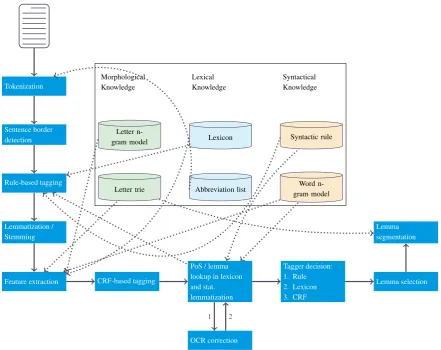
Figure 1 shows the activity diagram of the entire tagging process of TLT-CRF and the different features being in-cluded. For lemmatization, we employ the lemmatizer AliseTraof (Eger, 2015). AliSeTra operates on single to-kens disregarding their textual context. However, since this context can play an important role in choosing the correct lemma of a token, we combine the probability computed by AliSeTra with the one computed by a language model (SRILM – (Stolcke, 2002)) operating on lemma sequences. The total score of a candidate lemma is given by the arith-metic mean of both probabilities (normalized by the sum of the probabilities of all candidates). The morphologi-cal tagging of a tokenxis achieved by, firstly, tagging its PoS and the morphological categories independently
us-ing the same input features. In a second step, TLT-CRF identifies the syntactic word within the FLL that shares the same wordform and the majority of morphological cate-gories assigned to xin the latter step. If such an entry exist, all its morphological features are finally assigned tox. Otherwise, the category values determined by the tagger in the first step are used. With this pipeline ap-proach, we achieved a total morphological tagging accu-racy of 88.08%. We improved this accuaccu-racy to 88.84% via partial joint tagging, which can also be accomplished with older CRF applications like CRFsuite that are not able to handle huge amount of tags. For that, besides of an isolated tagging of morphological labels, we jointly tag certain la-bel combinations (currently onlycase,gender, and num-ber). In case of ties in the above described lexicon lookup, we prefer the lexicon entries that are compliant with the result of the joint prediction.
6.1.
Evaluation
We evaluate TLT-CRF with respect to lemmatization and morphological tagging using the Capitularies corpus (see above). We compare TLT-CRF with Lapos (Tsuruoka et al., 2011), TreeTagger (Schmid, 1994), StanfordTag-ger (Toutanova et al., 2003), OpenNLPTagStanfordTag-ger5and Mar-MoT (M¨uller and Sch¨utze, 2015) by training and evaluat-ing these taggers usevaluat-ing the same data set. The results of our evaluation are shown in Table 2. According to these results, TLT-CRF achieves promising results in compari-son to its state-of-the-art competitors. In our evaluation scenario, MarMoT is definitely the best performing tag-ger. However, TLT-CRF performs second best in the case of tagging PoS. MarMoT and TLT-CRF, which make use of the lexicon, perform best regarding PoS tagging. This stresses the importance of lexical resources. If we consider the inflectional categories in isolation, TLT-CRF performs worse than several of its competitors. However, if we con-sider joint learning of these inflectional categories, TLT-CRF performs second best again (see the line ALL in Table 2). This result shows that a 1st order CRF is a competitive alternative if a 3rd order CRF is out of reach (possibly due to restrictions of training time and processing time). Re-garding the taggers of our evaluation, only MarMoT and TLT-CRF natively support the use of a lexicon (OpenNLP supports a lexicon but this use is not documented). See (Eger et al., 2015) who evaluate an approach to incorporat-ing lexical knowledge into taggers without native lexicon
Tokenization
Sentence border detection
Rule-based tagging
Lemmatization / Stemming
Feature extraction CRF-based tagging
PoS / lemma lookup in lexicon and stat. lemmatization
OCR correction
Tagger decision: 1. Rule 2. Lexicon 3. CRF
Lemma selection Lemma segmentation
1 2
Morphological Knowledge
Lexical Knowledge
Syntactical Knowledge
Letter
n-gram model Lexicon Syntactic rule
Letter trie Abbreviation list Word
n-gram model
Figure 1: The activity diagram of TLT-CRF.
support.
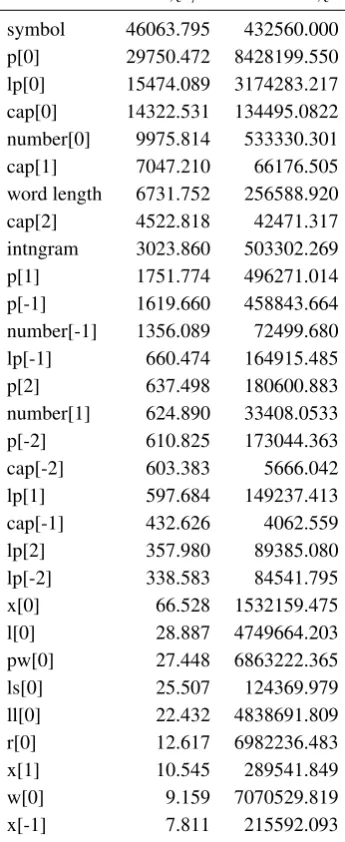
In order to get more insights into tagging accuracy, we in-vestigated the contingency of feature selection and PoS tagging, which may hint at the features’ impact on pre-dicting PoS. In particular, we calculated theχ2coefficient of representational features on the one hand and parts of speech on the other. To allow for comparison of features with different degrees of freedom, i.e., different number of feature values and associated PoS classes, we divide eachχ2coefficient value by its critical valuerfor the
sig-nificance level of 5%. Thus, a ratio above one indicates that feature and PoS are related (in terms of contingency). The most strongly correlated features are shown in Table 1. Numbers in brackets indicate the offsets to the focal token. The following feature abbreviations are used in Table 1:
• cap: focal token is capitalized or not
• intngram: PoS prediction of an intrinsic letter-based ngram model
• l: lemma as determined by a lexicon lookup (currently only unique lemmas are considered)
• ll: lemma as predicted by the lemmatizer
• lp: PoS associated to the lemma that is determined by the lemmatizer
• ls: suffix as determined by removing the lemma string, as determined by the lemmatizer, from the word form string
• number: token is a Roman, respectively an Hindu-Arabic numeral or not
• p: PoS from the lexicon
• r: last 7 characters of a word
• s: word skip-gram
• symbol: focal token is symbol (e.g., ‘.,!?:‘) or not
• w: word
• x: suffix as determined by the stemmer
Feature χ2/r χ2
word length 6731.752 256588.920
cap[2] 4522.818 42471.317
Table 1: The 30 features that are most strongly correlated (in terms of contingency) to the PoS classes.
Note thatcurrent word (w[0])is not among the 20 most strongly correlated features, which is mainly caused by the fact that Latin words are highly ambiguous. For, instance, a lot of adverbs are homonymous with prepositions. The same holds for adjectives and nouns. The evaluation also shows that the features of strongest correlation are located in a context of words that are maximally two tokens away from the focal term. The rule feature is not among the 30 features most strongly correlated to the PoS, but its relative χ-squared value is till considerably above 1 (e.g., 1.38, ab-soluteχ-square: 54.95). While the use of rules as hard
constraints degrades PoS accuracy, there is a small gain when employing them in a soft mode (+0.01%). Finally, one can observe that an intrinsicn-gram model, which is barely used in state-of-the-art PoS taggers, can be quite beneficial.
7.
Conclusion
We presented TLT-CRF as a hybrid morphological tagger for Latin which employs lexicon-based features as well as hand-crafted rules in the framework of 1st order CRFs. According to Table 2, TLT-CRF achieves promising results in comparison to several state-of-the-art competitors. TLT-CRF performs as the second-best tagger regarding PoS tag-ging and joint learning of inflectional categories. Because of its simple architecture that allows for including a wide range of additional morphological, lexical or syntactic fea-tures, it can be seen as a promising candidate for exploring feature-based models in the framework of 1st order CRFs. This finding is advantageous since CRFs of this sort are implemented very efficiently. Note that there are promis-ing alternatives to the CRFsuite which we used for imple-menting TLT-CRF. Unlike MarMoT, for example, CRF-suite does not support higher order models and is quite in-efficient in comparison to state of the art CRF systems. Thus, we plan to replace our current implementation of TLT-CRF by means of MarMoT while relying on the wide set of features studied in this paper.
Acknowledgment
We gratefully acknowledge financial support by the BMBF via the projectswww.comphistsem.org/project.
htmlandwww.cedifor.de/en.
References
Bellegarda, J. R. (2010). Part-of-speech tagging by latent analogy. IEEE Journal of Selected Topics in Signal Pro-cessing, 4(6).
Brants, T. (2000). TnT: A statistical part-of-speech tagger. InProc. of the 6th Conf. on Applied Natural Language Processing, ANLC ’00, pages 224–231.
Eger, S., vor der Br¨uck, T., and Mehler, A. (2015). Lexicon-assited tagging and lemmatization in Latin: A comparison of six taggers and two lemmatization meth-ods. InProc. of LaTeCH 2015, pages 105–113, Bejing.
TLT-CRF MarMoT Lapos TnT Mate TreeTagger Stanford OpenNLP Max.Entr Perceptron
PoS 96.07 96.32 95.86 95.16 95.67 95.15 95.55 94.54 94.11
case 94.93 95.51 94.64 92.86 94.56 92.12 94.58 93.41 92.27
degree 97.22 97.78 97.55 97.09 97.40 97.03 97.30 96.65 96.19
gender 95.62 96.72 96.09 95.35 95.84 94.75 95.83 94.55 93.76
mood 97.19 98.65 98.28 97.73 98.13 97.73 98.12 97.14 97.16
number 97.48 97.92 97.19 96.91 97.04 96.61 97.23 96.03 95.44
person 99.24 99.42 99.25 98.87 99.27 98.89 99.18 98.53 98.40
tense 98.12 98.88 98.53 98.17 98.41 98.12 98.43 97.62 97.54
voice 98.79 99.02 98.79 98.52 98.74 98.55 98.67 98.30 98.23
ALL 88.84 91.48 88.19 85.73 87.66 84.53 85.28 83.38 80.96
Table 2: Tag accuracies in % for different systems and categories (cf. (Eger et al., 2015)). For non-morphological taggers, all inflectional categories and PoS are tagged in isolation. Note that we did not yet evaluate the Mate Morphological Tagger.
Eger, S. (2015). Designing and comparing g2p-type lem-matizers for a morphology-rich language. In 4th Int. Workshop on Systems and Frameworks for Computa-tional Morphology, Stuttgart.
Jussen, B., Mehler, A., and Ernst, A. (2007). A corpus management system for historical semantics. Sprache und Datenverarbeitung. International Journal for Lan-guage Data Processing, 31(1-2):81–89.
Lafferty, J., McCallum, A., and Pereira, F. (2001). Con-ditional random fields: Probabilitistic models for seg-menting and labeling sequence data. InProc. of ICML 2001, St. Petersburg/Russia.
Landauer, T., Foltz, P. W., and Laham, D. (1998). In-troduction to latent semantic analysis. Discourse Pro-cesses, 25(2-–3):259—-284.
Mehler, A., vor der Br¨uck, T., Gleim, R., and Geelhaar, T. (2015). Towards a network model of the coreness of texts: An experiment in classifying Latin texts using the TTLab Latin tagger. In Ch. Biemann et al., editors, Text Mining: From Ontology Learning to Automated text Processing Applications, pages 87–112. Springer, Berlin/New York.
M¨uller, T. and Sch¨utze, H. (2015). Robust morphological tagging with word representations. InProc. of NAACL 2015, pages 526–536, Denver. ACL.
Okazaki, N. (2007). CRFsuite: a fast imple-mentation of conditional random fields (CRFs). http://www.chokkan.org/software/crfsuite/.
Passerotti, M. (2004). Development and perspectives of
the latin morphological analyser lemlat. Linguistica Computazionale, 20–21.
Schmid, H. (1994). Probabilistic parf-of-speech tagging using decision trees. InProc. of Int. Conf. on New Meth-ods in Language Processing, Manchester, UK.
Smith, D., Rydberg-Cox, J., and Crane, G. (2000). The perseus project: A digital library for the humanities. Lit-erary and Linguistic Computing, 15(1):15–25.
Spoustov´a, D. (2008). Combining statistical and rule-based approaches to morphological tagging of czech texts. The Prague Bulletin of Mathematical Linguistics, (89):23–40.
Stolcke, A. (2002). SRILM – an extensible language mod-eling toolkit. InProc. of the International Confernce of Spoken Language Processing, Denver, Colorado. Sutton, C. and McCallum, A. (2007). An introduction to
conditional random fields for relational learning. In Lise Getoor et al., editors, Introduction to Statistical Rela-tional Learning. MIT Press.
Toutanova, K., Klein, D., Manning, C. D., and Singer, Y. (2003). Feature-rich part-of-speech tagging with a cyclic dependency network. InProc. of NAACL 2003, pages 173–180, Stroudsburg, PA, USA.