Deterministic Authenticated-Encryption
A Provable-Security Treatment of the Key-Wrap Problem
P. ROGAWAY∗ T. SHRIMPTON†
Aug 20, 2007
An earlier version of this paper appears inAdvances in Cryptology — EUROCRYPT ’06, Lecture Notes in Computer Science, vol. 4004, Springer, 2006. This is the full version of that paper.
Abstract
Standards bodies have been addressing the key-wrap problem, a cryptographic goal that has never re-ceived a provable-security treatment. In response, we provide one, giving definitions, constructions, and proofs. We suggest that key-wrap’s goal is security in the sense of deterministic authenticated-encryption (DAE), a notion that we put forward. We also provide an alternative notion, a pseudorandom injection (PRI), which we prove to be equivalent. We provide a DAE construction, SIV, analyze its concrete security, de-velop a blockcipher-based instantiation of it, and suggest that the method makes a desirable alternative to the schemes of the X9.102 draft standard. The construction incorporates a method to turn a PRF that operates on a string into an equally efficient PRF that operates on a vector of strings, a problem of independent inter-est. Finally, we consider IV-based authenticated-encryption (AE) schemes that are maximally forgiving of repeated IVs, a goal we formalize as misuse-resistant AE. We show that a DAE scheme with a vector-valued header, such as SIV, directly realizes this goal.
Keywords: Authenticated encryption, cryptographic definitions, cryptographic standards, key wrapping,
modes of operation, provable security, secret-key cryptography, symmetric encryption, X9.102.
∗ Dept. of Computer Science, University of California at Davis, Davis, California 95616, USA; and Dept. of Computer Science,
Faculty of Science, Chiang Mai University, Chiang Mai 50200, Thailand.
Contents
1 Introduction 1
2 The Draft X9.102 Standard 3
3 DAE Security 5
4 Building a DAE Scheme: The SIV Construction 6
5 Enriching a PRF to take Vectors of Strings as Input: The S2V Construction 9
6 The SIV Mode of Operation 11
7 Misuse-Resistant AE 12
8 The PRI Characterization of DAE Security 14
Acknowledgments 16
References 16
A Critique of the Draft X9.102 Standard 18
B All-in-One vs. Two-Requirement Notions for AE 22
C DAEs Achieve Semantic Security when Plaintexts Carry a Key 25
D Building a DAE Scheme: The PTE Constructions 27
E Proof of Security for S2V 31
1
Introduction
The American Standards Committee Working Group X9F1 has proposed four key-wrap schemes in a draft standard known as ANS X9.102, and NIST has promulgated a request for comments on the proposal [13]. The S/MIME working group of the IEEE had earlier adopted a key-wrap scheme [17], and their discussions on this topic go back to at least 1997 [37]. NIST is considering specifying a key-wrap mechanism in their own series of recommendations [M. Dworkin, personal communications]. But despite all this, the key-wrap goal would seem to be essentially unknown to the cryptographic community. No published paper analyzes any key-wrap scheme, and there is no formal definition for key wrap in the literature, let alone any proven-secure scheme. Consequently, the goal of this paper is to put the key-wrap problem on a proper, provable-security footing. In the process, we will learn quite a bit that’s new about authenticated-encryption (AE).
Before proceeding it may be useful to give a very informal description of the key-wrap goal, echoing the wording in [13, p. 1]. A key-wrap scheme is a kind of shared-key encryption scheme. It aims to provide “privacy and integrity protection for specialized data such as cryptographic keys,. . .without the use of nonces” (meaning counters or random bits). So key-wrap’s raison d’ˆetre is to remove AE’s reliance on a nonce or random bits. At least in the context of transporting cryptographic keys, a deterministic scheme should be just as good as a probabilistic one, anyway. Another goal of key wrap is to provide “integrity protection. . .for cleartext associated data,. . .which will typically contain control information about the wrapped key” [13, p. 1].
CONTRIBUTIONS. We begin with a critique of the X9.102 key-wrap schemes, identifying the basic charac-teristics of each of the four algorithms. Overall, we find the proposed mechanisms somewhat disappointing in terms of usage restrictions, efficiency, and foundations. That said, we break none of the four schemes, and we owe this work to their existence. See Section 2 and Appendix A.
Guided by the proposed schemes, we offer a definition for what a key-wrap scheme should do. We call the goal deterministic authenticated-encryption (DAE). A thesis underlying our work is that the goal of a key-wrap scheme is DAE. In a DAE scheme, encryption deterministically turns a key, a header, and a message into a ciphertext. The header (which may be absent, a string, or even a vector of strings) is authenticated but not encrypted. To define security, the adversary is presented either a real encryption oracle and a real decryption oracle (both are deterministic), or else a bogus encryption oracle that just returns random bits and a bogus decryption oracle that always returns an indication of invalidity. For a good DAE scheme, the adversary should be unable to distinguish these possibilities. See Section 3.
Next we provide a DAE construction, SIV. (The acronym stands for Synthetic IV, where IV stands for
Initialization Vector.) The construction combines a conventional IV-based encryption scheme (eg, CTR mode
[27]) and a special kind of pseudorandom function (PRF)—one that takes a vector of strings as input. To encrypt, apply the PRF to the header and the message and use the result as the IV of the encryption scheme. We prove that SIV is a good DAE, assuming its components are secure. See Section 4.
In practice one would want to realize SIV from a blockcipher, and so we show how to turn a PRFf that operates on a single string into a PRFf∗that takes a vector of strings. Under our S2V construction, the cost of computing the PRFf∗= S2V[f]on a vectorX= (X1, . . . , Xn)is at most the total cost to computef on each componentXi, and it can be considerably less, as the contribution from a componentXi can be precomputed if it is to be held constant. See Section 5.
For a concrete alternative to the X9.102 schemes, we suggest to instantiate SIV using modes CTR and CMAC∗ = S2V[CMAC], where CTR is counter mode [27] and CMAC is an arbitrary-input-length variant of the CBC MAC [28]. The specified mechanism removes unnecessary usage restrictions, improves efficiency, and provides provable security. See Section 6.
vector-DAE Deterministic authenticated-encryption. Section 3. The main notion being investigated by this paper.
PRI Pseudorandom injection. Section 8. Like a strong PRP but injective instead of bijective. DAE-security and PRI-security differ by an amount that vanishes exponentially in the stretch of the scheme.
MRAE Misuse-resistant AE, Section 7. Strengthening of the usual definition of nonce-based AE to speak to what happens when a nonce gets reused. Easily constructed from a DAE that handles vector-valued headers.
SIV Synthetic IV. Section 4. Makes a DAE by first applying a PRF to the header and message to get an IV. Also our blockcipher-based mode of operation that instantiates this using CTR mode and S2V-applied-to-CMAC.
S2V String to vector. Section 5. Turns a PRF that takes a string as input into a PRF that takes a vector of strings as input. More efficient than an encoding-based approach.
PTE Pad-then-encipher. Appendix D. Makes a DAE by padding the input and then enciphering. Two versions, depending on how headers are handled. Most natural approach to DAE, but less desirable than SIV.
Figure 1: Roadmap of the new notions and schemes. The first three entries are security notions; the next three entries are schemes. The section reference indicates where the definition of the notion or scheme can be found.
valued header provides an immediate solution: just regard the IV as one component of the header. Adopting this viewpoint, SIV can be regarded as an IV-based AE scheme, one as efficient with respect to blockcipher calls as conventional two-pass AE schemes like CCM [29] but more resilient to IV misuse. See Section 7.
Finally, we give an alternative characterization of DAEs. A pseudorandom injection (PRI) is like a block-cipher except that the block-ciphertext may be longer than the plaintext (also, the message space may be richer than
{0,1}nfor some fixedn, and a header may be provided). We prove PRIs equivalent to DAEs, up to a term that is negligible when the PRI is adequately length-increasing.
Our definition of DAE merges the traditionally separate privacy and authenticity requirements of an AE scheme. It is possible to split the definition into separate privacy and authenticity goals and require both. Doing this yields an equivalent definition. Similarly, the separate privacy and authenticity requirements normally used to define AE [6, 8, 19, 20, 31, 33] can be merged into a single, unified goal. The all-in-one approach for defining AE seems to us simpler and more elegant than giving separate privacy and authenticity definitions and then asking for both. See Appendix B.
A reason for doing key wrap (DAE) instead of conventional (probabilistic) AE is the intuition that, if the plaintext carries a key, there shouldn’t be any need to inject additional randomness into the encryption process. One can formalize and prove this intuition, establishing, in effect, the semantic security of DAE for the context in which keys are embedded into plaintexts. A DAE scheme cannot by itself achieve semantic security because it is deterministic—we are saying that a random enough message space compensates for this, letting you recover the equivalent of semantic security. See Appendix C.
Besides SIV we also provide a second construction, one that uses different primitives. The
pad-then-encipher scheme, PTE, is based on an pad-then-enciphering scheme (ie, a length-preserving encryption scheme, like
CMC [16]). One pads the plaintext (eg, appending 0-bits) before enciphering. We prove the security of PTE. We investigate the pad-then-encipher is the paradigm because it seems to us the most natural approach to solving the key-wrap problem, as well as the approach that underlies two of the X9.102 schemes. See Appendix D.
ROADMAP. Given the number of new acronyms, definitions, and schemes introduced in this paper, the table of Figure 1 may provide a helpful summary. For the security notions, lower-case labels (eg, dae) are used as a superscript for advantage measures (eg,AdvdaeΠ )while their upper-case counterpart (eg, DAE) are used in English prose. Our table omits mention of notions that are standard or whose mention is confined to the appendices.
That said, in many contexts where one would think to use key wrap, one can use a conventional AE scheme, instead. This does not make studying the key-wrap problem pointless. First, it clarifies the relationship between key wrap and conventional AE. Second, DAE leads to misuse-resistant AE, and methods that achieve this aim make practical alternatives to conventional (not misuse-resistant) two-pass AE methods. Finally, practitioners have already “voted” for key-wrap by way of protocol-design and standardization efforts, and it is simply not productive to say “use a conventional AE scheme” after this option has been rejected.
THE SIGNIFICANCE OF HEADERS. We emphasize that our formalization of DAEs includes a header (also called a tweak or associated-data). For cryptographic practice, allowing a header seems to be almost essential. Network security protocols require sending packets only portions of which are encrypted, but all of which must be authenticated and bound together. Good security practice requires keys to be bound to control information such as expiration date and permitted usage, and the binding of keys to such control information has strongly informed security architecture (eg, IBM’s cryptographic control vectors [25]). Regarding headers as vectors facilitates both efficiency advantages and a cleaner abstraction boundary.
FURTHER RELATED WORK. AE goals were formalized over a series of papers [6, 8, 20, 31, 33]. The idea of binding the encryption process to unencrypted strings is folklore, with recent work in this direction includ-ing [23, 31, 36]. Bellare and Rogaway [8] investigate the paradigm of addinclud-ing randomness or redundancy to a plaintext and then enciphering it, an approach related to the ideas and results of Appendices C and D. Rus-sell and Wong [35] introduce a completely different approach for dealing with the encryption of low-entropy messages, and Dodis and Smith [12] extend this entropy-based approach. Phan and Pointcheval [30] study relationships among security notions for conventional (length-preserving and headerless) ciphers. The SIV construction resembles the AE scheme EAX [9]. A less ambitious relaxation on IV requirements than that formalized as misuse-resistant encryption is given in [32]. The proceedings version of this paper was published as [34].
2
The Draft X9.102 Standard
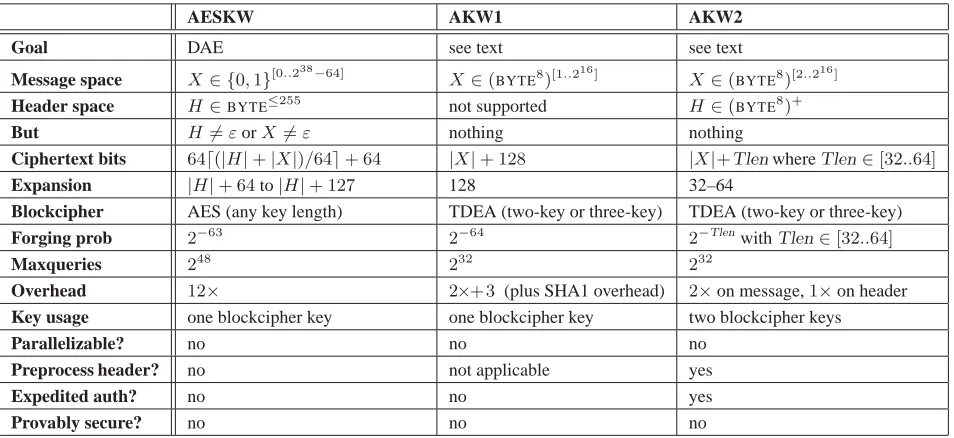
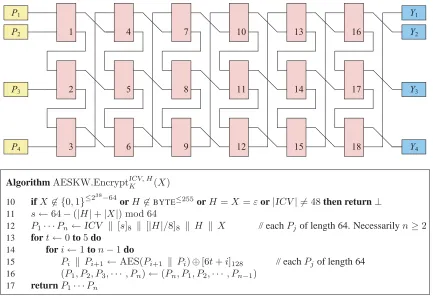
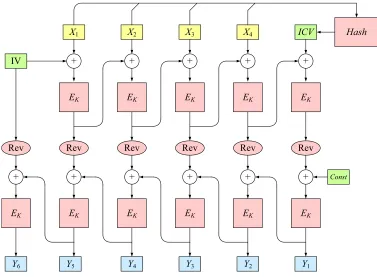
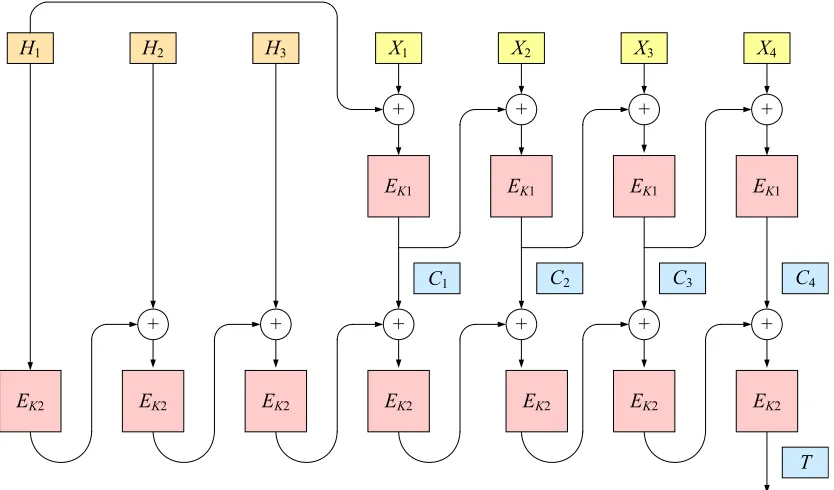
Four key-wrap schemes are defined in the draft ANS X9.102 standard [13]. The schemes are called AESKW and TDKW (which are essentially the same scheme, the former using AES and the later using triple-DES), AKW1, and AKW2. Scheme AESKW is based on a six-round, non-standard Feistel network. It was first proposed by NIST and is pictured and specified in Figure 7. Scheme AKW1 involves two layers of CBC encryption and one application of SHA1. It was developed by the S/MIME working group of the IETF [17] and is pictured in Figure 8. Scheme AKW2 involves a CBC encryption layer and a CBC MAC layer. It was designed to accommodate legacy financial-services devices and is pictured in Figure 9.
AESKW AKW1 AKW2
Goal DAE see text see text
Message space X ∈ {0,1}[0..238−64] X∈(BYTE8)[1..216] X∈(BYTE8)[2..216]
Header space H∈BYTE≤255 not supported H∈(BYTE8)+
But H =εorX=ε nothing nothing
Ciphertext bits 64(|H|+|X|)/64+ 64 |X|+ 128 |X|+TlenwhereTlen∈[32..64]
Expansion |H|+ 64to|H|+ 127 128 32–64
Blockcipher AES (any key length) TDEA (two-key or three-key) TDEA (two-key or three-key)
Forging prob 2−63 2−64 2−TlenwithTlen∈[32..64]
Maxqueries 248 232 232
Overhead 12× 2×+3 (plus SHA1 overhead) 2×on message,1×on header
Key usage one blockcipher key one blockcipher key two blockcipher keys
Parallelizable? no no no
Preprocess header? no not applicable yes
Expedited auth? no no yes
Provably secure? no no no
Figure 2: Basic characteristics of key-wrap mechanisms AESKW, AKW1, and AKW2 from the X9.102 draft. We omit TDKW because of its similarity to AESKW. Explanations of rows are given in the body.
the message space and the header space. Ciphertext bits: Ciphertext length as a function of already-named values. Expansion: How much longer the ciphertext is than the plaintext. Blockcipher: The underlying blockcipher. Forging prob: The target forging probability asserted by the spec. We are not asserting that the scheme actually achieves this value. Maxqueries: The maximum number of plaintext values that may be encrypted in an implementation compliant with the spec. We are not asserting that the scheme is actually secure up to this value. Overhead: The computational overhead, measured in blockcipher calls per block of data (message or header). Scheme AKW1 incurs additional overhead for applying SHA1 to the message. Key
usage: The number of blockcipher keys that key the blockcipher calls. Parallelizable? Can the
computation-time of the mechanism be arbitrarily sped up by adding additional hardware? Preprocess header? Can a fixed header be cryptographically processed just once, as opposed to dealing with it for each and every message?
Expedited auth? Is it faster to see if a ciphertext is inauthentic than to fully decrypt it? Provably secure?
Does the mechanism enjoy any provable-security guarantee? That is, has a proof of security been offered, under standard or reasonable assumptions, that the mechanism achieves some well-defined and desirable goal?
INTERPRETATION. Given Figure 2 and the associated discussion in Appendix A, our conclusion is that none of the X9.102 algorithms are mature. Most severely, none has been proven secure—and, prior to this paper, there was not even a clear target for a security proof. Each scheme has multiple problems from among the following: a restricted message space; an inability to handle an associated header; a restricted header space; ciphertext lengths that grow with the header length (even though the header is only authenticated); a large number of blockcipher calls; mysterious aspects of the construction (eg, the byte-reversals or xoring-in counters); and use of cryptographic primitives beyond a blockcipher. For a modern encryption scheme one might reasonably hope for a formally defined and provably achieved security goal, an aesthetic construction coming out of an enunciated paradigm, message headers being supported and the message space and header space being large and natural sets, message expansion of some fixed value, one or two blockcipher calls per block, and further efficiency characteristics (like being able to cheaply handle static headers).
abstraction boundary one is thinking in terms of is a blockcipher, too low-level a tool to make a convenient conceptual starting point.
3
DAE Security
NOTATION. For a distributionS letS← S$ mean that S is selected randomly fromS (ifS is a finite set the
assumed distribution is uniform). All strings are binary strings. When X andY are strings we write XY for their concatenation. WhenX ∈ {0,1}∗ is a string|X|is its length and, if1≤i≤j≤ |X|, thenX[i..j]
is the substring running from itsith tojth characters, or the empty stringεotherwise. By a vector we mean a sequence of zero or more strings, and we write {0,1}∗∗for the space of all vectors. We write a vector as
X = (X1, . . . , Xn)wheren=|X|is its number of components. IfX = (X1, . . . , Xn)andY = (Y1, . . . , Ym)
are vectors thenX, Y is the vector(X1, . . . , Xn, Y1, . . . , Ym). In pseudocode, Boolean variables are silently
initialized to false, sets are initialized to the empty set, and partial functions are initialized to everywhere undefined (set toundef). An adversary is an algorithm with access to one or more oracles, which we write as superscripts. ByAO ⇒1we mean the event that adversaryA, running with its oracleO, outputs 1. When an adversary has an oracle with an expressed domainDwe understand that the oracle returns the distinguished value⊥, read as invalid, if the adversary asks a query outside ofD.
SYNTAX. A scheme for deterministic authenticated-encryption, or DAE, is a tupleΠ = (K,E,D). The key
spaceKis a set of strings or infinite strings endowed with a distribution. For a practical scheme there must be a probabilistic algorithm that samples fromK, and we identify this algorithm with the distribution it induces. The encryption algorithm E and decryption algorithm D are deterministic algorithms that take an input in
K × {0,1}∗∗× {0,1}∗and return either a string or the distinguished value⊥. We writeEKH(X)orEK(H, X)
forE(K, H, X)andDKH(Y)orDK(H, Y)forD(K, H, Y). We assume there are setsH ⊆ {0,1}∗∗, the header
space, andX ⊆ {0,1}∗, the message space, such thatEKH(X) ∈ {0,1}∗iffH ∈ HandX ∈ X. We assume thatX ∈ X ⇒ {0,1}|X| ⊆ X. The ciphertext space is Y = {EKH(X): K ∈ K, H ∈ H, X ∈ X }. We requireDHK(Y) = X ifEKH(X) = Y, andDKH(Y) = ⊥if there is no suchX. It will be our convention that
EH
K(⊥) = DKH(⊥) = ⊥for allK ∈ K andH ∈ H. For anyK ∈ K,H ∈ H, andX ∈ X, we assume that |EH
K(X)| = |X|+e(H, X) for a functione: {0,1}∗∗× {0,1}∗ → Nwheree(H, X)depends only on the
number of components ofH, the length of each of these components, and the length ofX. The functioneis called the expansion function of the DAE scheme. Often we are concerned with the minimum expansion that might arise, and so define the numbers= minH∈H,X∈X{e(H, X)}as the stretch of the scheme.
Among what is formalized above: (1) encryption and decryption are given by algorithms, not just functions; (2) trying to encrypt something outside of the header space or message space returns⊥; (3) trying to decrypt something that isn’t the encryption of anything returns ⊥; (4) if you can encrypt a string of some length you can encrypt all strings of that length; and (5) the length of a ciphertext exceeds the length of the plaintext by an amount that depends on, at most, the length of the plaintext and the length of the components of the header.
A DAE is length-preserving ife(H, X) = 0for allH ∈ H,X ∈ X. An enciphering scheme is a length-preserving DAE. A tweakable blockcipher is an enciphering scheme where the plaintext space isX ={0,1}n
for somen≥1. A blockcipher is a tweakable blockcipher where the header spaceH={ε}is a singleton set; as such, we omit mention of it and writeE: K × {0,1}n→ {0,1}n.
SECURITY. We now give our formalization for DAE security.
Definition 1 Let Π = (K,E,D) be a DAE scheme with header space H, message spaceX, and expansion functione. The DAE-advantage of adversaryAin breakingΠis defined as
AdvdaeΠ (A) = Pr
K← K$
On queryH ∈ H,X ∈ X, the adversary’s random-bits oracle$(·,·)returns a random string of length|X|+ e(H, X). As always, oracle queries outside the specified domain return⊥. The⊥(·,·)oracle returns⊥on every input. We assume that the adversary does not ask(H, Y)of its right (ie, second) oracle if some previous left (ie, first) oracle query(H, X)returnedY; does not ask(H, X)of its left oracle if some previous right-oracle query(H, Y) returnedX; does not ask left queries outside ofH × X; and does not repeat a query. The last two assumptions are without loss of generality, as an adversary that violated any of these constraints could be replaced by a more efficient and equally effective adversary (in theAdvdaeΠ -sense) that did not. The first two assumptions are to prevent trivial wins.
DISCUSSION. The DAE-notion of security directly captures the amalgamation of privacy and authenticity. Assume thatAdvdaeΠ (A)is insignificantly small for any reasonable adversary. Then, for privacy, we know that any sequence of distinctEK-queries results in a distribution on outputs resembling a distribution on outputs that depends only on the length of each query (in fact, the outputs look like random strings of the appropriate lengths). For authenticity we have that, despite the ability to perform a chosen-plaintext attack (as provided by theEKoracle), we are unable to come up with a new queryY for whichDHK(Y)=⊥.
It is possible to disentangle the privacy and authenticity notions in theDAEdefinition, defining separate notions for deterministic privacy and deterministic authenticity. We do this in Appendix B, and explain why asking for both of these conditions is equivalent toDAE. While the traditional approach for defining AE has been to split the goal into two separate properties, the unified definition seems to us nicer and more succinct.
We point out that the DAE notion does not formalize the idea that the party that produces a valid ciphertext (a value that decrypts to something other than⊥) necessarily knows the underlying keyK. One could formalize this, but it would not coincide with DAE. Sometimes the key-wrap goal has been described in these terms. We suspect that when security-designers speak of having to know the key in order to produce a valid ciphertext what they typically mean is not a proof of knowledge, but just the inability for a party to produce a valid ciphertext in the absence of the key. It is the latter notion that is well captured by our DAE definition.
4
Building a DAE Scheme: The SIV Construction
CONVENTIONALIV-BASED ENCRYPTION SCHEMES. Encryption modes like CBC and CTR are what we call
conventional IV-based encryption schemes. Such a schemeΠ = (K,E,D)is syntactically similar to a DAE but in this context the header spaceHis a set of strings and is renamed the IV space,IV. We expect only privacy in a conventional IV-based encryption scheme, and demand a random IV. This makes the security notion rather weak, but sufficient for our purposes. The following definition captures the desired notion.
Fix a conventional IV-based encryption schemeΠ = (K,E,D)with IV-spaceIV ={0,1}n. For simplicity, assumeΠis length-preserving. LetE$be the probabilistic algorithm defined fromE that, on inputK ∈ Kand
M ∈ {0,1}∗, chooses anIV ← {$ 0,1}n, computesC ← EKIV(M) and returnsIV C. Then we define the advantage of adversaryAin violating the privacy ofΠby
Advpriv$Π (A) = Pr
K← K$ : AEK$(·)⇒1
−Pr
A$(·)⇒1
where the$(·)oracle, on inputM, returns a random string of lengthn+|M|. We assume that the adversary never asks a queryM outside of the message spaceX ofΠ.
X
C IV
EK2
FK1
IV’ if =
Hm X
C IV
DK2
H1 ...
...
FK1 Hm
H1 ...
...
AlgorithmEK 1,K2(H, X)
IV ←FK1(H, X)
C← EIV
K2(X)
returnY ←IV C
AlgorithmDK 1,K2(H, Y)
if|Y|< nthen return⊥
IV ←Y[1.. n], C←Y[n+ 1..|Y|] X← DIV
K2(C)
IV ←FK1(H, X)
ifIV=IVthen returnXelse return⊥
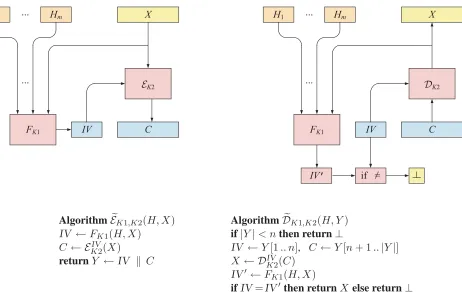
Figure 3: The SIV construction. The left side illustrates and defines encryption, the right side, decryption. The header isH = (H1, . . . , Hm), the plaintext isX, the key is(K1, K2), and the ciphertext isY =IV C. FunctionF: K1× {0,1}∗∗→ {0,1}nis a PRF and(K2,E,D)is an IV-based encryption scheme, such as CTR mode.
adversary. The advantage ofAin violating the pseudorandomness ofF is
AdvprfF (A) = Pr
K ← K: AFK(·)⇒1−Prρ←$ Func(X, n) : Aρ(·) ⇒1 .
It is tacitly assumed that the adversary has a mechanism of naming points inX by strings; ifX ⊆ {0,1}∗ then a string names itself, but ifX is not a set of strings then points ofX are encoded as strings in some natural way. Our definition of PRFs is unusual for allowing the inputXto be arbitrary (possibly not a string).
THE SIV CONSTRUCTION. Let F: K1 × {0,1}∗∗ → {0,1}nbe a PRF. Let Π = (K2,E,D)be a conven-tional IV-based encryption scheme with IV-lengthn and message spaceX. We writeFK(H, M)instead of
FK((H, M)). We construct from(F,Π)a DAEΠ = SIV[F,Π] = (K,E,D)with header space{0,1}∗∗and
message space X whereK = K1 × K2 and the encryption and decryption algorithms are as illustrated and defined in Figure 3. Recall thatY[n+ 1..|Y|] =εif|Y|< n.
We will now show that ifF is PRF-secure andΠis IND$-secure thenΠ = SIV[F,Π]is DAE-secure. The intuition behind the proof is this. If any bit of the header H or plaintext X is new then the string IV will look like a random string and soIV Cwill be difficult to distinguish from random bits. On decryption, the adversary must create a new(H, Y)whereY =IV C. Let’s imagine giving the adversary the corresponding plaintextXfor free. Now(H, X)is new because(H, X)determines(H, Y)and the adversary is not allowed to decipher values that it trivially knows the decipherment of. But if(H, X) is new thenIV is adversarially unpredictable and so its chance of being equal toIV is only about2−n.
In the following result we writeTimeΠ(μ), whereΠ = (K,E,D)is an IV-based encryption scheme and
time plus program size, all relative to some fixed RAM model of computation.
Theorem 2 LetF: K1 × {0,1}∗∗ → {0,1}n be a PRF and let Π = (K2,E,D) be a conventional IV-based encryption scheme with message space X and IV-lengthn. LetΠ = SIV[F,Π]. LetA be an adversary (for attacking Π) that runs in timet and asksq queries, these of total lengthμ. Then there exists adversaries B andDsuch that
Advpriv$Π (B) +AdvprfF (D) ≥ AdvdaeΠ (A)−q/2
n.
What is more,B andDrun in time at mostt =t+ TimeΠ(μ) +cμfor some absolute constantcand ask at mostqqueries, these of total lengthμ.
Proof: The proof proceeds in two stages. First we consider the DAE schemeG= SIV[Func({0,1}∗∗, n),Π]
(replacing the functionFK1 with a random functionρ ∈ Func({0,1}∗∗, n)). Then we extend this to account
for the insecurity of the PRFF.
Denote the forward and reverse algorithms associated to GasGρ,K2 andGρ,K−12, with(ρ, K2)being the key.
Letδ=AdvdaeG (A)andq=qL+qRandμ=μL+μRwhereqLandqRare the number of left and right oracle
queries, these totalingμLandμRbits, respectively. With the obvious simplifications in notation we have
δ = Pr
AGρ,K2(·,·), Gρ,K−1 2(·,·) ⇒1−PrA$(·,·),⊥(·,·)⇒1
=
Pr
AGρ,K2(·,·), Gρ,K−12(·,·)⇒1−PrAGρ,K2(·,·),⊥(·,·)⇒1
+
Pr
AGρ,K2(·,·),⊥(·,·) ⇒1−PrA$(·,·),⊥(·,·)⇒1 = p 1+p2
wherep1 andp2 represent the corresponding parenthesized expressions; it remains to bound these quantities. For p2 we construct from Aan adversary Bg for attacking the priv$-security ofΠ. LetB runA. WhenA asks its left-oracle a query (H, X), let B ask g(M) and return the result toA. When A asks a right-oracle query have B return ⊥. When A halts with output bit b, let B output b. Notice that ifg = EK$ then B properly simulatesGρ,K2(·,·),⊥(·,·)oracles forA(here we need the assumption thatAnever repeats a query).
Similarly, ifg= $thenBsimulates$(·,·),⊥(·,·)oracles forA. Hencep2 ≤Advpriv$Π (B).
To boundp1 consider giving the keyK2to the adversary and then asking it to carry out its distinguishing task. As this can only make the task easier we may assume
p1 = Pr
AGρ,K2(·,·), Gρ,K−12(·,·)⇒1−PrAGρ,K2(·,·),⊥(·,·)⇒1
≤ Pr
A(K2)Gρ,K2(·,·), G−ρ,K12(·,·)⇒1
−Pr
A(K2)Gρ,K2(·,·),⊥(·,·)⇒1 .
We can assume without loss of generality that Ahalts and outputs 1 as soon as a right-oracle query returns something other than ⊥. Under this assumption, encryption queries are useless for distinguishing between these two oracle pairs, as prior to the right oracle returningM = ⊥both pairs behave asGρ,K2(·,·),⊥(·,·).
Hencep1 is bounded by the probability thatAasks a right-oracle query(H, Y)such thatGρ,K−1 2(H, Y) =⊥. Examining the algorithm forG−ρ,K1 2 we see that this occurs only whenρ(H, X) = IV, whereX = DIVK2(C)
(withY having been parsed intoIV andC). Since the adversary is given the keyK2, it can computeDIVK2(C)
For the second part of the proof note that
AdvdaeΠ (A) = δ+ Pr
AEK1,K2(·,·),DK1,K2(·,·)⇒1−PrAGρ,K2(·,·),G−ρ,K12 ⇒1
whereΠ = ( K1× K2,E,D)and we have suppressed the random selectionsK1← K$ 1andK2← K$ 2. LetDg be an adversary for attackingFas a PRF, and let it operate as follows. AdversaryDpicksK2← K$ 2and runsA. WhenAasks a left oracle query(H, X),B answers by settingIV ←g(H, X), computingC ← EKIV2(X)and returning to Athe stringIV ||C. On a right oracle query (H, Y), adversary DparsesIV = Y[1..n], C = Y[n+ 1..|Y|], computesX ← DKIV2(C)and tests ifIV =g((H, X)), returningXtoAif so and⊥otherwise. WhenAhalts with output bitb, letDoutputb. ClearlyDcorrectly simulatesEK 1,K2(·,·),DK 1,K2(·,·)when
its oracleg = FK1 for some random keyK1, and GK1,K2(·,·), G−K11,K2(·,·) if insteadg = ρ for a random
ρ∈Func(M, n). So,AdvdaeE (A)≤δ+AdvprfF (D)and rearranging gives the result.
5
Enriching a PRF to take Vectors of Strings as Input: The S2V Construction
THE GOAL. Traditionally, a pseudorandom function (PRF) takes a single string as input: under the control of a keyK, a PRF f maps a stringX ∈ {0,1}∗ into a stringfK(X). But SIV uses a non-traditional PRF—a
functionF that, under the control of a keyK, maps a vector of stringsX = (X1, . . . , Xm) ∈ {0,1}∗∗into a stringFK(X). Let us call a PRF that takes a string as input an sPRF (string-input PRF) and a PRF that takes
a vector of strings as input a vPRF (vector-input PRF). This section is about efficient ways to turn an sPRFf into a vPRFf∗.
At first glance it might seem like there’d be little to say about sPRF-to-vPRF conversion: there’s an obvious approach for solving the problem, and it’s obviously correct. Namely, encode any vector of strings X = (X1, . . . , Xm)into a single stringX and apply the sPRF to that,fK∗(X) = fK(X). By encode we mean any reversible, easily-computed map of a vector of strings into a single one, say
X1, . . . , Xm = X1 N1 · · · Xm Nm
whereNi =|Xi|64 is the length ofXi encoded into 64 bits (assume that|Xi| < 264 for alli). The problem
with making a vPRF in such a way is a diminution of efficiency. First, computingfK∗(X)may take longer than the total time to computefK(Xi)for each componentXisince we have added64mbits for length annotation. (As an example, if f = CMAC-AESthen we are doubling the time to MAC X = (X1) where X1 is 16-bytes. CMAC was designed to avoid any unnecessary blockcipher calls and it seems a shame to squander this effort with sloppy sPRF-to-vPRF conversion.) Second, even if some components ofX stay fixed (sayX2 is constant), we must still re-process the entire encoded string each time we compute fK∗ at a new value. Third, the mechanism is not parallelizable; one cannot processXiuntil one is done processingXi−1. Fourth,
the assumption that |Xi| < 264, while reasonable in practice, is artificial and potentially wasteful, yet use of a stingier encoding will lead to greater complexity. Finally, the given encoding disrupts word alignment: if, for example, the first argument is one byte and all subsequent arguments are multiples of eight bytes, an implementation will now be dealing with non-word-aligned data. Fixing this problem by a smarter encoding will lead to increased complexity. We aim to do sPRF-to-vPRF conversion in a way that fixes the problems above.
NOTATION. Fix a valuen ≥ 2. Let0 = 0nand1 = 0n−11and2 = 0n−210. These are regarded as points in finite field F2n represented using a primitive polynomial in the customary way. For S ∈ {0,1}n let 2S
mean then-bit string representing the product of2andS. This can be computed with a left shift ofSfollowed by a conditional xor. By2iS we mean to do this multiplication by 2a total of itimes. ByN ⊕endX
fK
Y1
fK
Y3
X1 X2 X3 X4
fK
Y2
fK
Z T
dbl
end
fK
Y1
fK
Y3
X4
fK
Y2
fK
Z T
10*
X1 X2 X3
dbl dbl dbl
dbl fK (0)
dbl fK (0)
dbl
AlgorithmfK∗(X1, . . . , Xm) The S2V Construction,f∗= S2V[f]
10 ifm= 0then returnfK(1)
11 S←fK(0)
12 fori←1tom−1doS←2S⊕fK(Xi)
13 if|Xm| ≥nthenT ←S⊕endXmelseT ←2S⊕Xm10∗ 14 returnZ←fK(T)
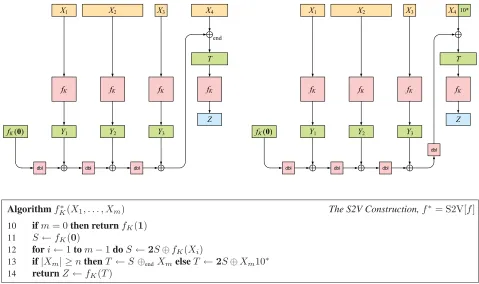
Figure 4: The S2V construction makes a PRFf∗: K × {0,1}∗∗ → {0,1}n from a PRFf: K × {0,1}∗ → {0,1}n.
Bottom: Definition of S2V. StringsX1, . . . , Xm ∈ {0,1}∗andm ≥0are arbitrary. Top: Illustration of it, computing
Z =fK∗(X1, X2, X3, X4). The left side shows the case for|X4| ≥n, the right side for|X4|< n
N ⊕end X = (0x−nN)⊕Xwherex = |X|. ByX10∗ we meanX10i wherei ≥ 0is the least number such
that|X|+ 1 +iis divisible byn.
THE S2V CONSTRUCTION. Let f: K × {0,1}∗ → {0,1}n be an sPRF. We construct from it the vPRF
f∗ = S2V[f]wheref∗: K × {0,1}∗∗→ {0,1}n
is specified and illustrated in Figure 4. The special treatment of the last component of input,Xm, is to handle the case where|Xm|< n. The construction has the desired
efficiency characteristics. The time to computefK∗(X)is essentially the sum of the times to computefK(Xi)
on each component; in particular, whenf =CMAC, say, the number of blockcipher calls to computefK∗(X)
is the sum of the number of blockcipher calls to compute each fK(Xi). Also, one can preprocess invariant
components so that the time to computefK∗(X)will not significantly depend on them. The computation off∗ is on-line (assuming thatf itself is on-line); in particular, the component lengths need not be known in ad-vance. Word alignment is not disrupted. And the scheme is parallelizable: different arguments can be acted on simultaneously, sof∗will be parallelizable iff is.
In a related effort we have proven the following result. The complexity-theoretic analog of Theorem 3 follows in the usual way. We only prove security when queries are restricted to vectors withn−1or fewer components. In practicen≥64well exceeds the number of components in a vector of associated data, making the restriction irrelevant. The proof appears in Appendix E.
Theorem 3 Let f = Func({0,1}∗, n) andf∗ = S2V[f]. Let A be an adversary that asks at most q ≥ 3
vector-valued queries having p components in all, and each vector having fewer than n components. Then
Advprff∗(A) ≤ pq/2n.
the standard way, so we omit a proof of the following:
Corollary 4 Letf: K × {0,1}∗ → {0,1}nbe a PRF and letf∗ = S2V[f]. LetAbe an adversary that runs in timetand asksq ≥3vector-valued queries, theqqueries having a total ofpcomponents andμbits and each vector having fewer thanncomponents. Then there exists an adversaryB where
Advprff (B)≥Advfprf∗(A)−pq/2n
andB asksq queries having a total ofpcomponents andμbits andB runs in timet+c(μ+p+q)for some absolute constantc.
PRACTICAL USES OFS2V. In the next section we will use the S2V construction for sPRF-to-vPRF conversion to make a DAE scheme. But we point out that real-world security protocols already employ, implicitly, PRFs that operate on vectors of strings. They usually do this in a complex and inefficient manner. A good illustration is the TLS protocol; they define a PRF that operates on 2-vectors, the PRF defined in a complex and feedback-dependent way from HMAC-MD5 and HMAC-SHA1. Then, wanting to apply the PRF to vectors with more than two components, they concatenate logically-separate strings to form the second component. Similarly, IEEE 802.11r does key derivation by applying a PRF to input that includes long constants (host and user names) that remain fixed across many derivations. We suggest that when a security protocol wants to apply a PRF to what is logically a vector of strings the protocol should realize this with just such an abstraction. Concatenation should be avoided in achieving that abstraction (because it is, in general, both inefficient and wrong). The vPRF primitive should be realized in the protocol as a higher-level abstraction made from an sPRF.
6
The SIV Mode of Operation
SIV MODE. Forn ≥ 64, fix an n-bit blockcipher E. Let Π = CTRbe counter mode [27] over E. For concreteness and implementation convenience, let the increment function used for CTR mode be the addition of one modulo2n. Before any increments, again for implementation convenience (see below), let us zero-out the leftmost bit in each of the last two 32-bit words of the counter. (The loss of two bits of a random IV has inconsequential impact on the priv$-security of CTR mode.) LetF =CMAC∗ = S2V[CMAC]be the result of applying the S2V construction to CMAC [28], with an underlying blockcipher ofE. (Recall that CMAC [28] is a NIST-recommended CBC MAC variant with message space{0,1}∗.) Consider the scheme SIV[F,Π]. By combining Theorems 2 and 3 and known results about CMAC and CTR mode [3, 18], the suggested mechanism is a provably secure DAE scheme assumingEis a secure PRP. The proven security falls off, as usual, inσ2/2n
whereσis the total number of blocks asked about. We overload the name SIV and call the mode of operation just described SIV mode. See Figure 5 for the specification. The addition operation shown there has the natural interpretation, modulo2n, whileB &C denotes the bitwise-and of equal-length stringsB andC. The only thing left unspecified in the definition of SIV mode is the underlying blockcipherE, which would typically be AES.
COMMENTS. Comparing SIV-AES and the X9.102 scheme AESKW, say, we note that, with SIV-AES, (1) the message space and header space are now{0,1}∗ instead of unusual sets; (2) message expansion is now inde-pendent of header length and message length; (3) the number of blockcipher calls is reduced by a factor of at least six; (4) vector-valued headers can now be handled, and the contribution of any component can be pre-processed if it is to be held fixed; (5) one now has a provable-security guarantee, falling off inσ2/2n, whereσ is the total number of message blocks acted on. On the other hand, there is an effective attack on SIV if one can ask this many message blocks, while we do not know if this is true for AESKW.
AlgorithmEKH11,...,HK2 t(X)
IV ←CMAC∗K1(H1, . . . , Ht, X)
C←CTRK2(IV, X)
returnY ←IV C
AlgorithmDH1,...,Ht
K1K2 (Y) if|Y|< nthen return⊥
IV ←Y[1.. n], C←[n+ 1..|Y|]
X ←CTRK2(IV, C)
IV←CMAC∗K1(H1, . . . , Ht, X)
ifIV=IVthen returnXelse return⊥
Algorithm CMAC∗K(X1, . . . , Xm)
S←CMACK(0) //precompute
fori←1tom−1doS←2S⊕CMACK(Xi)
if|Xm| ≥n
then return CMACK(S⊕endXm) else return CMACK(2S⊕Xm10∗)
AlgorithmCTRK(IV, X) Ctr ←IV & 1n−64 0131 0131
Pad ←EK(Ctr) EK(Ctr+1) EK(Ctr+2) · · ·
returnC←X ⊕ Pad[1..|X|]
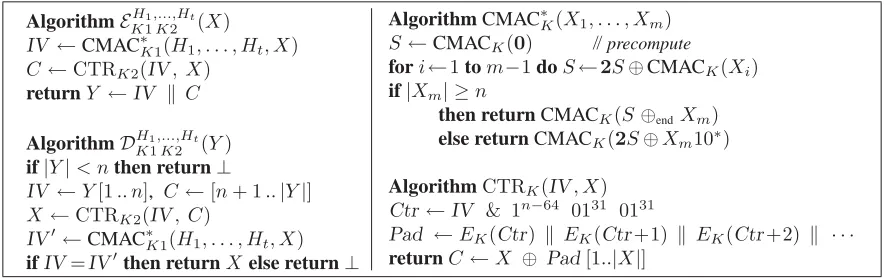
Figure 5: The SIV mode of operation. The mechanism is the generic SIV scheme instantiated using CMAC∗and CTR modes, each of these based on a blockcipherE: K × {0,1}n→ {0,1}n.
by a single “cryptographic” pass over the plaintext, plus a universal-hash-function computation over the header and plaintext. Similarly, a parallelizable MAC like PMAC [10] could have been used in place of CMAC, illustrating that DAE can be achieved by a parallelizable scheme. And if all messages to be encrypted were of one length, that length being a positive multiple of the blocksize, then the raw CBC MAC could have replaced CMAC.
Our earlier descriptions of SIV mode used a different incrementing function within CTR mode, multiplying by two in the finite field with2npoints. We made this choice for reasons of economy of techniques: doubling in the finite field was already used within S2V, as well as in CMAC. But, in software, especially when coding in a high-level programming language, finite-field doubling is a little bit expensive to be doing with every
n-bit word of plaintext. So we have switched to modulo 2n increment, but where one first clears the most significant bit in each of the last two 32-bit words of the counter. This zeroing-out ensures that if|M| ≤n231
bits (ie, 32 GBytes for n = 128) there can be no carry-out of the last 32-bit word, making an increment of
Ctr (modulo2n) equivalent to incrementing just its last 32-bit word (modulo232). Similarly, if|M| ≤ n263
bits (as it invariably will be), an increment ofCtr (modulo2n) is equivalent to incrementing its final 64 bits (modulo 264). Of course from a provable-security point of view, all of these details are irrelevant, since all reasonable instantiations of CTR mode will achieve essentially the same priv$-security.
7
Misuse-Resistant AE
This section gives an application of DAEs motivated not by the key-wrap problem but by the goal of construct-ing symmetric encryption schemes that are resistant to misuse. We are specifically concerned with IV-misuse, meaning that the IV is used in a way other than the way mandated by the scheme; for example, using a counter when the scheme requires a random value, or repeating an IV when the scheme requires it to be a nonce. Ex-perience has shown that IVs are frequently mishandled. An encryption scheme robust against misuse should at least be an AE scheme (as programmers, protocol designers, and even books often assume that encryption provides for authenticity) and so we will treat IV-misuse within the context of authenticated encryption and not privacy-only encryption. The notion is applicable to the latter context, too.
have been used with this particular IV. Our formalization will capture this intent.
REVISED SYNTAX FOR AN IV-BASED ENCRYPTION SCHEME. Let us update the syntax of a conventional IV-based encryption scheme to accommodate an associated header. In this case an IV-based encryption scheme is a tupleΠ = (K,E,D) where everything is as before except that the encryption algorithm and decryption algorithm take an extra argument: now they are deterministic algorithms that mapK × {0,1}∗∗× {0,1}∗× {0,1}∗to{0,1}∗∪ {⊥}. We writeEK(H,IV, X)orEKH,IV(X)in place ofE(K, H,IV, X)andDK(H,IV, C)
orDH,KIV(Y)in place ofD(K, H,IV, Y). There must be setsH, IV, andX such thatEKH,IV(X) ∈ {0,1}∗
iff H ∈ HandIV ∈ IV andX ∈ X. We callIV the IV space of Π. We require thatDH,KIV(Y) = X if
EKH,IV(X) =Y andDKH,IV(Y) =⊥if there is no suchX.
MISUSE-RESISTANT AE SECURITY. To measure the AE-security of an encryption scheme Π = (K,E,D)
in the face of possible IV-reuse, imagine an adversary that may ask any sequence of encryption queries, even those that repeat IVs, and any sequence of decryption queries, which may likewise repeat IVs. We want the encryption oracle to return bits that look random except when this is impossible—on a repeated triple of (header, IV, message)—and the decryption oracle should return⊥except when the triple is already known to have a valid decryption. For simplicity, assume as before that our IV-based encryption scheme is length-preserving.
Definition 5 LetΠ = (K,E,D)be an IV-based encryption scheme that can handle an associated header and letAbe an adversary. Then the MRAE-advantage ofAin attackingΠis
AdvmraeΠ (A) = Pr
K← K$ : AEK(·,·,·),DK(·,·,·) ⇒1−PrA$(·,·,·),⊥(·,·,·)⇒1 .
The adversary may not repeat a left-query and may not ask a right-query(H,IV, Y)if some previous left-query
(H,IV, X)returnedY.
Of course the EK oracle returnsEK(H,IV, X) on input(H,IV, X) andDK returnsDK(H,IV, Y) on input
(H,IV, Y). As before$(H,IV, X)returns a random string of lengthn+|X|and⊥(·,·,·)always returns⊥. The MRAE-notion of security trivially implies nonce-based AE-scheme security: the latter is the special case where the adversary is not allowed to repeat anIV to any left query. Note that all proposed AE schemes to date [19, 21, 26, 29, 33] do fail should an IV get repeated: existing AE schemes are not MRAE-secure.
BUILDING A MISUSE-RESISTANTAESCHEME. We can turn a DAE schemeΠ = (K,E,D)with header space
{0,1}∗∗and message spaceX into a misuse-resistant AE schemeΠ = ( K,E,D)by regarding the IV as one of the components, say the last component, of the header. In particular, SIV mode can be regarded as an MRAE scheme by asserting that one of the header components, say the last one specified, is an IV.
CORRECTNESS. Correctness of the MRAE scheme described above is nearly immediate. Given an adversaryA for breaking the misuse-resistant AE scheme (it distinguishesEK(·,·,·), DK(·,·,·)from$(·,·,·), ⊥(·,·,·)) we get a comparably good adversaryBfor breaking the DAE, distinguishingEK(·,·), DK(·,·)from$(·,·), ⊥(·,·): adversaryBrunsAand maps left queries(H,IV, X)to queries(H,IV, X), and maps right queries(H,IV, Y)
to queries(H,IV, Y). The syntax and DAE-security notion for a PRI have been designed to “match up” so that there is nothing to do.
COMMENTS. Since all we have done in the construction is to hijack a component of the header as an IV, it seems as though nothing has actually been done. Yet the MRAE goal is conceptually different from the DAE goal, the former employing an IV and gaining for this a stronger notion of security. The header and the IV are conceptually different, the one being user-supplied data that the user wants authenticated, the other being a mechanism-supplied value needed to obtain a strong notion of security.
from a vector-input PRF and an IND$-secure conventional encryption scheme. At least if one is unconcerned with optimizing efficiency, a vector-input PRF is easily made from a string-input PRF. String-input PRFs and IND$-secure conventional encryption schemes can be built from blockciphers by well-known means. So each step along our path is easy or well-known. Still, the direct construction of an MRAE or DAE scheme from a blockcipher is not a simple matter, as evidenced by the long history of buggy or baroque AE schemes Perhaps simple is how things seem after finding the right abstraction boundaries.
8
The PRI Characterization of DAE Security
A secure pseudorandom injection (PRI) resembles a random injective function with the desired amount of length-expansion. We allow a chosen-ciphertext attack in our definition (that is, we focus on a “strong” PRI, analogous to a strong PRP [24]), giving the adversary both the forward and backward direction of the function. We allow the PRI to be tweakable [23], so that the scheme can be used to authenticate an associated header. We allow the domain to be fairly arbitrary—in particular, we consider message spaces that contain strings of various lengths.
Formally, letΠ = (K,E,D)be a DAE with header spaceHand message spaceX. Imagine an adversaryA given access to two oracles—one forE and one forD. We want to say that this pair looks just like a random injectionfand its inversef−1, the random injectionf having the same signature asE. Fore: H × X →Nlet
InjH
e (X,Y)be the set of all injective functionsf fromH × X toYsuch that|f(H, X)|=|X|+e(H, X).
Definition 6 Let Π = (K,E,D) be a DAE with header space H, message space X, and expansione. The
PRI-advantage of adversaryAin breakingΠis
AdvpriΠ (A) = Pr
K← K$
: AEK(·,·),DK(·,·)⇒1−Prf ←$ InjH
e(X,Y) : Af(·,·), f−1(·,·)⇒1
.
Thef−1 oracle above, on input(H, Y)returns the pointX such thatf(H, X) =Y; if there is no such point then it returns the distinguished value⊥. Recall that oracle queries outside the domain of the oracle return⊥. As before, we may assume without loss of generality that the adversary does not repeat a query, that it does not ask(H, Y)of its right oracle if some previous left oracle query(H, X)returnedY, that it does not ask(H, X)
of its left oracle if some previous right-oracle query (H, Y) returnedX, and that it does not ask any query
(H, X) outside ofH × X. When a PRI is length-preserving we call it an enciphering scheme and use the notationAdv±Πprp(A)orAdv±Πprp(A)according to whether or not it accommodates a nontrivial tweak space. Assuming a reasonable amount of stretch, the PRI and DAE notions of security are very close, as the following theorem shows.
Theorem 7 Let Π = (K,E,D) be a DAE with header space H, message space X, and stretch s, and let
τ = minX∈X{|X|}be the length of a shortest plaintext. LetAbe an adversary that asks at mostqLleft-oracle
queries,qRright-oracle queries, for a total ofq=qL+qRqueries. Then
AdvpriΠ (A)−AdvdaeΠ (A) ≤ q2/2s+τ+1+ 4qR/2s.
In other words, as the stretch s grows, the DAE and PRI notions converge. The quantitative difference be-tween the measures is small if the stretch is, say, s = 128 bits. Among other reasons, it is to achieve this equivalence with PRIs that our definition for them used indistinguishability from random bits rather than, say, indistinguishability from the encryption of random bits.
Proof: LetAbe an adversary that has access to two oracles. Let it askqLqueries of its left oracle andqRqueries
of its right oracle, and letq=qL+qR. With the obvious notational simplifications we have
AdvpriΠ (A)−AdvΠdae(A) = Pr
Af(·,·), f−1(·,·)⇒1−PrA$(·,·),⊥(·,·)⇒1
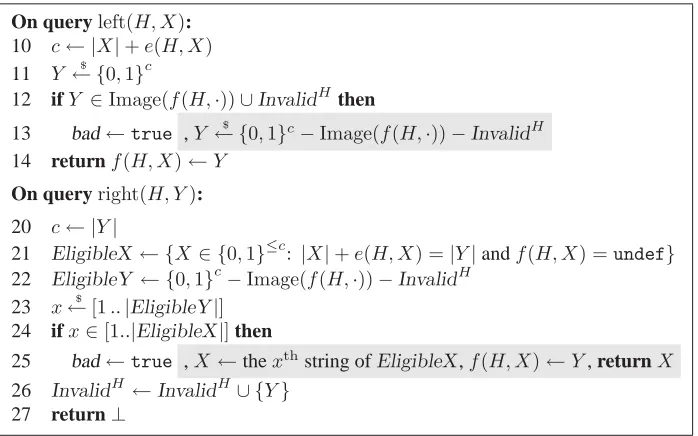
On queryleft(H, X):
10 c← |X|+e(H, X)
11 Y ← {$ 0,1}c
12 ifY ∈Image(f(H,·))∪InvalidHthen
13 bad←true ,Y ← {0$ ,1}c−Image(f(H,·))−InvalidH
14 returnf(H, X)←Y
On queryright(H, Y):
20 c← |Y|
21 EligibleX ← {X ∈ {0,1}≤c: |X|+e(H, X) =|Y|andf(H, X) =undef}
22 EligibleY ← {0,1}c−Image(f(H,·))−InvalidH
23 x←$ [1..|EligibleY|]
24 ifx∈[1..|EligibleX|]then
25 bad←true ,X←thexthstring ofEligibleX,f(H, X)←Y, returnX
26 InvalidH←InvalidH∪ {Y}
27 return⊥
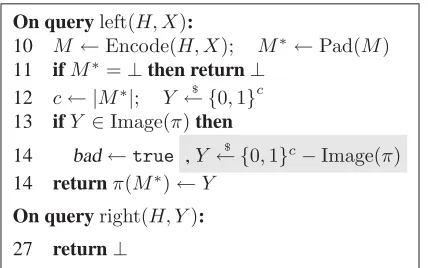
Figure 6: Games used in the proof of Theorem 7. GameG1is the complete code; gameG0omits the shaded statements.
for the games G0 and G1 defined in Figure 6. Recall that booleans are initialized to false, sets are initial-ized to empty, and partial functions are initialinitial-ized to everywhere undefined with the symbolundef. The set
Image(f(H,·))contains all pointsY = undefsuch thatf(H, X) = Y for someX ∈ X. Set difference is indicated with a minus sign. Look first at gameG0. Much of the code (lines 12–13 and 20–26) is irrelevant to what the adversary sees. Each queryleft(H, X)returns a random string of|X|+e(H, X)bits and each query
right(H, Y)returns⊥. Thus gameG0’s(left,right)oracles faithfully simulate a pair of oracles($,⊥)and we have thatPr[AG0⇒1] = Pr[A$,⊥⇒1].
GameG1is more subtle. We claim that its(left,right)oracles are simply a lazy evaluation of a pair of oracles
(f, f−1)with the desired domain and range. To see this, understand first that the partial functionf(H,·) main-tains the correspondenceX→f(H, X)for those domain points that we have already assigned values to, while the setInvalidH maintains the set of pointsY that have become ineligible to bef(H, X)values, for anyX, by virtue of having been askedright(H, Y)and having returned⊥, effectively asserting thatf−1(H, Y) =⊥and soY is outside the image off(H,·). Now, starting atleft(H, X)queries, we begin at line 10 by calculating the lengthcof the ciphertext that we must return. The code at lines 11–14 returns a random stringY of lengthc subject to the constraint thatY is outside of the image off(H,·)and not ineligible to be anf(H, X)value by virtue of having asserted that there is no preimage forY with tweakH. Looking next atright(H, Y)queries, we calculate at line 21 the set EligibleX of valuesX that could possibly map toY using tweakH, and we calculate at line 22 the set of stringsY that could, at this moment be paired with strings inEligibleX. By our conventions on the adversary making no “pointless” queries, the stringY will necessarily be among the strings
inEligibleY. Since we aim to randomly and injectively pair points inEligibleX with points inEligibleY,
the chance that a given point Y inEligibleY has a preimage in EligibleX is just |EligibleX|/|EligibleY|. Lines 23 and 24 effectively flip a coin with this bias, deciding if the stringY ∈EligibleY should or should not be given a (random) preimage inEligibleX. If it is not given a preimage, we record this decision by augmenting
InvalidH at line 26. If it is given a preimage, it is given a random one by lines 23–25, the choice is recorded, and the random preimage is returned. We have thus provided a perfect simulation of an(f, f−1)oracle, and so
Pr[AG1⇒1] = Pr[Af,f−1 ⇒1].
LetBADbe the event thatAG0causesbad to get set totrue. We must bound the probability ofBAD. Remem-ber that the shaded statements have been expunged from the game. Prior to BADoccurring, each left-query adds a single point to a set Image(f(H,·)) but has no impact on any set InvalidH, while each right-query adds a single point to a set InvalidH but has no impact on any set Image(f(H,·)). If theith query is left-query then the setImage(f(H,·))∪InvalidH will have at mosti−1points and the chance thatbad will get set at line 13 will be at most (i−1)/2s+τ and so, overall, the probability that bad gets set at line 13 is at mostqi=1(i−1)/2s+τ ≤ q2/2s+τ+1. If theithquery is a right-query thenbad will be set with probability
|EligibleX|/|EligibleY|for the current setsEligibleX andEligibleY. How big can|EligibleX|be? Asked a queryY of lengthc, even if every string of length at mostc−s(the maximal possible length) is inEligibleX, still we will have that|EligibleX|<2c+1−s. Conversely, how small can|EligibleY|be? On theithquery we know
that|EligibleY|>2c−i. So on theithquery we have that|EligibleX|/|EligibleY|<2c+1−s/(2c−i)≤22−s
assumingi≤2c−1or, more strongly, assumingq ≤2s+τ−1. Summing over allqRright-queries we have that the probability thatbad gets set at line 25 is at most4qR/2s. Since the result becomes vacuous whenq >2s+τ−1,
we may now drop that technical condition and conclude the theorem.
Acknowledgments
Many thanks to the X9F1 working group, whose draft standard motivated this paper, and Morris Dworkin, who made this work known to us [13]. Thanks to Jesse Walker for an enormous number of valuable comments; to Susan Langford for noticing a significant error in an earlier draft; to Steve Bellovin for voicing his concerns about IV-misuse at a meeting back in 2000 (his comments ultimately motivated Section 7); to Mihir Bellare for his typically perceptive reading; to the Eurocrypt 2006 PC for their comments; and to Dan Harkins for comments, test vectors, and encouraging the choice of a more efficient incrementing function in SIV mode. Phil Rogaway was supported by NSF 0208842 and a gift from Intel Corp. Much of this paper was written while Rogaway was a visitor to the School of Information Technology at Mae Fah Luang University, Thailand. Many thanks to MFLU and, in particular, to Dr. Thongchai Yooyativong and Dr. Tatsanee Mallanoo, for their generous hospitality.
References
[1] J. An and M. Bellare. Does encryption with redundancy provide authenticity? Advances in Cryptology – Euro-crypt ’01, LNCS vol. 2045, Springer, pp. 512–528, 2001.
[2] M. Bellare, A. Boldyreva, L. Knudsen, and C. Namprempre. On-Line ciphers and the Hash-CBC constructions. Advances in Cryptology – Crypto ’01, LNCS vol. 2139, Springer, pp. 292–309, 2001.
[3] M. Bellare, A. Desai, E. Jokipii, and P. Rogaway. A concrete security treatment of symmetric encryption: analysis of the DES modes of operation. Proc. of the 38th Symposium on Foundations of Computer Science, IEEE Press, pp. 394–403, 1997.
[4] M. Bellare, A. Desai, D. Pointcheval, and P. Rogaway. Relations among notions of security for public-key en-cryption schemes.Advances in Cryptology – Crypto’98, LNCS vol.1462, Springer, pp. 26–45, 1998.
[5] M. Bellare, J. Kilian, and P. Rogaway. The security of the cipher block chaining message authentication code. J. of Computer and System Science (JCSS), vol. 61, no. 3, pp. 362–399, Dec 2000.
[6] M. Bellare and C. Namprempre. Authenticated encryption: relations among notions and analysis of the generic composition paradigm.Advances in Cryptology – Asiacrypt ’00, LNCS vol. 1976, Springer, pp. 531–545, 2000. [7] M. Bellare and P. Rogaway. Code-based game-playing proofs and the security of triple encryption. Cryptology