Volume 7, No. 2, March-April 2016
International Journal of Advanced Research in Computer Science
REVIEW ARTICLE
Available Online at www.ijarcs.info
Internet of Things in Learning Systems – A Perspective of Platforms
Issa Kamar
Research Center CRITC Arts Sciences and Technology University
Beirut, Lebanon
Parag Chatterjee
School for Advanced Research in Engineering Sciences National University of Technology (UTN.BA)
Buenos Aires, Argentina
Ali Hamie
Research Center CRITC Arts Sciences and Technology University
Beirut, Lebanon
Abstract: With the advancement of smart technologies, educational systems across the world are showing path breaking revolutions, embracing the smart learning methods. Rather than focusing only on the learning contents, analyzing learning behavior and connecting the learners in a peer learning environment stands quite important in this scenario. Internet of Things being the technology to connect things, has taken its scope to a higher dimension, shaping the pathway to subtle interaction between people and things. Making use of Internet of Things in learning systems would open up new pathways to proffer effective learning. Primarily some of these pathways for integrating Internet of Things in learning systems have been discussed. To design an effective pathway for implementing Internet of Things in learning systems, a detailed study of its platforms is needed. In this work, a handful of such platforms have been reviewed based on few parameters. The disparities among these platforms have been separately pointed out. Implementing Internet of Things in learning systems would need to take care of these disparities so as to design a ubiquitous learning network across the globe.
Keywords: Education, Internet of Things, Learning, Platforms, Smart, Ubiquitous
I. INTRODUCTION
Education has reached its new height with the inclusion of digital technologies in it. Despite the traditional classroom based education being profuse across the globe, several online tools have attributed a lot towards acting as efficient supportive medium in education. Technology is covering education just as a part of its inevitable influence in every sector. Education sector has created enough stir to make the business community rethink its prospects in global scenario [1]. Aspiring education communities are striving hard to make the best out of the technologies to shape education in a smarter way. With technology as a catalyst, education is moving from a knowledge-transfer model to a collaborative, active, self-directed, and engaging model that helps learners increase their knowledge and develop the skills needed to succeed in the “Learning Society” [2]. Recent technology has put more emphasis on active learning by more engaging and direct procedures, which is also endorsed beneficial by several research initiatives. The boom in social networking has also contributed to this active as well as collaborated learning, promoting a newer approach towards education. Web learning paradigms getting more profuse also confirms the fact that the modern learning community has been relying upon Internet and connected technologies a lot. The interaction with learning materials has also seen its newer approach from technology where classrooms are getting open and education is reaching beyond barriers. However adopting newer technologies though opened up the global space of learning has still several bars towards its full spread. Despite the increasing connectivity, newer leap of innovation is inevitable to make the most out of the connection and collaboration.
The idea of connectedness and collaborative intelligence has given birth to Internet of Things (IoT) – the next level of connectivity. It uses the power of connected data and is really a promising technology which could shape education to a new
dimension, flanked with learner-oriented active and customized learning using the power of connected knowledge.
Pertaining to education, the aspects of Internet of Things (IoT) has been explored in this paper leading to a smarter approach toward learning, mostly seeing from a perspective of IoT platforms. IoT in learning system involves interaction with heterogeneous devices along with seamless sharing of information in order to provide personalized services to the learners and instructors. The crux of this technology lies in the field of connection profiles of the devices. Extensiveness in the heterogeneity of the devices in learning systems leads to difficulty in designing middleware systems or platforms compliant to the variant types of end users, device providers and application developers. Taking Moore’s Law into point, the development in hardware surpasses leaps and bounds, posing a challenge towards the software to cope up with the change. This poses the need of widely compatible platforms keeping provisions to continue its compliance even with the upgrading hardware.
review of the platforms but also to devise a strategy to make the learning systems smart and ubiquitously available and to proffer customized and efficient learning experience for a better learning outcome.
II. INTERNET OF THINGS IN LEARNING SYSTEMS
The traditional education system mostly depends upon classroom-based education where the teacher broadcasts the learning contents. The learners absorb the contents, use books and other supportive tools (online resources, eBooks etc.) for gaining further knowledge. Learners are assessed through tests standardized for a class. The major issue of this system is the ununiformed distribution in terms of imparting teaching. Accordingly, the pace of learning varies immensely in a class taken together. Despite this uneven structure, the assessment is performed with similar set of assessment material, which clearly results to a discriminative approach of assessment. Clearly this leads to separate learning outcomes, despite having a structured and standardized module for a class. It is for this reason the latest trends of education have started proceeding towards open and self-paced paradigms like flipped classrooms and Massive Open Online Courses (MOOCs).
Traditional eLearning systems have some drawbacks because of their limitations in scalability, availability, distribution of computing power and huge storage systems, as well as sharing information between users [3]. Here lies the foundation of the need of integrating IoT in learning systems to develop a ubiquitous learning environment where the entire learning behavior is taken care of to shape the learning system intelligently.
In a typical eLearning system, there exists an e-communication between the learners and teacher and this definitely involves a potential link between their educational resources. From an IoT perspective, the resources need to communicate constantly for giving rise to a connected pool of data. However, taking the system to a perspective of IoT, the initiative shifts to blurring the gap between physical objects and the connective data [4]. The concept is to not only connect the devices but also connect the interacting human entities and their behavior in the same platform. This would give rise to more personalized data linked to a learner or teacher. Analyzing the entire data obtained as a connective measure from the devices and interacting people would help shaping the entire eLearning platform in a customized and efficient manner. Tremendous increase in processing power and storage capacity along with widespread systems for distribution across clouds and social networks has created the immense possibility in terms of IoT. Social computing makes use of rigorous analytics of user behavior for customized experience. Transforming the eLearning system to a similar approach would cater learner-specific contents and assessments which in turn would lead to the best learning outcomes. However it is a fact that the social learning techniques are most used for open learning MOOCs; Though MOOCs open up pathways to ubiquitous learning [5], most of the structured education systems being not in this category, IoT needs to focus especially in this area, trying to act as a link between classroom-based learning and open learning.
The foundation of IoT in education rests upon four pillars – people, process, data and things [6]. Therefore these four entities need to be intertwined intelligently in order to develop an efficient and connected learning scenario.
A. People
The primary concentration in a learning environment of IoT is on the learners. However to make the system comprehensive, the connection profile needs to be established between learner-learner, learner-teacher, teacher-learner and teacher-teacher. Instead of a typical peer-to-peer communication, the platforms need to accommodate simultaneous peer-to-peer and broadcast communications.
B. Process
Process plays a vital role in the IoT platforms for its applicability in learning systems. Just like an event management, the processes govern the entire flow in the IoT based learning system. Ultimately, this data can be incorporated into a full-fledged analytics system to customize students’ learning process. Online learning paradigms like MOOCs have already been considered to be based on event management strategies. Similarly process management is an inevitable phase in an IoT based learning system, even in the classroom scenario.
C. Data
The Internet revolution has been responsible for a tremendous thrust in generating data. In a typical environment of IoT, the data is mostly connected, being collected from heterogeneous sources. The educational stuffs getting smarter involve a huge pool of data. This invokes the mechanism of sharing data from the common pool to cater connected services. Performing analytics over the data gives rise to knowledge which when clubbed with intelligence obtained by machine learning process would provide an ultimate personalized learning experience for a learner. This holds the primary foundation to designing learner-specific personalized assessment questions and almost real-time evaluation for a fast review of the learning process. Sharing datasets of learner analytics globally would open up immense possibilities in collaborative research with a better approach toward problem solving in terms of learning paradigms.
D. Things
Devices communicating within themselves and sharing data would be one of the best environments for smart education, looking from an IoT perspective. Collecting the information from all the physical objects with which a learner interacts and connecting them using IoT for a mutual sharing strategy would help creating personalized profile linked to each learner. The analyzed data would help smart devices work accordingly catering the learning model in a customized manner. Taking the notion of customization into consideration, each learner would have separate profiles in the learning management system. Logging into the system would open the specific profile of a learner, catering personalized services.
III. A REVIEW OF THE PLATFORMS
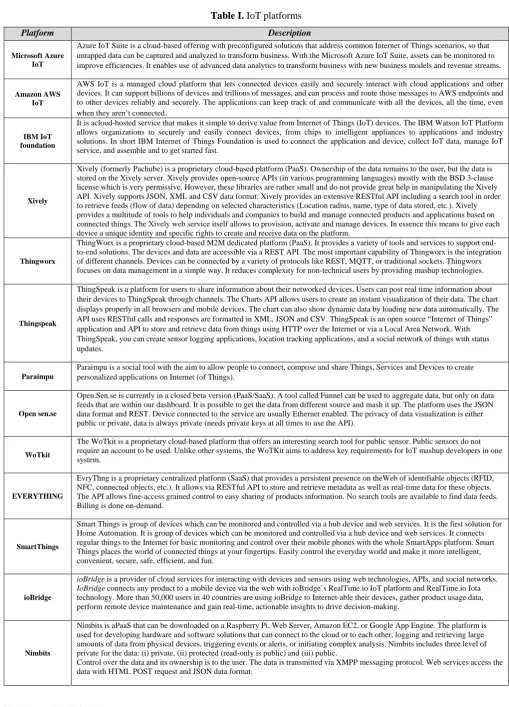
agreeing upon common standards poses its variance, thereby making it difficult to twine them together. Taking this issue into concern, this section portrays a review on the existing
[image:3.595.41.551.91.798.2]platforms and their key aspects in terms of its integration with learning systems. A brief description has been put up in Table I.
Table I. IoT platforms
Platform Description
Microsoft Azure IoT
Azure IoT Suite is a cloud-based offering with preconfigured solutions that address common Internet of Things scenarios, so that untapped data can be captured and analyzed to transform business. With the Microsoft Azure IoT Suite, assets can be monitored to improve efficiencies. It enables use of advanced data analytics to transform business with new business models and revenue streams.
Amazon AWS IoT
AWS IoT is a managed cloud platform that lets connected devices easily and securely interact with cloud applications and other devices. It can support billions of devices and trillions of messages, and can process and route those messages to AWS endpoints and to other devices reliably and securely. The applications can keep track of and communicate with all the devices, all the time, even when they aren’t connected.
IBM IoT foundation
It is acloud-hosted service that makes it simple to derive value from Internet of Things (IoT) devices. The IBM Watson IoT Platform allows organizations to securely and easily connect devices, from chips to intelligent appliances to applications and industry solutions. In short IBM Internet of Things Foundation is used to connect the application and device, collect IoT data, manage IoT service, and assemble and to get started fast.
Xively
Xively (formerly Pachube) is a proprietary cloud-based platform (PaaS). Ownership of the data remains to the user, but the data is stored on the Xively server. Xively provides open-source APIs (in various programming languages) mostly with the BSD 3-clause license which is very permissive. However, these libraries are rather small and do not provide great help in manipulating the Xively API. Xively supports JSON, XML and CSV data format. Xively provides an extensive RESTful API including a search tool in order to retrieve feeds (flow of data) depending on selected characteristics (Location radius, name, type of data stored, etc.). Xively provides a multitude of tools to help individuals and companies to build and manage connected products and applications based on connected things.The Xively web service itself allows to provision, activate and manage devices. In essence this means to give each device a unique identity and specific rights to create and receive data on the platform.
Thingworx
ThingWorx is a proprietary cloud-based M2M dedicated platform (PaaS). It provides a variety of tools and services to support end-to-end solutions. The devices and data are accessible via a REST API. The most important capability of Thingworx is the integration of different channels. Devices can be connected by a variety of protocols like REST, MQTT, or traditional sockets. Thingworx focuses on data management in a simple way. It reduces complexity for non-technical users by providing mashup technologies.
Thingspeak
ThingSpeak is a platform for users to share information about their networked devices. Users can post real time information about their devices to ThingSpeak through channels. The Charts API allows users to create an instant visualization of their data. The chart displays properly in all browsers and mobile devices. The chart can also show dynamic data by loading new data automatically. The API uses RESTful calls and responses are formatted in XML, JSON and CSV. ThingSpeak is an open source “Internet of Things” application and API to store and retrieve data from things using HTTP over the Internet or via a Local Area Network. With ThingSpeak, you can create sensor logging applications, location tracking applications, and a social network of things with status updates.
Paraimpu
Paraimpu is a social tool with the aim to allow people to connect, compose and share Things, Services and Devices to create personalized applications on Internet (of Things).
Open sen.se
Open.Sen.se is currently in a closed beta version (PaaS/SaaS). A tool called Funnel can be used to aggregate data, but only on data feeds that are within our dashboard. It is possible to get the data from different source and mash it up. The platform uses the JSON data format and REST. Device connected to the service are usually Ethernet enabled. The privacy of data visualization is either public or private, data is always private (needs private keys at all times to use the API).
WoTkit
The WoTkit is a proprietary cloud-based platform that offers an interesting search tool for public sensor. Public sensors do not require an account to be used. Unlike other systems, the WoTKit aims to address key requirements for IoT mashup developers in one system.
EVERYTHING
EvryThng is a proprietary centralized platform (SaaS) that provides a persistent presence on theWeb of identifiable objects (RFID, NFC, connected objects, etc.). It allows via RESTful API to store and retrieve metadata as well as real-time data for these objects. The API allows fine-access grained control to easy sharing of products information. No search tools are available to find data feeds. Billing is done on-demand.
SmartThings
Smart Things is group of devices which can be monitored and controlled via a hub device and web services. It is the first solution for Home Automation. It is group of devices which can be monitored and controlled via a hub device and web services. It connects regular things to the Internet for basic monitoring and control over their mobile phones with the whole SmartApps platform. Smart Things places the world of connected things at your fingertips. Easily control the everyday world and make it more intelligent, convenient, secure, safe, efficient, and fun.
ioBridge
ioBridge is a provider of cloud services for interacting with devices and sensors using web technologies, APIs, and social networks.
IoBridge connects any product to a mobile device via the web with ioBridge’s RealTime.io IoT platform and RealTime.io Iota
technology. More than 50,000 users in 40 countries are using ioBridge to Internet-able their devices, gather product usage data, perform remote device maintenance and gain real-time, actionable insights to drive decision-making.
Nimbits
Nimbits is aPaaS that can be downloaded on a Raspberry Pi, Web Server, Amazon EC2, or Google App Engine. The platform is used for developing hardware and software solutions that can connect to the cloud or to each other, logging and retrieving large amounts of data from physical devices, triggering events or alerts, or initiating complex analysis. Nimbits includes three level of private for the data: (i) private, (ii) protected (read-only is public) and (iii) public.
Thinger
Thinger.io platform is an Open Source platform for the Internet of Things, it provides a ready to use scalable cloud infrastructure for connecting things. Makers and companies can start controlling their devices from the internet in minutes, without worrying about the required cloud infrastructure.
The platforms play an immense role in determining the best integration of IoT in learning systems. Learning systems hold a significant amount of heterogeneity in the entities for potential connection through IoT. To integrate IoT in eLearning mechanisms, the machines need to be trained accordingly with
[image:4.595.48.550.198.591.2]a pool of dataset collecting comprehensive information about a learner. Acquiring knowledge about a learner would enable the catering of personalized services, powered by the connectivity in all learning entities. Table II portrays a further detailed description of the IoT platforms based on few parameters.
Table II. Review of IoT platforms
Platform Protocols Network Security
or Encryption Authentication
SDK/
language Data format
Certified Platforms
Microsoft Azure IoT Suite
AMQP,MQT
T,HTTP IPv4
TLS (only server authentication)
Per-device with SAS token
.Net and UWP.jave,C,Node
JS
Binay, XML, JSON
Intel, Raspberry Pi 2
Amazon AWS IoT
MQTT and HTTP
IPv4
IPv6 TLS
X.509 certificate client authentication,
IAM service, Cognito service
C, NodeJS JSON
Broadcom, Marvell, Renesas, Texas Instruments, Microchip, Intel,
Mediatek, Qualcomm, Seeed,
BeagleBoard
IBM IoT foundation
MQTT and HTTP
IPv4,
IPv6 TLS
Per-device with token
C#,C,Python
Java, NodeJS JSON
Raspberry Pi Blue mix
Xively
HTTP,TCP Socket,Web socket, MQTT
IPv4,
IPv6 SSL API key
Java,PHP,Ruby,Py thon,
JSON, CSV, XML
API
Thingworx
HTTP,Web socket, MQTT
IPv4 Not available Not available Java, .NET, C,
iOS, and Android. Not available Libelium
Thingspeak HTTP IPv4 SSL API key Java, Visual C#
JSON, CSV, XML
Arduino, Raspberry Pi,Electic Imp
Paraimpu HTTP, Web
socket IPv4 SSL Token C,Java JSON, CSV Arduino
Open sen.se HTTP, Web
socket IPv4 Not supported API key JSON
WoTkit HTTP IPv4 Not supported
API key, HTTP basic authentication,
OAuth
Java JSON
EVERYTHING HTTP IPv4 SSL API key JSON
SmartThings HTTP IPv4 SSL API key, OAuth JSON
ioBridge HTTP, Web socket IPv4 SSL Not available JSON,XML, JSNOP
Nimbits HTTP, Web
socket IPv4 SSL API key JSON
Thinger HTTP , Web socket IPv4 SSL API key JSON
The review of the IoT platforms based on few parameters opens up aspects of its integration in learning systems. Use of IPv4 in most of the IoT suited indicates to its lesser sustainability, because of vigorous IPv4 depletion. Similarly, IoT solutions supporting IPv6 are expected to succeed in the long run. Also, one of the primary aspects is the ample number of open-source IoT suites and boosted development in that direction. Small scale learning systems between closed user groups could be the potential users of these open source IoT solutions to connect their learning devices and make them work seamlessly together.
IV. CONCLUSION
V. REFERENCES
[1] P. Chatterjee and A. Nath, "Massive open online courses (MOOCs) in higher education — Unleashing the potential in India," MOOC, Innovation and Technology in Education (MITE), 2014 IEEE International Conference on, Patiala, 2014, pp. 256-260. doi: 10.1109/MITE.2014.7020283
[2] Cisco, “The Learning Society”, 2010, http://bit.ly/a1YSqY
[3] Sajal Mitra, Ajanta Das and Sarbani Roy, “Development of E-Learning System in Grid Environment”, Information Systems Design and Intelligent Applications, Advances in Intelligent Systems and Computing 340, doi: 10.1007/978-81-322-2247-7_15
[4] Kevin Ashton, “That ‘Internet of Things’ Thing: In the Real World, Things Matter More than Ideas,” July 2009, http://www.rfidjournal.com/articles/view?4986
[5] P. Chatterjee and A. Nath, "Massive open online courses (MOOCs) in education — A case study in Indian context and vision to ubiquitous learning,"MOOC, Innovation and Technology in Education (MITE), 2014 IEEE International
Conference on, Patiala, 2014, pp. 36-41.
doi: 10.1109/MITE.2014.7020237