A: An Experimental Investigation into. . .
B: . . . Split Utterances
Christine Howes, Patrick G.T. Healey and Gregory J. Mills
Queen Mary University of London
Interaction, Media and Communication Research Group, London, E1 4NS
{chrizba, ph, gj}@dcs.qmul.ac.uk
Abstract
A distinguishing feature of dialogue is that more that one person can contribute to the production of an utterance. However, un-til recently these ‘split’ utterances have re-ceived relatively little attention in mod-els of dialogue processing or of dialogue structure. Here we report an experiment that tests the effects of artificially intro-duced speaker switches on groups of peo-ple engaged in a task-oriented dialogue. The results show that splits have reliable effects on response time and on the num-ber of edits involved in formulating sub-sequent turns. In particular we show that if the second half of an utterance is ‘mis-attributed’ people take longer to respond to it. We also show that responses to ut-terances that are split across speakers in-volve fewer deletes. We argue that these effects provide evidence that: a) speaker switches affect processing where they in-terfere with expectations about who will speak next and b) that the pragmatic effect of a split is to suggest to other participants the formation of a coalition or sub-‘party’.
1 Introduction
Split utterances, defined simply as utterances which are split between speakers1, are known to occur in dialogue, as evidenced by
Conversa-1What we call split utterances have been variously
re-ferred to as collaborative turn sequences (Lerner, 1996; Lerner, 2004),collaborative completions (Clark, 1996) co-constructions(Helasvuo, 2004), co-participant completions
(Hayashi, 1999; Lerner and Takagi, 1999)collaborative pro-ductions(Szczepek, 2000) andanticipatory completions(Fox and others, 2007) amongst others.
tional Analysis (CA) studies, based on the anal-ysis of naturally occuring dialogues. In addi-tion to numerous analyses of split utterances in generic English dialogues, there are cross lin-guistic studies, and observations of conversations with aphasics. In Finnish, split utterances within a single clause conform to the strict syntactic constraints of the language (which has a rich inflectional morphology), despite the change in speaker (Helasvuo, 2004). Similarly, in Japanese, a verb-final language, speakers also engage in “co-participant completions” (Hayashi, 1999; Lerner and Takagi, 1999). There is also evidence of split utterances in conversations with aphasics (Oelschlaeger and Damico, 1998), demonstrat-ing that the phenomenon is pervasive in dia-logue. However, with the possible exception of Szczepek (2000) who analysed some 200 splits from 40 hours of recorded English conversation, these studies tend to be unconcerned with frequen-cies of occurrence; that split utterances occur at all renders them worthy of study.
Split utterances are a clear and canonical exam-ple of coordination in dialogue. In order for one person to continue an utterance which has been be-gun by another person requires the hearer to have coordinated with the initial speaker up to the point at which they take over the role of producer2.
Analysis of split utterances, when they can or cannot occur and what effects they have on the co-ordination of agents in dialogue, is therefore an area of interest not only for conversational an-alysts wishing to characterise sytematic interac-tions in dialogue, but also linguists trying to for-mulate grammars of dialogue, and psychologists interested in alignment mechanisms in dialogue.
2
In this regard, studies of split utterances, in both spontaneous dialogues and experimentally, as be-low, provide a complementary way of studying structural alignment to the traditional experimen-tal set up exemplified by Branigan and colleagues (Branigan et al., 2000; Branigan et al., 2003; Branigan et al., 2006). Indeed, Poesio and Rieser (In preparation) claim that “[c]ollaborative com-pletions . . . are among the strongest evidence yet for the argument that dialogue requires coordina-tioneven at the sub-sentential level” (italics origi-nal).
Broadly speaking, there have been two types, or levels, of explanations of split utterances of-fered; pragmatic accounts and processing ac-counts. Pragmatic accounts are favoured by Con-versational Analysts, with various aspects of split utterances analysed. However, in line with CA as-sumptions, these analyses are almost exclusively concerned with the conditions under which split utterances can occur. Lerner (1991), for ex-ample, identifies a number of ‘compound’ turn-constructional units, such as the IF-THEN con-struction (whereby the second participant is in some sense licensed to provide the THEN part of the structure). However, Lerner’s insistence on identifying the circumstances in which split utter-ances usually occur misses the important general-isation that, syntactically, they can be anywhere in a string (hisopportunistic completions). His claim that an anticipatory completionis ordinarily “de-signed as a syntactic continuation of the utterance part it follows at the point of onset”, seems to hold for all split utterances.
The occurrence of split utterances also has im-plications for the organisation of turn-taking, as outlined in Sacks et al. (1974). According to Sche-gloff (1995), turn-taking operates, not on individ-ual conversational participants, but on ‘parties’. For example, if a couple are talking to a third per-son, they may organise their turns as if they are one ‘party’, rather than two separate individuals. Lerner (1991) suggests that split utterances can clarify the formation of such parties; “collabora-tively produced sentences reveal a relationship be-tween syntax and social organisation. It provides evidence of how syntax can be mobilised to organ-ise participants into “groups”.”
The processing approach towards split utter-ances is exemplified by the interactive alignment model of Pickering and Garrod (2004). They
claim that;
. . . it should be more-or-less as easy to complete someone else’s sentence as one’s own, and this does appear to be the case.
(Pickering and Garrod, 2004, p186)
According to this model, speaker and listener ought to be interchangeable at any point, and this is also the stance taken by the grammatical frame-work of Dynamic Syntax (Cann et al., 2005). In Dynamic Syntax (DS), parsing and production are taken to use exactly the same mechanisms, lead-ing to a prediction that split utterances ought to be strikingly natural (Purver et al., 2006). Addition-ally, for a third person to process an utterance that appears to come from two separate speakers ought not be more difficult than processing the same ut-terance from a single speaker, regardless of where in a string the changeover occurs.
According to Poesio and Rieser (In prepara-tion), “the study of sentence completions can shed light on a number of central issues. . . this type of data may be used to compare competing claims about coordination – i.e. whether it is best ex-plained with an intentional model like Clark’s. . . or with a model based on simpler alignment models like Pickering and Garrod’s.” As they see inten-tions as crucial to dialogue management, they con-clude that a model which accounts for intentions (such as their PTT account) better captures their task specific split utterance data (See Poncin and Rieser (2006) for details of the German data they are modelling).
be observed3.
To test these predictions, an experiment was set up to alter genuine single-turn utterances into split utterances at an arbitrary point in the string. Dif-ferent types of intervention were introduced, in a 2 x 2 factorial design, in order to separate out the ef-fects of an utterance appearing to come from two different participants from effects caused by an ap-parent change of floor.
2 Method
The effects of seeing an utterance split between speakers or not were tested using the Dialogue Experimentation Toolkit (DiET) chat tool, as de-scribed in Healey et al. (2003), which enables dia-logues to be experimentally manipulated.
The DiET chat tool allows interventions to be introduced into a dialogue in real time, thus caus-ing a minimum of disruption to the natural ‘flow’ of the conversation. In this case, a number of gen-uine turns in a three way conversation were artifi-cially split into two sections, with both parts either appearing to originate from the genuine source, or one or both parts being falsely attributed to another participant.
2.1 Materials
2.1.1 The Balloon Task
The balloon task is an ethical dilemma re-quiring agreement on which of three passengers should be thrown out of a hot air balloon that will crash, killing all the passengers, if one is not sac-rificed. The choice is between a scientist, who be-lieves he is on the brink of discovering a cure for cancer, a 7 months pregnant woman, and her hus-band, the pilot. This task was chosen on the basis that it should stimulate discussion, leading to dia-logues of a sufficient length to enable an adequate number of interventions.
2.1.2 The DiET Chat Tool
The DiET chat tool itself is a custom built java application consisting of two main components, which will be outlined in turn; the user interface, and the server console.
3
This is, of course, an oversimplification, and note that in contrast to pragmatic accounts, no claims are made regard-ing higher level discourse effects of the split utterance, as the focus is on the mechanisms which allow split utterances to occur. Additional mechanisms could of course be posited in processing models to account for any such differences.
2.1.3 User interface
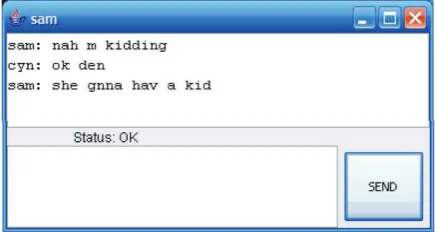
The user interface is designed to look and feel like instant messaging applications e.g. Microsoft Messenger. It consists of a display split into two windows, with a status bar, indicating whether any other participant(s) are actively typing, between them (see figure 1). The ongoing dialogue, con-sisting of both the nickname of the contributor and their transmitted text, is shown in the upper win-dow. In the lower window, participants type and revise their contributions, before sending them to their co-participants. All key presses are time-stamped and stored by the server.
Figure 1: The user interface chat window (as viewed by participant ‘sam’)
2.1.4 Server Console
All text entered is passed to the server, from where it is relayed to the other participants, not relayed directly between participants. Prior to be-ing relayed, some turns are altered by the server to create fake split utterances.
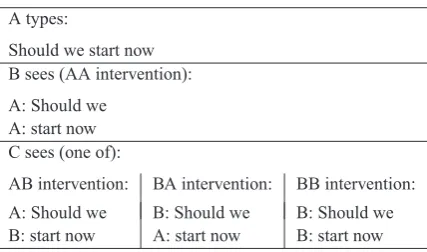
[image:3.595.307.525.254.370.2]the inverse could be the case (aBA-split), or both parts could be wrongly attributed to the other par-ticipant (a BB-split). This design was in order to separate the effects of a change in conversational momentum (floor change) from the effects of split-ting per se, hence the inclusion of the BB condi-tion where who apparently has the floor is altered without the utterance being attributable to differ-ent participants. This contrast is shown in table 1.
Table 1: Comparison of split types
A types:
Should we start now B sees (AA intervention): A: Should we
A: start now C sees (one of):
AB intervention: BA intervention: BB intervention: A: Should we B: Should we B: Should we B: start now A: start now B: start now
The intervention is triggered every 10 turns, and restricted such that the participant who receives the non AA-split is rotated (to ensure that each participant only sees any of the more substantially manipulated interventions every 30 turns). Which of the three non AA-splits they see (AB, BA or BB) is, however, generated randomly.
2.2 Subjects
41 male and 19 female native English speaking un-dergraduate students were recruited for the exper-iment, in groups of three to ensure that they were familiar with each other. All had previous expe-rience of internet chat software such as Microsoft Messenger and each was paid£7.00 for their par-ticipation.
2.3 Procedure
Each of the triad of subjects was sat in front of a desktop computer in separate rooms, so that they were unable to see or hear each other. Subjects were asked to follow the on screen instructions, and input their e-mail address and their username (the nickname that would identify their contribu-tions in the chat window). When they had en-tered these, a blank chat window appeared, and they were given a sheet of paper with the task de-scription on. Participants were instructed to read this carefully, and begin discussing the task with
their colleagues via the chat window once they had done so. They were told that the experi-ment was investigating the differences in commu-nication when conducted using a text only inter-face as opposed to inter-face-to-inter-face. Additionally, sub-jects were informed that the experiment would last approximately 20-30 minutes, and that all turns would be recorded anonymously for later analy-sis. Once all three participants had been logged on, the experimenter went to sit at the server ma-chine, a fourth desktop PC out of sight of all three subjects, and made no further contact with them until at least 20 minutes of dialogue had been car-ried out.
3 Results
A post experimental questionnaire and debrief-ing showed that participants felt the conversations went as smoothly as face-to-face dialogue. With the exception of one subject, who had taken part in a previous chat tool experiment and was there-fore aware that interventions may occur, none of the participants reported awareness of any inter-ventions.
As production and receipt of turns sometimes occurs in overlap in text chat, it is not possible to say definitively when one turn is made in di-rect response to another4. We therefore chose two separate measures; next turn – the first turn, by the first recipient to start and complete a response, after receipt of the intervention, and global– all the turns produced by both recipients between the most recent intervention and the next intervention, averaged to produce one data point per recipient per intervention. This means that in the next turn condition, only one datapoint is analysed for each intervention, despite two different people seeing an intervention (and both usually producing a sponse). This was to try and isolate the initial re-sponse to an intervention; for the other person who saw a split but did not respond first, it is not clear if they are responding to the split utterance, or to
4In online chat, participants can compose their next turns
the person whoalreadyresponded to the split ut-terance. In the global condition, in contrast, there are two datapoints for each intervention (one for each of the participants who saw a split utterance). Of the 253 interventions to which at least one recipient responded, 89 were AA/AB splits, 99 were AA/BA splits and 65 AA/BB splits. Table 2 shows the n values in each case.
Both next turn and global measures were anal-ysed according to two factors in a 2 x 2 factorial design;split– whether both parts of the utterance had appeared to come from the same person, or from different sources ([AA and BB]vs[AB and BA]), and floor change – who appeared to have produced the second part of the split, the genuine source, or the other participant ([AA and BA]vs [AB and BB]).
Measures selected for analysis weretyping time of turn (The time, in milliseconds, between the first key press in a turn and sending the turn to the other participants by hitting the return key) and length of turn in charactersas measures of produc-tion;deletes per character(The number of keyed deletes plus one (to prevent null values) divided by the total number of characters) as a measure of revisions; and typing time per character as a measure of speed. Data in tables are displayed in the original scale of measurement. However, as inspection of the data showed that they were not normally distributed, logarithmic transformations (using loge) were applied to the data prior to all formal analyses.
2 x 2 ANOVAs show a main effect of floor change on the typing time of turn (see table 2). This holds for next turns (F(3,249) = 7.13, p <
0.05) and globally (F(3,486) = 3.78, p < 0.05), with participants taking longer over their turns in the AB and BB conditions. There was no main effect of split, and no effect of interaction. This effect is greater locally than globally, with partici-pants who respond first after seeing a floor change condition taking more than 40% longer over their turns than those who saw a non-floor change con-dition. Globally the difference is in the order of 10%.
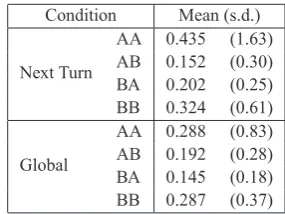
There was a main effect of split on the number ofdeletes per character, which also held both in the next turn condition (F(3,249)= 6.26,p <0.05) and globally (F(3,486) = 9.23, p < 0.05), with subjects seeing a split condition (AB or BA) us-ing fewer deletes per character than those seeing
[image:5.595.342.485.420.527.2]a non-split condition (see table 3). There was no main effect of floor change or interaction effect. This effect is also stronger in the next turn con-dition, with those not seeing a cross-person split using over 50% more deletes. In the global condi-tion, this difference is still 40%, though the overall proportion of deletes is approximately 25% lower, from 0.334 per character in the next turn condition to 0.244 globally.
Table 2: Typing time of turn by type of interven-tion
Condition Mean (s.d.) N (poss N)
Next Turn
AA 9475.54 (12258.5) 136 (253) AB 14560.70 (18863.9) 37 (89) BA 6968.24 (6437.0) 51 (99) BB 14812.59 (20367.8) 29 (65)
Global
AA 11122.27 (14413.5) 246 (253) AB 12500.98 (10944.6) 89 (89) BA 9800.77 (8810.3) 92 (99) BB 11561.67 (10138.4) 63 (65)
Table 3: Deletes per character by type of interven-tion
Condition Mean (s.d.)
Next Turn
AA 0.435 (1.63) AB 0.152 (0.30) BA 0.202 (0.25) BB 0.324 (0.61)
Global
AA 0.288 (0.83) AB 0.192 (0.28) BA 0.145 (0.18) BB 0.287 (0.37)
Additional analyses showed an effect of floor change on length of turn in characters (table 4) in the next turn condition (F(3,249) = 5.57, p <
As the experiment was looking for generic ef-fects of splitting on coordination, the location of the splits was random. A post-hoc analysis was therefore carried out to ascertain whether the stan-dalone coherence (as judged by the authors) of the two separate parts of the utterance was a possible confounding factor. Examples of coherence judge-ments are shown in table 5.
Table 4: Length of turn in characters by type of intervention
Condition Mean (s.d.)
Next Turn
AA 23.95 (22.0) AB 37.76 (34.9) BA 23.92 (18.4) BB 26.52 (21.5)
Global
AA 26.41 (20.4) AB 32.12 (23.9) BA 28.27 (18.4) BB 25.78 (13.6)
Table 5: Examples of standalone coherence judge-ment examples
Part of Split Coherent
First Second 1st 2nd
what the hell is that Y N the woman is pregnant she should stay Y Y these people said you did something N Y I think this is also the wish of the doctor N N
2 x 2 ANOVAs showed that in the next turn con-dition, there are no main effects of first or sec-ond part coherence, but there was an interaction effect of first part coherence by second part co-herence on deletes (F(3,249) = 4.05, p < 0.05), such that ifbothparts are independently coherent, or ifneitherpart is independently coherent, there are fewer deletes used in the turn immediately fol-lowing the intervention (see table 6). There are no significant global effects.
Table 6: Deletes per character by first and second part standalone coherence (next turn condition)
Coherence
Mean (s.d.) 1st 2nd
Y Y 0.198 (0.38) N 0.651 (2.26) N Y 0.304 (0.66) N 0.206 (0.30)
Running a 2 x 2 x 2 x 2 ANOVA with these ad-ditional factors does not alter the main effects ob-served for floor change or split, as detailed above. There are no additional interaction effects on any of the measures.
4 Discussion
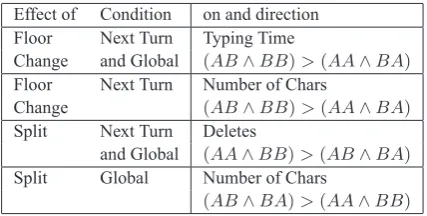
[image:6.595.309.523.268.376.2]As this is the first experimental study into split ut-terances using the DiET chat tool, what follows is necessarily exploratory. This discussion presents our current hypotheses as to how best to interpret the data, as summarised in table 7, below.
Table 7: Summary of significant effects
Effect of Condition on and direction Floor Next Turn Typing Time
Change and Global (AB∧BB)>(AA∧BA)
Floor Next Turn Number of Chars
Change (AB∧BB)>(AA∧BA)
Split Next Turn Deletes
and Global (AA∧BB)>(AB∧BA)
Split Global Number of Chars
(AB∧BA)>(AA∧BB)
Taking longer over the production of a turn (in-dependently of typing speed) indicates a lack of confidence in the conversation (misattributing the second part of the utterance thus reducing confi-dence), and is also indicative of local organisation of turn-taking. If a participant who has seen a floor change intervention (Participant C) responds first, then they may be taking longer over their turns be-cause there is less pressure on them to take a turn. This is because of the C’s expectations. They will falsely believe that the fake source (Participant B) has just completed a turn, and will therefore not expect them to take the floor, and the genuine source (Participant A) will not be taking the floor because they have just completed a turn (though C does not know this). It is probable that in the turn immediately following a floor change intervention both these factors are at play, whereas globally it is the weaker effect of generic confidence loss that is observed. This compounding of effects in the next turn condition would also help explain the di-vergent effects on the length of turn in characters in next turn and global conditions.
mo-mentum of the conversation.
More interestingly, independently of a change of floor, seeing an utterance that appears to be split between speakers also has an impact on the con-versation, seen in the amount of revision under-taken in formulating a response (deletes). One rea-son why participants might worry less about pre-cisely formulating their turns following a cross-person split is that the production of a cross-cross-person split could have the effect on the recipient of sug-gesting that the two other participants have formed a ‘party’ (Schegloff, 1995) with respect to the de-cision of who to throw out of the balloon. This might be understood as signalling the formation of a strong coalition between the other two partic-ipants, therefore making the recipient behave as though they are resigned to the decision of this coalition. This is not the same as the effect on the typing time of turn, whereby participants are less rushed when seeing a change of floor. Deletes, on the other hand, demonstrate how carefully partici-pants are constructing their turns. Excerpt 1, taken from the transcripts shows an example where this appears to be the case.
Excerpt 1 AB-Split showing apparent coalition between ‘Bhups’ and ‘Dan’ (‘fake’ part of split shown in bold)
Bhups: and he can tell his formula Dan: to tom and susie
If we take split utterances as an indicator of co-ordination then it is likely that if we believe our two conversational partners to be in coordination, we will worry less about precisely formulating our own contributions. This also backs up the idea that people are not interchangeable.
The interaction of first and second part coher-ence also underlines the effect of split on revi-sions as outlined above. In the case were both parts of the split could potentially stand as inde-pendent utterances, they are treated as such and the number of deletes per character is in line with the global average (i.e. they are treated as nor-mal dialogue). In the other non ambiguous case, where neither part could be interpreted as an ut-terance on its own, there are also fewer deletes, in line with the result that there are fewer deletes in strong split cases. Interestingly, the most dis-ruptive case is that where the first part could have been a standalone utterance, but the second part
could not. This could be seen as analogous to a garden path effect, and provides some indication that that the building up of interpretations is incre-mental, and not concerned with who supplies the input.
These results do not, of course, prejudice the claim that, at a purely mechanistic level, people could anticipate the structures needed to complete a turn, as the interactive alignment model sug-gests, because they are not concerned with the ac-tual production of a split utterance, rather on the effect it has on the conversation. They do indicate that in terms of the effects of seeing split utter-ances, the pragmatic approach offers a more fea-sible level of analysis. For example, if we wish to treat a jointly produced split utterance as sig-nalling especially strong alignment, then we need to account for more than simply syntax.
There is an issue with the design of the exper-iment which means that the floor change effects might be caused by a confounding variable; in essence, because one of the recipients always re-ceived an AA-split, in the cases which have been labelled as cases of floor change, the two recipi-ents will have been left with the impression that a different person made the final contribution. This means that there may well be a an effect of con-founded listener expectation (though see Schober and Brennan (2003) for discussion), although it should be noted that this does not have any bear-ing on the observed differences after an utterance split between speakers. It is also possible that split utterances might be particularly marked in a chat environment, though preliminary results of a corpus study show that, perhaps surprisingly, split utterances also occur naturally and as frequently in text-based chat (Eshghi, in prep) as they do in face-to-face dialogue (Purver et al., 2009). Be-cause of these issues, and the already noted po-tential problems of linearity in text-based chat, a follow-up study using a character-by-character chat tool interface is underway. This more directly enforces turn-taking, as it does not allow partici-pants to formulate their turn before communicat-ing it; each character is transmitted as and when it is entered.
5 Conclusions
that speaker switches affect processing where they interfere with expectations about who will speak next and that the pragmatic effect of a split is to suggest to other participants the formation of a coalition or sub-‘party’. It also clearly demon-strates that this type of experiment provides a fruit-ful line of future research in the ongoing attempt to adequately characterise dialogue, though further developments are needed.
References
H. Branigan, M. Pickering, and A. Cleland. 2000. Syntactic co-ordination in dialogue. Cognition, 75(2):13–25.
H. Branigan, M. Pickering, J. Pearson, J. McLean, and C. Nass. 2003. Syntactic alignment between com-puters and people: The role of belief about mental states. InProceedings of the Twenty-fifth Annual Conference of the Cognitive Science Society.
H. Branigan, M. Pickering, J. McLean, and A. Stewart. 2006. The role of local and global syntactic struc-ture in language production: Evidence from syn-tactic priming. Language and cognitive processes, 21(7-8):974–1010.
R. Cann, R. Kempson, and L. Marten. 2005. The Dy-namics of Language. Elsevier, Oxford.
H. Clark. 1996. Using Language. Cambridge Univer-sity Press.
A. Eshghi. in prep. Uncommon ground: the distri-bution of dialogue contexts. Ph.D. thesis, Depart-ment of Computer Science, Queen Mary University of London.
A. Fox et al. 2007. Principles shaping grammati-cal practices: an exploration. Discourse Studies, 9(3):299.
M. Hayashi. 1999. Where Grammar and Interac-tion Meet: A Study of Co-Participant CompleInterac-tion in Japanese Conversation.Human Studies, 22(2):475– 499.
P. G. T. Healey, M. Purver, J. King, J. Ginzburg, and G. J. Mills. 2003. Experimenting with clarifica-tion in dialogue. InProceedings of the 25th Annual Meeting of the Cognitive Science Society.
M. Helasvuo. 2004. Shared syntax: the gram-mar of co-constructions. Journal of Pragmatics, 36(8):1315–1336.
G. Lerner and T. Takagi. 1999. On the place of linguistic resources in the organization of talk-in-interaction: A co-investigation of English and Japanese grammatical practices. Journal of Prag-matics, 31(1):49–75.
G. Lerner. 1991. On the syntax of sentences-in-progress. Language in Society, pages 441–458.
G. Lerner. 1996. On the semi-permeable character of grammatical units in conversation: Conditional entry into the turn space of another speaker. In E. Ochs, E. A. Schegloff, and S. A. Thompson, editors, Interaction and grammar, pages 238–276. Cambridge University Press.
G. Lerner. 2004. Collaborative turn sequences. In
Conversation analysis: Studies from the first gener-ation, pages 225–256. John Benjamins.
M. Oelschlaeger and J. Damico. 1998. Joint produc-tions as a conversational strategy in aphasia. Clini-cal linguistics & phonetics, 12(6):459–480.
M. Pickering and S. Garrod. 2004. Toward a mech-anistic psychology of dialogue. Behavioral and Brain Sciences, 27:169–226.
M. Poesio and H. Rieser. In preparation. Completions, coordination, and alignment in dialogue. to appear.
K. Poncin and H. Rieser. 2006. Multi-speaker utter-ances and co-ordination in task-oriented dialogue.
Journal of Pragmatics, 38(5):718–744.
M. Purver, R. Cann, and R. Kempson. 2006. Grammars as parsers: Meeting the dialogue chal-lenge. Research on Language and Computation, 4(2-3):289–326.
M. Purver, C. Howes, P. G. Healey, and E. Gre-goromichelaki. 2009. Split utterances in dialogue: a corpus study. InSigDial 2009 workshop proceed-ings.
H. Sacks, E. Schegloff, and G. Jefferson. 1974. A sim-plest systematics for the organization of turn-taking for conversation. Language, pages 696–735.
E. Schegloff. 1995. Parties and talking together: Two ways in which numbers are significant for talk-in-interaction. Situated order: Studies in the social organization of talk and embodied activities, pages 31–42.
M. Schober and S. Brennan. 2003. Processes of in-teractive spoken discourse: The role of the partner.
Handbook of discourse processes, pages 123–64.
B. Szczepek. 2000. Formal Aspects of Col-laborative Productions in English Conversa-tion. Interaction and Linguistic Structures (InLiSt), http://www.uni-potsdam.de/u/