DOI: http://dx.doi.org/10.26483/ijarcs.v8i7.4534
Volume 8, No. 7, July – August 2017
International Journal of Advanced Research in Computer Science
RESEARCH PAPER
Available Online at www.ijarcs.info
ISSN No. 0976-5697
AN IMPROVED THINNING ALGORITHM FOR FINGERPRINT RECOGNITION
Ms. Meghna B. Patel
Assistant Professor, AMPICS,Ganpat University, Kherva, India
Dr. Satyen M. Parikh
Dean, FCA, Ganpat University,Kherva, India
Dr. Ashok R. Patel
Keiser University,Lakeland, 33805, Florida, USA
Abstract :Thinning is the important steps in pre-processing phase of fingerprint recognition.It explains the visual quality of skeleton with 1-pixel unit width. This paper presents the implementation work of famous thinning algorithms and enhances the Zhang-Suen algorithm in the facet of removal of pixel criteria for preserving the connectivity of pattern, remove noisy points, and for sensitivity of the binary image. The performances of the implemented algorithms are evaluated using Mean Square Error, Peak Signal Noise Ratio, and computational time measurement standard. The implementation is done on fingerprint databases FVC2000 and FingerDos using java platform.
Keywords: Fingerprint image thinning, Hilditch, Zhang-Suen, MSE, PSNR.
1. INTRODUCTION
Thinning process is useful for decreasing an object of theimage for collecting the most useful information which is useful for further analysis and recognitionprocess [1].It is applied on binarized image and produces another binarized image as an output image [2-3] or it is called as skeleton.Thinning process usedin many applications like OCR, document image analysis, fingerprint identification, biometric authenticationusing images of retina,signature authentication and so on [4].
The thinning process gives some benefits like:
Itdecreases the width size of the ridge pattern up to a single pixel.
Produces a thin line image of fingerprint image [5]. Maintain connectivity between the pixels of an object
[6].
The computer can process the data faster and reduce the processing time.
It reduces the usage of the memory because it generates only essential information and the size of the image becomessmaller [7-8].
The thinned image can be used for the classification process of fingerprint recognition[9]
The skeleton image contains information such as end points, bifurcation and connection points.
It reducesundesirable features and undesirable noise.
Thinning is the main process for fingerprint recognition [10] because post-processing steps like minutiae extraction and core point detection is depended on thinning process. The binarized imagesare not used for extracting the minutiae because the ridges are wide in it. For that make the all ridges of the image thick up to 1 pixel. To find out the global and local features of the fingerprint image which are useful in
classification, recognition and in matching [11, 41-43] process is become very easy from thinned image because it does not change the structure of ridge and valley.
2. RELATED WORK
Based on the literature review thinning algorithms either directly wok on grayscale image without binarization[12-16] or maximum algorithms required binary image as an input images[8,17-25]. Three types of algorithm are worked for binary images: 1) sequential algorithms, 2) parallel algorithms, and 3) medial axis transform algorithms [8]. Sequential and parallel algorithms are iterative thinning algorithms while medial axis algorithms are non-iterative thinning algorithms.
The iterative thinning algorithms inspect each single pixel in binary image and remove the boundary pixel of the imageunit pixel-width thinned image remains while in non-iterative thinning algorithm do not examine single pixels one by one, instead of that they produce some centerline of the pattern and then take a decision whether to remove that particular boundary pixel or not [26-27].
In [33] Guo Z et. al., and Zhang T.Y et. al., are implemented and provethat Zhang-Suenalgorithm give the better result. In [34] proposed Hilditch algorithm to acquire more suitable skeletons obtained and give better results in Chinese characters and numbers as well as [35] and [36] implemented Hilditch algorithm for fingerprint images. The following sections discuss the famous iterative parallel thinning algorithms; Hilditch’s algorithm [37], Zhange-Suen’s algorithm [28] and proposed enhanced Zhang-Zhange-Suen’s algorithm.
3. IMPLEMENTED WORK
First, implement Hilditch’s Algorithm [37]. It follow the below steps.
Hilditch's algorithm 3x3 windows is used. It involves performing various passes on the pattern. On every pass, it check the below four conditions if it satisfied then it change the pixel value from black to white.
2 < = N(p1) < = 6 M(p1)=1
p2.p4.p8=0 or M(p2)!= 1 p2.p4.p6=0or M(p4)!=1
Stop when nothing changes (no more pixels can be removed)
Here N(p1) = number of non-zero neighbors of p1 and M(p1) = number of 0,1 patterns in the sequence
p2,p3,p4,p5,p6,p7,p8,p9,p2
Then after implement Zhang-Suen algorithm[28]. This algorithm used 3X3 matrix as mask for binary image move down an entire image and go through the all pixels of the image. The below Fig. 1 show the 3X3 matrix.
P9 (i-1,j-1) P2 (i-1,j) P3 (i-1,j+1) P8 (i,j-1) P1 (i,j) P4 (i,j+1) P7 (i+1,j-1) P6 (i+1,j) P5 (i+1,j+1) [Fig. 1: 3*3 matrix]
This techniqueeliminatesentire contour points of the imageexcluding those which reside to the skeleton [28]. The difficulty in maintaining the image connectivity with 3x3 operator is restricted in fully parallel thinning algorithms [29]. Up to the image is not reach at stable, and for maintaining the image connectivity many parallel algorithms divide the iteration in two sub iteration [28-31]. It follow the below steps.
Here M(P1) is the number of 0 to 1 transitions from P2 to P9 in a clockwise direction
N(P1) is the number of non-zero neighbors of P1 that is N(P1) = P2 + P3 + P4 + … + P8 + P9.
Do until image is in steady state
In the first sub-iteration, the contour point P1 is deleted from the digital pattern if it satisfies the following conditions:
2 <= N(P1)<= 6 or M(P1)= 1or P2*P4*P6 = 0 or P4*P6*P8 = 0
In the second sub-iteration, the contour point P1 is deleted from the digital pattern if it satisfies the following conditions:
If 2<= N(P1) <=6 or M(P1) = 1 or P2*P4*P8 = 1 or P2*P6*P8 = 1
See in Appendix-I, that some new noisy points are created after implementing Zhang-Suen’s thinning algorithm. To remove this noisy point followed fix ridge algorithm after thinning process. This algorithm checks the each pixel of thinned image using 3X3 matrix like following Fig. 2.
P1 P2 P3
P8 P P4
P7 P6 P5
[Fig. 2.3*3 matrix implementation of fix ridge algorithm]
See in below e.g. If p is foreground and all its neighbors are background, then remove p. If p is background and check its four neighbors, if there are more than 3 neighbors is foreground and then mark p is foreground.
1
1 P 1
1
The fix ridge operationapplied two times for deleting the most of noisy point.
4. PERFORMANCE METRICS
There are three measurement standard are used to compare the performance of implemented algorithm.
1) PSNR and MSE value 2) Execution Time 3) Quality of an Image 1) PSNR and MSE value [38]
PSNR:-PSNR is defined as peak signal-to-noise ratio between two images using following equation (6). The quality is measured among original and recreated image using it. The quality of recreated images is given by high PSNR and with low MSE value.
MSE:-MSE is defined as Mean square error whichestimates the alteration among the original image and the thinned image. For example: Suppose two images are undistinguishable in all aspect then MSE among them is measuredas zero. First calculate the MSE value for calculating the PSNR value byusing the below equation (5):
∑
=−
=
N I i iy
x
N
y
x
MSE
1 2)
(
1
)
,
(
Where, N is the total number ofpixels in the input image.
The PSNR is computedusing below equation:
MSE
L
PSNR
2 10log
10
=
Where, L is the number of discrete gray level.
(5)
2) Execution Time
The execution time is used to count the complete time for the whole process.The calculation is consider as the time between the first line and last line of code.
3) Quality of an image
The standard quality of an image is used to measure the spurious branches, noise, and thickness of an image.
5. EXPERIMENTAL RESULTS AND ANALYSIS
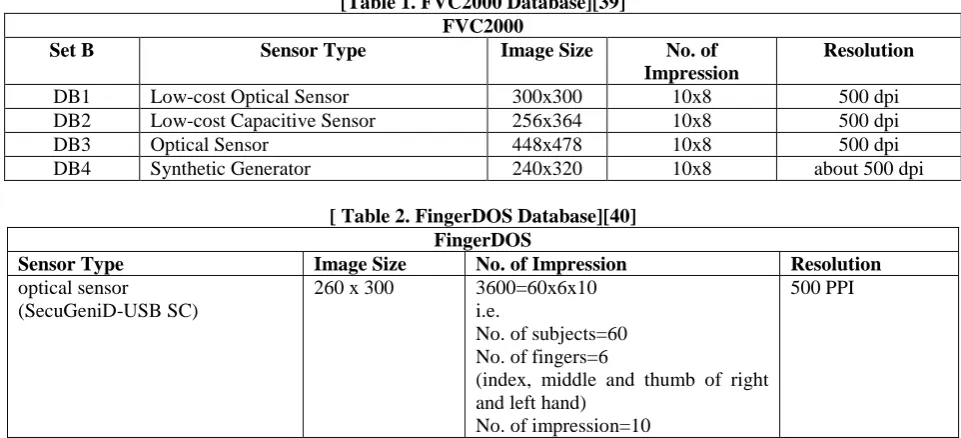
The implementation of thinning algorithms are done using java language and for the experiments the databases FVC 2000 DB1, DB2, DB3, DB4 released on the web [39], and FingerDOS database [40] are used. The details of the databases are given in below Table 1 and Table 2.
[Table 1. FVC2000 Database][39] FVC2000
Set B Sensor Type Image Size No. of
Impression
Resolution
DB1 Low-cost Optical Sensor 300x300 10x8 500 dpi DB2 Low-cost Capacitive Sensor 256x364 10x8 500 dpi
DB3 Optical Sensor 448x478 10x8 500 dpi
DB4 Synthetic Generator 240x320 10x8 about 500 dpi
[ Table 2. FingerDOS Database][40] FingerDOS
Sensor Type Image Size No. of Impression Resolution
optical sensor (SecuGeniD-USB SC)
260 x 300 3600=60x6x10 i.e.
No. of subjects=60 No. of fingers=6
(index, middle and thumb of right and left hand)
No. of impression=10
500 PPI
[image:3.595.56.537.151.370.2]The below Table 3 show the comparison of thinning algorithm with the PSNR and MSE value. The following table shows that the performance of the current proposed technique is enhancedthe result which having high PSNR
and low MSE value. Thus, interms of PSNR and in MSE value, it prove that the image produced by the proposed thinned algorithm generate the best value compare to other algorithms.
[Table 3. Performance Comparison of Thinning Algorithms using MSE & PSNR value] Images of FVC2000 and FingerDos Databases Hilditch
Algorithm
Zhang-Suen Algorithm
Enhanced Zhang-Suen
Algorithm MSE PSNR MSE PSNR MSE PSNR FVC2000_DB1_B_101_1.tif 19.254 28.455 16.173 31.322 13.852 33.944 FVC2000_DB2_B_101_1.tif 21.662 28.346 17.249 31.451 14.017 33.893 FVC2000_DB3_B_101_1.tif 19.364 29.584 16.795 31.531 13.795 33.962 FVC2000_DB4_B_101_1.tif 16.875 30.446 15.296 32.231 12.296 34.462 LEFT_HAND_INDEX_FINGER_0101.bmp 17.542 30.704 15.853 32.301 12.173 34.505 LEFT_HAND_MIDDLE_FINGER_1201.bmp 17.323 30.365 15.017 32.232 12.249 34.479 LEFT_HAND_THUMB_3702.bmp 16.454 31.128 15.256 32.243 12.256 34.476 RIGHT HAND_INDEX_FINGER_0401.bmp 17.986 31.694 15.117 32.243 12.201 34.496 RIGHT_HAND_MIDDLE_FINGER_1201.bmp 17.576 30.587 15.029 32.326 12.029 34.557 RIGHT_HAND_THUMB_3901.bmp 17.159 30.529 15.201 32.321 12.117 34.526
[Fig. 4.Comparison of MSE value] [Figure 5.Comparison of PSNR value]
The following Table 4 show the comparison of algorithms based on execution time.It is clear that the execution time of Zhang-Suen’s compare to Hilditch’s algorithm take lower time but the proposed enhanced algorithm take little bit few
more milliseconds to compute. But that can be neglect because the quality is important for the next minutiae extraction phase.
[Table 4.Comparisonof Execution Time (in milliseconds) for Thinning Algorithms] Images of FVC2000 and FingerDos Databases Execution Time (in milliseconds)
Hilditch Algorithm
Zhang-Suen Algorithm
Enhanced Zhang-SuenAlgorithm
FVC2000_DB1_B_101_1.tif 177 150 156
FVC2000_DB2_B_101_1.tif 181 153 158
FVC2000_DB3_B_101_1.tif 174 145 153
FVC2000_DB4_B_101_1.tif 127 106 111
LEFT_HAND_INDEX_FINGER_0101.bmp 134 114 117
LEFT_HAND_MIDDLE_FINGER_1201.bmp 137 114 114
LEFT_HAND_THUMB_3702.bmp 149 127 132
RIGHT HAND_INDEX_FINGER_0401.bmp 143 122 124
RIGHT_HAND_MIDDLE_FINGER_1201.bmp 134 111 119
RIGHT_HAND_THUMB_3901.bmp 143 124 122
The below Table 5 in Appendix-I show that the quality of an images are improved using the proposed enhanced thinning algorithm. The mark on the images show that removal of spurious branches, noise, and thickness of an image.
6. CONCLUSION AND FUTURE WORK
This paper presents the role of thinning in fingerprint recognition. It shows theimplementation of famous algorithm Hilditch and Zhang-Suen’s algorithm and also enhances the Zhang-Suen’s algorithm. The performance is evaluated on FVC2000 and FingerDOS databases using MSE and PSNR measurement parameter. The experimental result prove that the enhanced Zhang-Suen’s algorithm is better than the existing Hilditch and Zhang-Suen’s algorithm in above all the mentioned aspect. In future, we try to work on post-processing phase like minutiae extraction, remove
false point, core point detection and minutiae matching and try to enhance the accuracy level of fingerprint recognition.
7. REFERENCES
[1] M. Shimizu, H. Fukuda, and G. Nakamura.“Thinning Algorithm for Digital Figures of Characters”, Proceeding 4th IEEE SouthwestSymposium on Image Analysis and Interpretation, 2000.Pp: 83-87.
[2] A. K. Jain, Fundamentals of Digital Image Processing, Prentice-Hall, 1986
[3] Lawrence O’Gorman and RangacharKasturi, Document Image Analysis, IEEE Computer Society Executive Briefings, 1997
[4] HoussemChatbri, Keisuke Kameyama, Using scale space filtering to make thinning algorithms robust against noise in sketch images, Pattern Recognition Letters 42 (2014) 1–10 [5] E. Adeline, Enhancement of Parallel Thinning Algorithm for
Computer Science and Information Technology, UniversitiyTechnologi Malaysia, 2005. http://eprints.utm.my/3796/1/AdelineEngkamatMCD205ttt.pd
f.
[6] Rinaldi, Munir. Pengolahan Citra Digital denganPendekatanAlgoritmik. Bandung: PenerbitInformatika, 2004.
[7] Zhang, T. Y. dan Wang, P. S. P., “Analysis of Thinning Algorithms”, College of Computer Science Northeastern University Boston, MA 02115. 1992, pp.763-766.
[8] L. Lam, SW Lee, and CY.Suen, “Thinning Methodologies – A Comprehensive Survey”, IEEE Transaction on Pattern Analysis and Machine Intelligence. Vol. 14, No. 9, September 1992, pp. 869-885.
[9] Jang, BK., and Chin, RT., ’Analysis of Thinning Algorithms Using Mathematical Morphology”, IEEE Transactions on Pattern Analysis and Machine Intellegence. Vol. 12, No. 6, 1990, pp. 541-551.
[10] Z. Guo and R. Hall, “Parallel thinning with two-subiterationalgorithms,”Communications of the ACM, vol. 32, pp. 359–373, 1989.
[11] D. Maltoni and D.Maio, Handbook of Fingerprint Recognition, Springer, 2009.
[12] M.E. Hoffman, E.K. Wong, Scale-space approach to image thinning using the most prominent ridge line in the image pyramid data structure, in: Photonics West’98 Electronic Imaging, International Society for Optics and Photonics, 1998, pp. 242–252.
[13] J. Cai, Robust filtering-based thinning algorithm for pattern recognition, Comput. J. 55 (7) (2012) 887–896.
[14] A. Witkin, Scale-space filtering: a new approach to multi-scale description, International Conference on Acoustics, Speech, and Signal Processing (ICASSP), vol. 9, IEEE, 1984, pp. 150–153.
[15] T. Lindeberg, Scale-space theory: a basic tool for analyzing structures at different scales, J. appl. stat. 21 (1–2) (1994) 225–270.
[16] T. Sezgin, R. Davis, Scale-space based feature point detection for digital ink, in: ACM SIGGRAPH 2006 Courses, ACM, 2006, pp. 29–35.
[17] C. Arcelli, Pattern thinning by contour tracing, Comput. Graphics Image Process. 17 (2) (1981) 130–144.
[18] H. Chatbri, K. Kameyama, Sketch-based image retrieval by shape points description in support regions, in: International Conference on Systems, Signals and Image Processing (IWSSIP), 2013, pp. 19–22.
[19] H. Chatbri, K. Kameyama, Towards making thinning algorithms robust against noise in sketch images, in: International Conference on Pattern Recognition (ICPR), 2012, pp. 3030–3033.
[20] L. Huang, G. Wan, C. Liu, An improved parallel thinning algorithm, in: International Conference on Document Analysis and Recognition (ICDAR), IEEE, 2003, pp. 780–783. [21] L. Lam, C.Y. Suen, Evaluation of thinning algorithms from an
OCR viewpoint, in: International Conference on Document Analysis and Recognition (ICDAR), IEEE, 1993, pp. 287– 290.
[22] Y. Chen, Y. Yu, Thinning approach for noisy digital patterns, Pattern Recognit. 29 (11) (1996) 1847–1862.
[23] R. Singh, V. Cherkassky, N. Papanikolopoulos, Determining the skeletal description of sparse shapes, in: International Symposium on Computational Intelligence in Robotics and Automation (CIRA), IEEE, 1997, pp. 368–373.
[24] R. Palenichka, M. Zaremba, Multi-scale model-based skeletonization of object shapes using self-organizing maps, International Conference on Pattern Recognition (ICPR), vol. 1, IEEE, 2002, pp. 143–146.
[25] Y. Chen, Hidden deletable pixel detection using vector analysis in parallel thinning to obtain bias-reduced skeletons, Comput. Vision Image Underst. 71 (3) (1998) 294–311.
[26] W. Abu-Ain, B. Bataineh, T. Abu-Ain and K. Omar, “Skeletonization Algorithm for Binary Images”, Fourth International Conference on Electrical Engineering and Informatics (ICEEI) Elsevier, vol. 11, (2013), pp.704-709. [27] G.V. Padole and S. B. Pokle, “New Iterative Algorithms for
Thinning Binary Images”, IEEE Third International Conference on Emerging Trends in Engineering and Technology, vol. 7, (2010), pp. 166-171.
[28] T.Y. Zhang and C.Y. Suen, A Fast Parallel Algorithm for Thinning Digital Patterns, Communication of the ACM, Vol.27 No.3. pp 236, Mar 1984.
[29] Z. Guo and R. Hall, “Parallel thinning with two-subiterationalgorithms”,Communications of the ACM, vol. 32, pp. 359–373, Mar 1989.
[30] W. Abdulla, A. Saleh, and A. Morad, “A preprocessing algorithm forhand-written character recognition,” Pattern Recognition Letters 7, pp.13–18, 1988.
[31] R. Hall, “Fast parallel thinning algorithms: Parallel speed and connectivity preservation,” Communications of the ACM, vol. 32, pp. 124–129,Jan 1989.
[32] Davit Kocharyan, “A Modified fingerprint image thinning algorithm”, American Journal of Software Engineering and Applications, 2013, PP: 1-6, 10.11648/j.ajsea.20130201.11
[33] GulshanGoyal and RitikaLuthra, “Performance Comparison of ZS and GH Skeletonization Algorithms”, International Journal of Computer Applications (0975 – 8887), Volume 121 – No.24, July 2015
[34] for Text Image”, Conference on E-Learning, E-Business, Enterprise Information Systems, and E-Government, January 2010
[35] AtulGanbawle, J. A. Shaikh,”A Thinning Algorithm for Digital Figures of Characters” International Journal of Research in Engineering and Technology eISSN: 2319-1163 | pISSN: 2321-7308, Volume 03, Issue 08, Aug-2014, Available @ http://www.ijret.org
[36] Mrs. Hemlata Patel, PallaviAsrodia, “Fingerprint Matching Using Two Methods”, International Journal of Engineering Research and Applications , ISSN: 2248-9622, Vol. 2, Issue 3, May-Jun 2012, pp.857-860
[37] Hilditch, C.J., Linear Skeletons From Square Cupboards, in Machine Intelligence IV (B. Meltzer and D. Mitchieeds), University Press, Edinburgh, 1969. 403-420. 17, 2, 1970. 339. [38] J. Kwon, “Improved Parallel Thinning Algorithm to Obtain
Unit -Width Skeleton”,Journal of Multimedia & Its Applications (IJMA), vol. 5, no. 2, (2013), pp. 1-14.
[39] D. Maio, D. Maltoni, R. Capelli, J. L. WaymanAnd A. K. Jain, “Fvc2000: Fingerprint Verification Competition”, Ieee Trans. Pattern Anal. Mach. Intell., Vol. 24, No. 3, Pp. 402-412, 2002.
[40] F. Francis-LothaiAnd D. B. L. Bong, “Fingerdos: A Fingerprint Database Based On Optical Sensor,” Wseas Transactions On Information Science And Applications, Vol.12, No. 29, Pp. 297-304, 2015.
[41] Meghna B. Patel, Satyen M. Parikh, Ashok R. Patel, “Performance Improvement in Binarization for Fingerprint Recognition”, IOSR Journal of Computer Engineering (IOSR-JCE) e-ISSN: 2278-0661,p-ISSN: 2278-8727, Volume 19, Issue 3, Ver. II (May.-June. 2017), PP 68-74
[42] Meghna B Patel, Satyen M Parikh and Ashok R Patel, “Performance Improvement in Gradient based Algorithm for the Estimation of Fingerprint Orientation Fields”, International Journal of Computer Applications 167(2):12-18, June 2017.
Recent Technology and Engineering (ICECDS), August-2017, Proceeding in IEEE Digital Explore Library,
Appendix-I
[Table 5. Quality Analysis of an Image] Original Image Binarized Image Hilditch
Algorithm
Zhang-Suen Algorithm
Zhang-Suen with Fix Ridge Applied Once
Zhang-Suen with Fix Ridge Applied
Twice FVC2000
DB1 (101_1.tif)
DB2 (101_1.tif)
DB3 (101_1.tif)
DB4 (101_1.tif)
FingerDOS Database
1201.bmp (LEFT_HAND_MIDDLE_FINGER)
3702.bmp (LEFT_HAND_THUMB)
0401.bmp (RIGHT_HAND_INDEX_FINGER)
1201.bmp (RIGHT_HAND_MIDDLE_FINGER)