Volume 8, No. 5, May-June 2017
International Journal of Advanced Research in Computer Science
RESEARCH PAPER
Available Online at www.ijarcs.info
ISSN No. 0976-5697
Image Watermarking using Singular Value Decomposition with integration of Particle
Swarm Optimization in Discrete wavelet transform
Prabhjot Kaur Bal
Department Of Computer Engineering and Technology Guru Nanak Dev University Amritsar 143001, India
Ast.Prof.Prabhpreet Kaur
Department Of Computer Engineering and Technology Guru Nanak Dev University Amritsar 143001, India
Abstract: This paper proposes an additive watermarking method by using an optimization technique which make use of singular value decomposition (SVD) and makes use of Particle swarm optimization in discrete wavelet domain to enhance the watermarking scheme.SVD based watermarking Is done to provide high capacity. In order to improve the quality of images and to achieve the imperceptibility without losing robustness, an optimal scheme for embedding the secret message derived from PSO. Meanwhile PSO as a popular optimization technique and has been used as a method to balance the imperceptibility and robustness it is because PSO serves the weighting factor inside of embedding process. The proposed technique takes an advantage of Arnold transformations that provide security after successful watermark extraction.DWT is applied on the original image and the value of scaling factors to insert the watermark are obtained using PSO. Result comparisons shows that this algorithm proposed outperforms the additive work as compared to the existing algorithm.
Keywords: Watermarking; Singular Value Decomposition; Particle Swarm Optimization; Arnold Transformations; Discrete wavelet transform.
1. INTRODUCTION
Communication and multimedia technology are developing which further increases the number of services offered in digital form. Due to the unrestricted use of internet it becomes quite easy to create, copy the digital data and help in transmission. It seems very convenient while exchanging the information but this ease comes with the challenging problem of dissemination of copyrighted material. The data of some owner may be duplicated and distributed unrestrictedly and illegally. This security issue led to the emergence of digital watermarking. M. Arnold et al. (1995) [1] In watermarking a digital data is introduced into the data to be authorized to prevent the users from illegal distribution. This embedded data is usually the authors’ name, company name or any such information that is related to the legal users of the data. The owner can claim his data if required as the data would contain his signature. Analog data is considered superior to digital data. Basically all the services are provided in the digital form to prevent duplication of data. Kaveh Ahmadi et al. (2000) [2] This paper discussed the method of compressing the which helps in reducing the cost of transmitting the data. In the various applications where personal information needs to be protected, It reduces the probability of handling ore channels for communication. D. C. Lou, H.K. Tso et al. (2001) [3] After digital media came to existence security over the internet was provided using encryption technique. Different protection methodologies were used but still data was accessed by many authorized users by using hacking or cracking Lin,W. H.Wang et al. (2003) [4] Digital image watermarking helps in providing protection to the copyrighted data by hiding the necessary details. The copyright encroachment process lead to many problems to the real owner of the content. So to prevent the unauthorized access watermarking was practiced. Tian, Yuan, et al. (2003) [5] To deal with the problem that watermark is recognized by the attacker, more number of coefficient values are needed and the coefficient values which
watermarking algorithm are transparency, robustness and security J. Kennedy et al. (2007) [13]. But with this result the major difference between binary watermarks is easily recognized by the attackers as limited blocks are used in the sub band, and hence leads to destruction of the watermark. In other words, M. Al-khassaweneh et al. (2008) [14], to perform robust watermarking there is a need to sacrifice the quality of image. Different methods are available to hide the data .Among them more attention is achieved by multi resolution-based methods. This method produces images with better quality Watermarking is a process that deals with hiding the necessary information related to the owner of and the contents as well V. Aslantas et al.(2008)[15].
Tao, J.M. Zain et al. (2010) [22] To increase the robustness and control transparency, quantization needs to be increased while embedding the information. A new algorithm, particle swarm optimization (PSO) was used to provide watermarking .Scaling factors values that are needed to embed the watermark are calculating using this algorithm .Its main objective is to searches in the space area to find the optimal solution. AhmadY.Javaid et al. (2015) [5, 9 ] A new hybrid watermarking algorithm was proposed that makes use of GA and PSO. These are basically used to find the optimal /best value of strong protection and imperceptibility. In a block to search for DCT coefficients in a single block PSO is used. It further fulfills the requirements to provide optimization. It is the best method to embed the watermark and provides a balance between the robustness and imperceptibility and helps to maintain the image quality. Gupta et al.(2012) [27]. In order to achieve high robustness, scaling factor should be selected in an optimal manner. Scaling factor is selected with the help of Particle Swarm Optimization. The performance of watermarking is enhanced by using PSO and SVD together rather than using SVD alone. This combination helps to provide protection against different attacks. Kaveh Ahmadi, Ahmad (2015) [29].
2. RELATED WORK
A. Singular Value Decomposition (SVD)
For a given matrix SVD can be expressed as: Let W is a matrix that is to be decomposed and the decomposition is given as 𝑊𝑊 = 𝑋𝑋𝑋𝑋𝑋𝑋′P
(1) Where W is a m× n matrix and n≥m. where X def ined as a orthogonal matrix and columns of this matrix are known as singular vectors that are left aligned. Y is a diagonal matrix where the elements of this matrix are known as singular values that have a positive value Z
𝑅𝑅1 ≥ 𝑅𝑅2≥ 𝑅𝑅3 ≥ 𝑅𝑅𝑟𝑟+1= 𝑅𝑅𝑟𝑟+2= 𝑅𝑅𝑛𝑛 = 0 (2)
is a matrix whose elements are orthogonally arranged [19]. If rank of matrix W=r than R satisfies
Where R determines the diagonal elements of the matrix I. Different image processing applications image compression methods makes use of SVD. Algebraic expressions and image expressions can be solved by using this[8].It can get help in getting new representations by forming sub linear matrices of a given matrix. Generally a given matrix is decomposed into product of three sub matrices. Decomposed matrices are multiplied together to obtain the original matrix. The main use of SVD in calculating the
principal components of the watermark that are used to insert the watermark [5, 12 ].
Intrinsic properties of an image can be efficiently represented using SVD and the singular value obtained can help in determining the image brightness with the help of singular values. Singular vectors give the mathematical characteristics of an image [16]. Singular vectors give the mathematical characteristics of an image. Singular values obtained can be varied to achieve better watermarking. Matrices obtained are of different size and can be of different shapes such as rectangle or a square. During a image is processed the singular values are affected which
further provides protection against different attacks [19, 26].
B. Discrete Wavelet Transformation (DWT)
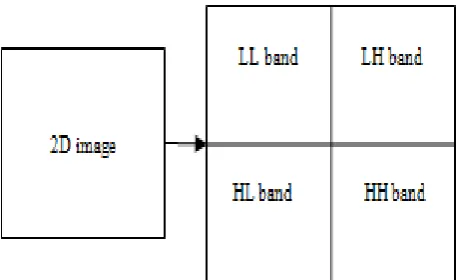
[image:2.595.323.553.569.709.2]In the watermarking process major issue is to resolve the trade-off between the strong protection and imperceptibility. By increasing the design strength value of the watermark that are to be embedded the robustness can be enhanced. It will further lead to increase in the visible distortion [3, 4]. DWT’s coefficients magnitude value is greatest in lower bands (LL) and lower for other three bands (HH, LH, HL). Efficiency of the wavelet coefficients increases as the magnitude increases. The frequency at which the host image is spread in the spatial localization is easily determined with the help of DWT [17, 18]. At same time spread of frequency and localization of spatial domain in the host is provided by the DWT. It is generally preferred over all other domains [19, 20]. The main concept of DWT is decomposing an original image into different sub images which consists of different spatial domain. The available images get decomposed into three different directions [24, 26]. In watermarking process DWT technique is mostly used. Wavelet filters are generally used to perform image transformation. When DWT is practiced on the original image in the embedding process as a result four bands are obtained (LL,HH,HL,LH).Further LL band is subdivided into smaller regions and depending on the principal comments size of the regions is decided. Inverse DWT is applied to get the watermarked image [28, 29]. Shift invariance is not provided by DWT because its bands get down sampled. So overcome this problem RDWT is used [30].
Figure 2. Results obtained after applying DWT on the image cameraman.
C. Arnold Transformations
The concept of Arnold transformations is mainly introduced to provide security to the watermark even after successful watermark extraction. It includes providing randomization to the pixels of the matrix. Arnold transformation is based on iteration process and is the most efficient method to provide randomization to the elements present in an array.
A unique key can be used to reverse the whole process [5, 14].It helps in providing authentication to the users and prevents unauthorized access of the watermark. It helps in increasing the imperceptibility of the Water marked image that is recovered [15, 16].If we apply transformation on a point (p, q) in the unit square it will change to a another new point (p ', q ') that is represented as:
�𝑋𝑋𝑋𝑋′′�=�1 1
1 2� �𝑋𝑋𝑋𝑋� (𝑚𝑚𝑚𝑚𝑚𝑚 1) (3)
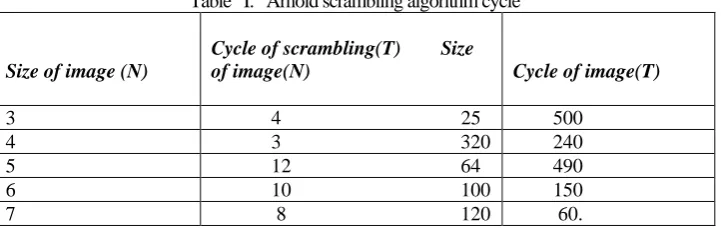
[image:3.595.62.262.62.180.2] [image:3.595.120.481.332.446.2]Figure 3. Distribution of image coordination Table I. Arnold scrambling algorithm cycle Size of image (N) Cycle of scrambling(T) Size of image(N) Cycle of image(T) 3 4 25 500
4 3 320 240
5 12 64 490
6 10 100 150
7 8 120 60.
The transformation of this type is known as Arnold scrambling with two dimensional. To specifically use it as a digital image, there is a need to alter the two dimensional Arnold scrambling with mod 1 to: �𝑋𝑋𝑋𝑋′′� = �1 11 2� �𝑋𝑋𝑦𝑦� (𝑚𝑚𝑚𝑚𝑚𝑚 𝑛𝑛) (4)
𝑃𝑃𝑥𝑥𝑦𝑦𝑛𝑛+1= 𝐴𝐴𝑃𝑃𝑥𝑥𝑦𝑦𝑛𝑛 (𝑚𝑚𝑚𝑚𝑚𝑚 𝑁𝑁) (5)
𝑃𝑃𝑥𝑥𝑦𝑦𝑛𝑛 = (𝑥𝑥, 𝑦𝑦)′ (6)
Where n represents the number of iterations, which are
denoted by n = 0, 1, 2....Image information such as gray value of the image. It further includes transplantation of the discrete lattice with the replacement of the discrete lattice for transplantation; a new image is produced after all the points are transverse [26].
D. Watermarking Scheme
Digital watermarking which is a special type of steganography is often used. It aims to solve the limited issues of copyright ownership. Applications include ownership identification, broadcast monitoring, access control, authentication and tamper proof, and enhancement of legacy systems. Watermarking is also related to image cryptography [9] which is , shuffling of bits so that decoding the original image becomes a difficult task.
Watermark referred to the information which is to be attached in the image. The whole process of attachment is known as watermarking. To protect copyrights watermarks are embedded. Hence hackers attempt to remove the watermark to copy or distribute images illegally [10,18]. Hacking attempts are attacks. The attacks can be ethical or unethical. There can be ethical hackers who try to identify the loopholes in a method and unethical hackers with malicious intent. The attacks can partially or totally corrupt the watermark data [21].
(a) Insertion of watermark: Inserting watermark works in two modes. In the first mode a secret key is chosen and the watermark to be inserted is scrambled using Arnold transformations.SVD is performed on the transformed image which helps in calculating the principal components. In the second mode, DWT is done on the host image and grouping is done in LL band and SVD is done [22]. After these two modes are combined so that the singular values obtained can be modified using the principal components generated using the principal components generated using SVD. At last inverse DWT and SVD is done to get the watermarked image [23, 25].
(p ,q)
p
Figure 4. Process of watermark insertion
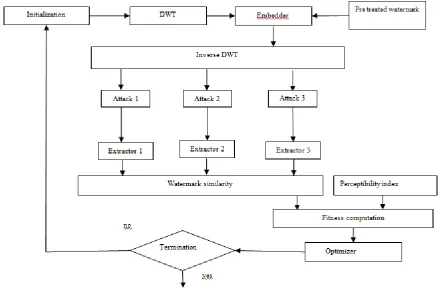
(b) Optimization of scaling factors: How good imperceptibility is achieved and the degree of robustness of
a watermark can be determined using the values of scaling factors can help in getting higher imperceptibility.
Figure 5. Process of optimization of scaling factors
but robustness decreases and larger values of scaling factors gives lesser imperceptibility but good robustness[6,10]. There is a need to maintain a balance between imperceptibility and robustness to get better optimistic
values. A scaling factor α is used which helps to maintain
balance.
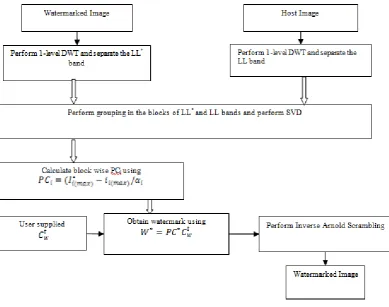
[image:4.595.75.517.400.690.2]performed in the LL bands and SVD is applied to calculate the principal components. Watermark is obtained and the inverse transformations are applied to get the watermarked image [4, 5].Inverse Arnold transfor-mations are applied to get the watermark image. Watermark is attached in the
[image:5.595.105.495.123.430.2]principal components so that this technique becomes free from errors. The principal components helps in the extraction of watermark . Original watermark is obtained at the last.
Figure 6. Process of watermark extraction
E. Artificial Bee Colony (ABC)
ABC algo is a type of algo that is based on heuristic method and work is carried out by the swarms. The idea to develop this algorithm was taken from the behaviour of honey bees [16, 17]. This algo consists of three important elements named as: employed bees, onlooker bees and the scout bees. The employed bees and the unemployed bees are considered as the main first listed two elements, where as the third element consists of rich food source in the hive. The behaviour of all kind of bees is discussed in the algorithm [20]. To depict the behaviour of these bees is necessary to provide self organization and intelligence in collective manner: Negative feedback is given by those bees which has poor food source [28]. The first two types of bees occupies their own space in their colony. The role of employed bees is to search for new solutions. The value of employed bees is same as to the number of solutions available. The onlookers bees selects the best food source available to it and the scouts bees randomly search for the new food sources that can be obtained. As far as optimization concept is considered the number of solutions, is same as the number of solutions available for the problem in the total population [13, 14]. The nectar quality present in a food source determines the fitness cost associated with every solution. The nectar information is read by the employed bees and then shared with the waiting bees in the hive. When the cycle of information sharing gets completed, the employed bee returns back to the food source [22]. When the last stage
is reached, the onlooker bees make use of the bio data obtained from the employed bees and select the food source. The food source with larger nectar quality has greater probability to get selected. The scout bees randomly develop a new solutions. The Accelerated coefficients and weights that are initially assigned helps to provide quick and convergence in an easy manner. performance is decided on the basis of work that is allocated to the scout bees and the selection procedure selected to decide the roulette [30].
F. Particle Swarm Optimization (PSO)
Particle swarm optimization is a type of computing model which was developed by Kennedy and Eberhart (1995) [1]. The applicants that participate in this are known as particles and the total number of particles is named as swarm. Basically, the algorithms that constitute particular swarms can be implemented simply and no criterion is required by them to decide for the functions that need to be optimized. The inspiration to these methods is obtained by The motion based behaviour of the different birds that fly [23, 25] each particle constitutes its own memory which is concerned with the best possible position occupied by them 𝑝𝑝𝑖𝑖𝑚𝑚𝑏𝑏𝑏𝑏𝑏𝑏𝑏𝑏 The number of visits they perform and the
communication capacity to convey information with their neighbours and to determine the global best position 𝑝𝑝𝑔𝑔𝑖𝑖𝑚𝑚𝑏𝑏𝑏𝑏𝑏𝑏𝑏𝑏 from all the possible best positions[25]. This
algorithm works in iterations from one iteration to another by following the below given equations where
𝑉𝑉𝑖𝑖𝑚𝑚𝑛𝑛𝑏𝑏𝑛𝑛 = 𝑛𝑛 × 𝑣𝑣𝑖𝑖𝑚𝑚 𝑝𝑝𝑟𝑟𝑏𝑏 + 𝑐𝑐1× 𝑟𝑟𝑟𝑟𝑛𝑛𝑚𝑚( )�𝑝𝑝𝑖𝑖𝑚𝑚𝑏𝑏𝑏𝑏𝑏𝑏𝑏𝑏 − 𝑥𝑥𝑖𝑖𝑚𝑚 � + 𝑐𝑐2 ×
𝑟𝑟𝑟𝑟𝑛𝑛𝑚𝑚() × (𝑝𝑝𝑔𝑔𝑖𝑖𝑚𝑚𝑏𝑏𝑏𝑏𝑏𝑏𝑏𝑏 − 𝑥𝑥𝑖𝑖𝑚𝑚 ) (7)
𝑝𝑝𝑖𝑖𝑚𝑚 𝑛𝑛𝑏𝑏𝑛𝑛 = 𝑝𝑝𝑖𝑖𝑚𝑚𝑝𝑝𝑟𝑟𝑏𝑏 + 𝑣𝑣𝑖𝑖𝑚𝑚𝑛𝑛𝑏𝑏𝑛𝑛 (8)
Where
-𝑣𝑣𝑖𝑖𝑚𝑚 : the velocity of particle in the search space area and is limited by the values [Vmin, Vmax]. Vmin and Vmax are, respectively, the one step moving distance.
- 𝑝𝑝𝑖𝑖𝑚𝑚 : It decides the position occupied by the ith particle.
- 𝑝𝑝𝑖𝑖𝑚𝑚𝑏𝑏𝑏𝑏𝑏𝑏𝑏𝑏 : It indicates the individual’s best position specified by particle i.
- 𝑝𝑝𝑔𝑔𝑖𝑖𝑚𝑚𝑏𝑏𝑏𝑏𝑏𝑏𝑏𝑏 : global best position of all the particles is indicated by gid th.
-𝑥𝑥𝑖𝑖𝑚𝑚 :.Each particles current position is given by this
- 𝑟𝑟𝑟𝑟𝑛𝑛𝑚𝑚() : It is a random function whose values lie in between between 0 and 1.
- 𝑛𝑛: It determines the inertial weight allocated.
- 𝑐𝑐1 and 𝑐𝑐2 are the arbitrary constants used.
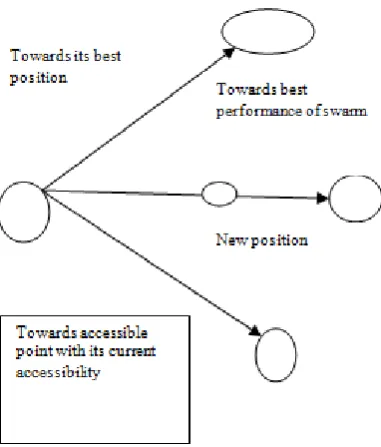
[image:6.595.209.400.305.529.2]Each particles new velocity is calculated by using Eq.(1).It generally requires the previous velocity of the particle the relationship addressed distance of the present position of the particle and the local and global optimal position of particles[29,30]. Afterwards the particle’s position is changed .
Figure 7.Displacement of particles in PSO
3. PROPOSED METHODOLOGY
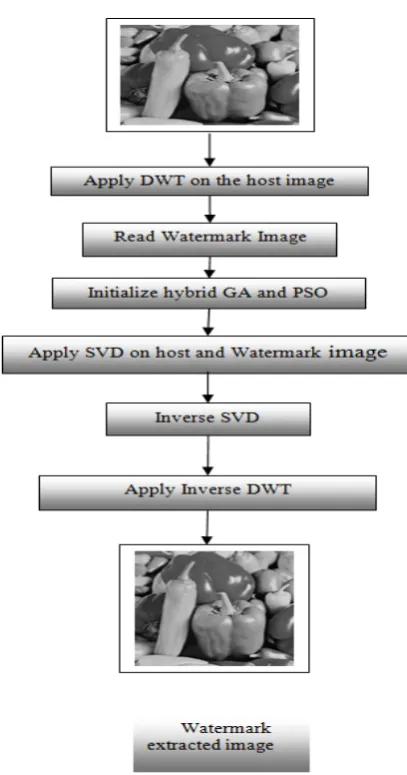
A new watermarking technique whose work is carried in the discrete wavelet transform (DWT) in combination with particle swarm optimization (PSO) and GA based SVD is represented to provide better security. The watermark scrambling is done by using the Arnold transform to protect watermark further. Arnold transform will change the watermark in such a way that it becomes meaningless for the hackers or crackers. The use of hybrid particle swarm optimization and GA based SVD will enhance the speed and security of the watermarking technique further. The flowchart of the proposed methodology is shown below. The below given steps are followed in the proposed methodology
(a) Discrete Wavelet Transform is applied on the cover image
Applying DWT coverts the input image into 4 bands LL, HL, LH, HH. Transform domain DWT is generally
preferred to be used as shows more robustness against different attacks. So in the watermarking schemes DWT schemes becomes the first choice. It further helps in increasing imperceptibility.
(b) Select the watermark to be inserted
Applying watermark on the cover image helps in detecting the rightful ownership of particular data or images. Two types of watermark can be used for insertion i.e. Visible or Invisible watermark. It further provides protection to the copyrighted images and enhances the security
(c) Initialize the algorithms ie. Particle swarm optimization (PSO) and the Genetic Algorithm
hybridization of swarm intelligence can help in obtaining the optimistic values.
Figure 8. The flowchart of proposed methodology
d) Apply Singular value decomposition (SVD) on the cover and watermark image
Watermarks principal components that are to be of applied is calculated by applying SVD on the host and watermark image. It helps in finding the authentication of the user. It further provides protection against different attacks.
(e) Apply inverse SVD and DWT
This step is basically performed to obtain the cover image back in its original shape.
4. RESULTS AND DISCUSSIONS
The proposed technique is tested on different images like peppers _gray, jet plane, corridor, house, Boat and many medical images are used. The host image is of size 500×500.W1 and W2 which are grey scaled images of size
130×130 are used as watermark to be embedded. The cover and watermark images are shown in fig 7.To depict the similarity between the cover and watermarked signature used MSE, BER are used to show the comparison. Different attacks are applied on the cover and watermark image and results are find out.
Figure9. Cover and watermark images used (a) jet plane (b) House (c) Pepper (d) corridor(e) boat (f) x ray chest
Table II.PSNR (db) Results for the proposed technique as compared with existing technique
Host image PSNR(db)
Existing Values W1 W2
Proposed Values W1 W2 Jet plane 50.6132 50.6134 76.3724 76.3725 Pepper_gray 51.0642 51.0650 75.8670 75.8671 Corridor 52.0146 52.0146 74.4386 76.4386 Xray chest 53.4435 53.4437 76.0957 76.0960 House 52.0136 52.0138 77.0959 77.0957
Table III.MSE (db) Results for the proposed technique as compared with existing technique
Host image MSE(db)
Existing Values W1 W2
Proposed Value W1 W2
Jet plane 0.2033 0.2033 0.0022 0.0022
Pepper_gray 0.5881 0.5881 0.0013 0.0013
Corridor 0.4020 0.4020 0.0018 0.0018
X ray chest 0.5993 0.5993 0.0023 0.0023
[image:8.595.88.509.353.461.2]House 0.4080 0.4080 0.0015 0.0015
Table IV.RMSE (db) Results for the proposed technique as compared with existing technique
Host image RMSE(db)
Existing Values W1 W2
Proposed Values W1 W2 Jet palne 0.5275 0.5275 0.0330 0.0330
[image:8.595.70.526.640.753.2]House 0.7741 0.7741 0.0484 0.0484 Pepper 0.6351 0.6351 0.0397 0.0397 Lena 0.7055 0.7051 0.0441 0.0441 Cameraman 0.6395 0.6395 0.0400 0.0400
Table V. BER (db) Results for the proposed technique as compared with existing technique
Host image BER(db)
Existing Values W1 W2
Proposed Value W1 W2 Jet plane 0.0186 0.0186 0.0129 0.0129
House 0.0199 0.0199 0.0134 0.0134
Pepper 0.0192 0.0192 0.0131 0.0131
Lena 0.0199 0.0199 0.0133 0.0133
cameraman 0.0192 0.0192 0.0131 0.0131
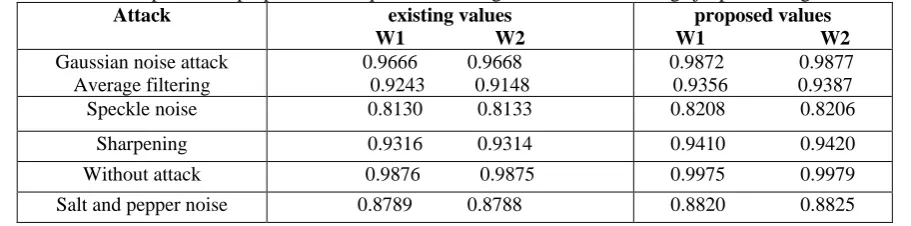
Table VI. Robustness comparison of proposed technique with existing values for cover image jet plane using watermark w(1&2)
Attack existing values
W1 W2
proposed values W1 W2
Gaussian noise attack Average filtering
0.9666 0.9668 0.9243 0.9148
0.9872 0.9877 0.9356 0.9387 Speckle noise 0.8130 0.8133 0.8208 0.8206
Table VII. Robustness comparison of proposed technique with existing values for cover image pepper using watermark w(1&2)
Attack existing values
W1 W2
proposed values W1 W2
Gaussian noise attack Average filtering
0.9667 0.9669 0.9241 0.9143
0.9862 0.9865 0.9357 0.9358 Speckle noise 0.8122 0.8123 0.8210 0.8208
Sharpening 0.9311 0.9316 0.9415 0.9416
Without attack 0.9873 0.9875 0.9986 0.9987 Salt and pepper noise 0.8788 0.8789 0.8813 0.8814
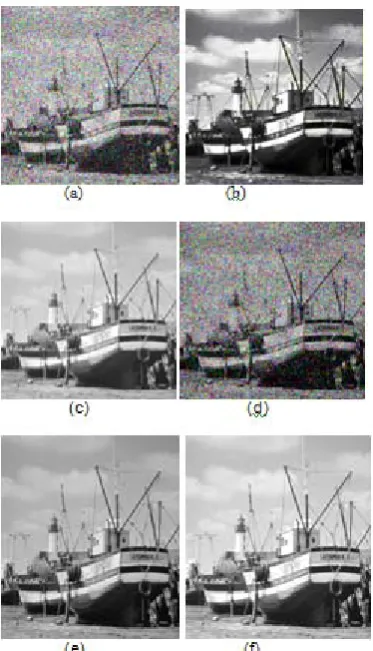
Figure 9.output host images obtained after applying (a) Gaussian filter attack (b) Speckle noise (c) Sharpening (d) Salt and pepper noise (e) without attack (f)Average filtering
5. QUANTITATIVE MEASURES
In this section a clear comparison among the proposed and existing technique is represented. Different parameters of the digital images are considered to conclude that the new proposed technique outperforms the existing technique. Table 2 shows the comparison of PSNR values obtained in the proposed and existing technique. It is expected that the value of PSNR must be maximized. Here PSNR values obtained by existing technique are represented by blue colour and the values of PSNR obtained by proposed technique are represented by red colour. The increase in the values depicts that the quality of image is improved.
Figure10 (a).Comparison of PSNR value of proposed and existing technique as given in table 2
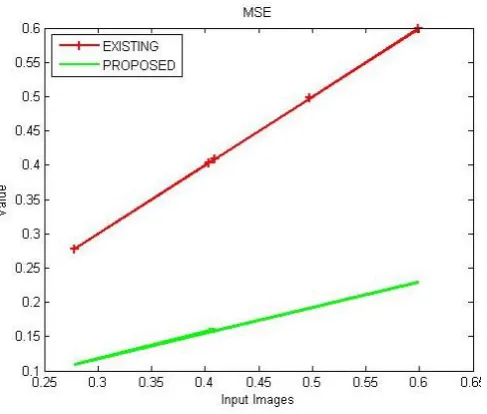
[image:9.595.310.568.88.454.2] [image:9.595.65.252.228.554.2]MSE(Mean square error): Figure 6.1 represents the quantitative analysis as found by mean square error. As MSE is expected to be least, It is clear from the given plot that the proposed method has shown a decrease in the value of MSE as compared to the existing technique. This decrease shows that the goal quality of the image is improved. The values of proposed method are represented by red colour and the existing method is given by blue colour.
Figure 11 (a).Comparison of MSE value of proposed and existing technique as given in table 3
Figure 11(b).Comparison of MSE value of proposed and existing technique as given in table 3(line)
RMSE: In Table 4 shows the comparative analysis of the root mean square error. There is a need to maximize the RMSE, so the important concept is to degrade the value of RMSE need to be maximized as possible. It is clear from the
given plot that the proposed method has shown a decrease in the value of MSE as compared to the existing technique.
Figure.12 (a).Comparison of RMSE value of proposed and existing technique as given in table 4
Figure 12 (a).Comparison of RMSE value of proposed and existing technique as given in table 4(line)
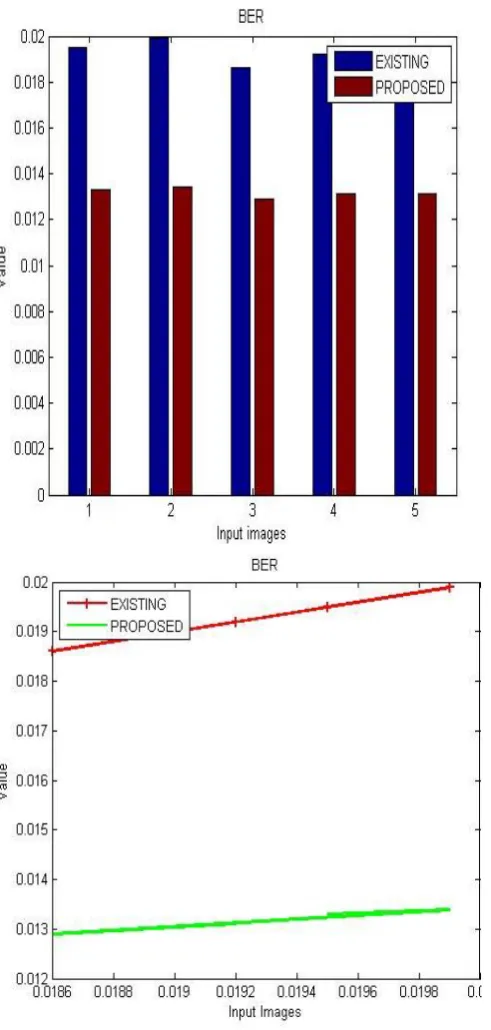
BER (Bit Error Rate): BER represents the number of bit errors encountered in a per unit time. It is a ratio that is calculated by dividing the total number of bit errors with the total number of bits transmitted bits in the given time interval.
[image:10.595.317.561.84.311.2] [image:10.595.38.286.163.435.2] [image:10.595.318.561.371.578.2] [image:10.595.40.284.469.676.2]
Figure 13 (b).Comparison of BER value of proposed and existing technique as given in table 5(line)
6. CONCLUSION
In this paper a new SVD based watermarking scheme is presented in integration with particle swarm optimization using discrete wavelet transform. The concept of DWT is introduced and applied over the cover image to provide resistance against different types of attacks. Singular value decomposition plays an important role in calculating the watermark’s principal components that are to be inserted. The proposed watermarking scheme shows that particle swarm optimization is used which finds the best values of the scaling factor and helps to achieve optimization. Optimistic values are obtained using hybridization. The performance of existing technique ABC is compared with the proposed technique PSO. The obtained experimental
results show that the proposed method gives better protection to detect the unauthorized access. The quantitative measures such as PSNR, MSE, RMSE, BER and different attacks used confirm the superiority of proposed technique over existing technique ABC.
REFERENCES
[1] J. Kennedy, and R. Eberhart, “Particle swarm optimization,”in Proc. IEEE Int. Conf. Neural Networks, Perth, WA, 1995, pp. 1942-1948.
[2] B. A. Thomas and J. J. Rodriguez, "Wavelet-based colour image denoising," in Proc. of International Conference on Image Processing, vol. 2, pp. 804-807, 2000.
[3] P. Meerwald, A. Uhl, A Survey of Wavelet-Domain
Watermarking Algorithms. In Proc. of SPIE, Electronics Imaging, Security and Watermarking of Multimedia Contents III, CA, USA 4314, (2001), pp. 505-516.
[4 ]M. Arnold, M. Schmucker and S. D. Wolthusen,
Techniques and Applications of Digital Watermarking and Content Protection. ARTECH HOUSE Publications, 2003.
[5] Tian, Yuan, et al. "Do singular values contain adequate information for face recognition?." Pattern recognition 36.3 (2003): 649-655.
[6] Anuradha and Rudresh Pratap Sing, “DWT Based
Watermarking Algorithm using Haar Wavelet,” International Journal of Electronics and Computer Science Engineering, ISSN 2277-1956/V1N1-01-06,2004
[7] J. Sun, B. Feng, W. Xu, Particle swarm optimization with
particles having quantum behaviour, in Proceedings of the IEEE Congress on Evolutionary Computation, Portland, Oregon USA, pp. 325-331, 2004.
[8] Ganic, Emir, and Ahmet M. Eskicioglu. "Robust embedding of visual watermarks using discrete wavelet transform and singular value decomposition." Journal of electronic imaging 14.4 (2005): 043004-043004.
[9] K. Hameed, A. Mumtaz, S. A. M. Gilani, Digital Image Water marking in the Wavelet Transform Domain, World Academy of Science Engineering and Technology 13, 2006. [10] Lien, B. K., & Lin, W. H.(2006). A watermarking method
based on maximum distance wavelet tree quantization. In Proceedings of 19th conference computer vision, graphics and image processing (pp. 269–276).
[11] D. C. Lou, H.K. Tso and J.L. Liu, "A copyright protection scheme for digital images using visual cryptography technique," Journal of Computer Standards and Interfaces, vol. 29, pp. 125-131, 2007.
[12] Liu, Shao-Hui, et al. "An image fragile watermark scheme based on chaotic image pattern and pixel-pairs." Applied Mathematics and Computation 185.2 (2007): 869-882.
[13] E. Vahedi, A. Zoroofi, and M. Shiva, “A new approach for image watermarking by using particle swarm optimization,” vol. 00, no. November, pp. 24–27, 2007.
[14] J. Kennedy, and R. Eberhart, “Particle swarm optimization,” in Proc. IEEE Int. Conf. Neural Networks, Perth, WA, 2008, pp. 1942-1948.
[15] L. Jing, F. Liu and B. Liu, Robust Image Watermarking Scheme with General Regression Neural Network and FCM Algorithm, Lecture Notes in Computer Science (2008), 243– 250.
[16] Haouzia, Adil, and Rita Noumeir. "Methods for image authentication: a survey." Multimedia tools and applications 39.1 (2008): 1-46.
[17] O. M. Al-Qershi, K. B. Ee, A Comparison Between Block-Based and Non Block-Block-Based Watermarking Schemes based on DWT, Second International Symposium on Electronic Commerce and Security, 2009.
[image:11.595.40.286.50.566.2]coefficient quantization,” Expert Systems with Applications, 36(9), 11509–11516, 2009.
[19] V. Aslantas, An optimal robust digital image watermarking based on SVD using differential evolution algorithm, Optics
Communications 282 (2009), 769–777.
[20] Bhatnagar, Gaurav, and Balasu bramanian Raman. "A new robust reference watermarking scheme based on DWT-SVD." Computer Standards & Interfaces 31.5 (2009): 1002-1013.
[21] M. Al-khassaweneh, H. Al-zoubi and S. Aviyente, The multi bit watermarking method for speech signals in the time frequency domain, Integrated Computer-Aided
Engineering17(1) (2010), 59–67
[22] H. Tao, J.M. Zain and A.N. Abdalla, Particle Swarm
Optimization for Digital Image Watermarking,
Communications in Computer and Information Science (2010), 1–8.
[23] W. Liao, J. Wang, X. Wang, and J. Wang, “Improved Particle Swarm Optimization Algorithms,” pp. 77–80, 2011.
[24] Lagzian, Samira, Mohsen Soryani, and Mahmood Fathy. "A new robust watermarking scheme based on RDWT-SVD." International Journal of Intelligent Information Processing 2.1 (2011): 22-29.
[25] Yuh- Rau Wang, Wei-Hung Lin and Ling Yang, “An intelligent watermarking method based on particle swarm optimization,” Expert Systems with Applications 38 (2011), 8024–8029.
[26] Gokhale, U. M., and Y. V. Joshi. " A semi fragile watermarking algorithm based on SVD-IWT for image authentication." Int. J. Adv. Res. Comput. Commun. Eng 1.4 (2012).
[27] Gupta, Akshya Kumar, and Mehul S. Raval. "A robust and secure watermarking scheme based on singular values replacement." Sadhana 37.4 (2012): 425-440.
[28] Yadav, Upasana, et al. "Different Watermarking Techniques & its Applications: A Review." International Journal Of Scientific And Engineering Research 5.4 (2014).
[29] Kaveh Ahmadi,Ahmad Y.Javaid, “An efficient compression based on adaptive thresholding in wavelet domain using particle swarm optimization”, science direct. Image communication, (2015),(33-39).