Western University Western University
Scholarship@Western
Scholarship@Western
Electronic Thesis and Dissertation Repository
12-13-2017 2:30 PM
Three Experiments on Complex Fluids
Three Experiments on Complex Fluids
Yang Liu
The University of Western Ontario
Supervisor John R de Bruyn
The University of Western Ontario Graduate Program in Physics
A thesis submitted in partial fulfillment of the requirements for the degree in Doctor of Philosophy
© Yang Liu 2017
Follow this and additional works at: https://ir.lib.uwo.ca/etd
Part of the Fluid Dynamics Commons
Recommended Citation Recommended Citation
Liu, Yang, "Three Experiments on Complex Fluids" (2017). Electronic Thesis and Dissertation Repository. 5118.
https://ir.lib.uwo.ca/etd/5118
This Dissertation/Thesis is brought to you for free and open access by Scholarship@Western. It has been accepted for inclusion in Electronic Thesis and Dissertation Repository by an authorized administrator of
Abstract
The behaviour of complex fluids is fundamentally interesting and important in many
ap-plications. This thesis reports on three experiments on the thermal and rheological behaviour
of complex fluids. The first is a study of the rheological properties of and heat transport in a
saline solution of hydroxyethyl cellulose. This material has been used as a tissue phantom in
testing the behavior of medical devices in MRI scanners. We find it behaves as a typical
entan-gled polymer, and flows in response to local heating, such as could occur due to eddy-current
heating of metallic devices in an MR scanner. We use laboratory experiments and numerical
simulations to determine the convective and conductive contributions to the heat transport in a
simple model of this system. Our results indicate that convective heat transport is of the same
order of magnitude as conductive transport under conditions typical of MRI device tests. The
second project is an investigation of the start-up flow and yielding of a simple yield-stress fluid
(Carbopol 940) in a vertical pipe. The Carbopol was displaced from below by an immiscible
Newtonian liquid (Fluorinert FC-40) injected at a constant, controlled rate. Rough and
smooth-walled pipes were used to study the effects of wall boundary conditions. In the rough-walled
pipe, the yielding involved a long transient with several steps: elastic deformation, the onset
of wall slip, yielding at the wall, and finally a steady-state plug flow that is well-described
by the predictions of the Herschel-Bulkley model. In contrast, in the smooth-walled pipe, the
wall shear stress never exceeded the yield stress. In the third project, we study the flow of
Carbopol solutions confined to square microchannels with sides ranging from 500 down to 50
µm. In the larger channels, the measured velocity profiles agreed well with simulations based on the bulks-scale rheology of the Carbopol and the Herschel-Bulkley model. In contrast, in
microchannels with sides less than 150µm the velocity profiles could not be fitted by a model with a finite yield stress, but instead were described by a power-law model with zero yield
stress. We explain the vanishing of the yield stress in terms of the confinement of the
bopol’s microstructure by the microchannels.
Keywords: Rheology, complex fluids, yielding, yield stress, confinement
Co-Authorship Statement
The work in chapter 3 has been published as: Yang Liu, Cameron C. Hopkins, William
B. Handler, Blaine A. Chronik, John R. de Bruyn, Rheology and heat transport properties
of a hydroxyethyl cellulose-based MRI tissue phantom, Biomedical Physics & Engineering
Express, 3:045008, 2016. I did all the experiments and data analysis and wrote early drafts of
this paper. Cameron C. Hopkins performed the numerical simulations. William B. Handler and
Blaine A. Chronik provided the HEC solutions and the expertise on MRI applications. All the
authors provided editorial comments on this paper. John R. de Bruyn supervised the project.
The work in chapter 4 has been submitted for publication: Yang Liu, John R. de Bruyn,
Start-up flow of a yield-stress fluid in a vertical pipe, Journal of Non-Newtonian Fluid
Me-chanics. I did all the experiments, simulations, and data analysis and was the primary author
of the paper. John R. de Bruyn supervised the project and provided editorial comments on the
paper.
The work in chapter 5 will be submitted for publication toJournal of Non-Newtonian Fluid
Mechanics. The authors include Yang Liu, Daniel Lorusso, David Holdworth, Tamie L.
Poep-ping, John R. de Bruyn. I designed the experiment, made the microchannels, and did all the
experiments, simulations, and data analysis, and was the primary author of the paper. Daniel
Lorusso and David Holdworth provided instruction and assistance in fabricating the channels.
Tamie L. Poepping provided equipment and expertise in the use of the channels and micro PIV.
John R. de Bruyn supervised the project and provided editorial comments on the paper.
Acknowledgments
I am highly indebted to my supervisor, Dr. John R. de Bruyn, for advising me with much
patience over the last five years. I learned how to do research the right way from John. None
of my work would have been possible without his support.
Special thanks go to Dr. Blaine A. Chronik and Dr. Tamie L. Poepping for cooperation and
collaboration in my research. Without their participation, I would not have finished this big
work.
Thanks also go to the Natural Sciences and Engineering Research Council of Canada and
the University of Western Ontario for funding this research. We are grateful to P. de Souza
Mendes for helpful conversations and to Ranjith Divigalpitiya of 3M Canada for providing the
Fluorinert.
My advisory committee, Dr. Richard A. Holt and Dr. Michael G. Cottam, provided helpful
advice at regular intervals throughout the project, and for this I’m grateful.
Here at the Department of Physics I worked with a number of fellow graduate students. I
wish to thank Cameron C. Hopkins who did some Comsol simulations for me and reviewed
the first draft of the introductory chapter of this thesis, and Nirosh Getangama and Nayeob Gi
who helped me to format this thesis using LATEX. Thanks also to former colleagues Grace
Ge, Maryam Mozaffari, and Masha Goiko who all contributed in many ways.
Brian Dalrymple and Frank Van Sas manufactured parts of the apparatus used in my
exper-iments. Tim Goldhawk and Todd Simpson assisted me in Nanofabrication Lab. Thanks also to
Henry Leparskas for computer support.
I especially want to thank Clara Buma, Jodi Guthrie, Brian Davis, Shailesh Nene and Phin
Perquin who always treated me with kindness.
Finally, I must give thanks to my family members, including my parents and other
rela-tives, who contributed so much to my education, career, and growth. Without their efforts and
support, I would not have reached this far.
Contents
Abstract i
Co-Authorship Statement iii
Acknowledgements iv
List of Figures ix
List of Tables xvii
List of Symbols xviii
List of Abbreviations xix
1 Introduction 1
1.1 Complex Fluids . . . 1
1.1.1 Viscoelasticity . . . 3
1.2 Rheology of complex fluids . . . 6
1.2.1 Shear thinning and shear thickening . . . 7
1.2.2 Yield-stress fluids . . . 8
1.2.3 Thixotropy . . . 10
1.2.4 Yielding . . . 14
1.2.5 Confinement effects . . . 15
1.3 Summary of Present Work . . . 16
1.3.1 Overview . . . 16
1.3.2 Rheology and heat transport properties of a hydroxyethyl cellulose–
based MRI tissue phantom . . . 17
1.3.3 Start-up flow of a yield-stress fluid in a vertical pipe . . . 17
1.3.4 Confinement effects on the rheology of Carbopol in microchannels . . . 18
Bibliography . . . 19
2 Materials and methods 25 2.1 Introduction . . . 25
2.2 Materials . . . 25
2.2.1 Hydroxyethyl cellulose . . . 25
2.2.2 Carbopol . . . 27
2.3 Techniques . . . 28
2.3.1 Shear Rheometry . . . 28
2.3.2 Particle Image Velocimetry (PIV) . . . 31
2.4 Apparatus . . . 33
2.4.1 Apparatus for yielding experiments . . . 34
2.4.2 NI LabVIEW . . . 34
2.4.3 Fabrication of microfluidic devices . . . 36
2.5 Ansys Fluent . . . 37
Bibliography . . . 43
3 Rheology and heat transport properties of a HEC-based MRI tissue phantom 45 3.1 Introduction . . . 45
3.2 Methods . . . 47
3.2.1 Sample Preparation . . . 47
3.2.2 Rheological Measurements . . . 48
3.2.3 Heat transport and flow measurements . . . 48
3.2.4 Numerical simulations . . . 50
3.3 Results . . . 51
3.3.1 Rheology . . . 51
3.3.2 Thermal convection . . . 55
3.4 Discussion and Conclusion . . . 61
Bibliography . . . 64
4 Start-up flow of a yield-stress fluid in a vertical pipe 67 4.1 Introduction . . . 67
4.2 Experiment . . . 69
4.2.1 Fluid preparation . . . 69
4.2.2 Rheological characterization . . . 70
4.2.3 Experimental setup . . . 71
4.3 Results . . . 73
4.4 Numerical simulation . . . 81
4.5 Discussion . . . 84
4.6 Conclusion . . . 87
4.7 Appendix . . . 87
Bibliography . . . 90
5 Confinement effects on the rheology of Carbopol 96 5.1 Introduction . . . 96
5.2 Experiment . . . 98
5.2.1 Fabrication of microchannels . . . 98
5.2.2 Fluid preparation and bulk rheology . . . 100
5.2.3 Micro-particle image velocimetry . . . 103
5.2.4 Computational fluid dynamics . . . 104
5.3 Results . . . 105
5.3.1 Water . . . 105
5.3.2 HEC . . . 107
5.3.3 Carbopol . . . 108
5.4 Discussion and conclusion . . . 111
Bibliography . . . 115
6 General Discussion and Conclusions 118 Bibliography . . . 123
Curriculum Vitae 126
List of Figures
1.1 Diagram showing shear stress, strain, and shear rate in a layer of fluid between two
horizontal plates. The upper plate moves with a velocityv, while the lower plate is
fixed. . . 2
1.2 Left: Diagram of the Maxwell Model. The right graphs show the stress relaxation behaviour obtained by solving the model for ˙γ(t>0 s)=0 s−1andτ(t=0 s)=τ0Pa. . . 4
1.3 Left: Diagram of the Kelvin–Voigt Model. The right graph shows the strain creeping behaviour obtained by solving the model forτ(t<0 s)=0 Pa,τ(t≥0 s)=τ0Pa, andγ(t=0 s)=0. . . 5
1.4 Flow curves of different types of fluids. . . 6
1.5 Flow curves of a thixotropic fluid measured with increasing steps in the shear rate and then decreasing steps. . . 11
1.6 The flow curve solved form>1 using Eq. (1.8). . . 13
2.1 The chemical formula of Hydroxyethyl cellulose (HEC). . . 26
2.2 The chemical formula of polyacrylic acid. . . 28
2.3 The microstructure of Carbopol. The dashed circles represent the swollen polymer blobs. . . 29
2.4 A schematic diagram of the cone-and-plate measuring tool of the shear rheometer. Ω is the angular velocity of the rotating cone.θ0is the cone angle. . . 30
2.5 Two successive video frames used for PIV analysis. The bright points are small parti-cles suspended in the experimental fluid and illuminated by a light source. The squares in the frames are interrogation windows. . . 32
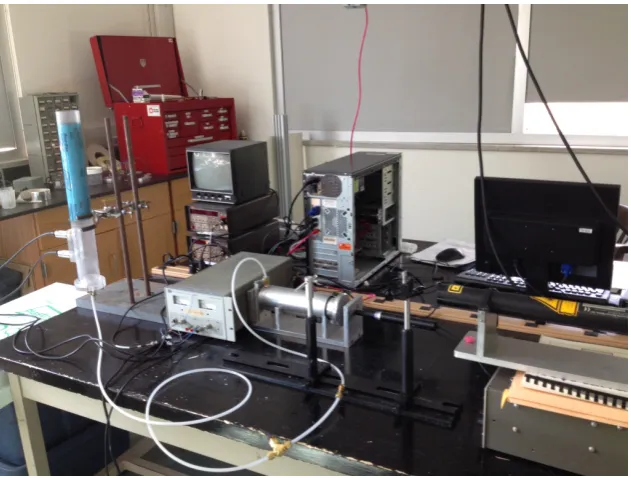
2.6 The overall set-up of the experiments in Chap. 4. . . 35
2.7 Some components of the overall apparatus shown in Fig. 2.6. . . 35
2.8 Left: GPIB-USB-HS (IEEE 488) used to connect voltmeters to the computer. Right:
PCI-1407 (IMAQ) hardware used to connect the camera to the computer. . . 37
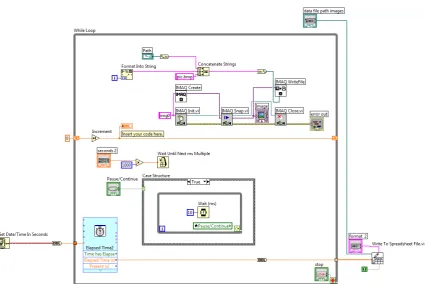
2.9 The LabVIEW block diagram code controlling the camera in the experiments
de-scribed in Chaps. 3 and 4. . . 38
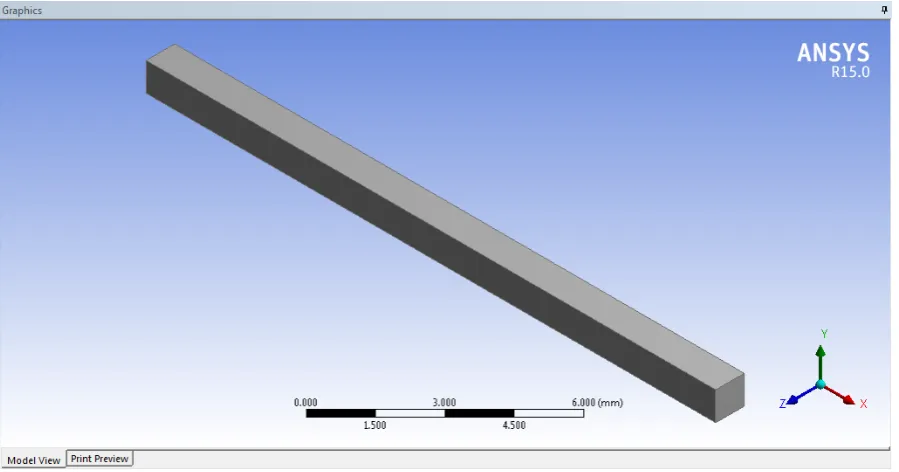
2.10 The computational domain used to simulate a channel in Chap. 5. . . 40
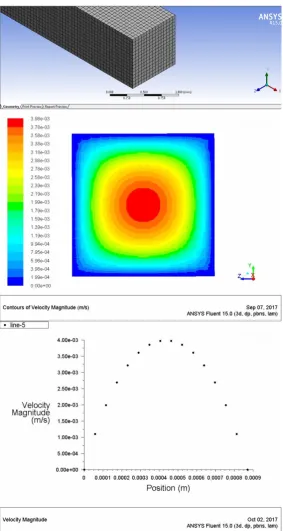
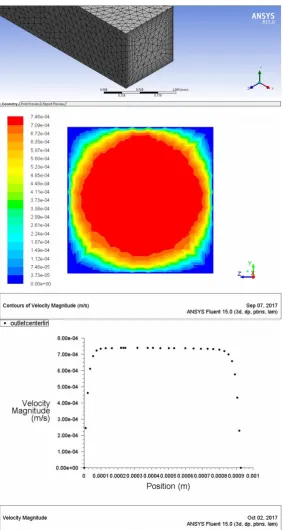
2.11 The results of a simulation for water flowing in the channel shown in Fig. 2.10. Top:
the computational mesh used in the simulations. Middle: the simulated velocity map
at the outlet of the channel. Bottom: the simulated velocity profile on the mid-height
line at the outlet of the channel. . . 41
2.12 The results of a simulation for Carbopol in the channel shown in Fig. 2.10. Top: the
computational mesh used in the simulations. Middle: the simulated velocity map at
the outlet of the channel. Bottom: the simulated velocity profile on the mid-height line
at the outlet of the channel. . . 42
3.1 The experimental set-up used to measure convective heat transport in fluids.
A tank contains the fluid of interest, which is seeded with small flow
visual-ization particles. The tank is 30.5±0.1 cm in length, 21.2±0.1 cm in height,
and 15.5±0.1 cm in width into the page. A heater is mounted at the left-hand
edge of the tank, and the temperature measured at four locations with optical
temperature probes. The visualization particles are illuminated by a laser sheet
coming in from the right-hand side of the diagram, and their motion is recorded
by a video camera looking into the page. The dotted rectangle indicates the
re-gion imaged by the camera. The origin of thex-ycoordinate system shown is
at the bottom left corner of the tank. . . 49
3.2 (a) The shear stressσas a function of shear rate ˙γof the HEC-saline solution at 25◦C. The waiting time at each value of ˙γwas 1 min. (b) Viscosityηobtained form the data plotted in (a). The dashed lines are fits to the Cross model, Eq.
(3.2). The open circles are for fresh HEC, while the filled circles are for the
aged solution. The inset shows the viscosity at a ˙γ = 1 s−1 measured with different values of the waiting time. . . 52
3.3 The zero-shear-rate viscosityη0for both fresh and aged HEC solutions plotted as a function of temperature. The open and filled circles are data for the fresh
and aged HEC solutions, respectively. The dashed lines are fits to Eq. (3.3), as
discussed in the text. . . 52
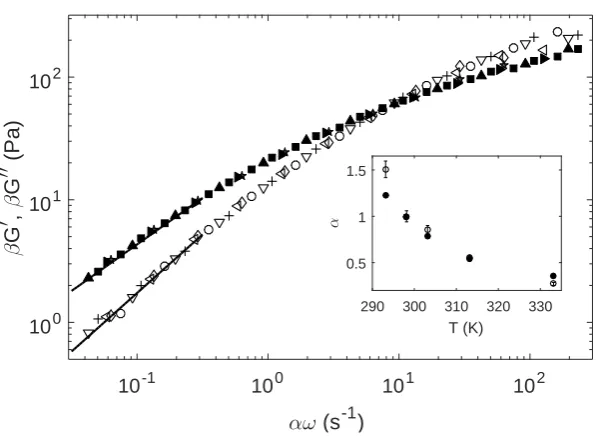
3.4 Elastic and viscous moduli of the fresh HEC-saline solution, scaled to a
tem-perature of 25◦C using time-temperature superposition. The different symbols
indicate data recorded at different temperatures: ⃝: 20◦C, : 25◦C, ▽: 30◦C,
△: 40◦C,⋄: 60◦C. Solid symbols areG′′ and open symbols areG′. The dashed
lines are power-law fits to the lowest-frequency data. The inset shows the
fre-quency scaling factor α for fresh (open symbols) and aged (solid symbols) HEC-saline solution. . . 54
3.5 The velocity field measured in an experiment using water. The field of view
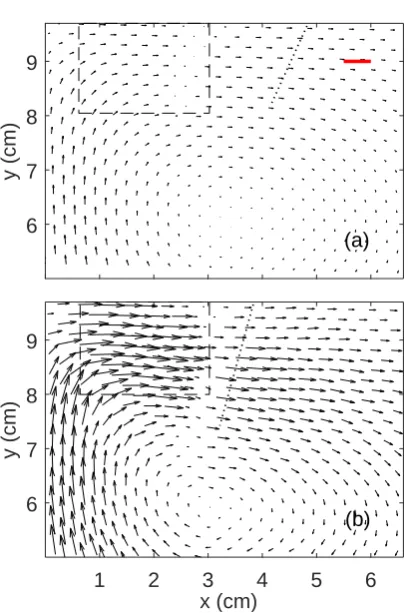
is at the top left of the fluid, in a vertical plane through the center of the tank,
as discussed in the text. The edge of the heater is at x = 0; the bottom of the
tank is ay y = 0, and the free surface of the fluid is at the top of the image.
The tip of temperature probe 1 is close to the heater, and the dotted line shows
the approximate position of temperature probe 2. The temperature difference
between these two probes was 4.2 K. The length of the scale bar at the top left
corresponds to a velocity of 0.05 cm/s. . . 55
3.6 The velocity field in experiments on the HEC solution. (a) shows the velocity
field when the temperature difference between probes 1 and 2 was 10.8 K; (b)
is for a temperature difference of 49 K. The field of view is at the top left of the
fluid, in a vertical plane through the center of the tank, as discussed in the text.
The edge of the heater is atx = 0; the bottom of the tank is ayy = 0, and the
free surface of the fluid is at the top of the image. The tip of temperature probe
1 is close to the heater, and the dotted line shows the approximate position
of temperature probe 2. The length of the scale bar at the top right of (a)
corresponds to a velocity of 3×10⁻³cm/s. . . 58
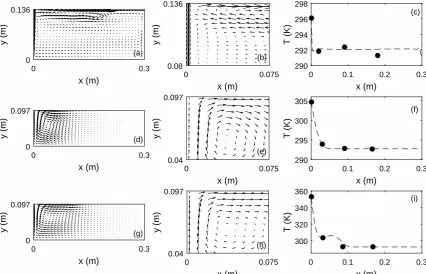
3.7 Simulations of the flow and temperature fields for the three experiments
de-scribed in the text. (a)-(c): Water, T1 = 295.9 K; (d)-(f): HEC solution, T1 = 304.7 K, (g)-(i): HEC solution, T1 = 352.8 K. The left-hand column shows the velocity field in the entire simulated domain, which models the tank
used in the experiments. The center column shows the velocity field in the
upper left corner of the domain. This corresponds to the region in which the
velocity was measured experimentally, as shown in Figs. 3.5 and 3.6. The
right-hand column shows the temperatures measured at the four probes as solid
circles, and the simulated temperature at approximately the same depth as a
dashed line. . . 59
4.1 The shear stressτas a function of shear rate ˙γ of 0.13 wt% Carbopol containing 0.6
vol% glass beads. Symbols are the measured data, and the dashed line is a fit to the
Herschel-Bulkley model, as described in the text. . . 70
4.2 A schematic diagram of the experimental apparatus. P1 and P2 are pressure gauges.
The solid horizontal line near the bottom of the pipe is the interface between the
Car-bopol and Fluorinert. The area between the dotted lines is the region used for flow
visualization. . . 72
4.3 Data from an experiment using 0.18 wt% Carbopol in the rough-walled pipe with a
very slow displacement rate,Ql = 5.02×10⁻⁸ m3/s. (a)P1, the pressure in the
Car-bopol. The dashed lines are linear fits to P1(t) at early (160-200 s) and late times
(300-400 s). The time at which the two fits intersect ist∗. (b)τw, the wall shear stress,
calculated from Eq. (4.1). The black circle isτ∗w, the wall shear stress att∗. The dashed
line is the yield stress measured with the rheometer. The three time intervals discussed
in the text and in Fig. 4.4 are shown by the grey rectangles. The uncertainty ofτwis
approximately the size of the symbols. . . 74
4.4 The flow velocity v(r) corrected for the slip velocity vs for the same experiment as
in Fig. 4.3. The r axis spans the full diameter of the pipe. The dashed line is the
steady-state velocity profile predicted by the HB model. . . 75
4.5 Additional results for the experiment shown in Fig. 4.3. (a)Q, the volumetric flow
rate. (b)|γw˙ |, the absolute value of the wall shear rate. (c)vs, the slip velocity. . . 75
4.6 Data from an experiment using 0.18 wt% Carbopol in the rough-walled pipe with a
displacement rate ofQl = 3.41×10⁻⁷ m3/s. (a) τw, the wall shear stress. The dark
circle isτ∗w, and the dashed line is the yield stress. The rectangles indicate the three
time intervals referred to in Fig. 4.7. The uncertainty ofτwis approximately the size
of the symbols. (b)vs, the slip velocity. (c) |γw˙ |, the absolute value of the wall shear
rate. . . 76
4.7 Velocity profiles for the same experiment as in Fig. 4.6. The dashed line is the velocity
profile predicted by the HB model. . . 77
4.8 Results of two experiments with 0.18 wt% Carbopol in the smooth-walled pipe. (a),
(b), and (c) are from an experiment with a low displacement rate, Ql = 5.02×10⁻⁸
m3/s. (a) τw, the wall shear stress. The black circle is τ∗w. The two time intervals
discussed in the text are shown by rectangles. (b) vs, the slip velocity. (c) |γw˙ |, the
absolute value of the wall shear rate. (d), (e), and (f) are the corresponding plots for an
experiment withQl=5.49×10⁻⁷m3/s. . . 78
4.9 Velocity profiles, corrected for slip, for the two experiments shown in Fig. 4.8. (a)
Ql =5.02×10⁻⁸m3/s. (b)Ql=5.49×10⁻⁷m3/s. . . 79
4.10 τ∗w as a function of the displacement rate Ql for three concentrations of Carbopol in
both rough and smooth pipes. Solid diamonds: rough-walled pipe. Open circles:
smooth-walled pipe. The horizontal dashed lines are the yield stress measured with
the rheometer. When error bars are not shown, the uncertainties are approximately the
size of the symbols. . . 80
4.11 Wall shear stressτw(black dots and line) and slip velocityvs(grey dots and line) as a
function of time for (a) 0.13 wt% Carbopol in the rough-walled pipe and (b) 0.18 wt%
Carbopol in the smooth-walled pipe. . . 81
4.12 Results from a simulation of a slow displacement. (a) The imposed wall shear stressτw
(black dots) and its time derivative ˙τw(grey dots) as a function of time. The dashed line
is the yield stress. (b)λw(t), the structure parameter at the wall of the pipe. (c)|γw˙ |(t),
the absolute value of the wall shear rate. The symbols indicate the times corresponding
to the velocity profiles plotted in Fig. 4.13 . . . 82
4.13 Simulated velocity profiles for a slow displacement. The symbols correspond to the
times indicated in Fig. 4.12. . . 83
4.14 Results from a simulation of a fast displacement. (a) The imposed wall shear stressτw
(black dots) and its time derivative ˙τw(grey dots) as a function of time. The dashed line
is the yield stress. (b)λw(t), the structure parameter at the wall of the pipe. (c)|γw˙ |(t),
the absolute value of the wall shear rate. The symbols indicate the times corresponding
to the velocity profiles plotted in Fig. 4.15. . . 83
4.15 Simulated velocity profiles for a fast displacement. The symbols correspond to the
times indicated in Fig. 4.14. . . 84
5.1 (a) The Plexiglas mold used to form the microchannels. The diameter of the mold is
1.7 cm. (b) The PDMS cast using the mold shown in (a) is bonded to the bottom plate,
and polyethylene tubes are inserted into the inlet and outlet reservoirs to form the full
microchannel assembly. . . 99
5.2 A micrograph of the cross-section of the top PDMS piece of Channel 4. The scale bar
is 10µm in length. . . 101
5.3 The viscosity as a function of shear rate for a 3.4 wt% HEC solution seeded with tracer
particles. The dashed line is a fit of the Cross model to the data. . . 102
5.4 The shear stress as a function of shear rate for a 0.14 wt% Carbopol 940 solution
seeded with tracer particles. The dashed line is a fit of the Herschel-Bulkley model to
the data. . . 103
5.5 A schematic diagram of the experimental setup. The fluid was pumped into the
mi-crochannel at a constant rate from a syringe driven by a syringe pump. A camera
con-nected to the microscope imaged the motion of fluorescent tracer particles suspended
in the fluid. . . 104
5.6 The velocity profiles in water at the mid-plane of Channels 1 and 5. The velocities have
been corrected for the slip velocity measured at the channel walls. xis the horizontal
position along the width of the channel. Circles: experimental measurements. Lines:
simulations. (a) Channel 1,Qin=23µl/hr. (b) Channel 5,Qin =0.4µl/hr. . . 106
5.7 The velocity profiles in the HEC solution at the mid-plane of Channels 1 and 5. The
velocities have been corrected for the slip velocity measured at the channel walls.
Cir-cles: experimental measurements. Lines: simulations. (a) Channel 1,Qin = 42µl/hr.
(b) Channel 5,Qin =0.4µl/hr. . . 107
5.8 The velocity profiles in Carbopol at the mid-plane of Channels 1, 3, 5. The velocities
have been corrected for the slip velocity measured at the channel walls. Symbols:
experimental measurements. Solid lines: simulations using the HB model with the
measured yield stress. Dashed lines: fits of the data to a power-law model, with zero
yield stress. (a) Channel 1. Circles: Qin = 55 µl/hr. Squares: Qin = 70 µl/hr. (b)
Channel 3. Circles: Qin = 6µl/hr. Squares: Qin = 10 µl/hr. (c) Channel 5. Circles:
Qin = 0.3µl/hr; for this data set the uncertainty inv−vsis approximately the size of
the symbols. Squares:Qin =1.4µl/hr. . . 109
5.9 vs/vmax, the ratio of the slip velocity to the maximum velocity at the mid-plane of the
channel plotted as a function of the width of the channel. Filled circles: Carbopol.
Unfilled circles: water. Unfilled squares: HEC. The uncertainties for the data without
errorbars shown are approximately the size of the symbols. . . 110
List of Tables
3.1 Comparison of simulated and experimentally determined heat transport. . . 61
4.1 Yield stress and Herschel-Bulkley model parameters for the Carbopol gels
con-taining glass beads used in this work. . . 71
5.1 Dimensions of the microchannels . . . 100
5.2 Parameters of the power-law model used to fit velocity profiles in the smaller
channels. . . 110
List of Symbols
τ shear stress G elastic constant
γ strain ˙
γ shear rate
η viscosity
t time
τy yield stress
M torque
Ω angular velocity
ω angular frequency G′′ viscous modulus
G′ elastic modulus
D thermal conductivity
T temperature
ρ density
C heat capacity
j heat flux
c concentration
g gravitational acceleration
Q flow rate
P pressure
List of Abbreviations
HB Herschel-Bulkley
HEC Hydroxyethyl cellulose
MRI Magnetic resonance imaging
PDMS Polydimethylsiloxane
Chapter 1
Introduction
1.1
Complex Fluids
Imagine a layer of fluid contained between two plates, as shown in Fig. 1.1. The top plate
moves to the right with velocityv, while the bottom plate is stationary. The fluid adheres to both
plates so that it moves at the same velocity as the boundaries, known as the no-slip boundary
condition. The shear stress is the resulting drag force imposed by the fluid on the plate per unit
area. The strain, the deformation of the fluid, is the ratio of the displacement of the fluid to the
height of the layer. The strain rate, also called the shear rate, is the first derivative of the strain
with respect to time. The viscosity is the ratio of the shear stress to the shear rate.
Simple liquids, like water and alcohol, flow in response to any applied stress, and are
Newtonian, meaning that at a fixed temperature, their viscosities are independent of shear
stress, shear rate, or flow history. Solids, like copper, respond elastically to a small applied
force and fracture for a large force. Complex fluids have both fluid-like and solid-like features
to their behaviour, and so are viscoelastic [1]. They are non-Newtonian, meaning that the
viscosity depends on the shear stress or the shear rate. For example, concentrated emulsions,
which consist of small droplets of one phase dispersed in the other, show solid behaviour
at small stresses but flow like a liquid at higher stresses. An everyday-life example of an
Chapter1. Introduction 2
Figure 1.1: Diagram showing shear stress, strain, and shear rate in a layer of fluid between two hori-zontal plates. The upper plate moves with a velocityv, while the lower plate is fixed.
emulsion is mayonnaise. The microstructure of the material that results from the presence
of the droplets, the interactions between the droplets, and the interfacial tension between the
two phases give emulsions their interesting properties. In general, the viscoelastic behavior
of complex fluids arises because the molecules making up the material assemble into larger
structures with length scales that are dramatically bigger than the individual molecules [2]. In
most cases, the structure is on the micron-scale. Many materials encountered in day-to-day life
and in industry are complex fluids, including shaving cream, chocolate paste, molten polymers,
battery slurry, hair gel, and biological fluids including mucus and blood. The dynamics of
complex fluids can be highly nonlinear. When a strain or a stress is imposed on a complex
fluid, the microstructure evolves over time, leading to complex dynamics on many time scales
[3]. These are caused by the rearrangement of the microstructure in response to the imposed
shear.
Complex fluids can have a range of complex rheological behaviour, depending on the
de-tails of the material. They can be shear-thinning, for which the viscosity decreases when
the shear rate increases. For example, blood is a thinning fluid. They can be
Chapter1. Introduction 3
shear-thickening fluid is a suspension of corn starch in water. Some materials undergo a
tran-sition from solid-like to fluid-like behaviour as the applied stress is increased. An example
in everyday life is hair gel. Many complex fluids have properties that depend on time and on
shear history, like waxy crude oil. Many of these properties are discussed in more detail in the
following sections.
1.1.1
Viscoelasticity
As mentioned above, complex fluids exhibit characteristics of both elastic solids and
vis-cous liquids. This is called viscoelasticity. The elasticity alone describes the ability of the
material to deform reversibly in response to an applied force. For small forces or strains,
Hooke’s Law applies, and the shear stress is linearly proportional to strain:
τ=Gγ. (1.1)
Here τis the shear stress, G is the elastic constant, and γ is the strain. Viscous liquids flow irreversibly in response to a shearing force, and Newton’s law of viscosity relates the shear
stress to the shear rate:
τ=ηγ.˙ (1.2)
Here ηis the viscosity, which describes the resistance to flow. Molecules in the liquid carry momentum, and the viscosity characterizes the diffusion of this momentum [4].
The elastic and viscous behaviour of a fluid can be represented by an elastic spring and a
viscous dashpot, respectively. Analogous to electric circuits, the spring and the dashpot can be
connected in two ways: in series, which is known as the Maxwell model and is shown in Fig.
1.2, or in parallel, known as the Kelvin-Voigt model, shown in Fig. 1.3. When the spring and
dashpot are connected in series, the stress on both elements is the same, while the strain is the
Chapter1. Introduction 4
Figure 1.2:Left: Diagram of the Maxwell Model. The right graphs show the stress relaxation behaviour obtained by solving the model for ˙γ(t>0 s)=0 s−1andτ(t=0 s)=τ0Pa.
given by ˙γ =γ˙dashpot+γ˙spring. Using Eqs. (1.1) and (1.2), we find for this model that
˙
γ= τη+ 1
G dτ
dt. (1.3)
This is a first order differential equation forτ, and solving it gives a stress that is a function of time. The right-hand side of Fig. 1.2 illustrates schematically the behaviour of the stress that
results from applying a certain strain rate for a long time fort < 0 s, so that the material is in a steady state with some non-zero stressτ0, then suddenly changing the strain rate to zero at t= 0 s, leading to a constant value of the strainγ0fort≥0 s. The solution of Eq. (1.3) for the shear stress is
τ=τ0e−
t
λ. (1.4)
Here,λ= Gη is the relaxation time. The Maxwell model says when a constant strain is imposed on the material, the stress relaxes experimentally to zero, as shown in the right-hand side graph
in Fig. 1.2. Experimentally, this is called a stress relaxation test. The physical picture
corre-sponding to this process is as follows: initially both the spring and the dashpot are stretched.
Chapter1. Introduction 5
Figure 1.3: Left: Diagram of the Kelvin–Voigt Model. The right graph shows the strain creeping behaviour obtained by solving the model forτ(t<0 s)=0 Pa,τ(t≥0 s)=τ0Pa, andγ(t=0 s)=0.
deformation from the spring to the dashpot, and leading to the stress exponentially decaying to
zero. In this process, the total strain is held constant. As the spring relaxes, the strain in the
spring decreases, but the strain in the dashpot increases.
In the Kelvin-Voigt model, the strain on both components is the same and the total stress in
the system is the sum of the stress on the two components:
τ=Gγ+ηdγ
dt. (1.5)
Solving this equation forγ(t) for a constant stressτ0applied suddenly att =0 s, and assuming
γ(t=0 s)=0, the solution for the strain is
γ= τ0 G(1−e
−t
λ). (1.6)
We find that the strain in the material increases over time, exponentially approaching a limiting
value, as shown in the right-hand side graph in Fig. 1.3. Experimentally, this is called a creep
test. During this test, initially the stress on the spring is zero since the deformation is zero. All
Chapter1. Introduction 6
shear rate ˙γ (s−1)
sh
ea
r
st
re
ss
τ
(P
a)
Newtonian
Shear thinning
Shear thickening
Bingham
Herschel-Bulkley
Figure 1.4:Flow curves of different types of fluids.
both components are the same, the spring has to deform as well. Thus the stress on the spring,
and the strain, build up over time. Since the total stress is being held fixed in this process, the
stress on the dashpot decreases.
Many more complex models involving additional components have been developed to
de-scribe more complex behaviour. These include the standard linear solid model [5] and the
generalized Maxwell model that consists of many Maxwell components connected in series
[6].
1.2
Rheology of complex fluids
Rheology is the study of the flow or deformation of materials. A common rheological
experiment involves measuring the a material’s flow curve, i.e., the shear stress as a function
of shear rate. Fig. 1.4 shows schematically the shear stress as a function of the shear rate
for different types of fluids. The flow curve of a Newtonian fluid is the black straight line
Chapter1. Introduction 7
shear stress at a fixed temperature and pressure. Molecular liquids and dilute solutions of low
molecular weight polymers are typically Newtonian. Perhaps the most common deviation from
Newtonian behaviour is shear-thinning behaviour, by which the viscosity of the fluid decreases
with increasing shear rate. Many polymer solutions or melts exhibit shear-thinning behaviour.
This is depicted in Fig. 1.4 by the purple curve with decreasing slope. Shear-thickening, by
which the viscosity of the fluid increases with increasing shear rate, is depicted in Fig. 1.4 by
the red curve with increasing slope. Concentrated particle suspensions, such as corn starch in
water, show shear-thickening [7]. The blue straight line with a non-zero intercept on the stress
axis represents what is known as a Bingham fluid. The intercept means that the material does
not flow for applied stresses below this threshold, which is called the yield stress. The green
curve with an intercept and with a changing slope is a Herschel-Bulkley fluid. It also has a
yield-stress, but with a slope which is dependent on shear rate.
1.2.1
Shear thinning and shear thickening
The basic mechanism behind shear-thinning is that the shear changes the structure of the
material to allow it to flow more easily. It can often be explained by changes of the
microstruc-ture in response to shear. In shear-thinning polymer solutions, the microstrucmicrostruc-ture consists of
entanglements of the polymer chains. In blood, it is due to aggregates of red blood cells. When
there is no shear, the polymer molecules in a polymer solution are entangled coils. When the
shear rate increases, the polymer molecules become stretched out by the shear. It is easier for
the stretched out molecules to slide past each other than it is for the coils, so the entanglements
are more easily released under shear [8]. In blood, the aggregates break down to single cells
under shear, causing shear thinning [9]. Suspensions of rod-like particles are also shear
thin-ning [10]. At rest, the rods are randomly oriented and have a large resistance to flow and thus
a high viscosity. Under high shear, the rods tend to align along the flow direction, making flow
easier and decreasing the viscosity.
Chapter1. Introduction 8
with rough particles [11]. It only happens when the volume fraction is high enough that the
particles jam [12]. The earliest observation of shear-thickening came from the paper industry.
It was found that the viscosity of paper coatings increased when the paper moved at high speed
[13]. In suspensions of uncharged particles such as corn starch in water, shear-thickening
oc-curs when the particles jam together. As a consequence, particle motion becomes arrested and
the particles interact through friction forces, increasing the flow resistance of the fluid. Shear
thickening can also arise due to other causes. In some concentrated colloidal suspensions,
strong hydrodynamic interactions between particles at high shear rates can induce fluctuations
in particle density, leading to the formation of chains of particles known as hydroclusters [13]
that preferentially align at 45◦ and 135◦ relative to the shear direction [14, 15]. This
shear-induced structure makes it more difficult for particles to pass each other, leading to higher
energy dissipation and an increased viscosity.
1.2.2
Yield-stress fluids
Two of the fluid models shown in Fig. 1.4 have non-zero intercepts on the shear stress axis.
For these types of fluids, if the applied stress is smaller than a threshold yield stress, they do
not flow and instead exhibit elastic-solid behaviour. When the applied stress is above the yield
stress they flow like a liquid. These fluids are referred to as yield-stress fluids. The blue flow
curve displaying a constant slope represents the Bingham model:
τ=τy+kγ τ > τ˙ y;
˙
Chapter1. Introduction 9
Here,τyis the yield stress andkis the plastic viscosity. The green flow curve with a yield stress
and a changing slope is a representation of a Herschel-Bulkley (HB) model:
τ= τy+kγ˙n τ > τy;
˙
γ= 0 τ≤ τy.
n is a power index, which is taken to be smaller than one. These two models describe
sim-ple, non-thixotropic yield-stress fluids, for which the viscosity and the yield stress are
time-independent. Examples of simple yield-stress fluids are some Carbopol solutions, foams, and
concentrated emulsions [16]. Even for simple yield-stress fluids, however, there has been a
debate over the last three decades as to whether the material truly changes from a solid to a
liquid when the yield stress is exceeded, or if the transition is instead from a highly viscous
liquid to a less viscous liquid. Barnes and Walters (1985) measured the viscosity of yield stress
materials using a stress-controlled rheometer; their results showed a high plateau viscosity at
low shear stresses and a decreasing viscosity at higher stresses [17]. Barnes and collaborators
also reported the similar phenomenon in [18, 19]. They argued that their results indicated that
there was no true yield stress, but rather that the low-stress state was a Newtonian fluid with a
very high viscosity. A similar phenomenon was observed in iron-oxide suspensions [20] and
kaolin dispersions [21]. More recent experiments by Møller et al. (2009) demonstrated that
the plateau viscosity at low shear stresses is a transient effect resulting from long relaxation
times in the materials close to the yield stress [22]. They observed that the plateau viscosity
at low shear stresses increased as the equilibration time at each value of the stress increased.
They also showed that the viscosity increased with time for as long as 104s when a small
con-stant shear stress was applied. This work clearly demonstrated that the earlier measurements
of Barnes and others were not performed in a steady state, and provided strong evidence for a
true yield stress.
The yield stress is difficult to measure, and different results are obtained using different
Chapter1. Introduction 10
measured when a constant shear rate is applied to a material initially at rest [24]. However,
the value of the stress overshoot strongly depends on the applied shear rate, and the overshoot
is not detected at high shear rates [25]. Another method of determining the yield stress is
measuring the shear stress as a function of the shear rate by either increasing or decreasing the
shear rate in steps, and fitting the data to either a Bingham model or a HB model. However, in
measurements performed by applying increasing steps in the shear rate, the fluid undergoes a
transition from a solid to a liquid during the first step. Elasticity plays an important role in this
process and the sample requires a long time to get to the steady state. Measuring a flow curve
by applying decreasing steps in the shear rate from high to low values avoids the long waiting
time needed to reach equilibrium and any effects of viscoelasticity [26].
1.2.3
Thixotropy
It is often reported that the measured yield stress can be very different depending on the
measuring time [27, 28]. Sometimes, this is simply because the sample has not reached steady
state when the data are collected [22]. A more fundamental explanation is that the material’s
rheological properties, such as viscosity and yield stress, vary significantly with time.
Flu-ids that behave in this way are referred to as thixotropic, and include, for example, attractive
glasses [29], adhesive emulsions [30], granular systems [31], pastes [32], and yogurt [33]. In
thixotropic fluids, the rate at which the microstructure recovers after being disrupted by shear
is slower than the rate of the shear itself. This implies that there is an equilibration time over
which the fluid properties adjust following a change in shear rate. In a thixotropic material, the
viscosity decreases with time in an induced flow, and increases when the fluid comes to rest
[34]. The viscosity of a thixotropic fluid is determined by a competition between the formation
and destruction of structure in the fluid. Fig. 1.5 shows the flow curves of a thixotropic fluid,
measured first by increasing the shear rate in steps, and then by decreasing it in steps. There
is a hysteresis between the two curves and the decreasing branch indicates a lower viscosity
Chapter1. Introduction 11
Shear rate ˙γ (s−1)
S
h
ea
r
st
re
ss
τ
(P
a)
increasing shear rate
decreasing shear rate
Figure 1.5: Flow curves of a thixotropic fluid measured with increasing steps in the shear rate and then decreasing steps.
increase of the shear. The structural breakdown in thixotropic fluids can show avalanche
be-havior, as observed by Coussot et al. [35]. They studied bentonite clay suspensions placed on
an inclined plate. They found that at a fixed slope angle above a critical value, the sample began
to flow and accelerated, indicating that the viscosity decreased at a constant stress due to the
breakdown of the microstructure. In contrast, for a slope smaller than the critical value, they
observed that the sample initially started flowing, then stopped completely [36]. This revealed
that at small enough stresses, the viscosity increased with time at a constant stress. This is a
consequence of the domination of structural build-up over break-up at small stresses. This
phe-nomenon is called viscosity bifurcation [36]. The increase of viscosity with time is also called
aging, while the decrease of viscosity at high shear rates is also called shear rejuvenation [29].
Chapter1. Introduction 12
structured state [37, 38]. One such model is given by
dλ dt =
1
θ −kλγ,˙ η= η0(1+βλm)
(1.7)
[26, 29]. In this model,θis the characteristic time to reform the structure, taken to be constant. k,β, andmare constant parameters of the model. η0is the constant viscosity at the limit of the fully unstructured state when λ = 0. The second term in the expression for ddtλ represents the rate of structural breakage, determined by the shear rate. The variation ofλwith time depends on the competition between structural breakdown and reformation. By solving this model for
dλ
dt = 0, we get the steady state value of the structure parameter,λeq =
1
kθγ˙. Inserting this into the
equation for the viscosity and using the fact thatτ=ηγ˙, we find the steady state shear stress to be
τeq = η
0β
(kθ)mγ˙m−1 +η0γ.˙ (1.8)
The stress form > 1 is shown as a function of shear rate in Fig. 1.6. The shear stress has a minimum at a critical shear rate ˙γc, and there is a region where the shear stress decreases as
the shear rate increases. This part of the flow curve is unsteady, and if imposed shear rate is
smaller than ˙γc, shear banding is observed [39, 26], as discussed below.
In thixotropic yield-stress fluids, shear localization that results in a heterogeneous flow field
is often observed when a low shear rate is imposed. According to the Bingham or HB
mod-els, any nonzero shear rates should be observable for an appropriately chosen stress that is
larger than the yield stress. In thixotropic fluids such as concentrated suspensions and
emul-sions, however, shear banding, which is the coexistence of an unsheared region and a region
of sheared material, is observed [40, 32]. Interestingly, the shear rate in the sheared band is
always equal to the critical shear rate ˙γc[36]. This shear banding is predicted by the flow curve
shown in Fig. 1.6. The regime where stress decreases as shear rate increases is not stable
Chapter1. Introduction 13
shear rate ˙γ (s−1)
sh
ea
r
st
re
ss
τ
(P
a)
˙
γc
Figure 1.6:The flow curve solved form>1 using Eq. (1.8).
globally imposed shear rate is smaller than ˙γc. Only shear rates larger than ˙γc or, equivalently,
viscosities smaller than a critical value can be observed in thixotropic fluids. This behavior is
in agreement with the viscosity bifurcation mentioned above.
Waxy crude oil is a thixotropic fluid and shows strong temperature-dependence. At
tem-peratures below a value called the pour point, it has a crystalline structure consisting of wax
particles which form a gel-like network structure, giving the oil a yield stress [43]. At high
temperatures, the wax melts and the crude oil behaves like a Newtonian fluid [44]. Below the
pour point, the fluid is thixotropic and its yield stress and viscosity strongly depend on shear
history and cooling rate since the waxy crystalline structure takes a relatively long time to
re-form or break up [45, 46]. A problem of importance to engineers in oil fields is the restart of
waxy crude oil in pipelines after a period of shutdown [47]. Flow can be restarted by
displac-ing the gelled oil by a warm Newtonian oil pumped into the pipe under a constant pressure.
In the absence of thixotropy and compressibility, the minimum pressure drop across the entire
length of the pipe required to restart the oil would be△P = 2τyL
Chapter1. Introduction 14
andLandRare the length and the radius of the pipe, respectively. In reality, since waxy crude
oil is compressible and thixotropic, a smaller pressure drop can also activate oil transportation
[48, 49, 50]. There is very little experimental work on the start-up flow of waxy crude oil,
mainly because of the difficulties brought by the thixotropy and compressibility. In Chap. 4
we model this problem in a study of the start-up flow of Carbopol solutions, which are simple
yield-stress fluids with very weak thixotropy and compressibility.
1.2.4
Yielding
The Bingham and Herschel-Bulkley models say that the yield-stress fluid changes from a
solid to a liquid suddenly when the yield stress is exceeded. Physically, however, this yielding
or fluidization transition does not occur instantaneously, but is a very complex and dynamic
process. Putz et al. measured the stress-controlled flow curves of Carbopol solutions on a shear
rheometer and observed three regimes: an elastic solid regime at low stress, in which the shear
rate remained constant with increasing shear stress; a viscous liquid regime characterized by
the Herschel-Bulkley model at high stress; and a regime in between that showed flow behavior
somewhere between elastic and viscous [51]. Divoux et al. studied the yielding of Carbopol
with a constant applied shear rate in the Couette geometry and observed that before steady
homogeneous flow developed, the shear was localized close to the rotor. The fluidization of the
material was observed to be a transient process and took a certain amount of time, depending
on the applied shear rate. This fluidization time,tf, was governed by a power-law function of
the applied shear ratetf( ˙γ)∼ γ˙Aα [52, 53]. They observed that for small applied shear rates this
shear banding remained stationary for hours before the system suddenly became fully fluidized.
Divoux et al. also studied the yielding of Carbopol under controlled-stress conditions, by
applying a constant shear stress larger than the yield stress [54]. They observed that the yielding
process in this case involved several steps: creep deformation, wall slip, shear banding, and
finally homogeneous flow. The fluidization time was again a power-law function of the applied
Chapter1. Introduction 15
able to derive the HB relation,τ= τy+η˜γ˙n, with ˜η= (λBA)
1
n, andn= α
β [54]. The expression for
the power-law indexnwas in agreement with their experimental results. Divoux’s experiments
demonstrated that shear banding occurs in Carbopol when it yields, even though it is a simple
yield-stress fluid with little or no thixotropy. Gibaud et al. studied the yielding of an attractive
colloidal gel by applying a constant shear stress in the Couette geometry [55]. They observed
that fluidization initially started at the rotor and gradually propagated throughout the whole
sample, with a fluidization time that decreased exponentially as a function of the applied shear
stress: tf ∼ exp (
−τ
τ0
)
, where τ0 is a constant. This expression for tf follows a Kramers-type
lawtf ∼ exp (E(τ)
kBT )
, where E(τ) = −τv is the energy barrier andv = kBT
τ0 . The importance of
this work is to relate yielding to overcoming of an energy barrier [55]. Rajaram et al. used a
fast scanning confocal microscope to image the microstructural evolution of a dilute colloidal
gel while it was yielding in the cone-and-plate geometry, with a constant applied shear rate
[56]. They observed three stages of microstructural change: an initial small movement of
particles along the flow direction, the final disconnected clusters, and an intermediate structure
between these two. This work relates the yielding dynamics to direct visualization of the
microstructure’s evolution. All of these experiments show that yielding is an indirect process
in which complex behavior may occur. In Chap. 4, we will use particle image velocimetry to
image the flow field of Carbopol in a pipe while it is yielding.
1.2.5
Confinement e
ff
ects
Many industrial fluids, like cosmetics, condiments, polymer melts, and glass melts exhibit
complex non-Newtonian flow behaviour. In some cases, the flow of these products occurs
in small geometries, motivating research on their fluid dynamics in confined systems. Some
experiments in this area are closely related to real industrial processes, such as freezing and
melting of metal oxide gels and porous glasses [57], and thin films of polymer melts [58]. In
general, it is found that when the scale of the flow geometry was comparable with the
Chapter1. Introduction 16
bulk behavior. Confinement effects are also interesting from a purely fundamental perspective.
Cohen et al. studied the microstructure of colloidal suspensions when they were confined
be-tween two flat plates [59]. They found that the layers of colloidal particles buckled and that
particles moved between layers to fill the volume in a more efficient way. Klein et al. studied
Octamethylcyclotetrasiloxane between two parallel plates [60]. They observed that the
mate-rial changed from a viscous liquid to a solid when the separation between the plates decreased
below seven times the thickness of the molecular layer [60]. Goyon et al. investigated the flow
of a concentrated yield-stress emulsion in two-dimensional microchannels, and demonstrated
the departure of the rheology from the bulk rheology when the height of the channel became
small enough [61, 62]. They observed that the fluid was sheared even in regions where the
stress was smaller than the bulk yield stress, and fitted the measured velocity profiles using
a non-local fluidity model. This model suggests that the local fluid dynamics does not only
depend on the local stress but also on the state of the surrounding fluid. This study reveals the
dynamical cooperativity of yield-stress fluids, which is negligible in large systems but becomes
more pronounced in small geometries. In Chap. 5, we studied the flow of Carbopol solutions
confined to square microchannels with sides ranging from 500 down to 50µm. In the smaller channels, confinement affects the organization of the microgel particles, and the rheology is
observed to be different from the bulk rheology.
1.3
Summary of Present Work
1.3.1
Overview
The flow behaviour of complex fluids is interesting in fundamental science and relevant to
applications in many industries. This thesis reports on three experiments on the rheological,
mechanical and thermal behaviour of complex fluids. The complex fluids studied are solutions
of hydroxyethyl cellulose (HEC), which is a linear polymer in water, and Carbopol, which is
vis-Chapter1. Introduction 17
coelastic and has zero yield stress. Carbopol is a model yield-stress fluid with little thixotropy
[29].
1.3.2
Rheology and heat transport properties of a hydroxyethyl cellulose–
based MRI tissue phantom
In Chap. 3, we study the rheological properties and heat transport of a saline solution of
hydroxyethyl cellulose which has been recommended for use as a tissue phantom in testing the
behavior of medical devices in MRI scanners. It has been stated in the standards governing
these tests that the viscosity of the fluid used should be large enough that bulk transport or
convection currents are not supported [63]. In this study we evaluated a hydroxyethyl cellulose
phantom to determine the degree to which it supports convective, as compared to conductive,
heat transport. We study the rheological properties of this fluid, and find that it behaves as a
typical viscoelastic polymer solution. As a result, it flows in response to local heating, such
as would occur due to eddy-current heating of a metallic device in an MR scanner. We use
laboratory experiments and numerical simulations to determine the convective and conductive
contributions to the heat transport in a simple model of this system. Our results indicate that
convective heat transport is of the same order of magnitude as conductive transport under
con-ditions typical of MRI device tests. This indicates that heating tests conducted with this fluid
are not completely conservative in terms of estimating local temperature changes for medical
devices in vivo. It also indicates that convective processes should be included along with
con-duction in computer simulations of device heating in order to allow accurate comparison with
experimental measurements.
1.3.3
Start-up flow of a yield-stress fluid in a vertical pipe
In Chap. 4, we investigate the start-up flow and yielding of a simple yield-stress fluid
Chapter1. Introduction 18
liquid (Fluorinert FC-40) injected at a constant, controlled rate at the bottom of the pipe. Rough
and smooth-walled pipes were used to study the effects of wall boundary conditions. The
shear stress at the wall was known from the pressure in the Carbopol measured by a pressure
gauge fixed on the pipe wall. The shear rate was known from measurements of the velocity
profile in the Carbopol made using particle-image velocimetry. In the rough-walled pipe, the
yielding involved a long transition with several steps: elastic deformation, the onset of wall slip,
yielding at the wall, and finally a steady-state plug flow that is well-described by the predictions
of the Herschel-Bulkley model. In contrast, in the smooth-walled pipe, the wall shear stress
never exceeded the yield stress. Our results demonstrate the importance of elasticity during the
yielding process, particularly for faster displacements.
1.3.4
Confinement e
ff
ects on the rheology of Carbopol in microchannels
In Chap. 5, we study the flow of Carbopol solutions confined to square microchannels with
sides ranging from 500µm down to 50µm. Velocity profiles in the midplane of the channels were measured using particle image velocimetry. For comparison, we also study the flow of
water and an HEC solution that do not have micrometer-scale structure. In the larger channels,
the measured velocity profiles in Carbopol agreed well with simulations based on the bulk-scale
rheology of the Carbopol and the Herschel-Bulkley model. In contrast, in microchannels with
sides of 150µm or smaller, the velocity profiles could not be fitted by a model with a finite yield stress, but instead were described by a power-law model with zero yield stress. Previous
light-scattering studies have shown that Carbopol has structural elements with a length scale greater
BIBLIOGRAPHY 19
Bibliography
[1] R. G. Larson. The structure and rheology of complex fluids, volume 150. Oxford
univer-sity press New York, 1999.
[2] A. Morozov and S. E. Spagnolie. Complex Fluids in Biological Systems. Springer, 2015.
[3] D. Bonn, S. Tanase, B. Abou, H. Tanaka, and J. Meunier. Laponite: Aging and shear
rejuvenation of a colloidal glass. Physical Review Letters, 89:015701, 2002.
[4] K. K. Chawla and M. A. Meyers. Mechanical behavior of materials. Prentice Hall, 1999.
[5] D. Roylance. Engineering viscoelasticity @ONLINE, 2001.
[6] E. Wiechert. Ueber elastische Nachwirkung. PhD thesis, Konigsberg University, 1889.
[7] A. Fall, F. Bertrand, G. Ovarlez, and D. Bonn. Shear thickening of cornstarch
suspen-sions. Journal of Rheology, 56:575–591, 2012.
[8] S. T. Milner. Relating the shear-thinning curve to the molecular weight distribution in
linear polymer melts. Journal of Rheology, 40:303–315, 1996.
[9] S. Chien. Red cell deformability and its relevance to blood flow. Annual Review of
Physiology, 49:177–192, 1987.
[10] L. Bergstr¨om. Shear thinning and shear thickening of concentrated ceramic suspensions.
Colloids and Surfaces A: Physicochemical and Engineering Aspects, 133:151–155, 1998.
[11] H. A. Barnes. Shear-thickening (dilatancy) in suspensions of nonaggregating solid
parti-cles dispersed in newtonian liquids. Journal of Rheology, 33:329–366, 1989.
[12] H. M. Laun. Rheological properties of aqueous polymer dispersions. Macromolecular
BIBLIOGRAPHY 20
[13] N. J. Wagner and J. F. Brady. Shear thickening in colloidal dispersions. Physics Today,
62:27–32, 2009.
[14] J. F. Brady and G. Bossis. The rheology of concentrated suspensions of spheres in simple
shear flow by numerical simulation. Journal of Fluid Mechanics, 155:105–129, 1985.
[15] X. Cheng, J. H. McCoy, J. N. Israelachvili, and I. Cohen. Imaging the microscopic
structure of shear thinning and thickening colloidal suspensions. Science, 333:1276–
1279, 2011.
[16] G. Ovarlez, S. Cohen-Addad, K. Krishan, J. Goyon, and P. Coussot. On the existence of a
simple yield stress fluid behavior. Journal of Non-Newtonian Fluid Mechanics, 193:68–
79, 2013.
[17] H. A. Barnes and K. Walters. The yield stress myth? Rheologica Acta, 24:323–326,
1985.
[18] H. A. Barnes. The yield stress-a review or παντα ρει-everything flows? Journal of Non-Newtonian Fluid Mechanics, 81:133–178, 1999.
[19] G. P. Roberts and H. A. Barnes. New measurements of the flow-curves for Carbopol
dispersions without slip artefacts. Rheologica Acta, 40:499–503, 2001.
[20] C. W. Macosko. Rheology: principles, measurements, and applications. Wiley-vch,
1994.
[21] J. Schurz. The yield stress-an empirical reality. Rheologica Acta, 29:170–171, 1990.
[22] P. C. F. Møller, A. Fall, and D. Bonn. Origin of apparent viscosity in yield stress fluids
below yielding. Europhysics Letters, 87:38004, 2009.
[23] M. Dinkgreve, J. Paredes, M. M. Denn, and D. Bonn. On different ways of measuring the
BIBLIOGRAPHY 21
[24] H. A. Barnes and Q. D. Nguyen. Rotating vane rheometry-a review. Journal of
Non-Newtonian Fluid Mechanics, 98:1–14, 2001.
[25] J. R. Stokes and J. H. Telford. Measuring the yield behaviour of structured fluids.Journal
of Non-Newtonian Fluid Mechanics, 124:137–146, 2004.
[26] P. Coussot. Rheometry of pastes, suspensions, and granular materials: applications in
industry and environment. John Wiley & Sons, 2005.
[27] Q. D. Nguyen and D. V. Boger. Measuring the flow properties of yield stress fluids.
Annual Review of Fluid Mechanics, 24:47–88, 1992.
[28] A. E. James, D. J. A. Williams, and P. R. Williams. Direct measurement of static yield
properties of cohesive suspensions. Rheologica Acta, 26:437–446, 1987.
[29] P. C. F. Møller, A. Fall, V. Chikkadi, D. Derks, and D. Bonn. An attempt to categorize
yield stress fluid behaviour. Philosophical Transactions of the Royal Society of London
A: Mathematical, Physical and Engineering Sciences, 367:5139–5155, 2009.
[30] A. Ragouilliaux, G. Ovarlez, N. Shahidzadeh-Bonn, B. Herzhaft, T. Palermo, and P.
Cous-sot. Transition from a simple yield-stress fluid to a thixotropic material. Physical Review
E, 76:051408, 2007.
[31] F. Da Cruz, F. Chevoir, D. Bonn, and P. Coussot. Viscosity bifurcation in granular
mate-rials, foams, and emulsions. Physical Review E, 66:051305, 2002.
[32] N. Huang, G. Ovarlez, F. Bertrand, S. Rodts, P. Coussot, and D. Bonn. Flow of wet
granular materials. Physical Review Letters, 94:028301, 2005.
[33] H. S. Ramaswamy and S. Basak. Rheology of stirred yogurts. Journal of Texture Studies,
22:231–241, 1991.
[34] J. Mewis and N. J. Wagner. Thixotropy. Advances in Colloid and Interface Science,
BIBLIOGRAPHY 22
[35] P. Coussot, Q. D. Nguyen, H. T. Huynh, and D. Bonn. Avalanche behavior in yield stress
fluids. Physical Review Letters, 88:175501, 2002.
[36] P. Coussot, Q. D. Nguyen, H. T. Huynh, and D. Bonn. Viscosity bifurcation in thixotropic,
yielding fluids. Journal of Rheology, 46:573–589, 2002.
[37] C. F. Goodeve. A general theory of thixotropy and viscosity.Transactions of the Faraday
Society, 35:342–358, 1939.
[38] H. Usui. A thixotropy model for coal-water mixtures. Journal of Non-Newtonian Fluid
Mechanics, 60:259–275, 1995.
[39] D. C. H. Cheng. Hysteresis loop experiments and the determination of thixotropic
prop-erties. Nature, 216:1099–1100, 1967.
[40] P. Coussot, J. S. Raynaud, F. Bertrand, P. Moucheront, J. P. Guilbaud, H. T. Huynh,
S. Jarny, and D. Lesueur. Coexistence of liquid and solid phases in flowing soft-glassy
materials. Physical Review Letters, 88:218301, 2002.
[41] J. Yerushalmi, S. Katz, and R. Shinnar. The stability of steady shear flows of some
viscoelastic fluids. Chemical Engineering Science, 25:1891–1902, 1970.
[42] T. Divoux, M. A. Fardin, S. Manneville, and S. Lerouge. Shear banding of complex fluids.
Annual Review of Fluid Mechanics, 48:81–103, 2016.
[43] M. Kane, M. Djabourov, J. L. Volle, J. P. Lechaire, and G. Frebourg. Morphology of
paraffin crystals in waxy crude oils cooled in quiescent conditions and under flow. Fuel,
82:127–135, 2003.
[44] J. A. Ajienka and C. U. Ikoku. The effect of temperature on the rheology of waxy crude
oils. OnePetro, 1991.
[45] L. T. Wardhaugh and DV D. V. Boger. The measurement and description of the yielding
BIBLIOGRAPHY 23
[46] C. Chang, D. V. Boger, and Q. D. Nguyen. The yielding of waxy crude oils. Industrial
and Engineering Chemistry Research, 37:1551–1559, 1998.
[47] C. Chang, Q. D. Nguyen, and H. P. Rønningsen. Isothermal start-up of pipeline
trans-porting waxy crude oil. Journal of Non-Newtonian Fluid Mechanics, 87:127–154, 1999.
[48] G. Vinay, A. Wachs, and J-F. Agassant. Numerical simulation of non-isothermal
vis-coplastic waxy crude oil flows. Journal of Non-Newtonian Fluid Mechanics, 128:144–
162, 2005.
[49] M. R. Davidson, Q. D. Nguyen, C. Chang, and H. P. Rønningsen. A model for restart
of a pipeline with compressible gelled waxy crude oil. Journal of Non-Newtonian Fluid
Mechanics, 123:269–280, 2004.
[50] G. Vinay, A. Wachs, and I. Frigaard. Start-up transients and efficient computation of
isothermal waxy crude oil flows. Journal of Non-Newtonian Fluid Mechanics, 143:141–
156, 2007.
[51] A. M. V. Putz and T. I. Burghelea. The solid–fluid transition in a yield stress shear thinning
physical gel. Rheologica Acta, 48:673–689, 2009.
[52] T. Divoux, D. Tamarii, C. Barentin, and S. Manneville. Transient shear banding in a
simple yield stress fluid. Physical Review Letters, 104:208301, 2010.
[53] T. Divoux, D. Tamarii, C. Barentin, S. Teitel, and S. Manneville. Yielding dynamics of a
Herschel-Bulkley fluid: A critical-like fluidization behaviour. Soft Matter, 8:4151–4164,
2012.
[54] T. Divoux, C. Barentin, and S. Manneville. From stress-induced fluidization processes
to Herschel-Bulkley behaviour in simple yield stress fluids. Soft Matter, 7:8409–8418,
BIBLIOGRAPHY 24
[55] T. Gibaud, D. Frelat, and S. Manneville. Heterogeneous yielding dynamics in a colloidal
gel. Soft Matter, 6:3482–3488, 2010.
[56] B. Rajaram and A. Mohraz. Dynamics of shear-induced yielding and flow in dilute
col-loidal gels. Physical Review E, 84:011405, 2011.
[57] H. K. Christenson. Confinement effects on freezing and melting. Journal of Physics:
Condensed Matter, 13:R95, 2001.
[58] G. Luengo, F. J. Schmitt, R. Hill, and J. Israelachvili. Thin film rheology and tribology of
confined polymer melts: contrasts with bulk properties.Macromolecules, 30:2482–2494,
1997.
[59] I. Cohen, T. G. Mason, and D. A. Weitz. Shear-induced configurations of confined
col-loidal suspensions. Physical Review Letters, 93:046001, 2004.
[60] J. Klein and E. Kumacheva. Confinement-induced phase transitions in simple liquids.
Science, pages 816–816, 1995.
[61] J. Goyon, A. Colin, G. Ovarlez, A. Ajdari, and L. Bocquet. Spatial cooperativity in soft
glassy flows. Nature, 454:84, 2008.
[62] J. Goyon, A. Colin, and L. Bocquet. How does a soft glassy material flow: finite size
effects, non local rheology, and flow cooperativity. Soft Matter, 6:2668–2678, 2010.
[63] ASTM.F2182-11a: Standard Test Method for Measurement of Radio Frequency Induced
Heating On or Near Passive Implants During Magnetic Resonance Imaging. ASTM
International, 2011.
[64] D. Lee, I. A. Gutowski, A. E. Bailey, L. Rubatat, J. R. de Bruyn, and B. J. Frisken.
Investigating the microstructure of a yield-stress fluid by light scattering.Physical Review