Available online: https://edupediapublications.org/journals/index.php/IJR/ P a g e | 1378
Alternative Signal Generation for PAPR Reduction by Using Shift
Value Set for CSS
U Himavarsha
M.E, Assistant Professor
Department of ECE, Stanley College of Engineering and Technology for women, Chapel Rd, Abids, Telangana
A
bstract---
The recent studies under LTE (long term evolution) will give us the knowledge about how to increase the performance of the transmission systems as well as how to increase the data rate. OFDM (Orthogonal Frequency Division Multiplexing) is recent technology which is studied under the LTE. The main advantages of OFDM systems are their ability of providing high data rate as well as low complexity as compared with previous techniques such as TDMA, FDMA and CDMA. The primary advantage of OFDM is its high data rate. But, as we require more and more data rate there is problem with transmission of data i.e. nonlinear distortions are present. This nonlinear distortion famously known as PAPR (peak to average power ratio) another drawbacks like bit error rate, ICI, etc. Several methods are implemented to overcome the drawback of PAPR. Traditional techniques like SLM and PTS, but they are having some drawbacks so there is need to develop the system which will work effectively compared to state of art techniques. Among the available techniques we used here improved PTS technique by applying CSS (cyclic shifted sequence),which will shift OFDM sequence cyclically and after that cyclically shifted sequence is used to generate alternative signal sequence by combining it for PAPR reduction. Execution results in MATLAB shows that the selected SV sets proposed system is giving enhanced output. To get optimized output we applied piecewise linear companding. Piecewise linear Companding is a novel technique which can be integrated with CSS by proper selecting the SV-set. Piecewise linear companding is a signal distortion technique, which will directly applied for publishing.Index Terms: Companding, piecewise linear Companding, CSS, PAPR, OFDM, PTS, SV-sets.
I.
I
NTRODUCTION
The OFDM study comes under LTE(long term evolution study).In ancient years, the Communication system business has started that specialize in fourth generation mobile communication systems which come under LTE studies. From past some years, the Communication business has started that specialize in fourth generation (4G) mobile communication systems. Current day’s we've got high demand for wireless application in day today that have high speed knowledge transmission for long distances. At this time number of mobile applications such as recently low date organizations area unit obtainable. In transmission applications the demand of high knowledge rates area unit developing to achieve the desirable data size. OFDM i.e. 4th generation technique could be a stand-out one in every of multicarrier modulation, that segments the complete entire frequency selective attenuation channel into totally different orthogonal narrowband level flat-fading sub channels, to transmittal the higher data rate consider like 12 Mb, knowledge steram’s in parallel over varied lower rate(3Mb) subcarrier. For data transmission OFDM uses multiple slender band subcarriers rather than employing a single wide band subcarrier.
Available online: https://edupediapublications.org/journals/index.php/IJR/ P a g e | 1379 To transmit the huge amount of data through OFDM
for every subcarriers the info divided into many parallel data streams because there is availability of multicarrier in OFDM. Then the Quadrature Amplitude Modulation is applied for every subcarrier with low data. The entire rate in OFDM is maintained same information measure for each single subcarrier modulation technique.
In wireless communication system OFDM is best technique for achieving higher information transmission and multipath weakening in systems. OFDM could be a special style of multicarrier modulation that is especially fitted to transmission over a dispersive channel. Here the carriers square measure orthogonal to every channel. That’s the carrier’s square measure wholly. The drawback of the use of multiple carriers is as number of carrier increases the phase shift between the subcarrier also decreased to certain extent .So, as there is very less phase between subcarrier means the subcarriers are overlapping with each other as there is more and more overlapping there is non-linear interference named as PAPR.
For transmission of the OFDM symbols we used multiple narrow band subcarriers instead of use of a wide band signal for transmission. A large number of closely spaced subcarriers we will use to carry data. The meaning of orthogonality of the carriers is nothing but each carrier must have an integer number of cycles over a symbol period. Spectrum of each carrier has a null at the center frequency of each of the other carriers in the OFDM system and used to reduce the interference between the carriers as interference is less there is more data efficiency compared to existing state-of-art techniques. This allows the carriers to be separated as close as possible by using some techniques like SLM, PTS. And thus the spectral efficiency is again improved to certain extent.
OFDM is known as one of the modulation scheme for improvement of the data and it works based on the “orthogonality principle” which is provided for subcarriers. OFDM mainly used for its ability to provide high data and supports many LTE based advance applications.OFDM is having advantages over all state of art traditional communication models which are mostly suffering from the drawbacks like timing jitter, relative fading, distortion as well as PAPR. The PAPR present while transmission will mostly result in Gaussian distributed output samples of
OFDM which are insignificant. Inter-modulation between sub-carriers of OFDM transmission and unwanted Out-of-Band Interference which are the main resultant of PAPR production.
There are main two three types for PAPR reduction.PAPR presence has been considerable area in OFDM for its speed consideration and huge amount of research has done with the help of different techniques like Companding Transform (CT), segmental mapping(SLM),Partial transmission sequence, Clipping and Filtering (CF), Tone Reservation (TR), etc. But this all techniques will not produce the state-of-art results while transmission.
Partial transmit sequences (PTS) is one of the low complexity techniques for the PAPR in OFDM. Therefore the OFDM signal is dividing with the help of different subcarriers in sub-blocks and then subblocks are phase rotated as well as they are finally combined to generate OFDM sequence. In this paper we proposed cyclic shift sequence (CSS) with the help of already existing PTS method. In this proposed work how we can reduce the PAPR in OFDM system by selecting good SV Set values which will follow autocorrelation functions. Finally this system is integrated with linear piece-wise Companding to produce best results for PAPR reduction in OFDM.
II.
R
ELATED
W
ORK
There are different techniques which are used for reduction of PAPR in OFDM system. Those techniques are broadly divided into three types such as signal distortion technique, signal scrambling technique and signal coding scheme. Signal distortion techniques we have to distort the signal and in signal scrambling technique we will check the probability of the transmission for different phase angles.
Available online: https://edupediapublications.org/journals/index.php/IJR/ P a g e | 1380 domain to time domain, for time domain signal we will
apply phase factor. But the main problem is as sub-block will increase there is an effective increase in complexity of the system. So, to overcome this type of drawback from PTS system there is development of parametric minimum cross entropy method (PMCE) to search optimal combination of the search parameters.
Chin-Liang Wang and Yuan Ouyang (2005) planned for the particular segment mapping technique (SLM). The SLM is additionally will provide us efficiency which is used to know OFDM - PAPR to bring to less extent. SLM provides higher result, however the issue is it needs of Inverse fast Fourier Transforms (IFFTs) to get a group of candidate transmission signals is somewhat complex so that results in high machine quality of the signal and this can results additional Impact on the signal.
In SLM there are in all two novel schemes were planned with lesser quality like the primary technique uses only one IFFT block to get the set of candidate signals, whereas the second uses two IFFT blocks to get the same desired signal. The simulation results of each the theme area unit nearly an equivalent with less performance and rate. Chin Liang wang continues his investigation by oversampling two-fold of the OFDM signals by applying peak search and partial interpolation technique. The planned theme with twofold oversampling has best PAPR estimation performance than the previous work while compared it with conventional scheme.
3.
P
ROPOSED
M
ETHODOLOGY
A. PAPR
Basic calculation of PAPR can be given in given formula,
PAPR= Peak power
Average Power =
𝑚𝑎𝑥 𝑥(𝑡) 2
𝐸 𝑥(𝑡) 2 (1)
Where E [·] denotes expected value.
For better performance PAPR should be very less, because this PAPR is nothing but non-linear distortion present in system.
B. Cyclic Shifted Sequences (CSS)
Fig.1: Block diagram of proposed CSS scheme
As shown in the above figure, the CSS scheme procedure is described with a set of symbols. Firstly, the original signal 𝑋 is converted into parallel form.Then divided into some fine partitions patterns named as 𝑉disjoint subblocks, input symbol subsequences X1, X2, . . . , XV. Then IFFT converts the V subblocks in frequency area to the V OFDM sign subsequences in time area x1, x2, . . . , xV, where as xv = xv(0), xv(1),. . . , xv(N − 1), 1 ≤ v ≤ V.
For simplicity, we are going to assume both N and V are integers of power of two. After that, the V OFDM signal subsequences are cyclically shifted and combined for further processing onto make the u-th (1 ≤ u ≤ U) alternative OFDM signal sequence as,
𝑥𝑢 = 𝑥
𝑣𝑢 𝑉
𝑣=1
(2)
Where, 𝑥𝑣𝑢denotes the leftward cyclically shifted version of
xv by some integer 𝜏𝑣𝑢 (1 ≤ v ≤ V). That is,
𝑥𝑣𝑢 = 𝑥𝑣 𝜏𝑣𝑢 , 𝑥𝑣 𝜏𝑣𝑢+ 1 , … . . , 𝑥𝑣 𝑁
− 1 , 𝑥𝑣 0 , … . , 𝑥𝑣 𝜏𝑣𝑢− 1 (3) Serial/
Paralle l
X
Partition into V Subblocks
IFF T
Cyclic Shift by
IFF T
Cyclic Shift by
IFF T
Cyclic Shift by
Select the OFDM signal sequence with the minimum PAPR from
Rep
ea
t
fo
r 1≤
Available online: https://edupediapublications.org/journals/index.php/IJR/ P a g e | 1381 The cyclic shift sequence they will compulsory follow
orthogonality between the input symbols X(k)’s because, as there is cyclic shifting in time domain is equivalent to multiplying a corresponding linear phase vector in frequency domain. As the SLM or PTS schemes, the candidate with all-time low PAPR, , is chosen by thoroughgoing hunt for transmission with the term log2 U bits facet info. By mistake any bits remained giving more BER then that should be considered under calculation.
In implementation we are going to represent as a shift value as well as is the SV set for u-th alternative OFDM sequence for transmission. We are going to construct U SV sets as ( ) to implement the CSS for alternative symbol sequences.
In CSS there are in all three partition strategies, i.e., random partitioning, adjacent partitioning, and interleaved partitioning strategies. It is widely considered that the random partition technique offers the simplest PAPR reduction performance and the next partitioning whereas the interleaved partitioning will not give better PAPR reduction performance however it wants the lowest machine quality for better performance.
C. Desirable Shift Value Sets In the CSS Scheme
In proposed CSS scheme, the PAPR performance is totally depends on U-SV sets which are going to provide the alternative signal. The CSS is the recent technique which is having better PAPR performance, some threshold level given to OFDM sequences are used rather than to reduce the PAPR for the alternative OFDM signal sequence itself, we've got less PAPR values after consideration of U SV sets that is used to generate OFDM signal sequences as statistically independent are performing better.
A. Desirable Shift Value Sets of proposed OFDM sequences
In fact, the elements in an OFDM signal subsequence don't seem to be mutually independent, which can be shown within the next subdivision. However for currently, we have a tendency to assume that the components within the OFDM signal subsequences are unit reciprocally will provide the better simplicity. That is represented below,
𝐸 𝑥𝑣1 𝑛1 . 𝑥𝑣2 𝑛2
∗
= 𝜍2, 𝑣1= 𝑣2𝑎𝑛𝑑𝑛1= 𝑛2
0, 𝑜𝑡𝑒𝑟𝑤𝑖𝑠𝑒 (4)
where 𝜍2 represents component power of an OFDM signal
subsequence and . ∗ denotes the complex conjugate.
We denote the correlation between the 𝑛𝑡 component of the 𝑖𝑡 alternative OFDM signal sequence and the 𝑚𝑡 component of the 𝑗𝑡 alternative OFDM signal sequence as
𝜌𝑖,𝑗 𝑛, 𝑚 = 𝐸 𝑥𝑖 𝑛 . 𝑥𝑗 𝑚 ∗ (5)
It is shown that the correlation in (6) only depends on the time difference between n and m. That is, (6) can be expressed as
𝜌𝑖,𝑗 𝑛, 𝑚 = 𝐸 𝑥𝑖 𝑛 . 𝑥𝑗 𝑛 − 𝛿𝑚𝑜𝑑𝑁 ∗
= 𝜌𝑖,𝑗 𝛿 (6)
where 0 ≤ δ ≤ N − 1.
In this case, we have
𝑥1= 𝑥 𝑣 0 , 𝑉
𝑣=1
𝑥𝑣 1 , 𝑉
𝑣=1
… , 𝑥𝑣 𝑁 − 1 , 𝑉
𝑣=1
(7)
Also, using (4), 𝑥2 by the SV set is expressed as
𝑥2= 𝑥 𝑣 𝜏𝑣2 , 𝑉
𝑣=1
𝑥𝑣 𝜏𝑣2+ 1 𝑚𝑜𝑑𝑁 , 𝑉
𝑣=1
… , 𝑥𝑣 𝜏𝑣2+ 𝑁 𝑉
𝑣=1
− 1 𝑚𝑜𝑑𝑁 (8)
𝜌1,2 𝛿 = 𝐸 𝑥1 𝑛 . 𝑥2 𝑛 − 𝛿𝑚𝑜𝑑𝑁 ∗ 𝑢𝑠𝑖𝑛𝑔 7
= 𝐸 𝑥1 0 . 𝑥2 −𝛿𝑚𝑜𝑑𝑁 ∗
= 𝐸 𝑥𝑣 0 . 𝑥𝑣 𝜏𝑣2− 𝛿𝑚𝑜𝑑𝑁 𝑉
𝑣=1
∗ 𝑉
𝑣=1
𝑢𝑠𝑖𝑛𝑔 8 &(9)
= 𝐸 𝑥𝑣 0 . 𝑥𝑣 𝜏𝑣2− 𝛿𝑚𝑜𝑑𝑁 𝑉
𝑣=1
∗ 𝑉
𝑣=1
𝑢𝑠𝑖𝑛𝑔 5 (10)
where the value of n does not affect 𝜌1,2 𝛿 , and thus we use n = 0. Using (5), the inner term in the equation (10) becomes
𝐸 𝑥𝑣 0 . 𝑥𝑣 𝜏𝑣2− 𝛿𝑚𝑜𝑑𝑁 ∗ = 𝜍
2, 𝜏
𝑣
2= 𝛿
0, 𝑜𝑡𝑒𝑟𝑤𝑖𝑠𝑒 (11)
Available online: https://edupediapublications.org/journals/index.php/IJR/ P a g e | 1382 𝜌1,2 𝛿 = 𝛼𝛿𝜍2 (12)
D. ACF of OFDM Signal Subsequences
The v-th OFDM signal subsequence is 𝑥𝑣 And then 𝑆𝑣 is the discrete power spectrum of that OFDM signal. It is represented as below
𝑆𝑣= 𝑝 0 , 𝑝 1 , … , 𝑝 𝑁 − 1 (13)
Where p(k) =𝐸 𝑋𝑣(𝑘) 2, and the value of p(k) will have
the worth of zero or one. Because the modulation order of all the sub-carriers of the signal are equal. And also the average power is set to one. If we consider one example, if the interleaved partition is employed,
𝑆1= 10101010 𝑎𝑛𝑑 𝑡𝑒𝑛 𝑆2= 01010101 when N=8
and V=2.
After applying inverse discrete Fourier transform (IDFT) to the 𝑆𝑣. We will get ACF 𝑅𝑥𝑣(𝑚) and the 𝑋𝑣 is considered as the input symbol sequence and it is having N-N/V zeros in a certain pattern and with respect to this ACF 𝑅𝑥𝑣(𝑚) is going to have a specific shape. Here we are going to calculate only the magnitude of the ACF because in the OFDM signal sequence, high peak is closely related to the magnitude of the components.
1) For interleaved partition: Here 𝑆𝑣 becomes as an impulse train having an interval of V. Then, the ACF will become change as the impulse train as [14] .
𝑅𝑥𝑣(𝑚) = 𝑁𝑉
0 𝑜𝑡𝑒𝑟𝑤𝑖𝑠𝑒 𝑖𝑓 𝑚
= 0 𝑚𝑜𝑑 𝑁
𝑉 (14)
2) For Adjacent Partition: Here 𝑆𝑣 becomes as a
rectangular function having a width of N/V. Then the ACF will becomes the function as [14].
𝑅𝑥𝑣(𝑚)
=
𝑁
𝑉 𝑖𝑓 𝑚 = 0 sin(𝑚𝜋/𝑉)
𝑁sin(𝑚𝜋/𝑁) 𝑖𝑓 𝑚 ≠ 0. (15)
3) For Random Partition: here 𝑆𝑣 Can be represented as a binary pseudo random sequence. Then the ACF is going to have the same shape of a delta function, but the components are close to zero except m=0.
In fig. 2 we can see the example of the magnitudes of ACFs with respect to the following spectrum when N=32 and V=2; 𝑆1= 1010 … 1010 For an interleaved partition;
𝑆1= 11 … 1100 … 00 For an adjacent partition; 𝑐 =
100101100111110001101110100000 For a random
partition, which is a one zero padded m-sequence with length 31; Clearly, 𝑆2 is a complement of 𝑆1In every partition and the shapes of 𝑅𝑥𝑣(𝑚) For v=1 and v=2 are same.
IV. EXPERIMENTAL RESULTS
In the proposed work, we implemented a novel integrated technique for PAPR reduction using CSS and another one is piecewise linear companding. Piecewise linear companding is algorithm for PAPR reduction under different signal distortions is analyzed and finally concluded that the proposed integrated technique outperforms excellent.
Figure.2: Performance of proposed work is discussed for three different partitioning techniques.
Analysis:Here we got graphs of m vs. ACF using different
Available online: https://edupediapublications.org/journals/index.php/IJR/ P a g e | 1383 Figure.3: Comparisons by CCDF for different partitioning
with conversional and proposed work.
Analysis:CCDF (complementary cumulative distributive
function) is one of the best parameter to check the performance of proposed work as well as conventional work. Calculation of CCDF is nothing but probability calculation.The CCDF should be less for better transmission system.
Figure.4: CCDF comparison for different partitioning techniques with a proper SV-set and without SV-set.
Analysis:Analysis of this system is done by CCDF which
is very interesting probability calculation technique. Those are having less probability of PAPR are shown downward in graph.
Fig.5: The optimality of the proposed SV sets for different partitioning also.
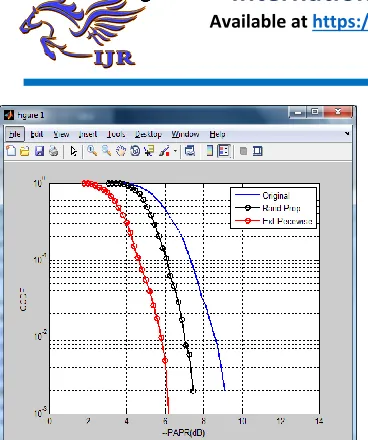
Analysis: we compared here the CCDF for different
transmission overheads like original signal, random partitioned signal and proposed transmission using CSS-SV set. We can observe here that the proposed work is having very less CCDF values compared with original and only partitioning methods. So we can say that proposed work outperforms the existing techniques.
E
XTENSION
Available online: https://edupediapublications.org/journals/index.php/IJR/ P a g e | 1384 Figure 6: Comparisons by CCDF for Original, proposed
and linear piecewise transform as extension methods
Analysis: As we need less complexity or somewhat similar
complexity but our aim is to get more data rate at given signal power. As simulation results are showing in above figure we can conclude that the PAPR for linear piecewise companding is very less compared to other techniques such as it is compared with original signal and CSS with SV-set. By graphical analysis we got the better performance of extension system compared all other techniques.
VI.
C
ONCLUSION
There are different state-of-art techniques for reduction of PAPR in OFDM. But compared to existing techniques we are getting better results for performance of this system which analyzed by MATLAB execution results. Proposed work is extension to existing technique PTS (partially transmit sequence).In this we used technique for selecting best SV-set value which will give us idea about PAPR reduction in cyclic shifted sequence(CSS) method. With the help of existing technique PTS which will provide less complexity, we will combine it with cyclic shifted sequence for lowest PAPR and high data rate. With the help of MATLAB execution we can show the improvement in performance of proposed work compared with conventional work. We extended this system by integrating CSS with piecewise linear companding which is a basic module of signal distortion technique. Finally, we will prove the extension system will gives us better data rate as well as robustness of the work is improved.
R
EFERENCES
[1] B. S. Krongold and D. L. Jones, “PAR reduction in OFDM via active constellation extension,” IEEE Trans. Broadcast., vol. 49, no. 3, pp. 258–268, Sep. 2003.
[2] S. H. Müller, R. W. Bäuml, R. F. H. Fischer, and J. B. Huber, “OFDM with reduced peak-to-average power ratio by multiple signal representation,” Ann. Telecommun., vol. 52, nos. 1–2, pp. 58–67, Feb. 1997.
[3] J.-Y. Woo, H. S. Joo, K.-H. Kim, J.-S. No, and D.-J. Shin, “PAPR analysis of class-III SLM scheme based on variance of correlation of alternative OFDM signal sequences,” IEEE Commun. Lett., vol. 19, no. 6, pp. 989– 992, Jun. 2015.
[4] Z. Latinovic and Y. Bar-Ness, “SFBC MIMO-OFDM peak-to-average power ratio reduction by polyphase interleaving and inversion,” IEEE Commun. Lett., vol. 10, no. 4, pp. 266–268, Apr. 2006.
[5] G. R. Hill, M. Faulkner, and J. Singh, “Reducing the peak-to-average power ratio in OFDM by cyclically shifting partial transmit sequences,” Electron. Lett., vol. 36, no. 6, pp. 560–561, Mar. 2000.
[6] G. R. Hill, M. Faulkner, and J. Singh “Cyclic shifting and time inversion of partial transmit sequences to reduce the peak-to-average power ratio in OFDM,” in Proc. IEEE PIMRC, London, U.K., Sep. 2000, pp. 1256–1259.
[7] L. Yang, K. K. Soo, S. Q. Li, and Y. M. Siu, “PAPR reduction using low complexity PTS to construct of OFDM signals without side information,” IEEE Trans. Broadcast., vol. 57, no. 2, pp. 284–290, Jun. 2011.
[8] G. Lu, P. Wu, and C. Carlemalm-Logothetis, “Peak-to-average power ratio reduction in OFDM based on transformation of partial transmit sequences,” Electron. Lett., vol. 42, no. 2, pp. 105–106, Jan. 2006.
Available online: https://edupediapublications.org/journals/index.php/IJR/ P a g e | 1385 [10] A. D. S. Jayalath and C. Tellambura, “SLM and PTS
peak-power reduction of OFDM signals without side information,” IEEE Trans. Wireless Commun., vol. 4, no. 5, pp. 2006–2013, Sep. 2005.