R E S E A R C H
Open Access
GPU-based 3D lower tree wavelet video
encoder
Vicente Galiano
1*, Otoniel L ´opez-Granado
1, Manuel P Malumbres
1, Leroy Anthony Drummond
2and Hector Migall ´on
1Abstract
The 3D-DWT is a mathematical tool of increasing importance in those applications that require an efficient processing of huge amounts of volumetric info. Other applications like professional video editing, video surveillance applications, multi-spectral satellite imaging, HQ video delivery, etc, would rather use 3D-DWT encoders to reconstruct a frame as fast as possible. In this article, we introduce a fast GPU-based encoder which uses 3D-DWT transform and lower trees. Also, we present an exhaustive analysis of the use of GPU memory. Our proposal shows good trade off between R/D, coding delay (as fast as MPEG-2 for High definition) and memory requirements (up to 6 times less memory than x264).
Keywords: 3D-DWT, Video coding, GPU, Manycore
1 Introduction
At video content production stages, digital video processing applications require fast frame random access to perform an undefined number of real-time decompressing-editing-compressing interactive opera-tions, without a significant loss of original video content quality. Intra-frame coding is desirable as well in many other applications like video archiving, high-quality high-resolution medical and satellite video sequences, applications requiring simple real-time encoding like video-conference systems or even for professional or home video surveillance systems [1] and digital video recording systems (DVR). However, intra coding does not take profit of the temporal redundancy between frames.
In the last years, most of all in areas such as video watermarking [2] and 3D coding (e.g., compression of volumetric medical data [3] or multispectral images [4], 3D model coding [5], and especially, video coding), three-dimensional wavelet transform (3D-DWT) based encoders have arisen as an alternative between simple intra coding and complex inter coding solutions that applies motion compensation between frames to exploit temporal redundancy.
*Correspondence: [email protected]
1Physics and Computer Architecture Department, Miguel Hern´andez University, Elche, 03202 Spain
Full list of author information is available at the end of the article
In [6], authors utilized 3-D spatio-temporal subband decomposition and geometric vector quantization (GVQ). In [7] a full color video coder based on 3-D subband coding with camera pan compensation was presented. In [8] an extension to 3D of the well known embedded zerotree wavelet (EZW) algorithm developed by Shapiro [9] was presented. Similarly, an extension to 3D-DWT of the set partitioning in hierarchical trees (SPIHT) algo-rithm developed by Said and Pearlman [10] was presented in [11], using a tree with eight descendants per coef-ficient instead of the typical quad-trees of image cod-ing. All of this 3D-DWT based encoders are faster than complex inter coding schemes but slower than simple intra coding solutions. So we will try in this study to speed up 3D video encoders to achieve coding delays as closer as possible to the ones obtained by intra video encoders but with a clearly superior compression perfor-mance. In order to achieve this goal, we will focus on GPU-based platforms.
Wide research have been carried out to accelerate the DWT, specially the 2D DWT, exploiting both multicore architectures and graphic processing units (GPU). In [12], a Single Instruction Multiple Data (SIMD) algorithm runs the 2D-DWT on a GeForce 7800 GTX using Cg and OpenGL, with a remarkable speed-up. A similar effort has been performed in [13] combining Cg and the 7800 GTX to report a 1.2–3.4 speed-up versus a CPU counterpart.
In [14], authors present a CUDA implementation for the 2D-FWT running more than 20 times as fast as the sequential C version on a CPU, and more than twice as fast as the optimized OpenMP and Pthreads versions implemented on a multicore CPU. In [15], authors present GPU implementations for the 2D-DWT obtaining speed-ups up to 20 when compared to the CPU sequential algorithm.
In this study, we present a GPU 3D-DWT based video encoder using lower trees as the core coding system. The proposed encoder requires less memory than 3D-SPIHT [11] and has a good R/D behavior. Furthermore, we present an in-depth analysis of the use of GPU’s to accelerate the 3D-DWT transform. Using these strategies, the proposed encoder is able to compress a Full-HD video sequence in real time.
The rest of the article is organized as follows. Section 2 presents the proposed 3D-DWT based encoder. In Section 3, a performance evaluation in terms of R/D, memory requirements and coding time is presented. Section 4 describes several optimization proposals based on CUDA to process the 3D-DWT transform, while in Section 5 we analyze these proposals when applied to the proposed encoder. Finally in Section 6 some conclusions are drawn.
2 Encoding system
In this section, we present a 3D-DWT based encoder with low complexity and good R/D performance. As our main concern is fast encoding process, no R/D optimization, motion estimation/motion compensation (ME/MC) or bit-plane processing is applied. This encoder is based on both the 3D-DWT transform and lower-trees (3D-LTW).
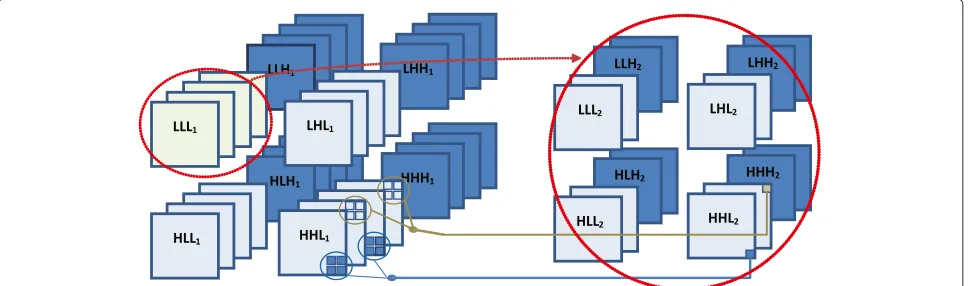
First of all, the 3D-DWT is applied to a group of pictures (GOP). In Figure 1 an example of a two level decomposi-tion of the 3D-DWT transform is applied to a eight-frame
video sequence. As it can be seen on the left side, spatial decomposition to all video frames is performed result-ing in four subbands (LL∗1, LH∗1, HL∗1, HH∗1). After applying the temporal decomposition, we will obtain the high-frequency temporal subbands (∗ ∗H1labeled sub-bands with a dark blue color), and the low-frequency ones (∗ ∗L1labeled subbands with a light blue color). On the right side of Figure 1, we show the second decomposi-tion level of the 3D-DWT transform. So, we will perform the same process to the frames belonging to the LLL1, performing the spatial and temporal DWT filtering to obtaining the corresponding subbands. Finally, we also show the wavelet coefficients offspring relationship, that the coefficient encoder will exploit. As it can be seen each coefficient of a particular subband atNth decompo-sition level will have eight descendants in the(N −1)th decomposition level as shown at figure.
After all 3D-DWT decomposition levels are applied, all the resulting wavelet coefficients are quantized and then, the encoding system compresses the input data to obtain the final bit-stream corresponding to that GOP. It is important to remark that the compressed bit-stream is ordered in such a way that the decoder obtains the bit-stream in the correct order.
2.1 Lower-tree wavelet coding
The proposed video coder is based on the LTW image coding algorithm [16]. As in LTW encoder, the proposed video codec uses a scalar uniform quantization by means of two quantization parameters:rplanesandQ. The finer quantization consists in applying a scalar uniform quanti-zation,Q, to all wavelet coefficients. The coarser quantiza-tion is based on removing the least significant bit planes, rplanes, from wavelet coefficients.
The encoder uses a tree structure to reduce data redun-dancy among subbands (similar to that of [?{KIM00}]), and also as a fast way of grouping coefficients, reducing
Table 1 Memory requirements for evaluated encoders (KB)
Format/ QCIF CIF ITU-D1 Full-HD
Codec
H264 35824 86272 227620 489960
x264 10752 18076 36600 178940
MPEG-2 4696 6620 9164 32820
3D-SPIHT 10152 34504 118460 645720
3D-LTW 1611 6390 20576 123072
the number of symbols needed to encode the image. This structure is called lower tree, and all the coefficients in the tree are lower than 2rplanes. In Figure 1, a example of the relationship between subbands is presented.
Let us describe the coding algorithm. In the first stage (symbol computation), all wavelet subbands are scanned from the first decomposition level to theNth (to be able to build the lower-trees from leaves to root) and the encoder has to determine if each 2 ×2 block of coef-ficients of both subband frames is part of a lower-tree. In the first level subband (see Figure 1), if the eight coefficients in these blocks (2 blocks of 2 × 2 coeffi-cients) are insignificant (i.e., lower than 2rplanes), they are
considered to be part of the same lower-tree, labeled asLOWER COMPONENT. Then, when scanning upper level subbands, if both 2×2 blocks have eighth insignif-icant coefficients and all their direct descendants are LOWER COMPONENT, the coefficients in that blocks are labeled asLOWER COMPONENT, increasing the lower-tree size.
As in the original LTW image encoder, when there is at least one significant coefficient in one of the two blocks of 2×2 coefficients or in its descendant coefficients, we need to encode each coefficient separately. Recall that in this case, if a coefficient and all its descendants are insignificant, we use theLOWER symbol to encode the entire tree, but if the coefficient is insignificant, and it has a significant descendant, the coefficient is encoded asISOLATED LOWER. However, if all descendants of a significant coefficient are insignificant (LOWER COMP-ONENT), we use a special symbol indicating the number of bits needed to represent it and a superscriptL(4L).
Finally, in the second stage, subbands are encoded from the LLLN subband to the first-level wavelet subbands
and symbols computed in the first stage are entropy coded by means of an arithmetic encoder. Recall that no LOWER COMPONENTis encoded. The value of signifi-cant coefficients and their sign are raw encoded.
3 Performance evaluation
In this section, we will compare the performance of our proposed encoder (3D-LTW) using Daubechies 9/7F filter
for both spatial and temporal domain with the following video encoders:
• 3D-SPIHT [17].
• H.264 (JM16.1 version) (high quality profile) [18].
• MPEG-2 (ffmpeg-r25117)—GOP size 15, sequence
type IBBPBBP . . . [19].
• x264 (mingw32-libx264 r1713-1 high quality profile) in both Inter and Intra mode [19].
The performance metrics employed in the tests are R/D performance, coding and decoding delay and memory requirements. All the evaluated encoders have been tested
Table 2 Average PSNR (dB) with different bit rate and coders
Codec/Bit rate
Kbps/dB x264 MPEG-2 x264 Intra 3D-SPIHT 3D-LTW
Foreman (CIF)
3040 44.99 40.74 39.95 40.32 41.38
1520 41.80 37.10 35.29 36.42 36.67
760 38.90 34.09 31.43 33.35 33.42
380 35.60 31.59 28.15 30.78 30.68
190 31.99 29.32 25.07 28.53 28.54
Container (CIF)
3040 47.20 43.59 37.97 47.82 46.54
1520 43.60 40.43 33.04 43.99 41.93
760 40.50 37.19 29.22 39.54 37.39
380 37.09 34.48 25.88 35.20 33.31
190 33.89 32.05 23.27 31.10 29.79
Hall (CIF)
3040 42.92 42.29 41.19 44.68 44.46
1520 40.55 39.89 36.60 42.27 41.66
760 38.94 37.95 31.89 40.11 38.93
380 37.25 35.95 27.32 37.39 35.43
190 34.80 33.59 23.88 33.56 31.90
Mobile (ITU-D1)
6400 40.33 37.82 35.56 38.24 38.86
3598 38.82 36.09 32.53 35.07 35.59
2100 37.57 34.37 30.12 32.53 32.69
1142 35.51 32.58 27.87 30.52 30.64
542 31.82 30.68 25.65 28.82 29.26
Ducks (Full-HD) 50fps
98304 37.34 38.49 36.26 37.77 36.07
49152 34.48 35.27 32.61 35.39 32.85
24576 32.46 32.28 29.16 33.68 31.49
12288 30.55 29.32 26.43 31.63 30.23
on an Intel PentiumM Dual Core 3.0 GHz with 2 Gbyte RAM memory.
The test video sequences used in the evaluation are: Foreman (QCIF and CIF) 300 frames, Container (QCIF and CIF) 300 frames, News (QCIF and CIF) 300 frames, Hall (QCIF and CIF) 300 frames, Mobile (ITU D1 576p30) 40 frames, Station2 (HD 1024p25) 312 frames, Ducks (HD 1024p50) 130 frames and Ducks (SHD 2048p50) 130 frames.
It is important to remark that MPEG-2 and x264 evaluated implementations are fully optimized, using CPU capabilities like Multimedia Extensions (MMX2, SSE2Fast, SSSE3, etc.) and multithreading, whereas
3D-DWT based encoders (3D-SPIHT and 3D-LTW) are non optimized C++ implementations.
3.1 Memory requirements
In Table 1, memory requirements of different encoders under test are shown. The 3D-LTW encoder running over a GOP size of 16 frames uses up to 6 times less memory than 3D-SPIHT, up to 22 times less memory than H.264 for QCIF sequence resolution and up to 6 times less mem-ory than x264 which is an optimized implementation of H.264, for small sequence resolutions. It is important to remark that 3D-SPIHT keeps the compressed bit-stream of a 16 GOP size in memory until the whole compression
a
b
is performed, while encoders like MPEG-2, H.264, 3D-LTW and x264 output the bit-stream inline. Block based encoders like MPEG-2 require less memory than the oth-ers encodoth-ers, specially at high definition sequences.
3.2 R/D performance
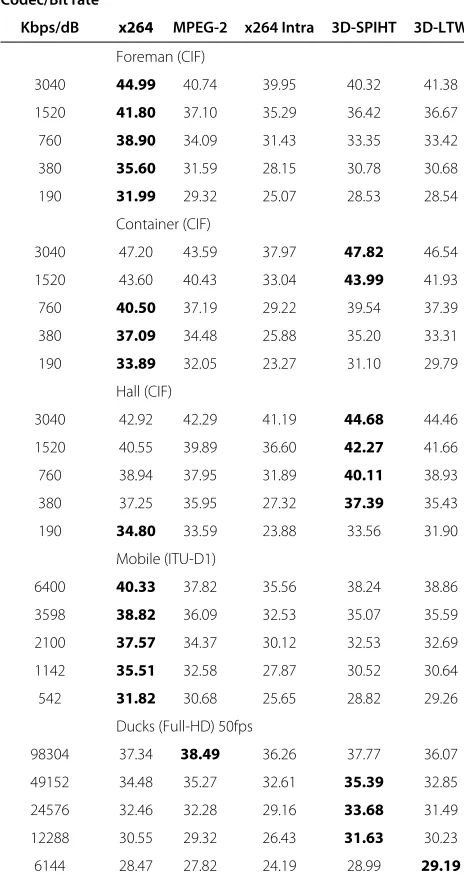
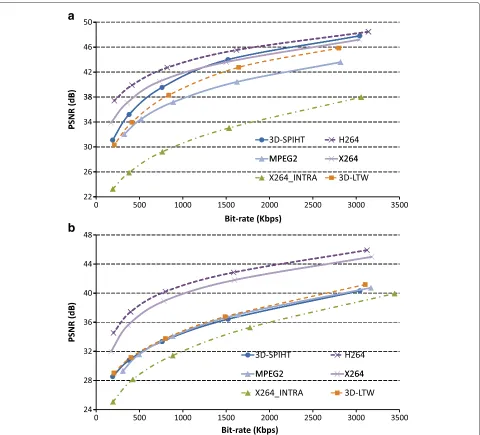
Regarding R/D, in Table 2 we can see the R/D behav-ior of all evaluated encoders for different sequences. As shown, x264 is the one that obtains the best results for sequences with high movement, mainly due to the exhaus-tive ME/MC stage included in this encoder, contrary to 3D-SPIHT and 3D-LTW that do not include any ME/MC stage. The R/D behavior of 3D-SPIHT and 3D-LTW is similar for images with moderate-high motion activity, but for sequences with low movement, 3D-SPIHT out-perform 3D-LTW, mainly due to the extra decomposition levels applied in high frequency subbands. Figure 2 shows an example of this effect in two different sequences, one with low motion activity like Container and other with
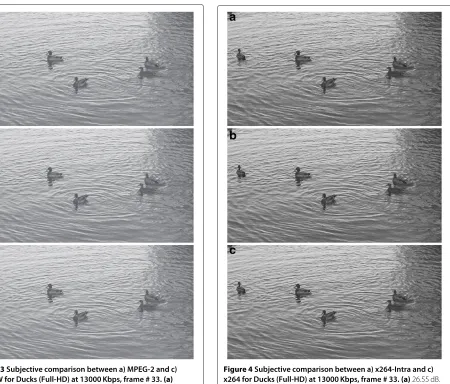
Figure 3Subjective comparison between a) MPEG-2 and c) 3D-LTW for Ducks (Full-HD) at 13000 Kbps, frame # 33.(a) 29.21 dB.(b)Original.(c)31.57 dB.
moderate motion activity like Foreman. Notice that the proposed 3D-LTW encoder improves the performance of the old-fashioned MPEG-2 inter video encoder. Also, it is worth to highlight the significant R/D improvement of both 3D-LTW and 3D-SPIHT over the x264 intra encoder (up to 11 dB). This R/D improvement is accomplished by exploiting only the temporal redundancy among video frames when applying the 3D-DWT. It is also interesting the behavior of 3D-DWT based encoder for high frame rate video sequences like Ducks. As it can be seen all 3D-DWT based encoders have a similar behavior than the other encoders, even better than x264 in INTER mode.
3.3 Subjective evaluation
We have also performed a subjective evaluation of the proposed encoder. Figures 3 and 4 show the 33rd frame of the Ducks sequence in Full-HD format compressed at 13000 Kbps. As we can see, both 3D-LTW and x264 obtain the best results. MPEG-2 obtain lower performance. Also,
Figure 5Coding time in frames per second for all evaluated encoders.
in Figure 4, we can see the poor performance of x264 Intra in this frame where disturbing blocking artifacts appear. Its interesting to see the great behavior of 3D-LTW which is even better than x264, even when no ME/MC is applied in the proposed encoder.
3.4 Coding/decoding time
In Figure 5, we present the total coding time (exclud-ing I/O) of all evaluated encoders and for different sequence resolutions. As it can be seen, MPEG-2 encoder is the fastest one due to its block-based processing algo-rithm. Regarding 3D-DWT based encoders, the proposed encoder 3D-LTW is up to 7 times as fast as 3D-SPIHT and up to 6 times as fast as x264 encoder.
a
b
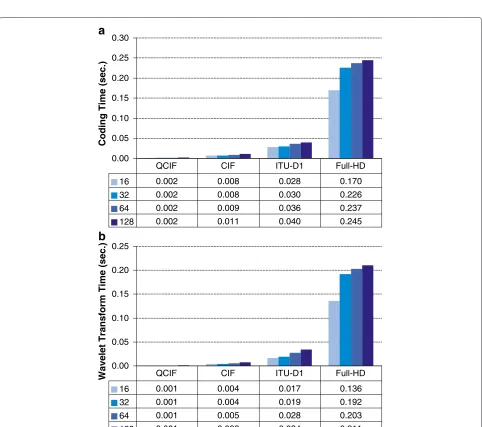
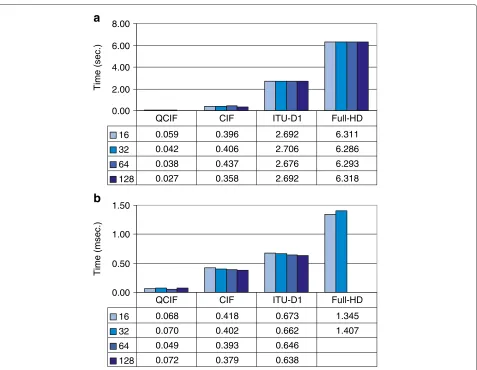
Also, in Figure 6a we present the total coding time of a frame for different video sequence resolutions as a func-tion of the GOP size for the 3D-LTW encoder. As it can be seen, for low resolution sequences there are near no differences in the total coding time, but for high resolu-tion video sequences, the total coding time will increase up to 40% as the GOP size increases. Furthermore, its interesting to see that the time required to perform 3D-DWT stage ranges between 45 and 80% of the total coding time depending on the GOP size, as seen in Figure 6b. So, improvements in the 3D-DWT computation will drasti-cally reduce the total coding time of the proposed encoder.
4 3D-DWT optimizations
As 3D-DWT computation requires more than 45% and up to 80% of the total coding time in the proposed encoder, in this section we present several GPU based strategies to improve the 3D-DWT computation time.
Two different GPUs architectures are used in this study. The first one is a GTX280 which contains 240 CUDA cores with 1 GB of dedicated video memory. The other one is a laptop GPU (GT540M) with 96 CUDA cores
and 2 GB of dedicated video memory. We can appreciate significant differences between both devices that will be reflected in the results shown in this section.
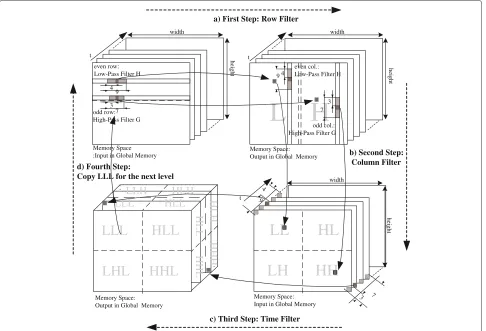
The algorithm used to compute the 3D-DWT in the GPUs is illustrated in Figure 7. Before the first computa-tion step, image data must be transferred from host mem-ory to the global memmem-ory of the device. We must transfer the number of frames indicated by the GOP size. As we increase the GOP size, more amount of global memory is needed in the GPU. All frames are stored in adjacent memory positions. In this way, the memory requirements for the GPU is Width× Height×frames×size of (float) bytes. As showed in Figure 7, in this implementation we are using two memory spaces in the global memory of the GPU: one for the input data and other for the output data after applying the filtering process. In the first step, each thread computes the row convolution and stores the result in the output memory. For computing the second step, the source data is now the output data obtained in the previous step, so it is not needed a copy of memory data for preparing this step. So, in the second step, the col-umn filter is applied and the 2D-DWT is completed for
a
b
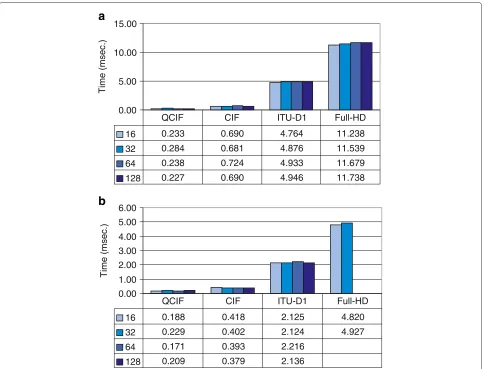
Figure 8GPU computational wavelet transform times per frame over GT540M and GTX280 for different video resolutions.(a)GT540M.(b) GTX280.
each frame and after that, the output is again in the source space memory. After that, in the third step, a 1D-DWT is performed to consider the temporal dimension. At the last step, data must be transferred to the host memory to proceed with the next GOP. The first level 3D-DWT is performed in the output space memory and if we want compute a second level we must copy data from output to input space. Then, in the second level only half of the resolution (LLL subband) must be computed, iterating the same steps that for the first level.
4.1 Performance evaluation of the GPU 3D-DWT
In this section, we present the performance evaluation of our GPU-based 3D-DWT algorithm in terms of com-putational and memory transfer times and the speed-ups obtained when compared to the CPU sequential algo-rithm. We present results for both previously mentioned GTX280 and GT540M platforms.
In Figure 8, we present the computational times for both GPU platforms used in this study and for two different video sequence resolutions considering GOP sizes varying from 16 to 128 and computing four wavelet decompo-sition levels. As shown in Figure 8, for ITU-D1 video frame resolution, the GTX280 is 2.3 times as fast as the GT540M regarding the GPU computational time. This is mainly due to the greater number of cores available in the GTX280 (2.5 times more cores). Moreover, in Figure 9a we compare computational times in GPU shown in Figure 8, versus the times needed to compute the wavelet trans-form in CPU, shown in Figure 6b), for a GOP size of 32 and we obtain an speed-up around 16.6 in GT540M, and 38 in GTX280. Computational times for Full-HD resolu-tion over GTX280 are not available due to global memory constraints.
a
b
Figure 9Speed-ups over GT540M and GTX280 for different video resolutions and a GOP size of 32.(a)Using Global memory access.(b) Using optimized shared memory access.
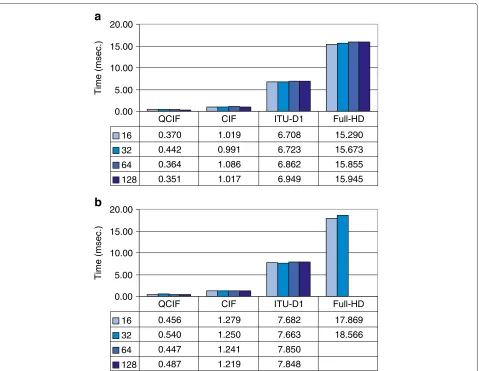
transfer times between host memory and GPU memory. We must notice that these times including transfer times are higher than the ones showed in Figure 8, being 1.3 in GT540M and 3.73 in GTX280. The global computa-tional time including the memory transfer time is lower in the GT540M than in the GTX280 due to the signif-icantly lower memory transfer time, thanks to a second generation of PCI Express bus which improves data trans-fers. As shown, data transfer between device memory and host memory introduce a significant penalty when using GPUs for general purpose computing. Comparing times from Figure 10 with the measured times in CPU, note that we continue obtaining a good speed-up of 12 in GT540M and over 10 in GTX280 as shown in Figure 9a.
4.2 Memory access optimization
The previously presented algorithm uses the global mem-ory to store both source and output data in wavelet com-putation. A reasonable speed-up (13) has been obtained with high video resolutions. However, we can achieve
a
b
Figure 10GPU Computation wavelet transform and transfer times per frame over GT540M and GTX280 for different video resolutions. (a)GT540M.(b)GTX280.
single large read of the 32 values can be performed at optimum speed.
In this new approach, each row/column/temporal fil-tering stage is separated into two sub-stages: (a) the threads load a block of pixels of one row/column/temporal array from the global memory into the shared memory, and (b) each thread computes the filter over the data stored in the shared memory and stores the results in the global memory. We must not forget about the cases when a row or column processing tile becomes clamped by video frame borders, and initialize clamped shared memory array indices with correct values. In this case, threads also must load in shared memory the values of adjacent pixels in order to compute the pixels located in borders.
In Figure 11, we evaluate the new algorithm for com-puting the wavelet transform using the shared memory. As we can see, both GPUs have reduced considerably the
a
b
Figure 11GPU computational wavelet transform times per frame over GT540M and GTX280 for different video resolutions using optimized shared memory access.(a)GT540M.(b)GTX280.
5 Performance evaluation of the proposed encoder using GPUs
After analyzing the performance of the GPU 3D-DWT computation, we will present a comparison of the pro-posed encoder against the other encoders in terms of coding delay.
In Figure 13, we present the total coding time (exclud-ing I/O) in frames per second of all evaluated encoders and for different sequence resolutions for a quality of 30 dB. Now, our proposal uses the GPU to compute the 3D-DWT stage. As it can be seen, 3D-LTW encoder is the fastest one being up to 3.2 times on average as fast as the non-GPU version of the proposed encoder, up to 22 times as fast as 3D-SPIHT and up to 19 times as fast as x264 which is a fully optimized version of H.264. After the GPU optimization of the 3D wavelet transform stage, the proposed encoder is able to compress a Full-HD sequence in real time. Remark, that the optimizations performed are due only to GPU strategies while other
encoders like x264, H263, MPEG-2, and MPEG-4 are fully optimized implementations, using CPU capabilities like Multimedia Extensions (MMX2, SSE2Fast, SSSE3, etc.) and multithreading.
Although, the GPU version of the 3D-LTW encoder has been speeded up to 3.2 times, now, the bottleneck in the global encoder is the coding stage after computing the 3D-DWT transform, specially at low compression rates, where there are lots of significant coefficients to encode. Several strategies could be performed in order to speed up even more the proposed encoder, like overlapping both GPU computation and memory transfer times, overlap-ping CPU processing times with GPU processing time, or using several GPUs to compute multiple 3D wavelet transforms from different GOPs.
6 Conclusions
a
b
Figure 12GPU computational wavelet transform and transfer times per frame over GT540M and GTX280 for different video resolutions using optimized shared memory access.(a)GT540M.(b)GTX280.
with eight nodes. We have compared our algorithm against 3D-SPIHT, H.264, x264, and MPEG-2 encoders in terms of R/D, coding delay and memory requirements.
Regarding R/D, our proposal has a better behavior than MPEG-2. When compared to 3D-SPIHT, our proposal has a similar behavior for sequences with medium and high movement, but slightly lower performance for sequences with low movement like Container. However, our proposal requires 6 times less memory than SPIHT. Both 3D-DWT based encoders (3D-SPIHT and 3D-LTW) outper-forms x264 in Intra mode (up to 11 dB) exploiting only the temporal redundancy among video frames when applying the 3D-DWT. It is also important to see the behavior of 3D-DWT based encoders when applied to high frame rate video sequences obtaining even better PSNR than x264 in Inter mode.
In order to speed up our encoder, we have presented an exhaustive analysis of GPU memory strategies to compute
the DWT transform. As we have seen, the GPU 3D-DWT algorithm obtains good speed-ups, up to 16 in the GT540M platform and up to 39 in the GTX280. Using these optimizations, the proposed encoder (3D-LTW) is a very fast encoder, specially for Full-HD video resolutions, being able to compress a Full-HD video sequence in real time.
The fast coding/decoding process and the avoiding of the use of motion estimation/motion compensation algo-rithms, makes the 3D-LTW encoder a good candidate for applications where the coding/decoding delay are crit-ical for proper operation or for applications where a frame must be reconstructed as soon as possible. 3D-DWT based encoders could be an intermediate solution between pure Intra encoders and complex Inter encoders. Although the proposed 3D-LTW encoder has been developed for natural video sequences where Daubechies 9/7F filter for the 3D-DWT stage has been widely used in the literature, other bi-orthogonal filters could be applied, depending on the final application. Even though longer fil-ters capture better the frequency changes on an image, differences on R/D for natural images are negligible with respect to Daubechies 9/7F filter. This effect could be extended to the temporal domain case. However, longer filters introduce an increment on the DWT computa-tion complexity because more operacomputa-tions per pixel must be performed, making the encoder slower. Obviously, if a longer filter is used in the DWT stage, the speed-up will be greater, because more operations per pixel will be performed in a parallel way.
As future study, we pretend to move other parts of the coding stage, like the quantization stage to the GPU to speed up even more the encoder. Furthermore, we pretend to overlap the CPU computation stage with the GPU com-putation of the 3D-DWT stage. Regarding quantization step over GPU, our first attempts shows that the 3D-DWT stage over GPU will be increased a 12% on average while the coding stage will be reduced a 17 % on average, which makes our encoder even faster.
Competing interests
The authors declare that they have no competing interests.
Acknowledgements
This research was supported by the Spanish Ministry of Education and Science under grant TIN2011-27543-C03-03 and the Spanish Ministry of Science and Innovation under grant number TIN2011-26254 and TEC2010-11776-E.
Author details
1Physics and Computer Architecture Department, Miguel Hern´andez
University, Elche, 03202 Spain.2Lawrence Berkeley National Laboratory, One
Cyclotron Road, Berkeley, CA 94703, USA.
Received: 15 November 2012 Accepted: 6 February 2013 Published: 19 February 2013
References
1. J-S Ryu, E-T Kim, Fast intra coding method of h.264 for video surveillance system. Int. J. Comput. Sci. Netw. Secur.7(10), 76–81 (2007)
2. P Campisi, A Neri, inIEEE International Conference on Image Processing, vol. 1. Video watermarking in the 3D-DWT domain using perceptual masking, Genoa, Italy, 2005), pp. 997–1000
3. P Schelkens, A Munteanu, J Barbariend, M Galca, X Giro-Nieto, J Cornelis, Wavelet coding of volumetric medical datasets. IEEE Trans. Med. Imag. 22(3), 441–458 (2003)
4. PL Dragotti, G Poggi, Compression of multispectral images by three-dimensional SPITH algorithm. IEEE Trans. Geosci. Rem. Sens.38(1), 416–428 (2000)
5. M Aviles, F Moran, N Garcia, Progressive lower trees of wavelet coefficients: Efficient spatial and SNR scalable coding of 3D models. Lecture Notes Comput. Sci.3767, 61–72 (2005)
6. CI Podilchuk, NS Jayant, N Farvardin, Three dimensional subband coding of video. IEEE Trans. Image Process.4(2), 125–135 (1995)
7. D Taubman, A Zakhor, Multirate 3-D subband coding of video. IEEE Trans. Image Process.3(5), 572–588 (1994)
8. Y Chen, WA Pearlman, inProc. SPIE Visual Communications and Image Processing, vol. 2727. Three-dimensional subband coding of video using the zero-tree method, Orlando, FL, 1996), pp. 1302–1309
9. JM Shapiro, Embedded image coding using zerotrees of wavelet coefficients. IEEE Trans. Signal Process.41(12), 3445–3462 (1993) 10. A Said, A Pearlman, A new, fast and efficient image codec based on set
partitioning in hierarchical trees. IEEE Trans. Circ. Syst. Video Technol.6(3), 243–250 (1996)
11. BJ Kim, Z Xiong, WA Pearlman, Low bit-rate scalable video coding with 3D set partitioning in hierarchical trees (3D SPIHT). IEEE Trans. Circ. Syst. Video Technol.10, 1374–1387 (2000)
12. T-T Wong, C-S Leung, P-A Heng, J Wang, Discrete wavelet transform on consumer-level graphics hardware. IEEE Trans. Multimedia.9(3), 668–673 (2007)
13. C Tenllado, J Setoain, M Prieto, L Pinuel, F Tirado, Parallel implementation of the 2d discrete wavelet transform on graphics processing units: filter bank versus lifting. IEEE Trans. Parallel Distrib. Syst.19(3), 299–310 (2008) 14. J Franco, G Bernab´e, J Fern´andez, ME Acacio, M Ujald ´on, inIn proceedings
of Para 2010: State of the Art in Scientific and Parallel Computing. Lecture Notes in Computer Science, vol. 7133. The gpu on the 2d wavelet transform, survey and contributions, Reykjavik, Iceland, 2010), pp. 173–183 15. V Galiano, O L ´opez, MP Malumbres, H Migall ´on, inIn proceedings of
International Conference on Computational and Mathematical Methods in Science and Engineering, vol. 2. Improving the discrete wavelet transform computation from multicore to gpu-based algorithms, Benidorm, Spain, 2011), pp. 544–555
16. J Oliver, MP Malumbres, Low-complexity multiresolution image compression using wavelet lower trees. IEEE Trans. Circ. Syst. Video Technol.16(11), 1437–1444 (2006)
17. BJ Kim, Z Xiong, WA Pearlman, Very low bit-rate embedded video coding with 3D set partitioning in hierarchical trees (3D SPIHT) (1997)
18. ISO/IEC 14496-10 and ITU Rec. H.264. Advanced video coding (2003) 19. ffmpeg (2010). http://ffmpeg.zeranoe.com/
doi:10.1186/1687-6180-2013-24