New Circular Security Counterexamples
from Decision Linear and Learning with Errors
Allison Bishop
∗Columbia University
[email protected]
Susan Hohenberger
†Johns Hopkins University
[email protected]
Brent Waters
‡University of Texas at Austin
[email protected]
November 30, 2015
Abstract
We investigate new constructions ofn-circular counterexamples with a focus on the case ofn= 2. We have a particular interest in what qualities a cryptosystem must have to be able to separate such circular security from IND-CPA or IND-CCA security. To start, we ask whether there is something special about the asymmetry in bilinear groups that is inherent in the works of [1] and [17] or whether it is actually the bilinearity that matters. As a further question, we explore whether such counterexamples are derivable from other assumptions such as the Learning with Errors (LWE) problem. If it were difficult to find such counterexamples, this might bolster our confidence in using 2-circular encryption as a method of bootstrapping Fully Homomorphic Encryption systems that are based on lattice assumptions.
The results of this paper broadly expand the class of assumptions under which we can build 2-circular counterexamples. We first show for any constant k ≥ 2 how to build counterexamples from a bilinear group under the decision k-linear assumption. Recall that the decisionk-linear assumption becomes progressively weaker askbecomes larger. This means that we can instantiate counterexamples from symmetric bilinear groups and shows that asymmetric groups do not have any inherently special property needed for this problem. We then show how to create 2-circular counterexamples from the Learning with Errors problem. This extends the reach of these systems beyond bilinear groups and obfuscation.
1
Introduction
The notion of key dependent message security [11] moves beyond our classical notion of encryption secu-rity [21]. It demands a system remain secure even if an attacker gains access to ciphertexts that encrypt mes-sages that are, or depend on, the very private keys of the system it is trying to attack. As a concrete example, consider a special case of key-dependent security calledn-circular security. Here an encryption scheme is said to ben-circular secure, if an adversary is unable to distinguishEnc(pk1,sk2),Enc(pk2,sk3), . . . ,Enc(pkn,sk1) from corresponding zero encryptions.
While the notion of key dependent or circular security might first appear to be just a technical exercise, this very problem arises in multiple contexts. Camenisch and Lysyanskaya [16] applied circular secure
∗Supported by NSF CNS 1413971 and NSF CCF 1423306.
†Supported by the National Science Foundation (NSF) CNS-1228443 and CNS-1414023, the Office of Naval Research under
contract N00014-14-1-0333, and a Microsoft Faculty Fellowship.
‡Supported by NSF CNS-1228599 and CNS-1414082, DARPA SafeWare, a Google Faculty Research Award, the Alfred P.
encryption to build an anonymous credentials scheme with certain properties. Other works used circular security in formal methods to prove the soundness of symbolic protocols [2, 25]. Perhaps the most compelling example comes from Gentry [19], who showed that a fully homomorphic scheme for limited depth can be “bootstrapped” to work for arbitrary depth circuits if the original system is sufficient to compute its own decryption circuit and is 1-circular secure.
The first positive examples of key-dependent message security were given in the random oracle model by Black et al. [11] and Camenisch and Lysyanskaya [16]. It was a significant time later when Boneh, Hamburg, Halevi and Ostrovsky [13] gave an elegant construction of an n-circular secure encryption in the standard model under the decision Diffie-Hellman assumption. Subsequently, a sequence of further works [8, 14, 9, 15, 7, 5] gave standard model constructions of key dependent security for functions that could be arbitrary circuits on the private key(s).
All the above constructions and proofs were based on encryption schemes with specific properties. A natural question is whether key-dependent message security is implied by IND-CPA (or IND-CCA) security. If this were true, we would get it for free, without needing such specific properties of the encryption scheme. A cursory examination of the problem shows that in the broadest sense the answer is no. One can derive a simple counterexample for 1-circular security (i.e., a system that encrypts its own private key) by slightly modifying a public key encryption system. To do so, simply augment a standard private key K with a randomly chosenK0∈ {0,1}λand appendy=f(K0) to the public key wheref is a one way function. When encrypting a message m = (m1, m2) the system will give out the message in the clear if f(m2) = y) and encrypt normally otherwise. Clearly, an encryption of the private key will be detectable. Yet, if the function
f is one way and the original system is IND-CPA secure, the resulting system will still be IND-CPA secure. While it can be trivially shown (by the argument above) that IND-CPA security does not imply 1-circular security, the case for n≥2 becomes significantly more challenging. Intuitively, when multiple public keys are thrown into the mix, we need a system that is powerful enough to allow for different ciphertexts to “talk” to each other in a manner that allows for cycle detection, but does not compromise IND-CPA security. So far there have been two approaches to this. For the case of n = 2, Acar et al. [1] and Cash, Green and Hohenberger [17] showed how to construct a counterexample from a certain class of asymmetric bilinear groups.1 Here there must exist a bilinear mape:G1×G2→GT where the decision Diffie-Hellman problem
is believed to remain hard respectively withinG1 and withinG2 (this is called the SXDH assumption). A second approach by Koppula, Ramchen and Waters [24] showed a counterexample under the assumption of indistinguishability obfuscation for poly-sized circuits. Independently and concurrently, Marcedone and Orlandi [26] showed this under the stronger assumption of virtual black box obfuscation.
Our Goals and Results In this work, we investigate new constructions of n-circular counterexamples with a focus on the case ofn= 2. We have a particular interest in what qualities a cryptosystem must have to be able to separate circular security from IND-CPA and IND-CCA security.
To start, we ask whether there is something special about the asymmetry in bilinear groups that is inherent in the works of [1, 17, 33] or whether it is actually more the bilinearity that matters. As a further question, we explore how to derive such counterexamples from other assumptions such as the Learning with Errors (LWE) problem. If it were difficult to find such counterexamples, this might bolster are confidence in using 2-circular encryption as a method of bootstrapping [19] fully homomorphic encryption systems that are based on lattice assumptions.
The results of this paper broadly expand the class of assumptions from which we can build 2-circular counterexamples. We first show for any constant k ≥ 2 how to build 2-circular counterexamples from a bilinear group under the decisionk-linear assumption. Recall that the decisionk-linear assumption becomes progressively weaker askbecomes larger. This means that we can instantiate counterexamples from symmet-ric bilinear groups and shows that asymmetsymmet-ric groups do not have any inherently special property needed for this problem. We then show how to create 2-circular counterexamples from the Learning with Error (LWE)
1In a similar vein, Rothblum [33] presented an elegant counterexample for bit-encryption under a generalization of the SXDH
problem. This extends the reach of these systems beyond bilinear groups and obfuscation, giving us a much broader understanding of circular security and its challenges.
Our Approach We begin by introducing a new abstraction called an n-Cycle Tester that will simplify the process of finding and describing counterexamples by focusing on the core problem. A cycle tester
consists of four algorithms (Setup,KeyGen,Enc,Test). The algorithms of Setup,KeyGen,Enc behave as in a normal encryption scheme with a common trusted setup algorithm, while the Test algorithm will take in an n-tuple of public keys and ciphertexts and detect (with some non-negligible probability) the presence of a cycle. Notably absent is the inclusion of a decryption algorithm. Thus, a tester does not require that ciphertexts be decryptable in the traditional sense — it only matters that theTestalgorithm work with some non-negligible probability. We found that relieving the responsibility of providing a system with decryption simplifies our constructions and allows us to focus on the main ideas. The security property required is IND-CPA security (recall that the basic IND-CPA game does not involve a decryption algorithm).
Of course, to obtain a full-fledged counterexample of an encryption system we actually do need to provide an encryption system that decrypts. We show how to generically derive such a counterexample forn-circular encryption by combining a standard IND-CPA secure cryptosystem (of sufficient message length) with a
n-cycle tester. The idea is fairly straightforward. The setup algorithm of the counterexample will run the respective setup algorithms of the encryption and cycle tester schemes. The public key is the pair of these public keys and the secret key is the pair of secret keys. To encrypt a message m = (m1, m2), first encrypt m = (m1, m2) under the regular encryption system, then encrypt just m2 under the cycle tester. We can now see that: (1) the cycle tester will allow for any key cycle to be detected and (2) the standard encryption scheme can be used for decryption. A simple hybrid argument shows that the IND-CPA security of the standard encryption scheme and cycle tester imply IND-CPA security of the derived counterexample system.
We also show that it is possible to extend this transformation idea to chosen ciphertext security, where we can combine any IND-CCA secure encryption system (of appropriate message length) with the same IND-CPA secure cycle tester to get an encryption system that is IND-CCA secure, but where encryption of key cycles can be detected.
Again, the usefulness of this framework is its modularity. We show these basic transformations once in Section 4, and then for each construction we only need to focus on the basic cycle tester abstraction.
A Cycle Tester from Asymmetric Bilinear Groups As a baseline for our exploration (see auxiliary Section 5 for further details), we first create a 2-cycle tester from asymmetric groups using the SXDH assumption. Our construction is extracted from Cash et al. [17] (also similar to [1, 33]), but simpler in that we only aim for the tester abstraction.
In our construction, theSetupalgorithm creates an asymmetric pairing description PP = (p,G1,G2,GT, e)
of prime orderp. It also produces generatorsg∈G1andh∈G2. The message space will beZ∗p.
A key can be of one of two types. The cycle detection algorithm Testwill work on any cycle of keys of two different types. The key generation algorithm KeyGen will first flip a coinβ ∈ {0,1} to determine its type. It then picks a random keys∈Z∗p. Ifβ = 0, it sets its public key to beK =gs ∈G1; otherwise, its
public key isK=hs∈
G2.
The encryption algorithm will choose a random exponent t ∈ Zp and if the key is of type β = 0, it
produces the ciphertext as (C1 = Ktm = gstm, C2 = gt) ∈ G21; otherwise if β = 1, it produces the ciphertext as (C1=Ktm=hstm, C2=ht)∈G22. With ciphertexts of this form, the test algorithm follows straightforwardly. Suppose we had a pair of ciphertextsy = (C = (C1, C2), C0 = (C10, C20)) that encrypted
a cycle for keys of different types. The algorithm can test this by simply computinge(C1, C20) ?
=e(C2, C10). Plugging ins, s0 as the respective keys, t, t0 as the encryption randomness, and m, m0 as the messages, we see that the test computes:
This equality holds ifm=s0 andm0 =sand will not hold with high probability for a message independent of the private key.
One thing we emphasize here is that IND-CPA is clearly broken if the SXDH assumption does not hold. Consider an encryption (C1 = Ktm = gstm, C2 = gt) ∈ G21 for the message m. The group elements
g,(gs)m =gsm, C
2 =gt, C1 =gstm clearly form a DDH tuple. So if DDH is easy in G1, any β = 0 type key is susceptible to attack. An analogous statement holds in G2 for anyβ = 1 key. This potential attack demonstrates that the above construction relies strongly on properties of asymmetric groups. We next show how to remove that reliance.
A Cycle Tester from the Decisionk-Linear Assumption We next move to constructing a cycle tester from the decisionk-linear assumption for any constantk≥2. Recall that thek-linear assumption [23, 34] is a parameterized family of assumptions on the source elements of bilinear groups. The assumption class becomes progressively weaker for larger values ofk. Importantly, by moving to the decisionk-linear assumption we remove our dependence on asymmetric groups.2 See Section 2.1 for a review.
In our construction, the setup algorithm first generates a bilinear source group Gof prime orderpwith
generatorg. Then it chooses a random invertible (rankk) matrixA∈Zkp×k and computesgA, which along
with the group description forms the common public parameters. (We use the notationgMas shorthand for the set of group elements resulting from raisinggto each matrix entry inM.) The message and key spaces are defined to be the set of rankkmatrices inZk×k
p .3
Once again the key generation algorithm will flip a coinβ to determine its type. Next it chooses a random Wfrom the set of invertible matrices inZk×k
p . Ifβ= 0 the key isgAW; otherwise it isgWA.
The encryption algorithm takes as input a message M ∈ Zkp×k and then computes its inverse M−1.
(Recall the message space is the set of invertible matrices.) If the type bit β = 0, the algorithm chooses a random row vector r of length k in Zp (i.e. a random matrix of dimension 1×k). The ciphertext is
computed and output asC1=grAW, C2=grAM −1
. Thus, the ciphertext will consist of two row vectors in the exponent. We observe all terms are computable from the public keys and public parameters. If the type bitβ = 1 the algorithm chooses a random column vectorrof lengthkin Zp (i.e., a random matrix of
dimensionk×1). The ciphertext is computed and output asC1=gWAr, C2=gM −1Ar
.
Now suppose we have two ciphertexts y = (C = (C1, C2), C0 = (C10, C20)) of different types (with the
first being ofβ= 0). We can then test for a cycle by testing ife(C1, C20) ? =e(C0
1, C2). To see why, suppose we had a cycle, so we have thatM0−1=W−1 andM−1=W0−1. Then, in the exponent, it follows that:
rAWM0−1Ar0 ?
= rAM−1W0Ar0
rAIAr0 =? rAIAr0
rA2r0 ?
= rA2r0.
So if there is a cycle, the test will output 1. In contrast, if the messages encrypted are independent of the key, the test will output 0 with high probability.
Finally, we can give a simple proof of IND-CPA security from the decision k-linear assumption. More specifically, we will use the matrixk-linear assumption, introduced by Naor and Segev [28], that was shown to be equivalent to the decision k-linear assumption. Informally, the assumption says that it is hard to distinguishgX andgY whereXis a random matrix of rank i > k andY is a random matrix (of the same dimension) of rankj > k. I.e., the rank of matrices in the exponent cannot be determined as long as it is greater thank. For our purposes, we will be interested in using the difficulty of distinguishing between rank
kand rankk+ 1 matrices.
2We emphasize though that our constructions could use an asymmetric form of bilinear maps if desired, although we describe
things in terms of symmetric groups. The main point is that there is no longer a reliance on asymmetry or that DDH is hard within each group.
3In our scheme, we actually let the message and key space be{0,1}λfor security parameterλand define a pseudorandom
Let us examine IND-CPA security for an encryption under a type β= 0 key. (The argument forβ = 1 will follow analogously.) We will devise a reduction algorithm that receives a matrix k-linear assumption challengegM, whereMis selected as either a random rankkmatrix or rankk+ 1 matrix. In the case where it is a rankkmatrix, our reduction algorithm will use it to derive the key and ciphertext values of
gA, gAW, grAW, grA.
These can be used to generate a well-formed ciphertext of a given message. However, if the reduction algorithm receives a random matrix of rankk+ 1, it will create key and ciphertext values distributed as
gA, gAW, grAW, guA.
In this case the fact that u is fresh randomness will information-theoretically hide the message from the attacker. It then follows that any attacker with non-negligible advantage against our system must break the matrixk-linear assumption.
In auxiliary Section A, we present a different 2-cycle tester from the Decision Linear assumption in symmetric pairing groups. This construction can be viewed as closer to an extension of the SXDH one from auxiliary Section 5 to symmetric groups where new variables and equations are introduced to prevent the use of pairings to disrupt IND-CPA security. However, it does not seem to generalize to a system that is secure using the decision k-linear assumption fork >2 or help move toward a Learning with Errors Assumption. At the same time, when compared to our more general construction just given for thek= 2 (decision linear assumption) case, it achieves smaller public keys. Public keys here are two group elements as opposed to four. Our techniques for this construction might be of future interest for other applications of transforming constructions proved under asymmetric group assumptions to those that do not rely on them. We defer further details of these techniques to auxiliary Section A.
A Cycle Tester from Learning with Errors Assumption While there are now many known examples of cryptographic functionalities that can be achieved in both the bilinear and lattice settings, it is not at all clear how to imitate the pairings-based approach above to obtain a cycle tester from the LWE assumption. Typically, encryption schemes proven secure under LWE have ciphertexts that are large, noisy vectors inZmq
and secret keys that are short vectors in Zm, with decryption computing a dot product and then removing
the small effect of the noise multiplied by the short key vector. It seems unlikely that we could build a cycle tester using only this kind of structure, as the cycle effect would be obscured by the interactions of large ciphertext vectors with the embedded noise.
Intuitively, we then expect that a cycle tester may use ciphertexts that have two parts: a noisy vector and a short vector. The large, noisy vectors will help us prove IND-CPA security from LWE, while the short vectors will help us perform the cycle test. Naturally, the main challenge is designing the relationship between the noisy and short vectors such that the short vectors do not break security when there is no cycle. The secret key for our scheme will generate a matrix B and a corresponding short trapdoor basis TB.
For IND-CPA security, it is important that B is hidden, so one should ignore the notational collision and not think of this as corresponding to the public matrixA in an LWE challenge, but rather the columns of
B will play the role of different hiddens vectors in typical LWE notation. The public key will be formed by choosing several random vectorsc1, . . . , c` and publishing noisy versions of c1B, . . . , c`B as well as the
(non-noisy) vectorsc1, . . . , c` (so theseci’s can be thought of as playing the role of the public matrixA in
an LWE challenge).
To encrypt a message, the message will first be used to generate a matrix Z and a corresponding short trapdoor basis TZ. The encryptor will mimic typical LWE-style encryption by forming a noisy version of
sB for some vectors, but since it does not knowB, it will formsas a linear combination ofc1, . . . , c` with
coefficients chosen randomly from{−1,1}. Note that the encryptor can then compute boths(without noise) and a noisy version ofsB. The noisy version ofsB becomes the noisy part of the ciphertext, and the other part of the ciphertext is a short vector vsuch that Zvequals the transpose ofs. Note that such a vectorv
For full details of how the cycle test works, see Section 7. The main idea is that when there is a 2-cycle, the secret key matrixB for one ciphertext is the same as the message matrixZ for the other ciphertext and vice versa. This leads to a common relationship between the short vector of one ciphertext and the noisy vector of the other, while when theB, Zmatrices of each are fresh and unrelated, this relationship does not appear. One convenient feature of this scheme as compared to the bilinear schemes is that there is no need for different types of ciphertexts. Intuitively, the pairing relationship has been replaced by a dot product relationship between a short vector and a noisy one.
Proving IND-CPA security for this scheme can be accomplished in a few steps. First, since B is hidden and its columns act like the hidden vectorsin a typical LWE challenge and theci’s act like rows of the public
matrix A, we can argue that LWE implies the noisy public versions of ciB can be replaced by uniformly
random vectors, independent of the ci’s and B. Next, using a convenient variant of the left over hash
lemma from [3], we argue that the random coefficients in {−1,1} that forms from the ci’s and the noisy
ciphertext vector from the public noisy vectors supply sufficient entropy to replace both of these with fresh uniformly random vectors as well. We are then left with an encryption that samples a uniformly random
s (now independent of the noisy part of the ciphertext) and samples the short part of the ciphertext as a short vector v such that Zv is the transpose ofs. Here we can argue that the distribution of such a v is statistically close to a distribution that is independent ofZ: this follows from a result in [20] that ensures us that the image of a short, Gaussian distributed vectorv under multiplication byZ is uniformly distributed in Zn
q. Thus, by employing LWE followed by a sequence of statistical arguments, we can arrive at a point
where the ciphertext is independent of the message, and this implies IND-CPA security.
Other Related Work Haitner and Holenstein [22] show black box impossibility results for proving key-dependent message security from different cryptographic assumptions. Their goal deviates from ours in two important ways. First, their work focuses on impossibility results for ciphertext encrypting functions of its own private keys, whereas we are concerned with the circular case where there is a cycle over multiple private keys. Second, we are interested in concrete counterexamples. In particular, it may be possible that IND-CPA security implies certain key-dependent security properties even if there does not exist any black box reduction. In contrast our counterexamples will show that this is impossible if certain specific number theoretic assumptions hold.
2
Preliminaries
2.1
Pairings
LetG1, G2 andGT be groups of orderp. A map e:G1×G2→GT is an admissiblepairing (also called a bilinear map) if it satisfies the following three properties:
1. Bilinearity: for all g∈G1,h∈G2, anda, b∈Zp, it holds thate(ga, hb) =e(gb, ha) =e(g, h)ab.
2. Non-degeneracy: if gandhare generators ofG1 andG2, resp., thene(g, h) is a generator ofGT.
3. Efficiency: there exists an efficient method that given any g∈G1 andh∈G2, computese(g, h).
A pairing generatorGis an algorithm that on input a security parameter 1λ, outputs the parameters for
a pairing group (p, g, h,G1,G2,GT, e) such thatpis an integer in Θ(2λ),G1,G2 andGT are groups of order
pwhere ggeneratesG1, hgeneratesG2 ande:G1×G2→GT is an admissible pairing.
The above pairing is called anasymmetricor Type-III pairing. This type of pairing is generally preferred in implementations for its efficiency. However, many works usesymmetric or Type-I pairings, where there is an efficient isomorphism ψ : G1 → G2 (and vice versa) such that a symmetric map is defined as e :
G1×ψ(G1)→GT. In this setting, we generally treatG=G1=G2for simplicity and writee:G×G→GT.
Decisional Diffie-Hellman Assumption (DDH) Let Gbe a group of prime order p∈ Θ(2λ). For all
p.p.t. adversariesA, the following probability is 1/2 plus an amount negligible inλ:
Pr[g←G;a, b←Z∗p;T0=gab;T1←G;d← {0,1};d0 ← A(g, ga, gb, Td) :d=d0].
Strong External Diffie-Hellman Assumption (SXDH):Lete:G1×G2→GT be bilinear groups. The
SXDH assumption states that the Decisional Diffie-Hellman (DDH) problem is hard in bothG1 and inG2.
This implies that there doesnotexist an efficiently computable isomorphism between these two groups, so SXDH is only possible in the asymmetric or Type-III setting.
Decision Linear and the k-LIN Family (k-LIN)We now present a family of assumptions called thek -LIN assumptions (wherek= 1 is the standard DDH assumption andk= 2 is called Decision Linear [12]) [23, 10]. Let G be a group of prime order p ∈ Θ(2λ). For all p.p.t. adversaries A and k ≥ 1, the following
probability is 1/2 plus an amount negligible inλ:
Pr[g, g1, . . . , gk←G;r1, . . . , rk←Zp;T0=g(r1+···+rk);T1←G;d← {0,1};
d0← A(g, g1, . . . , gk, g1r1, . . . , g
rk
k , Td) :d=d
0].
In the generic group model, thesek-LIN assumptions become progressively weaker for increasingk.
In our proof of security in Section 6 we will use a theorem due to Naor and Segev [28] that shows that under the decisionk-linear assumption no attacker can distinguish between a random ranki matrix and a random rankj matrix (in the exponent and of the same dimensions) for i, j≥k.
2.2
Lattices and LWE
We let q, n, and m denote positive integers. Given a matrix A∈ Zqn×m, we let Λ⊥q(A) denote the lattice {x∈Zm : Ax= 0 modq}. Foru∈Znq, we let Λuq(A) denote the set{x∈Zm : Ax=u modq}.
For a matrixA∈Zn×m, we let||A||denote the`2 length of the longest column ofA, and we let||A||GS denote ||Ae||, where Ae is the Gram-Schmidt orthogonalization of the columns ofA. We let At denote the
transpose of the matrixA.
Learning with Errors (LWE) Given integersn, m, a prime q, and a noise distribution χ over Z, the (n, m, q, χ)-LWE problem is to distinguish the distributions (A, Ats+e) and (A, u), where A is chosen
uniformly fromZn×m
q ,sis chosen uniformly fromZnq,eis chosen from χm, and uis chosen uniformly from
Zmq .
Under a quantum reduction, Regev [32] showed that for certain noise distributions, the LWE problem is as hard as the worst-case SIVP and GapSVP. Peikert [30] gave a reduction in the classical setting. Our construction will admit a range of parameters where solving the LWE problem is as hard as approximating the worst-case GapSVP to polynomial (inn) factors, which is believed to be computationally hard.
Trapdoor Generation We will rely on the polynomial time algorithm TrapGen(1n,1m, q) (developed
in [4, 6, 27]). This is a randomized algorithm that when givenm = Θ(nlogq), outputs a full rank matrix
A∈Znq×m and an accompanying basisTA∈Zm×m for Λ⊥q(A) such that the distribution ofA is negligibly
close (in n) to uniform over Zn×m
q and ||TA||GS = O( √
nlogq) with probability 1 (this can be obtained from [27]).
Discrete Gaussian Distributions We employ the discrete Gaussian distributionDσ(Γuq(A)) on Γuq(A),
parameterized byσ >0 (as defined e.g. in [32]). The salient fact we will use about this distribution is that for a random matrixA∈Zn×m
q andσ= ˜Ω( √
n), a vector sampled fromDσ(Λu
q(A)) has`2 norm less than
We will rely on a polynomial time algorithm SampleD(A, TA, u, σ) [20]. This is a randomized algorithm
that when σ =||TA||GS·ω(√logm), produces a random vector x from a distribution that is statistically close toDσ(Λu
q(A)).
We also employ the following result from [20] (appears as Corollary 5.4 in that work):
Lemma 2.1 Let n andq be positive integers with q prime, and let m≥2nlogq. Then for all but a 2q−n fraction of all A∈ Znq×m and for anyσ ≥ω(
√
logm), the distribution of the syndromeu=Ae modq is statistically close to uniform overZnq, whereeis distributed according toDZm,σ.
Randomness Extraction We will use the leftover hash lemma (see [3] e.g. for an even stronger state-ment):
Lemma 2.2 Suppose that ` >(j+ 1) logq+ω(logj)and q >2 is prime (for integers q, j, `). LetR be an
`×1 vector chosen uniformly in {1,−1}` modq. LetA and B be matrices chosen uniformly in
Zjq×` and
Zjq×1 respectively. Then, the distribution(A, AR)is statistically close to the distribution(A, B).
3
Security Definitions
In this work, we will focus on public key encryption schemes that admit a global setup algorithm.
Definition 3.1 (Public Key Encryption) Apublic key encryption scheme Π = (Setup,KeyGen,Enc,Dec)
for a message spaceM and secret key spaceS4 is a tuple of algorithms specified as follows:
• Setup(1λ)→ PP. The Setup algorithm takes as input the security parameter λ and outputs common public parameters PP.
• KeyGen(PP)→(pk,sk). The Key Generation algorithm takes as input the public parametersPP and outputs a public pk and secret key sk ∈S.
• Enc(pk, m∈M)→C. The Encryption algorithm takes as input a public key pk and a messagem∈M
and outputs a ciphertext C.
• Dec(sk, C) → m. The Decryption algorithm takes as input a secret key sk and a ciphertext C and outputs either an error message ⊥or a valuem∈M.
By negl(k) we denote somenegligible function, i.e., one such that, for all c >0 and all sufficiently large
k,negl(k)<1/kc. We abbreviate probabilistic polynomial time as PPT.
Perfect Correctness. An encryption scheme Π = (Setup,KeyGen,Enc,Dec) for message space M is said to be perfectly correct if for all λ ∈ N, m ∈ M, and (pk,sk) ∈ KeyGen(Setup(1λ)), it holds that
Dec(sk,Enc(pk, m)) =m.
Security. We recall the notion of indistinguishability of encryptions under a chosen-plaintext attack [21].
Definition 3.2 (IND-CPA Security) LetΠ = (Setup,KeyGen,Enc,Dec)be a public-key encryption scheme. For scheme Π, adversary A, and λ∈ N, let the random variable IND-CPA(Π,A, λ) be defined by the
prob-abilistic algorithm described on the left side of Figure 1. We denote the IND-CPA advantage of A by
AdvcpaΠ,A(λ) = 2·Pr[IND-CPA(Π,A, λ) = 1]−1. We say that Π is IND-CPA secure if AdvcpaΠ,A(λ) is neg-ligible for all PPTA.
We also consider the indistinguishability of encryptions under a chosen-ciphertext attack [29, 31, 18].
4Technically, the output of theSetupalgorithm may be required to establish the message and secret key spaces. For instance,
the setup algorithm may output a primepand the message space might be set asZ∗p. For simplicity, we provide a name for
IND-CPA(Π,A, λ)
b← {r 0,1} PP←Setup(1λ)
(pk,sk)←KeyGen(PP) (m0, m1)← A(pk)
y←Enc(pk, mb)
ˆb← A(y)
Output (ˆb=? b)
IND-CIRC-CPAn(Π,A, λ)
b← {r 0,1} PP←Setup(1λ)
Fori= 1 ton:
(pki,ski)←KeyGen(PP)
Ifb= 1 then
y←EncCycle(pk,sk) Else
y←EncZero(pk,sk) ˆ
b← A(pk,y) Output (ˆb=? b)
EncCycle(pk,sk) Fori= 1 ton
yi←Enc(pki,sk(imodn)+1) Outputy
EncZero(pk,sk) Fori= 1 ton
yi←Enc(pki,0
|sk(imodn)+1|)
Outputy
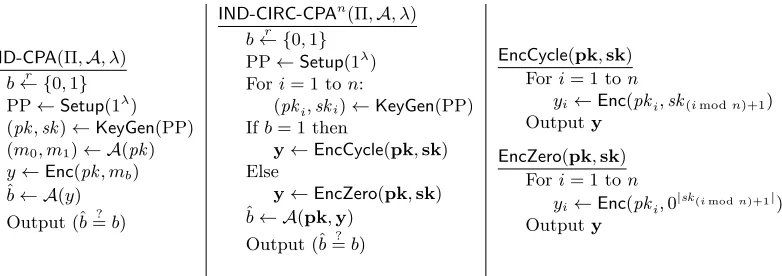
Figure 1: Experiments for Definitions 3.2 and 3.4, each for a message space M, and we assume that
m0, m1,ski∈M. We writepk,sk, andy for (pk1, . . . ,pkn), (sk1, . . . ,skn) and (y1, . . . , yn) respectively.
Definition 3.3 (IND-CCASecurity) LetΠ = (Setup,KeyGen,Enc,Dec)be a public-key encryption scheme. Let the random variableIND-CCA(Π,A, λ)be defined by an algorithm identical to IND-CPA(Π,A, λ)above, except that A has access to an oracle Dec(sk,·) that returns the output of the decryption algorithm and A cannot query this oracle on input y. We denote the IND-CCA advantage of A by AdvccaΠ,A(λ) = 2 · Pr[IND-CCA(Π,A, λ) = 1]−1. We say thatΠ is IND-CCAsecureif AdvccaΠ,A(λ)is negligible for all PPTA.
3.1
Circular Security
We next define circular security of public-key encryption. This definition is derived from the Key-Dependent Message (KDM) security notion of Black et al. [11]. We follow prior counterexample definitions [1, 17] which restrict the adversary’s power (e.g., cannot ask for any affine function of the secret keys). The adversary is asked to distinguish between an encryption cycle or encryptions of zero as in [13, 17]. The bit string zero is not actually in the message spaces we consider, but this value can be encoded to be in the space; equivalently, one can follow the approach of Acar et al. [1] which instead of zero, encrypts a fresh random message.
Definition 3.4 (IND-CIRC-CPAn) Let Π = (Setup,KeyGen,Enc,Dec) be a public-key encryption scheme. For integer n >0, schemeΠ, adversaryA andλ∈N, let the random variable IND-CIRC-CPAn(Π,A, λ)be
defined by the probabilistic algorithm in the middle of Figure 1. We denote the IND-CIRC-CPAn advantage ofAby
AdvnΠ-,circA -cpa(λ) = 2·Pr[IND-CIRC-CPAn(Π,A, λ) = 1]−1.
We say thatΠ is IND-CIRC-CPAn secureifAdvΠn-,circA-cpa(λ)is negligible for all PPT A.
4
A Framework for Generating Circular Counterexamples
We now present a general framework for creating circular security counterexamples, which we will instantiate under a variety of different assumptions in the subsequent sections. At the center of our framework is an abstraction called a “cycle tester”. Like an encryption scheme, a cycle tester must be able to encode a message in an IND-CPA secure manner. However, unlike an encryption scheme, the cycle tester need not support a decryption operation, instead it must support a testing operation which can detect the presence of an encryption cycle.
After formalizing this abstraction, we provide two results that use it. First, we show how our tester can be combined with any IND-CPA encryption scheme (of appropriate message length) to provide a full blown counterexample. Second, we extend this idea to show how to combine any tester with any IND-CCA encryption scheme to get an IND-CCA counterexample.
In addition to letting us focus on a narrower primitive for our counterexample, this separation avoids duplication of work and minimizes assumptions. In particular, we can design a single tester and then both the IND-CPA and IND-CCA counterexamples follow. Most prior works did not address IND-CCA counterexamples. While Cash et al. [17] did, their IND-CCA counterexample required the use of NIZKs, which is a stronger assumption than simply assuming the existence of IND-CCA encryption schemes as we do here. Our abstraction and transformation essentially show that designing IND-CCA counterexamples is no harder than designing IND-CPA ones.
We remark that Koppula et al. [24] have a IND-CPA counterexample with structure similar to our general transformation, however, no generic or IND-CCA theorems are proven.
Definition 4.1 (n-Cycle Tester) Acycle tester Γ = (Setup,KeyGen,Enc,Test)for message space M and secret key spaceS is a tuple of algorithms specified as follows:
• Setup(1λ)→ PP. The Setup algorithm takes as input the security parameter λ and outputs common public parameters PP.
• KeyGen(PP)→(pk,sk). The Key Generation algorithm takes as input the public parametersPP and outputs a public key pk and secret key sk ∈S.
• Enc(pk, m∈M)→C. The Encryption algorithm takes as input a public key pk and a messagem∈M
and outputs a ciphertext C.
• Test(pk,y) → {0,1}. On input pk = (pk1, . . . ,pkn) and y = (C1, . . . , Cn), the Testing algorithm outputs a bit in {0,1}.
It also must possess the following properties. LetΠ = (Setup,KeyGen,Enc,·)be an encryption scheme formed from the first three algorithms of the tester with an empty decryption algorithm. Then, it must hold that:
1. (IND-CPA security)Πis IND-CPA secure according to Definition 3.2.
2. (Testing Correctness) the Testing algorithm’s advantage in distinguishing encryption cycles, denoted
AdvnΠ-,circTest-cpa(λ)from Definition 3.4, is non-negligible.
We now prove two theorems.
Theorem 4.2 (CPA Counterexample from Cycle Testers) If there exists an IND-CPA-secure encryp-tion schemeΠfor message spaceM = (M1×M2)and secret key spaceS1⊆M1 and ann-cycle testerΓfor
message space M2 and secret key space S2⊆M2, then there exists an IND-CPA-secure encryption scheme Π0 for message spaceM = (M1×M2)and secret key spaceS = (S1×S2)that is n-circular insecure.
Proof. Let Π = (Setup1,KeyGen1,Enc1,Dec1) and Γ = (Setup2,KeyGen2,Enc2, Test2). We construct an IND-CPA Π0 = (Setup,KeyGen,Enc,Dec), together with its IND-CIRC-CPA2test algorithmTest, as follows.
KeyGen(PP): On input PP = (PP1,PP2), run (pk1,sk1)←KeyGen1(PP1) and (pk2,sk2)←KeyGen2(PP2). Outputpk = (pk1,pk2) andsk = (sk1,sk2).
Enc(pk, m): On input pk = (pk1,pk2) and m = (m1, m2) ∈ M, run c1 ← Enc1(pk1,(m1, m2)) and c2 ←
Enc2(pk2, m2). OutputC= (c1, c2).
Dec(sk, C): On inputsk= (sk1,sk2) andC= (c1, c2), outputDec1(sk1, c1).
Test(pk,y): On inputpk= (pk1, . . . ,pkn) andy= (C1, . . . , Cn), parsepki= (ai, bi) andCi= (ci, di) and
output the bitTest2((b1, . . . , bn),(d1, . . . , dn)).
The correctness of Test follows directly from that ofTest2. If (pk,y) contains an encryption cycle (or encryptions of zero, respectively), then so will ((b1, . . . , bn),(d1, . . . , dn)), and thus by definition of the cycle
tester, the test will distinguish between these cases with non-negligible advantage.
It remains to argue that Π0 is an IND-CPA secure encryption scheme. This follows by a simple hybrid argument based on the fact that an encryption in Π0 is a pair of encryptions from two different IND-CPA-secure schemes, Γ and Π. We omit this proof as it is a simplified version of the IND-CCA proof that we provide next.
2
Theorem 4.3 (CCA Counterexample from Cycle Testers) Letk, `be security parameters andp(·)be a polynomial. If there exists an IND-CCA-secure encryption schemeΠ(withk-bit secret keys and(p(`)+2k) -bit messages) and ann-cycle tester Γ (withk-bit secret keys,k-bit messages, andp(`)-bit ciphertexts), then there exists an IND-CCA-secure encryption schemeΠ0 for2k-bit messages that isn-circular insecure.
Proof. Let Π = (Setup1,KeyGen1,Enc1,Dec1) and Γ = (Setup2,KeyGen2,Enc2, Test2) with the length con-straints above. We construct an IND-CCA Π0 = (Setup,KeyGen,Enc,Dec), together with its IND-CIRC-CPA2 test algorithm Test, as follows. We can no longer simply append the cycle-tester encryption to the regular encryption, because changes to the cycle-testing portion might be leveraged to obtain a decryption of a portion of the challenge ciphertext. Instead, we encrypt this cycle-testing portion using the regular CCA-secure scheme.
Setup(1λ): On input 1λ, run PP1←Setup1(1λ) and PP2←Setup2(1λ). Output PP = (PP1,PP2).
KeyGen(PP): On input PP = (PP1,PP2), run (pk1,sk1)←KeyGen1(PP1) and (pk2,sk2)←KeyGen2(PP2). Outputpk = (pk1,pk2) andsk = (sk1,sk2).
Enc(pk,(ma, mb)): On inputpk= (pk1,pk2) and message (ma, mb)∈ {0,1}k×{0,1}k, runc2←Enc2(pk2, mb)
andc1←Enc1(pk1,(ma, mb, c2)). OutputC= (c1, c2).
Dec(sk, C): On inputsk = (sk1,sk2) andC= (c1, c2), runDec1(sk1, c1). If it does not return a message of the form (ma, mb, mc)∈ {0,1}k× {0,1}k× {0,1}p(λ)or ifmc6=c2, then output⊥(invalid ciphertext).
Otherwise, output the message (ma, mb)∈ {0,1}k× {0,1}k.
Test(pk,y): On inputpk= (pk1, . . . ,pkn) andy= (C1, . . . , Cn), parsepki= (ai, bi) andCi= (ci, di) and
output the bitTest2((b1, . . . , bn),(d1, . . . , dn)). Same as before.
As before, the correctness of Testfollows directly from that of Test2. If (pk,y) contains an encryption cycle (or encryptions of zero, respectively), then so will ((b1, . . . , bn),(d1, . . . , dn)), and thus by definition of
4.1
Proving IND-CCA Security via a Sequence of Games
It remains to argue that Π0 is an IND-CCA secure encryption scheme. This proof is significantly more involved than the IND-CPA case. We prove this using a sequence of games from an encryption of a message
M0 to an encryption of M1 (where these messages come from the IND-CCA game). The public and secret keys are always distributed as in the real scheme, but the structure of the challenge ciphertext changes in each hybrid. We underline these changes for the reader. Let the challenge messages be described as
M0= (m0,a, m0,b) andM1= (m1,a, m1,b). Then the hybrids are as follows:
Game 1 This corresponds to the original security gameIND-CCA(Π0,A, λ) in which the challenger interacts with adversaryA, except that the challenge ciphertext is always an encryption of messageM0.
1. RunSetup(1λ) to produce PP and thenKeyGen(PP) to produce (pk,sk).
2. On decryption queryCi fromA, outputDec(sk, Ci).
3. Provide the challenge ciphertext as C∗ = (c∗
1, c∗2), where c∗1 = Enc1(pk1,(m0,a, m0,b, c∗2)) and c∗2 =
Enc2(pk2, m0,b). This is a valid encryption ofM0.
4. On decryption queryCi6=C∗ from A, outputDec(sk, Ci).
Game 2 This is the same as Game 1, except that we change how the second decryption queries to reject
allrequests where the first portion of the query matches the first portion of the challenge.
1. RunSetup(1λ) to produce PP and thenKeyGen(PP) to produce (pk,sk).
2. On decryption queryCi fromA, outputDec(sk, Ci).
3. Provide the challenge ciphertext as C∗ = (c∗1, c2∗), where c∗1 = Enc1(pk1,(m0,a, m0,b, c∗2)) and c∗2 =
Enc2(pk2, m0,b). This is a valid encryption ofM0.
4. On decryption queryCi= (ci,1, ci,2)6=C∗fromA, ifci,1=c∗1output⊥, otherwise outputDec(sk, Ci).
Game 3 This is the same as Game 2, except that we now encrypt M1 in the cycle tester portion and continue to encryptM0in the regular encryption portion. We continue to reject all decryption queries where the regular encryption portion matches the challenge.
1. RunSetup(1λ) to produce PP and thenKeyGen(PP) to produce (pk,sk).
2. On decryption queryCi fromA, outputDec(sk, Ci).
3. Provide the challenge ciphertext asC∗= (c∗
1, c∗2), wherec∗1=Enc1(pk1,(m0,a,m0,b, c∗2)) andc∗2=Enc2(pk2, m1,b).
4. On decryption queryCi= (ci,1, ci,2)6=C∗fromA, ifci,1=c∗1output⊥, otherwise outputDec(sk, Ci).
Game 4 This is the same as Game 3, except that now the entire challenge ciphertext is an encryption of
M1. As before, we continue to reject all decryption queries where the regular encryption portion matches the challenge.
1. RunSetup(1λ) to produce PP and thenKeyGen(PP) to produce (pk,sk).
2. On decryption queryCi fromA, outputDec(sk, Ci).
3. Provide the challenge ciphertext as C∗ = (c∗1, c2∗), where c∗1=Enc1(pk1,(m1,a, m1,b, c∗2)) and c∗2 =
Enc2(pk2, m1,b).
Game 5 This is the same as Game 4, except now all decryption queries are answered as normal. The challenge ciphertext always contains an encryption ofM1.
1. RunSetup(1λ) to produce PP and thenKeyGen(PP) to produce (pk,sk).
2. On decryption queryCi fromA, outputDec(sk, Ci).
3. Provide the challenge ciphertext as C∗ = (c∗1, c2∗), where c∗1 = Enc1(pk1,(m1,a, m1,b, c∗2)) and c∗2 =
Enc2(pk2, m1,b).
4. On decryption queryCi6=C∗ from A, outputDec(sk, Ci).
4.2
Adversary’s Probability of Outputting 1 in these Games
LetProbiAdenote the probability that adversary Aoutputs a 1 in Gamei. We will now show, by a series of steps, that for any adversaryAthe difference in its probability of outputting 1 between Game 1 (encryption ofM0) and Game 5 (encryption ofM1) is negligible. Thus, it cannot distinguish between these two games.
Claim 4.4 For any adversaryA,Prob2A=Prob1A.
Proof. These games are identical except that in Game 1 all decryption queriesCi=C∗are rejected whereas
in Game 2 all decryption queries Ci = (ci,1, ci,2) such that ci,1 =c∗1 for C∗ = (c∗1, c∗2) are rejected. This results, however, in identical behavior on the decryption queries. Whenever ci,1 6=c∗1, both games answer the queries normally. WheneverCi=C∗, neither game answers this illegal challenge query. Onci,1=c∗1 but
ci,26=c∗2, Game 2 will output⊥. However, Game 1’s response is also to reject this query with the message
⊥for being a non-valid ciphertext, since the decryption of c∗1 results in an intermediate tuple of the form (m0,a, m0,b, c2∗) and the decryption algorithm checks thatc∗2 =ci,2, which won’t be true in this case. Thus,
the adversary gets identical responses to its decryption queries (and everything else) in both games. Since the games are identical, from the adversary’s viewpoint, it will output 1 with the same probability. 2
Claim 4.5 IfΓ is an IND-CPA-securen-cycle tester with security parameterλ, then for any adversaryA,
Prob3A−Prob2A≤negl(λ).
Proof. We show that an attacker’s probability of outputting 1 cannot be non-negligibly different in Games 2 and 3, because that would imply an attack on the IND-CPA security of the cycle tester. More formally, suppose there exists an adversary Asuch that Prob3A−Prob2A=. Then we can construct an adversaryB
that usesAto show that Γ is not an IND-CPA-securen-cycle tester. Bworks as follows:
1. B runsSetup1(1λ)→PP1 andKeyGen
1(PP1)→(pk1,sk1).
2. B obtains the public keypk2from the IND-CPA encryption challenger.
3. B sendspk= (pk1,pk2) toA.
4. Areturns two messagesM0= (m0,a, m0,b) andM1= (m1,a, m1,b).
5. B sends (m0,b, m1,b) to the cycle tester encryption challenger and obtains the challenge c∗2.
6. B forms the challenge ciphertext by computing c∗1 = Enc1(pk1,(m0,a, m0,b, c∗2)) and sending C∗ = (c∗1, c∗2) to A.
In the above, B perfectly simulates Game 2 for adversary A if the challenge ciphertext c∗2 contains an encryption ofm0,band, in the other case,Bperfectly simulates Game 3 for adversaryAwhen the challenge
ciphertext c∗
2 contains an encryption of m1,b. Moreover, B succeeds if and only if A succeeds. Thus, if
Prob3A−Prob2A = , then we have Pr[B is correct] = 1
2Pr[B is correct | IND-CPA challenger chose 0] + 1
2Pr[B is correct |IND-CPA challenger chose 1] = 1
2Pr[Ais correct |Game 2] + 1
2Pr[A is correct| Game 3] = 1
2(1−Prob 2
A) +12(Prob 3
A) = 12(1−Prob 2
A) +12(Prob 2
A+) = 12+
2. Since we assumed the cycle tester was IND-CPA secure, it must hold that≤negl(λ). 2
Claim 4.6 IfΠis an IND-CCA-secure encryption scheme with security parameterλ, then for any adversary A,Prob4A−Prob3A≤negl(λ).
Proof. Suppose there exists an adversary A such that Prob4A−Prob3A = . Then we can construct an adversaryBthat usesAto show that Π is not an IND-CCA-secure encryption scheme. B works as follows:
1. B obtains the public keypk1from the IND-CCA encryption challenger.
2. B runsSetup2(1λ)→PP2 andKeyGen2(PP2)→(pk2,sk2).
3. B sendspk= (pk1,pk2) toA.
4. On receiving a decryption query for ciphertext Ci = (ci,1, ci,2) fromA, B sendsci,1 to its IND-CCA encryption challenger to obtain a message M. B returnsM to A.
5. Areturns two messagesM0= (m0,a, m0,b) andM1= (m1,a, m1,b).
6. B computes c∗2 = Enc2(pk2, m1,b) and sends M00 = (M0, c∗2) and M10 = (M1, c∗2) to the IND-CCA challenger and obtains the challengec∗
1.
7. B sends the challenge ciphertextC∗ = (c∗1, c∗2) toA.
8. On receiving a decryption query for ciphertextCi= (ci,1, ci,2) whereci,16=c∗1 fromA,B sendsci,1 to its IND-CCA encryption challenger to obtain a messageM. BreturnsM toA
9. Eventually,Areturns a bit ˆb andBoutputs ˆbto its challenger.
In the above, B perfectly simulates Game 3 for adversary A if the challenge ciphertext c∗1 contains an encryption ofM00 and, in the other case,B perfectly simulates Game 4 for adversaryA when the challenge ciphertext c∗1 contains an encryption of M10. Moreover, B succeeds if and only if A succeeds. Thus, if
Prob4A−Prob3A =, then B’s probability of success in the IND-CCA security game is Pr[B is correct] = 1
2Pr[Bis correct|IND-CCA challenger chose 0] + 1
2Pr[Bis correct|IND-CCA challenger chose 1] = 1 2Pr[A is correct|Game 3] + 12Pr[Ais correct|Game 4] = 12(1−Prob3A) +12(Prob4A) =12(1−Prob3A) +12(Prob3A+) = 12+2. Since we assumed that Π was IND-CCA secure, it must hold that≤negl(λ). 2
Claim 4.7 For any adversaryA,Prob5A=Prob4A.
Proof. These games are identical except that in Game 4 all decryption queries Ci = (ci,1, ci,2) such that
ci,1 = c∗1 for C∗ = (c∗1, c∗2) are rejected in Game 5 whereas all decryption queries Ci = C∗ are rejected.
This results, however, in identical behavior on the decryption queries. This case is the mirror image of the
argument in the proof of Claim 4.4. 2
Conclusion of the Proof of Theorem 4.3 Given the above claims, we can conclude that if Γ is an IND-CPA-secure n-cycle tester and Π is an IND-CCA-secure encryption scheme (with the appropriate length constraints), then for any adversary A, it holds that Prob5A−Prob1A is negligible, implying that Π0 is an IND-CCA-secure encryption scheme.
5
Warm up: 2-Cycle Tester from the SXDH Assumption
We start with a simple 2-cycle tester set in Type-III pairing groups where the SXDH assumption holds. This is derived from a prior SXDH-based counterexample of Cash, Green and Hohenberger [17] and is also similar to the example of Acar et al. [1].
Our construction is described below. In it we slightly abuse notation and let our message space Z∗p be defined by ourSetupalgorithm. In Section 6 we show how to remedy this by having a message space be{0,1}λ
(that only depends on the security parameter λ) and having the Setup algorithm define a pseudorandom generator which maps from{0,1}λ to the algebraic message space needed for the construction.
Setup(1λ) → PP. Recall we assume a setting where all parties implicitly use shared public parameters. RunG(1λ) to generate a Type-III pairing description PP = (p, g, h,G1,G2,GT, e), such thatpis a prime in
Θ(2λ),
G1, G2 and GT are groups of orderpwhere g generatesG1,hgeneratesG2 ande:G1×G2→GT
is an admissible pairing. The message space isZ∗
p.
KeyGen(PP)→(pk,sk). Flip a coinβ ∈ {0,1} and choose randoms∈Z∗
p. Set the public key as:
pk =
(
(0, gs)∈ {0,1} ×G1 ifβ = 0; (1, hs)∈ {0,1} ×
G2 ifβ = 1.
The secret keysk iss, making the secret key spaceZ∗p (which is the same as the message space).
Enc(pk, m∈Z∗p)→C. To encrypt, parsepk= (β, K) and choose a randomt∈Z∗p. Generate the ciphertext
C= (C1, C2) as:
C=
(
(C1=Ktm=gstm, C2=gt)∈G21 ifβ = 0; (C1=Ktm=hstm, C2=ht)∈G22 ifβ = 1.
Test(pk,y) → {0,1}. Since we are testing for 2-cycles, parse pk = (pk = (β, K),pk0 = (β0, K0)) and y = (C = (C1, C2), C0 = (C10, C20)). If β =β0, output a random bit. Otherwise, assume without loss of generality thatβ = 0 andβ0 = 1. Then the test algorithm checks if
e(C1, C20) ?
=e(C2, C10).
If this check holds, then output 1 (guess cycle); otherwise output 0 (guess zeros).
Analysis of Test Algorithm In the IND-CIRC-CPA2 game, two public keys pk = (β, K),pk0 = (β0, K) are freshly generated by theKeyGen algorithm based on a shared common parameters freshly generated by theSetup algorithm. Sinceβ andβ0 are independently chosen bits, the probability that β =β0 is 1/2. In this case, the Test algorithm will output a random bit (i.e., a random guess) and thus will be successful exactly 1/2 the time.
Otherwise, we assume without loss of generality thatβ= 0 andβ0= 1 (if not, swap the two key/ciphertext pairs). In this game, the challenge ciphertexts (C, C0) are formed using theEncalgorithm. By plugging these values into theTestequation above, we have:
e(gstm, ht0) =e(gt, hs0t0m0)
e(g, h)stmt0 =e(g, h)s0t0m0t
e(g, h)sm=e(g, h)s0m0
Recall thatt, t0 ∈
Z∗p, so we can divide them out of the exponent. From the last equation, it is clear that if
have an encryption of zero (recall this is encoded as some elementz∈Z∗p, soz6= 0), then the left-hand-side
is e(g, h)sz and the right-hand-side is e(g, h)s0z, which will only be equal if s=s0. Since these secret keys were randomly chosen from Z∗p, the chance they are the same is 1/(p−1), which is negligible in λ. Thus,
the success of theTestalgorithm is (1/2)(1/2) + (1/2)((1/2) 1 + (1/2) (1-1/(p-1)) = 3/4 -negl(λ), which is more than sufficient probability to win theIND-CIRC-CPA2 game.
IND-CPA Security of the Tester
Theorem 5.1 The above encryption schemeΠ = (Setup,KeyGen,Enc,·)(where the decryption algorithm is ignored) isIND-CPA-secure under the SXDH Assumption inG1,G2.
Proof. Suppose that there exists a PPT adversaryAthat has a non-negligible advantagein the IND-CPA
security game. We can then construct a PPT algorithm B that solves the SXDH problem with advantage 1
2+
2. Bworks as follows:
1. Select a random bitβ ∈ {0,1}. Ifβ= 0, we will obtain a DDH instance (g, ga, gb, T
d)∈G41. Ifβ= 1, we will obtain the same instance inG2. We proceed assumingβ= 0; the case ofβ= 1 is analogous.
2. Set the public key pk as
pk= (β, K=gs=ga)
(implicitly settings=a) and output it toA. Note thatBdoes not know the secret key. 3. RunA(pk) to produce a tuple (m0, m1).
4. Select a random bitγ∈ {0,1}.
5. Set the challenge ciphertext as C∗= (C 1=T
mγ
d , C2=gb)∈G21.
6. Run A(C∗) to get a bit γ0. If γ =γ0, then output 0 (guess a DDH instance). Otherwise, output 1 (guessTd was random).
IfTd=gab, thenC1=T
mγ
d =g
abmγ =gstmγ and the ciphertext is well-formed according to the original
encryption algorithm. B wins with probability 12+in this case, sinceAdoes. Otherwise, C1 is a random group element, which means thatAguesses correctly with probability 12. In this case,Bwins with probability
1
2 as well. Bthen has an overall success probability of 1 2
1 2+
+12·1 2 =
1 2+
2, which gives a non-negligible advantage of 2.
2
6
A 2-Cycle Tester from the
k
-DLIN Assumption
We now present a 2-cycle tester from the decisionk-Linear assumption in pairing groups for any constantk
(where this assumption is believed to hold fork≥2 in this bilinear setting and the assumption grows weaker as kincreases). We will use a message space of {0,1}λ. In our exposition we will use boldface to denote a
matrix such asM. We also usegM as shorthand to denote the group elements corresponding to the raising
g to each individual element ofM.
Setup(1λ)→PP. The setup algorithm first runs G(1λ) to generate a (Type-1) group Gof prime orderp
with generator g. Next it defines a pseudorandom generator PRG : {0,1}λ →
Zkp×k, which maps strings
from {0,1}λ to invertible k×kmatrices over
Zp. Finally, it chooses a random invertible matrixA∈Zkp×k
and computes gA. The public parameters, PP consist of the group description
G, the description of PRG
KeyGen(PP)→ (pk,sk). The key generation algorithm first chooses random w∈ {0,1}λ. The secret key sk =w. Next, it computes PRG(w)→ W ∈ Zpk×k and chooses a bit β ∈ {0,1}. Finally, in addition to
implicitly including PP, it defines the public key as
pk=
(
(0, K =gAW)∈ {0,1} ×Gk×k ifβ = 0;
(1, K =gWA)∈ {0,1} ×
Gk×k ifβ = 1.
Enc(pk = (β, K), m∈ {0,1}λ)→ct. The encryption algorithm first computes computes PRG(m)→M∈
Zkp×k and then computesM−1. Note that since PRG maps to invertible matrices,Mwill have an inverse.
If the type bitβ = 0 the key K =gAW for someW. The algorithm choosesras a random row vector of lengthkinZp (i.e. a random matrix of dimension 1×k). The ciphertext is computed and output as
C1=grAW, C2=grAM −1
.
Thus, the ciphertext will consist of two row vectors in the exponent. We observe all terms are computable from the public keys and public parameters.
If the type bitβ = 1 the keyK=gWAfor someW. The algorithm choosesras a random column vector of lengthkinZp (i.e. a random matrix of dimensionk×1). The ciphertextct is computed and output as
C1=gWAr, C2=gM −1Ar
.
Test(pk,y)→ {0,1}. Since we are testing for 2-cycles, parsey= (C= (C1, C2),
C0= (C10, C20)). If the key types are identical i.e. β=β0 then just output a random bit as a guess.
Otherwise, presume thatβ = 0, β0= 1 (if it is the other way around just flip the order). Then compute
e(C1, C20) ?
=e(C10, C2) and output the result. Note here we overload notation so that the pairing operatore
is over a matrix of group elements and means matrix multiplication in the exponent. (Or in this case a dot product in the exponent.)
Analysis of Test Algorithm We analyze the correctness of the test algorithm. Let’s consider two secret keysw, w0where PRG(w) =Wand PRG(w0) =W0. Again, presume thatβ = 0, β0= 1. The corresponding public keys will be pk =gAW andpk =gW0A. Now consider an encryption ofm under pk and m0 under
pk0 where PRG(m) = M and PRG(M0) = M0. Let r and r0 be the respective randomness used for each encryption.
The test equations outputs 1 iffe(C1, C20) ?
=e(C10, C2) this is equivalent to testing
rAWM0−1Ar0 =? rAM−1W0Ar0. (1)
Let’s first consider the case where we have an encryption of a cycle. This means thatm0=wandm=w0
so we have thatM0−1=W−1 andM−1=W0−1. Substituting these in we see that
rAWM0−1Ar0 ?
= rAM−1W0Ar0
rAIAr0 =? rAIAr0
rA2r0 ?
= rA2r0.
Thus, on a cycle the test will output 1.
We now turn to the case of showing that an encryption of 0’s will output 0 (when the keys have different
β types) with all but negligible probability.
generator. If there, was more than a negligible difference of the test in outputting 1 in these two cases, it would lead to an attack on the security of the pseudorandom generator.
We can now observe that the matrices X=AWZAandX0 =AZW0A are distributed independently and uniformly random from full rank matrices. Note we substitutedZfor bothM0−1andM−1in Equation 1. Thenu=rX andu0 =rX0 are independently distributed as uniformly at random row vectors of lengthk. Finally, it follows that the probability that
ur0=? u0r0
is negligible in the security parameter. Thus, with probability negligibly close to 1 the test algorithm will output 0 when given an encryption of all 0’s.
IND-CPA Security of the Tester
Theorem 6.1 The above encryption scheme Π = (KeyGen,Enc,Test) (where the decryption algorithm is ignored) isIND-CPA-secure under thek-Linear Assumption in G.
Proof.
We prove security for the β= 0 case. The β= 1 case will follow analogously. We first define a sequence of games.
Game 1 This game is theIND-CPA security game for our construction
1. The challenger runs Setup(1λ)→PP = (
G,PRG, gA).
2. Recall, we consider a β = 0 key. The challenger runs PRG(w) → W∈ Zpk×k. LetV =AW. The
key is computed as K =gV. The challenger gives the parameters, PP and key pk∗ = (0, K) to the attacker.
3. AThe attacker submits two messagesm0, m1to the challenger.
4. The challenger flips a coin b ∈ {0,1}. Let Mb = PRG(mb) ∈ Zkp×k. The challenger chooses r as a
random row vector of lengthk inZp. The challenge ciphertext is computed and output as
C1∗=grV, C2∗=grAM−b1.
5. The attacker receives the challenge ciphertext. It then outputs a guessb0 and wins ifb0 =b.
Game 2
2. ChooseV as a random matrix of rank kin Zk×k
p . The key is computed asK =gV. The challenger
gives the parameters, PP and key pk∗= (0, K) to the attacker.
Game 3
4. The challenger flips a coinb ∈ {0,1}. Let Mb = PRG(mb)∈Zkp×k. The challenger chooses r,uas a
random row vectors of lengthkinZp. The challenge ciphertext is computed and output asC1∗=grV,
C2∗=guAM −1 b .
Proof. Suppose there exists an attacker A. We build a reduction algorithm B. B will first runGame 1 with the exception that it will received W∈ Zkp×k from the pseudorandom generator challenger. It then
computesV=AWand the key as. It then runs the rest of the experiment as inGame 1. If the attacker is successful in guessing the challenge bitb,Boutputs 1 to indicate pseudorandom; else it outputs 0 to indicate random.
WhenWis output from the PRG the reduction exports the view ofGame 1toA, thus the probability ofBoutputting 1 will be the probability A wins inGame 1. IfWis selected as a random matrix of rankk
inZk×k
p , then the reduction exports the view of Game 2. This follows since the multiplication of a random
full rank matrix by another full rank matrix is distributed the same as a random full rank matrixV. Thus the probability ofBoutputting 1 (in this case) will be the probability A wins inGame 2. Therefore if any PPT algorithm A has a non-neglgibile difference in advantage between Game 1 and Game 2, there will exist a PPT attack algorithmB.
2
Claim 6.3 If the decision k-linear assumption holds PRG, then any PPT attacker will have at most a negligible difference in advantage betweenGame 2 andGame 3.
Proof.
We prove this theorem relying on an instance of the decision matrix linear assumption introduced by Naor and Segev [28]. In our particular instance the challenger with give out a dimension (k+ 1)×2kmatrix
gT whereTis either chosen as a random rankk matrix or a random rankk+ 1 matrix.
Our reduction algorithm will receive the group descriptionGand the challengegT. IfTwas chosen as a random rankkmatrix it is statistically close to a matrix where the the topkrows are twok×kmatricesV andAconcatenated together. While the bottom row ofTconsists of a linear combination of the previousk
rows ofTand can be written as rT=rV|rAfor random length krow vectorr. Whereas ifTwas chosen as a random rank k+ 1 matrix then the last row would be (statistically close) to a random row vector of length 2kand could be written asrV|uAfor random length krow vectorsrandu.
Our reduction algorithm Breceives the challengegT and proceeds to run the security game. It uses the topkrows of the matrix to simulate giving out the parameters gA and K=gV as described above. Then it uses the left half of the bottom row of the matrix to output C1∗ =grV and the right half of the bottom row to output C2∗ =grAM−b1 or C∗
2 =guAM −1
b (depending on what the challenge was). We see that if the
challenge was a rankk matrix, then we are in Game 2. If the challenge was a rank k+ 1 matrix, then B
exports Game 3. Therefore any attacker than had a non-negligible difference of advantage between these games would break the decision matrixklinear assumption with non-negligible advantage. Since Naor and Segev showed this to be equivalent to the decisionk-linear assumption our claim holds.
2
Claim 6.4 The advantage of any attacker inGame 3 is 0.
Proof. SinceAandM−b1are full rankkthe matrixAM−b1is also of rankk. Since the row vectoruis chosen randomly and does not appear elsewhere the row vector uAM−b1 has the same distribution as a uniformly chosen row vector ˜u. In particular, the distribution is independent of the bit b and thus the ciphertext is independent ofb.
2
Our theorem follows from the fact that any PPT algorithm will have 0 advantage in the last game and its advantage in the first game must be negligibly close to this.
7
A 2-Cycle Tester from Learning with Errors
We now present a 2-Cycle Tester whoseIND-CPAsecurity follows from the Learning with Errors Assumption. We note that our construction is similar to multi-bit Regev encryption.
7.1
Construction
Setup(1n)→PP. The setup algorithm chooses m, q, `, σ, r, α. These parameters are chosen to satisfy the following constraints: m≥2nlogq,σ≥Lω(√logm),q≥5σ(m+ 1),` >(n+m+ 1) logq+ω(log(n+m)),
r:=σ`, α≤1/(r√m+ 1·ω(√logn)), and q >2 is prime. Here,L is defined as follows. We let z denote the number of uniform random bits employed by TrapGen to generate a matrix B in Zn×m
q along with a
trapdoor basisTB. Lis a bound such that||TB||GS≤Lwith overwhelming probability. (We note that this
range of parameters allows us to set αso that n/α is polynomial, and LWE is believed to be hard in this parameter regime.) The public parameters are PP = (m, q, `, σ, r, α, z).
KeyGen(PP)→(pk,sk). The key generation algorithm chooses a uniformly random secret keysk in{0,1}z
and runs TrapGen(sk) to produce a matrix B ∈ Znq×m and a corresponding trapdoor basis TB. It then
chooses independent and uniformly random vectors c1, . . . , c` ∈ Znq and noise vectorsγ1, . . . , γ` from χm,
whereχ is distributed asbqΨαc modq, where Ψα is a distribution onTof a normal variable with mean 0
and standard deviation α/√2πreduced modulo 1. (We think of these vectors as row vectors.) In addition to implicitly including the PP, it sets
pk={c1, . . . , c`, y1:=c1B+γ1, . . . , y`:=c`B+γ`}.
Enc(pk, m∈ {0,1}z)→ct. The encryption algorithm runs TrapGen(m) to produce a matrixZ∈
Znq×mand
a corresponding trapdoor basisTZ. It chooses random signsr1, . . . , r`∈ {−1,1}and computess:=P ` i=1rici.
It then uses TZ to sample a short (column) vectorv such that Zv=st, by calling the algorithm SampleD.
It computes
C=
`
X
i=1
riyi,
and sets the ciphertext asct = (C, v).
Test((pk0,pk1),((C0, v0),(C1, v1)))→ {0,1}. The cycle test algorithm comparesC0v1 to C1v0 and checks if there are close moduloq(if their distance is ≤2q/5). If so, it outputs 1. If not, it outputs 0.
Analysis of Test Algorithm We let B0, Z0, s0 be the B, Z and s values corresponding to ciphertext (C0, v0) and B1, Z1, s1 be the analogous values for (C1, v1). When there is a cycle, we then have Z0 =B1 andZ1 =B0. We then haveB0v1 =st1 andB1v0 =st0. Noting that C0=s0B0+ψ0 for some small vector
ψ0, we see that
C0v1=s0B0v1+ψ0v1=s0st1+ψ0v1.
Similarly,C1=s1B1+ψ1for some small vectorψ1, so we have that
C1v0=s1B1v0+ψ1v0=s1st0+ψ1v0.
We consider the size ofψ0v1−ψ1v0moduloq. First,|ψ0v1|is at most`times the maximal size of|γjv1|. Using the same analysis as in the proof of Lemma 8.2 of [20], each of these is ≤ q
5` with high probability.
Thus,|ψ0v1−ψ1v0| ≤ 25q with high probability.
Since all ofv0, v1, ψ0, ψ1are short, this will cause these values to be close moduloq, so the cycle test will output 1 with high probability.
When there is no cycle, the matricesB0andB1are (statistically close) to independent, uniformly random matrices. Thus the probability thats0B0v1 ands1B1v0 will be within 25q moduloqis negligibly close to 25. Thus the cycle test wins the distinguishing game with probability negligibly close to 12+12·3
7.2
IND-CPA Security of the Tester
To prove that this construction satisfies IND-CPA, we define a sequence of security games.
Game0 This is the regularIND-CPA security game for our construction:
1. The challenger runs Setup(1n)→PP = (m, q, `, σ, r, α, z).
2. The challenger chooses a uniformly random secret keysk in{0,1}zand runs TrapGen(sk) to produce a
matrixB∈Znq×mand a corresponding trapdoor basisTB. It then chooses independent and uniformly
random vectorsc1, . . . , c`∈Znq and noise vectorsγ1, . . . , γ`from χm. It sets
pk ={c1, . . . , c`, y1:=c1B+γ1, . . . , y`:=c`B+γ`}.
The challenger gives the parameters PP and keypk to the attacker.
3. AThe attacker submits two messagesm0, m1to the challenger.
4. The challenger flips a coin b ∈ {0,1}. It runs TrapGen(mb) to produce a matrix Z ∈ Znq×m and a
corresponding trapdoor basis TZ. It chooses random signs r1, . . . , r` ∈ {−1,1} and computes s :=
P`
i=1rici. It then uses TZ to sample a short (column) vector v such that Zv = s
t, by calling the
algorithm SampleD. It computes
C=
`
X
i=1
riyi,
and sets the ciphertext as (C, v).
5. The attacker receives the challenge ciphertext. It then outputs a guessb0 and wins ifb0 =b.
Game1
2. The challenger chooses a uniformly random secret key sk in {0,1}z and runs TrapGen(sk) to
pro-duce a matrix B ∈Zn×m
q and a corresponding trapdoor basis TB. It then chooses independent and
uniformly random vectors c1, . . . , c` ∈ Znq and uniformly random vectors y1, . . . , y`∈Zmq . It sets pk ={c1, . . . , c`, y1, . . . , y`}.
Game2
4. The challenger flips a coin b ∈ {0,1}. It runs TrapGen(mb) to produce a matrix Z ∈ Znq×m and a
corresponding trapdoor basis TZ. It chooses s randomly in Znq. It then uses TZ to sample a short
(column) vector vsuch that Zv=st, by calling the algorithm SampleD. It choosesC randomly from
Zmq and sets the ciphertext as (C, v).
Game3
4. The challenger samples the vectorvfromDZm,σ. It choosesCrandomly fromZmq and sets the ciphertext
as (C, v).
At this point, the distribution of the ciphertext is independent of the message, and it is clear that no PPT adversary can obtain a non-zero advantage.