51 |
P a g e
ONE WAY CORROBORATION: SERVICE
SELECTION FOR WEB-BASED BUSINESS
PROCESSES
K. Gopichand Reddy
1, J Armstrong Paulson
2 1Pursuing M.Tech (CS),
2Associate Professor Nalanda Institute of Engineering & Technology
Siddharth Nagar, Kantepudi(V),Sattenapalli(M),Guntur (D)-522438, (India)
ABSTRACT
Internet has covered the way for the appearance of web databases. Data mining is procedure used by
organizations to turn raw data into useful information. Data mining such databases for required information
has become a common task. Data mining can be a reason for apprehension when only selected data, which is
not delegate of the overall sample group, is used to establish a certain theory. There are many algorithms which
are applied to get the exact data which is used by the user. The obtainable solutions such as user’s profile,
query logs and database principles execute ranking in user independent and/or query independent method. This
can’t give effective ranking strategy. This paper presents a new approach known as Query and User Dependent
Ranking for giving ranking to query results of deep web databases. Search engine has got two types of searches
i.e. User search and Query search. One of the problems in this context is ranking the results of a user query. We
are going to discuss about these two techniques and also going to show an advanced search where we can tell
that it is more efficient than the existing techniques. Data Mining is employed here and also the ranking
algorithm is used for the query searches done by the user on a particular data from the raw database. To get the
efficient output expected by user we have used the Ranking algorithm which is associated with the workload.
The representation is based on the perception that comparable users show comparable ranking preferences
over the results of similar queries. Then we describe these similarities properly in different ways and discuss
their effectiveness analytically and experimentally over two distinct Web databases.
Index Terms: Raw Data, Web Databases, Data Mining, Query Search, Ranking Algorithm.
I INTRODUCTION
Data Mining is the very recognizable perception in Computer knowledge which helps users to get related data as
of the raw data; it earnings that by the accomplishment of a data mining algorithm we can excavation the
functional data from very huge data. As like Data Mining here is also one more term which is unfathomable
Web. Profound Web is also called as Deepnet which is not noticeable to the user; it is the World Wide Web
content that is not division of the exterior web. Profound web is the terms which tell that the standard user
cannot reach the root of it i.e. not all the users can find the information from that detailed investigate steam
engine only the sanctioned user’s can admission all the information. For example, some university,
52 |
P a g e
public access. Additional sites might limit database right to use to member or subscribers. Unfathomable webalthough it is not recognized to numerous of the user but they contain come across these types of websites, the
websites which give access to their data only after a genuine confirmation of that user. For illustration, we have
a website “Slideshare.net” which gives information only after you confirm yourself and only after this check
that user can get data; point to be taken into deliberation is that we want not pay any quantity to that association
for access the data. On the similar time we have Google explore engine which never asks a user to get register
for the data access from their database.
Here we require recognizing a point here which is from Google we cannot get any data it’s just an arrangement
tool which helps user to find the way to his fortune from the Google search engine. For illustration, at any time
we type for thorough content from Google it gives us entirety of links of other domain which keep up that data
of our explore. But if we evaluate this with Slideshare.net, here user will search for his requirement and that
domain will get the results closely matching to the need in this domain itself but it will not give the links of
other domains from where a user can get his data.
To tell more about the work in data mining there are two possible scenarios i.e. user search and query search.
Both these techniques are used for searching the data but the difference is that in user search the operation will
be performed based on the user requirements and in the case of query search the operation will performed on the
system based. Both the techniques use database query for the search and so the design used for the retrieval of
the information will be purely on the different queries used by the developer of that domain. When user gives
the requirements about the data the query will add the details using the AND/OR operators in the queries to
search the data from the database. Each dataset that comes out from the DB when the search is performed is
termed as tuples. Example: Suppose there are two users who want to know details about a bike which is
available in the market and so we track the details provided by them for their search i.e. When first user
searches the values provided by him are “made=Yamaha and year=2013” and as the input is not specific we get
many tuples i.e. we get many options from which again a user to select the one he wants. Suppose the input was
“made=Yamaha and price=50000 and year=2014” then also we get tuples but the no. of tuples compared to
above result will be less. From this example, we can come to a conclusion that when we have more input
parameters for the search the search will be more optimized and when the options are less the time taken to get
the exact result will be more. Also from the queries we can see that operators like AND or OR can be used to
fetch the results from the database.
II RELATED WORK
This describes about the searches that will be performed and also the comparison between them. There are two
types of searches that will be performed on the search engines i.e. user search and query search. In this paper,
we are adding a new type of search i.e. advance search. Advance search is for fetching the data from the
database in a smart manner i.e. the data will be retrieved even with the less details that user gives to the search
engine. User search is a type of mechanism where the user gives his inputs to fetch the data from that
53 |
P a g e
exact result but the search engine does not have the capability to get the user expected result with the minimumvalues specified by the user. When the user can see different tuples that have been fetched by the application
and seeing them the user changes the input given and again based on the second input the system gives some
output to the user. Again the process is same i.e. seeing the tuples generated the user will select the data which
he wants from the generated output and if still the requirement is not matching then again a new set of input is
given till the expected output is not achieved.
Example: The inputs can be given in this manner
a. “made=Yamaha and year=2014”
b. “made=Yamaha and year=2014 and color=blue”
c. “made=Yamaha and year=2014 and model=abc and color=blue”
From the above four set of data points we can tell that the user started searching for the bike and could get the
output what he was actually looking for so again the inputs were modified. In this manner the user was
continuously changing the inputs at fourth try he got the exact output, the result can be expected appropriately
when the requirement from the user is accurate and the search engine will not have any issue for searching the
data from its database. We have a web portal called “olx.in” which uses the details provided by user to fetch the
results from the database and again the user has a search bar where if the output what was seen dint match with
the requirement then the user can change his requirement to get the data of his choice. Here the user is given
chance to explore his thought for the type of requirement which he is actually looking for. This type of search
actually refers to User search.
We have other type of search which is Query search. Here the user need to select the type of requirement and
based on that the query will be generated by the application. With the query that is generated the result will be
displayed to the user and if still the output shown to user is not matching the criteria then user has got the
flexibility to modify the inputs and perform the search again with the new set of data. For every search that is
being performed by the user a new query will be generated and will be tracked by the application and with this
queries that are mined by the application later can be used to compute the results based on the query similarity.
The term query similarity means that if a particular user is searching with his requirement then that requirement
may match with some other user also for better results and feasibility the queries will be mined and used for the
later purpose.
III PROPOSED SYSTEM AND ARCHITECTURE
Query Search is a search which can be found in many of the web portals, one which I would like to tell is
“watchkart.com”. This portal helps the user to give his requirement in the form of UI designed by the
application and once the user has selected his requirements then the output will be generated for user and here
also we get tuples and from which if the user is not satisfied then the user has got the flexibility to modify the
search pattern and give different requirement. We will now see the difference between user search and query
54 |
P a g e
are substituted into the DB query and results will be fetched but where as in query search the user will selectfrom the options given and a query will be generated with the set of data that user has selected. From the above
said point it is very clear that in user search the query is predefined and only the inputs will be substituted but
where as in query search every time a new set of input data is given a new query will be generated and this data
will be mined for future purpose i.e. when a new user is giving same type of requirements then it will be
selected from already created rather creating a new one. Also in this process when the same query is being
generated number of times we are going to implement a ranking algorithm to know the rank of the queries
which are being generated by different users for their requirements. Based on the queries a ranking function will
be generated and when the queries are generated they also give rise to work load which will be defined in detail.
Fig 1: Similarity Model for Ranking.
Workload is nothing but the query generation and interaction with the database for the information retrieval.
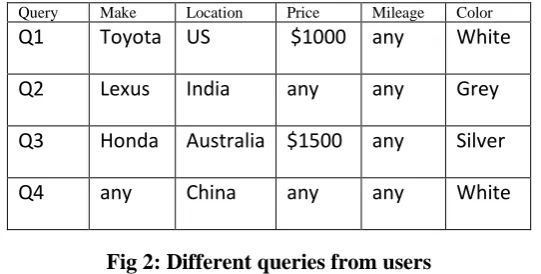
Query Make Location Price Mileage Color
Q1
Toyota US
$1000 any
White
Q2
Lexus
India
any
any
Grey
Q3
Honda
Australia $1500
any
Silver
Q4
any
China
any
any
White
Fig 2: Different queries from users
When a user gives his requirements for search then the application will give set of tuples i.e. matching the
requirement different values will be shown and if the user is satisfied the result will be generated and if the
requirement is not fulfilled then the input will vary for the second time and if still it does not match the
requirement the process goes on till the requirement is fulfilled. For example assume the below outputs that we
55 |
P a g e
Number of users searching this type of item can be calculated and to know the query similarity the equation is,Similarity (Q,
) =
There is also a chance that the tuples may also be same and that similarity can be calculated as,
Sim (T, ) =
So far, we have discussed about the user search and query search and now the discussion is about the advance
search that we are going to interject into this implementation for the best results. Advance search is going to
fetch the data from the various databases and also it’s not going to tell the user to give some more requirements
for the best result, it is going to fetch the result from the database based on the data given by user for the first
time itself and the main logic involved here is that it is going to display the content to the user which has the
more rank and which was taken by more number of users i.e. it means that when a user has got some data and if
that data is consumed by applying the ranking algorithm the count is incremented and in this manner where
many users like this user consume this data then that data with user specific query will get good rank and so
because of it that data will be presented to the user. Advance search is the best optimized one and the main logic
part is similar to the user search and in the database query the input from user will be substituted with the like
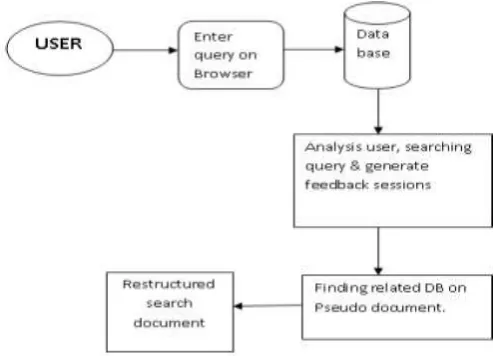
keyword. Below is the process for getting the ranking functions from the different user queries that are accepted
by the application.
Fig 3: Architecture Diagram
Algorithm: Deriving Ranking Functions from Workload
Input : , , Workload W (M queries, N users)
Output : Ranking Function Fxy to be used for Ui, Qj Step 1: for p = 1 to M do
Calculate Query Condition Similarity (Qj, Qp) end for
56 |
P a g e
Select QKset i.e., top-K queries from the above sorted setStep 2: for r = 1 to N do
Calculate User Similarity (Ui, Ur) over QKset end for
Sort(U1, U2; . . .UN) to yield Uset Step 3: for Each Qs QKset do
for Each Ut Uset do
Rank(Ut;Qs) = Rank(Ut Uset) + Rank(Qs QKset)
end for
end for
Where in the above process,
U –user specific, Q – queries, F – function, W – workload.
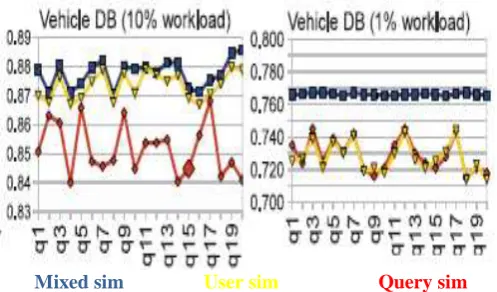
Mixed sim User sim Query sim
Fig 4: Ranking quality of a combined similarity model.
IV CONCLUSION
In this paper, we projected a user and query reliant solution for ranking query results for Web databases. We
appropriately distinct the likeness models such as user, query and combined and accessible untried
consequences over two Web databases to confirm our analysis. We confirmed the expediency of our conclusion
for real-life databases. Further, we discuss the problem of establish a workload, and presented a learning method
for inferring individual ranking functions. And we have proposed an advance search option for the various
users using this application to get the result in very less time. Apart from this we have also shown the
implementation of user search and query search also shown the feasibility report between them. Moreover we
have used the multiple web databases in this implementation to show the results gathered from different
databases depending on the user requirement. We demonstrated the practicality of our implementation for
real-life databases. Further, we discussed the problem of establishing a workload, and presented a learning method
for inferring individual ranking functions. In this paper apart from the user and query search we have also
57 |
P a g e
REFERENCES
[1]S. Agrawal, S. Chaudhuri, G. Das, and A. Gionis. Automated ranking of database query results. In CIDR,
2003.
[2]C. Basu, H. Hirsh, and W.W. Cohen, “Recommendation as Classification: Using Social and Content-Based
Information in Recommendation”.
[3]R. Baeza-Yates and B. Ribeiro-Neto. Modern Information Retrieval. ACM Press, 1999.
[4]M.K. Bergman, “The Deep Web: Surfacing Hidden Value,” J. Electronic Publishing.
[5]S. Chaudhuri, G. Das, V. Hristidis, and G. Weikum, “Probabilistic Ranking of Database Query Results,”
[6]Z. Xu, X. Luo, and W. Lu, “Association Link Network: An Incremental Semantic Data Model on Organizing
Web Resources,”
[7]L. Wu et al., “Falcon: Feedback Adaptive Loop for Content-Based Retrieval,”
[8]Telang, S. Chakravarthy, and C. Li, “Establishing a Workload for Ranking in Web Databases,” technical
report, UT Arlington, http://cse.uta.edu/research/Publications/Downloads/CSE- 2010-3.pdf, 2010
AUTHOR PROFILE
K. Gopichand reddy is currently pursuing M.Tech in the
Department of Computer Science, from Nalanda Institute of
Engineering & Technology (NIET), siddharth Nagar, Kantepudi(V), Sattenapalli (M), Guntur (D), Andhra Pradesh , Affiliated to JNTU-KAKINADA.
J Armstrong Paulson working as Associate Professor at