Round-reduced GIFT
?Baoyu Zhu1, Xiaoyang Dong2, and Hongbo Yu1,3
1
Department of Computer Science and Technology, Tsinghua University, Beijing, P. R. China
{xiaoyangdong,yuhongbo}@tsinghua.edu.cn
2 Institute for Advanced Study, Tsinghua University, P. R. China 3
Science and Technology on Communication Security Laboratory, Chengdu, P.R. China
Abstract. At Asiacrypt 2014, Sun et al. proposed a MILP model [20] to search for differential characteristics of bit-oriented block ciphers. In this paper, we improve this model to search for differential characteristics of GIFT [2], a new lightweight block cipher proposed at CHES 2017. GIFT has two versions, namely GIFT-64 and GIFT-128. For GIFT-64, we find the best 12-round differential characteristic and a number of iterative 4-round differential characteristics with our MILP-based model. We give a key-recovery attack on 19-round GIFT-64. For GIFT-128, we find a 18-round differential characteristic and give the first attack on 22-round GIFT-128.
Keywords: GIFT, Differential Cryptanalysis, Lightweight Block Ci-pher, MILP
1
Introduction
In recent years, research on lightweight block ciphers has received a lot of at-tentions. Lightweight block ciphers are widely used in Internet of things and wireless communication because their structures are simple and they can be run in low-power environment. Many lightweight block ciphers such as PRESENT [5], CLEFIA [17], LED [10], PRINCE [6], SIMON and SPECK [3] have been pub-lished in last decades. GIFT [2] is a new lightweight block cipher proposed by Banik et al. at CHES 2017, which is designed to celebrate 10 years of PRESENT. GIFT has an SPN structure which is similar to PRESENT. It has two versions, namely GIFT-64 and GIFT-128, whose block sizes are 64 and 128, and the round numbers are 28 and 40 respectively.
Many classical cryptanalysis methods could be converted to mathematical optimization problems which aims to achieve the minimal or maximal value of
?This paper is a corrected version of CT-RSA 2019. We would like to thank Siang
an objective function under certain constraints. Mixed-integer Linear Program-ming (MILP) is the most widely studied technique to solve these optimization problems. One of the most successful applications of MILP is to search for d-ifferential and linear trails. Mouha et al. first applied MILP method to count active S-boxes of word-based block ciphers [12]. Then, at Asiacrypt 2014, Sun et al. extended this technique to search for differential and linear trails [20], whose main idea is to derive some linear inequalities through the H-Representation of the convex hull of all differential patterns and linear bias of S-box. Xiang et al. [21] introduced a MILP model to search for integral distinguisher, Sasaki et al. [16] and Cui et al. [7] gave the MILP-based impossible differential search mod-el independently. There are many MILP-based tools proposed already, such as MILP-based differential/linear search model for ARX ciphers [8], MILP-based conditional cube attacks [11] on Keccak [4], etc.
Our Contributions
The designers of GIFT provided many analysis result about GIFT in [2]. They use MILP to compute the lower bounds for the number of active S-boxes in differential cryptanalysis firstly. Then they presented round-reduced differential probabilities. For GIFT-64, they provided a 9-round differential characteristic with probability of 2−44.415 and they expected that the differential probability of 13-round GIFT-64 will be lower than 2−63. For GIFT-128, they provided a 9-round differential probability of 2−47 and they expected that the differential probability of 26-round GIFT-128 will be lower than 2−127. The designers did not present actual attack on GIFT in [2].
In this paper, we generalize an efficient two-stage MILP-based model inspired by Sun et al.’s two-stage model [18]. Our model includes two interactive sub-models, denoted as outer-MILP and inner-MILP part. The outer-MILP part obtains the minimal active S-boxes, namely, the truncated differential. Then the inner-MILP part produces the differential characteristic with maximal prob-ability, the differential characteristic should match the truncated differential. With our two-stage model, we find some 12-round differential characteristics of GIFT-64, some of the differential characteristics are iterative. Moreover, using a 12-round differential characteristic with probability of 2−60, we give an attack on 19-round reduced GIFT-64 (out of 28 full rounds) with time complexity 2112, memory complexity 280 and data complexity 263.
attack on 22-round4 GIFT-128 (out of 40 full rounds) with the 18-round dif-ferential characteristic. All of the source code is uploaded to GitHub (https: //github.com/zhuby12/MILP-basedModel).
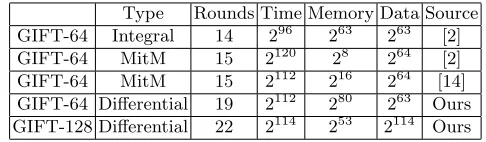
The summary of differential analysis of GIFT is shown in Table 1.
Table 1.Summary of cryptography analysis on GIFT
Type Rounds Time Memory Data Source GIFT-64 Integral 14 296 263 263 [2]
GIFT-64 MitM 15 2120 28 264 [2]
GIFT-64 MitM 15 2112 216 264 [14]
GIFT-64 Differential 19 2112 280 263 Ours
GIFT-128 Differential 22 2114 253 2114 Ours
2
Preliminaries
2.1 Description of GIFT
GIFT has an SPN structure which is similar to PRESENT. It has two versions, namely GIFT-64 and GIFT-128, whose block sizes are 64 and 128 and round numbers are 28 and 40 respectively. Both versions have a key length of 128 bits. Each round of GIFT consists of three steps: SubCells, PermBits and Ad-dRoundKey. The round function of GIFT-64 is shown in Figure 1. Similarly, GIFT-128 adopts thirty-two 4-bit S-boxes for each round.
SubCells Both versions of GIFT use the same invertible 4-bit S-box, which is the only nonlinear component of the algorithm. The action of this S-box in hexadecimal notation is given in Table 2.
Table 2.Sbox of GIFT
x 0 1 2 3 4 5 6 7 8 9 a b c d e f GS(x) 1 a 4 c 6 f 3 9 2 d b 7 5 0 8 e
PermBits The bit permutation used in GIFT-64 and GIFT-128 are given in Table 3.
4 The attack on 23-round GIFT-128 in our original paper at CT-RSA 2019 [22] is
4 B. Zhu et al.
In this work, we propose two versions ofGIFT,GIFT-64-128is a 28-round SPN cipher and GIFT-128-128is a 40-round SPN cipher, both versions have a key length of 128-bit. For short, we call them GIFT-64andGIFT-128respectively.
GIFTcan be perceived in three different representations. In this paper, we adopt the classical 1D representation, describing the bits in a row like PRESENT. It can also be described in bitslice 2D, a rectangular array like RECTANGLE[48] (see AppendixA), and even in 3D cuboid like3D[34] (see AppendixB).
Round function. Each round ofGIFTconsists of 3 steps: SubCells, PermBits, and AddRoundKey, which is conceptually similar to wrapping a gift:
1. Put the content into a box (SubCells); 2. Wrap the ribbon around the box (PermBits); 3. Tie a knot to secure the content (AddRoundKey).
Figure1 illustrates 2 rounds ofGIFT-64.
0 1 2 3 4 5 6 7 8 9 10 11 12 13 14 15 16 17 18 19 20 21 22 23 24 25 26 27 28 29 30 31 32 33 34 35 36 37 38 39 40 41 42 43 44 45 46 47 48 49 50 51 52 53 54 55 56 57 58 59 60 61 62 63 GS GS GS GS GS GS GS GS GS GS GS GS GS GS GS GS GS GS GS GS GS GS GS GS GS GS GS GS GS GS GS GS RKi
RKi+1
Fig. 1.2 Rounds ofGIFT-64.
Initialization.The cipher receives ann-bit plaintextbn−1bn−2...b0as the cipher stateS, wheren= 64,128 andb0 being the least significant bit. The cipher state can also be expressed assmany 4-bit nibbles S=ws−1||ws−2||...||w0, wheres= 16,32. The cipher also receives a 128-bit keyK=k7||k6||...||k0as the key state, whereki is a 16-bit word.
SubCells.Both versions ofGIFT use the same invertible 4-bit Sbox,GS. The Sbox is applied to every nibble of the cipher state.
wi←GS(wi), ∀i∈ {0, ..., s−1}.
The action of this Sbox in hexadecimal notation is given in Table3.
7
Fig. 1.Two rounds of GIFT-64
Table 3.Specifications of GIFT Bit Permutation
GIFT-64
i 0 1 2 3 4 5 6 7 8 9 10 11 12 13 14 15
P64(i) 0 17 34 51 48 1 18 35 32 49 2 19 16 33 50 3 i 16 17 18 19 20 21 22 23 24 25 26 27 28 29 30 31
P64(i) 4 21 38 55 52 5 22 39 36 53 6 23 20 37 54 7 i 32 33 34 35 36 37 38 39 40 41 42 43 44 45 46 47
P64(i) 8 25 42 59 56 9 26 43 40 57 10 27 24 41 58 11 i 48 49 50 51 52 53 54 55 56 57 58 59 60 61 62 63
P64(i) 12 29 46 63 60 13 30 47 44 61 14 31 28 45 62 15
GIFT-128
i 0 1 2 3 4 5 6 7 8 9 10 11 12 13 14 15
P128(i) 0 33 66 99 96 1 34 67 64 97 2 35 32 65 98 3 i 16 17 18 19 20 21 22 23 24 25 26 27 28 29 30 31
P128(i) 4 37 70 103 100 5 38 71 68 101 6 39 36 69 102 7 i 32 33 34 35 36 37 38 39 40 41 42 43 44 45 46 47
P128(i) 8 41 74 107 104 9 42 75 72 105 10 43 40 73 106 11 i 48 49 50 51 52 53 54 55 56 57 58 59 60 61 62 63
P128(i) 12 45 78 111 108 13 46 79 76 109 14 47 44 77 110 15 i 64 65 66 67 68 69 70 71 72 73 74 75 76 77 78 79
P128(i) 16 49 82 115 112 17 50 83 80 113 18 51 48 81 114 19 i 80 81 82 83 84 85 86 87 88 89 90 91 92 93 94 95
P128(i) 20 53 86 119 116 21 54 87 84 117 22 55 52 85 118 23 i 96 97 98 99 100 101 102 103 104 105 106 107 108 109 110 111
P128(i) 24 57 90 123 120 25 58 91 88 121 26 59 56 89 122 27 i 112 113 114 115 116 117 118 119 120 121 122 123 124 125 126 127
AddRoundKey The round keyRK is extracted from the key state. A round key isfirst extracted from the key state before the key state update.
For GIFT-64, two 16-bit words of the key state are extracted as the round key
RK =U||V. U and V are XORed tob4i+1andb4iof the cipher state respectively.
bi represents thei-thbit of the cipher state. ui andvi represent thei-thbit of
U and V.
U ←k1, V ←k0
b4i+1←b4i+1⊕ui, b4i←b4i⊕vi,∀i∈ {0,· · · ,15}
For GIFT-128, four 16-bit words of the key state are extracted as the round key RK = U||V. U and V are XORed to b4i+2 and b4i+1 of the cipher state respectively.
U ←k5||k4, V ←k1||k0
b4i+2←b4i+2⊕ui, b4i+1←b4i+1⊕vi,∀i∈ {0,· · · ,31}
The key state for two versions are updated as follows,
k7||k6|| · · · ||k1||k0←k1≫2||k0≫12|| · · · ||k3||k2
Round Constants For both versions of GIFT, a single bit ”1” and a 6-bit constantC={c5, c4, c3, c2, c1, c0}are XORed into the cipher state at bit position
n-1,23,19,15,11,7,3 respectively in each round. For GIFT-64,n-1 is 63 and for GIFT-128, n-1 is 127. {c5, c4, c3, c2, c1, c0} are initialized to ”0”, and they are updated as follow:
(c5, c4, c3, c2, c1, c0)←(c4, c3, c2, c1, c0, c5⊕c4⊕1)
2.2 Notations
Kij Thej-thbit of thei-thround key
∆P The differential in the plaintext
∆Xi
S The differential in the output of thei-thround’s Sbox
∆Xi
P The differential in the output of thei-thround’s Permutation
∆Xi
K The differential in the output of thei-thround’s AddKey
∆Xi
S,P,K ∆XSi or∆XPi or∆XKi
∆Xi
S,P,K{m} Them-thbit of∆XS,P,Ki
∆Xi
S,P,K{ml-mt} The (mt-ml+1) bits totally from theml-thbit to themt-thbit
of∆Xi S,P,K
3
Related Works
3.1 Mouha et al.’s Framework for Word-Oriented Block Ciphers
Definition 1. Consider a differential characteristic state∆consisting ofnbytes
∆= (∆0, ∆1, . . . , ∆n−1). Then, the difference vectorx= (x0, x1, . . . , xn−1)
cor-responding to∆ is defined as
xi=
0 if ∆i= 0,
1 otherwise. (1)
Based on Definition 1, Mouha et al. translated the XOR operation and the linear transformation to linear inequalities as follows:
– Equations describing the XOR operation:Suppose the input difference vector for the XOR operation be (x⊕in1, x⊕in2) and the corresponding output difference vector bex⊕out. The following constraints will make sure that when
x⊕in1, x⊕in2 andx⊕out are not all zero, then there are at least two of them are
nonzero:
x⊕in1+x⊕in2+x⊕out ≥2d⊕
d⊕ ≥x⊕in1, d⊕≥x⊕in2, d⊕≥x⊕out
(2)
whered⊕ is a dummy variable taking values in{0,1}.
– Equations describing the linear transformation:Assume linear trans-formationLtransforms the input difference vector (xL
1, xL2, . . . , xLm−1) to the output difference vector (yL
1, yL2, . . . , yLm−1). Given the differential branch numberBD. The following constraints can describe the relation between the input and output difference vectors, they should be subject to:
Pm−1
i xLi +
Pm−1
i yiL≥ BDdL
dL≥xLi, dL≥yiL, i∈ {0, ..., m−1}
(3)
wheredLis a dummy variable taking values in {0,1}.
3.2 Sun et al.’s Framework for Bit-Oriented Block Ciphers
At Asiacrypt 2014, Sun et al. [20] extended Mouha et al.’s framework [12] to bit-oriented ciphers. For bit-bit-oriented ciphers, Mouha et al.’s descriptions of XOR operation and linear transformation are also suitable.
Definition 2. Consider a differential characteristic state∆ consisting of n bit-s ∆ = (∆0, ∆1, . . . , ∆n−1). Then, the difference vector x = (x0, x1, . . . , xn−1)
corresponding to∆ is defined as
xi=
0 if ∆i= 0,
1 if ∆i= 1. (4)
Based on Definition 2, Sun et al. translated the S-box operation to linear in-equalities as follow:
S-box is active or not.A= 1 holds if and only ifx0, x1, . . . , xw−1are not all zero. The following constraints should be obeyed:
A
−xi≥0, i∈ {0, . . . , w−1}
Pw−1
i xi−A≥0
(5)
3.3 Valid Cutting-off Inequalities from the Convex Hull of S-box
The convex hull of a set Qof discrete points inRn is the smallest convex that
containsQ. A convex hull inRn can be described as the common solutions of a
set of finitely many linear equalities and inequalities.
Supposep= (x, y) = (x0, . . . , xw−1, y0, . . . , yv−1) is a differential pattern of a w×v S-box, in which xis the input differential vector and y is the output differential vector. If we treat a differential pattern of aw×vS-box as a discrete point in Rw+v, then we can get a set of finitely discrete points which includes
all possible differential patterns of the S-box. We can describe this definite set with the following inequalities:
α0,0x0+. . .+α0,w−1xw−1+β0,0y0+. . .+β0,v−1yv−1+γ0≥0
. . .
αn,0x0+. . .+αn,w−1xw−1+βn,0y0+. . .+βn,v−1yv−1+γn≥0
(6)
This is called the H-Representation of a w×v S-box, in which α and β are constant. With the help of SageMath [1], hundreds of linear inequalities can be derived by the differential distribution table of a S-box. But the inequalities is redundant in general, for example, the number of inequalities of GIFT S-box given by SageMath is 237. Because the efficiency of the MILP optimizer is reduced radically when the amount of linear inequalities increase, adding all of the inequalities to the MILP model will make the model insolvable in practical time.
4
MILP-based Model to Search Differential
Characteristic For GIFT-64
4.1 MILP-based two-stage algorithm to search for differential
characteristic
Two-stage search strategy to find differential characteristics of block ciphers is used in [9,13,18]. In the first step, truncated differential characteristics with minimal active S-box will be found. Then, concrete differential characteristics matching the truncated differential characteristic can be found in a subroutine algorithm. In previous works, one first chose a prespecified threshold of the number of active S-box. However, it is possible that the characteristic with the highest probability do not have the minimal number of active S-box. In this section, we propose Algorithm 1 to search for the best or better differential characteristic.
Algorithm 1MILP-based differential characteristic searching algorithm Require: r-round block cipher; valid cutting-off inequalities from the convex hull of
the S-box;M r is the minimal number of active S-boxes in all of ther-round dif-ferential characteristics.
Ensure: The highest probability; differential characteristics with high probability. 1: DefineM P r= 2−64as the initial differential probability of GIFT-64.
2: In the Outer-MILP part, construct a modelM1describing the differential behavior
of the cipher. The target value ofM1is a truncated differential characteristic, which
active S-boxes number is minimum in current solution space. DefineM rbound=M r as the lower bound of the number of active S-box inM1.
3: Solve the modelM1 using an MILP optimizer.
4: if A feasible solutionT Dis found inM1, save it to a file.then
5: ♦begin of Inner-MILP part
6: Construct a MILP modelM2 describing the differential behavior of the cipher
and add the truncated differential characteristic T D as a constraint to M2.
The objective function of M2 is the differential characteristic with maximal
probability.
7: Solve the model using an MILP optimizer. If a feasible solutionxis found, save
xand its probabilityP rto the file. IfP r > M P r, setM P requal toP r. 8: ♦end of Inner-MILP part
9: end if
10: Remove the truncated differentialT Dfrom the feasible region ofM1.
11: SolveM1 again. If a new solution T Dis found and its active S-boxes number is
equal toM r, save it and go to step 5. Else go to step 12.
12: If the number of active S-boxes of is more than M r and less than M r+ 3, set
M rboundequal toM rbound+ 1, go to step 5. If a new solutionT Dis not found or the number of active S-boxes ofT Dis greater than or equal to M r+ 3, return M P rand the collection of solutionx.
sub-models, denoted as outer-MILP part and inner-MILP part. The two stages are interactive. In the outer-MILP part, the objective function is the minimal active S-boxes. When a solution is found in the outer-MILP part, the truncated differential that contains the information of the positions of active S-boxes will input the inner-MILP part as constraints. In the inner-MILP part, it produces the differential characteristic with maximal probability that matches the trun-cated differential. Then the algorithm goes to the outer-MILP part with the truncated differential removed from its feasible region.
In addition, the maximal probability of the derived differential characteristic is also used to reduce the feasible region of the outer-MILP part dynamically. In details, if a differential characteristic with larger probability could be found in the next loops, the number of active S-boxes produced in outer-MILP part must be lower than a certain bound. The bound is dynamically computed by the current maximal probability. When the outer-MILP part is infeasible, the algorithm returned.
We apply Algorithm 1 to search for differential characteristics for GIFT-64, and get some interesting results.
4.2 Search for Differentials of GIFT-64
Algorithm 1 needs two convex hulls about the S-box in the outer-MILP part and the inner-MILP part respectively. First, we compute the H-representation of convex hull of differential patterns of S-box in Appendix A. Using SageMath, 237 inequalities are produced in the H-Representation of the convex hull of GIFT S-box, then after selecting inequalities by the method introduced in [15], we get 21 inequalities. Second, we study the convex hull of differential patterns with probabilities of the S-box. Sun et al. introduced the differential distribution probability of S-box to MILP-model in [19]. Since, for GIFT S-box, there are 4 possible probabilities, i.e. 1, 2−1.415, 2−2, 2−3, we need three extra bits (p
0, p1, p2) to encode the differential patterns with probability. The new differential pattern is (x0, x1, x2, x3, y0, y1, y2, y3;p0, p1, p2)∈F8+32 which satisfies Equation 7.
(p0, p1, p2) = (0,0,0),if Prs[(x0, x1, x2, x3)→(y0, y1, y2, y3)] = 1 = 2−0 (p0, p1, p2) = (0,0,1),if Prs[(x0, x1, x2, x3)→(y0, y1, y2, y3)] = 6/16 = 2−1.415 (p0, p1, p2) = (0,1,0),if Prs[(x0, x1, x2, x3)→(y0, y1, y2, y3)] = 4/16 = 2−2 (p0, p1, p2) = (1,0,0),if Prs[(x0, x1, x2, x3)→(y0, y1, y2, y3)] = 2/16 = 2−3
(7) Then the objective function is changed to minimize P
(3×p0+ 2×p1+ 1.415×p2).
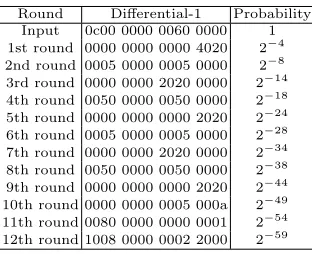
differential characteristic with highest probability is shown in Table 4. Meanwhile we get dozens of differential characteristics with probability 2−60.
Table 4.12-round Differential Characteristic with Probability 2−59
Round Differential-1 Probability Input 0c00 0000 0060 0000 1 1st round 0000 0000 0000 4020 2−4
2nd round 0005 0000 0005 0000 2−8
3rd round 0000 0000 2020 0000 2−14
4th round 0050 0000 0050 0000 2−18
5th round 0000 0000 0000 2020 2−24
6th round 0005 0000 0005 0000 2−28
7th round 0000 0000 2020 0000 2−34
8th round 0050 0000 0050 0000 2−38
9th round 0000 0000 0000 2020 2−44
10th round 0000 0000 0005 000a 2−49
11th round 0080 0000 0000 0001 2−54
12th round 1008 0000 0002 2000 2−59
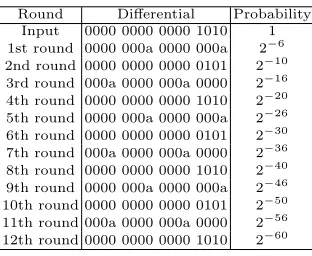
We observe that some of 12-round characteristics are iterative. As a result, we get eight 4-round differential characteristics with probability 2−20 totally. These 4-round characteristics are iterative, namely, their input states are identical to their output states. One of them is shown in Table 5, and these characteristics can be extended to more rounds. So we get one of 12-round differential characteristics cycled by three 4-round differential characteristics with probability 2−60in Table 6. A 13-round characteristic with probability 2−64 can also be generated by adding another round at the beginning of 12-round differential characteristic. Note that the designers of GIFT claimed that the differential probability of 13-round GIFT-64 will be lower than 2−63. Our result does not violate the claim, however the gap is very small.
Table 5.4-round Differential Characteristic with Probability 2−20
Round Differential-1 Probability Input 0000 0000 0000 1010 1 1st round 0000 000a 0000 000a 2−6
2nd round 0000 0000 0000 0101 2−10
3rd round 000a 0000 000a 0000 2−16
4th round 0000 0000 0000 1010 2−20
4.3 Attack on 19-round GIFT-64
Table 6.12-round Differential Characteristic with Probability 2−60
Round Differential Probability Input 0000 0000 0000 1010 1 1st round 0000 000a 0000 000a 2−6
2nd round 0000 0000 0000 0101 2−10
3rd round 000a 0000 000a 0000 2−16
4th round 0000 0000 0000 1010 2−20
5th round 0000 000a 0000 000a 2−26
6th round 0000 0000 0000 0101 2−30
7th round 000a 0000 000a 0000 2−36
8th round 0000 0000 0000 1010 2−40
9th round 0000 000a 0000 000a 2−46
10th round 0000 0000 0000 0101 2−50
11th round 000a 0000 000a 0000 2−56
12th round 0000 0000 0000 1010 2−60
four rounds at the end of the differential characteristic. Therefore, we can attack 19-round GIFT-64. According to the key schedule, the round key used in
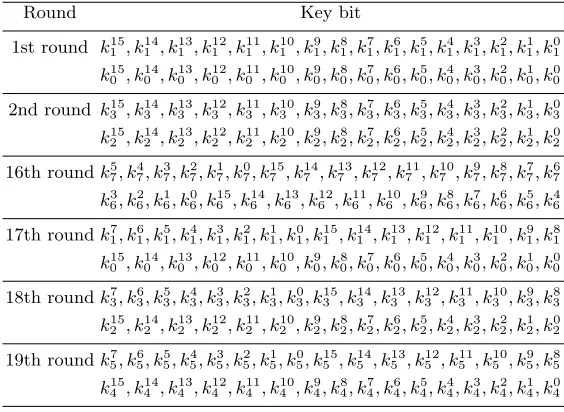
1-st, 2-nd, 16-th, 17-th, 18-th and 19-th round corresponds to (k1, k0), (k3, k2), (k7≫6, k6 ≫4), (k1 ≫8, k0), (k3 ≫8, k2) and (k5 ≫8, k4) in initial key state (k7, k6, k5, k4, k3, k2, k1, k0), respectively.
Table 7.19-round Differential Attack on GIFT-64
∆P ???? ???? ???? ???? ???? ???? ???? ???? ???? ???? ???? ???? ???? ???? ???? ????
∆X1
S ?000 0?00 00?0 000? ?000 0?00 00?0 000? ?000 0?00 00?0 000? ?000 0?00 00?0 000? ∆X1
P 0000 0000 0000 0000 0000 0000 0000 0000 0000 0000 0000 0000 ???? ???? ???? ???? ∆X1
K 0000 0000 0000 0000 0000 0000 0000 0000 0000 0000 0000 0000 ???? ???? ???? ???? ∆X2
S 0000 0000 0000 0000 0000 0000 0000 0000 0000 0000 0000 0000 0?0? 10?0 0?0? 10?0 ∆X2
P 0000 0000 0000 1??? 0000 0000 0000 0000 0000 0000 0000 1??? 0000 0000 0000 0000 ∆X2
K 0000 0000 0000 1??? 0000 0000 0000 0000 0000 0000 0000 1??? 0000 0000 0000 0000 ∆X3
S 0000 0000 0000 0001 0000 0000 0000 0000 0000 0000 0000 0001 0000 0000 0000 0000 ∆X3
P 0000 0000 0000 0000 0000 0000 0000 0000 0000 0000 0000 0000 0001 0000 0001 0000 ∆X3
K 0000 0000 0000 0000 0000 0000 0000 0000 0000 0000 0000 0000 0001 0000 0001 0000
4th round input 0000 0000 0000 0000 0000 0000 0000 0000 0000 0000 0000 0000 0001 0000 0001 0000 .
. .
. . .
15th round output 0000 0000 0000 0000 0000 0000 0000 0000 0000 0000 0000 0000 0001 0000 0001 0000
∆X16
S 0000 0000 0000 0000 0000 0000 0000 0000 0000 0000 0000 0000 ???? 0000 ???? 0000 ∆X16
P 0000 0000 0000 0?0? 0000 0000 0000 ?0?0 0000 0000 0000 0?0? 0000 0000 0000 ?0?0 ∆X16
K 0000 0000 0000 0?0? 0000 0000 0000 ?0?0 0000 0000 0000 0?0? 0000 0000 0000 ?0?0 ∆X17
S 0000 0000 0000 ???? 0000 0000 0000 ???? 0000 0000 0000 ???? 0000 0000 0000 ???? ∆X17
P ?000 ?000 ?000 ?000 0?00 0?00 0?00 0?00 00?0 00?0 00?0 00?0 000? 000? 000? 000? ∆X17
K ?000 ?000 ?000 ?000 0?00 0?00 0?00 0?00 00?0 00?0 00?0 00?0 000? 000? 000? 000? ∆X18
S ???? ???? ???? ???? ???? ???? ???? ???? ???? ???? ???? ???? ???? ???? ???? ???? ∆X18
P ???? ???? ???? ???? ???? ???? ???? ???? ???? ???? ???? ???? ???? ???? ???? ???? ∆X18
K ???? ???? ???? ???? ???? ???? ???? ???? ???? ???? ???? ???? ???? ???? ???? ???? ∆X19
S ???? ???? ???? ???? ???? ???? ???? ???? ???? ???? ???? ???? ???? ???? ???? ???? ∆X19
P ???? ???? ???? ???? ???? ???? ???? ???? ???? ???? ???? ???? ???? ???? ???? ???? ∆X19
K ???? ???? ???? ???? ???? ???? ???? ???? ???? ???? ???? ???? ???? ???? ???? ????
Data collection
Since GIFT-64 does not have whitening key layer at the beginning, after the
traverses the sixteen bits undetermined in ∆X1
P, i.e. the bit labeled by ”?” in
∆X1
Pof Table 7, thus it can generate 216×2−1= 231pairs obeying the differential.
Therefore, 2n structures can generate 2n
×231= 2n+31pairs.
For such a pair, it has an average probability of 2−16to meet the differential in 4-thround in Table 7. Then, the pair encrypted with the right key will obey the differential after 15th round with probability of 2−60. While the pair with a wrong key will obey it with a random probability of 2−64. Therefore, with the right key guess, 2n+31
×2−16
×2−60= 2n−45pairs will obey the differential after 15th round. Here we choosen= 47. So the data complexity is 247
×216= 263.
Round Key bit
1st round k115, k141 , k131 , k112, k111 , k110, k91, k18, k71, k61, k51, k14, k31, k21, k11, k10
k015, k140 , k130 , k012, k110 , k010, k90, k80, k70, k60, k50, k40, k30, k20, k10, k00
2nd round k315, k143 , k133 , k312, k113 , k310, k93, k38, k73, k63, k53, k34, k33, k23, k13, k30
k215, k142 , k132 , k212, k112 , k210, k92, k82, k72, k62, k52, k42, k32, k22, k12, k20
16th roundk75, k74, k37, k27, k17, k07, k157 , k714, k137 , k712, k117 , k710, k97, k87, k77, k76 k3
6, k62, k16, k06, k156 , k614, k136 , k612, k116 , k610, k96, k86, k76, k66, k56, k64
17th roundk7
1, k16, k51, k41, k31, k21, k11, k01, k151 , k114, k131 , k112, k111 , k101 , k91, k18
k15
0 , k140 , k130 , k012, k110 , k010, k90, k80, k70, k60, k50, k40, k30, k20, k10, k00
18th roundk7
3, k36, k53, k43, k33, k23, k13, k03, k153 , k314, k133 , k312, k113 , k103 , k93, k38
k15
2 , k142 , k132 , k212, k112 , k210, k92, k82, k72, k62, k52, k42, k32, k22, k12, k20
19th roundk7
5, k56, k55, k45, k35, k25, k15, k05, k155 , k514, k135 , k512, k115 , k105 , k95, k58
k15
4 , k144 , k134 , k412, k114 , k410, k94, k84, k74, k64, k54, k44, k34, k24, k14, k40
Table 8.Round Keys of GIFT-64
Key recovery
When processing the key recovery, the guessing key bits include:k3
1, k12, k11,
k0
1, k03, k20, k10, k00 in 1st round, k312, k212, k43, k42 in 2nd round; k76, k68, k714, k06 in 16th round,k15
1 ,k114, k131 ,k121 ,k03, k20,k01, k00 in 17th round, as well as all 64 key bits in 18th, 19th round. Totally, we construct 280 counters for the possible values of the 80 key bits above.
For each of the 247+31 = 278 pairs, we repeat the following key guessing phase. The whole attack procedure is a guess and filter approach. Guess two key bits k01, k00, then we can partially encrypt the plaintexts. As the middle values of right pairs should obey ∆X2
S{0}= 0, ∆XS{2 2}= 0, ∆XS{2 3}= 1, the
(plaintext, ciphertext) pairs can be filtered with a probability of 2−3. Similarly, guessing ki
1, k0i, i = 1,2,3 and partially encrypt, corresponding conditions in
∆X2
S{5,7},∆XS{2 8,10,11},∆XS{2 13,15}can filter the pairs with 2−2, 2−3 and
Similarly, the encryption at 2-nd, 16-th, 17-th, 18-th round can filter the pairs with probability 2−6, 2−8, 2−8, 2−48 while all 32 key bits in 19th round need to be guessed. Thus, 2−2 pairs will be left for a random key, while 4 pairs should be left for a right key.
The time complexity is 22
×231+47
×232= 2112, the data complexity is 263 and the memory complexity is 280.
5
Improved MILP-based Method to Find Differential for
GIFT-128
GIFT-128 adopts 128 bits state and has thirty-two 4-bit S-boxes in each round. The variables and constrains are twice as many as GIFT-64. The designers of GIFT [2] gives 9-round differential characteristics of GIFT-128. We test Algo-rithm 1 on 9-round GIFT-128 and obtain the designers’ conclusion. But it costs days to solve. In this section, we devise a segmented MILP-based method to search for longer differential characteristics for GIFT-128.
Suppose we aim to find a r-round differential characteristic for a block ci-pher. We first divide it as ri-round (i = 1,2, ..., t) sub-ciphers and Pt1ri = r.
We choose probability thresholds for r1-round,r2-round,...,rt-round ciphers as
Pr1, Pr2, ..., Prt, so that the probability pri for ri-round sub-cipher should be
larger than Pri. Choose a threshold value Ptarget forr-round. Ifpr1pr2. . . prt is
larger thanPtarget, an acceptable solution is found.
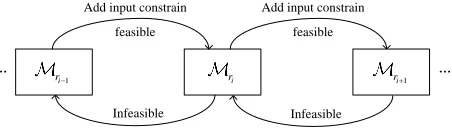
As shown in Figure 2, forri-round sub-cipher, the input state are fixed as
the output state of the differential characteristicDi−1 ofri−1-round sub-cipher, and construct the MILP modelMri. IfMri is feasible, we continue to construct Mri+1 forri+1-round sub-cipher; else, we remove Di−1 from Mri−1, and solve
it again. The search terminates until we find the differential characteristics of
r1-round,r2-round,...,rt-round sub-ciphers that could be connected to produce a
r-round differential characteristic.
Infeasible
i
r
feasible
1
i
r ri1
Add input constrain
feasible Add input constrain
Infeasible
… …
Fig. 2.The framework of our search algorithm
chooseri <6.Pri is chosen more flexible. According to the designers’ analysis in
[2], for 3/4/5-round GIFT-128, the numbers of minimum active S-boxes are 3, 5, and 7, respectively. The length of the sub-cipher can neither be too short nor be too long. If the number of rounds is smaller than 2, this sub-MILP-model is unnecessary to solve. On the other hand, if the number of rounds is bigger than 6 or 7, it costs too much time to solve the sub-model that we cannot bear. We do not want the probability ofri-round differential characteristic of GIFT-128 to be
much smaller than the highest one. SoPriare chosen according to the minimum
active S-boxes of ri-round GIFT-128. In this section, we choosePri=3 = 2−
30,
Pri=4 = 2
−40 and P
ri=5 = 2
−50 to act as the exact lower bound of differential
probability of each sub-model.
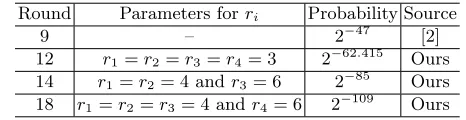
We use this model and the strategies above choosing parameters to search for differential characteristics for GIFT-128. We list some results in Table 9. The 12-round and 14-round differential characteristics are shown in Appendix C.
Table 9.Probabilities of Some Differential Characteristics of GIFT-128
Round Parameters forri Probability Source
9 – 2−47 [2]
12 r1=r2 =r3=r4= 3 2−62.415 Ours
14 r1=r2= 4 andr3= 6 2−85 Ours
18 r1=r2=r3= 4 andr4 = 6 2−109 Ours
The 18-round characteristic, shown in Table 10 is constructed by the con-nection of the following three 4-round differential characteristics and a 6-round differential characteristic:
Table 10.18-round Differential Characteristic of GIFT-128
Round Input Difference Probability
Input 0000 0000 7060 0000 0000 0000 0000 0000 1 1st 0000 0000 0000 0000 0000 0000 00a0 0000 2−5
2nd 0000 0010 0000 0000 0000 0000 0000 0000 2−7
3rd 0000 0000 0800 0000 0000 0000 0000 0000 2−10
4th 0020 0000 0010 0000 0000 0000 0000 0000 2−12
5th 0000 0000 0000 0000 4040 0000 2020 0000 2−17
6th 0000 5050 0000 0000 0000 5050 0000 0000 2−25
7th 0000 0000 0000 0000 0000 0000 0a00 0a00 2−37
8th 0000 0000 0000 0011 0000 0000 0000 0000 2−41
9th 0008 0000 0008 0000 0000 0000 0000 0000 2−47
10th 0000 0000 0000 0000 2020 0000 1010 0000 2−51
11th 0000 5050 0000 0000 0000 5050 0000 0000 2−61
12th 0000 0000 0a00 0a00 0000 0000 0000 0000 2−73
13th 0000 0000 0011 0000 0000 0000 0000 0000 2−77
14th 0090 0000 00c0 0000 0000 0000 0000 0000 2−83
15th 1000 0000 0080 0000 0000 0000 0000 0000 2−89
16th 0010 0000 0000 0000 0000 0000 8020 0000 2−94
17th 0000 0000 8000 0020 0000 0050 0000 0020 2−101
(0000 0000 7060 0000 0000 0000 0000 0000)−−−−−−−−−−−→4−round,2−12 (0020 0000 0010 0000 0000 0000 0000 0000)
(0020 0000 0010 0000 0000 0000 0000 0000) 4−round,2 −29
−−−−−−−−−−−→(0000 0000 0000 0011 0000 0000 0000 0000) (0000 0000 0000 0011 0000 0000 0000 0000)−−−−−−−−−−−→4−round,2−32 (0000 0000 0a00 0a00 0000 0000 0000 0000)
(0000 0000 0a00 0a00 0000 0000 0000 0000)−−−−−−−−−−−→6−round,2−36 (0000 0100 0020 0800 0014 0404 0002 0202)
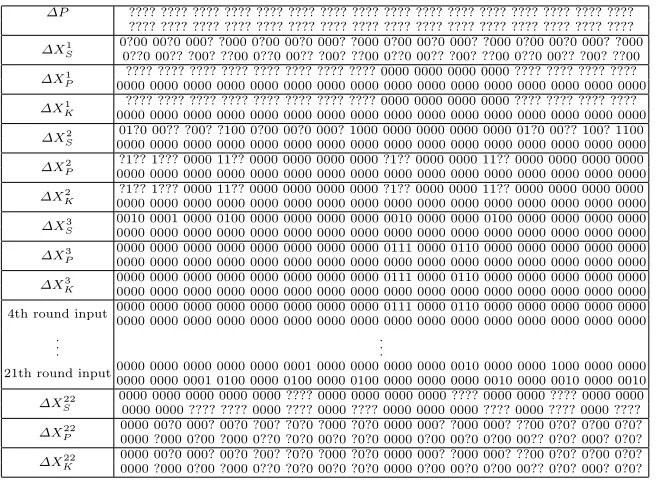
With the 18-round differential characteristic, we can add three rounds at its beginning and one round at the end to attack 22-round reduced GIFT-128. The attack procedure is similar to subsection 4.3.
Data collection
As shown in Table 11, there are 48 active bits in ∆X1
P, so we construct
data structure by traversing these active bits. Therefore 2n structures can
gen-erate 2n
×248×2−1 = 2n+95 pairs. After filtered by 88 zero bits in ∆X22
P , only
2n+95−88= 2n+7 pairs left. Key Recovery
When processing the key recovery, the guessing key bits include: in the first round, 24 key bits, i.e. k15∼8
5 ,k53∼0,k115∼8,k13∼0; in the 2nd round, 10 key bits, i.e. k15
7 , k147 , k153 , k143 , k127 , k123 , k77, k73, k47, k43; in the 22nd round, 20 key bits, i.e., k13
7 , k712, k117 , k710, k96, k67, k26, k60, k146 , k612, k83, k36, k43, k32, k72, k26, k52, k42,
k1
2, k152 . Since k34 are involved both in the 2nd round and 22nd round, there are 24+10+20-1=53 key bits are involved in the key recovery phase. Hence, we construct 253 independent counters for the possible values of the 53 key bits above.
The whole attack procedure is a guess and filter approach for the 2n+7pairs:
1. In the first round, guess two key bitsk15
5 ,k151 , then we can partially encrypt the plaintexts. As the middle values of right pairs should obey∆X2
S{127}=
0,∆X2
S{126}= 1,∆X2
S{124}= 0, the pairs can be filtered with a probability
of 2−3. There are 2n+4 pairs left.
2. Similarly, guess two key bits for each active S-box, we get filters 2−2,2−2,2−3, 2−3,2−3,2−3,2−4,2−3,2−2,2−3,2−4. There are 2n+4−32= 2n−28pairs left. 3. In the second round, guess two key bits for each active S-boxes, we get filters
2−3,2−3,2−2,2−3,2−2. There are 2n−28= 2n−41 pairs left.
4. In the 22nd round, there are 10 active S-boxes. In each active S-box, we guess 2 key bits and filtered pairs by a factor 2−4. There are 2n−41−40 = 2n−81 pairs left.
Complexity
In the data collection phase, we choosen = 66, so the data complexity is 266+48= 2114 chosen plaintexts. Under the correct key guessing, number of the right pairs are 266+95−109−48 = 16. For the wrong key guessing, the expected counter is 266−81= 2−15.
Table 11.22-round Differential Attack on GIFT-128
∆P ???? ???? ???? ???? ???? ???? ???? ???? ???? ???? ???? ???? ???? ???? ???? ????
???? ???? ???? ???? ???? ???? ???? ???? ???? ???? ???? ???? ???? ???? ???? ????
∆X1
S
0?00 00?0 000? ?000 0?00 00?0 000? ?000 0?00 00?0 000? ?000 0?00 00?0 000? ?000 0??0 00?? ?00? ??00 0??0 00?? ?00? ??00 0??0 00?? ?00? ??00 0??0 00?? ?00? ??00
∆X1
P
???? ???? ???? ???? ???? ???? ???? ???? 0000 0000 0000 0000 ???? ???? ???? ???? 0000 0000 0000 0000 0000 0000 0000 0000 0000 0000 0000 0000 0000 0000 0000 0000
∆X1
K
???? ???? ???? ???? ???? ???? ???? ???? 0000 0000 0000 0000 ???? ???? ???? ???? 0000 0000 0000 0000 0000 0000 0000 0000 0000 0000 0000 0000 0000 0000 0000 0000
∆X2
S
01?0 00?? ?00? ?100 0?00 00?0 000? 1000 0000 0000 0000 0000 01?0 00?? 100? 1100 0000 0000 0000 0000 0000 0000 0000 0000 0000 0000 0000 0000 0000 0000 0000 0000
∆X2
P
?1?? 1??? 0000 11?? 0000 0000 0000 0000 ?1?? 0000 0000 11?? 0000 0000 0000 0000 0000 0000 0000 0000 0000 0000 0000 0000 0000 0000 0000 0000 0000 0000 0000 0000
∆X2
K
?1?? 1??? 0000 11?? 0000 0000 0000 0000 ?1?? 0000 0000 11?? 0000 0000 0000 0000 0000 0000 0000 0000 0000 0000 0000 0000 0000 0000 0000 0000 0000 0000 0000 0000
∆X3
S
0010 0001 0000 0100 0000 0000 0000 0000 0010 0000 0000 0100 0000 0000 0000 0000 0000 0000 0000 0000 0000 0000 0000 0000 0000 0000 0000 0000 0000 0000 0000 0000
∆X3
P
0000 0000 0000 0000 0000 0000 0000 0000 0111 0000 0110 0000 0000 0000 0000 0000 0000 0000 0000 0000 0000 0000 0000 0000 0000 0000 0000 0000 0000 0000 0000 0000
∆X3
K
0000 0000 0000 0000 0000 0000 0000 0000 0111 0000 0110 0000 0000 0000 0000 0000 0000 0000 0000 0000 0000 0000 0000 0000 0000 0000 0000 0000 0000 0000 0000 0000
4th round input 0000 0000 0000 0000 0000 0000 0000 0000 0111 0000 0110 0000 0000 0000 0000 00000000 0000 0000 0000 0000 0000 0000 0000 0000 0000 0000 0000 0000 0000 0000 0000
. . . . . .
21th round input0000 0000 0000 0000 0000 0001 0000 0000 0000 0000 0010 0000 0000 1000 0000 0000
0000 0000 0001 0100 0000 0100 0000 0100 0000 0000 0000 0010 0000 0010 0000 0010
∆X22
S
0000 0000 0000 0000 0000 ???? 0000 0000 0000 0000 ???? 0000 0000 ???? 0000 0000 0000 0000 ???? ???? 0000 ???? 0000 ???? 0000 0000 0000 ???? 0000 ???? 0000 ????
∆X22
P
0000 00?0 000? 00?0 ?00? ?0?0 ?000 ?0?0 0000 000? ?000 000? ??00 0?0? 0?00 0?0? 0000 ?000 0?00 ?000 0??0 ?0?0 00?0 ?0?0 0000 0?00 00?0 0?00 00?? 0?0? 000? 0?0?
∆X22
K
0000 00?0 000? 00?0 ?00? ?0?0 ?000 ?0?0 0000 000? ?000 000? ??00 0?0? 0?00 0?0? 0000 ?000 0?00 ?000 0??0 ?0?0 00?0 ?0?0 0000 0?00 00?0 0?00 00?? 0?0? 000? 0?0?
Round Key bit
1st round k515, k145 , k513, k125 , k115 , k105 , k95, k58, k75, k65, k55, k54, k35, k25, k15, k05
k415, k144 , k413, k124 , k114 , k104 , k94, k84, k74, k64, k54, k44, k34, k24, k14, k04
k115, k141 , k113, k121 , k111 , k101 , k91, k81, k71, k61, k51, k41, k31, k21, k11, k01 k15
0 , k140 , k013, k120 , k110 , k100 , k90, k80, k70, k60, k50, k40, k30, k20, k10, k00
2nd round k15
7 , k147 , k713, k127 , k117 , k107 , k97, k87, k77, k67, k57, k47, k37, k27, k17, k07
k15
6 , k146 , k613, k126 , k116 , k106 , k96, k86, k76, k66, k56, k46, k36, k26, k16, k06
k15
3 , k143 , k313, k123 , k113 , k103 , k93, k83, k73, k63, k53, k43, k33, k23, k13, k03
k15
2 , k142 , k213, k122 , k112 , k102 , k92, k82, k72, k62, k52, k42, k32, k22, k12, k02
22nd roundk9
7, k78, k77, k76, k75, k74, k37, k27, k17, k07, k157 , k714, k137 , k712, k117 , k710
k11
6 , k106 , k69, k68, k67, k66, k56, k46, k36, k26, k16, k06, k156 , k614, k136 , k612
k39, k 8 3, k
7 3, k
6 3, k
5 3, k
4 3, k
3 3, k
2 3, k
1 3, k
0 3, k
15 3 , k
14 3 , k
13 3 , k
12 3 , k
11 3 , k
10 3
6
Conclusion
In this paper, first, we design a more efficient MILP-based differential search model. Using this model, we give a 12-round differential characteristic with prob-ability 2−60and get the first 19-round key-recovery attack on GIFT-64. Second, we improve our MILP-based model for block ciphers with large state size. With this model, we give 18-round differential characteristic with probability 2−109 and obtain the first 22-round key-recovery attack on GIFT-128.
MILP can efficiently find high-probabilistic differential characteristics when attacking algorithms whose permutation layer will not cause diffusion. In the future work, we can try to apply heuristic method to constrain global variables, so as to find a higher probability differential characteristics.
References
1. http://www.sagemath.org/
2. Banik, S., Pandey, S.K., Peyrin, T., Sasaki,Y.,Sim,S.M.,Todo,Y.: GIFT: A small present - towards reaching the limit of lightweight encryption. In: Cryptograph-ic Hardware and Embedded Systems - CHES 2017 - 19th International Confer-ence, Taipei, Taiwan, September 25-28, 2017, Proceedings. pp. 321-345 (2017), https://doi.org/10.1007/978-3-319-66787-4 16
3. Beaulieu, R., Shors, D., Smith, J., Treatman-Clark, S., Weeks, B., Wingers, L.: The simon and speck families of lightweight block ciphers. Cryptology ePrint Archive, Report 2013/404 (2013),https://eprint.iacr.org/2013/404
4. Berton, G., Daemen, J., Peeters, M., Assche, G.V.: The Keccak sponge function family,http://keccak.noekeon.org/
5. Bogdanov, A., Knudsen, L.R., Leander, G., Paar, C., Poschmann, A., Robshaw, M.J.B., Seurin, Y., Vikkelsoe, C.: PRESENT: an ultra-lightweight block cipher. In: Cryptographic Hardware and Embedded Systems - CHES 2007, 9th Internation-al Workshop, Vienna, Austria, September 10-13, 2007, Proceedings. pp. 450-466 (2007), https://doi.org/10.1007/978-3-540-74735-2 31
6. Borghoff, J., Canteaut, A., G¨uneysu, T., Kavun, E.B., Knezevic, M., Knudsen, L.R., Leander, G., Nikov, V., Paar, C., Rechberger, C., Rombouts, P., Thomsen, S.S., Yal¸cin, T.: PRINCE - A Low-Latency Block Cipher for Pervasive Computing Applications - Extended Abstract. In: Wang, X., Sako, K. (eds.) ASIACRYPT 2012. Lecture Notes in Computer Science, vol. 7658, pp. 208-225. Springer (2012) 7. Cui, T., Jia, K., Fu, K., Chen, S., Wang, M.: New automatic search tool for
im-possible differentials and zero-correlation linear approximations. IACR Cryptology ePrint Archive 2016, 689 (2016),http://eprint.iacr.org/2016/689
10. Guo, J., Peyrin, T., Poschmann, A., Robshaw, M.J.B.: The LED block cipher. In: Cryptographic Hardware and Embedded Systems - CHES 2011 - 13th International Workshop, Nara, Japan, September 28 - October 1, 2011. Proceedings. pp. 326-341 (2011), https://doi.org/10.1007/978-3-642-23951-9 22
11. Li, Z., Bi, W., Dong, X., Wang, X.: Improved conditional cube attacks on keccak keyed modes with MILP method. In: Advances in Cryptology - ASIACRYPT 2017 - 23rd International Conference on the Theory and Applications of Cryptology and Information Security, Hong Kong, China, December 3-7, 2017, Proceedings, Part I. pp. 99-127 (2017), https://doi.org/10.1007/978-3-319-70694-8 4
12. Mouha, N., Wang, Q., Gu, D., Preneel, B.: Differential and linear cryptanalysis using mixedinteger linear programming. In: Information Security and Cryptology -7th International Conference, Inscrypt 2011, Beijing, China, November 30 - Decem-ber 3, 2011. Revised Selected Papers. pp. 57-76 (2011), https://doi.org/10.1007/978-3-642-34704-7 5
13. Pierre-Alain, F., J´er´emy, J., Thomas, P.: Structural Evaluation of AES and Chosen-Key Distinguisher of 9-Round AES-128. In: Advances in Cryptology – CRYPTO 2013. Springer Berlin Heidelberg, Berlin, Heidelberg, pp. 183-203.
14. Sasaki, Y.: Integer Linear Programming for Three-Subset Meet-in-the-Middle Attacks: Application to GIFT. In: Advances in Information and Computer Security -13th International Workshop on Security, IWSEC 2018, Sendai, Japan, September 3-5, 2018, Proceedings. pp. 227-243 (2018)
15. Sasaki, Y., Todo, Y.: New algorithm for modeling s-box in milp based differential and division trail search. In: Farshim, P., Simion, E. (eds.) Innovative Security Solutions for Information Technology and Communications. pp. 150-165. Springer International Publishing, Cham (2017)
16. Sasaki, Y., Todo, Y.: New impossible differential search tool from design and crypt-analysis aspects - revealing structural properties of several ciphers. In: Advances in Cryptology - EUROCRYPT 2017 - 36th Annual International Conference on the Theory and Applications of Cryptographic Techniques, Paris, France, April 30 - May 4, 2017, Proceedings, Part III. pp. 185-215 (2017), https://doi.org/10.1007/978-3-319-56617-7 7
17. Shirai, T., Shibutani, K., Akishita, T., Moriai, S., Iwata, T.: The 128-Bit Blockci-pher CLEFIA (Extended Abstract). In: Biryukov, A. (ed.) Fast Software Encryption - FSE 2007. Lecture Notes in Computer Science, vol. 4593, pp. 181-195. Springer (2007)
18. Sun, S., Gerault, D., Lafourcade, P., Yang, Q., Todo, Y., Qiao, K., Hu, L.: Analysis of aes, skinny, and others with constraint programming. IACR Transactions on Symmetric Cryptology 2017(1), 281-306 (2017), https://tosc.iacr.org/index. php/ToSC/article/view/595
19. Sun, S., Hu, L., Wang, M., Wang, P., Qiao, K., Ma, X., Shi, D., Song, L., Fu, K.: Towards finding the best characteristics of some bit-oriented block ciphers and automatic enumeration of (related-key) differential and linear characteristics with predefined properties. Cryptology ePrint Archive, Report 2014/747 (2014), http: //eprint.iacr.org/2014/747
21. Xiang, Z., Zhang, W., Bao, Z., Lin, D.: Applying MILP method to searching integral distinguishers based on division property for 6 lightweight block cipher-s. In: Advances in Cryptology - ASIACRYPT 2016 - 22nd International Con-ference on the Theory and Application of Cryptology and Information Security, Hanoi, Vietnam, December 4-8, 2016, Proceedings, Part I. pp. 648-678 (2016), https://doi.org/10.1007/978-3-662-53887-6 24
22. Zhu, B., Dong, X., Yu, H.: MILP-Based Differential Attack on Round-Reduced GIFT. In: Topics in Cryptology - CT-RSA 2019 - The Cryptographers’ Track at the RSA Conference 2019, San Francisco, CA, USA, March 4-8, 2019, Proceedings. pp. 372-390, (2019).https://doi.org/10.1007/978-3-030-12612-4_19
A
Difference Distribution Table(DDT) of GIFT S-box
Table 13.DDT of GIFT S-box
B
Some 4-round Iterative Differential Characteristics of
GIFT-64
Table 14.4-round Iterative Differential Characteristics of GIFT-64
Round Input Difference Probability Input 0005 0000 0005 0000 1
1st 0000 0000 2020 0000 2−6
2nd 0050 0000 0050 0000 2−10
3rd 0000 0000 0000 2020 2−16
4th 0005 0000 0005 0000 2−20
Input 0000 000a0000 000a 1 1st 0000 0000 0000 0101 2−4
2nd 000a0000 000a0000 2−10
3rd 0000 0000 0000 1010 2−14
4th 0000 000a0000 000a 2−20
Input 0000 00a0 0000 00a0 1 1st 0101 0000 0000 0000 2−4
2nd a000 0000a000 0000 2−10
3rd 0000 0000 1010 0000 2−14
4th 0000 00a0 0000 00a0 2−20
Input 0000 0000 0101 0000 1 1st 00a0 0000 00a0 0000 2−6
2nd 1010 0000 0000 0000 2−10
3rd 0000a000 0000a000 2−16
4th 0000 0000 0101 0000 2−20
Input 0000 0202 0000 0000 1 1st 0000 0500 0000 0500 2−4
2nd 0202 0000 0000 0000 2−10
3rd 0000 5000 0000 5000 2−14
4th 0000 0202 0000 0000 2−20
Input 0000 1010 0000 0000 1 1st 0000 0a00 0000 0a00 2−6
2nd 0000 0101 0000 0000 2−10
3rd 0a00 0000 0a00 0000 2−16
4th 0000 1010 0000 0000 2−20
Input 0000 0050 0000 0050 1 1st 0000 0000 0000 0202 2−6
2nd 0000 0005 0000 0005 2−10
3rd 0000 0000 0202 0000 2−16
4th 0000 0050 0000 0050 2−20
Input 0500 0000 0500 0000 1 1st 2020 0000 0000 0000 2−6
2nd 5000 0000 5000 0000 2−10
3rd 0000 2020 0000 0000 2−16
C
12-round and 14-round Differential Characteristics of
GIFT-128
Table 15.12-round Differential Characteristic of GIFT-128
Round Input Difference Probability
Input 0000 0000 7060 0000 0000 0000 0000 0000 1 1st 0000 0000 0000 0000 0000 0000 00a0 0000 2−5
2nd 0000 0010 0000 0000 0000 0000 0000 0000 2−7
3rd 0000 0000 0800 0000 0000 0000 0000 0000 2−10
4th 0020 0000 0010 0000 0000 0000 0000 0000 2−12
5th 0000 0000 0000 0000 4040 0000 2020 0000 2−17
6th 0000 5050 0000 0000 0000 5050 0000 0000 2−25
7th 0000 0000 0a00 0a00 0000 0000 0000 0000 2−37
8th 0000 0000 0011 0000 0000 0000 0000 0000 2−41
9th 0090 0000 0000 0000 0060 0000 0000 0000 2−47
10th 1000 0000 0000 0000 0000 0000 0000 2000 2−52
11th 0000 0004 0000 0002 0000 0000 8000 0000 2−57
12th 0000 0000 0404 0020 0200 0010 0101 0000 2−62.415
Table 16.14-round Differential Characteristic of GIFT-128
Round Input Difference Probability
Input 0000 0000 0000 0000 0000 0706 0000 0000 1 1st 0000 0000 0000 0000 0000 0a00 0000 0000 2−5
2nd 0000 0000 0000 0100 0000 0000 0000 0000 2−7
3rd 0000 0000 0000 0000 0008 0000 0000 0000 2−10
4th 0000 0000 0000 0000 0000 2000 0000 1000 2−12
5th 0000 0404 0000 0202 0000 0000 0000 0000 2−17
6th 0000 0000 0505 0000 0000 0000 0505 0000 2−25
7th 00a0 00a0 0000 0000 0000 0000 0000 0000 2−37
8th 1100 0000 0000 0000 0000 0000 0000 0000 2−41
9th 6000 0000 0000 0000 0000 0000c000 0000 2−47
10th 0000 0000 2000 0020 0000 0000 0000 0000 2−51
11th 0041 0000 0000 0000 0014 0000 0000 0000 2−55
12th 9000 0000 0000c000 0000 0000 3000 1000 2−66
13th 0000 0000 0002 0000 0000 0000 8000 0088 2−77