
Extended Nested Dual System Groups, Revisited
Junqing Gong
∗Jie Chen
†Xiaolei Dong
‡Zhenfu Cao
§Shaohua Tang
¶October 7, 2015
Abstract
The notion of extended nested dual system groups (ENDSG) was recently proposed by Hofheinzet al.[PKC 2015]for constructing almost-tight identity based encryptions (IBE) in the multi-instance, multi-ciphertext (MIMC) setting. However only a composite-order instantiation was proposed and more efficient prime-order instantiations are absent. The paper fills the blank by presenting two constructions.
We revise the definition of ENDSG and realize it using prime-order bilinear groups based on Chen and Wee’s prime-order instantiation of nested dual system groups[CRYPTO 2013]. This yields the first almost-tight IBE in the prime-order setting achievingweakadaptive security in MIMC scenario under thed-linear (d-Lin) assumption. We further enhanced the revised ENDSG to capture stronger security notions for IBE, includingB-weakadaptive security andfulladaptive security. We show that our prime-order instantiation is readilyB-weak adaptive secure and full adaptive secure without introducing extra assumption.
We then try to find better solution by fine-tuning ENDSG again and realizing it using the technique of Chen, Gay, and Wee[EUROCRYPT 2015]. This leads to an almost-tight secure IBE in the same setting with better performance than our first result, but the security relies on a non-standard assumption,d-linear as-sumption with auxiliary input (d-LinAI) for an even positive integerd. However we note that, the 2-LinAI assumption is implied by the external decisional linear (XDLIN) assumption. This concrete instantiation could also be realized usingsymmetricbilinear groups under standard decisional linear assumption.
Keywords: Identity based encryptions, Dual system groups, Tight security, Security model, Prime-order bi-linear groups
∗Department of Computer Science and Engineering, Shanghai Jiao Tong University. Email:[email protected]
†Shanghai Key Laboratory of Multidimensional Information Processing and Shanghai Key Lab of Trustworthy Computing, East China Normal University. Email:[email protected]
Contents
1 Introduction 3
1.1 Background and Problem . . . 3
1.2 Motivation and Observation. . . 3
1.3 Contributions and Techniques . . . 4
1.4 Comparison and Discussion . . . 6
1.5 Related Work. . . 7
1.6 Independent Work . . . 7
1.7 Outline . . . 8
2 Preliminaries 8 2.1 Notations . . . 8
2.2 Identity Based Encryptions . . . 8
3 Revisiting Extended Nested Dual System Groups 9 4 Instantiating ENDSG fromd-Linear Assumption 11 4.1 Prime-order Bilinear Groups and Computational Assumptions. . . 11
4.2 Construction . . . 13
4.3 Left Subgroup Indistinguishability 1. . . 14
4.4 Left Subgroup Indistinguishability 2. . . 16
4.5 Generalized Many-Tuple Lemma . . . 19
4.6 Nested-hiding Indistinguishability . . . 20
5 Concrete IBE fromd-Linear Assumption 21 6 Achieving Stronger Security Guarantee 22 6.1 Warmup: AchievingB-weak Adaptive Security . . . 23
6.2 Computational Non-degeneracy and Full Adaptive Security . . . 23
6.3 Computational Non-degeneracy fromd-Linear Assumption . . . 24
7 Fine-Tuning Extended Nested Dual System Groups from Section 3 27 8 Instantiating ENDSG fromd-Linear Assumption with Auxiliary Input 28 8.1 d-Linear Assumption with Auxiliary Input . . . 29
8.2 Construction . . . 30
8.3 Left subgroup indistinguishability 1 . . . 31
8.4 Left subgroup indistinguishability 2 . . . 33
8.5 Left subgroup indistinguishability 3 . . . 36
8.6 Nested-hiding indistinguishability . . . 37
8.7 Computational Non-degeneracy . . . 40
9 Concrete IBE fromd-Linear Assumption with Auxiliary Input 43 A More about Bilinear Groups and Related Assumptions 46 A.1 d-Lifted Linear Assumption[JR14] . . . 46
A.2 External Decision Linear Assumption[ACD+12] . . . 46
A.3 Symmetric Bilinear Groups and Decisional Linear Assumption . . . 46
A.4 Generic Security ford-Linear Assumption with Auxiliary Input . . . 46
B IBE from Revised ENDSG in Section 3 48 B.1 Construction . . . 48
B.2 Security Proof . . . 49
C IBE from Fine-tuned ENDSG in Section 7 51 C.1 Construction . . . 51
1
Introduction
1.1
Background and Problem
Recently we have witnessed a breakthrough of proof technique in the field of functional encryptions. In 2009, Waters[Wat09]proposed a new proof paradigm for identity based encryptions (IBE), calleddual system technique, and obtained the first adaptively secure IBE with short public key in the standard model whose security relies on a static assumption and the security loss is O(q)whereq is the number of key extraction queries. From a high-level view, the dual system technique works with two copies of some target cryptographic primitive such as IBE. The first copy is put into the so-callednormal spaceand acts as the real system, while the second copy is put into the so-calledsemi-functional spaceand only used in the proof. Furthermore, the independence of the two spaces (say, orthogonality under pairing operations) allows us to make some changes in the semi-functional space for proof but still maintain the correctness in the normal space. It is worth noting that the new technique permits the simulator to reply all queries made by the adversary and avoids the security loss caused by the classical partition technique[BF01,BB04a,Wat05].
The revolution was then spreading across the field of functional encryptions. In particular, the dual system technique has been applied for establishing adaptive security of various types of functional encryptions, rang-ing from simple functionality, such as IBE[BKP14,CW14,JR13,CW13,Lew12,CLL+12,RCS12]to expressive and complicated functionality, like ABE and IPE[LOS+10,LW12,OT12,Att14,CW14,Wee14,AY15,CGW15]. Some of them applied the dual system technique in a modular and abstract fashion such as Wee’s predicate encoding[Wee14]and Attrapadung’s pairing encoding[Att14].
The dual system technique also helped us to go further. Chen and Wee[CW13]combined the dual system technique with the proof idea underlying the Naor-Reingold pseudorandom function [NR04] and achieved the first almost-tight IBE from standard assumption in the standard model. The security loss isO(n)wheren
the length of identities, and unrelated to the number of key extraction queries anymore. They established the real system in the normal space and a mirror one in the semi-functional space for proof as the original dual system technique [Wat09]. However, instead of dealing with key extraction queries (in the semi-functional space) separately as Waters[Wat09], they handled all (i.e.,q) secret keys as a whole in the next step following the proof strategy of Naor and Reingold[NR04]. In detail, we may imagine the master secret key as a truly random function taking identities as input. Starting from the original master secret key whose domain is just {ε}, the proof argues that we can double the domain size until it reaches the size of the identity space if identities are encoded in a bit-by-bit fashion[Wat05]. For identity space{0, 1}n, only nsteps are required.
Finally, the property of the random function allows us to information-theoretically hide the challenge message. Recent work by Hofheinzet al.[HKS15]extended Chen and Wee’s result [CW13] and achieved almost tightness in the multi-instance, multi-ciphertext(MIMC) setting where the adversary simultaneously attacks multiple challenge identities in multiple IBE instances. In Chen and Wee’s paradigm[CW13], theith step that increases the domain size from 2i−1to 2ican only handle the situation where all challenge ciphertexts share
the same ith bit, which no longer holds in MIMC setting. The proposed solution[HKS15]is to further split the semi-functional space into two independent (in some sense) subspaces, labelled by∧and∼respectively. The ith step starts from ciphertexts with∧-semi-functional component. We then move the semi-functional components in all ciphertexts for identities whoseith bit is 1 to the∼-semi-functional space. At this moment, (1) in the ∧-semi-functional space, all ciphertexts share the same ith bit 0; (2) in the ∼-semi-functional space, all ciphertexts share the sameith bit 1, which means that one can now applied Chen and Wee’s proof strategy[CW13]in both subspaces separately.
Unfortunately, only an instantiation usingcomposite-orderbilinear groups was proposed in[HKS15]. Our goal is to realize a fully and almost-tightly secure IBE in MIMC setting usingprime-orderbilinear groups. We emphasize that it is not just a theoretical interest to pursue such a solution. Most schemes (including[HKS15]) using composite-order bilinear groups base their security on theSubgroup Decision Assumption[BWY11]which implies the hardness of factoring the group order. This forces us to work with elliptic curve groups with quite large, say 1024 bits, base field when implementing the scheme. In contrast, for constructions in the prime-order setting, we could employ smaller base field, say 160 bits, without sacrificing the security level. Although the construction now becomes complex in general, this still brings us a considerable advantage in both computation and space efficiency.
1.2
Motivation and Observation
using prime-order bilinear groups and apply the general transformation in[HKS15]. However we observe that the definition of ENDSG in[HKS15]sets too strong requirements on algebraic structure of underlying groups, which makes it hard to be instantiated using existing techniques for prime-order bilinear groups.
An ENDSG describes a set of abstract groups with a bunch of structural and computational requirements supporting Hofheinzet al.’s proof strategy. We roughly recall1that an ENDSG defined in[HKS15] consists of five algorithms: SampP,SampG,SampH,ÛSampG, andåSampG. Informally, the first algorithm generates
a set of groupsG,H,GT of orderN (as well as other parameters) and the other four algorithms are used to
sample random elements from some subgroup of G orH (which are associated with ciphertexts and secret
keys, respectively, in the context of IBE). We emphasize that they required that
– GroupsGandHare generated by someg∈Gandh∈H, respectively. (From the specification of group
generatorG.)
– The outputs ofSampG,ÛSampG, andåSampGare distributed uniformly over the generators of different
nontrivial subgroups ofGn+1of coprime order, respectively. (From theG-subgroups.)
However, nearly all techniques realizing dual system technique in the prime-order setting employs vector spaces over Fp (for a prime p) to simulate group G andH[Lew12, LW12, OT12,CW13, CW14, CGW15].
Meanwhile subgroups ofGandHare naturally simulated by its subspaces. Firstly, since a vector space is an
additive group but not cyclic in general, neitherGnorHis cyclic. Secondly, anyd-dimensional subspace has
pd vectors, thus the orders of the outputs ofSampG,ÛSampG, andåSampGmust share a common factor p. In
a word, techniques based on vector spaces by no means meets the requirements shown above.
Fortunately, we observe that both requirements are applied nowhere but to provide random self-reducibility of computational requirements (including LS1, LS2, NH) when they proved “ENDSG implies IBE”. For example, the Left-subgroup indistinguishability 1 (LS1) said that, for any (PP,SP) ←SampP(k,n), the following two distributions are computationally indistinguishable.
g:g←SampG(PP) and
n
g·bg:g←SampG(PP), bg←ÛSampG(PP,SP) o
.
GivenTwhich is eithergorg·bg, the simulator (in the proof) can samples←Z
∗
N and generate another
inde-pendent problem instanceTsfollowing the two requirements we have reviewed. We note that this property is
crucial for achieving almost-tight reduction in MIMC setting where the adversary is able to enquire more than one challenge ciphertext. This suggests that, if we adapt the ENDSG to support such random self-reducibility explicitly, it will still imply an IBE in MIMC setting and the limitations on underlying groups may be removed. As this happens, many existing techniques in the prime-order setting can now be applied to realize ENDSG and finally derives an almost-tight IBE in MIMC setting usingprime-orderbilinear groups.
1.3
Contributions and Techniques
In this paper, we revise the definition of ENDSG, and show that the revised ENDSG not only implies an IBE in MIMC setting but also can be almost-tightly instantiated using prime-order bilinear groups. Putting them together, we obtain an almost-tight IBE in the same setting from prime-order bilinear groups. In particular, we proposed two instantiations: the first one is proven secure under the d-linear assumption (d-Lin), while the second one is proven secure under a stronger assumption, d-linear assumption with auxiliary input,d-LinAI for short, but achieves shorter keys and ciphertexts.
Revisiting Extended Nested Dual System Groups. Our ENDSG is defined mainly in the spirit of[HKS15]
but with the difference that we provide (in requirements like LS1) enough independently-sampled subgroup elements directly instead of assuming some special algebraic structure. As an example, we define LS1 as: for any(PP,SP)←SampP(k,n), the following two distributions are computationally indistinguishable.
n¦
gj
©
j∈[q]:gj←SampG(PP)
o
and n¦gj·bgj ©
j∈[q]:gj←SampG(PP), bgj←ÛSampG(PP,SP) o
.
Here the parameterqdepends on the number of challenge ciphertexts. This makes the definition more general and allows us to realize the notion using diverse algebra frameworks, especially prime-order bilinear groups. On the other hand, it still almost-tightly implies a fully secure IBE in MIMC setting. The construction and the proof are nearly the same as[HKS15].
To be fair, Hofheinzet al.’s definition is more convenient in the sense that any instantiation of ENDSG immediately results in analmost-tightIBE in MIMC setting. In contrast, an instantiation of our definition with
loosesecurity reduction (say, with security lossO(q)) clearly can not lead totightly secureIBE. Hence, when working with our definition, we should not jump to the conclusion before checking the tightness. We also remark that wedo notnegate prime-order instantiations of Hofheinzet al.’s ENDSG.
Instantiation fromd-Linear Assumption. We implement our revised ENDSG by extending the prime-order instantiation of NDSG by Chen and Wee [CW13]. The security only relies on thed-Lin assumption and the security loss isO(d)and independent of the number of samples, sayq, given to the adversary. By the generic construction [HKS15] (also c.f. Appendix B), we obtain the first almost-tight IBE in MIMC setting in the prime-order setting and fill the blank left by Hofheinzet al.[HKS15].
Technically, we extend the basis from 2d×2d matrix used in [CW13] to 3d×3d matrix in order to accommodate the additional semi-functional space. In detail, the first d-dimension subspace is the normal space, the nextd-dimension subspace is the∧-semi-functional space, and the lastd-dimension subspace is the ∼-semi-functional space.
The main challenge is to realize theLeft Subgroup Indistinguishability 2 (LS2) property (c.f. Section3). Roughly, we must prove thatg·bg (sampled from the normal space and∧-semi-functional space of G) and
g·eg(sampled from the normal space and∼-semi-functional space ofG) are computationally indistinguishable
even when the adversary can access tobh∗·eh∗ ∈Hwherebh∗ ∈H is orthogonal to the normal and ∼
-semi-functional space ofG andeh∗ ∈H to the normal and∧-semi-functional space ofG. To simulatebh∗·eh∗, we
further extend the subspace ofbh∗ andeh∗ from 1-dimension to d-dimension which allows us to utilize the
technique for provingright subgroup indistinguishability property of Chen-Wee’s prime-order instantiation of dual system groups[CW14]. So as to support this technical extension and conform to our revision, we model the process of samplingbh∗ andeh∗ as two algorithms ÛSampH
∗
andåSampH
∗
respectively, and give adversary adequate samples in related computational requirements.
Achieving Stronger Security Guarantee. Hofheinzet al.[HKS15]achieved weak security from their ENDS-G where the adversary is allowed to make single challenge query for each identity in each instance. They introduced a variant of the BDDH assumption (s-BDDH) and proved the full security of their original construc-tion where the above restricconstruc-tion on the adversary is removed. This addiconstruc-tional computaconstruc-tional requirement is realized under thedual system bilinear DDH assumption(DS-BDDH).
The revisions we have made do not involve the s-BDDH assumption, and the resulting ENDSG only leads to weak security. Motivated by and based on our prime-order instantiation, we investigate two flavors of stronger security: B-weakandfull adaptive security. The former model allows adversary to make at mostBchallenge queries for each identity in each instance where Bis a prior bound, while the latter one sets no limitation on the number of challenge queries on a single identity, i.e., polynomially many queries are allowed.
For each of them, we follow Hofheinzet al.’s method. Concretely, to achieve stronger security, we only need to enhance thenon-degeneracyproperty in our revised ENDSG (see Section3) and updating the indis-tinguishability betweenGame3andGame4(reviewed in Section6, c.f. AppendixB) in Hofheinzet al.’s proof to make it sound in stronger models, where the non-degeneracy property is applied. We then prove that our instantiation of ENDSG under the d-Lin assumption (see Section4) satisfies the enhanced non-degeneracy property. The two results together imply an IBE with stronger security guarantee and almost-tight reduction in MIMC setting. In particular,
1. We enhance the non-degenerate property to B-boundedversion which states that the non-degeneracy property holds even when a singlebh∗works withB bg0’s whereBis a prior bound. It is easy to show that
our instantiation under thed-Lin assumption isd-bounded non-degenerated unconditionally.
2. We enhance the non-degeneracy property tocomputational version which is essentially similar to the s-BDDH assumption[HKS15] and states that the non-degeneracy property holds even when a single
bh∗ works withpolynomially many bg0’s. Luckily, we can prove that our instantiation is computationally
non-degenerated under thed-Lin assumption, and no additional assumption is required.
Towards More Efficient Instantiation. Having obtained the first construction, we continue to purse more efficient solutions. One possible method is to reduce the dimension of two semi-functional spaces. Because we hope to continue to base our construction on the standardd-Lin assumption, we found the attempt gives rise to two technical problems due to the lack of space.
– We can not prove Computational Non-degeneracy (ND) property as before since neither bg0 norbhhas
enough space to program thed-Lin problem during the simulation.
The second issue is easy to solve by the observation that there are two semi-functional spaces and we only use one of them so far. We first define a variant of computational non-degeneracy property taking the ∼semi-functional space into account. Then if two semi-functional spaces together has at leastddimensions, this computational non-degeneracy property should be proved as before. On the other hand, from the view of IBE, we could use the pseudo-randomness of e(bg0·eg0,bh
∗·
eh∗)to prove the security (fromGame3toGame4,
c.f. AppendiexB) instead of juste(bg0,bh∗). To make the intuition explicit and general, we define three
Left-subgroup indistinguishability (LS) requirements as: (1) LS1: g≈g·bg·eg; (2) LS2: g·bg·eg≈g·eg; (3) LS3:
g·bg·eg≈g·bg, where≈stands for “computationally indistinguishable”.
In contrast, the first issue is seemingly hard to circumvent. Therefore, we decide to prove the LS2 property under an enhanced d-Lin assumption where we give adversary more elements on another source group for simulatingbh∗·eh∗, which is called d-linear assumption with auxiliary input (d-LinAI, c.f. Section 8) for an
even positive integer d. Even though this assumption is non-standard in general, we point out that the concrete assumption withd=2 is implied by the external decision linear assumption (XDLIN)[ACD+12](c.f. Section9
and AppendixA.2), which has been formally introduced and used to build other cryptographic primitives. We further fine-tune the ENDSG by hiding public parameters forSampHfrom the adversary when defining computational requirements, including LS1, LS2, LS3, NH, and ND. We argue that the absence of this part of public parameters will not arise difficulty in building IBE since they always correspond to the master secret key which is not necessary to be public according to the security model. Instead, we give the adversary enough samples from Hn+1which is sufficient for answering key extraction queries in the proof of “ENDSG implies
IBE”. We hope it will bring us a simple, clean and efficient solution.
In summary, we have fine-tuned the ENDSG in three aspects: (1) update non-degeneracy requirement; (2) re-define LS requirements; (3) hide parameters forSampH. We describe the fine-tuned ENDSG in Section7
and verify in AppendixCthat these modifications won’t prevent ENDSG from almost-tightly deriving a fully secure IBE in MIMC setting.
The start point of instantiating the fine-tuned ENDSG is the prime-order instantiation of dual system groups recently proposed by Chenet al.[CGW15], which is quite simple due to a new basis randomizing technique. We technically work with 2d×2d matrix and generate the basis using the dual pairing vector space method
[OT08,OT09,LOS+10]. The firstd-dimension subspace is normal space, the remaining twod/2-dimension subspaces act as∧semi-functional subspace and∼semi-functional subspace, respectively. Note that the latter two are now smaller but enough for our proof (the entire semi-functional space hasddimension). Finally, the basis is then randomized following[CGW15]. Here we always assume positive integerdis even.
The security of this instantiation is almost tightly reduced to thed-LinAI assumption, which leads to an almost-tightly secure IBE in MIMC setting with full security and higher efficiency than our first construction. As we have mentioned, the concrete IBE with d = 2 is based on the XDLIN[ACD+12]. This also suggests that this concrete construction can be further adapted to work withsymmetricbilinear groups and the security is now based on the decisional linear assumption in the symmetricsetting, which is well-established and has been extensively used in many sub-field of cryptography.
1.4
Comparison and Discussion
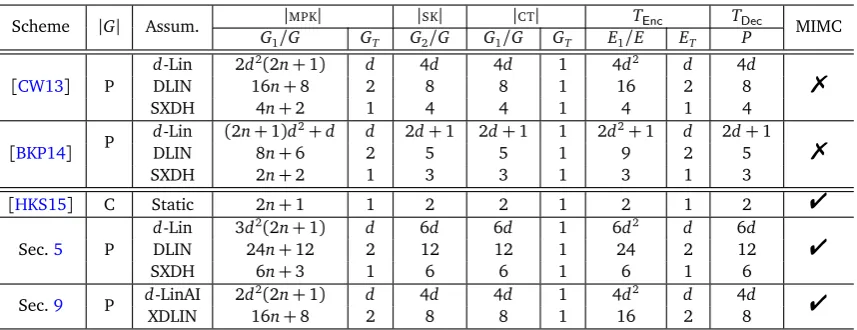
We make a comparison among existing almost-tightly secure IBE schemes in MIMC setting in terms of time and space efficiency. The details are shown in Table 1. Our comparison involves the composite-order construction by Hofheinzet al. [HKS15], the prime-order construction in Section5based on the decisional linear (DLIN, 2-Lin) and symmetric external Diffie-Hellman (SXDH, 1-Lin) assumption, and the prime-order construction from Section 9based on the XDLIN (2-LinAI) assumption. As a base line, we also consider the efficiency of prime-order construction by Chen and Wee[CW13]and Blazyet al.[BKP14], which isnotbuilt for MIMC setting.
Hofheinzet al.’s construction (see the third row) works with a symmetric bilinear group whose order is the product of four distinct primes, the sizes of group elements are much larger, and exponentiation operations and pairing operations are much more expensive. Therefore the overall efficiency is not acceptable even though the numbers of group elements in MSK, SKandCTare smaller and EncandDecrequire less exponentiation operations and pairing operations.
Scheme |G| Assum. |MPK| |SK| |CT| TEnc TDec MIMC G1/G GT G2/G G1/G GT E1/E ET P
[CW13] P
d-Lin 2d2(2n+1) d 4d 4d 1 4d2 d 4d
%
DLIN 16n+8 2 8 8 1 16 2 8
SXDH 4n+2 1 4 4 1 4 1 4
[BKP14] P
d-Lin (2n+1)d2+d d 2d+1 2d+1 1 2d2+1 d 2d+1 %
DLIN 8n+6 2 5 5 1 9 2 5
SXDH 2n+2 1 3 3 1 3 1 3
[HKS15] C Static 2n+1 1 2 2 1 2 1 2 "
Sec.5 P
d-Lin 3d2(2n+1) d 6d 6d 1 6d2 d 6d
"
DLIN 24n+12 2 12 12 1 24 2 12
SXDH 6n+3 1 6 6 1 6 1 6
Sec.9 P d-LinAI 2d
2(2n+1) d 4d 4d 1 4d2 d 4d
"
XDLIN 16n+8 2 8 8 1 16 2 8
Table 1: Comparing Efficiency among existing and proposed almost-tight IBE schemes. n is the length of identities. Column|MPK|,|SK|, and|CT|show the size of master public keys, user’s secret keys and ciphertexts, respectively. Each
sub-column contains the number of elements inG,G1,G2, andGT. ColumnTEncandTDecshow encryption and decryption cost,
respectively. Each sub-columnE,E1, andETshows the number of exponentiations on groupG,G1, andGT, respectively,
and sub-column P shows the number of pairings. Column “Assum.” shows the underlying assumption. “Static” means static assumptions in the composite-order bilinear group. Column “|G|” indicates the group order, “P” for prime and “C” for composite order, respectively.
(see the last row), each group element inGandHis a vector of 4-dimension overG. Although the resulting
IBE is still less efficient than Blazy et al.’s construction [BKP14] under the DLIN assumption, the stronger computational assumption (i.e., XDLIN) helps us to narrow the gap. We may view this as a tradeoff between strength of security and efficiency without changing the security model. We leave it as an open problem to find more efficient fully secure IBE with tight reduction in MIMC setting, especially from standard d-linear assumption.
1.5
Related Work
Dual System Groups and Its Variants. Chen and Wee proposed the notion of dual system group[CW14], which captures key algebraic structure supporting the dual system technique. They used this abstract primitive to obtain an HIBE scheme with constant-size ciphertext using prime-order bilinear groups. The nested dual system group, an variant of dual system groups, was proposed by Chen and Wee[CW13]to reach almost-tight adaptively secure IBE in the standard model. Chen, Gay, and Wee[CGW15]combined the dual system group with predicate encodings and obtained a more general framework leading to a lot of constructions in the prime-order setting. Very recent work by Gonget al.[GCTC15]extended the concept of dual system group to build an unbounded HIBE[LW11,Lew12]with shorter ciphertexts in the prime-order setting.
Identity Based Encryption. The notion of identity based encryptions was introduced by Shamir[Sha84]in 1984. The first practical realization was proposed by Boneh and Franklin [BF01]using bilinear groups and Cocks[Coc01]using quadratic residue. Both of them rely on the heuristic random oracle model. Since then several practical solutions in the standard model were proposed, including Boneh-Boyen’s IBE[BB04b,BB04a], Waters’ IBE[Wat05], and Gentry’s IBE[Gen06]. In 2009, Waters[Wat09]proposed a new proof methodology, the dual system encryption, and presented an IBE scheme with short public key and proved its security under several simple assumptions in the standard model. Recently, Chen and Wee[CW13]achieved almost-tight IBE by utilizing the dual system technique in a novel way. Very recently, Blazyet al.[BKP14]built the connection between IBEs and affine message authentication code which is a symmetric primitive. IBE can also be realized using other algebra framework such as lattices[GPV08,ABB10a,ABB10b].
1.6
Independent Work
The independent work by Attrapadung, Hanaoka, and Yamada[AHY15]also involves several constructions of almost-tight IBE in MIMC setting. They developed an elegant framework for building almost-tight IBE in MIMC setting from the so-called broadcast encoding, which is a special form of Attrapadung’s pairing
encod-ing[Att14], and obtained a series of almost-tight IBE schemes with various properties (including sub-linear
Φprime
cc ) is similar to our second construction based on the XDLIN assumption shown in Section9. In fact, they share the same performance in terms of the size of ciphertexts and secret keys and running time of Encand
Dec. However we note that we also provide an generalization of this construction but proven secure under the non-standardd-LinAI assumption. Furthermore, our first construction in Section5is full adaptively secure under the d-Lin assumption, which is a more general and weaker assumption than the XDLIN used by both Attrapadunget al.’s and our second constructions.
1.7
Outline
The paper is organized as follows: Section2presents necessary background. Section3gives our revised definition of ENDSG. We realize our revised ENDSG in the prime-order setting in Section4and investigate how to update our ENDSG and its prime-order instantiation to achieve higher security level in Section6. A derived concrete IBE is presented in Section5. The next two sections are devoted to gain more efficient solutions. We fine-tune the notion of ENDSG in Section7and present a prime-order realization in Section8. The resulting concrete IBE is shown in Section9.
2
Preliminaries
2.1
Notations
For a finite setS, we uses←Sto denote the process of pickingsfromSat random. For anyn∈Z+, we
take[n]as the brief representation of set{1, . . . ,n}. For a probabilistic algorithmAlg, y ←Alg(x;r)means that we run the algorithmAlgon inputxand randomnessr, and then assign the result to variable y. We may omitrfor brevity when it is clear from the context.Algλ(x)means we runAlgforλtimes using independent random coins. Fixed an input x, we may viewAlg(x;r)as a random variable and use[Alg(x;r)]to indicate its support, i.e., the set of all possible outputs of algorithm Algon inputx. “p.p.t.” stands for “probabilistic polynomial time”.
We use ord(G)to denote the order of groupG. Leteidenote the vector with 1 on theith position and 0
elsewhere andhei withh∈Gbe a vector overGwithhon theith position and 1 elsewhere. For two vectors g:= (g1, . . . ,gn)∈Gnandg0:= (g0
1, . . . ,g0n)∈G
n, we defineg
·g0 = (g1·g10, . . . ,gn·gn0)∈Gnwhere “
·” on the right-hand side is the group operation ofG. For any vectorx= (x1, . . . ,xn)andi∈[n], we definex−i as a vector(x1, . . . ,xi−1,⊥,xi+1, . . . ,xn)whoseith position is unknown (we take⊥as a placeholder), andx|ias
its prefix of lengthi, i.e.,x|i:= (x1, . . . ,xi).
2.2
Identity Based Encryptions
Algorithms. An IBE scheme in the multi-instance setting consists of five p.p.t. algorithms defined as follows2. (1) Theparameter generation algorithmParam(1k,SYS)takes as input a security parameterk∈Z+in its unary
form and a system-level parameterSYS, and outputs a global parameterGP. (2) Thesetup algorithmSetup(GP) takes as input a global parameter GP, and outputs a master public/secret key pair(MPK,MSK). (3) The key generation algorithmKeyGen(MPK,MSK,y)takes as input a master public keyMPK, a master secret keyMSKand an identityy, and outputs a secret keySKyfor the identity. (4) Theencryption algorithmEnc(MPK,x,M)takes as input a master public keyMPK, an identityxand a messageM, outputs a ciphertextCTx for the message under the identity. (5) Thedecryption algorithmDec(MPK,SK,CT)takes as input a master public keyMPK, a secret key SKand a ciphertextCT, outputs a messageMor a failure symbol⊥.
The so-called “multi-instance setting” indicates that we are considering a collection of IBE instances estab-lished under the same global parameterGP. We leave the system-level parameterSYSundefined for generality. It may depend on concrete constructions or application scenarios.
Correctness. Roughly speaking, the correctness says that, for any IBE instance equipped with a legal master public/secret key pair, any secret key honestly generated using the master secret key for some identity should be able to recover the message from a ciphertext for the same identity under the master public key. Formally, for any parameterk∈Z+, anySYS, anyGP∈[Param(1k,SYS)], any(MPK,MSK)∈[Setup(GP)], any identityx, and any messageM, it holds that
Pr[Dec(MPK,KeyGen(MPK,MSK,x),Enc(MPK,x,M)) =M]¾1−2−Ω(k).
The probability space is defined by the random coins consumed by algorithmKeyGenandEnc.
Adaptive Security in the Multi-instance, Multi-ciphertext Setting. Roughly, the adaptive security in the multi-instance, multi-ciphertext setting extends the traditional adaptive security model for IBE[BF01]in the sense that the adversary can access to multiple IBE instances (obtaining master public key and users’ keys) and attack multiple ciphertexts (i.e., challenge ciphertexts), which is formalized by Hofheinzet al.[HKS15]. Ideally, the adversary is free to choose the challenge instance, the challenge identity and the challenge message pair. Hofheinzet al.[HKS15]also identified a weaker variant in which only one challenge ciphertext is allowed for each challenge identity in each challenge instance, and called the ideal onefull security.
We review the experimentExpIBEA (k,λ,qK,qC,qR)between a challengerC and an adversaryA [HKS15],
which captures both the weaker and full security notion.
Setup. C getsGP←Param(1k,SYS)and creates(MPKι,MSKι)←Setup(GP)forι∈[λ]. All master public keys
MPKι ι∈[λ] are sent toA. C also chooses a secret random bitβ∈ {0, 1}and initializesQK andQC as
empty sets.
Query. A is allowed to make two types of queries: key extraction queries and challenge queries. C answers
every queries as follows:
– For each key extraction query (ι,y), C returns SK ←KeyGen(MPKι,MSKι,y) and updatesQK := QK∪ {(ι,y)};
– For each challenge query (ι∗,x∗,M∗
0,M∗1), C returns CT∗ ←Enc(MPKι∗,x∗,M∗β)and updatesQC := QC∪ {(ι∗,x∗)}.
Guess. A outputs its guessβ0∈ {0, 1}.
We say an adversaryA wins experimentExpIBE
A (k,λ,qK,qC,qR), denoted byExpIBEA (k,λ,qK,qC,qR) =1, if and
only if (1)β = β0, (2)Q
K∩QC =;, (3) A made at mostqK key extraction queries, (4) there are at most qC challenge identities, and (5) for each of them, there exist at mostqRchallenge ciphertexts. We define the
advantage ofA as
AdvIBEA (k,λ,qK,qC,qR) =
Pr[ExpIBEA (k,λ,qK,qC,qR) =1]−1/2 .
The probability space is defined by random coins consumed by both C and A. An IBE is (λ,qK,qC,qR) -adaptively-secure if, for any p.p.t. adversaryA the advantageAdvIBEA (k,λ,qK,qC,qK)is bounded by 2−Ω(k).
Clearly, the (λ,qk,qC,qR)-adaptive security with unboundedqRis consistent with the full security, while the
(λ,qk,qC, 1)-adaptive security is exactly the weak security. Furthermore, we defineB-weak adaptive security,
an intermediate security notion between them, as(λ,qK,qC,B)-adaptive security for a priori boundB¾1.
3
Revisiting Extended Nested Dual System Groups
This section revises the ENDSG proposed by Hofheinzet al.[HKS15]. Our main goal is to reduce the de-pendence on some special algebraic structure which hinders the development of more instantiations, especially those using prime-order bilinear groups. (See Section1.) We show our revised ENDSG followed by a series of remarks clarifying motivations and reasons behind several technical decisions. As discussed in Section1, key points are: (1) removing special group requirements; (2) explicitly providing samples in each computational assumption; (3) generalizing subgroup ofbh∗andeh∗.
Syntax. Our revised ENDSG consists of eight p.p.t. algorithms defined as follows:
– SampP(1k,n): Output: (1)
PPcontaining (a) group description(G,H,GT)and an admissible bilinear map e:G×H→GT; (b) an efficient linear mapµ defined onH; (c) an efficient sampler forHand
Zord(H), respectively; (d) public parameters forSampGandSampH. (2)SPcontaining secret parameters
forÛSampG,åSampG,SampHÛ
∗
andSampHå
∗
.
– SampGT: Im(µ)→GT.
– SampG(PP): Outputg= g0,g1, . . . ,gn
∈Gn+1.
– SampH(PP): Outputh= h0,h1, . . . ,hn∈Hn+1.
– SampG( , ): Outputg= g ,g , . . . ,g
– åSampG(PP,SP): Outputeg= eg0,eg1, . . . ,egn∈Gn+1.
– ÛSampH
∗
(PP,SP): Outputbh∗∈H.
– åSampH
∗
(PP,SP): Outputeh∗∈H.
The first four algorithms are used in the real system, while the remaining ones are defined for the proof. The notationSampG0refers to the first element in the output ofSampG, i.e.,g0. The notational convention also applies toSampH,SampGÛ, andåSampG.
Correctness. For allk,n∈Z+and all(PP,SP)∈[SampP(1k,n)], it is required that:
(Projective.) For allh∈Hand all possible randomnesss,SampGT(µ(h);s) =e(SampG0(PP;s),h).
(Associative.) For all (g0,g1, . . . ,gn) ∈ [SampG(PP)] and all (h0,h1, . . . ,hn) ∈ [SampH(PP)], e(g0,hi) =
e(gi,h0)fori∈[n].
Security. For allk,n∈Z+and all(PP,SP)∈[SampP(1k,n)], it is required that:
(Orthogonality.) For allbh∗∈[ÛSampH
∗
(PP,SP)]and alleh∗∈[SampHå
∗
(PP,SP)],
1. µ(bh∗) =µ(eh∗) =1;
2. e(bg0,eh∗) =1 for allgb0∈[ÛSampG0(PP,SP)];
3. e(eg0,bh∗) =1 for allge0∈[åSampG0(PP,SP)];
The first requirement implies thate(g0,eh∗) =e(g0,bh∗) =1 for allg0∈[SampG0(PP)]by the projective
property (c.f. Section 3.2 in[CW13]).
(Non-degeneracy.) Over the probability space defined by bg0←ÛSampG0(PP,SP), with overwhelming
proba-bility 1−2−Ω(k),e(
b
g0,bh∗)is distributed uniformly overGT when samplingbh∗←ÛSampH
∗
(PP,SP).
(H-subgroup.) The output ofSampH(PP)is distributed uniformly over some subgroup ofHn+1, while those
ofSampHÛ
∗
(PP,SP)andåSampH
∗
(PP,SP)are distributed uniformly over some subgroup ofH.
(Left subgroup indistinguishability 1 (LS1).) For any p.p.t. adversaryA, the following advantage function
is negligible ink,
AdvLS1A (k,q):=Pr[A(D,T0) =1]−Pr[A(D,T1) =1] ,
where
D:= (PP), T0:=¦gj
©
j∈[q], T1:=
gj· bgj
j∈[q]
andgj←SampG(PP)andgbj←ÛSampG(PP,SP).
(Left subgroup indistinguishability 2 (LS2).) For any p.p.t. adversaryA, the following advantage function
is negligible ink,
AdvLS2A (k,q,q0):=Pr[A(D,T0) =1]−Pr[A(D,T1) =1] ,
where
D:=
PP,
n bh∗j·eh∗j
o
j∈[q+q0],
n
g0j·bg
0 j
o
j∈[q]
, T0:=¦gj·bgj ©
j∈[q], T1:=
gj· egj
j∈[q]
andbh∗j←ÛSampH
∗
(PP,SP),eh∗j←åSampH
∗
(PP,SP),g0j←SampG(PP),bg0j←ÛSampG(PP,SP),gj←SampG(PP),
b
gj←ÛSampG(PP,SP), andegj←åSampG(PP,SP).
(Nested-hiding indistinguishability (NH).) For all η∈[bn/2c]and any p.p.t. adversaryA, the following
advantage function is negligible ink,
where
D:=
PP,
n bh∗j
o
j∈[q+q0],
n eh∗j
o
j∈[q+q0],
¦
(bgj)−(2η−1) ©
j∈[q],
¦
(egj)−2η ©
j∈[q]
,
T0:=¦hj
©
j∈[q0], T1:=
hj· (bh∗∗j )e2η−1·(eh∗∗j )e2η
j∈[q0] andbh∗j ← ÛSampH
∗
(PP,SP), eh∗j ← åSampH
∗
(PP,SP), bgj ← ÛSampG(PP,SP), egj ← åSampG(PP,SP), hj ←
SampH(PP),bh∗∗j ←ÛSampH
∗
(PP,SP),eh∗∗j ←åSampH
∗
(PP,SP). We further define
AdvNHA (k,q,q0):= max η∈[bn/2c]
n
AdvNHA(η)(k,q,q0)o.
Remark 1 (notations) The ENDSG is mainly defined for building IBE. We remark that, in the description of LS1,
LS2, and NH, the parameter q and q0roughly corresponds to the maximum number of challenge ciphertexts and key extraction queries, respectively.
Remark 2 (samplingbh∗andeh∗, andH-subgroup) We model the process of sampling over subgroup generated
bybh∗ andeh∗ (in [HKS15]) as algorithm ÛSampH
∗
and åSampH
∗
, respectively. This allows us to employ more complex algebraic structure (say, extending the subspaces from one dimension to higher one), which is crucial for our prime-order instantiation in Section4. Due to its generality, theH-subgroup property must be extended to
take bothSampHÛ
∗
andåSampH
∗
into account.
Remark 3 (G-subgroup andH-subgroup) Since we provide adequate samples ofGn+1directly in the last three
computational security requirements and further re-randomization is not necessary in the proof, theG-subgroup
in the original definition could be safely removed. However this won’t let the revised ENDSG free fromH-subgroup
property. The simulator still need the property to re-randomize T0or T1in NH(η)usingSampH(PP)to maintain the consistency of truly random functions on two identities sharing the sameη-bit prefix.
On one hand, our revised definition for ENDSG is essentially consistent with Hofheinz et al.’s
defini-tion [HKS15]. In particular, it is not hard to see that one may use Hofheinz et al.’s ENDSG [HKS15] to
realize this revised version. Therefore their instantiation using composite-order bilinear groups can also be taken as an instantiation of the revised version above. On the other hand, although our revised definition is more general, it still almost-tightly implies an IBE in MIMC setting. In fact, the construction, the security result and its proof are nearly the same as those presented in[HKS15]. One may consider them as rewriting Hofheinzet al.’s results [HKS15] in the language of our revised ENDSG. We present the construction and s-ketch of the proof in AppendixBfor completeness. It is worth noting that the construction only achieves weak adaptive security. We will show how to enhancenon-degeneracyto reach full adaptive security in Section6.
4
Instantiating ENDSG from
d
-Linear Assumption
We give an instantiation of our revised ENDSG (defined in Section3) using prime-order bilinear groups based on the technique of Chen and Wee [CW13]. Following the generic construction proposed in[HKS15]
(c.f. Appendix B), this yields the first fully and almost-tight secure IBE in MIMC setting using prime-order bilinear groups. (See Section5.)
4.1
Prime-order Bilinear Groups and Computational Assumptions
A prime-order (asymmetric) bilinear group generator GrpGen(1k)takes security parameter 1k as input
and outputs G := (p,G1,G2,GT,e), where G1, G2 andGT are finite cyclic groups of prime order p, and e:
G1×G2→GTis a non-degenerated and efficiently computable bilinear map. We letg1,g2andgT:=e(g1,g2)
be a generator ofG1,G2andGT, respectively. We state the (standard)d-linear assumption (d-Lin for short) in
G1(see Assumption1), the analogous assumption inG2can be defined by exchanging the role ofG1andG2.
Assumption 1 (d-Linear Assumption inG1) For any p.p.t. adversaryA, the following advantage function is
negligible in k,
AdvdA-Lin(k):=Pr[A(D,T0) =1]−Pr[A(D,T1) =1] ,
where
T0:=gad+1(s1+···+sd)
1 , T1:=g
ad+1(s1+···+sd)+ sd+1 1
andG:= (p,G1,G2,GT,e)←GrpGen(1k), s
1, . . . ,sd←Zp, and a1, . . . ,ad,ad+1,sd+1←Z∗p.
“Matrix-in-the-exponent" Notation. For an m×nmatrix X= (xi,j)overZp and a group element g of G
(which may beG1,G2orGT), we definegX:= (gxi,j)which is anm×nmatrix overG. We naturally extend
the domain of pairinge: given two matricesAandBoverZpwhose multiplication is well-defined, we define e(g1A,gB2):=e(g1,g2)A>B, which is a matrix (of proper size) over GT. As a special case, for vectorsxandy
over Zp of the same length, we have e(g1x,g y
2):=e(g1,g2)x >y
∈GT, the standard inner product〈x,y〉in the exponent. We will use0to denote both vectors and matrices with only zero entries when it’s size is clear from the context; if necessary, we may give out its dimension or size in the subscript.
An extended version of d-Lifted Linear Assumption. We describe an extension of thed-Lifted Linear (d -LLin) assumption [JR14] (c.f. Appendix A.1) for improving the readability of our proofs, which is called
(d,`,q)-Lifted Linear Assumption, and(d,`,q)-LLin for short. As usual, we just show the assumption inG1
and the counterpart inG2is readily derived. The extension is made in two steps: we first consider`correlated challenges, and then considerqindependent copies of it, i.e., itsq-fold[EHK+13].
Assumption 2 ((d,`,q)-Lifted Linear Assumption inG1) For any p.p.t. adversaryA, the following advantage
function is negligible in k,
Adv(Ad,`,q)-LLin(k):=Pr[A(D,T0) =1]−Pr[A(D,T1) =1] ,
where
D:=
G,g1,g2,ga1 1 , . . . ,g
ad 1 ,
n
gbi,j
1
o
i∈[`],j∈[d],
¦
ga1s1,j
1 , . . . ,g adsd,j
1
©
j∈[q]
,
T0:=ngbi,1s1,j+···+bi,dsd,j
1
o
i∈[`],j∈[q], T1:=
(
g
bi,1s1,j+···+bi,dsd,j+ sd+i,j
1
)
i∈[`],j∈[q] andG:= (p,G1,G2,GT,e)←GrpGen(1k), a
1, . . . ,ad,bi,j←Z∗p, s1,j, . . . ,sd,j←Zp, sd+i,j←Z∗p.
We show that the(d,`,q)-LLin assumption is tightly implied by the standardd-Lin assumption (see Lem-ma 1). We remark that, since `corresponds to a relatively small parameter, say 2, in our construction and
q corresponds to the number of adversary’s queries which may be 230, we will prove Lemma 1under the assumption that` <qfor simplicity.
Lemma 1 (d-Lin⇒(d,`,q)-LLin) For any p.p.t. adversaryA, there exists an adversaryBsuch that
Adv(Ad,`,q)-LLin(k)¶`·AdvBd-Lin(k) +1/(p−1),
andTime(B)≈Time(A) +`2d·poly(k)wherepoly(k)is independent ofTime(A).
Proof. We may prove the lemma in two steps. Following [JR14]and[CW13], one can prove that, for any
p.p.t. adversaryA, there exists an adversaryBwithTime(B)≈Time(A) +`d·poly(k)such that
Adv(Ad,`,1)-LLin(k)¶AdvdB-Lin(k).
Applying Lemma 1 in[EHK+13], we have that, for any p.p.t. adversaryA, there exists an adversaryBwith
Time(B)≈Time(A) +`2d·poly(k)such that
AdvA(d,`,q)-LLin(k)¶`·AdvB(d,`,1)-LLin(k) +1/(p−1).
Putting them together, one may deduce the lemma immediately.
We now give the proof of the first claim. For simplicity, we discard the subscript jrelated to parameterq
when considering(d,`, 1)-LLin. Given ad-Lin problem instance
g1,g2,ga1 1 , . . . ,g
ad
1 ,g ad+1 1 ,g
a1s1 1 , . . . ,g
adsd
1 ,g
ad+1(s1+···+sd)+sd+1 1
Simulatinga1, . . . ,ad ands1, . . . ,sd. We implicitly defineai:=aiandsi:=si for alli∈[d]. Theai andsion
the left-hand side refers to those in the(d,`, 1)-LLin problem instance we want to simulate, while those on the right-hand side come from thed-Lin problem instance.
Simulating gbi,j
1 fori∈[`], j∈[d]. Sampleγi,δi,j←Z∗pfor alli∈[`]andj∈[d]and implicitly setbi,j:= γiad+1+δi,jaj. Therefore we can simulate
gbi,j
1 :=
gad+1 1
γi ·gaj
1
δi,j .
Simulating the Challenge. For anyi∈[`], we observe that
bi,1s1+· · ·+bi,dsd = (γiad+1+δi,1a1)s1+· · ·+ (γiad+1+δi,dad)sd
= γiad+1(s1+· · ·+sd) + (δi,1a1s1+· · ·+δi,dadsd).
We can simulate the challenge as
gbi,1s1+···+bi,dsd+sd+i
1 :=
gad+1(s1+···+sd)+sd+1 1
γi ·ga1s1
1
δi,1
· · ·gadsd
1
δi,d .
Analysis. Thanks to the entropy ofδi,j, the simulation ofbi,jis perfect. Ifsd+1=0, we can see thatsd+i=0
for alli∈[`]; ifsd+1←Z∗p, we implicitly setsd+i:=sd+1γi. (Thead+1on the left-hand side and the right-hand side is for the(d,`, 1)-LLin andd-Lin assumption, respectively.) Observe that, since allγi are hidden byδi,j,
allsd+iare independently and uniformly distributed overZp. Therefore we proved our first claim.
4.2
Construction
Our construction is based on the prime-order instantiation of NDSG by Chen and Wee[CW13]and works with 3d×3dmatrices under thed-Lin assumption. (For more motivation, see Section1). We letπL(·),πM(·), andπR(·)be functions mapping from a 3d×3dmatrix to its left-mostdcolumns, the middledcolumns, and the right-mostdcolumns, respectively. Algorithms of our revised ENDSG are shown as follows.
– SampP(1k,n): Generate (p,G
1,G2,GT,e)←GrpGen(1k)and define(G,H,GT,e):= (G13d,G 3d 2 ,GT,e).
SampleB,R←GL3d(Zp)andA1, . . . ,An←Z3pd×3d. SetB∗:= (B−
1)>. Define
D:=πL(B), Di=πL(BAi); E:=πM(B), Ei=πM(BAi);
D∗:=B∗R, D∗i =B∗A>iR; F:=πR(B), Fi=πR(BAi);
wherei∈[n]. Defineµ(g2k):=e(g1D,g2k) =e(g1,g2)D>kfor allk∈Z3pd. Output
PP:=
g1D, gD1
1 , . . . , g Dn
1 g2D∗, gD
∗ 1
2 , . . . , g D∗
n
2
andSP:=
gπM(B∗) 2 ,g1E, g
E1
1 , . . . , g En
1 gπR(B∗)
2 ,gF1, g F1
1 , . . . , g Fn
1
.
We assumePPalways containsG,H,GT,e,µ.
– SampGT(gpT): Samples←Zdpand output g
s>p
T ∈GT.
– SampG(PP): Samples←Zdp and outputgDs1 ,g1D1s, . . . ,gDns
1
∈(G31d)n+1.
– SampH(PP): Sampler←Z3pdand output
g2D∗r,gD
∗ 1r 2 , . . . ,g
D∗ nr
2
∈(G23d)n+1.
– ÛSampG(PP,SP): Samplebs←Zdp and output
gEbs
1 ,g E1bs
1 , . . . ,g Enbs
1
∈(G3d 1 )
n+1.
– åSampG(PP,SP): Samplees←Zdp and output
gFes
1,g F1es
1 , . . . ,g Fnes
1
∈(G13d)n+1.
– ÛSampH
∗
(PP,SP): Samplebr←Zpd and outputgπM(B∗)br
2 ∈G3 d 2 .
– åSampH
∗
(PP,SP): Sampleer←Zpd and outputgπR(B∗)er
Correctness. We may check all correctness requirements as follows:
(Projective.) For allk∈Z3pd and alls∈Z
d
p, we have that
SampGT(µ(gk2);s) =e(g1,g2)s>(D>k)=e(g1Ds,gk2) =e(SampG0(PP;s),g2k).
The second equality follows the fact thats>(D>k) = (Ds)>k.
(Associative.) For alls∈Zdpand allr∈Z
3d
p , we have, for alli∈[n],
e(g1Ds,gD∗ir
2 ) =e(g1,g2)¯s >B>(B∗A>
iR)r=e(g
1,g2)¯s >(BA
i)>(B∗R)r=e(gDis
1 ,g D∗r 2 ),
where ¯s := (s0)∈Z3pd. The first and the last equality follow the definition ofπL(·)while the second equality uses the fact thatB>(B∗A>i R) = (B>B∗)A>iR=Ai>R=A>i(B>B∗)R= (BAi)>(B∗R).
Security. We may check the following security requirements:
(Orthogonality.) For allbr,er,bs,es∈Zdp, we check that
1. µ(gπM(B∗)br
2 ) =e(g1,g2)πL(B) >π
M(B∗)br=e(g
1,g2)0d×dbr= (1, . . . , 1)>∈Gd
T;
2. µ(gπR(B∗)er
2 ) =e(g1,g2)πL(B) >π
R(B∗)er=e(g
1,g2)0d×der= (1, . . . , 1)>∈Gd
T;
3. e(gπM(B)bs
1 ,g πR(B∗)er
2 ) =e(g1,g2)bs
>π
M(B)>πR(B∗)er=e(g
1,g2)bs
>0 d×der=1
GT;
4. e(gπR(B)es
1 ,g πM(B∗)br
2 ) =e(g1,g2)es
>π
R(B)>πM(B∗)br=e(g
1,g2)es
>0 d×dbr=1
GT.
The second equality of them follows the fact thatπL(B)>πM(B∗) =π
L(B)>πR(B∗) =πM(B)>πR(B∗) = πR(B)>πM(B∗) =0d×d.
(Non-degeneracy.) For allbs∈Z
d
pandbr∈Z
d
p, we have that
e(gEbs
1 ,g πM(B∗)br
2 ) =e(g1,g2)bs >π
M(B)>πM(B∗)br=e(g
1,g2)bs >
br.
With probability 1−1/pd, samplingbs ←Z
d
p results inbs 6=0, in which case the inner productbs
>
bris
distributed uniformly overZpand thereforee(gE1bs,g πM(B∗)br
2 )is distributed overGTwhen pickingbr←Z
d p.
(H-subgroup.) This follows from the fact thatZ3pd (for algorithmSampH) andZ
d
p (for algorithm ÛSampH ∗
andSampHå
∗
) are additive groups.
We check the remaining security properties (LS1, LS2, and NH) in the following subsections.
4.3
Left Subgroup Indistinguishability 1
We may rewrite the LS1 advantage functionAdvLS1A (k,q)as follows:
AdvLS1A (k,q):=Pr[A(D,T0) =1]−Pr[A(D,T1) =1] ,
where
D:= (PP), T0:=¦gj
©
j∈[q], T1:=
¦
gj·bgj ©
j∈[q],
and
PP := g πL(B) 1 , g
πL(BA1)
1 , . . . , g
πL(BAn)
1 gB2∗R, gB∗A>1R
2 , . . . , g
B∗A> nR
2
!
;
gj := g
B sj 0d 0d
!
1 ,g BA1
sj 0d 0d
!
1 , . . . ,g BAn
sj 0d 0d
!
1
;
gj·bgj := g
B
sj
bsj 0d
1 ,g BA1
sj
bsj 0d
1 , . . . ,g BAn
sj
b
sj 0d
1
;
forsj,bsj←Z
![3,3′ {Ethane 1,2 diylbis[carbonylbis(azanediyl)]}dipyridinium tetrachloridoplatinate(II)](data:image/gif;base64,R0lGODlhAQABAIAAAP///wAAACH5BAEAAAAALAAAAAABAAEAAAICRAEAOw==)