Foundations of Homomorphic Secret Sharing
∗Elette Boyle† IDC Herzliya
Niv Gilboa‡ Ben-Gurion University
Yuval Ishai§ Technion
Huijia Lin¶ UC Santa Barbara Stefano Tessarok
UC Santa Barbara
December 27, 2017
Abstract
Homomorphic secret sharing (HSS) is the secret sharing analogue of homomorphic encryp-tion. An HSS scheme supports a local evaluation of functions on shares of one or more secret inputs, such that the resulting shares of the output are short. Some applications require the stronger notion ofadditiveHSS, where the shares of the output add up to the output over a finite Abelian group. While strong feasibility results for HSS are known under specific cryptographic assumptions, many natural questions remain open.
We initiate a systematic study of HSS, making the following contributions.
• A definitional framework. We present a general framework for defining HSS schemes that unifies and extends several previous notions from the literature, and cast known results within this framework.
• Limitations. We establish limitations on information-theoretic multi-input HSS with short output shares via a relation with communication complexity. We also show that addi-tiveHSS for non-trivial functions, even the AND of two input bits, implies non-interactive key exchange, and is therefore unlikely to be implied by public-key encryption or even oblivious transfer.
• Applications. We present two types of applications of HSS. First, we construct 2-round protocols for secure multiparty computation from a simple constant-size instance of HSS. As a corollary, we obtain 2-round protocols with attractive asymptotic efficiency features under the Decision Diffie Hellman (DDH) assumption. Second, we use HSS to obtain nearly optimal worst-case to average-case reductions in P. This in turn has applications to fine-grained average-case hardness and verifiable computation.
Keywords: Cryptography, homomorphic secret sharing, secure computation, communication com-plexity, worst-case to average-case reductions.
∗
This is a full version of [BGI+18].
†
Email: [email protected]
‡
Email: [email protected]
§
Email: [email protected]
¶
Email: [email protected]
k
1
Introduction
Fully homomorphic encryption (FHE) [RAD78, Gen09] is a powerful cryptographic primitive that supports general computations on encrypted inputs. Despite intensive study, FHE schemes can only be based on a narrow class of cryptographic assumptions [vDGHV10, BV14, GSW13], which are all related to lattices, and their concrete efficiency leaves much to be desired.
In this paper we consider the following secret sharing analogue of FHE, referred to as homo-morphic secret sharing (HSS) [BGI16a]. A standard (threshold) secret sharing scheme randomly splits an inputxintomshares, (x1, . . . , xm), such that any set oftshares reveals nothing about the input. An HSS scheme supports computations on shared inputs by means of local computations on their shares. More concretely, there is a local evaluation algorithm Evaland decoder algorithm
Dec satisfying the following homomorphism requirement. Given a description of a function F, the algorithm Eval(F;xj) maps an input share xj to a corresponding output share yj, such that
Dec(y1, . . . , ym) =F(x).
An HSS scheme as above can be trivially obtained by letting Evaloutput (F, xj) and Dec first
reconstruct x from the shares and then compute F. However, this trivial scheme is not useful. Analogously to the output compactness requirement of FHE, we require that the HSS output shares be compact in the sense that their length depends only on the output length ofF and the security parameter. In fact, it is often useful to make the more stringent requirement that Dec
compute F(x) as the sum y1+. . .+ym in some finite Abelian group. We refer to such an HSS scheme as anadditive HSS. We also consider a relaxed notion of weak compactnessthat allows the length of the output shares to grow sublinearly with the input size.
Finally, one can naturally consider a multi-input variant of HSS, where inputs x1, . . . , xn are
independently shared, Eval locally maps the j-th shares of the ninputs to the j-th output share, and Dec outputs F(x1, . . . , xn). In fact, multi-input HSS is meaningful even when F is a fixed
function rather than an input ofEval. For instance, one may consider additive 2-input HSS where
F computes the AND of two input bits, or compact 2-input HSS where F takes an inner product of two input vectors.
HSS vs. FHE.HSS can generally be viewed as a relaxation of FHE that offers protection against bounded collusions. However, as observed in [BGI16a], in some applications of FHE it is possible to use HSS as an alternative that offers the same level of security. For instance, in the context of secure two-party computation [Yao86, GMW87], using HSS to share the inputs of the two parties does not compromise security in any way, since the two parties together can anyway learn both inputs.
this work.
Finally, recent works obtain HSS schemes that support rich classes of computations under the Decision Diffie Hellman (DDH) assumption [BGI16a, BGI17, BCG+17] or the security of the Paillier encryption scheme [FGJS17, Cou17], which are not known to imply FHE. These constructions use very different techniques from those underlying known FHE constructions. This suggests a potential for further diversifying the assumptions and structures on which HSS can be based, which may potentially lead to more efficient substitutes for known FHE schemes.
1.1 Our Contribution
The current state of the art in HSS mostly consists of isolated positive results and leaves open some of the most basic questions. In this work we initiate a more systematic study of HSS, making the following contributions. We refer the reader to the relevant sections for a high level overview of the main ideas behind each contribution.
A definitional framework. We start, in Section 2, by presenting a general framework for HSS that unifies and extends several previous notions from the literature. In Section 3 we cast some known primitives and previous results within this framework. This includes a simple extension of a previous Learning With Errors (LWE)-based construction from [DHRW16] to the setting of multi-input HSS, whose details appear in Appendix B.
Limitations. In Section 4 we establish two types of limitations on multi-input HSS. First, in Sec-tion 4.1, we show that weakly compactinformation-theoreticmulti-input HSS schemes for security thresholdt≥m/2 do not exist for functions that have high (randomized, one-way) two-party com-munication complexity. This includes simple functions such as inner product or set disjointness. The high level idea is to obtain a low-communication two-party protocol from the HSS scheme by having the two parties use a common source of randomness to locally simulate the HSS input shares of both inputs, without any interaction, and then have one party send its HSS output share to the other. Second, in Section 4.2, we show thatadditiveHSS for non-trivial functions, or even for com-puting the AND of two input bits, implies non-interactive key exchange (NIKE), a cryptographic primitive which is not known to be implied by standard public-key primitives such as oblivious transfer. Loosely, two parties can simultaneously exchange HSS shares of input bits whose AND is zero, and output their HSS-evaluated output share as a shared key. This result provides some explanation for the difficulty of constructing strong types of HSS schemes from general assumptions.
Applications. In Section 5 we present two types of applications of HSS. First, in Section 5.1, we construct 2-round protocols for secure multiparty computation (MPC) from a simple constant-size instance of additive HSS with n = 3 inputs andm = 2 shares, for computing 3Mult(x1, x2, x3) =
x1x2x3. At a very high level, this reduction crucially relies on a randomized encoding of functions by degree-3 polynomials [AIK05], which allows decomposing the computation of an arbitrary function
to-gether with NIZK (e.g., [GGHR14, GLS15]) or bilinear groups [GS17a]. Very recently, it was shown that 2-round MPC can be based on the (minimal) assumption that 2-round semi-honest oblivious transfer protocols exist [GS17b, BL17]. Our protocol can be instantiated in the public-key infras-tructure model under DDH, which is weaker than or incomparable to the feasibility results of other recent constructions. However, our protocols using HSS still have several advantages, in particular, they enjoy better asymptotic efficiency, and they are in the more general “client-server” model, where the computation of the input clients can be done offline, and the computation of the output clients is relatively cheap.
A second type of applications, presented in Section 5.2, is to obtaining worst-case to average-case reductions in P. Roughly speaking, the HSS evaluation functionEval for computing F defines a function ˆF such that computingF on any given input x can be reduced to computing ˆF on two or more inputs that are individually pseudorandom. A similar application of FHE was already pointed out in [CKV10]. However, an advantage of the HSS-based reductions is that they allow
ˆ
F to have a single bit of output. Another advantage is the potential for diversifying assumptions. We discuss applications of the reductions implied by HSS to fine-grained average-case hardness and verifiable computation. In particular, the HSS-based approach yields checking procedures for polynomial-time computations that achieve better soundness vs. succinctness tradeoffs than any other approach we are aware of.
2
General Definitional Framework for HSS
In this section we give a general definition of homomorphic secret sharing (HSS) that can be instantiated to capture different notions from the literature. We consider multi-input HSS schemes that support a compact evaluation of a function F on shares of inputs x1, . . . , xn that originate
from different clients. More concretely, each clientirandomly splits its inputxi betweenm servers
using the algorithmShare, so thatxi is hidden from anytcolluding servers. We assumet=m−1
by default. Each server j applies a local evaluation algorithm Eval to its share of the n inputs, and obtains an output shareyj. The outputF(x1, . . . , xn) is reconstructed by applying a decoding
algorithm Decto the output shares (y1, . . . , ym).
As discussed in the Introduction, HSS as above can be trivially realized by lettingSharebe any
m-out-of-msecret sharing scheme,Evalthe identity function, andDeca function that reconstructs the inputs from their shares and then appliesF. However, applications of HSS require thatDecbe in some sense “simpler” than computing F. The most natural simplicity requirement, referred to as compactness, is that the output length of Eval, and hence the complexity of Dec, depend only on the output length of F and not on the input length of F. A more useful notion of simplicity is the stronger requirement of additive decoding, where the decoder computes the exclusive-or of the output shares or, more generally, adds them up in some Abelian group G. We also consider
weaker notions of simplicity that are motivated by applications of HSS and are needed to capture HSS constructions from the literature.
We now give our formal definition of general HSS. We refer the reader to Example 3.1 for an example of using this definition to describe an HSS scheme for multiplying two field elements using Shamir’s secret sharing scheme. Here and in the following, we use the notation Pr[A1;. . .;Am : E]
to denote the probability that event E occurs following an experiment defined by executing the sequence A1, . . . , Am in order.
Definition 2.1 (HSS). An n-client, m-server, t-secure homomorphic secret sharing scheme for a function F : ({0,1}∗)n+1 → {0,1}∗, or (n, m, t)-HSS for short, is a triple of PPT algorithms
(Share,Eval,Dec) with the following syntax:
• Share(1λ, i, x): On input 1λ (security parameter), i ∈ [n] (client index), and x ∈ {0,1}∗
(client input), the sharing algorithmShareoutputsm input shares, (x1, . . . , xm). By default, we require Share to run in (probabilistic) polynomial time in its input length; however, we also consider a relaxed notion of efficiency whereShareis given the total length `ofalln+ 1 inputs (includingx0) and may run in timepoly(λ, `).
• Eval j, x0,(xj1, . . . , x
j n)
: On inputj∈[m] (server index),x0 ∈ {0,1}∗(common server input), and xj1, . . . , xjn (jth share of each client input), the evaluation algorithm Eval outputs yj ∈
{0,1}∗, corresponding to server j’s share ofF(x
0;x1, . . . , xn).
• Dec(y1, . . . , ym): On input (y1, . . . , ym) (list of output shares), the decoding algorithm Dec
computes a final outputy ∈ {0,1}∗.
The algorithms (Share,Eval,Dec) should satisfy the following correctness and security requirements:
• Correctness: For anyn+ 1 inputsx0, . . . , xn∈ {0,1}∗,
Pr
∀
i∈[n] (x1i, . . . , xmi )←Share(1λ, i, xi)
∀j∈[m]yj ←Eval j, x0,(xj1, . . . , xjn)
:Dec(y
1, . . . , ym) =F(x
0;x1, . . . , xn)
= 1.
Alternatively, in astatistically correctHSS the above probability is at least 1−µ(λ) for some negligibleµand in aδ-correct HSS (orδ-HSS for short) it is at least 1−δ−µ(λ). In the case ofδ-HSS the error parameterδ may be given as an additional input toEval, and the running time of Evalis allowed to grow polynomially with 1/δ.
• Security: Consider the following semantic security challenge experiment for corrupted set of serversT ⊂[m]:
1: The adversary gives challenge index and inputs (i, x, x0) ← A(1λ), with i ∈ [n] and
|x|=|x0|.
2: The challenger samplesb← {0,1}and (x1, . . . , xm)←Share(1λ, i,x˜), where ˜x=
(
x ifb= 0
x0 else .
3: The adversary outputs a guessb0 ← A((xj)j∈T), given the shares for corruptedT.
– computationally secureif it is (S,1/S)-secure for all polynomials S;
– statistically α-secureif it is (S, α)-secure for all S;
– statistically secure if it statisticallyα-secure for some negligibleα(λ);
– perfectly secureif it is statistically 0-secure.
Remark 2.2 (Unbounded HSS). Definition 2.1 treats the number of inputs nas being fixed. We can naturally consider an unbounded multi-input variant of HSS whereF is defined over arbitrary sequences of inputs xi, and the correctness requirement is extended accordingly. We denote this
flavor of multi-input HSS by (∗, m, t)-HSS. More generally, one can allow all three parametersn, m, t
to be flexible, treating them as inputs of the three algorithmsShare,Eval,Dec.
Remark 2.3 (Robust decoding). Definition 2.1 allows Dec to use all output shares for decoding the output. Whent < m−1, one can consider a stronger variant of HSS whereDeccan recover the output from any t+ 1 output shares. Such a robust notion of threshold homomorphic encryption was recently considered in [JRS17]. In this work we do not consider robust decoding.
Remark 2.4 (Functions vs. relations). In this work we only consider HSS for functions, where the output is fully determined by the inputs. It is sometimes useful to consider the more general problem of HSS for relations(or search problems), where there may be more than one admissible output. The notion of share conversion from [BIKO12] can be seen as a special case of HSS for relations.
2.1 Notions of Simple Decoding
As discussed above, Definition 2.1 can be trivially realized by Eval that computes the identity function. To make HSS useful, we impose two types of requirements on the decoding algorithm. The strictest requirement is that Dec simply add the output shares over a finite field F or, more
generally, an Abelian group G. We refer to such an HSS scheme as being additive, and assume
by default (unless a group or field are specified) that Dec computes the exclusive-or of its inputs, namely the group is of the formG=Z`2. Note that any HSS scheme where Dec computes a fixed linear combination of the output shares (over some finite field or ring) can be converted into an additive scheme by letting Eval multiply its outputs by the coefficients of the linear combination. See Example 3.1 for a relevant concrete example.
A more liberal requirement is compactness, which says that the length of the output shares depends only on the output length and the security parameter, independently of the input length. Finally, we also consider a further relaxation that we call weak compactness, requiring that the length of the output shares be sublinear in the input length when the input length is sufficiently bigger than the security parameter and the output length. See Remark 2.7 for motivation and further discussion. We formalize these notions below, and then discuss other variants of additive and compact HSS in Remarks 2.6 and 2.7.
Definition 2.5(Additive and compact HSS). We say that an (n, m, t)-HSS scheme Π = (Share,Eval, Dec) for F is:
• AdditiveifDecoutputs the exclusive-or of themoutput shares, orG-additive ifDeccomputes
• Compact if there is a polynomial p such that for every λ, `out, and inputs x0, x1, . . . , xn ∈
{0,1}∗ such that |F(x
0;x1, . . . , xn)| = `out, the length of each output share obtained by
applying Share with security parameterλand then Eval is at mostp(λ)·`out (or O(`out) for
perfect or statisticallyα-secure HSS with a constantα);
• Weakly compactif there is a polynomialpand sublinear functiong(`) =o(`), such that for ev-eryλ, `in, `out, and inputs x0, x1, . . . , xn∈ {0,1}∗ of total length`inwith|F(x0;x1, . . . , xn)|=
`out, the length of each output share obtained by applyingSharewith security parameterλand
thenEvalis at mostg(`in) +p(λ)·`out (org(`in) +O(`out) for perfect or statisticallyα-secure
HSS with a constant α). More generally, we can specify the precise level of compactness by referring to an HSS scheme as being g(λ, `in, `out)-compact.
Remark 2.6(Generalized additive HSS). Our default notion of additive HSS considers the output of F as an element in a group of the form Z`2, namely Dec computes the bitwise exclusive-or of its inputs. Some applications motivate additive HSS with respect to a general Abelian group G
that can be given as an additional input. In particular, this is useful for applications that require aggregating outputs on different inputs (see, e.g., [BGI15, BGI16a]). The above definition can be extended to accommodate this by allowingFto take a description ofGas an additional input, where F(G, x0;x1, . . . , xn) is guaranteed to take values fromG, and allowing all of the HSS algorithms
to receive Gas an additional input. In this case Dec performs addition over the groupGgiven as
input. In another dimension of generalization, it is may be useful to require that the m outputs jointly form a valid encoding of the output ofF with respect to a given linear code. This is useful for the robust reconstruction feature discussed in Remark 2.3.
Remark 2.7 (On the different notions of compactness). The main notion of compactness from Definition 2.5 corresponds to the strict notion of compactness that is typically required in the context of FHE. It is easy to see that every additive HSS is also compact in this sense. However, even in the case of perfect HSS, there are natural constructions that are compact but are not additive. Such HSS schemes are implicit in the best known constructions of information-theoretic private information retrieval schemes and locally decodable codes [Yek07, Efr09, BIKO12]. The more liberal notion of weak compactness serves two purposes. First, our negative results for information-theoretic HSS apply to this notion, which makes them stronger. Second, the liberal notion is needed to capture some known HSS schemes in which the length of the output shares needs to grow (sublinearly) with the input length; see Section 3.
Finally, another variant of the compactness requirement imposes a restriction on the computa-tional complexityofDec. Note that our default notion of compactness implies thatDecis polynomial in`out and λ, but one may consider relaxed variants that allow sublinear dependence on the input
length. See Section 5.2 for applications that depend on the computational complexity ofDec.
2.2 Default Conventions
It is convenient to make the following default choices of parameters and other conventions.
• We assume t=m−1 by default and write (n, m)-HSS for (n, m, m−1)-HSS.
• In the case of perfectly secureorstatistically α-secureHSS, λis omitted.
• Forn≥2 clients, we assume by default that the servers have no input and writeF(x1, . . . , xn),
omitting the server input x0. Note that (n, m, t)-HSS with server input can be reduced to (n+ 1, m, t)-HSS with no server input by letting the server input be shared by one of the clients.
• We consideradditive HSSby default. This stronger notion is useful for several application of HSS, and most HSS constructions realize it.
• We will sometimes be interested in additive HSS for a constant-size (finite) functionF, such as the AND of two bits; this can be cast into Definition 2.1 by just considering an extension
ˆ
F of F that outputs 0 on all invalid inputs. Note that our two notions of compactness are not meaningful for a constant-size F. We can similarly handle functions F that impose restrictions on the relation between the lengths of different inputs. Since Eval can know all inputs lengths, we can ensure that Decoutput 0 in case of mismatch.
• As noted above, the common server input x0 is often interpreted as a “program” P from a class of programs P (e.g., circuits or branching programs), and F is the universal function defined byF(P;x1, . . . , xn) =P(x1, . . . , xn). We refer to this asHSS for the class P.
2.3 HSS with Setup
When considering multi-input HSS schemes, known constructions require different forms of setup
to coordinate between clients. This setup is generated by a PPT algorithm Setup and is reusable, in the sense that the same setup can be used to share an arbitrary number of inputs. We consider the following types of setup:
• No setup: This is the default notion of HSS defined above.
• Common random string (CRS) setup: An algorithmSetup(1λ) is used to generate a uniformly random stringσwhich is given as input toShare,Eval, andDec. The correctness and security definitions are extended in the natural way, where both the adversary and the challenger in the security game are given access to an honestly generated σ. This can be relaxed to a common reference string that can be picked from an arbitrary distribution. However, this relaxation will not be useful in this work.
• Public-key setup: We consider here a strong form of public-key setup in which Setup(1λ) outputs a public key pkand m secret evaluation keys (ek1, . . . ,ekm), where each key is given
to a different server. The algorithmShareis given pkas an additional input, andEval j, . . .
is givenekj as an additional input. The security game is changed by giving both the adversary
and the challenger pkand giving to the adversary (ekj)j∈T in addition to (xj)j∈T. Following
the terminology from [BGI17], we refer to HSS with this type of setup aspublic-key(∗, m, t) -HSS.
3
Constructions
from Section 2.
We start with a detailed example for casting Shamir’s secret sharing scheme [Sha79] over a finite fieldFas a perfectly secure,F-additive (2, m, t)-HSS scheme for the functionF that multiplies two
field elements. Such a scheme exists if and only if m >2t.
Example 3.1 (Additive (2, m, t)-HSS for field multiplication). Let m, t be parameters such that
m > 2t, let F be a finite field with |F|> m, let θ1, . . . , θm be distinct nonzero field elements, and let λ1, . . . , λn be field elements (“Lagrange coefficients”) such that for any univariate polynomial p over F of degree at most2twe have p(0) =Pmj=1λjp(θj). LetF :F×F→F be the (constant-size)
function defined by F(x1, x2) = x1·x2. A perfectly secure, additive (2, m, t)-HSS scheme for F is
defined by the following algorithms. (Since F is a constant-size function we are not concerned with efficiency; we also omit x0 since there is no server input and omit the security parameter λ since
security is perfect.)
1. Share(i, x): pick r1, . . . , rt uniformly at random from F and let p(Z) = x+r1Z +r2Z2 +
. . .+rtZt be a random polynomial of degree at most t with x as its free coefficient. Output
(p(θ1), . . . , p(θm)). Note that Share does not depend on i (the inputs are shared in the same way).
2. Eval j,(xj1, xj2): Output λj·xj1x
j
2.
3. Dec(y1, . . . , ym): Outputy1+. . .+ym.
We now survey some other instances of HSS schemes from the literature.
• Additivem-out-of-msecret sharing over an Abelian groupGis aG-additive, perfectly secure
(∗, m)-HSS for the function F(x1, . . . , xn) = x1+. . .+xn where xi ∈ G. This is the first
instance of HSS considered in the literature [Ben86].
• Generalizing Example 3.1, multiplicative secret sharing [CDM00] over a finite field F is an
F-additive, perfectly secure (2, m, t)-HSS for the function F that multiplies two field
ele-ments. Such schemes exist if and only if m > 2t. Multiplicative secret sharing schemes such as Shamir’s scheme serve as the basis for secure multiparty computation protocols in the information-theoretic setting [BGW88, CCD88]. More generally, information-theoretic
F-additive (d, m, t)-HSS for multiplyingdelements ofFexists if and only ifm > dt[BIW10].
Multiplicative schemes with a smaller thresholdtthat work over a constant-size field (indepen-dent ofm) can be based on algebraic geometric codes [CC06]. Efficient multiplicative schemes that support a pointwise multiplication of two vectors are considered in [FY92, CCCX09].
• A 1-roundk-server private information retrieval (PIR) scheme [CGKS98, CG97] can be seen as a weakly compact (1, k,1)-HSS for the selection function F(D;γ) =Dγ. For the 2-server
• Non-trivial instances of compact, perfectly-secure (1,3,1)-HSS for certain classes of depth-2 boolean circuits [BIKO1depth-2] implicitly serve as the basis for the best known constructions of information-theoretic 3-server PIR schemes and 3-query locally decodable codes [Yek07, Efr09].
• The main result of [BGI16a] is a construction of (single-input, computationally secure, addi-tive) (1,2)-δ-HSS for branching programs under the DDH assumption. The same paper also obtains a public-key (∗,2)-δ-HSS variant of this result. Similar results assuming the circular security of the Paillier encryption were recently obtained in [FGJS17, Cou17].
• The notion of function secret sharing (FSS) from [BGI15] is dual to the notion of HSS for a program class P. It can be cast as an additive (1, m)-HSS for the universal function
F(x;P) =P(x), whereP ∈ P is a program given as input to the client andx is the common server input. The special case of distributed point function (DPF) [GI14] is FSS for the class of point functions (namely, functions that have nonzero output for at most one input). DPF can be seen as additive (1, m)-HSS for the functionF(x; (α, β)) that outputsβ ifx=α and outputs 0 otherwise. It is known that one-way functions are necessary and sufficient for DPF withm= 2 servers [GI14]. Whether they are sufficient for 3-server DPF is open.
• We observe that additive1 (∗, m)-HSS forcircuitswith statistical correctness can be obtained from the Learning With Errors (LWE) assumption, by a simple variation of the FSS construc-tion from spooky encrypconstruc-tion of [DHRW16] (more specifically, their techniques for obtaining 2-round MPC). The share size in this construction must grow with the circuit depth, hence
Share only satisfies the relaxed notion of efficiency; this dependence can be eliminated by relying on a stronger variant of LWE that involves circular security. We provide details of the underlying tools and construction in Appendix B.
We note that a key feature of HSS is that Dec does not require a secret key. This rules out nontrivial instances of single-server HSS. In particular, single-server PIR [KO97] and fully homomorphic encryption [Gen09] cannot be cast as instances of our general definitional framework of HSS.
4
Limitations
In this section, we discuss some inherent limitations in HSS. First, in Section 4.1, we show lower bounds on the length of output shares in statistically-secure HSS using communication complexity lower bounds. Then, in Section 4.2, we show that additive (2,2)-HSS for the AND of two bits implies non-interactive key-exchange (NIKE). Given what is known about NIKE (in particular it only follows from non-generic assumptions, and it is not known to be implied directly by public-key encryption or OT), this gives a strong justification for the lack of instantiations from generic assumptions.
1If one does not insist on additive HSS and settles for the weaker notion of compactness, then single-input HSS
4.1 Lower Bounds for Statistically-Secure Multi-Input HSS
We show lower bounds on the length of output shares in statistically-secure multi-input HSS using communication-complexity lower bounds. The key step is to derive a public-coin two-party protocol to compute a functionF from an HSS scheme for the functionF, with the additional property that the communication cost of the resulting protocol only depends on the length of theoutput shares.
4.1.1 Communication Complexity Refresher
We consider an arbitrary public-coin interactive protocol Π between two parties, Alice and Bob, who start the execution with respective inputs x ∈ X and y ∈ Y, and common random tape R. (We can assume wlog that the protocol is otherwise deterministic, and all random coins come from
R. Moreover, the setsX and Y are finite here.) At any point in the execution, one of the parties can return an output value, denoted Π(R, x, y). The cost of Π is the maximum number of bits exchanged by Alice and Bob, taken as the worst case over all possible inputs x, y, and random tapes R. We also say that such a protocol is one-way (or one round) if only one message is sent, and this goes from Alice to Bob.
We are interested in the inherent cost of a protocol Π that evaluates a functionF :X × Y → Z. In particular, the(randomized) communication complexity ofF with error , denoted R(F), is the
minimum cost of a public-coin protocol Π such that Pr[Π(R, x, y)6=F(x, y)]≤for allx, y, where the probability is over the public random string R. If we restrict ourselves to one-way protocols, then we define analogously the one-way communication complexity of F with error , denoted
RA→B(F). It is clear that RA→B(F)≥R(F) must always hold.
The following are classical examples of lower bounds on the (one-way) randomized communica-tion complexity. (We note that the choice of the constant 1/3 is arbitrary, as any other constant
< 12 would do.)
Theorem 4.1(e.g., [KN97]). Let IP`:{0,1}`× {0,1}`→ {0,1} be such thatIP`(x, y) =
P` i=1xiyi
(mod 2). Then, R1/3(IP`) = Ω(`).
Theorem 4.2([KS92]). LetDISJ`:{0,1}`×{0,1}`→ {0,1}be such thatDISJ`(x, y) =¬W`i=1(xi∧
yi). Then, R1/3(DISJ`) = Ω(`).
Theorem 4.3 ([KNR99]). Let INDEX`:{0,1}`×[`]→ {0,1} be such thatINDEX`(x1x2. . . x`, i) =
xi. Then, R1A/→3B(INDEX`) = Ω(`).
4.1.2 Lower Bounds on the Length of Output Shares
We start with a lower bound on the length of the output shares in (2,2)-HSS. (Recall that (n, m )-HSS is a shorthand for (n, m, t=m−1)-HSS.) Below, we describe informally how to extend the technique to more general settings.
Recall that a (2,2)-HSS scheme is defined for a functionF : ({0,1}∗)2 → {0,1}∗. (In this section, we consider the case where the servers have no inputx0, but the results extend straightforwardly to handle server inputs.) For any two integers `1,in, `2,in, it is convenient to define the restriction
F`1,in,`2,in : {0,1}`1,in × {0,1}`2,in → {0,1}∗ such that F`1,in,`2,in(x
1, x2) = F(x1, x2). Also, for a suitable functiong, we say that a (2,2)-HSS scheme isg-compactif, for security parameterλ, when the two inputs have lengths`1,in and`2,in, respectively, the output shares have length each at most
Proposition 4.4 (Compactness lower bound). Let (Share,Eval,Dec) be a (2,2)-HSS scheme for a function F : ({0,1}∗)2 → {0,1}∗, which is statistically α-secure, g-compact, and δ-correct. Then,
for all λ, and `1,in, `2,in>0,
g(λ, `1,in, `2,in)≥RAδ(→λ)+4B α(λ)(F`1,in,`2,in). (1)
Proof. Let α=α(λ), δ=δ(λ). We first consider the following private-coin protocol Π to compute the functionF`1,in,`2,in for all x
1 ∈ {0,1}`1,in and x2 ∈ {0,1}`2,in:
Protocol Π(x1, x2):
• Alice runs (x11, x21)←Share(1λ,1, x1). Bob runs (x12, x22)←Share(1λ,2, x2).
• Bob sendsx12 to Alice.
• Alice computesy1 ←Eval(1λ,1,(x11, x12)), and sends (x21, y1) to Bob.
• Bob computesy2 ←Eval(1λ,2,(x21, x22)),y ←Dec(1λ, y1, y2), and outputs y.
Clearly, the protocol has error probability at most δ. We now show how to use public randomness and reverse sampling, as well as HSS security, to eliminate the need to exchange the input shares
x12 and x21. To this end, let us define the following distributions on pairs of input shares (x1, x2):
• Distribution Di(x): (x1, x2)←Share(1λ, i, x) for i= 1,2
• Distribution De1(x): (xe1, x2) ← Share(1λ,1,0`1,in), x1 ← D1(x)|x2, where D1(x)|x2 is the distribution ofx1 inD1(x) conditioned on the second input-share value being equal x2 (if it is well defined), and an arbitrary distribution otherwise.
• Distribution De2(x): (x1,xe2) ← Share(1λ,2,0`2,in), x2 ← D2(x)|x1, where D2(x)|x1 is the distribution ofx2 inD2(x) conditioned on the second input-share value being equal x1 (if it is well defined), and an arbitrary distribution otherwise.
The statistical distance 1 between D1(x) and De1(x) is at most 2α. This is because D1(x) can equivalently be sampled by replacing 0`1,in with x in
e
D1(x) and therefore, the statistical distance betweenD1(x) andDe1(x) cannot be larger than the statistical distance between thex1’s sampled in
D1(x) andDe1(x). Then, by statisticalα-security, this distance cannot be larger than 2α. Similarly, the distance 2 betweenD2(x) and De2(x) is also at most 2α. This can be exploited to obtain the following one-way public-coin2 protocol Π0 with cost at mostg(λ, `1,in, `2,in).
2
Public coin generation:
• Sample (x21, x12), where (ex11, x21)←Share(1λ,1,0`1,in), (x1 2,xe
2
2)←Share(1λ,2,0`2,in)
Protocol Π0((x12, x21), x1, x2):
• Alice first samples x1
1 ← D1(x1)|x21, then computes y1 ← Eval(1λ,1,(x11, x12)), and sends y1 to Bob.
• Bob first samples x22 ← D2(x2)|x12, then computes y2 ← Eval(1λ,2,(x21, x22)), and finally outputs y←Dec(1λ, y1, y2).
The output of Π0 can be seen as a (possibly randomized) function of the four inputs shares
x11, x21, x12, x22, and similarly, the output of Π can be obtained by applying the same function to the input shares. As the statistical distance between the joint distributions of all four shares in Π0 and Π is at most 1+2≤4α, the error probability can increase by at most 4αwhen moving from Π to Π0. Therefore, the length of y1 in Π0 must be at least Rδ+4α(F`1,in,`2,in), which concludes the
proof.
As an application, consider any statistically secure (2,2)-HSS scheme for inner products, i.e., for the functionIP: ({0,1}∗)2 → {0,1}such thatIP(x1, x2) =IP`(x1, x2) whenever|x1|=|x2|=`. Then, the following corollary implies that such scheme cannot be weakly compact. Similar lower bounds can be obtained for disjointness, and for the index function.
Corollary 4.5. There exists no weakly compact, statistically 1/24-secure 1/6-correct (2,2)-HSS scheme for IP.
Proof. Apply Proposition 4.4 with `1,in = `2,in = `, δ = 1/6, and α = 241 . Regardless of the
security parameter, the length of the output shares must be at least RA1/→3B(IP`) = Ω(`1,in+`2,in)
by Theorem 4.1, and this violates weak compactness.
Extensions. Proposition 4.4 can be extended to obtain lower bounds for general (n, m, t)-HSS wherem, n≥2 andt≥m/2. We briefly summarize the main ideas here.
• (n,2)-HSS.For anyn-ary functionF : ({0,1}∗)n→ {0,1}∗, we can define a two-party function as follows. Fixk∈ {1, . . . , n−1}, as well as Alice’s indicesI1 = (a1, . . . , ak), and Bob’s indices
I2 = (b1, . . . , bn−k), where {a1, . . . , ak, b1, . . . , bn−k}= [n]. Then,
F0((xa1, . . . , xak),(xb1, . . . , xbn−k)) =F(x1, . . . , xn).
The proof of Proposition 4.4 can be adapted to lower bound the length of the output shares in an (n,2)-HSS scheme forF via RA→B(F0), noting one would then choose the setsI1, I2 to maximize communication complexity of the resulting F0.
• Simultaneous messages. In the case of (n, m)-HSS, where n ≥ m, we can alternatively ob-tain useful lower bounds via communication complexity in the simultaneous message model
[KNR99, BGKL03], where m players send a message to a referee that decides the output. Roughly, a variant of the proof of Proposition 4.4 would build a protocol where the messages sent are exactly them servers’ output shares.
4.2 Additive Multi-Input HSS Implies Non-Interactive Key Exchange
It is known that roughly any non-trivial additive HSS (even for a single input) implies the existence of one-way functions [GI14, BGI15]; in turn, one-way functions have been shown to imply (single-input) additive (1,2)- and (1, m)-HSS for certain classes of simple functions [CG97, GI14, BGI15, BGI16b]. However, to date, all constructions of additive HSS supporting multiple inputs rely on a select list of heavily structured assumptions: DDH, LWE, Paillier, and obfuscation [BGI16a, DHRW16, FGJS17]. A clear challenge is whether one can instantiate such an object from weaker general assumptions, such as one-way functions, public-key encryption, or oblivious transfer.
We show that this is unlikely to occur. We demonstrate the power of additive multi-input HSS by proving that even the minimal version of (2,2)-additive-HSS for the AND of two input bits already implies the existence ofnon-interactive key exchange (NIKE)[DH76], a well-studied cryptographic notion whose known constructions similarly are limited to select structured assumptions. NIKE is black-box separated from one-way functions and highly unlikely to be implied by generic public-key encryption or oblivious transfer.
On the other hand, we observe that (2,2)-additive-HSS for AND is unlikely to be implied by
NIKE, as the primitive additionally implies the existence of 2-message oblivious transfer (OT) [BGI16a], unknown to follow from NIKE alone.
We first recall the definition of NIKE. For a two-party protocol Π between Alice and Bob, we denote byoutA(Π) and outB(Π) their respective outputs, andTransc(Π) the resulting transcript.
Definition 4.6 (NIKE). A 2-party protocol Π with single-bit output is a secure non-interactive key-exchange (NIKE)protocol if the following conditions hold:
• Non-Interactive: The protocol Π consists of exchanging a single (simultaneous) message.
• Correctness: The parties agree on a consistent output bit: Pr[outA(Π) = outB(Π)] = 1,
over randomness of Π.
• Security: There exists a negligible functionνsuch that for any non-uniform polynomial-time
E, for every λ ∈ N, it holds Pr[b ← E(1λ,Transc(Π)) : b = outA(Π)] ≤ 1/2 +ν(λ), where
probability is taken over the randomness of Π andE.
Proposition 4.7. The existence of additive(2,2)-HSS for the AND function F :{0,1}2 → {0,1}
defined by F(x1, x2) =x1x2 implies the existence of non-interactive key exchange.
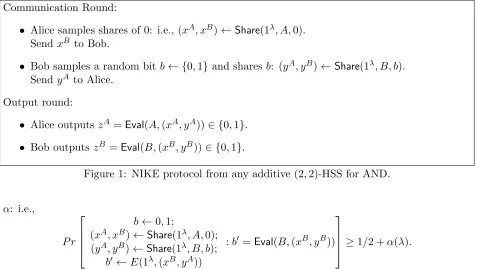
Proof. Consider the candidate NIKE protocol given in Figure 1.
Non-interactive: By construction, the protocol consists of a single communication round.
Correctness: Follows by the additive decoding correctness of the (2,2)-HSS for AND. Namely, with probability 1, it holdszA+zB = 0∈ {0,1}; that is, zA=zB.
Communication Round:
• Alice samples shares of 0: i.e., (xA, xB)←Share(1λ, A,0). SendxB to Bob.
• Bob samples a random bitb← {0,1}and shares b: (yA, yB)←Share(1λ, B, b). SendyAto Alice.
Output round:
• Alice outputszA=Eval(A,(xA, yA))∈ {0,1}.
• Bob outputszB=Eval(B,(xB, yB))∈ {0,1}.
Figure 1: NIKE protocol from any additive (2,2)-HSS for AND.
α: i.e.,
P r
b←0,1;
(xA, xB)←Share(1λ, A,0); (yA, yB)←Share(1λ, B, b);
b0 ←E(1λ,(xB, yA))
:b0 =Eval(B,(xB, yB))
≥1/2 +α(λ).
We prove in such caseα must be negligible, via the following two claims.
Claim 4.8. E must succeed with advantage α if Alice shares 1 instead of 0: Explicitly, there exists a negligible function ν1 for which
P r
b←0,1;
(xA, xB)←Share(1λ, A,1); (yA, yB)←Share(1λ, B, b);
b0 ←E(1λ,(xB, yA))
:b0=Eval(B,(xB, yB))
≥1/2 +α(λ)−ν1(λ).
Proof of Claim 4.8. Follows by the security of Alice’s HSS execution. Namely, consider a distin-guishing adversary Dfor the (2,2)-AND-HSS, who performs the following:
1: Sample a random bitb← {0,1}, and HSS shareb as (yA, yB)←Share(1λ, B, b).
2: Receive a challenge secret sharexB, generated either as (xA, xB)←Share(1λ, A,0) or (xA, xB)← Share(1λ, A,1).
3: ExecuteE on “transcript” xB and yA: Letb0 ←E(1λ,(xB, yA)).
4: Output 0 if and only ifb0 =b.
By construction, the distinguishing advantage of D is exactly the difference in the prediction ad-vantage of E from the real protocol and the protocol in which Alice shares 1 instead of 0. Thus, this difference must be bounded by some negligible functionν1.
Claim 4.9. The prediction advantage α(λ) of E must be negligible inλ.
Proof of Claim 4.9. Follows by the security of Bob’s HSS execution. Namely, consider a distin-guishing adversary Dfor the (2,2)-AND-HSS, who performs the following:
2: Receive challenge secret shareyA, generated as (yA, yB)←Share(1λ, B, b) for random challenge bitb← {0,1}.
3: ExecuteE on “transcript” xB and yA: Letb0 ←E(1λ,(xB, yA)).
4: Outputb0 as a guess forb.
By construction, the distinguishing advantage of D is precisely α(λ)−ν1(λ). Thus (since ν1 is negligible), it must be thatα is negligible, as desired.
This concludes the proof of Proposition 4.7.
As a direct corollary of this result, any form of HSS which implies additive (2,2)-HSS for AND automatically implies NIKE as well. This includes HSS for any functionalityF with an embedded AND in its truth table.
As an example, consider a form of split distributed point function [GI14], where the nonzero input value α ∈ {0,1}` of the secret point function f
α is held split as additive shares across two
clients. This corresponds to additive (2,2)-HSS for the function F(x;α1, α2) = [x == (α1⊕α2)] (i.e., evaluates to 1 if and only ifx =α1⊕α2). Such a notion would have applications for secure computation protocols involving large public databases, where the indexαof the desired data item is not known to either party, but rather determined as the result of an intermediate computation. Unfortunately, we show that such a tool (even for inputs of length 2 bits) implies NIKE, and thus is unlikely to exist from lightweight primitives.
Corollary 4.10. The existence of “split” DPF, i.e. additive(2,2)-HSS for the functionF(x;α1, α2) = [x== (α1⊕α2)], implies the existence of NIKE.
Proof. Consider the special case of 2-bit values α0, α1 ∈ {0,1}2. We show evaluation of F enables evaluation of AND of clients’ input bits, and thus additive (2,2)-HSS for AND. Indeed, for any
b1, b2 ∈ {0,1}, observe that F((0,0); (1, b1),(b2,1)) = [(0,0) == ((1, b1)⊕(b2,1))] = [(0,0) == (b1⊕1, b2⊕1)] =b1∧b2.
5
Applications
In this section we present two types of applications of HSS. In Section 5.1 we present an application to 2-round secure multiparty computation, and in Section 5.2 we present an application to worst-case to average-worst-case reductions.
5.1 From (3,2)-HSS to 2-Round MPC
Let us define the following function overZ2: 3Mult(x1, x2, x3) =x1x2x3. In this section, we show that (3,2)-HSS for 3Multimplies 2-round MPC for arbitrary functions in the client-server model. Recall that (n, m)-HSS refers to HSS with n clients, m servers, tolerating up to m−1 corrupted servers. Similarly, a (n, m)-MPC protocol is a MPC protocol in the client server model with n
clients,m servers, and is semi-honest secure against up to (m−1) corrupted servers.
Combining this with the additive δ-HSS construction of [BGI16a] from DDH would result in (n, m)-MPC from DDH with (at best) only 1/poly(λ) correctness. Fortunately, we can do better. Indeed, as an intermediate step in the proof of Theorem 5.1 (Lemmas 5.7 and 5.8 below), we prove that (3,3)-MPC for 3Mult-Plus also suffices to imply (n, m)-MPC for general functions. A construction of (3,3)-MPC for general functions (in the PKI model) was shown to follow from DDH in [BGI17] (in fact, they obtain (n, c)-MPC for any constant number of serversc). Combining this with Lemmas 5.7 and 5.8, and the fact that PRGs in NC1 also follow from DDH, we obtain the following result. This improves directly over the 2-round MPC result of [BGI17], by supporting an arbitrary polynomial number of servers instead of constant. A detailed comparison between our 2-round MPC protocols and other recent ones is provided in Section 5.1.3.
Corollary 5.2 (2-round MPC from DDH). For any n, m, and any polynomial-time computable function F : ({0,1}∗)n → {0,1}, there is a construction of an (n, m)-MPC protocol that securely
computes F in the PKI model, assuming DDH.
Overview of Proof of Theorem 5.1 We prove Theorem 5.1 by combining the following steps.
Step 1: (3,2)-HSS for 3Mult-Plus. Starting from an additive (3,2)-HSS scheme Π3Mult for
the function3Mult, thanks to the property of additive reconstruction, we can directly modify it to obtain an additive (3,2)-HSS for the function3Mult-Plus(again overZ2) defined as
3Mult-Plus((x1, z1), (x2, z2), (x3, z3)) = x1x2x3+z1+z2+z3 .
Lemma 5.3. There is a construction of additive (3,2)-HSS for the function 3Mult-Plus from any additive(3,2)-HSS for the function 3Mult.
Proof. An additive (3,2)-HSS for 3Mult-Plus can be obtained by simply combining the additive (3,2)-HSS Π3Mult for3Multwith an additive (3,2)-HSS ΠAdd for addition as follows: The 3 clients
and 2 servers run the protocol Π3Multand ΠAddin parallel, using inputsx1, x2, x3 in the former and inputsz1, z2, z3in the latter, respectively. Each serverSjforj∈[2] obtains two output sharesyj3Mult
andyAddj , and outputsyj =y3Multj +yAddj . It follows from the correctness and security of Π3Multand
ΠAdd that the above described scheme is a correct and secure HSS scheme for Π3Mult-Plus.
Step 2: (3,3)-MPC for 3Mult-Plus. From an additive (3,2)-HSS scheme for 3Mult-Plus, we can use theserver-emulation technique from [BGI17] to construct a 3-client3-serverMPC protocol for3Mult-Plus. In fact, the technique in [BGI17] is way more general, it shows that from any given
n-clientm-server HSS for3Mult-Plus, one can construct an-clientm2-server MPC protocol for any
n-ary functionF, assuming the existence of low-depth PRGs.
Lemma 5.4 (Server-Emulation in [BGI17]). Assume existence of PRGs in NC1. For any n, m
and polynomial-time function F : ({0,1}∗)n → {0,1}, there is a construction of an (n, m2)-MPC
protocol Π that securely computes F, from an additive(n, m)-HSS for 3Mult-Plus.
Their general lemma implies the following corollary we need, using the fact that one can reduce the number of servers by having a single server simulating multiple ones. See Claim 5.6.
Claim 5.6. For anyn,m,m0 < m, and any polynomial-time computable functionF : ({0,1}∗)n→
{0,1}, there is a construction of a(n, m0)-MPC protocolΠ0 that securely computesF, from a(n, m) -MPC protocol Π that securely computes F.
Proof. To reduce the number of servers, in Π0, the firstm0−1 servers act exactly as the firstm0−1 servers in Π, and the last server acts as all of the last m−m0+ 1 servers in Π. Correctness holds trivially. Security holds as the view of an attacker participating in an execution of Π0 corrupting a strict subset S of the m0 servers, and an arbitrary subsetT of the clients, is identical to the view of an attacker participating in an execution of Π, corrupting the same set of clients, and still a strict subset S0 of them servers. In particularS0 =S ifS does not contain the m0’th server, and
S0 =S ∪ {m0, m0+ 1,· · · , m}otherwise. Therefore, if Π securely computes F, so does Π0.
Step 3: (3, m)-MPC for 3Mult-Plus — Increase the number of servers. Next, from a (3,3)-MPC protocol for computing3Mult-Plus, we show how to construct (3, m)-MPC protocol for computing the same function3Mult-Plus, with an arbitrary numberm of servers.
Lemma 5.7. For any m, there is a construction of (3, m)-MPC protocol that securely computes
3Mult-Plus, from a(3,3)-MPC protocol that securely computes 3Mult-Plus.
Proof Overview. Let Π3 be a (3,3)-MPC protocol for 3Mult-Plus; consider m servers, and three clients C1, C2, and C3. Recall that each client Cd has input (xd, zd). If we naively let the three
clients execute Π3 with some subset of 3 servers, in the case all three servers are corrupted, the security of Π3 no longer holds, and the inputs of all clients are potentially revealed. Thus, the challenge is ensuring that when all but one server is corrupted, the inputs of honest clients remain hidden. To achieve this, each client secret-shares its input bitxd=
P
jsdj; as long as serverSj is
uncorrupted, the j’th share sdj for each honest client’s input xd remains hidden, and hence so are
the inputs xd. (The additive partzd of the inputs can be hidden easily; we omit this part in this
brief overview.) Towards this, note that multiplying x1, x2, x3 boils down to computing the sum of all possible degree 3 monomials over the shares x1x2x3 = Pijks1is2js3k. Our idea is using the
protocol Π3 to compute each monomial s1
is2js3k hidden with some random blinding bits, and using
a protocol ΠAdd for addition to cancel out these random blinding bits, as well as add z1, z2, z3, all of which done in parallel. More specifically,
• for everyi, j, k,C1, C2, C3 together with three appropriate servers described below run Π3 to enable the output client to obtain Mijk =s1is2js3k+t1ijk+t2ijk+t3ijk, wheretdijk is a random
blinding bit sampled by client Cd;
• in parallel, C1, C2, C3 together with all mservers run a (3, m)-MPC protocol ΠAdd to enable
the output client to obtain the sum T =T1+T2+T3, whereTd=zd−Pi,j,ktdijk;
• finally, the output client adds allMijk withT, which gives the correct output, i.e.,x1x2x3+
z1+z2+z3.
The only question left is what are the three servers involved for computingMijk; they naturally
should be serversSi, Sj, Sk, since for an honest client, sayC1, if serverSi is uncorrupted, the share
s1i remains hidden in all computations ofMijkinvolving this share. This allows us to argue security.
One technicality is that some monomials may have form s1
is2is3j or s1is2is3i and only correspond to
two serversSi, Sj or oneSi. In the former case, we will use the (3,2)-MPC protocol Π2, and in the
A full proof is provided in Section 5.1.1.
Step 4: (n, m)-MPC for F — Increase the number of clients and handle general functions. Finally, we show how to construct MPC protocols for computing any n-ary function
F, from MPC protocols for computing3Mult-Plus, using the same numberm of servers.
Lemma 5.8. Assume the existence of PRGs in NC1. For any n, m, and any polynomial-time computable function F : ({0,1}∗)n → {0,1}, there is a construction of (n, m)-MPC protocol that securely computes F, from a (3, m)-MPC protocol that securely computes 3Mult-Plus.
Proof Overview. Staring from a (3, m)-MPC protocol Π3Mult-Plus for 3Mult-Plus, our goal is
con-structing a (n, m)-MPC protocol ΠF for an arbitraryF with an arbitrary number of clients. To do
so, we reduce the task of computing F to the task of computing a degree-3 randomized encoding
REF(x1,· · · , xn; r) ofF. Here, having a degree of 3 means thatREF can be represented as a degree
3 polynomial in its input and random bits. Such a randomized encoding scheme is constructed in [IK02, AIK04], assuming the existence of a low-depth PRG. The first question is where does the random taper come from. A natural choice is havingr =r1+· · ·+rn contributed by all clients.
When the randomized encoding has degree 3, its computation can be expanded into a sum of de-gree three monomials, that is, REF(x1,· · ·, xn ; r = r1 +· · ·+rn) = Pa`ijk vivjvk ,where each
variable vi is either a bit in some input xl or a bit in some random taperl. This decomposes the
computation of F into many 3-way multiplications, which can be done securely using3Mult-Plus. More specifically, in the protocol ΠF,
• for every monomiala`
ijkvivjvk, the three clientsCli, Clj, Clk holding the variablesvi, vj, vkrun
Π3Mult-Plus with allm servers to enable the output client to obtainMijk=aijk` vivjvk+t`,ijk1 +
t`,ijk2 +t`,ijk3, where the three tvariables are random blinding bits sampled by the three clients respectively;
• in parallel, all clients and servers run a (n, m)-MPC protocol ΠAdd for addition to enable the
output client to obtain the sum of all tblinding elements;
• the output client adds allMijk terms, subtracts the sum of blinding elements to obtain the
randomized encoding ofF, and decodes the randomized encoding.
A full proof is provided in Section 5.1.2.
5.1.1 Increase the Number of Servers – Proof of Lemma 5.7
In this section we construct a (3, m)-MPC protocol Πm that securely computes3Mult-Plus for any number mof servers. Our construction makes use of the following sub-protocols:
• A (3,3)-MPC protocol Π3 for computing 3Mult-Plus, and a (3,2)-MPC protocol Π2 for com-puting 3Mult-Plus. By Claim 5.6, the latter is implied by the former.
Claim 5.9 (MPC for ADD). For any n, m, there is a construction of (n, m)-MPC protocol that (perfectly) securely computes Addn:{0,1}n→ {0,1} defined below:
Addn(x1, x2,· · ·, xn) =
X
i∈[n]
xi
Proof. To compute the sum, each client Ci samples a random m-way secret share of its input xi,
that is,si1,· · ·, simsuch thatPj∈[m]sij =xi, and sends sharesij to serverSj for allj∈[m]. Each serverSj sums up all the shares it receives as its output shareyj =Pi∈[n]sij. It is easy to see that
correctness holds. For security, if all clients are corrupted, the view of the corrupted parties can be emulated honestly, since all inputs are known to the simulator. Otherwise, since at least one server is uncorrupted, the shares sent from the honest clients to corrupted servers can be emulated using random bits. This emulation is perfect, since without knowing the shares that honest clients send to honest servers, the marginal distribution of the shares sent to corrupted servers are random.
The ProtocolΠm: The three (input) clientsC1, C2, C3receive respectively inputs (x1, z1), (x2, z2) and (x3, z3); themserversS1,· · ·Smand the output clientOhave no input. They proceed as follows
to compute3Mult-Plus((x1, z1), (x2, z2), (x3, z3)) =x1x2x3+z1+z2+z3.
1. Each clientCdford∈[3] additively share its inputxd, by sampling{sdi}i∈[m] randomly from {0,1}subject to P
sdi =xd. Cd additionally sample random bitstdijk for everyi, j, k ∈[m].
2. For every i, j, k∈[m], clientsC1, C2, C3 work with serversSi, Sj, Sk andO to compute
Mijk=s1is2js3k+t1ijk+t2ijk+t3ijk ,
by running in parallel appropriate protocols as described below.
Case 1: i, j, k are all distinct. In this case, C1, C2, C3 execute protocol Π3 with Si, Sj, Sk
and O, using inputs (s1i, t1ijk), (sj2, t2ijk), and (s3k, t3ijk) respectively.
Case 2: Exactly two of i, j, k are equal.
• If they have pattern (i, i, j), the clients execute the protocol Π2 with Si, Sj and O,
using inputs (s1
i, t1iij), (s2i, t2iij), and (s3k, t3iij) respectively.
• If they have pattern (i, j, i), the clients execute the protocol Π2 with Si, Sj and O,
using inputs (s1i, t1iji), (s2j, t2iji), and (s3i, t3iji) respectively.
• If they have pattern (j, i, i), the clients execute the protocol Π2 with Si, Sj and O,
using inputs (s1j, t1jii), (s2i, t2jii), and (s3i, t3jii) respectively.
Case 3: Ifi=j =k, each clientCd sends (sdi, tdiii) directly to server Si, who computesMiii
and sends it toO. Denote this simple protocol as Π1.
In each case,O obtainsMijk.
3. ClientsC1, C2, C3 run ΠAddwith all servers S1,· · ·, Sm and O to compute the sum
T = X
d∈[3]
Td, where Td=zd−
X
i,j,k∈[m]
tdijk ,
where Cd uses input Td, and O obtains output T. This execution is carried out in parallel
4. Finally, the output client O outputs
y = X
i,j,k∈[m]
Mi,j,k+T
Correctness: It is easy to verify thatO obtains the correct output.
y = X
i,j,k∈[m]
s1is2js3k+tijk1 +t2ijk+t3ijk+ X
d∈[3]
zd− X
i,j,k∈[m]
tdijk
= X
i,j,k∈[m]
s1is2js3k+ X
d∈[3]
zd
= x1x2x3+z1+z2+z3=3Mult-Plus((x1, z1), (x2, z2), (x3, z3))
The SimulatorSimm of Πm: To show the security of Πm, we need to construct a simulatorSimm, such that, for every possible corruption setI excluding at least one server,Simm can simulate the view of the corrupted players using only the inputs of the corrupted clients, and the output if the output client is corrupted. Formally, letRealΠm(I,{(xd, zd)}d∈[3]) denote the view of the corrupted
partiesI in an execution of Πmwith client inputs{(xd, zd)}d∈[3]. The simulatorSimm must satisfy:
RealΠm(I, {xd, zd}d∈[3])
λ ≈
Simm(I, {xd, zd}ds.t.Cd∈I, y 0
) λ, y0 = (
y O ∈ I ⊥ O 6∈ I
We now formally describe the simulation procedureSimm(I,{(xd, zd)}ds.t.Cd∈I, y).
IfO is corrupted,Simm proceeds as follows:
1. Simm samples the following shares and blinding bits.
Sampling I: For every corrupted client Cd ∈ I, Simm samples {sdi} at random subject to
thatP
i∈[m]sdi =xd, and samples tdijk at random for everyi, j, k ∈[m].
Sampling II: For every i, j, k ∈ [m], such that, Si, Sj, Sk are all corrupted, Simm samples
s1i, s2j, s3k and t1ijk, t2ijk, t3ijk at random.
Sampling III: If all clients are corrupted, that is, {C1, C2, C3} ⊆ I, compute for alli, j, k
Mijk=s1is2js3k+t1ijk+t2ijk+t3ijk ,
using shares and blinding bits sampled in step Sampling I.
Otherwise, computeMijk honestly fori, j, k, such that,Si, Sj, Skare all corrupted, using
shares and blinding bits sampled in step Sampling II. For everyi, j, k, such that, not all of Si, Sj, Sk are corrupted, sampleMijk at random.
Let S denote the set of shares sampled, T the set of blinding bits, and M the set of Mijk
bits computed or sampled.
2. For everyi, j, k∈[m],Simmsimulates the execution for computingMijk in two cases
Case I: {Si, Sj, Sk} ⊆ I. In this case, the security of protocols Π3, Π2, and Π1 no longer
hold as all servers are corrupted. Simm finds sharess1
i,s2j,s3k and blinding bitst1ijk,t2ijk,
t3ijk in S and T respectively (sampled in step Sampling II). It emulates the view of the corrupted parties in the execution for computing Mijk by emulating the honest clients
using inputs (s1
i, t1ijk), (s2j, t2ijk), (s3k, t3ijk).
Case II: {Si, Sj, Sk} 6⊆ I. In this case,Simm relies on the security of protocols Π3, Π2, and
Π1 to simulate.
Case 1: i, j, k are all distinct. Simm finds share sdi
d (id = i if d = 1, id = j if d= 2,
and id =k ifd= 3) and blinding bit tdijk of each corrupted client Cd ∈ I in S and
T respectively (sampled in step Sampling I). It then invokes the simulator Sim3 of protocol Π3 with inputs
Sim3
I ∩ {C1, C2, C3, Si, Sj, Sk, O}, {sdid, t
d
ijk}ds.t.Cd∈I, Mijk
to simulate the view of the corrupted parties in the execution for computingMijk.
Case 2: Exactly two ofi, j, k are equal. Simm finds the relevant sharesd
id and blinding
bit tdijk of each corrupted client Cd ∈ I in S and T as before. It then invokes the
simulatorSim2 of protocol Π2 with inputs
Sim3
I ∩ {C1, C2, C3, Si, Sj, Sk, O}, {sdid, t
d
ijk}ds.t.Cd∈I, Mijk
to simulate the view of the corrupted parties in the execution for computingMijk.
Case 3: If i = j = k, only one server Si is involved in computing Miii and is
uncor-rupted. Thus the only message in the view of the corrupted parties is the message from Si to O sendingMiii. Simm emulates the message using Miii∈ M computed
or sampled in step Sampling III. Denote bySim1 this simulation procedure.
3. Finally, Simm simulates the execution of ΠAdd by invoking the simulator SimAddfor ΠAdd
SimAdd
I,
Td=zd+
X
ijk
tdijk
ds.t.Cd∈I ,
y− X ijk Mijk .
IfO is uncorrupted, Simm proceeds as described above, except for the following:
• In Step 1, Simm does not execute Sampling III.
• In Step 2, to simulate the executions computingMijk, in Case 1 and 2,Simm invokesSim3 and
Sim2 withoutMijk, and in Case 3, sinceO is uncorrupted, there are no messages to simulate.
• In Step 3, to simulate the execution of ΠAdd, Simm invokes SimAdd without the output y−
P
ijkMijk.
Correctness of Simulation: To show that the view generated by Simm is indistinguishable to the view of the corrupted parties in the real execution, we introduce the following intermediate hybrid simulation procedure:
1. For every clientCd (honest and corrupted),HSimemulates perfectly its shares and blinding bits at random, that is, sampling{sd
i}at random subject to that
P
i∈[m]sdi =xd, and samples
tdijk at random for everyi, j, k ∈[m]. Then, it computes all Mijk honestly
Mijk=s1is2js3k+t1ijk+t2ijk+t3ijk .
2. For every i, j, k ∈[m], HSimsimulates the view of the corrupted parties in the execution for computing Mijk as Simm does, but using the above honestly generated {sdi, tdijk} as inputs
and {Mijk}as outputs forSim3,Sim2,Sim1.
3. HSimsimulates the view of the corrupted parties in the execution of ΠAddasSimmdoes, using
the above honestly generated{tdijk} as inputs andy−P
ijkMijk as output for SimAdd.
We first argue that the view of the corrupted parties in the real execution is indistinguishable to that generated by the hybrid simulator, that is,
RealΠm(I, {(xd, zd)}d∈[3])
λ ≈
HSim(I, {(xd, zd)}d∈[3]) λ
The only difference between the hybrid simulation and the real execution is that in the former all executions of Π3,Π2,Π1,ΠAdd are simulated, whereas in the latter, they are executed honestly.
Since HSim generates the inputs and outputs fed to Sim3,Sim2,Sim1,SimAdd honestly. It follows
directly from the security of Π3,Π2,Π1,ΠAdd that the above indistinguishability holds.
Next, we argue that the hybrid simulation is indistinguishable to the actual simulation, that is,
HSim(I, {(xd, zd)}d∈[3]) λ ={Simm(I, {(xd, zd)}ds.t.Cd∈I, y)}λ
The only difference in the two simulation procedures lies in how the inputs and outputs fed to the simulators Sim3,Sim2,Sim1,SimAdd are generated. In HSim, they are generated honestly, whereas
Simm generates them with the following difference:
• For every honest clientCd, and every corrupted serverSi, the sharesdi is generated at random,
not subject to being consistent withxd.
• If not all clients are corrupted, for everyi, j, k s.t. not all ofSi, Sj, Sk are corrupted, Mijk is
sampled at random instead of computed honestly.
We argue that the above sampling procedure produces the same distribution as in HSim. First, for every uncorrupted client Cd, the shares sdi corresponding to uncorrupted severs Si 6∈ I are
never used by neither Simm norHSim. Therefore, the marginal distribution ofsdi corresponding to corrupted seversSi∈ I are random. Second, for every i, j, k s.t. not all ofSi, Sj, Sk are corrupted,
the blinding bits tdijk belonging to the honest clients Cd 6∈ I are never used by neither Simm nor
HSim. Therefore, the distribution of Mijk is also random. Since the rest of the simulation is
identical inHSimand Simm, we have that their distributions are identical.
5.1.2 General Client-Server MPC for Any Functionality – Proof of Lemma 5.8
For any polynomials n, m, and any polynomial-time computable function F : ({0,1}∗)n → {0,1}, we construct a (n, m)-MPC protocol ΠF that securely computes F. To this end, we rely on the
following tools:
• A degree-3 randomized encoding (REF,RE.Eval) for F (see Definition 5.10 below).
• A (3, m)-MPC protocol Π3Mult-Plus that securely computes3Mult-Plus, as guaranteed to exist
by Lemma 5.7.
• A (n, m)-MPC protocol ΠAdd that securely computes Add, as given by Claim 5.9.
Definition 5.10. Arandomized encoding scheme(REF,RE.Eval) for a functionF :{0,1}∗ → {0,1}
consists of two algorithms that behave as follows.
[
F(x) ← REF(x) probabilistically samples a string, which acts as a randomized encoding for
the computation (F, x), in time polynomial in T|x|, the worst-case running time of (a given
implementation of)F on inputs of length |x|.
y←RE.Eval(F[(x)), which is meant to deterministically compute a string y from the randomized
encoding F[(x), in time polynomial in|F[(x)|.
They satisfy the following conditions.
Correctness: For anyx∈ {0,1}∗,
Pr[ RE.Eval(REF(x))6=F(x) ]≤negl(|x|) ,
where the probability is taken over the randomness ofREF.
Simulation: There exists an algorithm RE.Sim such that the following ensembles are computa-tionally indistinguishable,3
REF(x) x ≈
RE.Sim(1|x|, F(x)) x ,
whereRE.Sim runs in time polynomial inT|x| as defined above.
The Protocol ΠF: Let (REF,RE.Eval) be the degree-3 randomized encoding scheme for the
functionF. To computeF(x1,· · · , xn), thenclientsC1,· · · , Cn, with respective inputsx1,· · ·, xn,
work with them servers S1,· · ·Sm to enable the output clientO to obtain a randomized encoding
of the computation (F, x),
[
F(x) =REF(x1,· · · , xn ; r=r1+· · ·+rn) ,
where the random tape r is the (bit-wise) sum ofn random tapes r1,· · · , rn contributed by each
client, andOcan then evaluate the randomized encodingF[(x) to obtain the actual outputy=F(x).
3Here, the ensemble short-hand means that there exists a negligible functionνsuch that for every stringx∈ {0,1}∗