Mahnush Movahedi, Jared Saia, and Mahdi Zamani
Department of Computer Science, University of New Mexico
{movahedi, saia, zamani}@cs.unm.edu
Abstract. In secure multi-party shuffling, multiple parties, each holding an input, want to agree on a random permutation of their inputs while keeping the permutation secret. This problem is important as a primitive in many privacy-preserving applications such as anonymous communication, location-based services, and electronic voting. Known techniques for solving this problem suffer from poor scalability, load-balancing issues, trusted party assumptions, and/or weak security guarantees.
In this paper, we propose an unconditionally-secure protocol for multi-party shuffling that scales well with the number of parties and is load-balanced. In particular, we require each party to send only a polylogarithmic number of bits and perform a polylogarithmic number of operations while incurring only a logarithmic round complexity. We show security under universal composability against up to aboutn/3 fully-malicious parties. We also provide simulation results showing that our protocol im-proves significantly over previous work. For example, for one million parties, when compared to the state of the art, our protocol reduces the communication and computation costs by at least three orders of magnitude and slightly decreases the number of communication rounds.
1 Introduction
Shuffling a sequence of values is a fundamental tool for randomized algorithms; applications include fault-tolerant algorithms, cryptography, and coding theory. In secure multi-party shuffling (MPS)
problem, a group of parties each holding an input value want to randomly permute their inputs while ensuring no party can map any of the outputs to any of the input holders better than can be done with a uniform random guess. An MPS protocol is a useful primitive for achieving privacy and robustness in many applications such as anonymous communication [Cha81], location-based services [GG03], electronic voting [Nef01], secure auctions [FA00], and general multi-party computation [BGT13].
Despite many applications of MPS, we are not aware of any technique that can be used to achieve a scalable and secure MPS protocol. We believe this is of increasing importance with the growth of modern networks. Moreover, most protocols lack load-balancing – a crucial requirement for protocols running in large networks. With the rise of sophisticated cyber-attacks, it is now essential to provide provable guarantees against strong adversaries. Also, relying on trusted parties has become a major security issue in today’s world.
In this paper, we address these concerns by proposing a scalable and load-balanced protocol for MPS that is unconditionally-secure against malicious attacks and does not rely on trusted parties. Our Contribution. We first propose a formal definition of security for MPS. Our definition is different from the standard definition of security for multi-party computation (MPC) [BGW88], where a group of parties each holding aprivate input want to compute a known function over their inputs, without revealing any more information about their inputs than what is revealed by the output of the function. Instead of focusing on inputs privacy, we base our definition on the secrecy of the output permutation.
Next, we propose an unconditionally-secure MPS protocol that scales polylogarithmically with the number of parties, tolerates malicious faults, and is load-balanced. Simulations of our protocol suggest that it compares favorably with the current state of the art in terms of communication cost, computation cost, and the number of communication rounds.
In our protocol, we achieve sublinear per-party communication complexity by requiring each party to only communicate with polylogarithmic-size groups of parties rather than with all par-ties. This approach, however, introduces important technical challenges to our model; the most important one is to guarantee the adversary cannot break the security of our protocol via coali-tions of corrupted parties in more than one group, when we share the same secret information with the parties in these groups. Some prior work solve this by relaxing the load-balancing require-ment [BGT13], the resiliency bound [ZMS14], or practical efficiency [DKMS12]. We propose a novel technique calledshare renewal without relaxing any of these requirements.
When a protocol is concurrently executed alongside other protocols, one requires to ensure this composition preserves the security of the protocol.1 Since our goal is to design modular MPS protocols that can be flexibly used with other protocols, we show security of our protocol under the universal composability framework as described by Canetti [Can01].
Our Model. Consider nparties P1, ..., Pn in a fully-connected synchronous network with private
and authenticated channels. We assume the parties have no access to any trusted party and/or to any reliable broadcast channel. We consider a malicious adversary who corrupts at mostt < n of the parties and can see (and analyze) the entire traffic in the network, but cannot see the content of messages transmitted between uncorrupted parties since we assume private links. The corrupted parties not only can gossip their information with other corrupted parties but also can deviate from the protocol in any arbitrary manner, e.g., by sending invalid messages or remaining silent. We finally assume that the adversary is static meaning that it has to select the set of corrupted parties at the start of the protocol.
Problem Statement. LetFbe a finite field, and π:{1, ..., n} → {1, ..., n} denote apermutation;
a one-to-one and onto function that maps a sequence of n elements (x1, ..., xn) ∈ Fn to another
sequence (xπ(1), ..., xπ(n))∈Fn. For i∈ {1, ..., n}, every party Pi holds an input xi ∈F. A multi-party shuffling (MPS) protocol allows these parties to agree on a permutation π of the sequence
(x1, ..., xn). We consider two variants of this problem. In the first variant, which we callsingle-output
MPS, each partyPiis required to receive only one of the shuffled inputsxπ(i). In the second variant, which we callall-output MPS, each party receives the entire output sequence (xπ(1), ..., xπ(n)). We now define our notion of security.
Definition 1. An MPS protocol is said to be t-secure if and only if, in the presence of a malicious adversary corrupting up to t < n of the parties, the protocol ensures
– Unlinkability: the adversary can guess π correctly with probability at most (n−1t)!. We refer to the set of possible permutations from which the adversary tries to guess the secret permutation π as the unlinkability set.
– Correctness:each party is guaranteed that the output it receives is one of the inputs (for single-output MPS) or contains all (and only all) the inputs (for all-single-output shuffle).
– Output delivery: corrupted parties cannot prevent honest parties from receiving their output.
1An adversary attacking several protocols that run concurrently can cause more harm than by attackingstand-alone
In this paper, we consider a relaxed version of Definition 1. This allows us to achieve the highest level of efficiency in our protocol in exchange of a very small increase in the success probability of the adversary.
Definition 2. We say an MPS protocol is almost t-secure if and only if in the presence of a malicious adversary corrupting up to t < n of the parties, the protocol guarantees correctness and output delivery, and that the adversary can guess π correctly with probability at most (n−1t)!(1 +δ), where δ =o(1) is called the deviation factor.
1.1 Our Results
We prove the following main theorem in Section 4.
Theorem 1. There exists a universally-composable MPS protocol such that with probability 1− O(n−3), it guarantees the following properties:
– The protocol is almost t-secure against a computationally-unbounded malicious adversary with static corruptions, where t <(1/3−)n, for some positive constant .
– The deviation factor is O(2−2k
√
logn
), for some constant k >1.
– Each party sends O˜(1) bits and computesO˜(1) operations.2
– The protocol terminates after O(logn) rounds of communication.
In Section 3.4, we also construct a computationally-secure variant of Theorem 1 to observe (via simulations) how much cryptographic techniques can influence practical efficiency of our protocol. This protocol provides the same guarantees as Theorem 1 except for a polynomially time-bounded adversary. We provide our simulation results in Section 5.
1.2 Related Work
Shuffling in the multi-party setting has already been studied, primarily in the context of mix-nets. As first defined by Chaum [Cha81], a mix-net consists of a chain of servers (called mixes) that randomly reorder a sequence of messages in a way that the correlation with the corresponding input messages remains hidden. To ensure honest behavior in the malicious setting, a verifiable shuffling [Nef01,AW07] technique is often used, where each mix is asked to prove correctness of its shuffles without leaking how the shuffle was performed.
Unfortunately, Mix-nets and verifiable shuffling techniques rely on cryptographic assumptions. Moreover, mix-nets require semi-trusted servers and are known to be vulnerable totraffic-analysis
attacks [PW86]. In traffic analysis, a global adversary maps messages to their senders and recipients by monitoring the traffic exchanged between parties. Protocols such as [RS93,BFT04] attempt to solve this with provable guarantees. However, they are either complicated and scale linearly with the number of parties [RS93], or are not secure against malicious attacks and an adversary monitoring all communication channels [BFT04].
Chaum [Cha88] uses MPC to introduce thedining cryptographers network (DC-net) for achiev-ing unlinkability3 between inputs and outputs; a crucial requirement for both anonymous
commu-2
The symbol ˜Ois used as a variant of the big-O notation that ignores the logarithmic factors. Thus,f(n) = ˜O(g(n)) meansf(n) =O g(n) logkg(n)
, for somek.
3
Table 1.Comparison of MPS techniques
Protocol Adversarial Power
Malicious Adversary?
Fraction of Parties Controlled
Fraction of Links Monitored
MPS
Security Latency Bandwidth
Easy to Implement? Chaum [Cha81] Computational No O(1)† See note‡ See note§ polylog(n) polylog(n) Yes Rackoff and Simon [RS93]Computational No O(1)† All Statistical£polylog(n) O˜(n) No Bermanet al.[BFT04] Computational No O(1)† O(1) Statistical£polylog(n) polylog(n) Yes
Boyleet al.[BGT13] Computational Yes 1/3− All Almost polylog(n) O˜(n) No Daniet al.[DKMS12] Unconditional Yes 1/3− All Almost O(logn) O˜(√n) No This paper Unconditional Yes 1/3− All Almost O(logn) O˜(1) Yes
†This protocol assumes the rest of parties are trusted.
‡[PW86] shows traffic-analysis attacks on this protocol if all links are monitored by the adversary. §Originally supposed to generate perfect shuffles but known attacks reduce shuffle security.
£Measures the statistical distance between the distribution generated by the system and the
uniform distribution [RS93].
nication and MPS. He uses a simple MPC technique to design an unconditionally-secure anonymous broadcast protocol called . When a partyP wants to broadcast a messageM anonymously, all par-ties participate in a multi-party sum with input zero exceptP who participates with its input M. As a result of MPC, all parties learn the sum of the inputs (i.e.,M) without any party being able to trace the output to P. The DC-net eliminates the two limitations of Mix-nets: cryptographic assumptions and traffic-analysis vulnerability.
Although the original DC-net allows only one participant to broadcast at a time, there are variants such as [vABH03] that implement all-to-all anonymous broadcast and thereby enable multi-party shuffling of the inputs. Unfortunately, DC-nets suffer from collision and jamming attacks. Although several work address these issues [vABH03,GJ04,CGWF13], they either do not scale well with the number of parties [vABH03,GJ04] or require a few highly-available servers [CGWF13].
MPS is closely related to data-oblivious protocols [GO96]. A protocol is data-oblivious if its control flow is independent of input data. Such a protocol can be used to anonymize access pat-terns or prevent an adversary from taking over a certain fraction of protocol inputs. Customized shuffling techniques are designed in the context of oblivious RAMs [GO96], oblivious database manipulation [LWZ11], oblivious sorting [Zha11,Goo11,HKI+12], and evaluation of sublinear func-tions [BGT13].A multi-party sorting protocol such as that of [Zha11,HKI+12] can be used to per-form MPS. Although these protocols scale well withn, they scale poorly with the number of parties. Rackoff and Simon [RS93] show that if all parties send at each time step, then the traffic-analysis problem can be solved using MPC. This means that a general MPC scheme such as [BGW88] that can securely compute any functionality (including shuffling), can be used to design an MPS protocol with traffic-analysis resistance. Although much theoretical progress has been made in the MPC literature to achieve polylogarithmic overhead [BGT13,DKMS12], there is a lack of practical solutions, especially for large number of parties. Moreover, most of these techniques cannot be easily implemented due to a lack of detailed protocol specifications.
2 Preliminaries
We now define our notation and describe the tools used throughout this paper.
Notation. For prime p, let Fp denote a finite field withp elements. We say an event occurswith high probability, if it occurs with probability 1−1/nc, for some positive constantc.
Verifiable Secret Sharing. A secret sharing protocol allows a party (calledthe dealer) to share a secret among n parties such that any set oft or less parties cannot gain any information about the secret, but any set of at least t + 1 parties can reconstruct it. A verifiable secret sharing (VSS) protocol is a secret sharing protocol with the additional property that after the sharing phase, a corrupted dealer is either disqualified or the honest parties can reconstruct the secret, even if shares sent by corrupted parties are spurious. In our protocol, we use the VSS scheme of Ben-Or et al. [BGW88]. We refer to the sharing protocol of this scheme as VSS-Share and to its reconstruction protocol as VSS-Reconst.
The VSS scheme of [BGW88] is based on Shamir’s secret sharing [Sha79]. In this scheme, the dealer shares a secret samong n parties by choosing a random polynomial f(x) of degree t such thatf(0) =s. For all i∈[n], the dealer sendsf(i) to the i-th party. Since at least t+ 1 points are required to reconstruct f(x), no coalition of t or less parties can reconstruct s. A secret sharing scheme is linear if given two shares ai and bi of secrets a and b, ci = ai +bi is a valid share of
c=a+b.
Theorem 2 ([BGW88]). There exists a synchronous linear VSS scheme for t < n/3 that is unconditionally-secure against a static malicious adversary.
Quorum Building. King et al. [KLST11] give a protocol that can be used to bring all parties to agreement on a collection of n quorums. A quorum is a set of N = O(logn) parties, where it is guaranteed that at most a fixed fraction of the parties in the set are corrupted. In general, one can use any BA algorithm (such as [BGH13]) to build a set of quorums in the way described in [KLST11].
Theorem 3 ([KLST11,BGH13]).There exists an unconditionally-secure protocol that brings all honest parties to agreement onnquorums with probability1−O(n−3). The protocol hasO˜(n) amor-tized communication and computation complexity over the number of parties, and it can tolerate up to (1/3−)n corrupted parties, for any positive . Each quorum is guaranteed to have T < N/3
corrupted parties.
We refer to this protocol asBuild-Quorums. Several recent MPC schemes [BGT13,ZMS14] make use of quorums to achieve scalability. We are particularly inspired by Dani et al. [DKMS12]. Sorting Networks. A sorting network is a network of comparators. Each comparator is a gate with two input wires and two output wires. When two values enter a comparator, it outputs the lower value on the top output wire, and the higher value on the bottom output wire. Aj-tai et al. [AKS83b] describe an asymptotically-optimalO(logn) depth sorting network. However, this network is not practical due to large constants hidden in the depth complexity. Leighton and Plaxton [LP90] propose a probabilistic sorting circuit with depth 7.44 lognthat sorts a randomly chosen input permutation with very high probability meaning that it sorts all butσ·n! of the n! possible input permutations, whereσ = 1/22κ
√
logn
, for some constantκ >0.4
4This gives a Monte Carlo guarantee: for (1−σ)n! of input permutations, the circuit sorts correctly, but for the
Secure Comparison. Given two linearly secret-shared valuesa, b, Damg˚ardet al.[DFK+06] pro-pose an efficient protocol for computing a new secret-shared valueρ= (a≤b) meaning that ρis 1 if a≤b and 0 otherwise. Their protocol is unconditionally secure, has O(1) rounds, and requires
O(`) invocations of a secure multiplication protocol, where ` is the bit-length of elements to be compared. We denote this protocol byCompare. For multiplication of secret-shared values, we use the protocol of Ben-Or et al. [BGW88] with the simplifications of Gennaro et al. [GRR98]. By plugging the VSS of Theorem 2 into the protocol of [GRR98], we achieve an unconditionally-secure multiplication protocol, which we denote byMultiply.
Secure Broadcast In the malicious setting, when parties have only access to secure pairwise channels, a protocol is required to ensure secure (reliable) broadcast. Such a broadcast protocol guarantees all parties receive the same message even if the broadcaster (dealer) is corrupted and sends different messages to different parties. It is known that a Byzantine agreement protocol can be used to perform secure broadcasts. Braud-Santoni et al. [BGH13] describe the following result. In our proofs, we refer to this algorithm by BA.
Theorem 4 ([BGH13]). There exists an unconditionally-secure protocol for performing secure broadcasts among n parties. The protocol has O˜(n) amortized communication and computation complexity, and it can tolerate up to (1/3−)n corrupted parties, for any positive .
The algorithm of [BGH13] achieves this result by relaxing the load-balancing requirement. If concerned with load-balancing, one can instead use the load-balanced Byzantine agreement of Kinget al. [KLST11] withO(√n) blowup.
3 Our Protocol
We now describe our MPS protocol. Consider two finite fields Fp and Fq of prime orders p and q
respectively. The high-level idea is as follows: for each partyPi holding an inputxi ∈Fp, a uniform
and independent random valueri ∈Fq is chosen to form an input pair (ri, xi), wherei∈[n]. Then,
the sequence of pairs ((r1, x1), ...,(rn, xn)) is sorted according to the first elements of the pairs. We
show that, for sufficiently large prime q, this algorithm randomly shuffles the sequence of inputs
(x1, ..., xn) with high probability.
To compute this functionality securely, we construct the circuit shown in Figure 1, which we denote by M. This circuit consists of the probabilistic sorting circuit of [LP90] augmented by
n input gates; the functionality of each gate is computed by a quorum. M is created jointly by all parties before the protocol starts during an input-independent setup phase. Then, it is jointly evaluated by all parties possibly many times to shuffle many input sequences5.
The circuit Mis constructed in the following way. First, we create nquorumsQ1, ..., Qn each
withN =O(logn) parties. We assign each partyPi toQi, for alli∈[n]. This quorum is responsible
for receiving Pi’s input xi and choosing a random valueri on behalf of Pi. Now, let C denote the
probabilistic sorting network of [LP90] andm=Θ(nlogn) be the number of gates in C.
For all j∈[m], we assign the j-th gate of C toQ(jmodn). This quorum is later used for secure evaluation of the gate’s functionality. For simplicity of notation, we assume the quorums associated with the output gates of C are Q1, ..., Qdn/2e.6 When used to receive inputs of M, we refer to
5This setup phase is information-theoretically secure and does not rely on one-time pads. Thus, the same Mcan
be usedanynumber of times for shuffling many input sequences.
6Note that a quorum can bere-used any number of times for local computations as long as its inputs for each use
𝑄1
𝑄1
𝑃1
𝑥1
(𝑟1, 𝑥1)
𝑄2
𝑃2
𝑥2
(𝑟2, 𝑥2) 𝑄 𝑚−𝑛
2 mod 𝑛
𝑥𝜋 1 𝑥𝜋 2
⋯
𝑄𝑛/2𝑄𝑛−1
𝑃𝑛−1
𝑥𝑛−1
(𝑟𝑛−1, 𝑥𝑛−1)
𝑄𝑛
𝑃𝑛
𝑥𝑛
(𝑟𝑛, 𝑥𝑛)
𝑄𝑚 mod 𝑛
𝑥𝜋 𝑛−1 𝑥𝜋 𝑛
⋮
⋯
⋯
⋮
Probabil
isti
c
Sorting Circ
uit
𝑃1 𝑃2
⋯
𝑃𝑛−1 𝑃𝑛Fig. 1.MPS circuit
Q1, ..., Qnasinput quorums. When used to send outputs ofMto all parties, we refer toQ1, ..., Qdn/2e
asoutput quorums.
Creating the probabilistic sorting circuitC requiresO(log2n) random bits known to all parties. We generate these bits by asking one of the quorums to agree on a sequenceRofO(log2n) random bits, and then send R to all parties via a binary tree of quorums. This randomness is then used by the parties to agree on the structure of C using the random butterfly tournament procedure described in [LP90].
To ensure privacy, every quorum in M receives and maintains its inputs in a secret-shared format, i.e., each party receives only a share of each input rather than the actual input. Moreover, all computations in these quorums are performed over secret-shared values. When we say a party
VSS-shares (or secret-shares) a value sin a quorum Q (or among a set of parties), we mean the party participates as the dealer with input sin the protocolVSS-Sharewith all parties in Q(or in the set of parties). As a result, the parties agree on a random polynomialf(x) such thatf(0) =s, and thei-th party receivesf(i) as his verified share ofs.
Protocol 1 shows our main protocol, where M is evaluated level-by-level until the final out-puts are generated by the output quorums. For all i∈[n], parties in the output quorum Qi send
their shares directly to Pi who reconstructs the corresponding secret xπ(i), where π denotes the permutation generated by the circuit.
Protocol 1Secure Multi-Party Shuffling Scheme
Inputs. For all i∈ [n], party Pi holds an input xi. Let C denote the probabilistic sorting network
of [LP90] and ddenote its depth.
Goal.Parties jointly compute a random shuffle of their inputs.
The protocol:
1. Setup.
(a) Parties runBuild-Quorumsto agree on nquorumsQ1, ..., Qn.
(b) Parties in Q1 run Gen-Rand and VSS-Reconst repeatedly to generate a sequence R of
Θ(log2n) random bits.
(c) Parties inQ1 sendR to all other quorums in the following way. For alli∈ {2, .., n}, parties inQi receive R from Qbi/2c, and then send it to all parties inQ2i and Q2i+1.
(d) For alli∈[n] and j∈[m], parties assign Qi toPi and Q(jmodn) to the j-th gate of C, and connect the gates based on the random butterfly tournament described in [LP90] and the random sequence R.
2. Input Sharing. PartyPi VSS-shares his input xi withQi.
3. Random Generation.Parties in input quorum Qi perform the following steps:
(a) Run Gen-Rand to generate a random secret-shared valueri ∈ Fq, where q > 32kn2lognfor
any k >0.
(b) RunRenew-Shares to send the secret-shared pair (ri, xi) to Qdi/2e.
4. Sorting. C is evaluated level-by-level starting from the input gates. For each gateG inC and quorum Qassigned to G, parties in Qperform the following steps:
(a) Comparison. Let (r, x) and (r0, x0) be the secret-shared inputs of G. The parties run
Compareto securely compare the secret-shared valuesr, r0. Letρ= (r≤r0) be the resulting secret-shared value. The parties compute the output secret-shared pairs (s, y) and (s0, y0) from
s=ρ·r+ (1−ρ)·r0, y=ρ·x+ (1−ρ)·x0
s0 =ρ·r0+ (1−ρ)·r, y0=ρ·x0+ (1−ρ)·x
For every addition of secret-shared values a, b, parties locally compute a+b. For every multiplication, they runMultiply.
(b) Output Resharing.Parties runRenew-Sharesto send secret-shared valuess, y, s0, y0 to the parent quorum.
5. Output Delivery. For alli∈[n−1], let (si, yi) and (si+1, yi+1) be the pairs of secret-shared values the output quorumQdi/2e computes in the previous step.
(a) Each party in this quorum sends his share of yi to party Pi and his share of yi+1 to party
Pi+1.
3.1 Share Renewal
Once the computation of each gate is finished, parties in the quorum associated with that gate send the secret-shared result to any quorums associated with gates that need this result as input. Let
Q denote a quorum at which the computation of a gate has finished, and letQ0 denote a quorum that requires the output of that computation. In order to secret-share the result to Q0 without revealing any information to any individual party (or to any coalition of corrupted parties in both
Q and Q0), a fresh sharing of the result must be distributed in Q0. If s is secret-shared using a polynomial f(x) of degree t, then a fresh sharing of s is a new secret sharing of s defined using another polynomial g(x) of degree t chosen uniformly and independently at random. We refer to the problem of generating a fresh sharing of a secret-shared value among a new set of parties as
share renewal.
Handling the share renewal problem efficiently and robustly is challenging. Daniet al.[DKMS12] solve it by masking the result inQ using a fresh random value and unmasking it in Q0. Although their approach is secure against up to T < N/3 corrupted parties in each quorum, they do not provide an explicit construction and simple constructions seem very expensive in terms of both communication and computation costs.7
Boyle et al. [BGT13] overcome this problem by sending encrypted inputs to only one quorum which does all of the computation using fully-homomorphic encryption. This is not load-balanced, as it incurs a large computation and communication overhead to parties in that quorum. Za-maniet al.[ZMS14] propose a simple technique for this problem that is, unfortunately, secure only against up toT < N/6 corrupted parties in each quorum.
We now describe a novel technique for share renewal that is secure against up to T < N/3 corrupted parties in each quorum. Letsdenote the output ofQthat is secret-shared among parties inQusing a random polynomialf(x) of degreet. Our technique is based on the observation that if every share ofsis reshared using a fresh random polynomial, then a specific linear combination of the new shares defines a new random polynomialg(x) such that g(0) =s. This was first observed by Gennaroet al.[GRR98] as a simple method for polynomial randomization and degree-reduction in the multiplication protocol of [BGW88].
Let g(x) = s+a1x+...+aTxT. Our goal is to calculate the coefficients a1, ..., aT.
Follow-ing [GRR98], we write
1 1 · · · 1 1 2 · · · 2N−1
.. .
1N · · ·NN−1
s a1 .. . aN = f(1) f(2) .. .
f(N)
,
where aT+1,· · · , aN = 0. The matrix above is an N-by-N Vandermonde matrix that is
non-singular and hence is invertible. Let λ1λ2· · ·λN
be the first row of the inverse matrix. Thus,
s= λ1f(1) +...+λNf(N). For all i∈[N], consider a fresh polynomial hi(x) of degree T, where hi(0) =f(i). We defineg(x) =PNi=1λihi(x). Sinceg(0) =λ1f(1)+...+λNf(N) =s, the polynomial g(x) defines a fresh sharing of s. Using this, we define our share renewal protocolRenew-Shares in Protocol 2.
7Their approach relies on the existence of an unmasking circuit securely evaluated by parties inQ0
Protocol 2Renew-Shares
Inputs. A set of parties P1, ..., PN jointly hold a secret-shared value s, i.e., a polynomial f(x) of
degree T < N/3 is defined such that f(0) =s, and for all i∈[N], Pi holdsf(i).
Goal. Generate a fresh sharing of s among another group of parties P10, ..., PN0 . This means that the protocol must calculate a polynomialg(x) of degreeT uniformly and independently at random such thatg(0) =s, and for all j∈[N],Pj0 holds g(j).
The protocol:
1. Each party Pi runs Reshare to VSS-share f(i) among P10, ..., PN0 using a random polynomial hi(x) of degreeT such that hi(0) =f(i).
2. Each party Pj0 locally computes its share of sfrom g(j) =PN
i=1λihi(j).
In the first step of Renew-Shares, we ask each party to reshare its share f(i) by running a protocol called Reshare. This protocol ensures that every corrupted party shares its correct share
f(i) instead of some random or maliciously-chosen value. Asharov and Lindell [AL11] implement a protocol (called subshare) that ensures this resharing process is done robustly. We refer to this protocol as Reshare. In Section 4, we prove Renew-Shares is UC-secure against at most T < N/3 corrupted parties in each quorum.
3.2 Random Generation
We define protocol Gen-Rand using a simple and well-known technique for generating uniformly random secret which is done by adding shares of uniformly random secrets received from all parties. Protocol 3 describes the protocol.
Protocol 3Gen-Rand
Goal. A set of parties P1, ..., PN want to agree on a secret-shared value r chosen uniformly at
random from Fq, for some primeq. The protocol:
1. For all i∈[N], party Pi choosesρi ∈Fq uniformly at random and VSS-shares it among all N
parties.
2. For all j ∈[N], let ρ1j, ..., ρN j be the shares Pj receives from the previous step. Pj computes rj =PNk=1ρkj.
3.3 Remarks
In the following, we discuss alternative approaches that could be used to design different MPS protocols from Protocol 1.
data-oblivious protocols that often use MPS as an intermediate step, an all-output MPS protocol can be used in some applications such as anonymous broadcast. To achieve all-output MPS, the output delivery step of Protocol 1 becomes as follows. For all i∈[n−1], parties in the output quorumQdi/2erunVSS-Reconstto reconstructyi andyi+1 and then send (yi, yi+1) to allnparties. Each party receiving a set of N pairs from each output quorum, chooses one pair via majority filtering and considers it as the output of that quorum.
Remark on Deterministic Sorting Networks. While the probabilistic sorting network of [LP90] is sufficient for us to achieve an almost t-secure MPS with logarithmic latency (Theorem 1), one can instead use a deterministic sorting network such as those of [AKS83a,Bat68] to achievet-secure MPS (i.e., uniform shuffling) at the expense of increased latency, communication, and computation costs. We are not aware of a sorting network that can result in better asymptotic and practical costs than the sorting network of [LP90] in terms of latency, communication, and computation costs. Remark on Permutation Networks. One approach for solving MPS is to securely evaluate a
permutation network instead of obliviously sorting random values. A permutation network is a network of swappers, where each swapper is a gate with two inputs and two outputs; it permutes the inputs randomly with probability 1/2. A permutation network with ninput wires is typically used to generate a random permutation of n values. A network consisting entirely of switches with swapping probability of 1/2 cannot generate uniform permutations of nvalues, because for a network with m swappers, there are 2m different outcomes. Since n! is not a power of 2, some of the possible n! permutations are generated with higher probability than others.
Waksman [Wak68] suggests an O(nlogn) time and memory algorithm for generating unbi-ased permutations. The idea is to first choose a permutation uniformly at random and then com-pute a proper setting of swappers that represents the permutation.8 Unfortunately, it is not clear how this algorithm can be implemented efficiently in a load-balanced multi-party setting. Czu-maj et al. [CKLK01] propose a permutation network with O(1/n2) statistical distance from the uniform distribution. To the best of our knowledge, this network provides the smallest distance among known networks with polylog(n) depth. Still, this result cannot be used to achieve an al-mostt-secure MPS (as in Definition 2) because in worst case, the adversary can guess the correct permutation with probability 1/n! +O(1/n2) that is ω(1/n!).
3.4 Cryptographic Variant of Protocol 1
We now describe a computationally-secure variant of Protocol 1 using two cryptographic subpro-tocols: the VSS protocol of [KZG10] (known aseVSS) and the multiplication protocol of [GRR98]. Since eVSS generates commitments over elliptic curve groups, it requires smaller message sizes than other cryptographic VSS schemes such as [GRR98].
Theorem 5 ([KZG10]). There exists a constant-round linear VSS scheme for t < n/2 secure against a computationally-bounded adversary.
Theorem 6 ([GRR98]). There exists a constant-round multiplication protocol secure against a computationally-bounded malicious adversary corrupting up to n−21 parties.
Theorem 7. By plugging the VSS of Theorem 5 and the multiplication protocol of Theorem 6 into Protocol 1, each party is required to send O˜(1)messages of size `=O(κ+ logn) each and compute
˜
O(`) operations, where κ is the security parameter. The protocol has latency O(logn).
8Here, we assume each swapper has a control bit that when it is set, the swapper always swaps its two inputs,
In Section 5, we empirically compare this cryptographic variant with Protocol 1.
4 Security Proofs
The error probability in Theorem 1 comes entirely from the following steps of Protocol 1 failing to output correct results with some probability:
– Setup: Protocol Build-Quorumsmay fail to create good quorums. Theorem 3 shows this failure happens with probability o(1).
– Random Generation: It is possible that two or more input quorums choose exactly the same random elements from Fq. In this situation, we say acollision happens. Collisions increase the
probability that the adversary can correctly guess the secret permutation generated by the protocol. Lemma 2 proves that, for sufficiently large q, failure due to collisions happens with probability o(1).
– Sorting: The sorting circuit of [LP90] may fail to sort correctly with probabilityo(1).
All other components of our protocol are deterministic and thus have no error probability. For simplicity, we assume the three steps above return without failure.9 However, even assuming the sorting step of Protocol 1 returns without failure, the adversary can still take advantage of the
a priori knowledge that a σ fraction of the input permutations are never sorted by the circuit, to reduce the set of possible input permutations; thus increasing his chance of correctly guessing the secret permutation. In Lemma 1, we show thisa priori knowledge increases the chance of the adversary in correctly guessing the secret permutation by only a small (i.e.,o(1)) amount. Hence, Protocol 1 achieves an almost t-secure MPS. We prove this lemma in Section 4.
Lemma 1. Protocol 1 implements an almost t-secure MPS.
In Lemma 2, we find suitable values for q (the size of the field of random values) such that the probability of collision is bounded by a sufficiently small value. We prove this lemma by a simple application of the Chernoff bound in Section 4.
Lemma 2. For some prime q, let Fq be the field of random elements generated in the Random Generation step of Protocol 1. The probability that a collision happens between any two parties is o(1) if q=Ω(kn2logn), for some k >0.
We prove the security of Protocol 1 in the universal composability framework. To this end, we define a hybrid model based on the modular composition theorem [Can01], and argue that, for any adversary that interacts with our protocol, there exists a simulator such that no environment can tell apart whether it is interacting with a run of the hybrid protocol and the adversary, or with a run of the ideal model of our protocol and the simulator. The following lemma is proved in Section 4.1.
Lemma 3. Up to the output delivery step, Protocol 1 guarantees the following:
1. Any set of t <(1/3−)n parties cannot learn any information about the protocol inputs other than what they can jointly learn solely from their set of inputs.
9For simplicity in our proofs, we assume the subprotocol Build-Quorums is run only once, and it does not run
2. Any set of t <(1/3−)nparties cannot prevent the protocol from succeeding. 3. The security is maintained under universal composability.
We now prove Theorem 1. Throughout this section, whenever we talk about a protocol that runs among N =O(logn) parties belonging to a quorum, we denote the set of indices of the corrupted parties in this quorum byI. We start by proving Lemma 1.
Proof. LetX = (x1, ..., xn) be the input sequence andY = (y1, ..., yn) be the output sequence
gen-erated by Protocol 1 such that, for all i ∈ [n], yi =xπ(i), where π: [n]→[n] is the permutation mappingX toY. To prove Protocol 1 is almost t-secure, we show that the adversary can guessπ
correctly with probability at most (n−1t)!(1 +o(1)). We do this by measuring the information leaked by the protocol about π to an adversary controlling at most tparties.
Before proceeding, we remark that the set of all permutations (each as a functionf : [n]→[n]) overnvalues is always the same regardless of the values themselves. Formally, letA andB denote any two arbitrary sets, SA denote the set of all permutations of elements in A, and SB denote
the set of all permutations of elements in B. Then, SA = SB. This is because a permutation is
essentially a function mapping every position in a sequence to anotherposition in that sequence, and the set of all such functions overnvalues{1, ..., n}is always the same. Throughout this proof, we let S denote the set of all possible permutations over nvalues. Clearly,|S|=n!.
Let H denote the unlinkability set which is the set of all permutations from which the ad-versary tries to guess π, where |H| ≤ |S|. In fact, the larger H, the smaller the chance of the adversary in breaking the security of the protocol. If the protocol did not leak any information, then |H| = |S| = n!. To show this, let X+ denote the sequence of inputs to the sorting circuit denoted byC. This sequence contains the elements ofX augmented by the random valuesr1, ..., rn
generated in the Random Generation step of Protocol 1; thus X+ = ((r1, x1), ...,(rn, xn)). Let
Y+ = ((s1, y1), ...,(sn, yn)) denote the sequence that C outputs. We say an arbitrary sequence
Z+ = ((t
1, z1), ...,(tn, zn)) is equal toY (and denoteZ+=Y+) if and only ifyi =zi, for alli∈[n].
In fact, Z+ = Y+ if and only if ti is the i-th smallest element in {r1, ..., rn} conditioned on
knowing thei−1 smallest elements. Note that although the inputs toCare values chosen uniformly and independently at random from Fq, the set of permutations that each can map the inputs of C to its outputs is still S because there are n input positions and n output positions. Thus, the number of possible permutations mapping X+ to Y+ is n·(n−1)·...·1 = n! = |S|. Since for every input sequence X the protocol builds exactly one augmented sequence X+, the number of permutations mappingX toY that the protocol can generate is also n!.
Even though Protocol 1 is capable of generating all n! permutations (that exist in S), it leaks some information allowing the adversary to rule out two subsets of permutations from S making
H smaller than S. These subsets are as follows:
1. R1: The largest subset of S that the adversary can obtain by learning t protocol inputs and their order in the output sequence. This is revealed after the output delivery step of Protocol 1 by the coalition oftcorrupted parties. By fixingtpositions in the input sequence, the adversary rules out |R1|=n!−(n−t)! permutations fromS.
2. R2: A subset ofSconsisting of aσfraction of the permutations inS. These are the permutations that cannot be sorted byC. Thus, the adversary rules out|R2|=σ|S|=σn! permutations from
S.
the elements of R2 are uniformly distributed over S. Formally, let ψ denote the random variable corresponding to the permutation that the protocol randomly chooses fromS. Lemma 4 shows that the adversary has no control over the sequence of random values (r1, ..., rn). This means that the
events ψ∈R1 and ψ∈R2 are statically independent. Thus,
Pr(ψ∈R1∧ψ∈R2) = Pr (ψ∈(R1∩R2)) = Pr(ψ∈R1)·Pr(ψ∈R2) = Pr(ψ∈R1)·
|R2|
|S|
=σPr(ψ∈R1).
Since Pr(ψ∈R1) = |R|S1|| and Pr (ψ∈(R1∩R2)) = |R1∩SR2|,
|R1∩R2|=σ|R1|.
In Lemma 3, we prove that, other than t input values and their order in the output sequence, Protocol 1 does not reveal any information about the inputs to the adversary. This means that the adversary cannot learn more information aboutπother than what it learns fromR1 and R2. Thus,
|H| ≥ |S| − |R1∪R2|
=|S| − |R1| − |R2|+|R1∩R2|
=n!−(n!−(n−t)!)−σn! +σ(n!−(n−t)!) = (1−σ)(n−t)!.
We now show that, from the adversary’s point of view, the elements of H are all equally likely to be the secret permutation. In Lemma 4, we show that the Random Generation step of Protocol 1 securely generates a uniform and independent sequence (r1, ..., rn) that is completely unknown to
the adversary. Since the protocol chooses the permutation π from H according to this random sequence,π is also chosen uniformly and independently at random.
Letξ ∈H denote the random variable corresponding to the permutation guessed by the adver-sary. The probability that the adversary guesses the correct permutation π is
Pr(ξ =π) = 1
|H| ≤
1 (1−σ)(n−t)!
= 1
(n−t)!
1 + σ 1−σ
= 1
(n−t)!
1 + 1
22κ√logn
−1
≤ 1
(n−t)!
1 + 2−2k
√
logn
= 1
(n−t)!(1 +o(1))
In the third line, we set σ =O(2−2κ
√
logn
) from [LP90], for any constant κ >0. The fourth line is correct for any constant k >1. The last line is correct because 2−2k
√
logn
Lemma 4. The Random Generation step of Protocol 1 generates a sequence(r1, ..., rn), where each element is chosen uniformly and independently at random fromFq, and the adversary does not learn anything about the sequence.
Proof. Based on the security of Gen-Rand shown in Lemma 6, each input quorum Qi agrees on a
uniform and independent random valueri chosen fromFq. Since at mostT < N/3 of the parties in Qi are corrupted, andri is kept in the secret-shared format, the adversary cannot learn anything
about the sequence and/or maliciously set/change the sequence.
We now prove Lemma 2. Based on the security of Gen-Rand shown in Lemma 6, all elements generated by the input quorums in the random generation step of Protocol 1 are chosen uniformly at random and independent of all other random elements generated throughout the protocol. Let
Pi and Pj be two parties and ri, rj ∈ Fq be the random values assigned to them respectively by
their corresponding input quorums. The probability that ri = rj is 1/q. Let Xij be the following
indicator random variable and Y be a random variable giving the number of collisions happening between any two parties. We write
Xij =
(
1, ri =rj
0, otherwise, Y =
X
i,j∈[n]
Xij.
Using linearity of expectations,
E(Y) =E
X
i,j∈[n]
Xij
= X
i,j∈[n]
E(Xij) =
1
q
n
2
= n(n−1) 2q .
We want to find an upper bound on the probability of collisions using the Chernoff bound that is
P r(Y ≥(1 +α)E(Y))≤e−α
2E(Y) 3 .
To ensure that no collision happens with high probability, we need to have (1 +α)E(Y) < 1 while e−α
2E(Y) 3 < 1
nk, for any k >0. Choosing α <
1
E(Y) −1 and solving the inequalities forE(Y) we get
e−α
2E(Y) 3 < 1
nk ⇒ e
−α2E3(Y) < e−klogn ⇒ 1− α2E(Y)
3 <−klogn ⇒
(α+ 1)2E(Y)
3 > klogn ⇒ E(Y)<
1 3klogn.
SinceE(Y) = n(n2q−1) < 3klog1 n, solving this forqgives the boundq > 32kn2lognandα <3klogn−1.
4.1 Security Under Composition
The UC framework is based on the simulation paradigm [Gol00], where the protocol is considered in two models: ideal and real. In the ideal model, the parties send their inputs to a trusted party who computes the function and sends the outputs to the parties. We refer to the algorithm run by the trusted party in the ideal model as thefunctionality of the protocol. In the real model, parties run the actual protocol that assumes no trusted party. We refer to a run of the protocol in one of these models as theexecution of the protocol in that model.
A protocol P securely computes a functionality F if for every adversary A in the real model, there exists an adversaryS in the ideal model, such that the result of a real execution ofP withA
is indistinguishable from the result of an ideal execution withS. The adversary in the ideal model,
S, is called thesimulator.
The simulation paradigm provides security only in the stand-alone model. To prove security under composition, the UC framework introduces an adversarial entity called the environment, denoted by Z, who generates the inputs to all parties, reads all outputs, and interacts with the adversary in an arbitrary way throughout the computation. The environment also chooses inputs for the honest parties and gets their outputs when the protocol is finished.
A protocol is said toUC-securely compute an ideal functionalityF if for any adversaryAthat interacts with the protocol there exists a simulatorS such that no environmentZ can tell whether it is interacting with a run of the real protocol and A, or with a run of the ideal modelF and S.
Now, consider a protocol P that has calls to` subprotocolsP1, ...,P` which are already proved to be UC-secure. To facilitate the security proof of P, we can use the modular composition the-orem [Can00]. This theorem states that, in order to prove the security of P, it is sufficient to compare the ideal model to ahybrid model (instead of the real model), where the subprotocols are assumed to be ideally computed by a trusted third-party. This hybrid model is usually called the
(P1, ...,P`)-hybrid model because it involves both a real protocol execution and an ideal trusted
third-party computing the subprotocols.
4.2 Proof Sketch
Before proceeding to the proof, we remark that the error probability in Theorem 1 comes entirely from the possibility that Build-Quorums or the threshold counting procedure may fail to output correct results. All other components of our algorithm are deterministic and thus have no error probability. We also assume that, at the beginning of our MPC protocol, the parties have already agreed on ngood quorums, and the threshold counting procedure is performed successfully.10
As in [Gol04], we refer to the security in the presence of a malicious adversary controlling t
parties t-security. For every gateu ∈ M, we letQu denote the quorum associated with u, and Iu
denote the set of the corrupted parties in the quorum associated withu. Also, letI denote the set of all corrupted parties, where |I|< t.
In the context of perfectly-secure protocols, Kushilevitz et al.[KLR10] show Theorem 8, which helps us derive the UC-security of some of our building blocks. This theorem targets perfectly-secure protocols that are shown secure using a straight-line black-box simulator. A black-box simulator is a simulator that is given only oracle access to the adversary (see [Gol00] Section 4.5 for a detailed definition). Such a simulator is straight-line if it interacts with the adversary in the same way as real parties meaning that it proceeds round by round without ever going back.
10For simplicity, we assume the primitive Build-Quorumsis run only once, and it does not run concurrently with
Theorem 8 ([KLR10]). Every protocol that is perfectly-secure in the stand-alone model and has a straight-line black-box simulator is UC-secure.
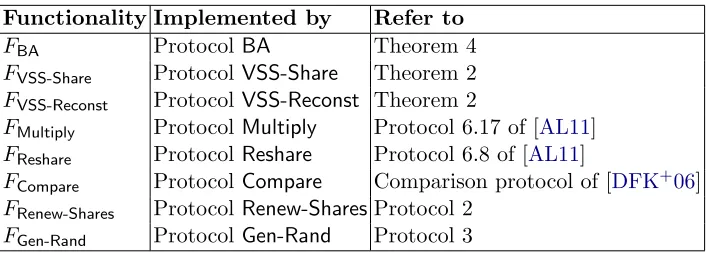
Our goal is to prove the UC-security of Protocol 1. Following the modular composition theorem, we first define the ideal functionalities shown in Table 2 that correspond to the subprotocols used in Protocol 1. We then prove that Protocol 1 ist-secure in the (FBA,FVSS-Share,FVSS-Reconst,FMultiply,
FCompare,FRenew-Shares,FGen-Rand)-hybrid model. Finally, we use Theorem 8 to infer the UC-security
of Protocol 1.
In order to prove the t-security of Protocol 1 in the hybrid model, we first show that all of our subprotocols are UC-secure. Similar to the above approach, we first prove t-security of every subprotocol in its corresponding hybrid model using a straight-line black-box simulator and then use Theorem 8 to infer its UC-security. To prove the t-security of a protocol Π, we describe a
Table 2.Ideal functionalities
Functionality Implemented by Refer to
FBA ProtocolBA Theorem 4
FVSS-Share ProtocolVSS-Share Theorem 2
FVSS-Reconst ProtocolVSS-Reconst Theorem 2
FMultiply ProtocolMultiply Protocol 6.17 of [AL11]
FReshare ProtocolReshare Protocol 6.8 of [AL11]
FCompare ProtocolCompare Comparison protocol of [DFK+06]
FRenew-Shares ProtocolRenew-SharesProtocol 2
FGen-Rand ProtocolGen-Rand Protocol 3
simulatorSΠ that simulates the real protocol execution by running a copy ofΠ in the ideal model.
For each call to a secure subprotocol π, the simulator calls the corresponding ideal functionality
Fπ. Aview of a corrupted party from execution of a protocol is defined as the set of all messages
it receives during the execution of that protocol. At every stage of the simulation process,SΠ adds the messages received by every corrupted party in that stage to its view of the simulation. This is achieved by running a copy ofΠfor each corrupted party with its actual input as well as by running a copy ofΠ for each honest party with a dummy input.11The view of the adversary is then defined as the combined view of all corrupted parties. Finally, we argue that the view of the adversary from the execution of the hybrid model is indistinguishable from its view of the simulation.
Lemma 5. Subprotocols BA, VSS-Share, VSS-Reconst, Reshare, Multiply, and Compare are UC-secure.
Proof. Lindell et al. [LLR06] show that any BA protocol in the standard model (such as the protocols of [BGH13,KLST11]) is secure under concurrent general composability. Using Theorem 8, since the security proofs of VSS-Share, VSS-Reconst, Reshare, and Multiply given in [AL11] use straight-line black-box simulators, these protocols are UC-secure. Finally, Compare is shown to be UC-secure in [DFK+06].
The ideal functionality FGen-Rand is given in Protocol 4. At least N −T of the inputsρ1, ..., ρN
are sent by uncorrupted parties and thus are chosen uniformly and independently at random from
Fq. Hence,r=PNi=1ρi is also a uniform and independent random element ofFq.
11S
Protocol 4FGen-Rand
Goal.For a gateu∈ M, generate a random valuer∈Fand VSS-share it among partiesP1, ..., PN
in the quorum associated withu.
Functionality:
1. Receive inputsρ1, ..., ρN ∈FfromP1, ..., PN respectively. For everyi∈[N], ifPi does not send
an input, then define ρi = 0.
2. Calculate r =PN
i=1ρi and invokeFVSS-Share to send a share ri of r toPi.
Lemma 6. The protocol Gen-Rand is UC-secure.
Proof. We prove the t-security of Gen-Rand in the FVSS-Share-hybrid model which is similar to Protocol 3 except that every call to VSS-Share is replaced with a call to the ideal functionality
FVSS-Share. The corresponding simulator SGen-Rand is given in Protocol 5.
Protocol 5SGen-Rand
Inputs. For a gateu ∈ M, the inputs {ρj}Pj∈Iu of the corrupted parties P1, ..., PN in the quorum
associated withu.
Simulation:
1. For every Pi ∈(Qu−Iu) (i.e., for every honest party Pi), callFVSS-Share with dummy input 0. Let si
1, ..., siN denote the outputs.
2. For every Pj ∈Iu,
(a) Run FVSS-Share with input ρj. Let ρj1, ..., ρjN denote the outputs. For everyk ∈[N], add ρkj
to the view ofPj.
(b) Compute rj =
PN
k=1ρkj and add rj to the view of Pj.
The views of the corrupted parties in the hybrid execution and the simulation are indistin-guishable because the only difference between the two views is thatSGen-Rand generates the shares from dummy input 0 instead of actual inputs. Since FVSS-Share generates uniform and independent random shares from any input, the two views are identically distributed. Following Theorem 8, since our simulator is straight-line and black-box,Gen-Rand is UC-secure.
Lemma 7. The protocol Renew-Shares is UC-secure.
Proof. The corresponding ideal functionalityFRenew-Shares is shown in Protocol 6. In this function-ality, we denote the ideal functionality of Reshare by FReshare which is equal to FV SSsubshare defined
in [AL11]. Using this functionality, a set of parties can verifiably secret-share values that are them-selves shares. If a corrupted partyPi provides an invalid secret-sharing of its sharesi, or it remains
quiet (in which case FRenew-Shares sets si = ⊥), FV SSsubshare defines a new sharing that represents si
Protocol 6FRenew-Shares
Goal. Given a secret s shared among a group of parties P1, ..., PN, generate a fresh sharing of s
among another group of parties P10, ..., PN0 .
Functionality:
1. Receive inputs s1, ..., sN from P1, ..., PN respectively. For every i∈[N], if Pi does not send an
input, then define si=⊥.
2. For every i∈[N], invokeFReshare to generate a sharing of si over a polynomialhi(x) of degree T such thathi(0) =si.
3. For every j∈[N], compute g(j) =PN
i=1λjhi(j) and sendg(j) to P
0 j.
We prove in the (FVSS-Share, FReshare)-hybrid model which is similar to Protocol 2 except that every call to VSS-Share and Reshare are replaced with calls to the ideal functionalities FVSS-Share
and FReshare respectively. The corresponding simulatorSRenew-Shares is given in Protocol 7.
Protocol 7SRenew-Shares
Inputs.The inputs {sj}j∈I and outputs{g(j)}j∈I of the corrupted parties. Simulation:
1. For every i /∈I, callFReshare with dummy input 0. Letsi1, ..., siN denote the outputs.
2. For each j∈I,
(a) Run FReshare with input sj. Let sj1, ..., s
j
N denote the outputs. For every k ∈[N], add skj to
the view ofPj.
(b) Compute g(j) =PN
k=1λjhk(j) and addg(j) to the view of Pj.
LetQandQ0be two quorums involved in the share renewal procedure, where parties inQwant to send a secret-share valuesto parties inQ0. Consider a corrupted partyP. First, ifP /∈(Q∪Q0), then elements ofVIEWP are independent of the sharesQsends to Q0. Moreover, elements ofVIEWP
are independent of the output ofQ0 sinceQ0 also renews its outputs.
Second, if P ∈(Q∪Q0), VIEWP consists of at most two secret-shares of s defined using two
independently random polynomials. The view of a corrupted partyP inQ0 only containssubshares
(i.e., shares of shares) ofsthat reveal nothing about the original shares. Using these subshares, P
can reconstruct only one share of the secret over a new random polynomial that is independent of the shares of the parties in Q. The adversary can obtain at most N/3 shares of any secret-shared value duringFReshare;N/3 shares ofscome from corrupted parties inQandN/3 shares come froms being secret-shared inQ0 using another random polynomial. SinceFResharegenerates a new random polynomial, the first set ofN/3 shares are independent of the second set ofN/3 shares. Since least
N/3 + 1 shares are required for reconstructing the secret, the two views are indistinguishable.
We are now ready to prove Lemma 3.
Proof. We prove the security of Protocol 1 in the (FBA,FVSS-Share, FVSS-Reconst,FMultiply,FCompare,
Lemma 6, and Lemma 7. The last step of the proof is to show that Protocol 1 is secure in the (FBA,
FVSS-Share,FVSS-Reconst,FMultiply,FCompare,FRenew-Shares,FGen-Rand)-hybrid model. This is done by an induction over all gates of the sorting circuit. The view of the adversary VIEWI from simulation is
simply constructed by collecting all shares held by corrupted parties in the quorums associated with every gate of the circuit. Based on Theorem 8, since we have proved the t-security of Protocol 1 using a straight-line black-box simulator, the protocol is UC-secure.
4.3 Cost Analysis
We first compute the cost of each step of the protocol separately and then compute the total costs. Let ν1(n) and ν2(n) denote the communication and computation complexity of VSS-Share respectively when it is invoked among n parties. For our unconditional Protocol 1, we assume
VSS-Share implements the sharing protocol of Theorem 2, and for our cryptographic MPS, we as-sumeVSS-Shareimplements the sharing protocol of VSS of Theorem 5. Both of these VSS protocols take constant rounds of communication.
– Setup.The communication and computation costs are equal to those costs of the quorum build-ing algorithm of Theorem 3 which is ˜O(1) for each party. This protocol takes constant rounds of communication.
– Input Sharing. This step invokes VSS-Sharing n times among N = O(logn) parties. So, this step sends O(n·ν1(N)) bits and performs O(n·ν2(N)) operations. Since the VSS scheme is constant-round, this step also takes constant rounds of communication.
– Random Generation. Gen-Rand sends O(N ·ν1(N)) messages, performs O(N ·ν2(N)), and has constant rounds.
– Sorting. The sorting network [LP90] has O(nlogn) comparators and depth O(logn). So, the communication cost of this step is equal to the communication and computation cost of running
O(nlogn) instantiations of Compare and Renew-Shares. Compare requires O(logq) invocation of Multiply (see [DFK+06]) which sends O(N4·ν1(N)) messages and computesO(N4·ν2(N)) operations.Renew-Sharesalso sendsO(N·ν1(N)+N3) messages and computesO(N·ν2(N)+N3) operations. Hence, the sorting step sends O(nlogn·logq ·N4 ·ν
1(N)) messages computes
O(nlogn·logq·N4·ν2(N)). Since the sorting circuit has depth O(logn), and Compare takes constant rounds, this steps takes O(logn) rounds of communication.
– Output Delivery. For each output quorum, the costs of output delivery is equal to the commu-nication and computation costs of sending N elements to one of the parties. The party then locally reconstructs the output by runningVSS-Reconst over at mostN shares. Thus, the total communication and computation complexity of this step is O(n·N). This step takes only one round of communication.
Log number of parties
5 10 15 20 25 30
Log number of Kilobytes sent
0 10 20 30 40 50
60 Communication costs
Log number of parties
5 10 15 20 25 30
Log number of operations
20 30 40 50 60 70
80 Computation costs
Log number of parties
5 10 15 20 25 30
Log number of rounds 6
8 10 12 14
Latency costs
Boyle et al. [10] Dani et al. [23] Our result (perfect) Our result (crypto) Our result (amortized)
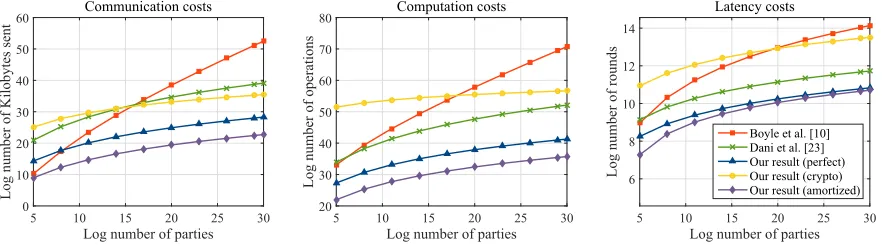
Fig. 2.Communication cost (left), computation cost (middle), and the number of communication rounds (right)
5 Simulation Results
To study the feasibility of our scheme and compare it to previous work, we simulated a proof-of-concept prototype of our protocol (and the cryptographic variant described in Section 3.4) along with two others that are based on a similar model to ours. These protocols are due to Dani et al.[DKMS12] and Boyle et al.[BGT13]. To the best of our knowledge, these protocols are the most efficient in terms of communication cost, computation cost, and the number of rounds for large networks. Since the protocols of [DKMS12] and [BGT13] are general MPC algorithms, we use them for computing our (single-output) shuffling functionality described in Section 3. We are interested in evaluating our protocols for large networks; thus, our choice of protocols for this section is based on their scalability for large values ofn.
The prototypes are written in C#, using .NET Framework 4.5, NTL 6.1, GMP 6.0, PBC12 0.5.14, and PolyCommit13 libraries. We ran the simulations on an Intel Xeon E5 machine running Windows 8.1. We simulated our cryptographic protocol for inputs chosen from the field of integers with a 160-bit prime; this ensures about 80 bits of security. We set the parameters of our protocols in such a way that we ensure the probability of error for the quorum building algorithm of [BGH13] is smaller than 10−5. For the sorting circuit, we set k = 2 to get σ < 10−8 for all values of n in the experiment. Clearly, for larger values of n, the error becomes superpolynomially smaller, e.g., forn= 225, we getσ <10−300. For all protocols evaluated in this section, we assume cheating (by corrupted parties) happens in every round of the protocols. This is done by having t = bn/3c of the parties send random message in every round of the protocols.
Figure 2 illustrates the simulation results obtained for various network sizes between 25 and 230 (i.e., between 32 and about 1 billion). To get a system-independent estimation of the computation costs, we implemented a wrapper that counts the number of processor instructions evaluated during the execution of each protocol. We repeat each experiment five times and report the average for each network size. To better compare the protocols, the vertical and horizontal axis of all plots are scaled logarithmically.
In Figure 2, we report results from three different versions of our protocols. The first plot (marked with triangles) refers to our unconditionally-secure protocol (Protocol 1). The second plot (marked with circles) represents the cryptographic variant of Protocol 1 described in Section 3.4. The third plot (marked with diamonds) shows the cost of our unconditionally-secure protocol with amortized (averaged) setup cost. To obtain this plot, we run the setup phase of Protocol 1 once 12http://crypto.stanford.edu/pbc
13
and then use the setup data to run the online protocol 100 times. The total number of bits sent was then divided by 100 to get the average cost.
We observe that our protocol performs significantly better than the prior work. For example, forn= 215(about 33 thousand parties), our amortized protocol requires each party to send about 128MB of data, while the protocols of [BGT13] and [DKMS12] each send more than one terabyte of data per party. For the computation cost, our amortized protocol requires each party to perform about one billion operations, while the other protocols require each party to perform more than 1013operations. Finally, our amortized protocol requires about 500 rounds of communication, while the protocols of [BGT13] and [DKMS12] require about 1500 and 4100 rounds of communication respectively.
6 Conclusion
We described a multi-party shuffling protocol that is fully decentralized and tolerates up tot <(1/3−)n
malicious faults. Moreover, our protocol is load-balanced and can tolerate traffic-analysis attacks. The amount of information sent and the number of computations performed by each party scales polylogarithmically with the number of parties. Scalability is achieved by performing local commu-nications and computations in groups of logarithmic size.
Several open problems remain. First, can we decrease the number of rounds of our protocol using a smaller-depth sorting circuit? For example, since our protocol sorts uniform random num-bers, it seems possible to use a smaller depth non-comparison-based sorting circuit like bucket sort. Second, can we improve performance even further by detecting and blacklisting parties that exhibit adversarial behavior? Finally, can we adopt our results to the asynchronous model of communica-tion? We believe that this is possible for a suitably chosen upper bound on the fraction of faulty parties.
Acknowledgment
The authors would like to acknowledge supports from NSF under grants CCF-1320994, CCR-0313160, and CAREER Award 644058. We are also grateful for valuable comments from Ran Canetti (Boston University), Bryan Ford (Yale University), Shafi Goldwasser (MIT), Aniket Kate (Purdue University), Yehuda Lindell (Bar-Ilan University), and anonymous reviewers of this paper.
References
AKS83a. M. Ajtai, J. Koml´os, and E. Szemer´edi. An 0(nlogn) sorting network. InProceedings of STOC’83, pages 1–9, New York, NY, USA, 1983. ACM.
AKS83b. M. Ajtai, J. Koml´os, and E. Szemer´edi. Sorting inclognparallel steps.Combinatorica, 3(1):1–19, January 1983.
AL11. Gilad Asharov and Yehuda Lindell. A full proof of the BGW protocol for perfectly-secure multiparty computation. Cryptology ePrint Archive, Report 2011/136, 2011.
AW07. Ben Adida and Douglas Wikstr¨om. How to shuffle in public. In Proceedings of the 4th Conference on Theory of Cryptography, TCC’07, pages 555–574, Berlin, Heidelberg, 2007. Springer-Verlag.
BGH13. Nicolas Braud-Santoni, Rachid Guerraoui, and Florian Huc. Fast Byzantine agreement. InProceedings of the 2013 ACM Symposium on Principles of Distributed Computing, PODC ’13, pages 57–64, New York, NY, USA, 2013. ACM.
BGT13. Elette Boyle, Shafi Goldwasser, and Stefano Tessaro. Communication locality in secure multi-party com-putation: how to run sublinear algorithms in a distributed setting. In Proceedings of the 10th theory of cryptography conference on Theory of Cryptography, TCC’13, pages 356–376, Berlin, Heidelberg, 2013. Springer-Verlag.
BGW88. Michael Ben-Or, Shafi Goldwasser, and Avi Wigderson. Completeness theorems for non-cryptographic fault-tolerant distributed computing. InProceedings of the Twentieth ACM Symposium on the Theory of Computing (STOC), pages 1–10, 1988.
Can00. Ran Canetti. Security and composition of multiparty cryptographic protocols. Journal of Cryptology, 13(1):143–202, 2000.
Can01. Ran Canetti. Universally composable security: a new paradigm for cryptographic protocols. InProceedings of the 42nd Annual Symposium on Foundations of Computer Science, FOCS ’01, pages 136–145, Oct 2001. CGWF13. Henry Corrigan-Gibbs, David Isaac Wolinsky, and Bryan Ford. Proactively accountable anonymous mes-saging in verdict. InProceedings of the 22nd USENIX Security Symposium, pages 147–162, Berkeley, CA, USA, 2013.
Cha81. David Chaum. Untraceable electronic mail, return addresses, and digital pseudonyms. Commun. ACM, 24(2):84–90, February 1981.
Cha88. David Chaum. The dining cryptographers problem: Unconditional sender and recipient untraceability.
Journal of Cryptology, 1:65–75, 1988.
CKLK01. Artur Czumaj, Przemka Kanarek, Krzysztof Lorys, and Miroslaw Kutylowski. Switching networks for generating random permutations, 2001.
DFK+06. Ivan Damg˚ard, Matthias Fitzi, Eike Kiltz, JesperBuus Nielsen, and Tomas Toft. Unconditionally secure constant-rounds multi-party computation for equality, comparison, bits and exponentiation. In Theory of Cryptography, volume 3876 of Lecture Notes in Computer Science, pages 285–304. Springer Berlin Heidelberg, 2006.
DKMS12. Varsha Dani, Valerie King, Mahnush Movahedi, and Jared Saia. Brief announcement: breaking theo(nm) bit barrier, secure multiparty computation with a static adversary. In Proceedings of the 2012 ACM symposium on Principles of distributed computing, PODC ’12, pages 227–228, New York, NY, USA, 2012. ACM.
FA00. Stajano Frank and Ross Anderson. The cocaine auction protocol: On the power of anonymous broadcast. InProceedings of the Third International Workshop on Information Hiding, IH 99, pages 434–447, London, UK, 2000. Springer-Verlag.
GG03. Marco Gruteser and Dirk Grunwald. Anonymous usage of location-based services through spatial and temporal cloaking. InProceedings of the 1st International Conference on Mobile Systems, Applications and Services, MobiSys ’03, pages 31–42, New York, NY, USA, 2003. ACM.
GJ04. Philippe Golle and Ari Juels. Dining cryptographers revisited. InAdvances in Cryptology – EUROCRYPT ’04, volume 3027 ofLecture Notes in Computer Science, pages 456–473. Springer Berlin Heidelberg, 2004. GO96. Oded Goldreich and Rafail Ostrovsky. Software protection and simulation on oblivious RAMs. J. ACM,
43(3):431–473, May 1996.
Gol00. Oded Goldreich. Foundations of Cryptography: Basic Tools. Cambridge University Press, New York, NY, USA, 2000.
Gol04. Oded Goldreich. Foundations of Cryptography: Volume 2, Basic Applications. Cambridge University Press, New York, NY, USA, 2004.
Goo11. Michael T. Goodrich. Randomized shellsort: A simple data-oblivious sorting algorithm. J. ACM, 58(6):27:1–27:26, December 2011.
GRR98. Rosario Gennaro, Michael O. Rabin, and Tal Rabin. Simplified VSS and fast-track multiparty compu-tations with applications to threshold cryptography. In Proceedings of the Seventeenth Annual ACM Symposium on Principles of Distributed Computing, PODC ’98, pages 101–111, New York, NY, USA, 1998. ACM.