ISSN 2348 – 7968
The Performance of Activated Carbon Based Cola Nuts
Shells for the Removal of Co(II) and Ni(II) Ions from
Aqueous Solution
Abega Aime Victoire1, Ndi Julius Nsami1, Ngomo Horace Manga1, Kouotou Daouda1, Nkwaju Yanou Rachel1, Numbonui Julius Ghogomu2 and Ketcha Joseph Mbadcam1
1
Department of Inorganic Chemistry, University of Yaoundé I, Physical and Theoretical Chemistry Laboratory, Faculty of Science, P.O. Box 812, Yaoundé, Cameroon
2
Laboratory of Noxious Chemistry and Environmental Engineering, Department of Chemistry, Faculty of Science, University of Dschang, Cameroon
ABSTRACT
The removal of Ni(II) and Co(II) ions from
aqueous solution by activated carbon from kola nuts shells
was investigated. The influences of the contact time,
adsorbent dose, pH and the initial concentration were
experimentally done at 25°C by batch adsorption
technique. The experimental results showed that the
optimum pH of adsorption were 4.3 and 6 corresponding
to 275 mg/g and 260 mg/g of the quantities of Co(II) and
Ni(II) ions adsorbed respectively. The Langmuir, D-K-R
and Tempkin adsorption isotherms described well the
adsorption data for both adsorbates. The maximum
adsorption capacities Qmax determined using the D-K-R
isotherm model was found to be 286.862 mg/g and
302,778 mg/g respectively for Co(II) and Ni(II) ions. The
pseudo-second order kinetic model fitted the adsorption of
both the adsorbates owing to their correlation coefficients
closer to unity. According to the DKR isotherm model, the
adsorption mechanism seems to be chemisorption. Finally,
results indicated that the activated carbons from kola nuts
shells are performant for the removal of Ni(II) and Co(II)
ions from aqueous solution.
Keywords: Activated carbons, Cola nuts shells, Nickel,
Cobalt, adsorption and aqueous solution
1-INTRDUCTION
The excessive release of the heavy metals
into the environment due to the rapid
industrialization has created a major global concern. Consequently many heavy metals such as cadmium, copper, cobalt, nickel, lead, mercury and chromium are often detected in industrial wastewaters. Mostly
from the metal plating, mining activities, smelting,
battery manufacture, pesticides, pigment
manufacture, printing, paint manufacture, tanneries petroleum refining and photographic industries [1]. These heavy metals have harmful effect on human physiology and other biological system when they exceed the tolerance levels. The major problem is that they are not biodegradable and tend to accumulate in living organisms thus causing various diseases and disorders [2].
It’s well demonstrated that Cobalt and Nickel are widely dispersed in the environment. Humans are frequently exposed to their effect by breathing air, drinking water and eating food [3, 4]. However, some techniques are available for the removal of these heavy metals ions from aqueous solution. Amongst these techniques are ion exchange, solvent precipitation, flocculation, reverse osmosis, membrane separation processes and adsorption [5, 6]. Nevertheless, these techniques have some disadvantages like their high operational cost and appropriate disposal of the residual metal sludge [7]. Adsorption technique compare to the afore mentioned appears to be an attractive process due to its high efficiency and easy implementation process which do not required the utilization of other chemical reagents.
In the present work, activated carbon prepared with a local and available biomass (Kola nut shells) found in the North-west region of Cameroon have been used for the removal of Co(II) and Ni(II) ions. The effect of some factors as contact time, pH, dose of adsorbent and initial concentration of metal ions were investigated. The kinetics study of Co(II) and Ni(II) ions was analyzed using various kinetic models. Whereas the equilibrium study was done using Langmuir, Freundlich, Dubinin Kaganer Radushkevich (D-K-R) and Tempkin models
2-Materials and methods
2-1 Adsorbent
The Kola nuts shells from the North-west region of Cameroon were initially washed with tap water, then with deionized water, sun dried, ground and sieved through a sieve (RETSCH) to get particles sizes of ≤ 1.5 mm. The sample obtained was kept into an oven at 110°C for 24 hours. Before each impregnation process, the sample was removed from the oven and cooled in a desiccator for 30 min. The impregnation ratio of 1:1 (mass reagent KOH/mass of sample) was done in a beaker and the mixture was dried for 24 hours in an oven at 110°C.
2-2 Carbonization
The carbonization and activation were done by a single step process by carrying out thermal decomposition of the Kola nuts shells impregnated with KOH as activing agent in the absent of oxygen in a carbonite furnace at 500°C for a resident time of 1hour. When the activation was achieved, the furnace was allowed to cool to room temperature. The pyrolysed carbon was first washed with 1 HCl (v/v) followed by distilled water several times until a neutral pH. Later, the activated carbon obtained was dried for 24 hours in an oven at 110°C, collected and kept in closed bottle for further use.
2-3 Preparation of Co(II) and Ni(II) ions solutions
All the reagents used in this work were of analytical grade. A stock solution of both Ni(II) and Co(II) ions of concentration 3000 mg/L was prepared by dissolving 12.525g of NiCl2.6H2O and
14.966g of Co(NO3)2.6H2O in two different
volumetric flask of 1L. The two conical flasks were stirred on a magnetic agitator for 30 min to obtain a homogeneous mixture. Other experimental solutions were prepared by dilution of each stock solution to the required concentrations.
2-4 Adsorption experiments
The
batch adsorption tests were carried-out at room temperature. For each run, the known initial concentration (1200-2000 mg/L) of Co(II) and Ni(II) ions were kept into contact with a known weight of activated carbon. After agitation, the solutions were filtered and the filtrate were subsequently analyzedfor metal ion concentration by using a UV/Visible spectrophotometer, model FA05005. A similar measurements were carried-out for the various adsorbents doses, pH and initial concentration of Co(II) and Ni(II) ions. The percentage removal (%R) of Co(II) and Ni(II) ions and the amount adsorbed (Qe) per unit mass of adsorbent were calculated by using the following expressions:
(1)
%R = (2)
where, Co and Ce are the initial and equilibrium
concentration respectively, V represents the volume
of the solution and m is the mass of the adsorbent.
2-5 Adsorbent characterization
For the characterization of the adsorbents, FTIR spectroscopy was used to identify the functional groups and the chemical bonds on the activated carbon. The BET method and the iodine number calculations were equally used to calculate the specific surface area and the morphology of the activated carbon.
2-6 Adsorption isotherms - The Langmuir isotherm
The Langmuir isotherm describes the adsorption of a solute from a liquid solution. The Langmuir adsorption isotherm is often expressed as:
(3)
Where Qe (mg/g) is the quantity adsorbed at equilibrium, Ce is the equilibrium concentration of adsorbate in solution (mg/L), Qmax is the maximum
adsorption capacity corresponding to complete monolayer coverage, KL is the Langmuir constant
related to the energy of adsorption (L/mg) [8]. The linear form of its equation is expressed as:
(4)
- The Freundlich isotherm
ISSN 2348 – 7968
The Freundlich isotherm model is applied to the
adsorption on a heterogeneous surface with
interaction between the adsorbed molecules, and is
not restricted to the formation of a monolayer. This
model assumes that as the adsorbate concentration
increases, the concentration of adsorbate on the
adsorbent surface also increases and,
correspondingly, the sorption energy exponentially
decreases on completion of the sorption centers of
the adsorbent [9]. The expression for the Freundlich
model is given by:
Qe=KfCe1/n
(5)
The linear form is given by the following equation
:
lnQe = lnKF + lnCe (6)
Where Qe is the quantity adsorbed at equilibrium (mg/g), KF is the Freundlich constant, 1/n is the
heterogeneity factor which is related to the capacity and intensity of the adsorption, and Ce is the concentration at the equilibrium (mg/L). The values of KF and 1/n can be obtained from the slope and
intercept of the plot of lnQe against lnCe
.
- The D-K-R isotherm
The Dubinin–Kaganer-Radushkevich isotherm is generally used to express the adsorption mechanism with a Gaussian energy distribution onto a heterogeneous surface. The model has often successfully fitted high solute activities and the intermediate range of concentrations data well. The DKR adsorption isotherm and its mean free energy are often expressed as [10]:
lnQe =lnQmax – KDKR ε² (7)
ε =RTln (1+ 1/Ce) (8)
Where, Qe is the quantity adsorbed at the equilibrium (mg/g), Qmax is the theoretical isotherm saturation capacity (mg/g), KDKR is the Dubinin– Kaganer-Radushkevich isotherm constant (mol/kJ). The approach was usually applied to distinguish the physical and chemical adsorption of metal ions with its mean free energy, E per molecule of adsorbate
(for removing a molecule from its location in the sorption space to the infinity)
- The Tempkin isotherm
This isotherm contains a factor that takes into account the adsorbent–adsorbate interactions. The Tempkin model assumes that the heat of adsorption of all the molecules in the layer would decrease linearly rather than logarithmic. As implied in the equation, its derivative is characterized by a uniform distribution of binding energies which was carried out by plotting the quantity adsorbed Qe against lnCe and the constants were determined from the slope and intercept. The model is given by the following equation [10]:
Qe = RT/bT ln(KT. Ce) (9)
The linear form of this equation is:
Qe=BlnKT + BlnCe (10)
B=RT/bT Constant related to heat of sorption
(J/mol), R is the universal gas constant and T is absolute temperature (K).
2-7 Adsorption kinetics
The study of the adsorption kinetics describes the resistances to solute transfer from the solution up to the boundary layer of the solid-liquid interface to the pore water and then to the solid
.
- Pseudo-first order model
The pseudo-first order equation was suggested by Lagergren for the adsorption of solid-liquid system. It is generally expressed as follows [11]:
(11)
Where Qe and Qt are the adsorption capacities at
the equilibrium and time, t, respectively (mg/g), K1
is the rate constant of pseudo-first order equation (min-1). After the integration and applying boundary conditions, t=0 to t=t and Qt=0 to Qt=Qt the
integrated form of this equation becomes:
ln( )=ln K1 t (12)
This equation is verified if the plot of ln(Qe-Qt) as
function of time gives a straight line. K1 is deduced
from slope and Qt from the vertical intercept
.
- Pseudo-second order model
The pseudo-second order adsorption kinetic rate equation is expressed as[11]:
(13)
Where, K2 is the rate constant of the pseudo-second
order adsorption. From the boundary condition, t=0 to t=t and Qt=0 to Qt=Qt ; the integrated rate law
can be written as[11]:
(14)
This equation can be rearranged to the linear form as follows:
(15)
- The Elovich model
T
he Elovich equation is generally expressed by:(16)
Where α is the initial sorption rate (mg/min/g) and β is the desorption rate constant (g/mg) during any experiment. To simplified Elovich equation, Chien and Clayton (1980) assumed αβt >>1 and by applying the boundary condition t=0 to t=t and Qt=0
to Qt=Qt , the linear form can be written as follows
[8]:
Qt= ln (αβ) + lnt (17)
Thus, a plot of Qt versus ln(t) should yield a linear relationship with a slope of (1/β) and intercept of 1/β ln(αβ) if the sorption process fits the Elovich equation.
- The intraparticle diffusion model
When the intraparticle mass transfer resistance is a rate limiting step, then the sorption process describes as being controlled by the particle diffusion. The intraparticle diffusion model is expressed as equation [8]:
R = Kidta (18)
Where R is the adsorbed percentage (%), Kid the
intraparticle diffusion rate constant (mg/min) and a
the adsorption mechanism. A linear form of the equation (18) is given as:
ln(R) = ln Kid + aln(t) (19)
The plot of ln(R) versus ln(t) give a linear, relationships which help to deduce the constant, a and Kid from the slope and intercept of the plot
respectively.
3- Results and Discussion
3-1 Surface chemistry
The functional group is an important characteristic of the activated carbon since it determines the surface properties of carbons and has significant implications on their behaviors [12].The FTIR spectra registered for the activated carbon is plotted in fig.1. A broad band located around 3321cm-1 is attributed to hydroxyl groups or adsorbed water [9]. The band around 1574cm-1 is usually caused by C=C (skeletal) vibrations [13, 14]. The band at 1416cm-1 is compatible with presence of N-H vibration. Another peak at the wave length number around 1371cm-1 is attributed to the C=O bond in carboxyl group double bond [12]. The earlier parts of the spectra located in the wave length number of 1000-1500cm-1 are also quite similar in both the adsorbent material. This part represents various configuration of C, O, N, H bonds in the activate carbon structure. For example the two badly visible peaks at 1163cm-1 and 1089cm-1 may be assigned to C-O-C vibration in ether type structure and ester C-O vibration respectively [15]. Finally, low intensity bands at 873, 802 and 753cm-1 may be related to substitution in aromatic rings ( tri, di and mono substitution respectively) [12,15].
ISSN 2348 – 7968
C:\Program Files\OPUS_65\MEAS\KOH.1 KOH ATR platinum Diamond 1 Refl 03/04/2013
3 32 1. 0 1 1 57 4. 6 2 1 41 6. 4 5 1 37 1. 5 3 1 31 5. 5 2 1 16 3. 2 6 1 08 9. 8 5 8 73 .81 8 02 .76 7 53 .18 5 73 .36 5 38 .86 5 15 .65 4 61 .58 3 80 .47 500 1000 1500 2000 2500 3000 3500 Wavenumber cm-1 0 .0 6 0 .0 8 0 .1 0 0 .1 2 0 .1 4 0 .1 6 A b s or b anc e U ni ts
Seite 1 von 1
Fig-1: The FT-IR spectra of Kola nut shell activated carbon before adsorption
3-2 Porous structure and iodine number analysis
Table1 shows the total volume of pores, the surface area of activated carbon and the iodine number. The N2 -BET specific surface area of cola
nut shells activated carbon is very low (2,048m2/g); the average pores diameter is 94Å which implies the presence of mesopores. This activated carbon has almost the presence of micropores according to its iodine number of 513,945mg/g. In the scientific literature, the same range of values of iodine number has been obtained but the microporosity was predominant on the activated carbon [16].
Table1: Characteristics (specific surface area, pores volume, iodine number, porosity) of cola nut shells activated carbon
4- Adsorption
4-1 Effect of the contact time
The contact time is inevitably a fundamental parameter in the mass transfer phenomena like the adsorption. Therefore it is important to study its effect on the adsorption capacity of Co(II) and Ni(II) ions by cola nut shells activated carbon. Fig.2 presents the effect of the contact time on the
adsorbed quantities of Co(II) and Ni(II) ions. The initial concentration of the two metal ions is 1600 mg/L, the adsorbent dose of the activated carbon is 0.05g, the pH of solutions are 5.7 and 6.5 for Co(II) and Ni(II) solutions respectively.
Fig2: Effect of contact time on the removal of Co(II) and Ni(II
)
Fig.2 shows that the adsorption of Co(II) and Ni(II) ions increase rapidly with time from 0 to 20 min and then becomes almost constant. Equilibrium is reached after 45 min for the adsorption of the two metal ions. The first part of the graph which seems to be a rapid phase occurred because of the availability of the large number of adsorbent sites and rapid diffusion of metal ions from solution to the surface of the activated carbon. Additionally, the enhancement of these two metal ions with increase in agitation time may be due to the decrease of the boundary layer resistance to mass transfer in the bulk solution and an increase in the kinetic energy of hydrated ions. The second part of the graph which seems to be a slow phase may be due to the decrease of the number of active sites which causes retardation in adsorption process [12, 17, 18].
4-2 Effect of the adsorbent dose
In order to study the effect of the adsorbent dose on adsorption of Co(II) and Ni(II) ions, a series of adsorption experiments were carried-out with different masses of the adsorbent varying from 0.025 to 2 g at the initial concentration 1600 ppm
.
BET Surface area (m²/g) 2, 0448
adsorption cumulative Surface area of pores (m²/g) 0,992 désorption cumulative Surface area of pores (m²/g) 2,6723 total Volume of pores (c /g) 0,004816 Average diameter of pores (Å) 94
Iodine number (mg/g) 513,945
Fig.3: Effect of adsorbent dose (a) percentage of metal ions removal as a function of mass (b) quantity of metal ions adsorbed in function of mass
Fig.3, (a) shows that the percentage removal of the two metal ions increases with the adsorbent dosage. This trend is expected because as the adsorbent dose increases, the number of adsorbent particles increases and thus more Co(II) and Ni(II) ions will be attached to the surface of the adsorbent [19,20,21].
However, fig.3 (b) shows that when the adsorbent dose increase the quantity adsorbed of Co(II) and Ni(II) ions decreases. This may be due to the fact that as the amount of the adsorbent increases, the total surface area available for the adsorption of metal ions reduces as a result of the overlapping or aggregation of adsorption sites [22]. The maximum quantities adsorbed are 290 mg/g for Co(II) and 280 mg/g for Ni(II) for an adsorbent dose of 0.025 g. Further experiments had been done with 0,05 g of adsorbent because this mass of the activated carbon is consistent and also has a high adsorption capacity.
4-3 Effect of the pH
The pH of the aqueous solution is an important parameter for controlling the adsorption process. It affects the degree of ionization of the heavy metals ions in solution and also controls the binding of metal ions with the surface functional groups [15, 23].The batch adsorption study at different pH values were carried out in the range of 2-7 for Ni(II) and of 2-6 for Co(II) ions using initial concentration of 1600 mg/L for both Ni(II) and Co(II) ions and the activated carbon dose of 0,05 g.
Fig.4: Effect of initial pH of the solution
Fig.4 presents the effect of pH on the two metal ions adsorption. These results revealed that the maximum adsorption occurred at pH 4.3 and 6 for Co(II) and Ni(II) respectively. At lower pH, the Co(II) and Ni(II) ions removal was inhibited. This can be attributed to the adsorption competition between the hydrogen ions, Co(II) and Ni(II) ions on the adsorption sites. In fact, at low value of the pH, the medium contains a high concentration of hydrogen ions [23, 24]. While a decrease of the pH favorited the deprotonation on the surface of the adsorbent thus enhancing the metals adsorption [25]. In addition, there are also possible sites on the unmodified activated carbon surface for specific adsorption of H+ ions that can be exchange with the metal cations in the solution [25]. At pH values higher than 6 for Co(II) ions and 7 for Ni(II) ions , the insoluble cobalt and nickel hydroxide starts respectively, precipitating from the solution making the true adsorption studies impossible [23, 26]. The working pH values for Co(II) and Ni(II) ions onto activated carbon was chosen to be 4.3 and 6 for Co(II) and Ni(II) ions respectively and the other adsorption experiments were performed at these pH values
.
ISSN 2348 – 7968
4-4 Effect of the initial concentration
The effect of the initial concentration on the adsorption capacity of activated carbon from cola nut shells for Co(II) and Ni(II) is showed in the fig.5.
Fig.5: Effect of Initial Concentration on Co(II) and Ni(II) ions
The results showed that the quantities of metal ions adsorbed per unit of mass of activated carbon increase with increase in the initial concentration and becomes constant at 2000 ppm. This increase of the quantities of both the Co(II) and Ni(II) ions adsorbed is due to the decrease of the resistance uptake of the metal ions with an increase in the metal ions concentration [26]. However, at higher concentration (2000 to 2200 mg/L), the metal ions need to diffuse to the adsorbent surface by intraparticule diffusion and greatly hydrolyzed ions which diffuse at slower rate because all the adsorption sites are occupied [27, 28].
4-5 Effect of equilibrium concentration
The figs. 6a and 6b present isotherms which are
obtained by plotting the quantity adsorbed versus the equilibrium concentration:
(a)
(b)
Fig.6: Effect of equilibrium concentration of Ni(II) and Co(II) ions
These figures showed that the isotherms that were obtained are of the type IV which involves porous adsorbent possessing pores mainly in the mesopore range; also the interaction adsorbent is stronger than interaction adsorbate-adsorbate. This confirmed the BET results obtained.
4-6 Adsorption isotherms studies
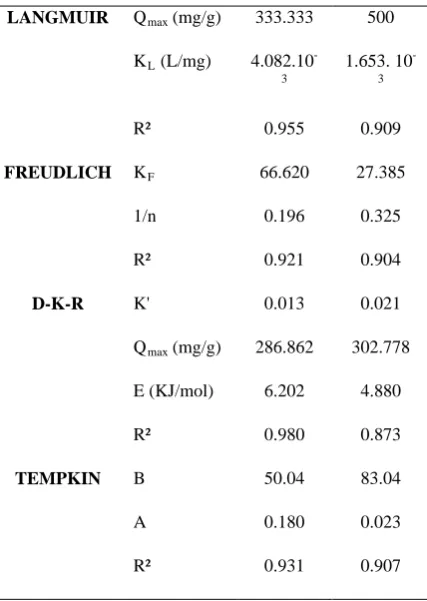
The isotherm experiment data were confronted to the Langmuir, Freundlich, D-K-R, and Tempkin equations and the adsorption parameters were determined (Table 2). The experimental data and the models equations used for both Co(II) and Ni(II) adsorption equilibrium isotherms are shown in fig.7.
(a)
(b)
(c)
(d)
Fig.7: Adsorption isotherm of Co(II) and Ni(II) ions onto activated carbon. a) Langmuir (b) Freundlich (c) D-K-R (d) Tempkin
The adsorption constant of a given isotherm allows, not only to evaluate the adsorbent properties of a sample, but also to determine if the adsorption is favorable or not. The constant of Langmuir KL
evaluates the intensity of adsorption. If the value of KL is high, we have strong affinity between the
metal ions and the surface of activated carbon. The values obtained from the Langmuir isotherm model are 4.082 g/L and 1.653 g/L for Ni(II) and Co(II) ions respectively and suppose that we have a middle interaction between the Co(II) and Ni(II) ions onto activated carbon. The correlation coefficients for this model are lower than 0.96 thus the Langmuir model is not suitable to explain the adsorption of both Co(II) and Ni(II) ions onto activated carbon.
The values of Freundlich constants, n determines if the adsorption of metal ions onto activated carbon is favorable or not. If the constant n is between 1 and 10, then the adsorption is favorable with great intensity of adsorption; and if the term 1/n is between 0 and 1 then we have on the activated
carbon heterogeneous surface. For these
experiments, the values of n were 5.1 for Ni(II) ions and 3.07 for Co(II) ions which consequently are between 1 and 10. On this basis it appears that the adsorption of both the two metal ions is favorable with great intensity. The exponent 1/n lies between 0 and 1 and shows that the surface of the cola nut shells activated carbon is heterogeneous and confirms the results of the characterization. But it can also be seen that the Freundlich model has values of the correlation coefficients lower than 0.96 which restricts the utility of this model to describe well the metal ions adsorption onto this sample.
ISSN 2348 – 7968
The Tempkin adsorption model explains the nature of adsorbent-adsorbates interaction and also the energetic information of the adsorption process. If the Tempkin constant B is positive, then the adsorbent-adsorbates interaction is gravitational. For the cola nut shells activated carbon, these constant are all positive. Thus the metal ions-carbon interactions are gravitational. The functional groups (fig.1) present at the surface of this material are the carbonyl CO), the amine N-H), the carboxyl (-COOH) and the hydroxyl (-OH) which have free electrons and the metal ions have a deficit of electrons and these characteristics explain well why the behavior of interactions are gravitational. We also noticed that, the attraction is much stronger for the Co(II)-carbon than for the Ni(II)-carbon with values of constant B equal to 50.04 and 83.04 J/mol for Ni(II) and Co(II) ions respectively.
The D-K-R model gives information of the binding energies. The average free energy E, of a molecule of adsorbent expresses the energy released when a molecule of the adsorbate passes from the solution into the adsorbent. The energy was calculated using the equation below:
E=1/ (2KDKR)-1/2 (20)
The values of the energy of adsorption were 4.880 and 6.202 KJ/mol respectively for Co(II) and Ni(II) ions and are characteristics of Van Der Walls forces. The D-K-R model seems to be more general, so it is very suitable to explain the adsorption of metal ions on various adsorbents. This model explain well the adsorption of Ni(II) ions because the value of R2 > 0.96 [29].
The theoretical values of the adsorption capacities determined by the D-K-R model approach those determined experimentally, so we can deduced that this activated carbon has a high efficacy at low concentration [29].
Table 2: Parameter values of the adsorption isotherm of Co(II) and Ni(II) ions onto activated carbon from cola nut shells
ADSORBATES Ni(II) Co(II)
LANGMUIR Qmax (mg/g) 333.333 500
KL (L/mg) 4.082.10 -3
1.653. 10
-3
R² 0.955 0.909
FREUDLICH KF 66.620 27.385
1/n 0.196 0.325
R² 0.921 0.904
D-K-R K' 0.013 0.021
Qmax (mg/g) 286.862 302.778
E (KJ/mol) 6.202 4.880
R² 0.980 0.873
TEMPKIN B 50.04 83.04
A 0.180 0.023
R² 0.931 0.907
4-7 Adsorption kinetics
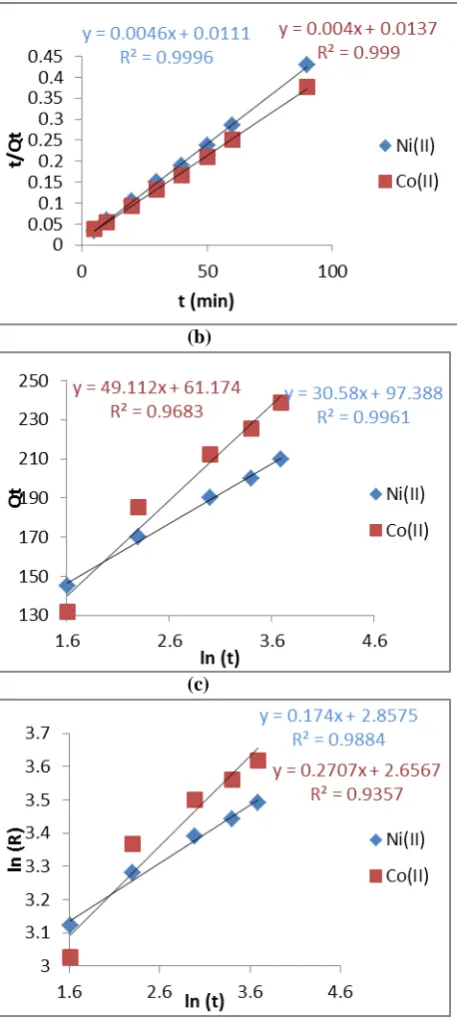
In this work, the kinetic of adsorption of Co(II) and Ni(II) ions onto activated carbon was studied. Four types of kinetic models namely the pseudo first order, pseudo second order, Elovich and intra particle diffusion models were used to confront the experimental data:
(a)
(b)
(c)
(d)
Fig.8: Adsorption kinetics of Co(II) and Ni(II) ions onto activated carbon. a) Pseudo first order b) pseudo-second order c) Elovich
model. d) Intra particle model
The straight lines plot showed a good agreement of the experiment data with the pseudo second order, Elovich and pseudo first order model. Table 3 listed the results of the rate constants studies for different kinetic models. The Comparison of the R² values of these three models show a significant agreement with the adsorption mechanism with
successfulness of the pseudo second order model. The pseudo first order model involves physisorption; which explains why the energies of adsorption showed low energies values of the Van Der Walls type. Nevertheless, the pseudo second order and Elovich models involve the variation of energy of chemisorption with heterogeneous actives sites in the activated carbon [22.30]. The Elovich model has been applied satisfactorily to some chemisorption processes and has been found to cover a wide range of slowed adsorption rate [30].
The intra particle diffusion constants kid give an
enhancement in the rate of adsorption whereas the values of a, illustrate a better adsorption mechanism. This related to improve bonding between both Co (II) and Ni (II) ions and the adsorbent particles.
The high values of R² coefficients of all these models make it difficult to distinguish which kinetic model is better fitted. It is responsible to conclude that both physical and chemical adsorption equally participate in the overall process of Co( II) and Ni (II) metal ions adsorption on the cola nut shells activated carbon. This result shows that the intra-particle diffusion process is one of the rate limiting steps, besides many processes which control the overall rate of adsorption. All of which will be operating simultaneously [24.31]. The pseudo first order model showed that physisorption is the phenomenon which limits the rate and involves the Van Der Walls forces in the reaction between adsorbate molecule and adsorbent. Similary, the Elovich model shows that the rate limiting step is chemisorption involving the valence forces caused the exchange of electrons between the adsorbent and the adsorbate.
Table.3: The parameter values of the kinetics of the adsorption of Co(II) and Ni(II) ions onto activated carbon from cola nut shells
ISSN 2348 – 7968
4-8 Adsorption Mechanism:
In order to understand the adsorption mechanism, a large quantity of work has been done to investigate the influence of adsorption process on the kinetic model, isotherm model and Fourier Transform infrared (FTIR) technology. The main mechanisms include hydrogen-bonding, physisorption, chemisorption, ion exchange and precipitation [32].
The highest value of the correlation coefficient R² of the pseudo second order model show that chemical adsorption is the main mechanism of metal ions (R² >0, 99). The values of intra particle diffusion constant show that it is not the limiting process and thus do not control the step. After the film diffusion, the adsorbate is attracted by the functional groups such as oxygen, nitrogen of the surface of the activated carbon and result to the attractive interaction for both adsorbent and adsorbates. Metal ions being the positives ions which have deficiencies of electron will react as Lewis acid on the surface more than the electrons. Consequently they form dative bonds between adsorbent and adsorbate
These results are confirmed by FTIR spectra after the adsorption bellow:
C:\Program Files\OPUS_65\MEAS\CA Co2+.0 CA Co2+ ATR platinum Diamond 1 Refl 31/08/2013
30 13 .35 16 91 .76 15 72 .66 12 18 .82 9 82 .41 8 72 .74 7 94 .75 7 42 .55 6 76 .49 6 26 .63 5 37 .13 5 07 .60 4 88 .43 4 63 .77 4 35 .10 4 15 .51 4 07 .43 3 91 .44 500 1000 1500 2000 2500 3000 3500 Wavenumber cm-1 0 .0 5 0 .0 7 0 .0 9 0 .1 1 0 .1 3 A b s or b anc e U ni ts
Seite 1 von 1
C:\Program Files\OPUS_65\MEAS\CA Ni2+.0 CA Ni2+ ATR platinum Diamond 1 Refl 31/08/2013
30 43 .47 15 55 .64 13 73 .19 12 12 .74 9 88 .58 8 75 .28 8 01 .24 7 50 .69 7 10 .93 6 91 .18 6 64 .81 6 27 .38 5 53 .21 5 05 .94 4 60 .94 4 48 .36 4 31 .41 4 16 .78 3 95 .74 500 1000 1500 2000 2500 3000 3500 Wavenumber cm-1 0 .0 6 0 .0 8 0 .1 0 0 .1 2 0 .1 4 A b s or b anc e U ni ts
Seite 1 von 1
Fig.9: The FT-IR spectra of cola nut shells activated carbon after adsorption a) Co(II) ions onto activated carbon (in red) b) Ni(II) ions onto activated carbon (in blue).
The disappearance of –OH, vibrating at 3321 cm-1 and other pics at 1371, 1315, 1163, and 1089 cm-1on the spectra before adsorption and the appearance of picks at 626, 676 cm-1 on the spectra 9-a) and 664, 691 cm-1 (spectra 9-b) for the vibration of CO – Co O – Ni were observed respectively.
Also the appearance of vibration pics at 435,488 cm
-1
and 415 cm-1 (spectra 9-a) and 448,431 and 416 cm-1 (spectra 9-b) indicate the formation of the N – Co and N – Ni vibrations respectively [32, 33].
ADSORBATES Ni(II) Co(II)
PSEUDO-FIRST ORDER
K1 0.073 0.079
Co(II) 88.667 138.103
R² 0.996 0.979
PSEUDO-SECOND ORDER
K2
(g.
1.455x 1.231x
QE (mg/g) 250 250
R² 0.999 0.999
ELOVICH B 0.033 0.020
A 753.544 169.936
R² 0.996 0.968
INTRAPATICLE DIFFUSION
Kid 17.409 14.239
A 0.174 0.270
R² 0.988 0.935
This is the relationship with values of kinetics and isotherms models which showed the existence of strong interaction between the adsorbates and the activated carbon. The formation of multi-layer can be explain by the fact that, after the formation of the first layer on the activated carbon surface, the residual strength founded still allow the adsorbent to attract other molecules of adsorbate which are in the bulk of the solution.
5- Conclusion
The adsorption of Co(II) and Ni(II) by cola nut shells activated carbon from aqueous solution was found to be greatly dependent on solution pH and the initial concentrations.. The pseudo-second order, pseudo first order and Elovich kinetic models revealed that these three models may explained the adsorption mechanisms and that chemisorption is the process which controls more the overall rate of the adsorption. The results of this investigation proved that the cola nut shells activated carbon is a reliable and dependable adsorbent with good potential for removal of metal ions from aqueous media.
Acknowledgement
The authors are grateful to the Research Unit: Adsorption and Surface of the Applied Physical and
Analytical Chemistry Laboratory of the University
of Yaoundé I. And also to authors, editors, and
publishers of all the articles, journals and books
from where the literature for this article has been
reviewed and discussed
6-references
[1] W.S.Wangah, M.A.K.M.Hanafiah. “Removal of heavy metal ion from waste waterby chemically modified plant waste as adsorbents: A Review”. Biosource Technology. Vol 99. (2008). pp 3935 – 3948
[2] M.Korbiah, E.Demirbas, E.Serturk, M.Ince. “Adsorption of heavy metal ion from aqueous solution by activated carbon prepared from apricot stone”. Biosource Technology. Vol 96. (2005). pp 1518 – 1521
[3] y.V.Hete, S.B.Gholase, R.U.Koppe.
“Adsorption study of cobalt on treated granular activated carbon”. Journal of Chemistry. Vol 9. (2012). pp 335 – 339.
[4] G.Kanthimathi, P.Kotteeswaran, P.Thillai Arasu, P.Govidaraj, M.Kottaisany. “A comparative study of the adsorption efficiency of the newly synthetic nano iron oxide and removal of the Nickel (II) ions”. E – Journal of Chemistry. Vol 9. (2012). pp 2384 – 2393 [5] A.Demirbas, “Heavy metal adsorption onto
agro-based waste material: A review”. Journal of Hazardous material.Vol157. (2008). pp220-229.
[6] D.Rajan, M.Talat, S.H.Hasan., “Biosorption of arsenic from aqueous solution using agricultural residue rice polish”.Journal of Hazardous
material.Vol166(2009)..pp1050_1059.
[7] M.Emadi,E.Shams, M.Kazem Amini.
“Removal of zinc from aqueous solution by magnetite silica core-shell nanoparticles”. Journal of Chemistry.Vol2013. (2013). 10pages.
[8] J.Ketcha Mbadcam, S.Gabche Anagho,
J.Ndi Nsami, A.M.Kammegne. “Kinetic and equilibrium study if the adsorption lead (II) ion from aqueous solution onto two Cameroon clays: Kaolinite and smectite. Journal of Environmental Chemistry and Ecotoxicology. Vol 3. (2011). pp 290 – 297.
[9] D.T. Najua, C. A. Luqman, Z. Zawani, A. R . Suraya . “Adsorption of Copper from Aqueous Solution by Elais Guineensis Kernel Activated Carbon.” Journal. Engineering. Science. Technology . vol 2. (2008). p186. [10]K.Y. Foo, B.H. Hameed. (2010). “Insights into
the modeling of adsorption isotherm systems”. Chemical Engineering Journal.vol 156.pp 2-10.
[11]E. Demirbas E, M. Kobya, E. Senturk, T. Ozkan. “Adsorption Kinetics for the Removal of Chromium(VI) from Aqueous Solutions on the Activated Carbons prepared from Agricultural Wastes Water”. Science Applied. Vol 30. (2007). pp533-539. ”
[12]S.Yuanyuan, Y.Qinyan, H.Lihui, X.Xing,
L.Qiang. “Comparative study on
characterization and adsorption properties of activated carbon with H3 PO4 and H2P2O7
activation employing Cyperus alternifolius as precursor”. Chemical Engineering Journal. Vol 181. (2012). pp790 – 797
ISSN 2348 – 7968
[13]L.Kunquan, Z.Zheng, I.Ye. “Characterization and lead adsorption properties of activated carbons prepared from coton stalk by one-step H3 PO4 activation”. Journal of Hazardous
Materials. Vol 181. (2010). pp 440 – 447 [14]M.Olivares-Marin, L.Fernandez-Gonzalez, A.
Macias-Garcia,V.Gomez-Serrano. “Preparation of activated carbon of cherry stones by physical carbonization with H3PO4. Journal of
Analytical and Applied pyrolysis. Vol 94. (2012). pp 131 - 137
[15]M.M.Rao, A.Ramesh, G.P.C.Rao, K.Seshaiah. “Removal of copper and cadmium from the aqueous solution by activated carbon derived from ceiba pentadra hulls”. Journal of Hazardous Materials. Vol 129. (2006). pp123 – 129.
[16]D.Kouotou, H. Ngomo Manga, A. Baçaoui, A.
Yaacoubi, J. Ketcha Mbadcam.’’Physicochemical activation of oil
palm shells using response surface
methodology:optimization of activated carbons preparation’’. International Journal of Current Research. Vol 5.(2013).pp431-438.
[17] S.Idris, Y.A.Iyaba, B.E.N.Dauda,
M.N.Ndaminso, M.T.Umar. “Kinetic study of utilizing grounut shells as an adsorbent in removing chromium and Nickel from Dye Effluent. American Chemical Science Journal. Vol 2. (2012). pp 12 – 24.
[18] A.E.Hamadi, S.Arsalane, M.Halim. "Kinetics and isotherm studies of copper removal by brunshite calcium phosphate: linear and nonlinear regression comparison". E.Journal of Chemistry. Vol 9. (2012). pp 1532 – 1542.
[19] C.K.Singh, J.N.Sahn, K.K.Mahalik,
C.R.Mohanty, B.Ray Mohan, B.C.Meikap. "Study on the removal of Pb(II) from water by activated carbon developed from tamarin wood activated with sulfuric acid". Journal of Hazardous Material. Vol 153. (2008). pp 221 – 228
[20] G.Kanthimathi, P.Kotteswaran, P.Thillai Arasu, P.Govidaraj, M.Kottaisany. " A
comparative study of the adroption effiency of the newly synthetic nano iron oxyde and commercial activated charcoal towards th removal the nickel II) ions". E.Journal of chemistry. Vol 9. (2012). pp 2384 – 2393.
[21]A.K.Meena, G.K.Mishra, P.K.rai,
C.rajagopal,P.N.Nagar."Removal of heavy metal ions from aqueous solution using carbon aerogel as and adsorbent". Journal of Hazardous Material. Vol27. (2005).pp 1 – 11 [22] J.Ndi Nsami, J.Ketcha Mbadcam. "The
adsorption efficiency chemically prepared activated carbon from coma nut shells by ZnCl2 on methylene Blue". Journal of
Chemistry.vol 2013,(2013). 7 pages
[23] J.S.Essomba, J.Ndi Nsani, P.D.Belibi Belibi, G.M.Tagne J.Ketcha Mbadcam . "Adsorption of Cadmium (II) ions from aqueous solution onto kaolinite and metakaolinite".Pure and applied Chemical Sciences.vol 2. (2014). pp 11 – 30
[24] S.Gabche Anagho, D.R.T.tchuifon,
N.G.Ndifor-Angwafor, J.ndi Nsami, J.Ketcha Mbadcam, M.Chare. "Nickel adsorption from aqueous solution onto kaolinite and metakaolinite : kinetic and equilibrium studies". International Journal of Chemistry. Vol 4. (2013). pp 1 – 4
[25]M.Nadeen, M.ShablirM.A.Abdullah, S.S.Shab, G.McKay. "Sorption from cadmium from aqueous solution by surfactant modified carbon adsorbents". Chemical Engineering Journal. Vol 148. (2009). pp 365 – 370.
[26]V.C.Srivastrava, F.D.Mall, I.M.Mishra."Study of sorption behaviors through characterization and kinetics". Chemical Engineering and Processing. Vol 47. (2008). pp 1269 – 1280 [27]M.A.Ashraf, M.J.Maah, I.Yussof. "Removal of
lead from synthetic solution by protonated teleost’s biomass ". E.Journal of Chemistry. Vol 9. (2012). pp 345 – 353.
[28]J.Yisa, H.Hussaina, J.O.Tajani. "Application of adsorbent from dim palm for the removal of manganese (II), zinc (II) and copper (II) ions from aqueous solution". Vol 7. (2011). pp 226 – 230.
[29]D.J.D Dima, A.R.Ntieche, J.Ndi Nsami,
J.Ketcha Mbadcam. "Adsorption of acetic acid onto activated carbon obtained from maize cobs by chemical activation with Zinc Chloride (ZnCl2)". Research Journal of Chemical
Science. Vol 2. (2012). pp 42 – 49
[30]M.Suguna, M.Siva Kumar, M.Venket Subbiah, A.Krishnaiah. "Removal of divalent manganese from aqueous solution using Tamarindus indica fruit nut shell". Journal of Chemical and
pharmaceutical research. Vol 2. (2010). pp 7 – 20.
[31]G.Zao,X.Wu,X.Tan,X.Wang. "Sorption of heavy metal ions from aqueous solution: a review".The open colloidal science journal.Vol4. (2011). pp55-61.
[32]K.P.Srisvasta, A.Kumar, K.Singh. "Bivalent transition metal complexes of tridente shiff base ligand: An ecofnendy study ".Journal of chemistry pharmaceutics resource.Vol2. (2010). pp68-77.
[33]H.Kumar, R.P.Caudhany. "Biological study of azo based heterocyclic shiff base and its transition metal complexes ".pelagia research library.Vol1. (2010). pp55-61.