An Efficient Passive-to-Active Compiler for
Honest-Majority MPC over Rings
Abstract. Multiparty computation (MPC) over rings such asZ232 or
Z264 has received a lot of attention recently due to the potential benefits in implementation and performance. Several actively secure protocols over these rings have been implemented, for both the dishonest majority setting and the setting of three parties with one corruption. However, in the honest majority setting, no concretely-efficient protocol for arithmetic computation over rings has yet been proposed that allows for an arbitrary number of parties.
We present a new compiler for MPC over the ring Z2k in the honest
majority setting, that takes several building blocks, which can be essen-tially instantiated using semi-honest protocols, and compiles them into a maliciously secure protocol. At a high level, we follow the framework of Chida et al. (CRYPTO 2018) for finite fields, and use techniques from Cramer et al. (CRYPTO 2018) to achieve compatibility for rings with only a small overhead. Per multiplication gate, our compiler requires only two invocations of a semi-honest multiplication protocol over the larger ringZ2k+s, wheresis the statistical security parameter. As with previous
works in this area aiming to achieve high efficiency, our protocol is secure with abort and does not achieve fairness, meaning that the adversary may receive output while the honest parties do not.
Using our compiler, we obtain two maliciously secure protocols that are both highly efficient. The first works for three parties and is based on replicated secret sharing, and requires each party to send just 2(k+s) bits per multiplication gate. Our second protocol works for any number of parties, and uses a variant of Shamir secret sharing that was recently proposed by Abspoel et al. (TCC 2019). The protocol requires each party to send just 3(k+s) bits in the online computation and 3(k+s) lognbits in the input-independent offline step, per multiplication gate. To the best of our knowledge, this is thefirst concretely-efficient protocol for MPC over rings with an honest majority that works for anarbitrarynumber of parties. We implemented our two protocols, run extensive experiments to measure their performance and report their efficiency. Our results are the first to show experimentally that computation over rings for anynis practically viable.
1
Introduction
Most MPC protocols are “general purpose”, meaning that they can in principle compute any computable function. This generality is typically obtained by representing the function as an arithmetic circuit modulo some integerp. Note that implied in this representation, is a set of integers on which computation can be performed. Traditionally, MPC protocols are classified as being eitherboolean orarithmetic, where the former havep= 2 and the latter has p >2. However, most of the existing arithmetic MPC protocols, independently of their security, require the modulus to be a prime (and for some protocols this prime must be large) [5,6,20,32,26,16,33].
It was only recently that practical protocols in the arithmetic setting for a non-prime modulus were developed. The SPDZ2k protocol securely evaluates
functions in the dishonest majority case [17], while several other works focus on honest majority case for small number of parties [26,16,2,25]. Computation over
Z2k is appealing due benefits in performance over computation over fields, as
verified in [24]. These benefits are partly due to the fact that arithmetic over rings likeZ232 orZ264 can be implemented more efficiently in modern hardware
than arithmetic overFp, which requires a software implementation for reduction
modulop. Also, non-arithmetic operations like comparison and truncation become simpler and more efficient in this setting [24,34]. Though results are recent, MPC over rings has already been used in applications like privacy-preserving machine learning and secure evaluation of neural networks [34,36,18,40]. However, to this date, no concretely-efficient protocol that works for any number of parties has been proposed in the honest majority setting.
1.1 Our Contributions
In this work, we develop highly efficient protocols over Z2k by presenting a
generic compiler that transforms a passively secure protocol for computation overZ2k+s, to a protocol over the ringZ2k which is actively secure with abort
and provides roughlysbits of statistical security.1We require our input protocol to be secure up to additive attack: an active adversary attacking the protocol may only introduce an additive error at each multiplication gate, rather than arbitrary (e.g. multiplicative) errors. While this may seem like a strict condition, in fact most existing passively secure protocols satisfy this condition [28]. Both the input and output protocols of our compiler are secure in the honest majority setting.
The amortized cost of our compiler per multiplication gate is justtwo invo-cations of the passively secure protocol over the ring Z2k+s. Furthermore, our
compiler preserves the important property shared by some honest-majority mul-tiplication protocols, which is that dot-products on shared vectors have the same communication cost as one single multiplication. This property is crucial for many applications like secure array indexing [7], or even more importantly applications
1
relying on matrix arithmetic like SVMs or neural networks, as shown for example in [34], and has not been achieved over rings in the literature before.
We apply our compiler to two passively secure protocols overZ2k, and thus
obtain two actively secure protocols. The first protocol works for an arbitrary number of parties, and to the best of our knowledge we obtain the first actively secure protocol over Z2k that provides concrete efficiency in this setting. It is
based on a version of Shamir secret sharing over rings [2], which embeds the shares in an extension ring. Because the size of the shares of our secret-sharing scheme is increased by a factor of lognbits, each party needs to communicate 3(k+s) logn
bits in the input-independent offline step. Through a novel optimization that also applies to the passively secure protocol, we are able to eliminate the logn
factor in the online computation, resulting with bandwidth of just 3(k+s) bits in the online computation.
The second protocol works in the three-party setting and is extremely efficient. It is based on a protocol that uses replicated secret sharing and which is known to be very efficient [4]. Our compiled protocol for the three-party case requires each party to send just two elements in the ringZ2k+s per multiplication gate,
i.e., communicating 2(k+s) bits per party. Furthermore, this protocol is thefirst actively secure three-party protocol over rings with the property that arbitrarily long secure dot products can be computed at the communication cost of one single multiplication. Previous protocols like [25,26] use Beaver-based preprocessing and do not achieve this property.
Implementation. We compare both protocols to other works, both theoretically
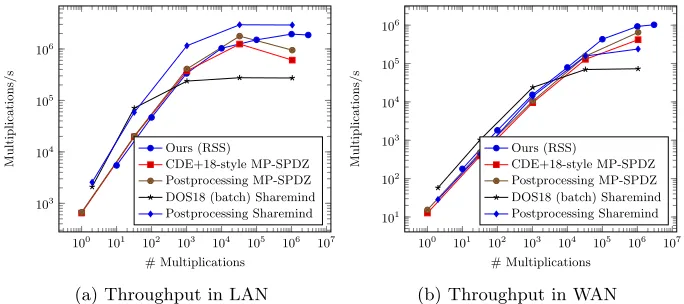
and empirically. Our implementation for the 3-party protocol shows that 1 million multiplications in a circuit with depth-20 over the ringZ264, can be processed
in 400 ms in a LAN network. For the Shamir-based protocol, we are able to process a circuit of 1 million multiplications in depth-20 over the ringZ264 in 2
seconds overall with 3 parties in a LAN network, from which only 200 ms are spent on the online computation. For 9 parties, this increases to just 3 seconds, from which 500 ms are spent on the online computation To obtain these results, we implemented the secret-sharing scheme overZ2k via Galois rings of [2]. Our
work demonstrates the practical viability of these techniques, which may have applications beyond MPC.
Our protocols perform well with respect to their field analogues [16], which illustrates the benefits of working over the ringZ2k in terms of concrete efficiency.
1.2 Overview of our Techniques
Compiler. The starting point of our work is the general compiler by Chida et
al. [16], which achieves a similar result to ours, but over fields. In that work, the authors show that passively secure honest majority protocols over fields, that satisfy the property of being secure up to additive attacks, can be compiled to achieve active security without a noticeable loss in efficiency. The main idea behind their compiler is that each input and intermediate value is encoded as
AMD encoding, with the property that adversary which adds an offset to the codeword that is independent ofxandr, is detected with high probability. Over fields the statistical security grows with the field size, but this does not hold for non-field ringsZ2k. In particular, the probability of detecting errors for the
ringZ2k remains 1/2, regardless of the size ofk.
Our main observation is that a similar issue appears in the dishonest majority scenario, where a MAC scheme is required in order to enforce correct behavior from the parties when reconstructing a value. More precisely, the MAC scheme used in the SPDZ protocol [23] relies on the same property as above. This MAC scheme was adapted to work overZ2k in [17] by, instead of working over Z2k,
moving toZ2k+s to provide some “extra room” for authentication.
At a very high level, our compiler is obtained by following the template from [16], and using the “SPDZ2k trick” from [17] for the underlying AMD code, and
it is described and analyzed in Section4. However, various subtle issues arise when trying to combine these two techniques directly.
For example, one of the critical steps in the compiler is to check whether a given secret-shared value xequals 0, without revealing anything else. Over fields, this can be done by openingr·xfor uniformly randomr; with high probability
rx= 0 if and only ifx= 0, and forx6= 0 we have thatrxis uniformly random. However, this does not work over Z2k, e.g. since forx= 2k−1 we have rx= 0
with probability 1/2. In Section3.1we present a novel check for equality with zero that works over rings, which may be of independent interest.
Efficient input protocols. Similarly to [16], we apply our compiler to two
passively secure protocols: one based on replicated secret sharing and one based on Shamir secret sharing. For the first protocol, we simply observe in Section5.1
that the proof presented in [33], which shows that replicated secret sharing over fields is secure up to additive attacks, also holds overZ2k.
Now, for the second protocol, we rely on the recent work of [2] that extends Shamir secret sharing to the ring setting via Galois rings. Their protocol for the honest majority setting is based on [5], but since they aim for guaranteed output delivery, their techniques are quite complex and the concrete efficiency is not so clear. We show how to use their techniques in an efficient way. This includes protocols for efficiently generating random sharings and multiplication of shared values. In particular, we combine their core ideas with the semi-honest protocol from [21], to obtain a simple multiplication protocol that is secure against additive errors. Moreover, note that the secret-sharing scheme from [2] does not have shares in the secret space ringZ2k but in a Galois ring extension R∼= (Z2k)dlog(n)e. Through a simple but novel optimization detailed in Section5.2,
we are able to avoid communicating full elements inRin the online phase, but instead communicate just one element of Z2k, ensuring the online phase has
linear complexity in the number of players.
1.3 Related Work
However, their compiler does not preserve the adversary threshold when moving from passive to active security. In addition, in [22] and [25] the compiler was instantiated for the 3-party case only.
The only concretely efficient protocol for arithmetic computation over rings that works for any number of parties is the SPDZ2k protocol [17] which was
proven to be practical in [24]. This protocol is for the dishonest majority and thus requires the use of much heavier machinery, which makes it orders of magnitudes slower than ours. However, they deal with a more complicated setting and provide stronger security.
In the three-party setting with one corruption, there are several works which provide high efficiency for arithmetic computations over rings. The Sharemind protocol [8] is being used to solve real-world problems but provides only pas-sive security. The actively secure protocol of [26], which was optimized and implemented in [3], is based on the “cut–and–choose” approach. This protocol requires each party to send 7 ring elements per multiplication gate. The advantage of their approach is that this amount stays the same also when working over small rings (e.g., boolean circuits). Thus, while we achieve lower bandwidth for large rings such asZ232 andZ264, their protocol will be favorable when working
over small rings. The protocol of [15] has a slightly overall higher bandwidth than [3], but focuses on minimizing online (input-dependent) cost. The actively secure three-party protocol of [25] is the closest to our protocol in the sense that they also focus on efficiency for large rings. The overall communication per multiplication gate of their protocol is 3(k+s) bits sent by each party, which is higher than ours by (k+s) bits. We provide a detailed empirical comparison with [25] in Section6.4. Finally, parallel to this work, a new promising direction was presented by [11]. They used the sub-linear distributed zero-knowledge proof from [9] to achieve malicious security at almost the same cost as semi-honest for large circuits. However, their protocol was not implemented and experiments that were carried-out for 31-bit Merssene field, show that only their verification step takes several seconds for a 1-million gate circuit due to heavy computational work. This is expected to be even worse for rings. Also, it is not clear at the moment how to extend their techniques to more than 3 parties.
2
Preliminaries and Definitions
Notation. LetP1, . . . , Pndenote thenparties participating in the computation,
and lett denote the number of corrupted parties. In this work, we assume an honest majority, and thust < n2. Throughout the paper, we useH to denote the subset of honest parties andC to denote the subset of corrupted parties. We use [n] to denote the set{1, . . . , n}.ZM denotes the ring of integers moduloM, and
the congruencex≡ymod 2` is denoted byx≡`y.
2.1 Linear Secret Sharing and its Properties
Let `be a positive integer. A perfect (t, n)-secret-sharing scheme (SSS) overZ2`
each one of them in such a way that any subset of at least t+ 1 parties can reconstructxfrom their shares, but any subset of at mosttparties cannot learn anything aboutxfrom their shares. We denote byshare(x) the sharing interactive procedure and byopen(JxK) the procedure to open a sharing and reveal the secret. Theshareprocedure may take also in addition tox, a set of shares{xi}i∈J for
J ⊂[n] and|J| ≤t, such thatshare(x,{xi}i∈J) satisfiesJxK= (x 0
1, . . . , x0n), with
x0i = xi for i ∈ J. The open procedure may take an indexi as an additional
input. In this case, the secret is revealed toPi only. In case the sharingJxKis not
correct as defined below,open(JxK) will output⊥. An SSS is linear if it allows the parties to obtain shares of linear combinations of secret-shared values without interaction.
Our compiler applies to any linear SSS overZ2k that has a multiplication
protocol that is secure against additive attacks, as defined in Section2.3. The only extra, non-standard properties required by our compiler are the following (for a formalization of the requirements of the SSS, see Appendix A):
Modular Reduction. We assume that theopenprocedure is compatible with
modular reduction, meaning that for any 0≤`0≤`and anyx∈Z2`, reducing
each share inJxK`modulo 2`
0
yields sharesJxmod 2`0
K`0. We denote this by JxK`→JxK`0.
Multiplication by 1/2. Given a shared valueJxK`, we assume if all the shares
are even then shifting these shares to the right yields sharesJx0K`−1, where
x0=x/2.2
Throughout the entire paper, we set the threshold for the secret-sharing scheme to bebn−1
2 c, and we denote byt the number of corrupted parties. Since
we assume an honest majority, it holds thatt < n/2 and so the corrupted parties can learn nothing about a shared secret. This also means that the shares of the honest parties always fully determine the shares of the corrupted parties. We will use this property frequently in our functionalities.
Now we define what it means for the parties to havecorrect shares of some value. LetJ be a subset of honest parties of size t+ 1, and denote byval(JvK)J
the value obtained by these parties after running theopenprotocol, where no corrupted parties or additional honest parties participate, i.e. open(JvKJ). Note
thatval(JvK)J may equal ⊥and in this case we say that the shares held by the
honest parties are not valid. Informally, a secret sharing is correct if every subset oft+ 1 honest parties reconstruct the same value (which is not⊥). The formal definition appears in AppendixA.
2.2 Security Definition
We use the standard definition of security based on the ideal/real model paradigm [12,29], with security formalized for non-unanimous abort. This means that the
2 If all the shares
JxK`are even then these shares may be written asJxK`= 2·JyK`,
which, by the homomorphism property, are shares of 2·y. Since these are shares ofx
adversary first receives the output, and then determines for each honest party whether they will receiveabortor receive their correct output. It is easy to modify our protocols so that the honest parties unanimously abort by running a single (weak) Byzantine agreement at the end of the execution [30]. For simplicity, we omit this step from the description of our protocols. Our protocol is cast in the synchronous model of communication, in which it is assumed that the parties share a common clock and protocols can be executed in rounds.
2.3 Secure Multiplication up to Additive Attacks [27,28]
Our construction works by running a multiplication protocol (for multiplying two values that are shared among the parties) that is not fully secure in the presence of a malicious adversary and then running a verification step that enables the honest parties to detect cheating. In order to achieve this, we start with a multiplication protocols with the property that the adversary’s ability to cheat is limited to carrying out a so-called “additive attack” on the output. Formally, we say that a multiplication protocol is secure up to an additive attack if it realizes
Fmult defined in Functionality1. This functionality receives input sharingsJxK
andJyKfrom the honest parties and an additive valuedfrom the adversary, and outputs a sharing of x·y+d. Since the corrupted parties can determine their own shares in the protocol, the functionality allows the adversary to provide the shares of the corrupted parties, but this reveals nothing about the shared value.
As we will discuss in the instantiations sections (Section5.1 and 5.2), the requirements defined by this functionality can be met by some semi-honest multiplication protocols over Z2`, namely replicated secret sharing and the more
recent protocol of Cramer et al. [2], which is an extension of Shamir Secret Sharing to the setting ofZ2`. This will allow us to implement this functionality
in a very efficient way.
Functionality 1Fmult(`)
1. Upon receivingJxK
H ` andJyK
H
` from the honest parties, the ideal functionalityFmult
com-putesx, yand the corrupted parties sharesJxK
C
` andJyK
C
`.
2. FmulthandsJxK
C
` andJyK
C
` to the ideal-model adversary/simulatorS.
3. Upon receivingdand {αi}i|Pi∈C from S, functionalityFmult definesz ≡` x·y+d and
JzK
C
` ={αi}i|Pi∈C. Then, it runsshare(z,JzK
C
`) to obtain a sharezjfor each partyPj.
4. The ideal functionalityFmulthands each honest partyPjits sharezj.
Efficient Sum of Products. In addition to the above, we consider a similar
functionality FDotProduct that, instead of computing one single multiplication,
3
Building Blocks and Sub-Protocols
Our compiler requires a series of building blocks in order to operate. These include generation of random shares and public coin-tossing, as well as broadcast. Furthermore, as mentioned in Section1.2, a core step of our compiler is checking that a shared value is zero, leaking nothing more than this binary information. We define this functionality and instantiate it in Section3.1. We stress that our presentation here is very general and it assumes nothing about the underlying secret sharing scheme beyond the properties stated in Section2.1.
3.1 Basic Building Blocks
Frand – Generating Random Shares. We define the ideal functionalityFrand
to generate a sharing of a random value unknown to the parties. The functionality lets the adversary choose the corrupted parties’ shares, which together with the random secret chosen by the functionality, are used to compute the shares of the honest parties.
The way to compute this functionality depends on the specific secret sharing scheme that is being used. For example, for the case of replicated secret sharing we consider the well-known method [4] that is based on distributing replicated keys for a PRF, which allows the parties to generate shares of random values without interaction. For the case of Shamir secret sharing (Section 5.3), we consider an instantiation which relies on super-invertible matrices [21] to achieve linear communication complexity, together with the “tensoring-trick” from [13,2] in order to instantiate such matrices efficiently.
Fcoin – Generating Random Coins. Fcoin(`) is an ideal functionality that
chooses a random element from Z2` and hands it to all parties. A simple way
to computeFcoinis to use Frand to generate a random sharing and then open it.
In the plain model, one can generate random coins by having each party (more precisely, it suffices fort+ 1 parties to do this) shares a random secret, which are then summed by the parites and opened to reveal the sum of the secrets. The fact that there is a least one honest party which shares a secret guarantees that the obtained value is uniformly distributed over the ring. On the other hand, the properties of the open procedure, guarantee that if the corrupted parties distributed an incorrect sharing, the honest parties will detect it and abort.
Fbc – Broadcast with Abort. Another essential primitive for our compiler is
A simple way to computeFbc is the well-known echo-broadcast protocol,
where the parties echo the message they received and send it the other parties. Note that this protocol does not achieve unanimous abort and gives the adversary the ability to determine which of the honest parties will output the sent message and which will abort (as mentioned in Section2.2).
Finput – Secure Sharing of Inputs. In this section, we present our protocol for securely sharing the parties’ inputs. The protocol is the same as in [16] (and many prior works): for each input xbelonging to a party Pj, the parties call
Frandto generate a random sharingJrK; denote the share held byPi by ri. Then, r is reconstructed toPj, who broadcasts x−rto all parties. Finally, each Pi
outputs the shareJr+ (x−r)K=JxK. The functionality this protocol instantiates
is denoted byFinput, and it is formalized in SectionBin the Appendix.
FCheckZero – Checking Equality to 0. We assume a functionalityFCheckZero, which receivesJvKH
` from the honest parties, uses them to computev and sends
accept to all parties if v ≡` 0. Else, if v 6≡` 0, the functionality sends reject.
This functionality is described in detail as Functionality4in Section Cin the appendix. In the same section, we show how to instantiate this functionality, which is non-trivial when compared to the field sertting. For example, a simple way to approach this problem when working over a field is sampling a random multiplicative maskJrK, multiply Jr·vK=JrK·JvK, openr·vand check that it is equal to zero. Clearly, since ris random then r·v looks also random if v6= 0. However, this technique does not work over the ring Z2`: for example, ifv is a
non-zero even number thenr·v is always even, which reveals too much aboutv. Instead of following the same idea as over fields, we adapt the ideas introduced in [24] to perform oblivious equality check. In a nutshell, this technique consists of generating shares of the bit representation of the shared valueJvK`, and then
executing an OR circuit to check that all these bits are 0. This approach requires several tools, like a correct multiplication protocol and the generation of shared valuesJbK` wherebis a random bit. Furthermore, the results in [24] are set in
the setting of a concrete secret-sharing scheme, namely additive secret sharing. In SectionCwe show how to implement these requirements and how to extend the techniques of [24] to an arbitrary secret-sharing scheme.
Finally, although this instantiation is generic in the sense that it works for an arbitrary secret sharing scheme satisfying the conditions stated in Sections2.1
andA, it is not very efficient. In practice, concrete secret sharing schemes allow for cheaper check-to-zero protocols, as show later on.
4
The Main Protocol for Rings
In this section, we present our construction to compute arithmetic circuits over the ringZ2k. A formal description appears in Protocol1. Our protocol follows the
using a random sharingJrK. This is done by taking each inputJvKand multiply it withJrK. Once the parties hold a pair of sharings on each input wire (JvK,Jr·vK), the parties go over the circuit while maintaining this invariant. For linear gates this can be done locally by each party due to the homomorphism property of the secret sharing scheme. For multiplication gates, with two inputs with sharings (JxK,Jr·xK) and (JyK,Jr·yK), the parties run a multiplication protocol twice, to multiplyJxKandJyKand to multiplyJr·xKandJyK. To carry out all the above multiplications, the parties use the functionalityFmult, which only guarantees
security up to additive attack (and thus can be instantiated by highly-efficient protocols as we will see in Section5.1and Section 5.2).
Protocol 1Computing Arithmetic Circuits Over the RingZ2k
Inputs:Each partyPj (j∈ {1, . . . , n}) holds an inputxj∈ZL2k.
Auxiliary Input:The parties hold the description of an arithmetic circuitCoverZ2k that computesfon inputs of lengthM=L·n. LetN be the number of multiplication gates inC. In addition, the parties hold a parameters∈N.
The protocol:
1. Secret sharing the inputs:
(a) For each inputxj held by partyPj, partyPjrepresent it as an element ofZL2k+s and
sendsxj toFinput(k+s).
(b) Each partyPj records its vector of shares (xj1, . . . , x
j
M) of all inputs, as received from Finput(k+s). If a party received⊥fromFinput, then it sendsabortto the other parties and halts.
2. Generate randomizing shares:The parties callFrand(k+s) to receiveJrKk+s, wherer∈R
Z2k+s.
3. Randomization of inputs:For each input wire sharingJvmKk+s(wherem∈ {1, . . . , M})
the parties callFmultonJrKk+sto receiveJr·vmKk+s.
4. Circuit emulation: The parties traverse over the circuit in topological order. For each gate
G` the parties work as follows:
– G` is an addition gate: Given tuples (JxKk+s,Jr·xKk+s) and (JyKk+s,Jr·yKk+s)
on the left and right input wires respectively, the parties locally compute (Jx+yKk+s,Jr·(x+y)Kk+s).
– G` is a multiplication-by-a-constant gate: Given a constant a ∈ Z2k and
tuple (JxKk+s,Jr·xKk+s) on the input wire, the parties locally compute
(Ja·xKk+s,Jr·(a·x)Kk+s).
– G` is a multiplication gate: Given tuples (JxKk+s,Jr·xKk+s) and (JyKk+s,Jr·yKk+s)
on theleftandrightinput wires respectively:
(a) The parties callFmultonJxKk+sandJyKk+sto receiveJx·yKk+s.
(b) The parties callFmultonJr·xKk+sandJyKk+sto receiveJr·x·yKk+s.
5. Verification stage:Let{(JziKk+s,Jr·ziKk+s)}
N
i=1be the tuples on the output wires of all multiplication gates and let{JvmKk+s,Jr·vmKk+s}Mm=1be the tuples on the input wires of the circuit.
(a) Form= 1, . . . , M, the parties callFrand(k+s) to receiveJβmKk+s.
(b) Fori= 1, . . . , N, the parties callFrand(k+s) to receiveJαiKk+s.
(c) Compute linear combinations:
i. The parties callFDotProducton (Jα1Kk+s, . . . ,JαNKk+s,Jβ1Kk+s, . . . ,JβMKk+s) and
(Jr·z1Kk+s, . . . ,Jr,·zNKk+s,Jr·v1Kk+s, . . . ,Jr·vMKk+s) to obtain JuKk+s=J
PN
i=1αi·(r·zi) +PMm=1βm·(r·vm)Kk+s.
ii. The parties call FDotProduct on (α1, . . . , αN, β1, . . . , βM) and
(Jz1Kk+s, . . . ,JzNKk+s,Jv1Kk+s, . . . ,JvMKk+s) to obtain JwKk+s=J
PN
i=1αi·zi+PMm=1βm·vmKk+s.
(d) The parties runopen(JrKk+s) to receiver.
(e) Each party locally computesJTKk+s=JuKk+s−r·JwKk+s.
(f) The parties callFCheckZero(k+s) onJTKk+s. IfFCheckZero(k+s) outputsreject, the
parties output⊥and abort. If it outputsaccept, they proceed.
6. Output reconstruction:For each output wire of the circuit withJvKk+s, the parties locally
convert toJvKk. Then, they run vmod 2k = open(JvKk, j), wherePj is the party whose
output is on the wire. IfPj received⊥from theopenprocedure, then it sends⊥ to the
other parties, outputs⊥and halts.
Unfortunately, the fact that the underlying multiplication protocol is secure only up to additive attacks means that the output of the multiplications might be incorrect. Thus, before reconstructing the outputs, the parties run a short verification step which guarantees that if cheating took place, the honest parties will detect it and abort. This is achieved by having the parties first taking a random linear combination of the shares on output wires of all multiplication gates and the shares on input wires, i.e. computingJuK=JPN
i=1αi·zi+ PM
m=1βm·vmK,
and taking a random linear combination of the randomized sharing on these wires, i.e., computingJwK=JPN
i=1αi·(r·zi) +P M
m=1βm·(r·vm)K, where N is
the number of multiplication gates,M is the number of input wires and allαi
andβmare random secrets. Then, the parties check thatJTK=JwK−r·JuKis a
sharing of 0 using the ideal functionalityFCheckZero.
The protocol as described so far works directly for circuits which are defined over a finite field F. As shown in [16], if the adversary carries out an additive
attack in any of the multiplication, the check will pass for exactly one choice ofr
or a random coefficient, resulting with a cheating probability of 3/|F|. However,
this does not work when moving to rings. To see this, assume that the adversary has attacked exactly one gate, indexed by i0, such thatzi0 =xi0·yi0+di0 and
r·zi0 = (r·xi0)·yi0 (i.e., the adversary added di to the result of multiplying
xi0·yi0 and acted honestly when multiplyingr·xi0 withyi0). For simplicity
assume that the output of this gate is an output wire of the circuit. Thus, we have thatT = (r·xi0)·yi0−r·(xi0·yi0+di0) =r·di0. Now, when working over
fields,T = 0 only if r= 0 (since di06= 0), which happens with probability 1/|F|.
However, when working over the ringZ2k, the adversary can choosedi0 = 2
k−1,
which means thatT ≡k 0 ifris even, which happens with probability 1/2.
In order to reduce the cheating success probability, we borrow the idea of [17] to work on the larger ringZ2k+s. This solves the above attack which now can
succeed with probability 1/2s+1 only (since nowr·di0 ≡k+s0 fordi0 = 2
k−1 is
equivalent tor≡k+s−(k−1)0, i.e., for this to hold the adversary needs to guess
the upper s+ 1 bits of r). More generally, we show in Lemma 1that for any attack in any of the calls to Fmult with an additive value d 6≡k 0, the honest
parties will outputacceptat the end of the verification step with probability of at most 2−s+log(s+1). On the other hand, the adversary may now also carry out
attacks with additive values that are congruent to 0 modulo 2k but not modulo
2k+s. While this has no effect on the correctness of the output (since it does not
change the lowerkbits of the values on the wires), a challenge here is to show that it is possible to simulate correctly whenFCheckZeroreturnsacceptorreject. In Theorem1, where we prove the security of our compiler, we show that there are several cases here and that the simulation has the same distribution as in the real execution.
protocol secure. In particular, if the coefficients were revealed to the parties, then the adversary will be able to carry out a selective failure attack where one bit of information is revealed byFCheckZero. To see this, assume again that
the adversary has attacked exactly one gate, indexed by i0, in the following
way. When multiplyingxi0 withyi0, the adversary acted honestly, but when
multiplying r·xi0 withyi0, it added the value di0. Thus, on the output wire,
the parties hold a sharing of the pair (xi0·yi0, r·xi0·yi0+di0). Now, assume
that this wire enters another multiplication gate, indexed by j0 with input
shares on the second wire being (wj0, r·wj0) and that the output of this second
gate is an output wire of the circuit. Thus, on the output of this gate, the parties will hold the sharing (xi0 ·yi0·wj0,(r·xi0 ·yi0 +di0)wj0) (assuming
the adversary does not attack this gate as well). In this case, we have that
T =αi0·di0+αj0·(di0·wj0) =di0(αi0+αj0·wj0). Now, ifdi0= 2
k+s−1then it
follows that T ≡k+s0 if and only ifαi0+αj0·wj0 is even.
The attack presented above does not change theklower bits of the values on the wires, and thus has no effect on the correctness of the output. However, ifαi0
andαj0 are public and known to the adversary, then byFCheckZero’s ouptut the
adversary may be able to learn whetherwj0 is even or not. In contrast, whenαi0
andαj0 are kept secret, learning whetherαi0+αj0·wj0 is even or odd does not
reveal any information aboutwj0 since it is now perfectly masked byαi0 andαj0.
Therefore, to prevent this type of attack, we are forced to use random secrets for our random linear combination. Here is where the functionality FDotProduct
becomes handy, as it allows to compute the sum of products of sharings in an efficient way which is exactly what we need to computePN
i=1JαiK·JziK.
Lemma 1. IfAsends an additive value d6≡k 0in any of the calls toFmult in
the execution of Protocol 1, then the value T computed in the verification stage of Step 5equals 0 with probability2−s+log(s+1).
Proof: Suppose that (JxiKk+s,JyiKk+s,JziKk+s) is the multiplication triple
corresponding to the i-th multiplication gate, where JxiKk+s,JyiKk+s are the
sharings on the input wires and JziKk+s is the sharing on the output wire. We
note that the values on the input wires may not actually be the appropriate values as when the circuit is computed by honest parties. However, in the verification step, each gate is examined separately, and all that is important is whether the randomized result isJr·ziKk+sfor whateverzi is here (i.e., even if an error was
added by the adversary in previous gates). By the definition ofFmult, a malicious
adversary is able to carry out an additive attack, meaning that it can add a value to the output of each multiplication gate. We denote byδi ∈Z2k+s the value that
is added by the adversary whenFmult is called withJxiKk+s andJyiKk+s, and by γi∈Z2k+s the value added by the adversary whenFmult is called with the shares
JyiKk+s andJr·xiKk+s. However, it is possible that the adversary has attacked
previous gates and soJyiKk+s is actually multiplied withJr·xi+iK, where the
value i ∈Z2k+s is an accumulated error from previous gates.3 Thus, it holds
3
thatval(JziK)
H =x
i·yi+δi andval(Jr·ziK)
H= (r·x
i+i)·yi+γi. Similarly,
for each input wire with sharing JvmK, it holds thatval(Jr·vmK)
H=r·v
m+ξm,
whereξm∈Z2k+s is the value added by the adversary whenFmult is called with
JrKk+sand the shared input JvmKk+s. Thus, we have that
val(JuK)H =
N
X
i=1
αi·((r·xi+i)·yi+γi)
+
M
X
m=1
βm·(r·vm+ξm) +Θ1
val(JwK)H =
N
X
i=1
αi·(xi·yi+δi) + M
X
m=1
βm·vm+Θ2
whereΘ1∈Z2k+s andΘ2∈Z2k+s are the values being added by the adversary
whenFDotProduct is called in the verification step, and so
val(JTK)
H =val(
JuK)
H−r·val(
JwK)
H=
=
N
X
i=1
αi·((r·xi+i)·yi+γi) + M
X
m=1
βm·(r·vm+ξm) +θ1
−r·
N
X
i=1
αi·(xi·yi+δi) + M
X
m=1
βm·vm+Θ2 !
=
N
X
i=1
αi·(i·yi+γi−r·δi) (1)
+
M
X
m=1
βm·ξm+ (Θ1−r·Θ2),
where the second equality holds becauseris opened and so the multiplication
r·JwKk+salways yieldsJr·wKk+s. Let∆i=i·yi+γi−r·δi.
Our goal is to show that val(JTK)H, as shown in Eq. (2), equals 0 with
probability at most 2−s+log(s+1). We have the following cases.
– Case 1: There exists m∈[M] such thatξm6≡k0.Letm0 be the smallest such
mfor which this holds. Thenval(JTK)H ≡
k+s0 if and only if
βm0·ξm0 ≡k+s − N X i=1
αi·∆i− M
X
m=1
m6=m0
βm·ξm−(Θ1−r·Θ2)
.
then given the randomized sharingJx0iKk+s, definei=x 0
i−r·xias the accumulated
Let 2u be the largest power of 2 dividingξ
m0. Then we have that
βm0 ≡k+s−u
−PN
i=1αi·∆i−P M
m=1
m6=m0
βm·ξm−(Θ1−r·Θ2)
2u · ξ m0 2u −1 .
By the assumption that ξm6≡k 0 it follows thatu < k and so k+s−u > s
which means that the above holds with probability at most 2−s, sinceβ m0 is
uniformly distributed overZ2k+s.
– Case 2: All ξm≡k 0.By the assumption in the lemma, some additive value
d6≡k 0 was sent to Fmult. Since none was sent for the input randomization,
there exists somei∈ {1, . . . , N} such thatδi 6≡k 0 orγi 6≡k 0. Let i0 be the
smallest suchifor which this holds. Note that since this is the first error added which is6≡k 0, it holds thati0 ≡k0. Thus, in this case,val(JTK)
H≡ k+s0 if
and only ifαi0·∆i0≡k+sY, where
Y = − N X i=1
i6=i0
αi·∆i− M
X
m=1
βm·ξm−(Θ1−r·Θ2)
.
Let qbe the random variable corresponding to the largest power of 2 dividing
∆i0, where we defineq=k+sin the case that∆i0 ≡k+s0. LetE denote the
event αi0·∆i0 ≡k+sY. We have the following claims.
• Claim 1: Fork < j ≤k+s, it holds that Pr[q=j]≤2−(j−k).
To see this, suppose thatq=j andj > k. It holds then that∆i0 ≡j 0, and
so ∆i0 ≡k 0. We first claim that in this case it must hold that δi0 6≡k 0.
Assume in contradiction thatδi0 ≡k0. In addition, by our assumption we
have thatγi0 6≡k0,i≡k0 and∆i0 =i0·yi0+γi0−r·δi0 ≡k 0. However,
i·yi0≡k0 andr·δi0≡k 0 imply thatγi0 ≡k0, which is a contradiction.
We thus assume thatδi0 6≡k 0, and in particular there existsu < k, such
thatuis the largest power of 2 dividingδi0. It is easy to see then thatq=j
implies that r ≡j−u
i0·yi0+γi0 2u
·δi0
2u
−1
. Sincer ∈Z2k+s is uniformly
random andu < k, we have that this equation holds with probability of at most 2−(j−u)≤2−(j−k).
• Claim 2: Fork < j < k+sit holds that Pr[E | q=j]≤2−(k+s−j). To prove this let us assume that q = j and that E holds. In this case
we can writeαi0 ≡k+s−j
Y
2j ·
∆
i0 2j
−1
. For k < j < k+s it holds that
0< k+s−j < s and therefore this equation can be only satisfied with probability at most 2−(k+s−j), given thatα
i0 ∈Z2s is uniformly random. • Claim 3: Pr[E |0≤q≤k]≤2−s.
This is implied by the proof of the previous claim, since in the case that
q=j with 0≤j ≤k, it holds that k+s−j ≥s, so the event E implies
that αi0 ≡s
Y
2j ·
∆
i0 2j
−1
Putting these pieces together, we thus have the following:
Pr [E] = Pr [E |0≤q≤k]·Pr[0≤q≤k] +
k+s
X
j=k+1
Pr [E |q=j]·Pr[q=j]
≤2−s+s·2−s= (s+ 1)·2−s= 2−s+log(s+1). (2)
To sum up the proof, in the first case we obtained thatT = 0 with probability of at most 2−s whereas in the second case, this holds with probability of at
most 2−s+log(s+1). Therefore, we conclude that the probability that T = 0 in
the verification step is bounded by 2−s+log(s+1) as stated in the lemma. This
concludes the proof.
We are now ready to prove the security of Protocol1.
Theorem 1. Let f be an n-party functionality over Z2k and let s be a
sta-tistical security parameter. Then, Protocol 1 securely computes f with abort in the (Finput,Fmult,Fcoin,Frand,FCheckZero)-hybrid model with statistical error 2−s+log(s+1), in the presence of a malicious adversary controllingt < n2 parties.
Proof: LetAbe the real world adversary who controls a set of corrupted parties
C and letS be the ideal world simulator. The simulatorS works as follows:
1. Secret sharing the inputs:S receives fromAthe set of corrupted parties inputs (values vj associated with partiesPi∈ C) and the corrupted parties’ shares
{JvmK C
k+s} M
m=1that Asends toFinputin the protocol.
2. Generate the randomizing share: SimulatorS receives the shareJrKCk+s of the corrupted parties thatAsends toFrand.
3. Randomization of inputs: For every input wirem = 1, . . . , M, simulator S
plays the role of Fmult in the multiplication of themth input JvmKk+swith
JrKk+s. Specifically,S handsAthe corrupted parties shares inJvmKk+sand JrKk+s (it has these shares from the previous steps). Next, S receives the
additive valued=ξm∈Z2k+s and the corrupted parties’ sharesJzKCk+s of the
result thatAsends toFmult. SimulatorS stores all of these corrupted parties
shares.
4. Circuit emulation:Throughout the emulation,Swill use the fact that it knows the corrupted parties’ shares on the input wires of the gate being computed. This holds initially from the steps above, and we will show it computes the output wires of each gate below. For each gateG`in the circuit,
– If G` is an addition gate: Given the shares of the corrupted parties on the
input wires, S locally adds them as specified by the protocol, and stores them.
– If G` is a multiplication-by-a-constant gate: Given the shares of the
– If G` is a multiplication gate: S plays the role of Fmult in this step (as
in the randomization of inputs above). Specifically, simulator S handsA
the corrupted parties’ shares on the input wires as it expects to receive fromFmult (it has these shares by the invariant), and receives fromAthe
additive value as well as the corrupted parties’ shares for the output. These additive values areδ`∈Z2k+s (for the multiplication of the actual values)
andγ`∈Z2k+s (for the multiplication of the randomized value), as defined
in the proof of Lemma1. S stores the corrupted parties’ shares.
5. Verification stage: Simulator S works as follows. S plays the role of Frand
receiving the sharesJα1K C
k+s, . . . ,JαNK C
k+sandJβ1K C
k+s, . . . ,JβMK C
k+s∈Z2k+s
sent toFrandbyA. Then, it plays the role ofFDotProductreceiving the shares
JuK C
k+s, the sharesJwK C
k+sand the additive attacksΘ1 andΘ2 sent byAto FDotProduct. Next,S chooses a randomr∈Z2k+s and computes the shares of rby (r1, . . . , rn) =share(r,JrK
C
k+s), using the sharesJrK C
k+s provided byAin
the “generate randomizing share” step above. Next, S simulates the honest parties sending their shares inopen(JrKk+s) toA, and receives the shares that
Asends to the honest parties in thisopen. If any honest party would abort (it knows whether this would happen since it has all the honest parties’ shares), thenS simulates it sending⊥to all parties, externally sendsabortj for every
Pj∈H to the trusted party computingf, and halts.
Finally,S simulatesFCheckZero, as follows:
(a) If any non-zeroξm, δi, γi was provided toFmult byAin the simulation
that is not congruent to 0 modulo 2k, thenSsimulatesF
CheckZerosending
rejectto the parties.
(b) Otherwise, if anyξm, δi, γi was provided toFmult byAin the simulation
that is not congruent to 0 modulo 2k+s, then S simulates FCheckZero
sendingacceptto the parties with probabilitypandrejectwith probability 1−p, where p= 2−(k+s−u) anduis determined as follows:
If∃ξm6≡k+s0, letm0be the smallest mfor which this holds. Then,uis
the largest for which 2u dividesξm0.
Otherwise, allξm≡k+s0, but there isi∈ {1, . . . , N}for whichδi6≡k+s0
orγi6≡k+s0. Leti0be the smallest index for which this holds. Then,u
is the largest for which 2u dividesγ
i0−r·δi0.
(c) Finally, if allξm, δi, γi≡k+s0, thenS setT =Θ1−r·Θ2 and simulates FCheckZerosendingacceptifT ≡k+s0 andrejectotherwise.
In any of the above, ifS sentaborttoA, thenS externally sendsabortj for
everyPj ∈H to the trusted party computingf. Otherwise,S proceeds to the
next step.
In addition, S receives the messages from A for the reconstructions to the honest parties. If any of the messages in the reconstruction of an output wire associated with an honestPj are incorrect (i.e., the shares sent byAare not
the correct shares it holds), thenS sendsabortj to instruct the trusted party
to not send the output to Pj. Otherwise, S sends continuej to the trusted
party, instructing it to sendPj its output.
We claim that the view of the adversary in the simulation is distributed identically to its view in the real execution, except with probability 1/2s−log(s+1).
In order to see this, observe first that if all ξm, δi, γi values are congruent to 0
modulo 2k+s, then the simulation is perfect.
Next, consider the case that someξm, δi, γivalue is not congruent to 0 modulo
2k. In this case, the simulatorS always simulatesFCheckZero outputtingreject.
However, in a real execution where someξm, δi, γi value is not congruent to 0
modulo 2k, functionalityFCheckZeromay returnaccept. This event happens when
T ≡k+s0. By Lemma1, the probability thatT ≡k+s0 in such a real execution is
less than 2−s+log(s+1). Thus, in this case, the statistical difference between these distributions is less than 2−s+log(s+1), as stated in the theorem.
Finally, we show that when allξm, δi, γi are congruent to 0 modulo 2k but
not modulo 2k+s the simulation is identically distributed to the real execution. Let∆i=i·yi+γi−r·δi. If there existsξm6≡k+s0, then letm0be the smallest
mfor which this holds. Then, using Eq. (2), we have thatval(JTK)H ≡
k+s0 in
the real execution if and only if
βm0·ξm0 ≡k+s − N X i=1
αi·∆i− M
X
m=1
m6=m0
βm·ξm−(Θ1−r·Θ2)
.
Let 2u be the largest power of 2 dividingξ
m0. Then we have
βm0 ≡k+s−u
−PN
i=1αi·∆i−P M
m=1
m6=m0
βm·ξm−(Θ1−r·Θ2)
2u · ξ m0 2u −1 .
Sinceβm0 is chosen uniformly from Z2k+s and its value is kept secret, we obtain
thatFCheckZero will returnacceptin the real execution with probability 2−k+s−u
which is exactly the probability thatS sendsaccepttoA.
Otherwise, allξm≡k+s0, but there existsisuch thatδi 6≡k+s0 orγi6≡k+s0.
Let i0 be the smallest i for which this holds. Observe that this implies that
i0 ≡k+s0, as there were no attacks on previous gates. Thus, we have in the real
execution thatval(JTK)H ≡
k+s0 if and only if
αi0·(γi0−r·δi0)≡k+s − N X i=1
i6=i0
αi·∆i−(Θ1−r·Θ2)
Let ube the largest for which 2u divides γ
i0−r·δi0. Then, we have that the
above holds if and only if
αi0≡k+s−u
−PN
i=1
i6=i0
αi·∆i−(Θ1−r·Θ2)
2u
· γ
i0−r·δi0
2u
−1
.
As before, sinceαi0 is distributed uniformly overZ2k+s and kept secret during
the execution, the above holds with probability 2−k+s−u. This is exactly the probability thatFCheckZero, simulated byS, outputsacceptin the simulation.
Going over all cases, we conclude that the statistical difference betweenA’s view in the real and simulated execution is 2−s+log(s+1). This concludes the proof.
Concrete efficiency. We now analyze the performance of the protocol. Recall
that M is the number of inputs andN is the number of multiplication gates in the circuit. We denote byO the number of output wires of the circuit, and for a given functionalityF∗(`), we denote byC∗(`) the communication cost (in bits) of
calling this primitive.
For each input wire, we have one call toFinput(k+s), which is translated into one call toFrand(k+s), one call toopen(JrKk+s, i) and one element inZ2k+s
that is sent by some partyPi to the other parties. In addition, there is one call
to Fmult(k+s) to randomize each input. This adds up toM·(2· Crand(k+s) +
Copen(i)(k+s) + (k+s)).
For each multiplication gate, we callFmult(k+s) twice. Then, in the verification
step,Frand(k+s) is called for each input wire and multiplication gate. This adds N·(Crand+ 2· Cmult(k+s)). The remaining of the verification step consists of two
calls toFDotProduct(k+s), one call toopen(JrKk+s) and one call toFCheckZero(k+s).
Recall that we assume that the protocol realizingFDotProduct(k+s) has the same
communication complexity as Fmult(k+s), so this adds up to 2· Cmult(k+s) +
Copen(i)(k+s) +CCheckZero(k+s). However, as these are small constants which do
not depend on the size of the circuit, we exclude them from the final count. In the output reconstruction step, for each output wire, there is one call toopen(JvKk, i).
We thus have that the cost of the protocol is
M· 2· Crand(k+s) +Cmult(k+s) +Copen(i)(k+s) + (k+s)
+N·(Crand(k+s) + 2· Cmult(k+s)) +O· Copen(i)(k).
For circuits whereN M, O (i.e., there are much more multiplication gates than input and output wires), this is translated toN·(Crand(k+s)+2·Cmult(k+s)).
Notice that for some instantiations, like the replicated secret sharing based one from Section5.1,Frandis “free” in the sense that it can be implemented efficiently
by relying on a computational assumption, e.g., PRGs with correlated keys.
Basic Primitives for Secure Computation. We conclude this section with
truncation, among others, which are of importance in many applications of secure computation like private machine learning or flow-control in MPC programs.
The study of basic primitives for MPC has a rich history, including some works as [14,34,24,19]. However, most of these works are concerned with the case of MPC over fields and as such they face different challenges and provide different solutions. For example, a very simple operation that arises in these primitives over fields is dividing by powers of 2, which is achieved over fields of odd characteristic by simply multiplying (locally) by the inverse of this number. However, overZ2kthis is not so straightforward, which complicates the extension
of these techniques to the ring case.
Recent work has studied the development of basic primitives over rings [34,24]. In particular, the work of [24] has shown that, in spite of being more general than fields (and hence more complex), rings offer several benefits for many of the basic primitives considered in the literature. Intuitively, this stems from the fact that Z2` is inherently more “compatible” with bits, which is what these
primitives are mostly concerned with. Hence, it is natural to analyze whether or not our compiler supports these basic primitives.
We first observe that our check-to-zero protocol from Section3.1is already an instantiation of a basic primitive. Furthemore, just like we adapted this check-to-zero from [24] to our setting, other techniques from that work can be easily incorporated into ours in order to provide bit-decomposition and bit-extraction, truncations and signed comparisons. At the heart of these primitives lies the generation of random shared bits, which as we saw in SectionC, extends smoothly to the setting of an arbitrary secret sharing scheme. The fact that shares can be converted from mod 2k to mod 2 also plays an important role, and a converse
conversion can be envisioned using the ideas from [24].
However, we stress that all of this comes at the expense of using the expensive
FCorrectMult for all of the multiplication calls. A natural question to ask is whether it is possible to useFmult, which can be realized very efficiently, instead
ofFCorrectMult. Answering this question is beyond the scope of this work and is left as an open problem.
5
Two Protocols Secure up to Additive Attack
In this section, we present a brief overview of two protocols that are passively secure up to additive attack, and which we will compile to active security. Details can be found in the appendices.
5.1 Replicated Secret Sharing for Three Parties
The first protocol is an efficient three party instantiation of our compiler from replicated secret sharing. To share a value x∈ Z2` choose uniformly random x1, x2, x3 ∈ Z2` subject to the condition Pixi ≡` x. Each player Pi has the
pair (xi, xi+1) as their share; we take subscript indices modulo 3, i.e.P3 holds
parties. Note that reconstructing a secret is robust in the sense that parties either reconstruct the correct value xor they abort.
Replicated secret sharing satisfies the properties described in Section2.1, and one can efficiently realize the required functionalities described in the same section. SpecificallyFrandcan be realized with out any communication andFmult
can be realized by having each party sending one ring element [34,4,33]. Also
FDotProductcan be computed at the same cost ofFmult [16].
In addition,FCheckZerocan be realized very efficiently by relying on a random oracle H, as follows. We want to check whether P
ixi ≡` 0, or equivalently
xi−1≡`−(xi+xi+1). Now, eachPi computeszi=H(−(xi+xi+1)) =H(xi−1).
Since xi−1 is held by Pi−1 and Pi+1, they can also compute this value. Since
only one party is corrupted, it suffices that eachPi will sendzi toPi+1, and each
receiving party verifies whether it matches the value they expect, and aborts if it does not. For completeness, we present all protocols in Appendix D.
Efficiency analysis. Using the analysis from Section 4, we know that the
amortized communication complexity per multiplication gate isCrand(k+s) + 2·
Cmult(k+s). In our caseCrand(k+s) = 0, andCmult(k+s) = 3·(k+s), so the
overall amortized communication per multiplication is of only 6·(k+s) bits. For each party this translates to sending 2(k+s) bits for each multiplication.
5.2 Shamir Secret Sharing for Any Number of Parties
In this section, we present our instantiation based on Shamir’s secret sharing over rings, using the techniques from [2]. Over finite fields, Shamir’s scheme requires a distinct evaluation point for each player, and one more for the secret. This is usually not a problem if the size of the field is not too small. However, over commutative rings R the condition on the sequence of evaluation points
α0, . . . , αn∈Ris that the pairwise differenceαi−αj is invertible for each pair
of indicesi6=j. For our ring of interestZ2`, the largest such sequence the ring
admits is only of length 2 (e.g. (α0, α1) = (0,1)).
The solution from [2] is to embed inputs fromZ2` into a large enough Galois
ring Rthat has Z2` as a subring. This ring is of the formR=Z2`[X]/(h(X)),
whereh(X) is a monic polynomial of degreed=dlog2nesuch thath(X) mod 2∈
F2[X] is irreducible. Elements ofRthus correspond uniquely to polynomials with
coefficients inZ2` that are of degree at mostd−1. Note the similarity between
the Galois ring and finite field extensions ofF2: elements of the finite fieldF2d
correspond uniquely to polynomials of at most degree d−1 with coefficients in F2.
There is a ring homomorphism π : R → Z2` that sends a0+a1X +· · ·+
ad−1Xd−1∈R to the free coefficienta0, which we shall use later on.4 For more
relevant structural properties of Galois rings, see [2].
We adopt the above-mentioned version of Shamir’s scheme overR, but restrict the secret space to Z2`. The share space will be equal toR. Let 1≤τ ≤nbe
4
the privacy parameter of the scheme. Then, the set ofcorrect share vectors is
Cτ =
(f(α1), . . . , f(αn))∈Rn
f ∈R[X], deg(f)≤τ,
andf(α0)∈Z2` ⊂R
. (3)
With the restriction that the secret is inZ2`, we have thatCτ is an Z2`-module,
i.e. the secret-sharing scheme is Z2`-linear. Since it is based on polynomial
interpolation, the properties from 2.1can be easily seen to hold. This includes division by 2 if all the shares are even.
In this section, we denote a sharing underCτ asJxK= (x1, . . . , xn). We call τ the degree of the sharing. The reason we are explicit aboutτ is that we will use sharings of two different degrees. This stems from the critical property of this secret-sharing scheme that enables us to evaluate arithmetic circuits: this secret-sharing scheme is multiplicative. This means there is a Z2`-linear map Rn→
Z2` that for sharingsJxK,JyKsends (x1y1, . . . , xnyn)7→x·y.
Put differently, (x1y1, . . . , xnyn)∈C2τ is a degree-2τsharing with secretx·y.
We denote itJx·yK(2t)= (x1y1, . . . , xnyn) — in particular note the parenthesized
subscript refers to the degree of the sharing, as opposed to the modulus. Note thatCi⊆Cj for 0< i < j; in particular every degree-2τsharing is also a sharing
of degreen−1. A sharing of degreen−1 is related to additive secret sharing, where the secret equals the sum of the sharesx=P
ixi. The difference is that
here there are constants, i.e. we may writex=P
iλixi, forλ1, . . . , λn∈R. We
shall make use of this in our multiplication protocol, ensuring that parties only need to communicate an element ofZ2` instead of an element ofR. However, note
thatJ·K(2t)does not meet the definition of a secret-sharing scheme in Section2.1,
in particular because the corrupted parties shares are not well defined and cannot be computed from the honest parties’ shares.
5.3 Generating Randomness
We efficiently realize Frand by letting each player Pi sample and secret-share
a random element si, and then multiplying the resulting vector ofn random
elements with a particular5Vandermonde matrix [21].6 Of the resulting vector,
τ entries are discarded to ensure the adversary has zero information about the remaining ones. Thus, n−τ random elements are outputted, resulting in an amortized communication cost ofO(n) ring elements per element. A priori the adversary can cause the sharings to be incorrect; this is remedied with Protocol3
by opening a random linear combination of the sharings and verifying the result. Since our secret-sharing scheme J·K is Z2`-linear, we would like to choose
our matrix with entries in Z2`. Unfortunately, the Vandermonde matrix we
need does not exist overZ2`, for the same reason secret sharing does not work.
However, the secret-sharing scheme which consists of dparallel sharings of J·K
5
Over fields this can be a general Vandermonde matrix, but this is not sufficient over
R.
6
be interpreted as an R-linear secret-sharing scheme [13,2]. This secret-sharing scheme, which we denote ash·i, has share spaceSd (since the scheme is identical
to sharing d independent secrets in S in parallel using J·K), and secret space
Rd. The scheme isR-linear because the module of share vectors, which is (C τ)d,
is an R-module via the tensor product (Cτ)d ∼= Cτ ⊗S Sd ∼= Cτ ⊗S R. In
practice, a single secret-shared elementhximay be interpreted as a secret-shared column vector (Jx1K, . . . ,JxdK)
T. To compute the action of an element r ∈R
on hxiin this representation, we first need to fix a basis of R over S. Recall
R=Z2`[X]/(h(X)), so we may pick the canonical basis 1, X, . . . , Xd−1∈R. This
allows us to represent an elementa∈Ras a column vector (a0, . . . , ad−1)T ∈Sd,
i.e. explicitly:a=a0+a1X+· · ·+ad−1Xd−1. Multiplication byr∈R is anS
-linear map of vectorsSd→Sd, i.e. it can be represented as ad×dmatrixMrwith
entries inS. The productrhxi=hrxiis then equal toMr(Jx1K, . . . ,JxdK)
T. If a
single partyP has a vector of shares (s1, . . . , sd)∈Rforhxi= (Jx1K, . . . ,JxdK)
T,
thenMr(s1, . . . , sd)T is their vector of shares corresponding tohrxi.
In our protocol, the parties will calculate a matrix-vector product (hr1i, . . . ,hrn−τi)T =
A(hs1i, . . . ,hsni)T, whereA has entries inR. This can be computed by writing
out the R-linear combinations hrii = P n
k=1aikhski = P n
k=1Maikhski, with
hski= (Jsk1K,JskdK)|. Fix a sequenceβ1, . . . , βn∈Rsuch that for each pair of
indices i6=j we have that βi−βj is invertible.7 We letA be the (n−τ)×n
matrix such that the j-th column is (1, βj, βj2, . . . , β n−τ−1
j )
T. This matrix is
hyperinvertible, i.e. any square submatrix is invertible [2].
Protocol 2Generating random sharings ofJ·K
1. Each party Pi samples an elementsi ←(Z2`)dand secret-shares it ashsii among all
parties.
2. The parties locally compute the linear matrix-vector product to obtain (hr1i, . . . ,hrn−τi)T :=A(hs1i, . . . ,hsni)T.
3. The parties execute Protocol3 dκ/de times in parallel onhr1i, . . . ,hrn−τiIf any
exe-cution fails, they abort. Otherwise, for each j = 1, . . . , n−τ they interpret hrji =
(Jrj1K, . . . ,JrjdK) and outputJr11K, . . . ,Jr1dK,Jr21K, . . . ,Jr(n−τ)dK.
Lemma 2. Protocol2securely computes(n−τ)dparallel invocations ofFrandfor
J·K with statistical error of at most2
−κ in the presence of a malicious adversary
controllingt < n/2parties.
The proof is in SectionE.1
5.4 Checking Correctness of Sharings
We check whether sharings are correct by taking a random linear combination of the sharings, masking it with a random sharing, and opening the result to all parties.
7
This protocol does not securely compute an ideal functionality, because privacy is not preserved if the sharings are incorrect. The way we use it this does not matter, since we only verify correctness of sharings of random elements.
Protocol 3Checking correctness of sharings ofh·i
– Input:possibly incorrect sharingshx1i, . . . ,hxNi, and a possibly incorrect sharinghri ←
(Z2`)
dof a random element
– Protocol:
1. The parties callFcoin Ntimes to geta1, . . . , aN←(Z2`)
d.
2. The parties computehui:=a1hx1i+· · ·+aNhxNi+hri.
3. The parties runopen(hui). If it returns⊥, output⊥. Else, outputcorrect.
Lemma 3. If at least one of the input sharings hx1i, . . . ,hxNi is incorrect,
Protocol3outputs correctwith probability at most 21d.
To show correctness, we use the following consequence from [2, Lemma 3].
Lemma 4. LetC⊆Rn be a free R-module. Then for allx /∈C andu∈Rn, we
have that
Pr
r←R[rx+u∈C]≤
1 2d
where ris chosen uniformly at random from R.
Proof: [Proof of Lemma3] LetC denote theR-module of correct share vectors (such as in (3)). One of the input sharings is incorrect; without loss of generality assume it ishx1i. The protocol open(hui) returns a value not equal to⊥if and only ifhui=a1hx1i+ (a2hx2i+· · ·+anhxni+hri) is inC. By Lemma 4this
probability is bounded by 1/2, sincea1 was chosen uniformly at random. Since huiis masked with hri, the protocol is private.
5.5 Secure Multiplication up to Additive Attacks
Multiplication follows the outline of the passively secure protocol of [21]. The protocol begins with an offline phase, whererandom double sharingsare produced, i.e. a pair of sharings (JrK,JrK(2t)) of the same uniformly random elementrshared
using polynomials of degreeτ and degree 2τ, respectively.
We denote a double sharing asJrK(τ,2τ):= ((r1, r10), . . . ,(rn, r0n)). It is a Z2`
-linear secret-sharing scheme with secret spaceZ2` and share spaceR⊕R. The
set of correct share vectors is theZ2`-module
((f(α1), g(α1)), . . . ,(f(αn), g(αn)))
f, g∈R[X], f(α0) =g(α0)∈Z2`,
deg(f)≤τ, deg(g)≤2τ
.
Secret-sharing an element r under J·K(τ,2τ) involves selecting two uniformly
To generate sharings in J·K(τ,2τ), we essentially use Protocol 2. However,
this protocol does not securely realizeFrand, since in Lemma2we use the fact
that the simulator can compute the corrupted parties’ shares from the honest parties’ shares, which is not the case for the degree-2τ part (hence whyJ·K(2t),
therefore alsoJ·K(τ,2τ), does not meet the definition of a secret-sharing scheme in
Section2.1). This will only lead to an additive attack in the online phase, which is why we can still use the protocol.
Protocol 4Secure multiplication up to an additive attack
– Inputs:Parties hold correct sharingsJxK,JyK
– Offline phase:The parties execute Protocol2forJ·K(τ,2τ)instead ofJ·K. They only check
correctness for theJ·Kpart, and not for theJ·K(2t)part. They obtain a random double sharing (JrK,JrK(2t)).
– Online phase:
1. The parties locally calculateJδK(2t):=JxK·JyK−JrK(2t).
2. Each Pi for i = 1, . . .2τ+ 1 sendsui :=π(λiδi) toP1 (recallπ(a0+a1X+· · ·+
ad−1Xd−1) =a0∈Z2`, and theλiare constants such that
Pn
i=1λiδi=δ)
3. P1can now reconstructδasδ=Pni=1ui.
4. P1broadcastsδ.
5. The parties locally computeJx·yK=JrK+δ.
The reason each party sends ui instead of δi to P1 is two-fold. It saves
bandwidth, since only an element ofZ2` needs to be communicated instead of an
element ofR. More importantly though, if the inputsJxK,JyKare not guaranteed to be correct, then sending full sharesδi can compromise privacy.
Note that it is important that the random double sharingJrK(τ,2τ)is
guaran-teed to be correct.
Lemma 5. Protocol4securely computesFmult with statistical error≤2−κin the
Frand-hybrid model in the presence of a malicious adversary controlling t < n/2
parties.
The proof appears in SectionE.2. When evaluating a circuit gate-by-gate using Protocol4, we consider an optimization in which we do not need to execute the broadcast (which might be expensive) for each multiplication, but instead they will perform a broadcast just before opening the values. In the multiplication protocol,P1will just send a value (not guaranteed to be the same) to all other
parties. Each party Pi keeps track of a hash value hi of all received values in
step 4 of the protocol far. Before opening their outputs, each party Pi sends
its hash hi to all other parties. If any party detects a mismatch, they abort.
Note that security up to additive attack is guaranteed only after this procedure succeeds, which is executed before opening the output.