Non-Uniform Bounds in the Random-Permutation, Ideal-Cipher,
and Generic-Group Models
Sandro Coretti∗ New York University
Yevgeniy Dodis† New York University
Siyao Guo‡ Northeastern University
March 3, 2018
Abstract
The random-permutation model (RPM) and the ideal-cipher model (ICM) are idealized mod-els that offer a simple and intuitive way to assess the conjectured standard-model security of many important symmetric-key and hash-function constructions. Similarly, the generic-group model (GGM) captures generic algorithms against assumptions in cyclic groups by modeling encodings of group elements as random injections and allows to derive simple bounds on the advantage of such algorithms.
Unfortunately, both well-known attacks, e.g., based on rainbow tables (Hellman, IEEE Trans-actions on Information Theory ’80), and more recent ones, e.g., against the discrete-logarithm problem (Corrigan-Gibbs and Kogan, EUROCRYPT ’18), suggest that the concrete security bounds one obtains from such idealized proofs are often completely inaccurateif one considers
non-uniformorpreprocessing attacks in the standard model. To remedy this situation, this work
• defines the auxiliary-input (AI) RPM/ICM/GGM, which capture both non-uniform and preprocessing attacks by allowing an attacker to leak an arbitrary (bounded-output) func-tion of the oracle’s funcfunc-tion table;
• derives the first non-uniform bounds for a number of important practical applications in the AI-RPM/ICM, including constructions based on the Merkle-Damg˚ard and sponge paradigms, which underly the SHA hashing standards, and for AI-RPM/ICM applications with computational security; and
• using simpler proofs, recovers the AI-GGM security bounds obtained by Corrigan-Gibbs and Kogan against preprocessing attackers, for a number of assumptions related to cyclic groups, such as discrete logarithms and Diffie-Hellman problems, and provides new bounds for two assumptions.
An important step in obtaining these results is to port the tools used in recent work by Coretti et al. (EUROCRYPT ’18) from the ROM to the RPM/ICM/GGM, resulting in very powerful and easy-to-use tools for proving security bounds against non-uniform and preprocessing attacks.
∗
Supported by NSF grants 1314568 and 1319051.
†
Partially supported by gifts from VMware Labs and Google, and NSF grants 1619158, 1319051, 1314568.
‡
1 Introduction
The random-permutation and ideal-cipher models. The random-permutation model (RPM) and the ideal-cipher model (ICM) are idealized models that offer a simple and intuitive way to prove the (conjectured) security of many important applications. This holds especially true in the realms of symmetric cryptography and hash-function design since most constructions of block ciphers and hash functions currently do not have solid theoretical foundations from the perspective of provable security. In fact, the exact security bounds obtained in such idealized models are often viewed as guidance for both designers and cryptanalysts in terms of thebest possiblesecurity level that can be achieved by the corresponding construct in the standard model. By and large, this method has been quite successful in practice, as most separations between the standard model and various idealized models [12, 11, 39, 30, 3, 8] are somewhat contrived and artificial and are not believed to affect the security of widely used applications. In fact, the followingRPM/ICM methodologyappears to be a good way for practitioners to assess the best possible security level of a given (natural) application.
RPM/ICM methodology. For “natural” applications of hash functions and block ciphers, the concrete security proven in the RPM/ICM is the right bound even in the standard model, assuming the “best possible” instantiation for the idealized component (permutation or block cipher) is chosen.
Both the RPM and the ICM have numerous very important practical applications. In fact, most practical constructions in symmetric-key cryptography and hash-function design are naturally de-fined in the RPM/ICM. The following are a few representative examples:
• The famous AES cipher is an example of key-alternating cipher, which can be abstractly described and analyzed in the RPM [2, 13], generalizing the Even-Mansour [24, 23] cipher
EMπ,s(x) = π(x⊕s)⊕s, where π is a public permutation, s is the secret key, and x is the
message.
• The compression function of the SHA-1/2 [47, 42] and MD5 [44] hash functions, as well as the popular HMAC scheme [4], is implemented via the Davies-Meyer (DM) hash function
DME(x, y) =Ex(y)⊕y, for a block cipherE. But its collision-resistance can only be analyzed
in the ICM [52].
• The round permutation of SHA-3 [41]—as part of the sponge mode of operation [6]—can be defined in the RPM: given old n-bit state s and new r-bit block message x (where r < n), the new state s0 = π(s⊕(xk0n−r)), where π is a public permutation. The sponge mode is useful for building CRHFs, message authentication codes (MACs), pseudorandom functions (PRFs) [7], and key derivation functions [26], among others.
• The round function of MD6 [45] can be written as fQ(x) = truncr(π(xkQ)), where Q is a
constant, truncr is the truncation tor bits, and π is a public permutation. This construction
was shown indifferentiable from a random oracle in the RPM [21].
• Many other candidate collision-resistant hash functions can be described using either ideal ciphers (e.g., the large PGV family [9]) or random permutations (e.g., [49, 6, 46, 21]).
such as the discrete-logarithm problem (DL), the computational and decisional Diffie-Hellman prob-lems (CDH and DDH), and many more. Generic attacks are algorithms that do not exploit the specific representation of the elements of a group. This property is modeled by considering generic encoding captured by a random injection σ : ZN → [M] and allowing the algorithm access to a
group-operation oracle, which, given a pair of encodings (σ(x), σ(y)), returnsσ(x+y).
The justification for the GGM is rooted in the fact that there are no unconditional hardness proofs for important group-related problems, and that there are some groups based on elliptic curves for which no better algorithms than the generic ones are known. Hence, results in the GGM provide at least some indication as to how sensible particular assumptions are. There are a plethora of security bounds proven in the GGM, e.g., lower bounds on the complexity of generic algorithms against DL or CDH/DDH by Shoup [48] or the knowledge-of-exponent assumption by Abe and Fehr [1] and Dent [18].
Non-uniformity and preprocessing. Unfortunately, a closer look reveals that the rosy picture above can only be true if one considers uniform attacks (as explained below). In contrast, most works (at least in theoretical cryptography) consider attackers in the non-uniform setting, where the attacker is allowed to obtain some arbitrary (but bounded)advice before attacking the system. The main rationale for this modeling comes from the realization that a determined attacker will know the parameters of a target system in advance and might be able to invest a significant amount of preprocessing to do something to speed up the actual attack, or to break many instances at once (therefore amortizing the one-time preprocessing cost). Perhaps the best known example of such attacks arerainbow tables[33, 40] (see also [35, Section 5.4.3]) for inverting arbitrary functions; the idea is to use one-time preprocessing to initialize a clever data structure in order to dramatically speed up brute-force inversion attacks. Thus, restricting to uniform attackers might not accurately model realistic preprocessing attacks one would like to protect against.
There are also other, more technical, reasons why the choice to consider non-uniform attackers is convenient (see [15] for details), the most important of which is security under composition. A well-known example are zero-knowledge proofs [29, 28], which are not closed under (even sequential) composition unless one allows non-uniform attackers and simulators. Of course, being a special case of general protocol composition, this means that any work that uses zero-knowledge proofs as a subroutine must consider security against non-uniform attackers in order for the composition to work. Hence, it is widely believed by the theoretical community that non-uniformity is the right cryptographic modeling of attackers, despite being overly conservative and including potentially unrealistic attackers—due to the potentially unbounded pre-computation allowed to generate the advice.
Idealized models vs. non-uniformity and preprocessing. When considering non-uniform at-tackers, it turns out that the RPM/ICM methodology above is blatantly false: once non-uniformity or preprocessing is allowed, the separations between the idealized models and the standard model are no longer contrived and artificial, but rather lead to impossibly good exact security of most
widely deployedapplications. To see this, consider the following examples:
• One-way permutations: Hellman [33] showed that there is a preprocessing attack that takes
against attackers of size up to N.
• Even-Mansour cipher: In a more recent publication, Fouque et al. [25] showed a non-uniformN1/3attack against the Even-Mansour cipher that succeeds with constant probability. As with OWPs, the analysis in the RPM model suggests an incorrect security leve, namely, up to the birthday bound since one easily derives an upper bound ofT2/N on the distinguishing advantage of any attacker in RPM.
Similar examples also exist in the GGM:
• Discrete logarithms: A generic preprocessing attack by Mihalcik [38] and Bernstein and Lange [5] (and a recent variant by Corrigan-Gibbs and Kogan [16]) solves the DL problem with advantage ST2/N in a group of order N, whereas the security of DL in the GGM is known to beT2/N [48].
• Square DDH: A generic preprocessing attack by Corrigan-Gibbs and Kogan [16] breaks the so-calledsquare DDH (sqDDH)problem—distinguishing (gx, gx2) from (gx, gy) in a cyclic group G=hgi of order N—with advantagepST2/N, whereas the security of sqDDH in the GGM can be shown to be T2/N.
1.1 Contributions: Non-Uniform Bounds in the RPM/ICM/GGM
Given the above failure of the idealized-models methodology, this paper revisits security bounds derived in the RPM, ICM, and GGM and re-analyzes a number of applications highly relevant in practice w.r.t. their security against non-uniform attackers or preprocessing. To that end, following the seminal work of Unruh [51] as well as follow-up papers by Dodiset al.[19] and Corettiet al.[15], the idealized models are replaced by weaker counterparts that adequately capture non-uniformity and preprocessing by allowing the attacker to obtainoracle-dependent advice. The resulting models, called the auxiliary-inputRPM, ICM, and GGM, are parameterized byS (“space”) andT (“time”) and work as follows: The attacker A in the AI model consists of two entities A1 and A2. The first-stage attacker A1 is computationally unbounded, gets full access to the idealized primitive O, and computes some advice z of size at most S. This advice is then passed to the second-stage attacker A2, who may make up to T queries to oracle O (and, unlike A1, may have additional application-specific restrictions, such as bounded running time, etc.). The oracle-dependent advice naturally maps to non-uniform advice when the random oracle is instantiated, and, indeed, none of the concerns expressed in the above examples remain valid in the AI-RPM/ICM/GGM.
Symmetric primitives. In the AI-RPM and AI-ICM, this work analyzes and derives non-uniform security bounds for (cf. Table 1 and Section 4):
• basic applications such as inverting a random permutation, the Even-Mansour cipher, using the ideal cipher as a block cipher directly, the PRF security of Davies-Meyer, a salted version of the Davies-Meyer compression function;
• the collision-resistance, the PRF security, and the MAC security of the sponge construction, which underlies the SHA-3 hashing standard;
AI Security SM Security Best Attack
OWP STN NT STN [33]
EM STN21/2+TN2 TN2 NS1/2 [17]
BC-IC STK1/2+KT KT KS1/2 [17]
PRF-DM STN 1/2+NT NT NS1/2 [17]
CRHF-DM (STN)2 TN2 not known
CRHF-S ST2c2 +T
2
2r T
2 2c +T
2
2r ST
2 N [15]
PRF-S ST2c2
1/2 T2
2c NS
1/2 [17]
MAC-S ST2c2 +2Tr T
2
2c +2Tr min ST
N , S2T
N2 1/3
+NT [33]
CRHF-MD STN2 TN2 STN2 [15]
PRF-MD-N STN31/2+TN3 TN3 NS1/2 [17]
NMAC/HMAC STN3 TN3 minST
N , S2T
N2 1/3
+NT [33]
Table 1: Asymptotic upper and lower bounds on the security of applications in the AI-ICM/AI-RPM and in the standard model (SM) against (S, T)-attackers.
Surprisingly, except for OWPs [17], no non-uniform bounds were known for any of the above appli-cations; not even for applications as fundamental as BC-IC, Even-Mansour, or HMAC.
The bounds derived for OWP and the collision-resistance (CR) of Sponges and MD-DM are tight, i.e., there exist matching attacks by Hellman [33] (for OWPs) and by Coretti et al. [15] (for CR). For the remaining primitives significant gaps remain between the derived security bounds and the best known attacks. Closing these gaps is left as an interesting (and important) open problem.
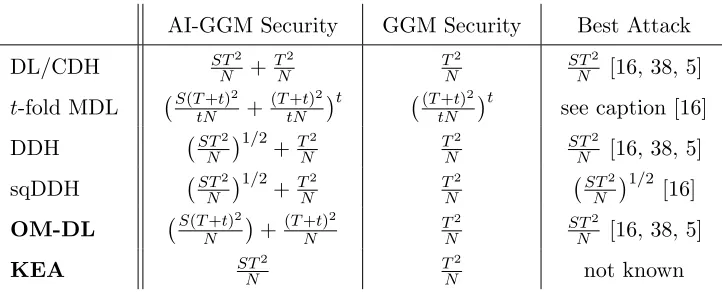
Generic groups. In the AI-GGM, the following applications are analyzed w.r.t. their security against preprocessing (cf. Table 2 and Section 5): the discrete-logarithm problem (DL), the multiple-discrete-logarithms problem (MDL), the computational Diffie-Hellman problem (CDH), the deci-sional Diffie-Hellman problem (DDH), the square decideci-sional Diffie-Hellman problem (sqDDH), the one-more discrete-logarithm problem (OM-DL), and the knowledge-of-exponent assumption (KEA).
• For DL, MDL, CDH, DDH, and sqDDH, the derived bounds match those obtained in recent work by Corrigan-Gibbs and Kogan [16]. As highlighted below, however, the techniques used in this paper allow for much simpler proofs than the one based on incompressibility arguments in [16]. All of these bounds are tight, except those for DDH, for which closing the gap remains an open problem.
• The bounds for OM-DL and KEA are new and may be non-trivial to derive using compression techniques.
AI-GGM Security GGM Security Best Attack
DL/CDH STN2 +TN2 TN2 STN2 [16, 38, 5]
t-fold MDL S(TtN+t)2 +(TtN+t)2t (TtN+t)2t see caption [16]
DDH STN21/2+TN2 TN2 STN2 [16, 38, 5]
sqDDH STN21/2+TN2 TN2 STN21/2 [16]
OM-DL S(TN+t)2
+ (T+Nt)2 TN2 STN2 [16, 38, 5]
KEA STN2 TN2 not known
Table 2: Asymptotic upper and lower bounds on the security of applications in the generic-group model against (S, T)-attackers in the AI-ROM; new bounds are in a bold-face font. The value t for the one-more DL problem stands for the number of challenges requested by the attacker. The attack against MDL succeeds with constant probability and requires that ST2/t+T2= Θ (tN).
trapdoor functions (cf. Section 6) in the AI-RPM, specifically, of a scheme put forth by Phan and Pointcheval [43]. Other schemes in the AI-RPM/ICM, e.g., [32, 34], can be analyzed similarly.
1.2 Methodology: Pre-Sampling
Bit-fixing oracles and pre-sampling. Unfortunately, while solving the issue of not capturing non-uniformity and preprocessing, the AI models are considerably more difficult to analyze than the traditional idealized models. From a technical point, the key difficulty is the following: conditioned on the leaked value z, which can depend on the entire function table of O, many of the individual values O(x) are no longer random to the attacker, which ruins many of the key techniques utilized in the traditional idealized models, such as lazy sampling programmability, etc.
One way of solving the above issues is to use incompressibility arguments, as introduced by Gennaro and Trevisan [27] and successfully applied to OWPs by Deet al.[17], to the random-oracle model by Dodis et al. [15], and to the GGM by Corrigan-Gibbs and Kogan [16]. Compression-based proofs generally lead to tight bounds, but are usually quite involved and, moreover, seem inapplicable to computationally secure applications. Hence, this paper, adopts the much simpler and more powerful pre-sampling approach taken recently by Coretti et al.[15] and dating back to Unruh [51]. The pre-sampling technique can be viewed as a general reduction from the auxiliary-input model to the so-called bit-fixing (BF) model, where the oracle can be arbitrarily fixed on some P coordinates, for some parameter P, but the remaining coordinates are chosen at random and independently of the fixed coordinates. Moreover, the non-uniformS-bit advice of the attacker in this model can only depend on the P fixed points, but not on the remaining truly random points. This makes dealing with the BF model much easier than with the AI model, as many of the traditional proof techniques can again be used, provided that one avoids the fixed coordinates.
Bit-fixing vs. auxiliary input. In order for the BF model to be useful, this work shows that any (S, T)-attack in the AI-RPM/ICM/GGM model will have similar advantage in the P -BF-RPM/ICM/GGM model for an appropriately chosenP, up to anadditiveloss ofδ(S, T, P)≈ST /P. Moreover, for the special case of unpredictability applications (e.g., CRHFs, OWFs, etc.), one can set
in the P-BF model; (b) for unpredictability applications, set P ≈ST, and obtain final AI security roughly 2·ε(S, T, ST); (c) for general applications, choose P to minimizeε(S, T, P) +δ(S, T, P).
The proof of the above connection is based on a similar connection between the AI-ROM and BF-ROM shown by [15] (improving a weaker original bound of Unruh [51]). While borrowing a lot of tools from [15], the key difficulty is ensuring that the P-bit-fixing cipher, which “approximates” the ideal cipher conditioned on the auxiliary input z, is actually a valid cipher: the values at fixed points cannot repeat, and the remaining values are chosen at random from the “unused” values (similar issues arise for generic groups). Indeed, the proof in this paper is more involved and the resulting bounds are slightly worse than those in [15].
Using the power of pre-sampling to analyze the applications presented above, the technical bulk consists of showing the security of these applications in the easy-to-handle BF-RPM/ICM/GGM, and then using Theorem 1 to translate the resulting bound to the AI-RPM/ICM/GGM. Most of BF proofs are remarkably straightforward extensions of the traditional proofs (without auxiliary input), which is a great advantage of the pre-sampling methodology over other approaches, such as compression-based proofs.
Computational security. Note that, unlike compression-based techniques [19, 16], pre-sampling can be applied to computational reductions, by “hardwiring” the pre-sampling set of size P into the attacker breaking the computational assumption. However, this means that P cannot be made larger than the maximum allowed running time tof such an attacker. Since standard pre-sampling incurs additive cost Ω(ST /P), one cannot achieve final security better that ST /t, irrespective of the value ofεin the (t, ε)-security of the corresponding computational assumption.
Fortunately, the multiplicative variant of pre-sampling for unpredictability applications sets the list size to be roughly P ≈ ST, which is polynomial for polynomial S and T and can be made smaller than the complexity t of the standard-model attacker for the computational assumption used. Furthermore, even though the security of public-key encryption is not an unpredictability application, the analysis in Section 6 shows a way to use multiplicative pre-sampling for the part that involves the reduction to a computational assumption.
1.3 Related Work
Tessaro [50] also adapted the presampling technique by Unruh to the random-permutation model; the corresponding bound is suboptimal, however. Deet al.[17] study the effect of salting for invert-ing apermutation as well as for a specific pseudorandom generator based on one-way permutations. Corrigan-Gibbs and Kogan [16], investigate the power of preprocessing in the GGM. Besides deriving security bounds for a number of important GGM applications, they also provide new attacks for DL (based on [38, 5]), MDL, and sqDDH.
The most relevant papers in the AI-ROM are those by Unruh [51], Dodiset al.[19], and Coretti
et al. [15]. Chung et al. [14] study the effects of salting in the design of collision-resistant hash functions, and used Unruh’s pre-sampling technique to argue that salting defeats pro-processing in this important case. However, they did not focus on the exact security and obtained suboptimal bounds (compared to the expected “birthday” bound obtained by [19]). Using salting to obtain non-uniform security was also advocated by Mahmoody and Mohammed [37], who used this technique for obtaining non-uniform black-box separation results.
2 Capturing the Models
This section explains how the various idealized models considered in this paper—the ideal-cipher-model (ICM), the random-permutation ideal-cipher-model (RPM), and the generic-group ideal-cipher-model (GGM)—are captured. Attackers in these models are modeled as two-stage attackers A = (A1,A2), and ap-plications as (single-stage) challengers C. BothA and C are given access to an oracle O. Oracles
O have two interfaces pre and main, where pre is accessible only to A1, which may pass auxiliary information to A2, and both A2 and C may access main. In certain scenarios it is also useful to consider an additional interfacemain-c that is only available to the challengerC.
Notation. Throughout this paper,P,K,N, andM are natural numbers and [x] ={0, . . . , x−1}
forx ∈N. For applications in the generic-group model, [N] is identified with the cyclic group ZN.
Furthermore, denote byPN the set of permutationsπ: [N]→[N] and byIN,M the set of injections
f : [N]→[M].
Oracles. An oracle O has two interfaces O.pre and O.main, where O.pre is accessible only once before any calls to O.mainare made. Some oracles may also have an additional interfaceO.main-c. Oracles used in this work are:
• Auxiliary-input ideal cipher AI-IC(K, N): Samples a random permutation πk ← PN for
eachk∈[K]; outputs allπkatO.pre; answers both forward and backward queries (k, x)∈[N]
atO.main by the corresponding valueπk(x)∈[N] orπk−1(x)∈[N], respectively.
• Bit-fixing ideal cipher BF-IC(P, K, N): Takes a list at O.pre of at most P query/answer pairs (without collisions for eachk); samples a random permutationπk← PN consistent with
said list for each k; the other interfaces behave as with AI-IC.
• Auxiliary-input random permutationAI-RP(N): Special case of an auxiliary-input ideal cipher with K= 1.
• Bit-fixing random permutation BF-RP(P, N): Special case of a bit-fixing ideal cipher withK = 1.
• Auxiliary-input generic group AI-GG(N, M): Samples a random injection σ ← IN,M; outputs all of σ atO.pre; answers forward queries x ∈[N] at O.main by the corresponding valueσ(x)∈[N]; answersgroup-operation queries (s, s0) atO.main as follows: ifs=σ(x) and
s0 = σ(y) for some x, y, the oracle replies by σ(x+y) and by ⊥ otherwise; answers inverse
queriessat interfaceO.main-cby returningσ−1(s) ifsis in the range ofF and by⊥otherwise.
• Bit-fixing generic group BF-GG(P, N, M): Samples a random size-N subsetY of [M] and outputs Y atO.pre; takes a list at O.pre of at most P query/answer pairs without collisions and all answers inY; samples a random injectionσ← IN,M with rangeYand consistent with said list; the other interfaces behave as with AI-GG.
• Standard model: None of the interfaces offer any functionality.
Attackers with oracle-dependent advice. Attackers A= (A1,A2) consist of a preprocessing procedureA1 and a main algorithmA2, which carries out the actual attack using the output of the preprocessing. Correspondingly, in the presence of an oracle O, A1 interacts with O.pre and A2
with O.main.
Definition 1. An (S, T)-attackerA= (A1,A2) in theO-model consists of two procedures
• A1, which is computationally unbounded, interacts with O.pre, and outputs an S-bit string, and
• A2, which takes an S-bit auxiliary input and makes at most T queries toO.main.
In certain contexts, if additional restrictions, captured by some parameters p, are imposed on A2 (e.g., time and space requirements of A2 or a limit on the number of queries of a particular type that A2 makes to a challenger it interacts with), Ais referred to as (S, T, p)-attacker.
Applications. Let O be an arbitrary oracle. An application G in the O-model is defined by specifying a challengerC, which is an oracle algorithm that has access to O.mainas well as possibly toO.main-c, interacts with an attackerA= (A1,A2), and outputs a bit at the end of the interaction. The success of A onG in theO-model is defined as
SuccG,O(A) := P
AO2.main(AO1.pre)↔CO.main,O.main-c= 1,
where AO.main 2 (A
O.pre
1 )↔CO.main,O.main-c denotes the bit output by C after its interaction with the attacker. This work considers two types of applications, captured by the next definition.
Definition 2. For an indistinguishability application G in the O-model, the advantage of an at-tacker A is defined as
AdvG,O(A) := 2
SuccG,O(A)− 1 2
.
For an unpredictabilityapplication G, the advantage is defined as
AdvG,O(A) := SuccG,O(A).
An application G is said to be ((S, T, p), ε)-securein the O-model if for every (S, T, p)-attacker A,
AdvG,O(A) ≤ ε .
Combined query complexity. In order to state and prove Theorems 1 and 1 in Section 3, the interaction of some attacker A= (A1,A2) with a challengerC in the O-model must be “merged” into a single entity D= (D1,D2) that interacts with oracleO. That is,D(·)1 :=A(·)1 and D(·)2 (z) :=
A(·)2 (z)↔C(·) forz∈ {0,1}S. Dis called thecombination of AandC, and the number of queries it
3 Auxiliary Input vs. Bit Fixing
Since dealing with idealized models with auxiliary input (AI) directly is difficult, this section es-tablishes useful connections between AI models and their bit-fixing (BF) counterparts, which are much less cumbersome to analyze. Specifically, for ideal ciphers, random permutations (as special cases of ideal ciphers), and generic groups, Theorem 1 below relates the advantage of attackers in a BF model to that in the corresponding AI model, allowing to translate the security of (1) any
application at an additive security loss and of (2) unpredictability applications at a multiplicative
security loss from the BF setting to the AI setting.
Theorem 1. Let P, K, N, M ∈N, N ≥16, and γ >0. Moreover, let
(AI,BF)∈ {(AI-IC(K, N),BF-IC(P, K, N)),(AI-GG(N, M),BF-GG(P, N, M))} .
Then,
1. if an application G is ((S, T, p), ε0)-secure in the BF-model, it is ((S, T, p), ε)-secure in the
AI-model, where
ε ≤ ε0+6(S+ logγ
−1)·Tcomb
G
P +γ;
2. if an unpredictabilityapplication Gis ((S, T, p), ε0)-secure in the BF-model for
P ≥ 6(S+ logγ−1)·TGcomb,
it is ((S, T, p), ε)-secure in the AI-model for
ε ≤ 2ε0+γ ,
where TGcomb is the combined query complexity corresponding toG.
Proof Outline
This section contains a brief outline of the proof of Theorem 1. The full proof of Theorem 1 is provided in Appendix A; it follows the high-level structure of the proof in [15], where a similar theorem is shown for the random-oracle model.
1. Leaky sources vs. dense sources: A (K, N)-cipher source X is the random variable cor-responding to the function table of a cipherF : [K]×[N]→ [M]. It turns out that if X has min-entropy H∞(X) =KlogN!−S for someS, it can be replaced by a convex combination of so-calleddense sources, which are fixed on a subset of the coordinates and have almost full min-entropy everywhere else:
Definition 3. A (K, N)-cipher source X is called ( ¯P ,1−δ)-dense for P¯ = (P1, . . . , PK) ∈
[N]K if it is fixed on at most Pk coordinates (k,·) for each k ∈ [K] and if for all families
I ={Ik}k∈[K] of subsets Ik of non-fixed coordinates (k,·),
H∞(XI) ≥ (1−δ)
K X
k=1
log(N−Pk)|Ik|,
where ab :=a!/(a−b)!. X is called (1−δ)-dense if it is (0,1−δ)-dense, and P¯-fixed if it is
More concretely, one can prove that a cipher sourceXas above is close to a convex combination of finitely many ( ¯P0,1−δ)-dense sources for some ¯P = (P1, . . . , PK) satisfying
K X
k=1
Pk ≈
S δ .
The proof is an adaptation of the proof of the corresponding lemma for random functions in [15], the difference being that the version here handles cipher sources.
2. Dense sources vs. bit-fixing sources: Any dense source has a corresponding bit-fixing source, which is simply a function table chosen uniformly at random from all those that agree with the P fixed positions. It turns out that aT-query distinguisher’s
• advantage at telling a dense source and its corresponding bit-fixing source apart can be upper bounded by approximatelyT δ, and that its
• probability of outputting1 is at most a factor of approximately 2T δlarger when interacting with the bit-fixing as compared to the dense source.
Compared to the case of random functions [15], some additional care is needed to properly handle inverse queries. Given the above, by setting
δ ≈ S
P ,
one obtains additive and multiplicative errors of roughly ST /P and 2ST /P, respectively.
3. From bit fixing to auxiliary input: The above almost immediately implies that an appli-cation that is ((S, T), ε)-secure in the BF-ICM is ((S, T), ε0)-secure in the AI-ICM for
ε0 ≈ ε+ST
P
and even
ε0 ≈ 2ε
if it is an unpredictability application, by settingP ≈ST. Observe that for the additive case, the final security bound in the AI-ICM is obtained by choosing P in a way that minimizes
ε(P) +ST /P.
For the generic-group model, the proof proceeds similarly, with two important observations:
(a) once the range is fixed, a random injection behaves like a random permutation, which is covered by ideal ciphers as a special case;
(b) the group-operation oracle can be implemented by three (two inverse and one forward) calls to the injection.
4 Non-Uniform Bounds for Hash Functions and Symmetric Primitives
This section derives non-uniform security bounds for a number of primitives commonly analyzed in either the random-permutation model (RPM) or the ideal-cipher model (ICM). The primitives in question can be grouped into basic,sponge-based, and Merkle-Damg˚ard-based applications.
In the following, for primitives in the RPM,π, π−1 : [N]→[N] denote the permutation and its inverse to whichAI-RP(N) andBF-RP(P, N) offer access at interfacemain. Similarly, for primitives in the ICM E, E−1 : [K]×[N]→[N] denote the ideal cipher and its inverse to which AI-IC(K, N)
Basic applications. The security of the following basic applications in the RPM resp. ICM is considered:
• One-way permutation inversion (OWP):Givenπ(x) for an x∈[N] chosen uniformly at random, an attacker has to find x.
• Even-Mansour cipher (EM): The PRF security of the Even-Mansour cipher
EMπ,s(m) := π(m⊕s2)⊕s1
with key s= (s1, s2).
• Ideal cipher as block cipher (ICM):The PRF security of the ideal cipher used as a block cipher directly.
• PRF security of Davies-Meyer (PRF-DM):The PRF security of the Davies-Meyer (DM) compression functionDME
DME(h, m) := E(m, h)⊕h
when h is used as the key.
• A collision-resistant variant of Davies-Meyer (CRHF-DM): The collision-resistance of a salted variant
DME,a,b(h, m) := E(m, h) +am+bh
of the DM compression function, where the first-stage attacker A1 is unaware of the public random salt value (a, b).
Sponge-based constructions. The sponge construction is a popular hash-function design paradigm and underlies the SHA-3 hash-function standard. ForN = 2n,r≤n,c=n−r, it hashes a message
m =m1· · ·m` consisting of r-bit blocksmi to y:=Spongeπ,IV(m) as follows, where IV∈ {0,1}c is a c-bit initialization vector (IV):1
1. Sets0 ←0rkIV.
2. For i = 1, . . . , `: set si ← π(mi⊕s(1)i−1ks (2)
i−1), where s (1)
i−1 denotes the first r bits of si−1 and
s(2)i−1 the remainingc bits. 3. Outputy :=s(1)` .
This work considers the following applications based on the sponge paradigm:
• Collision-resistance: The collision resistance of the sponge construction for a randomly chosen public IV unknown to the first-stage attackerA1.
• PRF security: The PRF security of the sponge construction with the IV serving as the key.
• MAC security: The MAC security of the sponge construction with the IV serving as the key.
1
Merkle-Damg˚ard constructions with Davies-Meyer: Another widely used approach to the design of hash functions is the well-known Merkle-Damg˚ard paradigm. For a compression function
f : [N]×[K]→[N] and an IV IV∈[N], a message m=m1· · ·m` consisting of` blocksmi∈[K],
is hashed toy :=MDf,IV(m) as follows:2
1. Seth0←IV.
2. For i= 1, . . . , `: set hi ←f(hi−1, mi).
3. Outputy :=h`.
This work considers the Merkle-Damg˚ard construction with f instantiated by the Davies-Meyer compression function
DME(h, m) := E(m, h)⊕h ,
resulting in the Merkle-Damg˚ard-with-Davies-Meyer function (MD-DM)
MD-DME,IV(m) := MDDME,IV(m),
which underlies the SHA-2 hashing standard. This work considers the following applications based on the MD-DM hash function:
• Collision-resistance: The collision resistance of the MD-DM construction for a randomly chosen public IV unknown to the first-stage attackerA1.
• PRF security: The PRF security of the NMAC/HMAC variants
NMACE,k(m) := DME(k1,MD-DME,k2(m))
of the MD-DM construction with key k= (k1, k2).
• MAC security: The MAC security of the NMAC/HMAC variant of the MD-DM construc-tion.
Discussion. The asymptotic security bounds derived for the applications listed above are sum-marized in Table 1. No non-uniform bounds were previously known for any of these primitives, except for OWPs, for which the same bound was derived by De et al. [17] using an involved, compression-based proof.
As can be seen from Table 1, a matching attack, derived by Hellman et al. [33], is known for OWPs. Moreover, for CRHFs based on sponges and Merkle-Damg˚ard with Davies-Meyer, a variant of a recent attack by Coretti et al. [15] closely matches the derived bounds.3 For the remaining applications, significant gaps remain: For indistinguishability applications such as BI-IC and PRFs, adapting an attack on PRGs by De et al. [17] results in an advantage of roughly pS/N. For the MAC applications, the best attacks are based on rainbow tables for inverting functions [33].
All security bounds are derived by following the bit-fixing approach: the security of a partic-ular application is assessed in the bit-fixing (BF) RPM/ICM, and then Theorem 1 is invoked to obtain a corresponding bound in theauxiliary-input (AI) RPM/ICM and similarly for the random-permutation model. Deriving security bounds in the BF-ICM/RPM turns out to be quite straight-forward, and all of the proofs closely follow the corresponding proofs in the ICM/RPM without
2
As with the sponge construction, for simplicity no padding is considered here.
3
auxiliary input; intuitively, the only difference is that one needs to take the listL of the at mostP
input/output pairs where A1 fixes the random permutation or the ideal cipher.
The security proofs for one-way permutations, the ideal cipher as block cipher, the collision-resistant variant of Davies-Meyer, collision-resistance of the sponge construction, and the PRF and MAC security of NMAC/HMAC with Davies-Meyer are provided after the brief overview below. The precise definitions of the remaining applications as well as the corresponding theorems and proofs can be found in Sections B, C, and D of the appendix.
4.1 One-Way Permutations
The one-way-permutation inversion application GOWP is defined via the challengerCOWP that ran-domly and uniformly picks an x∈N, passesy:=π(x) to the attacker, and outputs 1 if and only if the attacker returns x.
Theorem 2 below provides an upper bound on the success probability of any attacker in inverting
π in the AI-RP0-model, which is defined as the AI-RP-model, except that no queries to π−1 are allowed. The bound matches known attacks (up to logarithmic factors) and are also shown by De et al. [17] via a more involved compression argument.
Theorem 2. The applicationGOWPis
(S, T),O˜ STN
-secure in theAI-RP0(N)-model forN ≥16.
Proof. It suffices to show thatGOWPis (S, T), O PN+T
-secure in theBF-RP0(P, N)-model. Then, by observing that Tcomb
GOWP =T + 1, setting γ := 1/N and P = 2(S+ logN)(T+ 1) = ˜O(ST), and
applying Theorem 1, the desired conclusion follows.
Assume P +T < N/2 since, otherwise, the bound of O((P +T)/N) holds trivially. Let A = (A1,A2) be an (S, T)-attacker. Without loss of generality, assume A is deterministic and A2 makes distinct queries and always queries its output. Let L = {(x01, y10), . . . ,(x0P, y0P)} be the list submitted by A1. Recall that the challenger uniformly and randomly picks an x from [N] and outputsy :=π(x). Let x1, . . . , xT denote the queries made by A2 and let yi:=π(xi) for i∈[T] be
the corresponding answers. LetE be the event thaty appears inLnamely x=x0i for some i∈[P]. Note that
SuccG,BF-RP(A) ≤ P[E] +P[∃i∈[T], xi=x|¬E]
≤ P[E] +
T X
i=1
P[xi =x|¬E, x1 =6 x, . . . , xi−16=x].
Observe thatP[E]≤P/N. Moreover, conditioned ony /∈ Land any fixed choice of (x1, y1), . . . ,(xi−1, yi−1),
xiis a deterministic value whilexis uniformly distributed over [N]\{x1, . . . , xi−1, x01, . . . , x0P}. Thus,
P[xi =x|¬E, x16=x, . . . , xi−16=x] ≤ 1/(N −P−T) ≤ 2/N ,
where the second inequality usesP+T < N/2. Therefore, SuccG,BF-RP(A)≤ NP+2NT =O(PN+T).
4.2 The Ideal Cipher as a Block Cipher
b = 1, forward queries m are answered by f(m) and inverse queries c by f−1(c), where f is an independently chosen uniform random permutation; the attacker wins if and only if he correctly guesses b.
Theorem 3. Application GBC-IC is
(S, T, q),O˜
T K +
p
S(T+q)/K
-secure in theAI-IC(K, N) -model for N ≥16.
Proof. It suffices to show that GBC-IC is ((S, T, q), O((T +P)/K))-secure in the BF-IC(P, K, N )-model since then the theorem follows by observing thatTGcombBC-IC =T +q, setting γ:= 1/N and
P := p(S+ logN)(T +q)K = ˜ΘpS(T+q)K
,
and applying Theorem 1.
Clearly,A2only has non-zero advantage in guessing bitbif it makes a (forward or inverse) query involving the key k∗ chosen by the challenger or if k∗ appears in one of the prefixed query/answer pairs. The latter occurs with probability at mostP/K, whereas the former occurs with probability at most T /(K−(T +P))≤2T /K, using that T+P ≤K/2, an assumption one can always make since, otherwise,GBC-IC is triviallyO((T+P)/K)-secure.
4.3 A Collision-Resistant Variant of Davies-Meyer
The plain Davies-Meyer (DM) compression function cannot be collision-resistant against non-uniform attackers, which begs the question of if and how it can be salted to withstand non-non-uniform attacks. To that end, let N =K = 2κ for some κ∈Nand interpret [N] as a finite field of size N. For two valuesa, b∈[N], let
DME,a,b(h, m) := E(m, h) +am+bh .
Note that fora= 0 andb= 1,DME,a,b is the usual DM compression function.
The application GCRHF-DM of collision-resistance of the salted DM function is defined via the following challengerCCRHF-DM: it picks two random valuesa, b∈[N] and passes them to the attacker; the attacker wins if and only if it returns two pairs (h, m) 6= (h0, m0) such that DME,a,b(h, m) =
DME,a,b(h0, m0).
Theorem 4. GCRHF-DM is (S, T),O˜(STN)2-secure in the AI-IC(N, N)-model for N ≥16.
Proof. At the cost of at most 2 additional queries toE, assume that the pairs (h, m) and (h0, m0) output byA2 are such thatA2 has queried its oracleE on all points DME,a,b would queryE when
evaluated on (h, m) and (h0, m0). It suffices to show thatGCRHF-DM is(S, T), OTN2 +P(PN+T) -secure in the BF-IC(P, N, N)-model. Then, by observing that TGcombCRHF-DM =T + 2, setting γ := 1/N
and P = 2(S+ logN)(T+ 2) = ˜O(ST), and applying Theorem 1, the desired conclusion follows. SetT0 :=T+2 and consider an interaction ofA= (A1,A2) andCCRHF-DMin theBF-IC(P, N, N )-model. Denote by ((ki0, x0i), y0i) for i = 1, . . . , P the query/answer pairs prefixed by A1 and by ((ki, xi), yi) for i= 1, . . . , T0 the queries A2 makes to E. Let E be the event that there exists no collision among the prefixed values, i.e., there exist no i6=j such that
E(ki0, xi) +ak0i+bh0j = E(kj0, xj) +ak0j+bh0j (1)
1. ki6=kj: in this case, the two pairs cause a collision if and only if
a = (y
0
j−y0i)−b(x0i−x0j)
ki0−k0j ,
which happens with probability at most 1/N.
2. ki = kj: in this case, x0i =6 x0j, and the two pairs cause a collision if and only if b = (yj0 −
yi0)/(x0i−x0j), which happens with probability at most 1/N as well.
Summarizing, P[¬E]≤(P2+ 1)/N =O P2/N . Moving to queries made by A2, let E0
i be the event that after theith query made by A2, there exists no collision between any query pair and a prefixed pair or among the query pairs themselves; the corresponding conditions are analogous to (1). Consider the probability P[¬Ei0|Ei0−1,E]. If the
ith query is a forward query, then a collision occurs only ifyi =a(ki−kj) +b(xi−xj) +yj for some
j < ior if the analogous condition holds for a collision with a prefixed pair and somej∈ {1, . . . , P};
if theith query is a backward query, then a collision occurs only if
xi =
a(ki−kj)−(yj−yi)
b
for some j < i or if the analogous condition holds for a collision with a prefixed pair and some
j ∈ {1, . . . , P} (using that b6= 0). In either case,
P[¬Ei0|Ei0−1,E] ≤ (i−1) +P
N −(T0+P) ≤
2((i−1) +P)
N ,
using that T0+P ≤N/2, an assumption on may always make since, otherwise, the desired bound holds trivially. Summarizing, settingE0 :=E0
T0,
P[¬E0|E] = P[¬ET00|E] ≤ T0 X
i=1
P[¬Ei0|Ei0−1,E]
≤
T0 X
i=1
2((i−1) +P)
N
= O
T2
N +
T P N
.
Clearly, A2 only wins if E or E0 occurs, and hence the overall security in the BF-IC(P, N, N )-model isOTN2 + P(PN+T).
4.4 CRHFs from Unkeyed Sponges
The applicationGCRHF-Sof collision resistance for the sponge construction is defined via the following challenger CCRHF-S: it picks an initialization vector IV ← {0,1}c uniformly at random, passes it to
the attacker, and outputs 1 if and only if the attacker returns two messages m 6= m0 such that
Spongeπ,IV(m) =Spongeπ,IV(m0).
Theorem 5. Application GCRHF-S is
(S, T, `),O˜
S(T+`)2
2c + (T+`)2
2r
-secure in the AI-RP(N)
-model, for N = 2n= 2r+c≥16.
Node graphs. A useful formalism for security proofs of sponge-based constructions is that of node and supernode graphs, as introduced by Bertoniet al. [6]. For a permutationπ :{0,1}n→ {0,1}n,
consider the following (directed) node graph Gπ = (V, E) with V = {0,1}r × {0,1}c = {0,1}n
and E = {(s, t)|π(s) =t}. Moreover, let G0π = (V0, E0) be the (directed) supernode graph, with
V0 ={0,1}c and (s(2), t(2))∈E0 iff ((s(1), s(2)),(t(1), t(2)))∈E for somes(1), t(1) ∈ {0,1}r. Observe
that the value of Spongeπ,IV(m) for an `-block message m = m1· · ·m` is obtained by starting at
s0 := (0r,IV) ∈ {0,1}n in Gπ, moving to si ← π(mi⊕s(1)i−1ks (2)
i−1) for i= 1, . . . , `, and outputting
s(1)` . In other words, in the supernode graph,m corresponds to a path of length` starting at node
IV and ending at s(2)` , ands(1)1 , . . . , s(1)` ∈ {0,1}r are the values that appear on that path.
Proof. At the cost of at most 2`additional queries toπ, assume that the messagesmandm0 output by A2 are such that A2 has queried its oracle π on all points Spongeπ,IV(·) would query π when evaluated on m and m0.
It suffices to show thatGCRHF-Sis(S, T, `), O(T+`)2 2r +
(T+`)2+(T+`)P) 2c
-secure in theBF-RP(P, N
)-model. Then, by observing thatTGcombCRHF-S =T+ 2`, settingγ := 1/N andP := 2(S+ logN)(T+`) =
˜
O(S(T+`)), and applying Theorem 1, the desired conclusion follows.
Consider now an interaction ofA2withCCRHF-Sand incrementally build the node and supernode graphs (as defined above), adding edges whenA2makes the corresponding (forward or inverse) query toπ, and starting with the edges that correspond to the at mostP prefixed query/answer pairs.
Let Ecoll be the event that a (valid) collision occurs. Clearly, this happens if and only if there exists a value s(1) ∈ {0,1}r that appears as the last value on two different paths from IV. Let
Epath,i be the event that after the ith query to π, there is a unique path fromIV to any node in the supernode graph and that no prefixed supernode is reachable from IV.
Observe that whenEpath:=Epath,T+2`occurs, the values that appear on these paths are uniformly random and independent since every node inside a supernode has the same probability of being chosen. Hence,
P[Ecoll|Epath] ≤
T + 2`
2
·2−r = O
(T +`)2 2r
.
Moreover,
P[¬Epath,i|Epath,i−1] ≤
(i+P)·2r
2r+c−(i−1 +P) ≤
i+P
2c−(T + 2`+P)/2r ≤
i+P
2c−1
if theith query is a forward query, and
P[¬Epath,i|Epath,i−1] ≤
i·2r
2r+c−(i−1 +P) ≤
i
2c−1
make since, otherwise, the lemma holds trivially. Letting T0 :=T+ 2`,
P[¬Epath] = P[¬Epath,T0] ≤ P[¬Epath,T0|Epath,T0−1] +P[¬Epath,T0−1]
≤
T0 X
i=1
P[¬Epath,i|Epath,i−1] +P[Epath,0]
≤
T0 X
i=0
(i+P) 2c−1 = O
(T +`)(T+`+P) 2−c
,
observing that P[Epath,0]≤ 2Pc, the probability that a node inside supernodeIV is prefixed.
4.5 PRFs via NMAC with Davies-Meyer
For simplicity, letK =N. Recall that the NMAC construction using the Davies-Meyer compression function is defined as
NMACE,k(m) := DME(k1,MD-DME,k2(m))
where k= (k1, k2).
The application GPRF-MD-N of PRF security for NMAC is defined via the following challenger
CPRF-MD-N: it picks a random bitb← {0,1}and a keyk←[N]; when the attacker queries a message
m = m1· · ·m` consisting of blocks mi, if b = 0, the challenger answers by NMACE,k(m), and, if
b = 1, the challenger answers by a value chosen uniformly at random for each m. The attacker wins, if and only if he correctly guesses the bit b.
The following theorem provides an upper bound on the advantage of an (S, T, q, `)-attacker in distinguishing the sponge construction from a random function in the AI-ICM, whereq is an upper bound on the number of messagesmthe attacker submits to the challenger and`is an upper bound on the length of those messages.
Theorem 6. GPRF-MD-Nis
(S, T, q, `),O˜
T q2`
N + q
S(T+`q)q2` N
-secure in theAI-IC(N, N)-model,
for N ≥16.
Proof. Follows from Lemma 7 by observing that TGcombPRF-MD-N =T +q`, setting γ := 1/N and P :=
q
S(T+q`)N
q2` , and applying Theorem 1.
Lemma 7. For anyP, N ∈N,GPRF-MD-Nis (S, T, q, `), O q2`T+NP-secure in theBF-IC(P, N, N)
-model.
The proof of Lemma 7 uses the fact the Merkle-Damg˚ard construction with the DM function is
almost-universal in the BF-ICM; this property is captured by the application GAU-MD defined by the following challenger CAU-MD: It expectsA
2 to submit two messagesm andm0. Then, it picks a random key k. The attacker wins ifMD-DME,k(m) =MD-DME,k(m0).
The proof of almost-universality uses Lemma 24, which states that the DM function is a PRF when keyed by h.
Lemma 8. For any P, N ∈ N, GAU-MD is (S, T, q, `), O `T+NP-secure in the BF-IC(P, N, N)
Proof (sketch). Consider a sequence of ` hybrid experiments, where in the ith hybrid, instead of evaluating MD-DME,k(m) for m = m1· · ·m`, the challenger computes MD-DME,k0(mi+1· · ·m`), where k0 ← f(m1· · ·mi) for a uniformly random function f : [N]i → N. By the PRF security
of the Davies-Meyer function (cf. Lemma 24), the distance between successive hybrids is at most 8(T+P)/N. Moreover, in the last hybrid, the success probability ofA2 is at most 1/N.
Proof (of Lemma 7, sketch). Using the PRF security of the Davies-Meyer (DM) function (Lemma 24), it suffices to show security in the hybrid experiment in which the outer DM evaluation is replaced by a uniform random function f. In this hybrid experiment, A2 only has non-zero advantage in guessing bit bif two of its q queries to the challenger cause a collision right before f. Let ε be the probability that this event occurs.
Consider the following attacker A0 := (A1,A02) against the CAU-MD: A02 runs A2 internally, forwarding its oracle queries to and back from its own oracle, and answering every queryA2 would make to its challenger by a fresh uniformly random value. Once A2 terminates, A0
2 picks a pair of queries made byA2uniformly at random and subits it to its own challenger. It is easily seen that the advantage of A02 is at leastε/q2. Therefore, the final PRF security of NMAC isq2`(T+P)/N.
4.6 MACs via NMAC with Davies-Meyer
The applicationGMAC-MD-N of MAC security of the NMAC construction is defined via the following challengerCMAC-MD-N: it initially picks a random keyk←[N]; when the attacker queries a message
m=m1· · ·m`consisting of blocksmi, the challenger answers byMD-DMO,k(m). The attacker wins
if he submits a pair (m, y) withMD-DMO,k(m) =y for a previously unqueriedm.
Theorem 9. GMAC-MD-Nis(S, T, q, `),O˜q2`S(TN+q`)-secure in theAI-IC(N)-model, forN ≥16.
Proof. It suffices to show that GMAC-MD-N is (S, T, q, `), O q2`T+NP
-secure in the BF-IC(P, N )-model. Then, by observing that TGcombMAC-MD-N =T +q`, settingγ := 1/N and P = 2(S+ logN)(T +
q`) = ˜O(S(T+q`)) and applying Theorem 1, the desired conclusion follows.
The bound in the BF-IC(P, N)-model follows immediately from Lemma 7 and the fact that with a truly random function, the adversary’s success probability at breaking the MAC is at most
q/N.
4.7 Extensions to HMAC
Recall that, for simplicity, K =N. The HMAC construction using the Davies-Meyer compression function is defined as
HMACE,k(m) := MD-DME,IV(k⊕opad,MD-DME,IV(k⊕ipad, m)),
whereIV∈[N] is some fixed initialization vector. As usual, results for NMAC carry over to HMAC, even in the presence of leakage about the ideal cipher. More precisely, the HMAC construction can be seen as a special case of the NMAC by observing that
HMACE,k(m) = NMACE,k1,k2(m)
for k1 = E(k⊕ipad,IV)⊕IV and k2 = E(k⊕opad,IV)⊕IV. Hence, in the BF-IC-model, unless (k⊕opad,IV) or (k⊕ipad,IV) are prefixed byA1 or queried byA2, which happens with probability
5 The Generic-Group Model with Preprocessing
This section analyzes the hardness of various problems in the generic-group model (GGM) with preprocessing. Specifically, the following applications are considered, where N ∈N is an arbitrary
prime and σ the random injection used in the GGM:
• Discrete-logarithm problem (DL): Givenσ(x) for a uniformly randomx∈[N], findx.
• Multiple-discrete-logarithms problem (MDL): Given (σ(x1), . . . , σ(xt)) for uniformly
random and independent xi ∈[N], find (x1, . . . , xt).
• Computational Diffie-Hellman problem (CDH): Given (σ(x), σ(y)) for uniformly ran-dom and independent x, y∈[N], findxy.
• Decisional Diffie-Hellman problem (DDH):Distinguish (σ(x), σ(y), σ(xy)) from (σ(x), σ(y), σ(z)) for uniformly random and independentx, y, z ∈[N].
• Square decisional Diffie-Hellman problem (sqDDH): Distinguish (σ(x), σ(x2)) from (σ(x), σ(y)) for uniformly random and independentx, y∈[N].
• One-more-discrete-logarithm problem (OM-DL): Given access to an oracle creating DL challenges σ(xi), for uniformly random and independentxi∈[N], as well as a DL oracle,
make t queries to the challenge oracle and at most t−1 queries to the DL oracle, and solve
all tchallenges, i.e., find (x1, . . . , xt).
• Knowledge-of-exponent assumption (KEA): The KEA assumption states that if an attackerAis given σ(x), forx∈[N] chosen uniformly at random, and outputs Aand ˆA with
A=σ(a) and ˆA=σ(ax), then it must know discrete logarithmaofA. This is formalized by requiring that for every Athere exist an extractor XA that is run on the same random coins asA and must output the valuea.
The asymptotic security bounds derived for the above applications are summarized in Table 2. The bounds for DL, MDL, CDH, DDH, and sqDDH match previously known bounds from [16, 38, 5]; they are tight in that there is a matching attack, except for the DDH problem, for which, remarkably, closing the gap remains an open problem. The bounds for OM-DL and KEA are new.
Note that all bounds with preprocessing are considerably worse than those without. For example, in the classical GGM, DL is secure up to roughly N1/2 queries, whereas it becomes insecure for
S =T =N1/3 in the AI-GGM.
All security bounds are derived by following the bit-fixing approach: the security of a particular application is assessed in the bit-fixing (BF) GGM, and then Theorem 1 is invoked to obtain a corresponding bound in the auxiliary-input (AI) GGM. This approach features great simplicity since deriving security bounds in the BF-GGM turns out to be remarkably straightforward, and all of the proofs closely follow the original proofs in the classical GGM without preprocessing; the only difference is that one needs to take the list L of the at most P input/output pairs where A1 fixes
σ into account.
As a representative examples, the proofs for the DL problem and the KEA are provided below. Readers familiar with the original proofs by Shoup [48] for DL and by Abe and Fehr [1] and Dent [18] for the KEA may immediately observe the similarity. The precise definitions of the remaining applications as well as the corresponding theorems and proofs can be found in Section E of the appendix.
5.1 Discrete Logarithms
The discrete-logarithm application GDL is defined via the challenger CDL that randomly and uni-formly picks an x ∈ [N], passes σ(x) to the attacker, and outputs 1 if and only if the attacker returns x.
Theorem 10 below provides an upper bound on the success probability of any attacker at com-puting discrete logarithms in the AI-GGM. The bound is matched by the attack of Mihalcik [38] and Bernstein and Lange [5]; a variation of said attack has recently also been presented by Corrigan-Gibbs and Kogan [16].
Theorem 10. GDL is ((S, T), ε)-secure in the AI-GG(N, M)-model for any prime N ≥16 and
ε = ˜O
ST2
N +
T2 N
.
Proof. It suffices to show that the applicationGDL is
(S, T), O
T P+T2
N
-secure in theBF-GG(P,
N, M)-model. Then, by observing thatTGcombDL =T+ 1, setting γ:= 1/N andP = 6(S+ logN)(T+
1) = ˜O(ST), and applying the second part of Theorem 1, the desired conclusion follows.
Consider now the interaction of A = (A1,A2) with CDL in the BF-GG-model. Recall that the
BF-GG-oracle outputs the range Y of the underlying random injection σ to A1 via interface pre. Condition on a particular realization of this set for the remainder of the proof.
Define the following hybrid experiment involving A1 and A2:
• For each of the at most P query/answer pairs (a0, s0) where A1 fixes σ, define a (constant) polynomial v(X) :=a0 and store the pair (v, s0).
• To create the challenge, choose a value s∗ uniformly at random from all unused values in Y, define the polynomialu∗(X) :=X, and store (u∗, s∗).
• A forward query aby A2 toBF-GG is answered as follows: define the (constant) polynomial
u(X) :=a, choose a values uniformly at random from all unused values inY, store the pair (u, s), and returns.
• A group-operation query (s1, s2) by A2 is answered as follows:
– If s1 ors2 is not in Y, return⊥.
– If s1 has not been recorded, choose a random unused a ∈ [N], define the (constant) polynomial u(X) := a, and store the pair (u, a). Proceed similarly if s2 has not been recorded. Go to the next item.
– Let u1 and u2 be the polynomials recorded with s1 and s2, respectively. If, for u0 :=
• When A2 outputs a value x0, pick a value x∈[N] uniformly at random and output 1 if and only if x0 =x.
Observe that the hybrid experiment only differs from the original one if for a group-operation query (s1, s2),u0(x) =v(x) for some recordedvoru0(x) =u(x) for some recordedu—and similarly for the polynomialu∗corresponding to the challenge. Since in the hybrid experiment,xis chosen uniformly at randomat the end of the execution, the probability of this event is at most ((T+1)P+(T+1)2)/N by the Schwartz-Zippel Lemma (cf. Lemma 37 in Section G of the appendix) and a union bound. Moreover, in the hybrid experiment, the probability that x0 =x is 1/N. The theorem follows.
5.2 Knowledge-of-Exponent Assumption
Informally, the knowledge-of-exponent assumption (KEA) states that if an attacker A is given (h, hx), for a generator h of a cyclic group of order N and x ∈ [N] chosen uniformly at random, and outputs group elements A and ˆA with ˆA =Ax, then it must know discrete logarithm a of A. This is formalized by requiring that for everyAthere exist anextractor XA that is run on the same random coins asA and must output the valuea.
The above is captured in the GGM by considering the following experiment ExpOA,XA parameter-ized by an attackerA= (A1,A2), an extractorXA, and an oracleO ∈ {AI-GG(N, M),BF-GG(N, M)}:
1. Run A1 to obtainz← AO1.
2. Choose x∈[N] uniformly at random, let y←σ(x), pick random coins ρ, and run
(a) A2 to get (A,Aˆ)← A2(z, y;ρ), and (b) XA to get a← XA(z, y;ρ).
3. Output 1 if and only if A=σ(a0) and ˆA=σ(a0x) for some a0, buta6=a0.
The KEA says that for every attackerA there exists an extractor XA such that the probability of the above experiment outputting 1 is negligible. The following theorem is equivalent to saying that the KEA holds in the AI-GGM.
Theorem 11. For every attackerA= (A1,A2), there exists an extractor XA such that
P[ExpOA,XA = 1] ≤ O˜
ST2
N
.
Sketch. The extractorXA internally runs A2 on the inputs received and keeps track ofA2’s oracle queries using polynomials as in the proof of Theorem 10. If at the end the polynomialsuAand uAˆ corresponding toA2’s outputs (A,Aˆ) have the formuA(X) =aanduAˆ(X) =aX, thenXA outputs
aand otherwise ⊥.
Observe that if the experiment outputs 1, then
• uAˆ6=X·uAsinceA2 only creates polynomials of degree at most 1, but
• uAˆ(x) =x·uA(x) for the challenge x.
Hence, the extractor only fails if at least two of the polynomials involved (includinguAˆ andX·uA)
collide on x, which is already analyzed in the proof of Theorem 10.
The experiment ExpOA,XA defining KEA does not exactly match the syntax of challenger and attacker to which Theorem 1 caters, but it is easily checked that the corresponding proof can be adapted to fit ExpOA,X
6 Computationally Secure Applications
A main advantage of the pre-sampling methodology over other approaches (such as compression) to dealing with auxiliary-input in idealized models is that it also applies to applications that rely on computational hardness assumptions. To illustrate this fact, this section considers a public-key encryption scheme based on trapdoor functions (cf. Section F for a definition) by Phan and Pointcheval [43] in the auxiliary-input random-permutation model (AI-RPM). Other schemes in the AI-RPM/ICM, e.g., [32, 34], can be analyzed similarly.
FDP encryption. LetF be a trapdoor family (TDF) generator. Full-domain permutation (FDP) encryption in the random-permutation model with oracle O is defined as follows:
• Key generation: Run the TDF generator to obtain (f, f−1)←F, wheref, f−1 : [N]→[N]. Set the public keypk:=f and the secret keysk:=f−1.
• Encryption: To encrypt a messagem with randomness r and public key pk =f, compute ˜
y←f(y) for y← O(mkr)) and output c= ˜y.
• Decryption: To decrypt a ciphertext c = y with secret key sk = f−1, compute mkr ← O−1(f−1(y)) and outputm.
The following theorem relates to the CPA security (cf. Section F for a definition) of FDP encryption in the AI-RPM.
Theorem 12. Let Π be FDP encryption with F. If GTDF,F is ((S0,∗, t0, s0), ε0)-secure, then, for any T ∈N, GPKE,Π is ((S, T, t, s), ε)-secure in the AI-RP(N, N)-model, where
ε = ˜O ε0+
r
ST
2ρ !
and S =S0−O˜(ST), t=t0−O˜(ttdf·T), and s=s0−O˜(ST), where ttdf is the time required to
evaluate the TDF.
The straightforward approach to proving the security of FDP encryption in the AI-RPM would be to analyze the scheme in the BF-RPM with list sizeP and then use the general part of Theorem 1 to obtain a bound in the AI-RPM. However, such an approach, due to the additive error in the order of ST /P would require a very large list and therefore make the reduction to TDF security extremely loose.
Instead, the actual proof, which is sketched in Appendix F, follows the same high-level structure as that of TDF encryption in the AI-ROM, analyzed in [15]:
1. It first considers a hybrid experiment that is only distinguishable from the original CPA experiment if the attacker queries a particular value to the random permutation. To bound the probability of this event occurring, the proof moves to the BF-RPM and the analysis there—which involves the reduction to TDF security—is carried back to the AI-RPM via the
unpredictability part of Theorem 1. This allows the list size to remain a moderateP0 ≈ST
and hence for a tight reduction.
Acknowledgments
The authors thank Dan Boneh, Henry Corrigan-Gibbs and Dmitry Kogan for valuable discussions on Generic-Group Models.
References
[1] Masayuki Abe and Serge Fehr. Perfect NIZK with adaptive soundness. In Theory of Cryp-tography, 4th Theory of Cryptography Conference, TCC 2007, Amsterdam, The Netherlands, February 21-24, 2007, Proceedings, pages 118–136, 2007.
[2] Elena Andreeva, Andrey Bogdanov, Yevgeniy Dodis, Bart Mennink, and John P. Steinberger. On the indifferentiability of key-alternating ciphers. In Advances in Cryptology - CRYPTO 2013 - 33rd Annual Cryptology Conference, Santa Barbara, CA, USA, August 18-22, 2013. Proceedings, Part I, pages 531–550, 2013.
[3] Mihir Bellare, Alexandra Boldyreva, and Adriana Palacio. An uninstantiable random-oracle-model scheme for a hybrid-encryption problem. In Advances in Cryptology - EUROCRYPT 2004, International Conference on the Theory and Applications of Cryptographic Techniques, Interlaken, Switzerland, May 2-6, 2004, Proceedings, pages 171–188, 2004.
[4] Mihir Bellare, Ran Canetti, and Hugo Krawczyk. Keying hash functions for message authen-tication. In Advances in Cryptology - CRYPTO ’96, 16th Annual International Cryptology Conference, Santa Barbara, California, USA, August 18-22, 1996, Proceedings, pages 1–15, 1996.
[5] Daniel J. Bernstein and Tanja Lange. Non-uniform cracks in the concrete: The power of free precomputation. In Advances in Cryptology - ASIACRYPT 2013 - 19th International Conference on the Theory and Application of Cryptology and Information Security, Bengaluru, India, December 1-5, 2013, Proceedings, Part II, pages 321–340, 2013.
[6] Guido Bertoni, Joan Daemen, Micha¨el Peeters, and Gilles Van Assche. On the indifferen-tiability of the sponge construction. In Advances in Cryptology - EUROCRYPT 2008, 27th Annual International Conference on the Theory and Applications of Cryptographic Techniques, Istanbul, Turkey, April 13-17, 2008. Proceedings, pages 181–197, 2008.
[7] Guido Bertoni, Joan Daemen, Micha¨el Peeters, and Gilles Van Assche. On the security of the keyed sponge construction. InSymmetric Key Encryption Workshop (SKEW), 2011.
[8] John Black. The ideal-cipher model, revisited: An uninstantiable blockcipher-based hash func-tion. In Fast Software Encryption, 13th International Workshop, FSE 2006, Graz, Austria, March 15-17, 2006, Revised Selected Papers, pages 328–340, 2006.
[9] John Black, Phillip Rogaway, and Thomas Shrimpton. Black-box analysis of the block-cipher-based hash-function constructions from PGV. In Advances in Cryptology - CRYPTO 2002, 22nd Annual International Cryptology Conference, Santa Barbara, California, USA, August 18-22, 2002, Proceedings, pages 320–335, 2002.
[11] Ran Canetti, Oded Goldreich, and Shai Halevi. On the random-oracle methodology as applied to length-restricted signature schemes. InTheory of Cryptography, First Theory of Cryptogra-phy Conference, TCC 2004, Cambridge, MA, USA, February 19-21, 2004, Proceedings, pages 40–57, 2004.
[12] Ran Canetti, Oded Goldreich, and Shai Halevi. The random oracle methodology, revisited. J. ACM, 51(4):557–594, 2004.
[13] Shan Chen and John P. Steinberger. Tight security bounds for key-alternating ciphers. In
Advances in Cryptology - EUROCRYPT 2014 - 33rd Annual International Conference on the Theory and Applications of Cryptographic Techniques, Copenhagen, Denmark, May 11-15, 2014. Proceedings, pages 327–350, 2014.
[14] Kai-Min Chung, Huijia Lin, Mohammad Mahmoody, and Rafael Pass. On the power of nonuni-formity in proofs of security. In Innovations in Theoretical Computer Science, ITCS ’13, Berkeley, CA, USA, January 9-12, 2013, pages 389–400, 2013.
[15] Sandro Coretti, Yevgeniy Dodis, Siyao Guo, and John Steinberger. Random oracles and non-uniformity. In Advances in Cryptology - EUROCRYPT 2018 - To appear, 2018.
[16] Henry Corrigan-Gibbs and Dmitry Kogan. The discrete-logarithm problem with preprocessing. InAdvances in Cryptology - EUROCRYPT 2018 - To appear, 2018.
[17] Anindya De, Luca Trevisan, and Madhur Tulsiani. Time space tradeoffs for attacks against one-way functions and prgs. InAdvances in Cryptology - CRYPTO 2010, 30th Annual Cryptology Conference, Santa Barbara, CA, USA, August 15-19, 2010. Proceedings, pages 649–665, 2010.
[18] Alexander W. Dent. The hardness of the dhk problem in the generic group model. Cryptology ePrint Archive, Report 2006/156, 2006. https://eprint.iacr.org/2006/156.
[19] Yevgeniy Dodis, Siyao Guo, and Jonathan Katz. Fixing cracks in the concrete: Random oracles with auxiliary input revisited. InAdvances in Cryptology - EUROCRYPT 2017 - 36th Annual International Conference on the Theory and Applications of Cryptographic Techniques, 2017.
[20] Yevgeniy Dodis, Krzysztof Pietrzak, and Daniel Wichs. Key derivation without entropy waste. In Advances in Cryptology - EUROCRYPT 2014 - 33rd Annual International Conference on the Theory and Applications of Cryptographic Techniques, Copenhagen, Denmark, May 11-15, 2014. Proceedings, pages 93–110, 2014.
[21] Yevgeniy Dodis, Leonid Reyzin, Ronald L. Rivest, and Emily Shen. Indifferentiability of permutation-based compression functions and tree-based modes of operation, with applica-tions to MD6. InFast Software Encryption, 16th International Workshop, FSE 2009, Leuven, Belgium, February 22-25, 2009, Revised Selected Papers, pages 104–121, 2009.
[22] Orr Dunkelman, Nathan Keller, and Adi Shamir. Minimalism in cryptography: The even-mansour scheme revisited. In Advances in Cryptology - EUROCRYPT 2012 - 31st Annual International Conference on the Theory and Applications of Cryptographic Techniques, Cam-bridge, UK, April 15-19, 2012. Proceedings, pages 336–354, 2012.