University of South Carolina
Scholar Commons
Theses and Dissertations
2017
Implementation of Common Core State Standards
and South Carolina College and Career Ready
Standards: Successes and Struggles
Matthew D. Scandrol
University of South Carolina
Follow this and additional works at:https://scholarcommons.sc.edu/etd Part of theEducational Administration and Supervision Commons
This Open Access Dissertation is brought to you by Scholar Commons. It has been accepted for inclusion in Theses and Dissertations by an authorized administrator of Scholar Commons. For more information, please [email protected].
Recommended Citation
Implementation of Common Core State Standards and South Carolina College and Career Ready Standards: Successes and
Struggles
by
Matthew D. Scandrol
Bachelor of Arts Mount Union College, 1998
Master of Education
University of South Carolina, 2003
Master of Education
University of South Carolina, 2006
Educational Specialist
University of South Carolina, 2008
Submitted in Partial Fulfillment of the Requirements
For the Degree of Doctor of Philosophy in
Educational Administration
College of Education
University of South Carolina
2017
Accepted by:
Edward Cox, Major Professor
Peter Moyi, Committee Member
Victoria Oglan, Committee Member
C. Spencer Platt, Committee Member
DEDICATION
To Danielle
I could not have done this without your love and support!
I know it was rough at times, but you kept me going.
You’re finally married to a Doctor!
To Don & Georgia
Thank you for instilling in me the desire to never quit, no
ACKNOWLEDGEMENTS
I would like to express my deepest thanks to Dr.
Edward Cox for keeping me going throughout this journey.
Your call to me a few years back “jump started” this
process. I truly appreciate your patience and time as I at
times mired through this. I would also like to thank the
members of my committee for seeing me though this. I know
at times it was frustrating, but I truly appreciate you
willingness to give of your time to enable me to complete
this journey.
Thank you to Dr. Donald Scandrol, Mrs. Barbara
Scandrol, Mr. David Scandrol, and Dr. David McCowin for
your eyes, knowledge, and suggestions throughout the
revision process. Each time, your feedback made it that
much better!
To the Faculty and Staff of J.C. Lynch Elementary
School, thank you for keeping me going and supporting me
throughout the journey. I appreciate all of the
encouragement that you all have given me these past years!
To Ms. Thomasena Benson, Mr. Larry Jackson, Mr. Tony
Lunsford, Ms. Sophia Frierson, Mr. Terry Troutman, and the
rest of the staff at Sneed Middle School, thanks for your
encouragement throughout the journey. It’s been a long
time coming!
Finally, to my loving wife Danielle, words cannot
express how much your love and support has meant to me.
Your encouragement kept me going, especially when it was
rough! I am truly thankful for you! Now you can say, I’m
ABSTRACT
In 2009 the Common Core State Standards (CCSS)
initiative was introduced to the nation’s education
systems. The CCSS initiative compelled schools and
districts to re-evaluate instructional programs to better
meet the instructional needs of students as well as the
professional development needs of teachers and
administrators.
On May 30, 2014, South Carolina became the second
state to withdraw from the CCSS initiative. South Carolina
developed its own statewide set of standards to replace the
Common Core for the 2015-2016 school year. Titled the
South Carolina College and Career Ready Standards (SCCCRS),
these standards are heavily influenced by the Common Core.
The purpose of this research is to examine School
Administrators’ attitudes towards CCSS/SCCCRS and their
effects on the school level implementation of the Common
Core State Standards/South Carolina College and Career
The researcher surveyed the school principals of five
school districts in South Carolina on their understanding
of SCCCRS and the degree of their involvement in the school
wide implementation as well as the degree of involvement in
professional development relating to the implementation of
SCCCRS. Based on the survey data, the researcher visited
five schools to discuss the struggles and successes of the
school’s implementation.
The results of the study indicate that administrator
attitude and administrator involvement in the planning and
implementation had a significant impact upon the
implementation of the SCCCRS. However, administrator
involvement is only one component in the implementation
process. School districts face a myriad of challenges with
their implementation. These challenges come in the forms
of adequate staff development time as well as the
availability of training resources, including materialsand
instructional coaches. In addition, the collective
attitude of the school’s faculty and staff also impact the
TABLE OF CONTENTS
DEDICATION ... iii
ACKNOWLEDGEMENTS ... iv
ABSTRACT ... vi
LIST OF TABLES ... xi
Chapter I: Introduction ... 1
Statement of the Problem ... 2
Significance ... 6
Research Questions ... 7
Summary of Methodology ... 8
Delimitations ... 10
Definition of Terms ... 11
Chapter II: Review of the Related Literature ... 14
Common Core Background and Development ... 15
Common Core State Standards for ELA and Mathematics . 20 Assessing Common Core and a History of Testing ... 29
Specific Common Core Assessments ... 38
Role of the Principal ... 47
State Adoption/Implementation of Common Core ... 56
South Carolina’s Response to Common Core ... 68
South Carolina College and Career Ready Standards ... 69
Chapter III: Research and Design Procedures ... 73
Conceptual Frameworks ... 73
Statement of Positionality ... 75
Instrumentation ... 76
Population and Sample ... 80
Validity ... 83
Data Collection ... 85
Limitations ... 89
Chapter IV: Analysis and Results ... 91
Analysis ... 92
Survey Results ... 97
Interview Results ... 104
Chapter V: Summary and Conclusions ... 141
Re-Statement of the Problem ... 141
Interpretation of the Findings ... 144
Implications ... 149
Conclusions ... 152
Final Thoughts ... 156
References ... 158
Appendix A-Principal’s Survey ... 170
Appendix B-Survey Data ... 173
Appendix D-Principal Survey Letter ... 176
LIST OF TABLES
Table 2.1 Development Indicators and Elements ... 18
Table 2.2 Areas of need in State ELA and Mathematics
Assessments ... 19
Table 2.3 Grade Level Lexile and Stretch Lexile Bands .... 24
Table 2.4 PARCC and Smarter Balanced ELA
Assessment Goals ... 41
Table 2.5 PARCC and Smarter Balanced Mathematics
Assessment Goals ... 42
Table 2.6 DOK Questioning Levels, Criteria,
and Examples ... 43
Table 2.7 Mean Percentage of DOK Level Questions
For Smarter Balanced Assessment Series ... 45
Table 2.8 Explanation of CEP Study Findings ... 59
Table 4.1 Principal Survey Responses Received ... 98
Table 4.2 Survey Results of Schools with High
Principal Understanding and Involvement ... 102
Table 4.3 Survey Results of Schools with Low
Principal Understanding and Involvement ... 102
Table 4.4 School Implementation Teams Interviewed by the Researcher ... 103
Table 4.5 Second Grade Math Unit 1, Unpacked Standards .. 133
Chapter I
Introduction
The United States is experiencing a fundamental shift
in education. In 2009 the Common Core State Standards
(CCSS) initiative was introduced to the nation’s systems of
education. The CCSS initiative compelled schools and
districts to re-evaluate instructional programs to better
meet the instructional needs of students as well as the
professional development needs of teachers and
administrators.
On May 30, 2014, South Carolina Governor Nikki
Haley, a Common Core opponent, signed into law a measure
for South Carolina to become the second state to withdraw
from the CCSS initiative. She perceived the CCSS as a
Federal overreach in state education, and was concerned
with the developmental appropriateness of the standardized
tests in regards to primary age students (Strauss, 2014).
The measure indicated that CCSS would be utilized during
the 2014-2015 school year. It would be replaced by the
Standards (SCCCRS), which were heavily influenced by the
Common Core Standards, for the 2015-2016 year.
A member of the College and Career Ready Standards
committee remarked that there is a 97% correlation between
the South Carolina College and Career Ready Standards and
Common Core Standards in both English Language Arts, and
Mathematics. In addition, the South Carolina Department of
Education has published comparative documents for the
SCCCRS ELA and SCCCRS Math standards. These documents
dissect each of the SCCCR Standards and their corresponding
CCSS standards in side-by-side tables.
The South Carolina College and Career Readiness
Standards have been referred to as Common Core “warmed
over” (Cassidy, 2015). The South Carolina Education
Oversight Committee identified the standards as more
challenging than the Common Core indicating that 15% of the
Math and 18% of the English Language Arts standards demand
more of the students than the corresponding Common Core
Standards. These standards were approved in March 2015 and
were implemented during the 2015-2016 school year.
Statement of the Problem
The Common Core State Standards (CCSS) is an effort to
establish a set of common expectations or benchmarks for
students are expected to learn and demonstrate their
knowledge, skills and abilities (KSA’s) of their grade
level and apply these KSA’s in English Language Arts (ELA)
and Mathematics with an additional literacy component for
all content areas. This initiative has been coordinated
through the National Governors Association Center for Best
Practices and the Council of Chief State School Officers.
The Common Core Standards were initially published in
2010. At its peak in 2013, there were 45 states, the
District of Columbia, and two territories that adopted,
planned to implement, and assess the CCSS, (Anderson,
Harrison, & Lewis, 2012). Lucy Calkins (2012) stated that
the CCSS are a “big deal.” The standards represented the
most sweeping reform of K-12 curriculum that has ever
occurred in this country (Calkins, Ehrenworth, & Lehman,
Pathways to the common core: Accellerating achievement,
2012).
According to Douglas Reeves (2000), the key to higher
achievement lies in a focused, multidisciplinary
requirement for students to think, reason, and write in a
clear, accurate, and persuasive manner. Reeves goes on to
state that critical thinking rather than memorization may
The implementation of the CCSS represented a
fundamental shift from an institutional and an
instructional educational environment of the past. Nancy
Kober, (2011) explains that the ultimate responsibility for
ensuring student mastery of knowledge and skills in the
CCSS rests with districts and schools, as well as their
administrators and teachers (Kober & Rentner, 2011). Kober
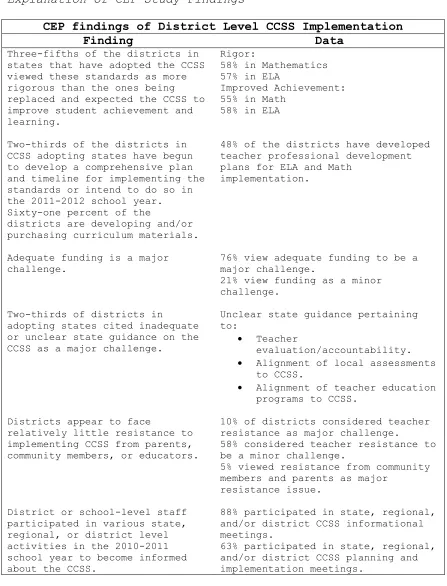
and Rentner identified several key findings about the CCSS:
Almost three-fifths (60%) of the districts in
the states that have adopted the CCSS viewed
these standards as more rigorous than those
they were replacing. The expectation was that
the CCSS would improve student learning.
Two-thirds (66%)of the districts in
CCSS-adopting states had begun to develop a
comprehensive plan and time-line for
implementing the standards or intended to do so
in the 2011-2012 school term; 61% of the
districts are developing and/or purchasing
curriculum materials.
Adequate funding is a major challenge: In those
districts of the states that had adopted CCSS,
cited inadequate and/or unclear guidance from
their respective state’s education department.
School-level staff participated in various
state, regional, or district activities in
school year 2010-2011 to become informed about
the CCSS.
CCSS in essence, requires that all teachers become
experts in both their content areas and literacy. For the
purposes of this study, literacy is defined as reading,
writing, communicating, thinking critically, and performing
in meaningful, relevant ways within and across disciplines
are essential practices for accessing and deeply
understanding content. Immersion in the language and
thinking processes of each discipline guides students to
develop and cultivate a deeper understanding of particular
disciplines. This requirement appears to be the most
daunting expectation and has received the most resistance.
Many teachers specializing in specific content and or
subject area possess a wealth of knowledge in their area of
expertise. However, these teachers often lack the necessary
skills to teach the literacy component, and it is this
aspect that is forcing the instructional shift. Since CCSS
is so new, there is little research to support the
Significance
Nancy Kober, (2011) explained that the ultimate
responsibility for ensuring student mastery of knowledge
and skills in the CCSS rests with districts and schools, as
well as their administrators and teachers (Kober & Rentner,
2011).
It has been largely left up to the individual schools
and districts to develop and implement their own, in-house
comprehensive professional development plans to ensure that
their teachers are able to successfully implement these
standards. This lack of uniform consistency coupled with
questions regarding the funding of the professional
development and implementation has created much
uncertainty, confusion, and frustration within the ranks of
school administrators.
This study is significant in the nature of its
concepts. With Common Core representing such a
sweeping change in academic thoughts and methods,
there is a sparse amount of information based on the
implementation of the CCSS, and the roles that school
administrators must assume in the development and
implementation process. In addition, the study seeks
to identify how the attitudes of school administrators
implementation. Furthermore, it seeks to identify
real world implementation strategies that are being
developed and deployed within the schools. This study
seeks to fill those gaps.
Research Questions
The purpose of this study is to examine school
administrators’ attitudes towards the SCCCRS and their
effects on the school level implementation of the South
Carolina College and Career Ready Standards. In addition,
it seeks to identify strategies and methods being utilized
in schools that are successfully implementing the SCCCRS
based on the following research questions:
1. What are the attitudes of the school leadership
towards SCCCRS, and how do they affect the
development and implementation of them?
2. What methods and strategies are schools
utilizing to effectively implement the South
Carolina College & Career Ready Standards in
their classrooms and to what degree is school
leadership involved in this process?
3. What is the relationship between the attitudes
and involvement of school administration
towards SCCCRS and the effectiveness of the
Summary of Methodology
The study explored a qualitative design involving five
school districts in the Interstate 95 Corridor of South
Carolina. These districts represent three counties and
encompass both rural and urban areas. The districts
studied are identified as the Alpha School District, Beta
School District, Gamma School District, Delta School
District, and Epsilon School District.
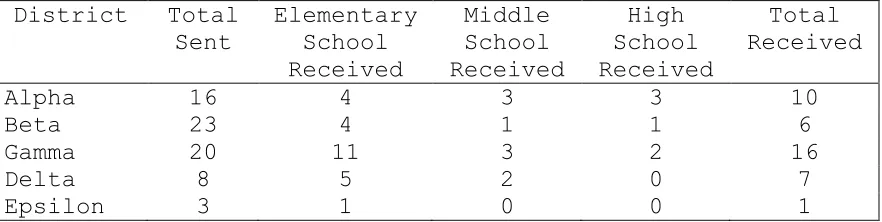
A researcher designed ten-question survey that was
sent to all 70 of the school principals within the five
studied districts (Appendix A). This survey was designed to
ascertain the principal’s knowledge and understanding of
the CCSS/SCCCRS. In addition, it sought to understand the
principal’s degree of involvement in the planning and
implementation of the CCSS/SCCCRS within the school. Based
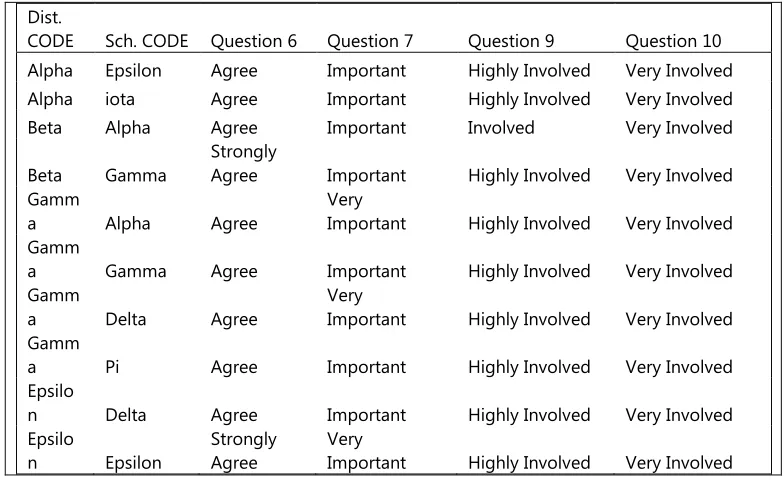
on that information, the researcher chose two schools with
high principal understanding of the SCCCRS, and high
principal involvement in the SCCCRS implementation. The
researcher also chose two schools that indicated low
principal understanding and low involvement in the planning
and implementation of SCCCRS.
For the purposes of this study, the researcher
identified the criteria for “High” based on the school
do you agree with the concepts and philosophies associated
with the CCSS and SCCCRS initiatives?” as either agree or
strongly agree. Question 7) “How important to education
are the CCSS initiative and SCCCR Standards?” as either
important or very important. Question 9) “How involved are
you in the development of strategies for implementation of
CCSS/SCCCRS in your school?” as either involved or highly
involved. And question 10) “How involved in CCSS/SCCCRS
Professional Staff Development are you?” as either involved
or very involved.
The criteria for “Low” was ascertained via the school
principal’s responses to survey question 6) “How strongly
do you agree with the concepts and philosophies associated
with the CCSS and SCCCRS initiatives?” as either strongly
disagree or disagree. Question 7) “How important to
education are the CCSS initiative and SCCCR Standards?,” as
either not important or somewhat important. Question 9)
“How involved are you in the development of strategies for
implementation of CCSS/SCCCRS in your school?” as either
not involved or somewhat involved. And question 10) “How
involved in CCSS/SCCCRS Professional Staff Development are
you?” as either not involved or somewhat involved.
Based on feedback received via the survey results, the
interviews (Appendix B) with the school level South
Carolina College and Career Readiness Standards
implementation teams. These semi-structured interviews
enabled the researcher to develop and gain an understanding
of the success and frustrations of the school level
implementation of the standards. The goal was to present
findings regarding the reasons for both success and
frustrations of SCCCRS implementation, and how the teachers
have embraced the changes and adapted to the challenges.
Delimitations
This study is limited to five school districts. Since
the study consists of only five districts the sample size
is relatively small, therefore limiting larger
generalizations regarding the results. The researcher
chose these districts due to the sizes and locations. In
addition, the researcher is familiar with the communities
serviced by the schools within the study.
The possibility of researcher bias may also limit the
results of this study. While the components of the survey
were piloted with respondents outside of the intended
districts, the possibility of design flaws in the survey
Definition of Terms
Administrators - Are local school level principals and
assistant principals.
Administrative Involvement - The amount of time a principal
has spent learning professionally about the CCSS/SCCCRS,
the amount of time the principal has spent planning staff
development sessions about the CCSS/SCCCRS, and the
principal’s level of participation in the CCSS/SCCCRS
professional development.
Common Core State Standards (CCSS) - A set of common
expectations for what Kindergarten through twelfth grade
students (K–12) are expected to know and apply in English
Language Arts (ELA) and Mathematics.
Effective Implementation - Schools that have high
administrator support and understanding of CCSS/SCCCRS,
high administrator involvement in developing instructional
strategies, and high involvement with the planning and
implementation of professional development relating to the
implementation of the CCSS/SCCCRS result in high student
achievement based on the South Carolina State Department of
Education School Report Cards.
High Knowledge of Common Core/Involvement (Successful) –
For the purposes of this study, the researcher identified
responses to survey question 6) “How strongly do you agree
with the concepts and philosophies associated with the CCSS
and SCCCRS initiatives?” as either agree or strongly agree.
Question 7) “How important to education are the CCSS
initiative and SCCCR Standards?” as either important or
very important. Question 9) “How involved are you in the
development of strategies for implementation of CCSS/SCCCRS
in your school?” as either involved or highly involved.
And question 10) “How involved in CCSS/SCCCRS Professional
Staff Development are you?” as either involved or very
involved.
Low Knowledge of Common Core/Involvement (Struggling) – The
criteria for “Low” was ascertained via the school
principal’s responses to survey question 6) “How strongly
do you agree with the concepts and philosophies associated
with the CCSS and SCCCRS initiatives?” as either strongly
disagree or disagree. Question 7) “How important to
education are the CCSS initiative and SCCCR Standards?” as
either not important or somewhat important. Question 9)
“How involved are you in the development of strategies for
implementation of CCSS/SCCCRS in your school?” as either
not involved or somewhat involved. And question 10) “How
involved in CCSS/SCCCRS Professional Staff Development are
Literacy – The SCCCRS define Literacy as: Reading, writing,
communicating, thinking critically, and performing in
meaningful, relevant ways within and across disciplines are
essential practices for accessing and deeply understanding
content. Immersion in the language and thinking processes
of each discipline guides students to develop and cultivate
a deeper understanding of particular disciplines.
Literacy Teacher - A teacher possessing the necessary
skills and strategies to teach students how to read, think,
analyze, communicate and respond to various texts both
orally and through writing.
South Carolina College and Career Ready Standards (SCCCRS)-
South Carolina’s response to the CCSS Initiative after the
state’s withdrawal from the CCSS. These standards were
implemented during the 2015-2016 school year and correlate
Chapter II
Review of the Related Literature
The Common Core State Standards (CCSS) is a national
effort to establish a set of common expectations or
benchmarks for students from kindergarten through the
twelfth grade. All Students are expected to learn and
demonstrate their knowledge, skills and abilities (KSA’s)
of their grade level and apply these KSAs in English
Language Arts (ELA) and Mathematics with an additional
literacy component for all content areas. This initiative
has been coordinated through the National Governors
Association Center for Best Practices and the Council of
Chief State School Officers.
The Common Core Standards were initially published in
2010. At its peak in 2013, 45 states, the District of
Columbia, and two territories adopted, planned to
implement, and to assess the CCSS, (Anderson, Harrison, &
Lewis, 2012). Calkins, Ehrenworth, and Lehman (2012),
states that the CCSS is a “big deal.” These standards
has ever occurred in this country (Calkins,
Ehrenworth, & Lehman, 2012).
According to Douglas Reeves (2000), the key to higher
achievement lies in a focused, multidisciplinary
requirement for students to think, reason, and write in a
clear, accurate, and persuasive manner. Reeves further
asserts that critical thinking rather than memorization
will lead to increased student achievement (Reeves, 2000).
This implementation is forcing both institutional and
instructional changes. Nancy Kober (2011) explains that
the ultimate responsibility for ensuring student mastery of
knowledge and skills in the CCSS rests with districts and
schools, their administrators and teachers (Kober &
Rentner, 2011).
CCSS/SCCCRS in essence, requires that ALL teachers
become experts in both their content areas as well as in
literacy. This component is the most daunting. It is this
aspect that is forcing a major mindset and instructional
shift.
Common Core Background and Development
According to the Common Core State Standards Webpage,
www.corestandards.org, the initiative was developed by the
National Governors Association Center for Best Practices
organizations were comprised of state governors and state
commissioners of education. The notion behind the CCSS was
rooted in the belief that our students were in need of
consistent, real world learning goals in a global society.
According to the CCSS for English Language Arts (ELA) and
Literacy in History/Social Studies, Science, and Technical
Subjects (Common Core State Standards for English Language
Arts and Literacy in History/Social Studies, Science, and
Technical Subjects, p. 7), students who meet the Common
Core State Standards are expected to be able to:
Demonstrate independence
Build strong content knowledge
Respond to varying demands of audience, task,
purpose, and discipline
Comprehend as well as critique
Value evidence
Use technology and digital media strategically
and capably
Understand other perspectives and cultures
The need for a unified national set of standards arose
from conversations and debates by leading academics in
education based on the intentions and realities of
historian, Dianne Ravitch (2005), wrote that the prevailing
situation of each state using its own standards and
assessments revealed little if any improvement in student
achievement. Ravitch (2006) asserted that national
standards should be set by teachers and professors, brought
together by college boards, and assessed by national tests.
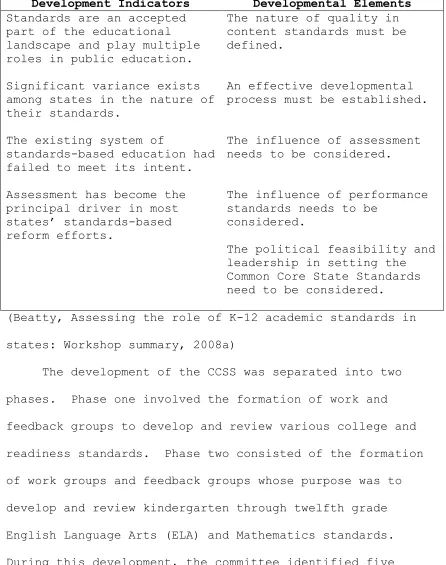
Beatty (2008a:2008b), reported that a 2008 study by
the James B. Hunt Jr., Institute for Educational Leadership
identified four key indicators and the elements in which
they are rooted in for the need to develop national
standards. Table 2.1 identifies and explains the
indicators and elements of the need for national standards
in American Education.
A Memorandum of Agreement (MOA) was signed in 2009 by
a large group of state and territorial representatives
agreeing to develop the set of Common Core State Standards.
Representatives from Alaska, Missouri, and Texas were
initially reluctant to join. South Carolina did not join
with the agreement, but later did so under then Governor
Table 2.1
Development Indicators and Elements
Development Indicators Developmental Elements
Standards are an accepted part of the educational landscape and play multiple roles in public education.
The nature of quality in content standards must be defined.
Significant variance exists among states in the nature of their standards.
An effective developmental process must be established.
The existing system of
standards-based education had failed to meet its intent.
The influence of assessment needs to be considered.
Assessment has become the principal driver in most states’ standards-based reform efforts.
The influence of performance standards needs to be
considered.
The political feasibility and leadership in setting the Common Core State Standards need to be considered.
(Beatty, Assessing the role of K-12 academic standards in
states: Workshop summary, 2008a)
The development of the CCSS was separated into two
phases. Phase one involved the formation of work and
feedback groups to develop and review various college and
readiness standards. Phase two consisted of the formation
of work groups and feedback groups whose purpose was to
develop and review kindergarten through twelfth grade
English Language Arts (ELA) and Mathematics standards.
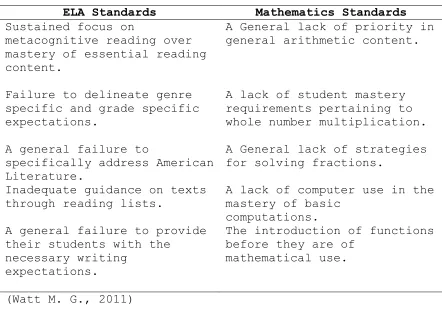
consistent areas of need in state ELA and Mathematics
standards. Table 2.2 outlines these five areas of need for
both English Language Arts (ELA) and Mathematics (Watt,
p.26).
Table 2.2
Areas of need in State ELA and Mathematics Standards
ELA Standards Mathematics Standards
Sustained focus on
metacognitive reading over mastery of essential reading content.
A General lack of priority in general arithmetic content.
Failure to delineate genre specific and grade specific expectations.
A lack of student mastery requirements pertaining to whole number multiplication.
A general failure to
specifically address American Literature.
A General lack of strategies for solving fractions.
Inadequate guidance on texts through reading lists.
A lack of computer use in the mastery of basic
computations. A general failure to provide
their students with the necessary writing
expectations.
The introduction of functions before they are of
mathematical use.
(Watt M. G., 2011)
An advisory group consisting of members of the testing
companies Achieve, ACT, The College Board, The National
Association of State Boards of Education, and State Higher
Education Executive Officers provided guidance and feedback
to the groups regarding both sets of standards (ELA and
the combination of the Readiness Standards and the
kindergarten through twelfth grade standards into what we
now know as the Common Core Standards.
Common Core State Standards for ELA and Mathematics
A 2010 California Department of Education Report
stated that the aim of the CCSS is to define what it means
to be literate in the 21st Century. This report remarked
that students mastering the CCSS will be fluent readers,
critical thinkers, informative writers, effective speakers,
and engaged listeners (California Department of Education,
2010).
The CCSS English Language Arts (ELA) standards are
comprised of four strands, which are organized by grade
level from kindergarten through eighth grade. The strands
are by grade span for high school, and include Reading,
Writing, Speaking and Listening, and Language.
The reading strand is further subdivided into six
additional sections pertaining to, Reading Literature,
Reading Informational Text, Foundational Skills, Writing,
Speaking and Listening, and Language.
The Common Core State Standards focus upon the means
needed to achieve the results. Yet, even as the Standards
emphasize achievements it is stated that room is left for
how these goals should be reached. Thus the standards do
not mandate such things as a particular type of writing
process or the full range of strategies that students may
need to monitor and direct their thinking and learning.
This enables teachers to provide students with whatever
tools and knowledge that the teachers identify most
necessary for meeting the student goals (Common Core State
Standards for English Language Arts and Literacy in
History/Social Studies, Science, and Technical Subjects, p.
4).
Foundational skills for grades kindergarten to fifth
grade are designed to develop students’ knowledge and
comprehension of print, the alphabet, and the conventions
of Standard English. To accomplish this, the grade level
standards stress phonological awareness, phonics, word
recognition, and fluency (California Department of
Education, 2010).
The CCSS ELA standards for grades sixth through
twelfth provide for the application of reading and writing
skills to subject area content (California Department of
Education, 2010).
The Common Core State Standards document parallels the
Balanced Literacy Model with its emphasis on addressing
element consists of introducing diversity of other
cultures, periods, and genres, while informational texts
consist of biographies, auto biographies, historical
writings, science, the arts, social sciences, technical
texts, and digital sources (Common Core State Standards for
English Language Arts and Literacy in History/Social
Studies, Science, and Technical Subjects).
The CCSS Reading Standards also focus on engaging the
student in critical analysis of both fiction and
non-fiction reading material. Students are required to analyze
an author’s perspective and purpose of each work, as well
as to compare and contrast texts, and evaluate evidence
used to support text thesis (Common Core State Standards
Initiative, 2010).
Writing standards balance narratives with
informational expository writings. Such writing begins in
kindergarten with students drawing, dictating, and writing.
Students then progress to writing in different genres and
writing for specific and varied purposes. In addition, they
are taught publishing skills through the use of technology
(Common Core State Standards Initiative, 2010).
Vocabulary acquisition is utilized across the four
identified strands. This is accomplished through the
standards, and through writing and collaborative
conversations during instruction.
The standards also foster oral communication,
collaboration, and listening skills. This is accomplished
in the development of communication skills in the students
learning process throughout the CCSS ELA standards.
Through this, students are able to express ideas, work
together, and listen critically to integrate and evaluate
information required of the standards. These learning
skills are neither taught nor learned in isolation; rather
they are achieved through connections with readings and
analysis of grade level texts and topics (California
Department of Education, 2010).
The ELA standards of CCSS also advocate for what is
referred to as a “staircase” of text complexity, which
begins in grade two. The purpose is to enable students at
this grade level to develop their own reading skills and to
apply them to more complex texts. The standards also state
that at the lowest band in each grade level, students focus
on reading texts within that text complexity band. In the
subsequent grade or grades within the band, the students
must “stretch” to read a certain proportion of texts from
the neighboring band. This pattern repeats throughout the
upon earlier gains as well as being able to challenge
themselves toward more complex texts, a crucial part of
their progress from primary to secondary level. (Common Core
State Standards for English Language Arts and Literacy in
History/Social Studies, Science, and Technical Subjects).
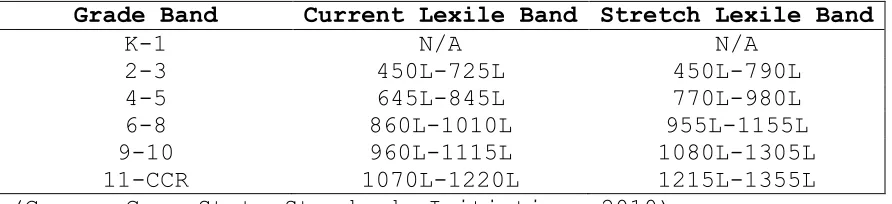
Table 2.3 illustrates the grade level bands; their Lexile
levels associated with the grade level, and recommended
“Stretch” Lexile levels should be.
Table 2.3
Grade Level Lexile and Stretch Lexile Bands
Grade Band Current Lexile Band Stretch Lexile Band
K-1 N/A N/A
2-3 450L-725L 450L-790L
4-5 645L-845L 770L-980L
6-8 860L-1010L 955L-1155L
9-10 960L-1115L 1080L-1305L
11-CCR 1070L-1220L 1215L-1355L
(Common Core State Standards Initiative, 2010)
The mathematics standards for the Common Core State
Standards define what students ‘theoretically’ should
understand and be able to grasp in the study of
mathematics. Students who master CCSS for mathematics are
ultimately expected to be prepared for college-level
courses and possess the skills necessary for success in
today’s workforce (Common Core State Standards Initiative,
A key component to the mathematics standards is the
question of student mastery and how this mastery is
identified and assessed. In short, can the student justify
his or her answer? Can the student explain how she or he
came to the solution?
Mastery also can be identified as
the ability to justify why a mathematical expression is
true or where a mathematical rule is derived (Common Core
State Standards Initiative, 2010, p. 4).
These standards include a focused and coherent set of
standards providing students the opportunity to achieve
proficiency in key topics that are introduced in the
primary grades and scaffold into the upper grades. By
focusing upon central concepts necessary for the study of
more advanced mathematics in later years the students gain
a “greater depth” of understanding (California Department
of Education, 2010).
The CCSS mathematics standards are grouped by grade
levels in kindergarten through the eighth grade. In
addition, they are organized into domains of slight
variance by grade level. For example, every kindergarten
through fifth grade class is to include “Operations and
Algebraic Thinking” within the process, with each grade
year building upon the information from the previous year’s
conceptual categories, i.e. Algebra, Functions, Modeling,
Geometry, and Statistics and Probability. The standards
provide for advanced placement courses such as eighth grade
Algebra I, Calculus, and Advanced Placement Probability and
Statistics (California Department of Education, 2010).
The CCSS mathematics Kindergarten through Eighth grade
standards consists of eleven domains:
Counting and Cardinality
Operations and Algebraic Thinking
Number and Operations in Base Ten
Number and Operations-Fractions
Ratios and Proportional Relationships
The Number System
Measurement and Data
Expressions and Equations
Functions
Geometry
Statistics and Probability
The CCSS mathematics secondary conceptual categories
consist of:
Number and Quantity
Algebra
Modeling
Geometry
Statistics and Probability
The CCSS mathematics focuses on arithmetic and fluency
with whole numbers during the early grades. The standards
provide kindergarteners through fifth grade students with
the necessary solid foundation in whole number arithmetic,
fractions, and decimals. Educators understand the
necessity of student mastery of these basics in order for
the understanding of more advanced concepts and procedures,
which students will experience in the upper grades. The
intent of the standards is to assure that students will
adequately master the progression of topics by providing
procedural fluency and conceptual understanding. This in
turn equips students with the necessary skills to
understand and comprehend more complex skills and
algorithms (California Department of Education, 2010).
Fluency with fractions is another key to CCSS
Mathematics. The standards state that student mastery of
conceptual and procedural knowledge of fractions is crucial
to success in Algebra. Starting in third grade, students
begin to develop their understanding of fractions as
numbers and the representations of fractions on a number
subtraction of fractions. Multiplication and division of
fractions is studied in fifth grade. Grades six and seven
consist of the development of the rational numbers concept
and proportional relationships (Common Core State Standards
Initiative, 2010).
Algebra readiness begins during the eighth grade. One
of the CCSS mathematics goals is that all students will
succeed in Algebra I. The theory is that students who
master all of the concepts and skills through grade seven
will be adequately prepared for algebra by grade eight.
The mastery of basic mathematical concepts and skills in
the earlier grades drives the eighth grade standards, which
is to prepare the students for learning, understanding, and
application of higher level mathematics including Algebra I
(California Department of Education, 2010).
The standards provide for real world applications
through the concept of mathematical modeling. The students
will apply the mathematical theories and operations that
have been learned to solve real world problems that arise
daily in life, workplace, and society. The standards
emphasize this skill and provide specific modeling
suggestions for real world situations that call for
mathematics utilization (California Department of
Assessing Common Core and a History of Testing
As part of the Federal Government’s No Child Left
Behind (NCLB) Act (PL 107-110), as well as to satisfy the
requirements of the Federal Elementary and Secondary
Education Act (ESEA) (PL 89-10), the Common Core Standards
must be formally assessed. Two testing consortiums were
chosen for this purpose, Smarter Balanced Assessment
Consortium (Smarter Balanced) and the Partnership of
Readiness for College and Careers (PARCC).
To understand the necessity of formally assessing the
Common Core State Standards via the Smarter Balanced and
PARCC testing programs, one must understand the role and
history of standardized testing in American education. The
utilization of standardized testing in American education
to measure student progress, student and school
accountability and to evaluate the effectiveness of school
improvement is not a recent phenomenon. It traces its
roots to the mid nineteenth century.
In 1845 Horace Mann persuaded the Boston Public School
Committee to allow him to administer written exams to the
city’s children in place of the traditional oral exams.
Mann’s purpose was to provide objective information about
monitor the quality of instruction, and compare schools and
teachers within each school (Gallagher, pp. 84-85).
The results of these first examinations indicated wide
gaps in the knowledge of Boston’s schoolchildren. As a
result of this, Mann proposed additional testing which were
approved as a means of determining which students were
prepared to move to the next academic level. Based on
Mann’s success, competitive written examinations were
adopted by school systems in nearly all U.S. cities, and in
1865, The New York Regents Exams were developed based on
Mann’s assessment concepts (Gallagher, p. 85).
The onset of America’s involvement in World War I
brought about significant expansion in the utilization of
standardized testing. In 1917 the United States Army in
cooperation with the American Psychological Association
(APA) developed group intelligence tests and group
intelligence scales, the Army Alpha and Beta (Hanson,
1993).
The purpose of this intriguing marriage of the
military and the APA was to quickly identify officer
candidates and to place soldiers into positions where it
was deemed that they would be the most effective. In
addition, these tests were the first to utilize the concept
enabled the Army to rapidly evaluate and process potential
officer candidates, and in doing so became the model for
subsequent standardized tests.
According to Hanson (1993), the war changed the image
of both the test and those tested. That is, the tests came
to be regarded as a legitimate means of making decisions
about the aptitude and achievements of so-called “normal
people” (Hanson, p. 212).
Based on what was thought to be the successfulness of
the Army testing experience, K-12 educators searched for
new and more efficient ways to predict, diagnose, and
explain learning differences. This led to the entrenchment
of student classification based on standardized
intelligence test scores. These tests were used to
stratify students of different abilities into curricular
paths, which also had the effect of restricting academic
and social choices (Zanderland, 1998). By 1929, over five
million standardized tests were administered annually to
school students, with the purpose of segregating those “who
learned” from those whom had not (Thorndike and Bregman,
1934).
In 1923, a consortium of college officials established
the College Entrance Examination Board (CEEB) to streamline
common entrance examination (Walsh & Bentz, 1995). The
CEEB also agreed to oversee the administration of the
examination. By 1925 the CEEB examination was streamlined
to that which has become known as the Scholastic Aptitude
Test (SAT), which has been used to influence the nature and
content for college preparatory instruction within
secondary schools (Walsh and Bentz, 1995).
By 1929, The University of Iowa created what has
become known as the Iowa Basic Skills, or Iowa test.
Because of their scoring efficiency and relatively low
cost, schools quickly adopted the Iowa test for their own
use. As a result, the Iowa test remains the most
frequently used achievement test in the nation (Gallagher,
p. 88).
The post-World War II era marked the expansion of
standardized testing as the nation itself became more
standardized – and less regionalized – through the growth
of national systems of transportation and communication. In
1947, as returning war veterans benefited from the so
called “G.I. Bill of 1944”, the Educational Testing Service
(ETS) was established. The ETS provided oversight for the
College Entrance Examination Board, for one thing, but in
the passing of the years the influence of the Educational
statistics as well as cognitive, developmental and social
psychology measurements (U.S. Congress, Office of
Technology Assessment, 1992).
By 1957 another perceived international threat stirred
educational emphasis when the Soviet Union orbited Sputnik
1, the first artificial Earth satellite. The so called
“Sputnik Surprise” enhanced the larger Cold War and ushered
in new developments in technology, the military and
science, including the space race. Americans, and American
education, had to react. This reaction shaped the course
of education during the era of the researcher’s parents.
Anecdotally, the researcher’s parents often commented about
how much a twenty-three inch, polished metal sphere with
four antennas so drastically changed and reshaped their
schools, with the purposeful infusion of what we know today
as STEM, science, technology, engineering and mathematics.
In short order, the National Merit Qualifying Tests
(NMQT) was added to the ETS and by 1959 the American
College Test (ACT) was introduced. The tests, which remain
today the most widely accepted instruments for college
admission, were aimed at college readiness assessment
(Walsh and Bentz, 1995).
Throughout the 1960’s and into the 1970’s the results
promotion and/ or retention, identification for special
education or remediation classes, academic honors, and the
determination of student academic versus vocational
placement (Gallagher, 2003).
In 1965, during another period of social and political
upheaval with the Civil Rights Era, the Elementary and
Secondary Education Act (ESEA; PL 89-10) was implemented as
part of President Lyndon Johnson’s “Great Society
initiative and the War on Poverty.” This act was said to
have represented “the most far-reaching federal legislative
acts affecting American Education” (Gallagher, 2003).
The ESEA or known as “Title I,” required schools to
administer standardized tests and to report their results
to the Federal Department of Education in order to qualify
for and access federal school funding (Gallagher, 2003).
The rationale for this act was to provide equal access to
education and to promote high standards of accountability.
The ESEA has been reauthorized every five years since its
original adoption in 1965, and has been refigured, as noted
below, as George W. Bush’s “No Child Left Behind” Act of
2001, and in 2015 as the “Every Child Succeeds Act”
presented by President Barrack Obama.
The political and social activism of the 1960’s and
Assessment of Educational Progress (NAEP) in 1969. The
NAEP was aimed at testing samples of students from the
individual states covering all subject areas in order to
“view national academic progress” (Berlinger and Biddle,
1995).
In 1974, Congress restructured the Title I testing
structure and recommended expanding standardized testing as
a means of assessing a school’s improvement process. By
the 1980’s thirty-three states had mandated forms of
minimum competency testing with about 200 million
standardized tests being administered annually to determine
student IQ and academic readiness (Rothman, 1995).
During the Reagan Administration the National
Commission on Excellence on Education was empowered in 1983
to develop a report titled, “A Nation at Risk”. The report
was issued to enhance the utilization of standardized
testing in American schools, and ominously stated:
Our nation is at risk. Our once
unchallenged preeminence in commerce, industry,
science, and technological innovation is being
taken over by competitors throughout the world.
The educational foundations of our society are
mediocrity that threatens our very future as a
nation and people (p.5).
Based on the above statement, schools and
colleges were urged to adopt more rigorous standards
and hold student performance to higher expectations.
State administered standardized tests at key
transition points in schooling were viewed as
appropriate measures for getting American Education
“back on track,” (Rothman, 1995). By 1989,
forty-seven states responded to the report’s recommendation
and expanded their state wide testing programs. In
addition, many local school districts implemented
plans to raise student achievement by allocating
higher financial resources to testing budgets and
aligning curriculum to a state administered test
(Rothman, 1995).
President William Clinton’s initiative, which was
known as the “Goals 2000: Educate America Act of
1994,” further emphasized the notion of higher student
achievement. Those supporting this initiative
believed that it would clarify the expectations of
teachers and students toward standardized testing, and
that clearer strategies could be employed to achieve
The aforementioned, “No Child Left Behind Act of 2001”
(NCLB), initiated by President George W. Bush, further
expanded the use of standardized tests to measure student
and school progress as well as school district and state
accountability and progress. Under this law, states are
required to test students in reading and math in grades 3-8
and once in high school. NCLB results were published
annually in the form of school, school district, and state
report cards.
It is noted in this brief historical outline that
emphasis on testing and educational improvement has been a
consistently emphasized theme by nearly every presidential
administration throughout the twentieth and into the
twenty-first centuries. This is perhaps especially true
during times of social and political unrest, as noted in
the developments during and after the World Wars, the Cold
War era, within the cultural turbulence of the Civil Rights
era, and beyond.
It seems that each administration has theorized that
national deficits can be addressed with better educational
methods and these methods can be gauged and evaluated by
various standardized methodologies. One wonders, however,
if such theories have ever been adequately funded for
the gaps of a pluralistic nation of regional and cultural
preferences and diversity. This, however, is a discussion
for another paper.
All of these instruments, while laudable in their
desire to enhance American education, all have lacked a
uniform assessment. That is, under all of these
initiatives the assessments were written and scored by
various states rather than a common evaluative process.
The concept therefore of using Smarter Balanced and
Partnership of Readiness for College and Careers (PARCC)
assessments were employed to provide a general continuity
and alignment of rigor and expectation.
Specific Common Core Assessments
As noted above, the goal of both Smarter Balanced and
the PARCC assessments was to provide formative and
summative comment to educators regarding student mastery of
the Common Core State Standards Initiative.
Considerable attention has been placed on the
summative aspect of these assessments; both consortia have
developed measures that will create effective on-demand,
technological-administered assessments. These assessments
provide performance tasks in both English-Language Arts
(ELA) and Mathematics. The Smarter Balanced assessment
Mathematics, while PARCC’s performance tasks are
administered in early spring. Student scores are then
aggregated across both contexts and used to determine
student understanding of the CCSS (Herman & Linn, p. 5).
End of year assessments utilize computer adaptive testing,
with algorithms used to customize items administered to
each student based on each individual student’s ability
level, which is identified from prior item responses. In
essence, the test tailors itself to the student (Herman &
Linn, p. 5).
Both consortia assess students in third through eighth
grades in ELA and Mathematics similar to the current South
Carolina state assessments. The approach of each type of
assessment differs for the high school students. Smarter
Balance summarily assesses students in eleventh grade only.
PARCC assesses all ninth through eleventh grade students in
ELA but uses state developed End of Course (EOC) test
results for Algebra I, Geometry, and Algebra II.
Smarter Balance and PARCC utilized Evidenced-Centered
Design (ECD) in their design and approach to summative
assessment validation. Hermann and Lin (2013), describe
this process as beginning with a clear delineation of the
skills that are to be evaluated. These skills are entered
the form of assessment targets that can be used to evaluate
student status. They go on to state that these items are
used to guide assessment development. In addition, the
models provide templates for creating task items that are
aligned with assessment targets. These models are used to
generate the actual test items, which are then subjected to
content and bias reviews; field tested, and revised as
needed (Herman & Linn, p. 6).
Hermann and Linn (2013), continue in stating that test
drafts/ blueprints are then developed to guide the creation
of test forms. These blueprints specify how many and what
type of items and tasks are to be sampled. In addition,
the blueprints also identify the targeted goals of the
assessments (Herman & Linn, pp. 6-7). Tables 2.4 and 2.5
illustrate and explain these assessment goals for ELA and
math for both assessment types.
This ECD framework is considerably different from the
model described by Herman and Fox as the so called “Black
Box” test development process, which is currently being
employed in many state assessments. The “Black Box” method
consists of standards and general test blueprints based on
content coverage. These tests end with scores and
proficiency levels that identify limited rationale about
Table 2.4
PARCC & Smarter Balance ELA Assessment Goals
PARCC ELA Smarter Balance ELA
Reading Students read and
comprehend a range of sufficiently complex texts independently.
Students can read closely and
analytically to comprehend a range of increasingly
complex literary and informational texts.
Writing Students write
effectively when using and/or
analyzing sources.
Students can produce effective and well-grounded writings for a range or purposes and audiences.
Research/Inquiry Students build and present knowledge through research and the integration, comparison, and synthesis of ideas.
Students can engage in research and inquiry to
investigate topics, and to analyze, integrate, and
present information. Speaking &
Listening
Students can employ effective speaking and listening skills for a range of
purposes and audiences.
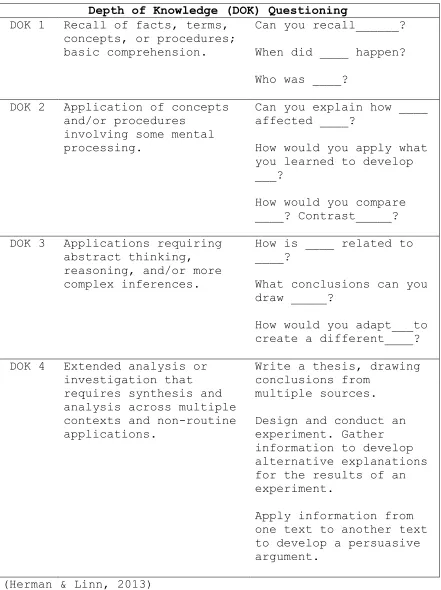
Smarter Balanced and PARCC utilize higher order questioning
and thinking in their assessments. This is done through
the Depth of Knowledge (DOK) methodology which is
delineated into four levels. Table 2.6 identifies the DOK
levels, what their specific questioning criteria consists
Table 2.5
PARCC & Smarter Balance Mathematics Assessment Goals
PARCC Mathematics Smarter Balance Mathematics
Major Concepts and
Procedures: Students solve problems involving the major content for grade level with connections to practices.
Concepts and Procedures: Students can explain and apply mathematical concepts and interpret and carry out mathematical procedures with precision and fluency.
Additional and Supporting Concepts and Procedures: Students solve problems
involving the additional and supporting content for their grade level with connections to practice.
Problem Solving: Students can solve a range of complex
well-posed problems in pure and applied mathematics, making productive use of
knowledge and problem solving strategies.
Expressing Math Reasoning: Students express mathematical reasoning by constructing mathematical arguments and critiques.
Communicating Reasoning: Students can clearly and precisely construct viable arguments to support their own reasoning and to critique the reasoning of others.
Modeling Real World Problems: Students solve real world problems engaging
particularly in the modeling practice.
Modeling and Data Analysis: Students can analyze complex, real-world scenarios and can construct and use
mathematical models to
interpret and solve problems.
Fluency: Students demonstrate fluency in areas set forth in the Standards for Content in grades three through six.
Table 2.6:
DOK Questioning Levels, Criteria, and Examples
Depth of Knowledge (DOK) Questioning DOK 1 Recall of facts, terms,
concepts, or procedures; basic comprehension.
Can you recall______?
When did ____ happen?
Who was ____?
DOK 2 Application of concepts and/or procedures
involving some mental processing.
Can you explain how ____ affected ____?
How would you apply what you learned to develop ___?
How would you compare ____? Contrast_____?
DOK 3 Applications requiring abstract thinking, reasoning, and/or more complex inferences.
How is ____ related to ____?
What conclusions can you draw _____?
How would you adapt___to create a different____?
DOK 4 Extended analysis or investigation that requires synthesis and analysis across multiple contexts and non-routine applications.
Write a thesis, drawing conclusions from
multiple sources.
Design and conduct an experiment. Gather information to develop alternative explanations for the results of an experiment.
Apply information from one text to another text to develop a persuasive argument.
A 2012 RAND Corporation study indicated that the
majority of states’ standardized tests consist of high
numbers of DOK 1 and DOK 2 levels of questions. The RAND
analysis of the state mathematics tests indicated that 100%
of the cognitive questions were within the DOK 1 and DOK 2
levels. The majority of which were DOK 1. Open-ended
mathematical responses indicated that 88% were in the DOK 1
and DOK 2, and 11% at DOK 3 (Yuan & Le, 2012).Similarly,
the ELA and Reading results showed that the majority of the
Reading items were within the DOK 1 to DOK 3 ranges. Of
those, 14% were considered DOK 3. Open ended reading
indicated some higher level questioning with 49% at DOK 3
and 11% DOK 4. States using separate writing tests
resulted in 47% at DOK 1 and DOK 2, and 33% at DOK 3.
Open-ended writing samples indicated 47% DOK 3 and 44% DOK
4 (Yuan & Le, 2012).
The RAND study astoundingly concluded that in the
overall sample 0% of American students experienced a deep
learning assessment on their current state mathematics
tests. State reading tests showed that only 16% of
students experienced deep reading assessments and only 2-3%
of students experienced deep level writing assessments.
The RAND study also concluded that overall only 3-10% of
assessed on deeper learning skills on at least one state
mandated and developed assessment (Yuan & Le, 2012).
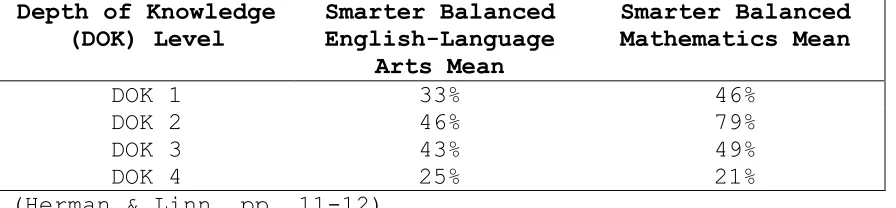
Conversely, Smarter Balance testing indicates high use
of DOK 2-4 levels with their fourth, eighth, and eleventh
grade assessments. Table 2.7 breaks down the DOK levels
and mean percentages of these questions utilized with the
Smarter Balanced assessments.
The increase in DOK levels, which both assessments are
employing pose significant challenges to their
implementation. The intentions are to provide the students
with exposure to higher-level thinking and response
questions. This, however, may also indicate a lack of
preparedness by both students and teachers. As discussed,
these tests are a major shift from the current state
mandated assessments.
Table 2.7:
Mean Percentage of DOK Level Questions for the Smarter Balanced Assessment Series
Depth of Knowledge (DOK) Level
Smarter Balanced English-Language
Arts Mean
Smarter Balanced Mathematics Mean
DOK 1 33% 46%
DOK 2 46% 79%
DOK 3 43% 49%
DOK 4 25% 21%
(Herman & Linn, pp. 11-12)
These assessments have prompted many states to
consortiums all together. Thirty-one states and territories
were partnered with Smarter Balanced, and twenty-six states
and territories were partnered with PARCC for the spring
2015 Assessments. As of this writing, only twenty-two
states and territories still remain with Smarter Balanced,
while only thirteen states and territories remain in the
PARCC consortiums. One Ohio teacher remarked that the
PARCC test is a “monstrosity.” She went on to say, “If the
developers of the PARCC Test had begun with the primary
goal of ensuring that most children will do dismally so
that schools and teachers will look very, very bad, then
they could not have done a better job!”
However, these assessments have forced states to
re-evaluate the nature of the assessments used in each state.
South Carolina administered the ACT Aspire Test to third
through eighth grade students in 2015. The Aspire Test
consists of similar percentages of DOK 2 and DOK 3 level
questioning that the Smarter Balance test will be
utilizing. Both tests are based on the Common Core
Standards, and both require the students to exercise their
higher order thinking skills. In addition, both tests have
forced teachers and administrators to re-evaluate the
levels of questioning in both daily lessons and
Role of the Principal
With the implementation of the Common Core State
Standards and its emphasis on all teachers being experts in
reading as well as their content area, the roles and
responsibilities of the school administrators have also
adapted from the management of a school to that of the
instructional leader. Within their respective school
systems, principals are expected to perform multiple roles.
Their primary responsibility, however, is to facilitate
effective teaching and learning with the overall mission of
enhancing student achievement (Hallinger & Heck, 2000;
Lezoutte, 1994; Waters, Marzano, and McNulty 2003).
Although teachers, supervisors, and district level
personnel are able to exhibit instructional leadership
behaviors, it is the school principal is the anchor for the
foundation of instructional leadership at the school level
(Sergiovanni, 1998).
Principals who strive to be instructional leaders are
committed to meeting the needs of their schools by serving
stakeholders and pursuing shared purposes (Sergiovanni,
1998). These administrators advocate excellence in student
performance by building a system of relationships with the
stakeholders in their schools (Hallinger & Heck, 2000). In