IJEDR1604138
International Journal of Engineering Development and Research (www.ijedr.org)908
A Survey Paper on Adaptive Routing protocols in
Mobile Ad Hoc Network
1
Ramandeep Kaur,
2Deepak Kumar Xaxa,
3Devendra Kumar
1M.Tech. Scholar, 2Assistant Professor,3M.Tech. 1CSE Department,
1School of Engg. & IT, MATS University, Gullu-Aarang Campus, Raipur (C.G.), India.
________________________________________________________________________________________________________
Abstract-A Mobile Ad-hoc Network builds the self-configuring wireless network with compilation of nodes and these mobile nodes with dynamism correspond to other nodes without any centralized infrastructure. Mobile nodes be similar to as router and forwards packets to other nodes in the network. A wide range of protocols are involved in Mobile Ad hoc Network for communicating and transferring of packets from peer to peer networks. An imperative and crucial issue for mobile ad hoc networks is routing protocol design that is a major technical dispute due to the dynamism of the network. During the last years, active research work resulted in a variety of suggestion. In this survey paper, different adaptive routing protocols designed for mobile ad hoc networks is discussed and compared with advantages and disadvantages of each. This survey paper aims at providing criteria according to which the protocols can be best fitted in MANET environment.
Index Terms - MANET, Adaptive Routing Protocols, AODV, LAR, ABR.
________________________________________________________________________________________________________
I.INTRODUCTION
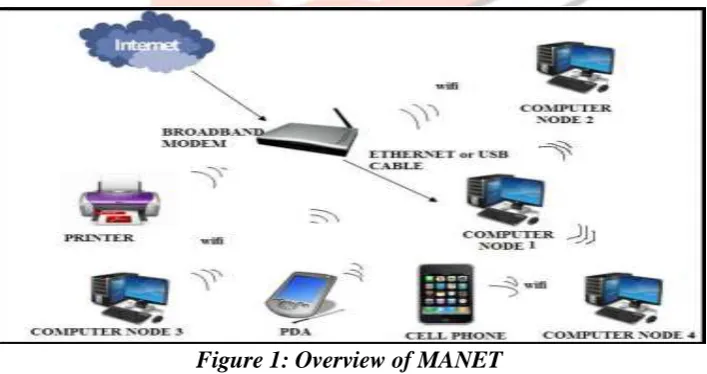
MANET (Mobile Ad hoc Network) is generally defined as a network which is composed of many free or autonomous nodes forms the wireless networks, often composed of mobile devices or other devices, which can operate without any support of any fixed infrastructure or centralized administration. For this reason they are also known as infrastructure-less networks. The nodes in the mobile network have the mobility to move around anywhere during the communication. The mobile agent acts as the intermediate nodes or router. The mobile nodes in the MANETs will be either bi-directional or unidirectional links. Every node in the network acts as the sender or receiver. Following figure 1 depicts the overview of MANET.
Figure 1: Overview of MANET
MANET nodes may be a laptop, a mobile phone and a personal digital assistant etc. which forms the wireless infrastructure by accessing internet connection without any base station. Every node operates independently by transferring data with other devices as depicted in Figure 1.
II.MANET ROUTING PROTOCOL CATEGORIES
There are many routing protocols for MANET are provided in order to route the packets from source to destination. These routing protocols are categorized into three categories, namely Proactive Protocols, Reactive Protocols and Hybrid routing protocols.
A. Proactive routing protocol
IJEDR1604138
International Journal of Engineering Development and Research (www.ijedr.org)909
sends broadcast message to entire network due to dynamic change in topology. There are many proactive protocols, some of them are: CGSR, DRF, DSDV, STAR, FSR, TBRF, LCA, HSLS, OLSR protocols etc.B. Reactive routing protocol
This type of protocol acts upon establishment of routes from source to destination whenever there is a request from sender for initiating the packet transfer mechanism. They are also known as on-demand routing protocols. The path will be provided for routing packets only on the basis of demand. Nodes will not maintain any table for storing information about destination. There are many reactive protocols, some of them are: ABR, AODV, CHAMP, DSR, TORA, LBR, SSR, SMP, RDMAR, LAR protocols etc.
C. Hybrid routing protocol
This type of protocol combines features of both the reactive and proactive routing protocol. In case of the intra-domain routing, these protocols uses the table driven approach, while in case of inter-domain routing these protocols uses the on demand approach. There are many reactive protocols, some of them are: ZRP, ZHLS, DZTR, CEDAR protocols etc.
III.RELATED WORK
AODV
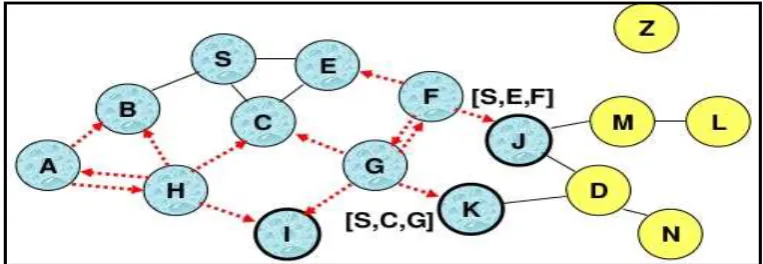
Ad-hoc On Demand distance Vector (AODV) [1] protocol provides quick and efficient route establishment when they are required (i.e. on demand), it doesn’t maintain all routes in the network therefore providing communication between the nodes with minimal overheads. In reactive routing protocol, the route of established path is maintained as long as it is needed. Nodes in MANET are not static, the nodes move from one place to another. Some nodes move with high velocity and some move slowly. If the destination or any intermediate node in the path to the destination is moved then Route Error (RERR) packet is provoked. This RERR is sent to each predecessor node lying in the route. This process continues until the RERR packet reaches to the source node. In turn, receiving RERR message the source node stops sending data and if it wants to continue interrupted data exchange it follows the route discovery procedure. Following figure 2 shows the process of AODV protocol messaging.
Figure 2: AODV Protocol Messaging
DSR
Dynamic Source Routing (DSR) protocol is proposed by Johnson Broch 1999 [2, 3, 4]. It is a simple and efficient routing protocol designed particularly for use in multi-hop wireless ad hoc networks of mobile nodes. It is similar to AODV it also forms a route of established path on-demand when a transmitting node requests for communication with other nodes. Conversely, it uses source routing instead of relying on the routing table at each intermediate device. DSR routing protocol is one of the most popular MANET routing protocols and several newer protocols are proposed based on its operation. It is a reactive routing protocol based on source node only i.e. it only discovers routes when they are required, and the source node recognizes the whole path to the destination, not just the next hop because the routing and data packets combine the whole path from source to destination. Following figure 3 shows the route discovery process of DSR routing protocol.
IJEDR1604138
International Journal of Engineering Development and Research (www.ijedr.org)910
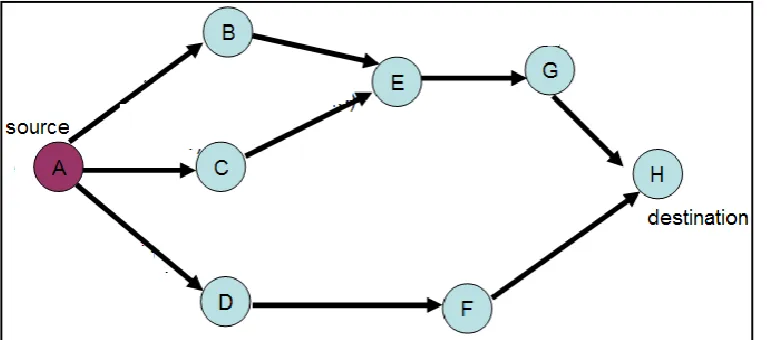
TORAThe Temporally Ordered Routing Algorithm (TORA) is eminently adaptive, capable and scalable distributed routing algorithm based on the theory of link reversal [5, 6]. TORA is anticipated for eminently dynamic environment means highly mobility network for multi-hop wireless networks. It is also a source-initiated on-demand routing protocol. TORA routing protocol acquire various routes from a source node to a destination node. The main characteristic of TORA is that the control messages are localized to a very small set of nodes near the occurrence of a topological contraction; all the nodes maintain routing information about neighboring nodes. This protocol has three basic functions: Route creation, Route maintenance and Route erasure. TORA has a unique characteristic of preserving multiple routes to the destination so that topological modifications do not require any response at all. This protocol reacts only when all routes to the destination are lost. Following Figure 4 shows the route discovery process of TORA routing protocol.
Figure 4: TORA Routing Protocol; Multipath Discover Process ABR
Associativity Based Routing (ABR) protocol is another source initiated routing protocol, which uses a query-reply technique to determine routes to the requisite destinations node [7]. Although, in ABR route selection is primarily based on stability, but to select stable route each node maintains an associativity mark off with their neighbors node, and the links with higher associativity mark off are selected in preference to the once with lower associativity mark off. Conversely this may not lead to the shortest path to the destination and the routes are liable to last longer. Therefore smaller numbers of route reconstructions are needed, and more bandwidth will be available for data communication of sending packets. The drawback of ABR is that it requires periodic beaconing to determine the degree of associativity of the links. This beaconing prerequisite needed all nodes to stay active at all time, which may result in additional power consumption.
LAR
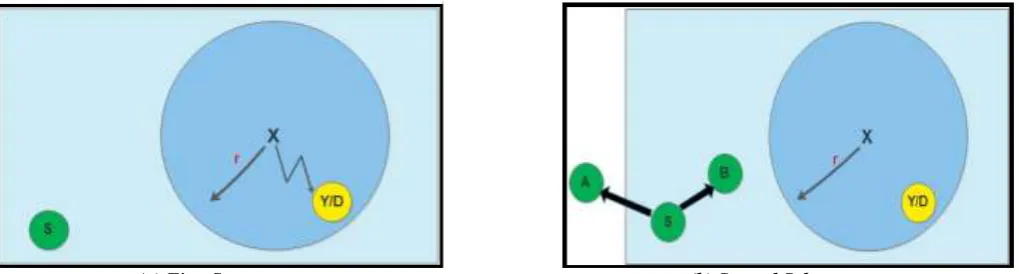
Location Aided Routing (LAR) [8] is based on flooding algorithms (such as DSR). LAR uses the location information to reduce the routing overheads present in the traditional flooding algorithm. LAR protocol speculates that each node knows its location through a GPS. LAR protocol proposed with two different schemes in [8], the first scheme calculates a request zone which defines a boundary where the route request packets can travel to reach the required destination node. The second scheme stores the coordinates of the destination in the route request packets [8]. In second scheme, the data packets can only travel in the direction where the relative distance to the destination becomes smaller as they travel from one hop to another. First scheme and Second scheme, both schemes limit the control overhead transmitted through the network and therefore conserve bandwidth. Both schemes also determine the shortest path (in most cases) to the destination, because the route request packets travel away from the source node and towards the destination node. The drawback of LAR protocol is that each node is required to carry a GPS. Following figure 5 shows LAR protocol (a) First Scheme (b) Second Scheme; where S= Source node, D= Destination node, X= last known location of node D, at time t0, Y= location of node D at current time t1 unknown for S, r= (t1-t0)*estimate of D’s speed.
IJEDR1604138
International Journal of Engineering Development and Research (www.ijedr.org)911
RDMARRelative Distance Micro-discovery Ad-hoc Routing (RDMAR) estimates the distance between source node and the required destination node in number of hops manner and thus limiting each route request packet to certain number of hops [9]. The source node sends the route with time-to-live (TTL) equal to above estimate which is confined to localized region. It minimizes the flooding effect by minimizing route request to certain number of hops. The main advantage of RDMR is that it does not require a location aided technology (such as a GPS) to determine the routing patterns, it overcomes the feature over LAR protocol. However, the first time it works with normal flooding operation and shows route discovery process having global effect.
CBRP
In Cluster Based Routing Protocol (CBRP) the nodes are organized in a hierarchy and divided into clusters [10]. Each cluster has a cluster-head, which coordinates the data transmission within the cluster and to other clusters which is responsible for the routing process. The diameter of a cluster is only two hops and clusters can be disjoint or overlapping. Cluster head communicate with each other through gateway nodes. The CBRP protocol suffers from temporary routing loops because some nodes may carry inconsistent topology information due to long propagation delay.
Figure 6: CBRP Protocol
ROAM
The Routing On-demand Acyclic Multipath (ROAM) routing protocol uses inter-nodal coordination along directed acyclic sub-graphs, which is derived from the router distance to destination and this operation is referred as a “diffusing computation” [11]. The ROAM routing protocol advantage is that it eliminates the search-to-infinity problem by stopping multiple flood searches when the required destination is no longer reachable. Secondly, each router maintains entries in a route table for destinations, which flow data packets through them. This reduces significant amount of storage space and bandwidth needed to maintain an up-to-date routing table. Although this has the benefit of increasing the network connectivity, it may also prevent nodes entering sleep mode to conserve power in highly dynamic networks.
ARA
The basic idea of Ant-Colony based Routing Algorithm (ARA) is taken from food searching behavior of real ants. This behavior of ants can be used to find the shortest path in the networks. When ants search for food they start from their nest and walk towards the food, while leaving behind a transient trail called pheromone. Especially, the dynamic component of this method allows a high adaptation to changes in Mobile ad-hoc networks. The advantage of ARA is that ,as ants do, it allows dynamic routing through shortest path if one node is broken. Most other algorithms instead assume that the network is static.
IJEDR1604138
International Journal of Engineering Development and Research (www.ijedr.org)912
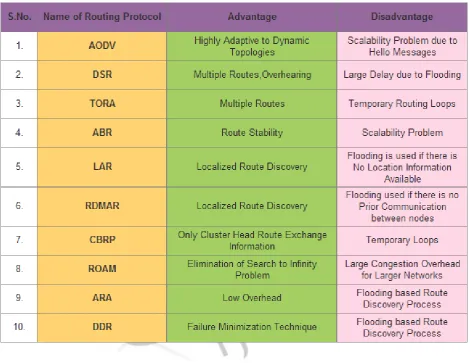
DDRDistributed Dynamic Routing (DDR) [24] is also a tree-based routing protocol. In this strategy tree are constructed using periodic beaconing messages which are exchanged by neighboring nodes only. The DDR algorithm consists of six phases: preferred neighbor election, forest construction, intra-tree clustering, inter-tree clustering, zone naming and zone partitioning. The advantage of DDR is that it does not rely on a static zone map to perform routing and it does not require a root node or a cluster head to coordinate data and control packet transmission between different nodes and zones. Furthermore, if a node is a preferred neighbor for many of its neighbors, many nodes may want to communicate with it. This means that channel contention would increase around the preferred neighbor, which would result in larger delays experienced by all neighboring nodes before they can reserve the medium. Following table 1 shows the comparison chart of discussed adaptive routing protocols with their advantages and disadvantages.
Table 1: Comparison Chart
IV.CONCLUSION
Routing is an indispensable constituent of communication protocols in MANET. The blueprint of the protocols are driven by specific goals and requirements based on respective assumptions about the network properties. In this survey paper it is tried to report a study on the reactive routing protocols for MANET and reveal the characteristics and trade-offs. Each of the protocols studied performs well in some cases and has certain drawbacks in others. Hence, security and power awareness mechanisms should be built-in features for all sorts of applications based on ad hoc network. As a future work, effort will be made to propose a solution for routing in Ad Hoc networks by tackling core issues of secure and power aware/energy efficient routing.
REFERENCES
[1] ICICES2014 - S.A.Engineering College, Chennai, Tamil Nadu, India, ISBN No.978-1-4799-3834-6/14/$31.00©2014 IEEE,“A Survey of Reactive Routing Protocols in MANET”, Daxesh N. Patel, Sejal B. Patel, Hemangi R.Kothadiya,Pinakin D. Jethwa, Rutvij H. Jhaveri.
[2] C.S. Murthy, B.S. Manoj, Ad hoc Wireless Networks Architectures and Protocols, Prentice Hall, NJ, USA, 2004. [3] S. Basagni, M. Conti, S. Giordano, I. Stojmenovic, Mobile Ad Hoc Networking, John Wiley & Sons, Inc., Hoboken,
New Jersey, 2004.
IJEDR1604138
International Journal of Engineering Development and Research (www.ijedr.org)913
[5] C. Schurgers and M.B. Srivastava: Energy efficient routing in wireless sensor networks,in the MILCOMProceedings on Communications for Network-Centric Operations: Creating the Information Force, McLean, VA (2001).
[6] Y. Yao and J. Gehrke: The cougar approach to in network query processing in sensor networks, in SIGMOD Record (September 2002).
[7] C. Toh, A novel distributed routing protocol to support ad-hoc mobile computing, in: IEEE 15th Annual International Phoenix Conf., 1996, pp. 480–486.
[8] Y.-B. Ko, N.H. Vaidya, Location-aided routing (LAR) in mobile ad hoc networks, in: Proceedings of the Fourth Annual ACM/IEEE International Conference on Mobile Computing and Networking (Mobicom’98), Dallas, TX, 1998.
[9] G. Aggelou, R. Tafazolli, RDMAR: a bandwidth-efficient routing protocol for mobile ad hoc networks, in: ACM International Workshop on Wireless Mobile Multimedia (WoWMoM), 1999, pp. 26–33.
[10]M. Jiang, J. Ji, Y.C. Tay, Cluster based routing protocol, Internet Draft, draft-ietf-manet-cbrp-spec-01.txt, work in progress, 1999.
[11]J. Raju, J. Garcia-Luna-Aceves, A new approach to on-demand loop-free multipath routing, in: Proceedings of the 8th Annual IEEE International Conference on Computer Communications and Networks (ICCCN), Boston, MA, October 1999, pp. 522–527.
[12]M. Günes, U. Sorges, I. Bouazizi, Ara––the ant-colony based routing algorithm for manets, in: ICPP workshop on Ad Hoc Networks (IWAHN 2002), August 2002, pp. 79–85.