Face Recognition Using Enhanced Kernel Based SVM Classification for
Matching
1N. Revathi, 2Dr. S. Selvamuthukumaran
1Research Scholar, Bharathiar University, Coimbatore, India
2Director-Computer Applications, A.V.C. College of Engineering, Mannampandal, India
ABSTRACT
Automatic face recognition system is an important component of intelligent human computer interaction systems for biometric. It is an attractive biometric approach, to distinguish one person from another. This paper deals with the edge detection technique with a modified form of SVM kernel classifier is utilized to take account of prior knowledge about facial structures and is used as the alternative feature extractor.
Keywords : Face Recognition, Classification, Edge Detection, Matching.
I.
INTRODUCTIONFace recognition has become an important problem for a long time. Commercial and law enforcement applications makes it critical for both business industry and public security. In addition, researchers from different fields including image processing and computer visions are continuously applying different algorithms for face recognition problems [1]. Till now, typical methods for face recognition include holistic methods, feature-based methods, and hybrid methods [1]. Holistic methods include algorithms such as principal component analysis (PCA) and its derivation two-dimensional principal component analysis (2DPCA) [1], [2]. Feature-based methods include algorithms such as hidden Markov model (HMM) [1], [3]. Hybrid methods include algorithms such as modular eigenfaces [1], [4]. In addition, k-means clustering and its derivation, due to their computational efficiency, are also used in face recognition. Autoencoders, including deep autoencoder [5], are widely used in complicated face recognition problems, too. Despite its long training time, convolutional neural network has also become a widely used algorithm to do image processing work
including face recognition problems due to its consideration of spatial characteristics.
Continuous development of remote sensing has contributed to the progress of hyperspectral imaging technology. Due to its high spectral resolution and rich object information, hyperspectral images have been adopted in much wider domains. Meanwhile, these properties have made the accuracy derived from classification process, which is influenced by feature generation, a core task in the hyperspectral imaging.
SVM to be used in more varieties of applications. Though it has been recognized that typical SVM shows high performance, especially superior accuracy in image classification, still, there is much space for improvement because of some uncertainty relating to the role of feature reduction[14].
This paper presents a learning-based face recognition method developed for specific applications, including security monitoring and location tracking. In such applications, multiple images per person are often available for training and real-time recognition is required. Since SVMs were originally developed for two-class classification, this basic scheme is extended for multi-face classification by adopting a one-per-class decomposition method.
II.
LITERATURE SURVEYThe literature contains a number of precedents where edge based wavelets are used for feature detection. Hwang [8] use first derivative wavelets to isolate singularities caused by edges in noisy data. Wavelet maxima thus obtained are subsequently used for noise smoothing and image reconstruction.
Yu et al. [9] develop an adaptive maximum likelihood ratio test for detecting faint optical targets in this case trucks in multispectral satellite images. Object detection is based on feature vectors containing spectral, orientation, and scale parameters, all of which are computed at multiple scales via the wavelet transform.
Gunes and Piccardi [10] in their work presented an approach to automatic visual recognition of expressive face and upper-body gestures from video sequences suitable for use in a vision-based affective multi-modal framework. After extracting a single expressive frame for both face and body from each
individual modalities. Later on they have fused facial expression and affective body gesture information at the feature and the decision level.
Kao et al. [11] have proposed an integration of face and hand gesture recognition. They have claimed that face recognition rate can be improved by hand gesture recognition. They have proposed a security elevator scenario. They have claimed that the integration of two search engines proposed by them is general and is not only for face and hand gesture recognition.
Nanni et al. [12] have presented some variants of Local Binary Patterns from Three Orthogonal Planes (LBP-TOP) for Human action classification. Human action classification has applications ranging from automatically labeling video segments to recognition of suspicious behavior in video surveillance cameras. They have combined their LBP-TOP variants with Local Ternary Patterns (LTP). The local gray scale difference in different planes of space-time volume is evaluated by encoding of LTP.
Ding et al. [13] presented an improved LBP (local binary pattern) texture descriptor, which is used to classify static hand-gesture images. The descriptor makes full use of correlation and differences of pixel gray value in the local regions. They claim that it is simple, coding is fast and the descriptor is a highly discriminative texture operator capable of representing different characteristics of static hand-gesture images. They have also claimed that the descriptor is robust to nonlinear illumination, scaling and gives the efficiency close to LBP. The classification is done using an Adaboost classifier.
III.
PROBLEM IDENTIFICATION In order to improve the recognition neural networks method was used which increases the recognition time but does not improves the efficiency.
Statistical approach have the limitation in accuracy whereas it depends solely on a number of factors amongst them is the lighting as this decreases the accuracy.
Edges characterize boundaries and are therefore a problem of fundamental importance in image processing and an important tool for image segmentation
Previous classification is very sensitive to scale, therefore, a low-level preprocessing is still necessary for scale normalization.
IV.
RESEARCH METHODOLOGYEdge detection refers to the process of identifying and locating sharp discontinuities in an image. The discontinuities are abrupt changes in pixel intensity which characterize boundaries of objects in a scene. Edges characterize boundaries and are therefore a problem of fundamental importance in image processing and an important tool for image segmentation. The concept of edge is highly useful in dealing with regions and boundaries as an edge point is transition in gray level associated with a point with respect to its background. Edges typically occur on the boundary between two regions.
SVM Kernal classification
In the proposed hybrid kernel ELM, a positive regularization coefficient is introduced in order to make the learning system more stable. Assume H‟H is non singular, the coefficient 1/λ is added to the diagonal of H‟H in the more stable and with better generalization performance. We then can have,
( )
( ) ( ) ( ) ( ) ( )
The output function can be written as,
( ) ( ) ( ) ( )
The hidden layer feature mapping h(x) need not to be known to users, instead its corresponding kernel K (u, v) can be computed. Here the Gaussian kernel is used,
k (u, v) = exp(-γ||u-v||2).
1) Let‟s assume tj=1, which means only one class data is used for training. The result β becomes a linear approximation mapping g(·) to T.
2) In geometry, it is a hyper plane approximation. Then it can be shown that the difference |f(x)-1| is the distance of any point (a sample, in either class) to the hyper plane constructed by the ELM.
3) Thus if the hyper plane can be used to represent one class, any point away from the plane will indicate that it is not in the same class, which means we can use it to detect novelty.
4) In the original ELM, as it is only a linear transformation, the one-class mapping is not represented accurately using the hyper plane. The detection result is thus not satisfying. With the hybrid kernel transform the data is mapped to a higher dimension space, similar to many other kernel methods
Matching Process
The SVM algorithm selects the class of hyperplanes whose dimension bounds can be computed and then uses to identify the optimal hyperplane that maximizes the margin of nearest examples. Now the N-dimensional input patterns are available for matching process. To compute k(x, y) for two facial patterns x and y, the products between the corresponding pixels of the localized regions in the two images are summed (indicated by dot products as weighed by the pyramidal receptive fields. The first nonlinearity, in the form of the exponent p1, is then applied to the output. The resulting values are summed, and the p2th power of the result is taken as the value k(x, y). The resulting kernel will be of the order up to p1 · p2, however, this does not contain all the possible pixel correlations but mainly just the local ones.
1. Compute new image z, defined as pixel-wise product of x and y.
2. Sample z with pyramidal receptive fields of diameter d, centered at selected locations (i, j) with interval r, to obtain values zij .
3. Raise each zij to power p1, to take into account all local correlations within the range of the pyramid.
4. Sum zp1 ij for all locations (i, j) and increase the result to power p2 to allow for global correlations of order p2.
Performance Analysis
The performance of the algorithm is evaluated using the measures like accuracy, sensitivity, specificity, positive predictive value or precision and negative predictive value defined as follows:
Figure 2-Detected face image after SVM classification Table-1 Calculation of accuracy
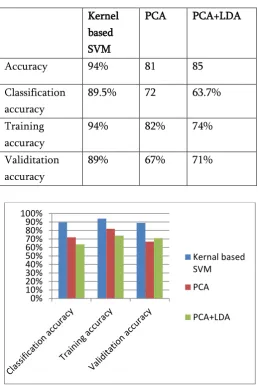
Kernel based SVM
PCA PCA+LDA
Accuracy 94% 81 85
Classification accuracy
89.5% 72 63.7%
Training accuracy
94% 82% 74%
Validitation accuracy
89% 67% 71%
Figure- 3. Comparison of various accuracy
Figure 3 shows the comparison of classification, training and validitation accuracy and it is concluded that kernel based Support Vector Machine has achieved better accuracy of about 94% during classification and hence it is better than Principle component analysis and linear discriminator based principle component analysis.
Figure-4 Overall accuracy
Figure 3 shows the comparison of classification, training and validitation accuracy and it is concluded that kernel based Support Vector Machine has achieved better accuracy of about 90% during classification and hence it is better than Principle component analysis and linear discriminator based principle component analysis.
V.
CONCLUSION
We have presented SVM Kernel classification implicitly combined with a distance-learning method in the transform subspace for face-recognition tasks. It consistently outperforms existing subspace methods for face recognition particularly in the case of very low dimensions. There is a trend in recent years that linear subspace methods may be too limited for difficult classification tasks. The modified method SVM, proposed in this paper, has the better performance in classifying more images with higher accuracy.
0% 10% 20% 30% 40% 50% 60% 70% 80% 90% 100%
Kernal based SVM
PCA
PCA+LDA
Accuracy
Kernal based SVM
PCA
VI.
REFERENCES
[1]. Zhao W, Chellappa R, Phillips P. J and Rosenfeld A 2003 Face recognition: a literature survey ACM. Compu. Surveys (CSUR) 35 399-458
[2]. Yang J, Zhang D, Frangi A. F and Yang J. Y 2004 Two-dimensional PCA: a new approach to appearance-based face representation and recognition IEEE Transactions on Pattern Analysis and Machine Intelligence 26.1 131-137
[3]. Nefian A. V and Hayes M. H 1999 An embedded HMM-based approach for face detection and recognition Proc. IEEE International Conference on Acoustics, Speech, and Signal Processing 6 3553-56
[4]. Pentland A, Moghaddam B and Starner T 1994 View-based and modular eigenspaces for face recognition Computer Vision and Pattern Recognition 94 84-91
[5]. Le QV 2013 Building high-level features using large scale unsupervised learning IEEE International Conference on Acoustics, Speech and Signal Processing 8595-98
[6]. M. Pal and G. Foody, “Feature Selection for Classification of Hyperspectral Data by SVM,” IEEE Trans. Geosci. Remote Sens, vol. 48, no. 5, pp. 2297-2307,2010
[7]. S. A. Hosseini and H. Ghassemian, “A new fast algorithm for multiclass.hyperspectral image classification with SVM”, International Journal of Remote Sensing, 32:23, 8657-8683, 2011 [8]. S. Mallat and W. L. Hwang, “Singularity
detection and processing with wavelets,” IEEE Trans. Inform. Theory, vol. 38, pp. 617-643, Mar. 2012.
[9]. X. Yu, I. S. Reed, W. Kraske, and A. D. Stocker, “A robust adaptive multispectral object detection by using wavelet transform,” in Proc.
Signal Processing, ICASSP- 92, pp. V-141–V-144.
[10]. Gunes and Piccardi, "Face Recognition Using Independent Component Analysis and Support Vector Machines," Pattern Recognition Letters, Vol.24, pp.2153-2157, 2003.
[11]. Kao et al. J. Matas, J. Kittler, and Y. P. Li, "Learning Support Vector Machines for Face Verification and Recognition," in Proceedings of IEEE International Conference on Automatic and Gesture Recognition, 2000, pp.208-213. [12]. Nanni, S. Li, and C. Kapluk, "Face Recognition
by Support Vector Machines," in Proceedings of the Fourth IEEE International Conference on Automatic Face and Gesture Recognition. Washington, DC, USA, 2000, pp.196-201. [13]. Ding, W. Gong, Y. Pan, W. Li, and Z. Hu,
"Gabor Features-Based Classification Using SVM for Face Recognition," in Advances in Neural Networks – ISNN 2005, Vol.3497, Lecture Notes in Computer Science. Chongqing: Springer, 2005, pp.118-123.
[14]. . K.M.Ponnmoli, S.Selvamuthukuaran,
„Analysis of Face Recognition using Manhattan Distance Algorithm with Image Segmentation‟,
International Journal of Computer Science and
Mobile Computing, 2014, Vol. 3, Issue. 7, pp 18 – 27