The 2018 Conference on Computational Linguistics and Speech Processing ROCLING 2018, pp. 169-183
©The Association for Computational Linguistics and Chinese Language Processing
Using
Statistical
and
Semantic
Models
for
Multi-Document
Summarization
Divyanshu Daiya
DepartmentofComputerScienceEngineering
LNMInstituteofInformationTechnology
Jaipur,INDIA
AnukarshSingh
DepartmentofComputerScienceEngineering
LNMInstituteofInformationTechnology
Jaipur,INDIA
Abstract. Wereportaseriesofexperimentswithdifferentsemanticmodelsontopofvarious
statisticalmodelsforextractivetextsummarization. Thoughstatisticalmodelsmaybetter
cap-ture word co-occurrencesand distribution aroundthe text, they fail to detectthe context and
thesenseofsentences/wordsasawhole. Semanticmodelshelpusgainbetterinsightintothe
contextofsentences. We showthathowtuningweightsbetweendifferentmodelscanhelpus
achievesignificantresultsonvariousbenchmarks. Learningpre-trainedvectorsusedin
seman-ticmodels further, on givencorpus, can giveaddition spikein performance. Usingweighing
techniquesin between various statisticalmodels too furtherrefines our result. For Statistical
models, wehaveusedTF/IDF,TextRAnk,Jaccard/CosineSimilarities. For SemanticModels,
we have used WordNet-based Model and proposed two models based on Glove Vectors and
Facebook’s InferSent. We tested our approach on DUC 2004 dataset, generating 100-word
summaries. We have discussedthesystem, algorithms, analysisand alsoproposed andtested
possible improvements. ROUGE scores were used to compare to other summarizers.
Keywords. Extractive Text Summarization, Semantic Summarization Models, Statistical
1. Introduction
Automatic Text Summarization deals with the task of condensing documents into a summary,
whose level is similar to a human-generated summary. It is mostly distributed into two distinct
domains, i.e., Abstractive Summarization and Extractive Summarization. Abstractive
sum-marization( Dejong et al. ,1978) involves models to deduce the crux of the document. It then
presents a summary consisting of words and phrases that were not there in the actual document,
sometimes even paraphrasing [20]. A state of art method proposed by Wenyuan Zeng [25]
pro-duces such summaries with length restricted to 75. There have been many recent developments
that produce optimal results, but it is still in a developing phase. It highly relies on natural
lan-guage processing techniques, which is still evolving to match human standards. These
short-comings make abstractive summarization highly domain selective. As a result, their application
is skewed to the areas where NLP techniques have been superlative. Extractive Summarization,
on the other hand, uses different methods to identify the most informative/dominant sentences
through the text, and then present the results, ranking them accordingly. In this paper, we have
proposed two novel stand-alone summarization methods.The first method is based on Glove
Model [17],and other is based on Facebook’s InferSent [4]. We have also discussed how we
can effectively subdue shortcomings of one model by using it in coalition with models which
capture the view that other faintly held.
2. Related Work
A vast number of methods have been used for document summarization. Some of the methods
include determining the length and positioning of sentences in the text [19], deducing centroid
terms to find the importance of text [19] and setting a threshold on average TF-IDF scores.
Bag-of-words approach, i.e., making sentence/Word freq matrix, using a signature set of words
and assigning them weights to use them as a criterion for importance measure [10] have also
been used. Summarization using weights on frequency words [14] describes that
high-frequency terms can be used to deduce the core of document.
While semantic summarizers like Lexical similarity is based on the assumption that important
sentences are identified by strong chains [6, 2, 13]. In other words, it relates sentences that
em-ploy words with the same meaning (synonyms) or other semantic relation. It uses WordNet [12]
to find similarity among words that apply to Word Frequency algorithm.POS(Part of Speech)
Tagging and WSD(Word Sense Disambiguation) are common among semantic summarizers.
Graphical summarizers like TextRank have also provided great benchmark results.TextRank
assigns weights to important keywords from the document using graph-based model and
uses Google’s PageRank (Brin and Page, 1998) for graphical modeling. Though semantic and
graphical models may better capture the sense of document but miss out on statistical view.
There is a void of hybrid summarizers; there haven’t been many studies made in the area.Wong
[23] conducted some preliminary research but there isn’t much there on benchmark tests to
our knowledge. We use a mixture of statistical and semantic models, assign weights among
them by training on field-specific corpora. As there is a significant variation in choices among
different fields. We support our proposal with expectations that shortcomings posed by one
model can be filled with positives from others. We deploy experimental analysis to test our
proposition.
3. Proposed Approach
For Statistical analysis we use Similarity matrices, word co-occurrence/ n-gram model,
andTF/IDF matrix. For semantic analysis we use custom Glove based model, WordNet based
Model and Facebook InferSent [4] based Model. For Multi-Document Summarization,after
training on corpus, we assign weights among the different techniques .We store the sense vector
for documents, along with weights, for future reference. For Single document summarization,
firstly we calculate the sense vector for that document and calculate the nearest vector from the
stored Vectors, we use the weights of the nearest vector. We will describe the flow for semantic
and statistical models separately.
3.1. Prepossessing
We discuss, in detail, the steps that are common for both statistical and semantic models.
3.1.1. Sentence Tokenizer
We use NLTK sentence tokenizer sent tokenize(), based on PUNKT tokenizer, pre-trained on
a corpus. It can differentiate between Mr. , Mrs. and other abbreviations etc. and the normal
sentence boundaries. [7]
Given a documentDwe tokenize it into sentences as<s1,s2,s3,s4...sn>.
3.1.2. Word Tokenizer
Replacing all the special characters with spaces for easier word-tagging and Tokenizing. We
use NLTK word tokenizer, which is a Penn Treebank–style tokenizer, to tokenize words.We
as:-si→<wI,wJ,wK,wL, ..>,i∈(1,n)
Then the number of unique words can be represented
as:-(I,J,K,L....)⊂(1, ..M) ,n→Totalsentences,M→Totaluniquewords
3.2. Using Stastical Models
3.2.1. Similarity/Correlation Matrices
Frequency Matrix generation: Our tokenized words contain redundancy due to digits and
transitional words such as “and”, “but” etc., which carry little information. Such words are
termed stop words. [22] We removed stop words and words occurring in<0.2% and>15% of the documents (considering the word frequency over all documents). After the removal, the
no. of unique words left in the particular document bepwherep<m(wheremis the total no.
of unique words in our tokenized list originally). We now formulate a matrixFn×p wherenis
the total number of sentences andpis the total number of unique words left in the document.
Elementei j in the matrixFn×pdenotes frequency of jthunique word in theith sentence.
Similarity/Correlation Matrix generation: We now have have sentence word frequency
vectorSfi as<fi1,fi2,fi3, ...fi4>where fia denotes frequency ofath unique word in theith
sen-tence. We now compute,
Sentence similarity(Sfi,Sfj)
We use two similarity measures : We generate the similarity matrix Simnj×n for each of the similarity Measure, where j indexes the similarity Measure. Element Ei j of Simnj×n denotes
similarity between ith and jth sentence. Consequentially, we will end up with Sim1n×n and Sim2n×n, corresponding to each similarity measure.
1. Jaccard Similarity: For some sets A and B,<a,b,c,... >and<x,y,z,...>respectively, the Jaccard Similarity is defined
as:-Jaccard similarity(A,B)← n(A∩B)
n(A∪B)
2. Cosine Similarity: The Cosine distance between ‘u’ and ‘v’, is defined
as:-Cosine similarity(A,B)←1− u·v ||u||||v||
3.2.3. TF/IDF
Term Frequency(TF)/Bag of words is the count of how many times a word occurs in the given
document. Inverse Document Frequency(IDF) is the number of times word occurs in complete
corpus. Infrequent words through corpus will have higher weights, while weights for more
frequent words will be depricated.
Underlying steps for TF/IDF summarization are:
1. Create a count vector
Doc1←< f rWord1,f rWord2,f rWord3, .. > 2. Build a tf-idf matrixWM×N with elementwi,jas,
wi,j=t fi,j×log(
N d fi)
Here, t fi,j denotes term frequency ofith word in jth sentence, andlog(d fNi)
repre-sents the IDF frequency.
3. Score each sentence, taking into consideration only nouns, we use NLTK POS-tagger
for identifying nouns.
Score(So,j)← ∑Noi,j
N
∑
p=1 Np,j 4. Applying positional weighing .
Scores[So,j] =Score(So,j)×(
o T)
o→Sentence index T→Total sentences in document j
5. Summarize using top ranking sentences.
3.3. Using Semantic Models
We proceed in the same way as we did for statistical models. All the pprocessing steps
re-main nearly same. We can make a little change by using lemmatizer instead of stemmer.
Stem-ming involves removing the derivational affixes/end of words by heuristic analysis in hope
to achieve base form. Lemmatization, on the other hand, involves firstly POS tagging [21],
and after morphological and vocabulary analysis, reducing the word to its base form.
Stem-mer output for ‘goes’ is ‘goe’, while lemmatized output with the verb passed as POS tag is
‘go’. Though lemmatization may have little more time overhead as compared to stemming, it
necessarily provides better base word reductions. Since WordNet [16] and Glove both require
dictionary look-ups, in order for them to work well, we need better base word mappings. Hence
3.3.3. Using Glove Model
Glove Model provides us with a convenient method to represent words as vectors, using vectors
representation for words, we generate vector representation for sentences. We work in the
following order,
1. Represent each tokenized wordwiin its vector form<a1i,ai2,a3i, . . .a300i >.
2. Represent each sentence into vector using following equation,
SVec(sj) =
1
|sj|w
∑
i∈sjfi,j(a1i,a2i, . . .a300i )
where fi,jbeing frequency ofwiinsj.
3. Calculate similarity between sentences using cosine distance between two sentence
vec-tors.
4. Populate similarity matrixSim4N×N using previous step.
3.3.4. Using Facebook’s InferSent
Infersent is a state of the art supervised sentence encoding technique [4]. It
out-performed another state-of-the-art sentence encoder SkipThought on several
bench-marks, like the STS benchmark (http://ixa2.si.ehu.es/stswiki/index.php/
STSbenchmark). The model is trained on Stanford Natural Language Inference (SNLI)
dataset [3] using seven architectures Long Short-Term Memory (LSTM), Gated Recurrent
Units (GRU), forward and backward GRU with hidden states concatenated, Bi-directional
LSTMs (BiLSTM) with min/max pooling, self-attentive network and (HCN’s) Hierarchical
convolutional networks. The network performances are task/corpus specific.
Steps to generate similarity matrixSim5N×N are:
1. Encode each sentence to generate its vector representation<li1,li2,li3, . . .l4096i >. 2. Calculate similarity between sentence pair using cosine distance.
3. Populate similarity matrixSim5N×N using previous step.
3.4. Generating Summaries
TF-IDF scores and TextRank allows us to directly rank sentences and choosektop sentences,
where k is how many sentences user want in the summary. On the other hand, the
similar-ity matrix based approach is used in case of all Semantic Models, and Similarsimilar-ity/correlation
based Statistical models. To rank sentences from Similarity matrix, we can use following
approaches:-1. Ranking through Relevance score
For each sentencesiin similarity matrix the Relevance Score is
as:-RScore(si) = N
∑
j=1Sim[i,j]
We can now choosektop ranking sentences by RScores. Higher the RScore, higher the
rank of sentence.
2. Hierarchical Clustering
Given a similarity matrixSimN×N, letsa,bdenote an individual element, then
Hierarchi-cal clustering is performed as
follows:-(a) Initialize a empty listR.
(b) Choose element with highest similarity value let it besi,jwhere,i6= j,si,j6=0
(c) Replace values in column and rowiin following
manner:-sd,i=
sd,i+sd,j
2 ,d∈(1,N), si,d=
si,d+sj,d
2 ,d∈(1,N)
(d) Replace entries corresponding to column and rowiby zeros.
(e) Addiand jtoR, if they are not already there.
(f) Repeat steps 2-5 until single single non-zero element remains, for remaining
non-zero element apply Step 5 and terminate.
(g) We will have rank listRin the end.
We can now choosektop ranking sentences fromR.
3.5. Single Document Summarization
After generating summary from a particular model, our aim is to compute summaries through
overlap of different models. Let us havegsummaries fromgdifferent models. Forpth summa-rization model, let theksentences contained
be:-Sump←(s(1,p),s(2,p). . . ,s(k,p))
Now for our list of sentences<s1,s2,s3, ..sn>we definecWeightas weight obtained for each sentence usinggmodels.
cWeight(si) = g
∑
j=1WiB(j,si)
3.6. Multi-Document/Domain-Specific Summarization
We here use machine learning based approach to further increase the quality of our
summa-rization technique. The elemental concept is that we use training set ofudomain specific
doc-uments, with gold standard/human-composed summaries, provided we fine tune our weights
Wi∀i∈(1,g)for different models taking F1-score/F-measure. [18] as factor.
F1Score=2.precision.recall
precision+recall
We proceed in the following
manner:-1. For each document in training set generate summary using each model independently,
compute theF1Scorew.r.t. gold summary.
2. For each model, assign the weights using
Wi= ∑
v j=1f
(j,i) 1
u ,i∈(1,g)
Here, f1(j,i)denotesF1Scorefor jth model inith document.
We now obtaincWeightas we did previously, and formulate cumulative summary, capturing
the consensus of different models. We hence used a supervised learning algorithm to capture
the mean performances of different models over the training data to fine-tune our summary.
3.7. Domain-Specific Single Document Summarization
As we discussed earlier, summarization models are field selective. Some models tend to
per-form remarkably better than others in certain fields. So, instead of assigning uniper-form weights
to all models we can go by the following approach.
1. For each set of documents we train on, we generate document vector using bidirectional
GRU ( [1] as described by Zichao Yang [24]for each document. We then generate
complete corpus vector as
follows:-cDocs=
v
∑
i=1(a1i,a1i,a1i, . . . ,aip,)
where,vis total training set size,pis number of features in document vector.
2. We savecDocsandweightscorresponding to each corpus.
3. For each single document summarization task, we generate given texts document vector,
perform nearest vector search over all storedcDocs, apply weights corresponding to that
corpus.
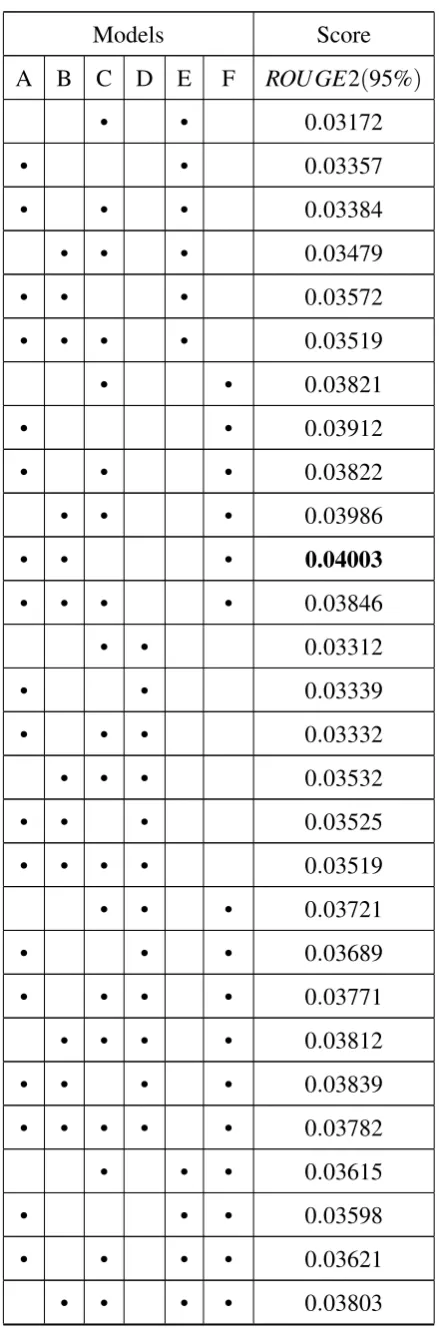
Table 1: Average ROUGE-2 Scores for Different
Combina-tion of Models.
Models Score
A B C D E F ROU GE2(95%)
• • 0.03172
• • 0.03357
• • • 0.03384
• • • 0.03479
• • • 0.03572
• • • • 0.03519
• • 0.03821
• • 0.03912
• • • 0.03822
• • • 0.03986
• • • 0.04003
• • • • 0.03846
• • 0.03312
• • 0.03339
• • • 0.03332
• • • 0.03532
• • • 0.03525
• • • • 0.03519
• • • 0.03721
• • • 0.03689
• • • • 0.03771
• • • • 0.03812
• • • • 0.03839
• • • • • 0.03782
• • • 0.03615
• • • 0.03598
• • • • 0.03621
• • • • 0.03803
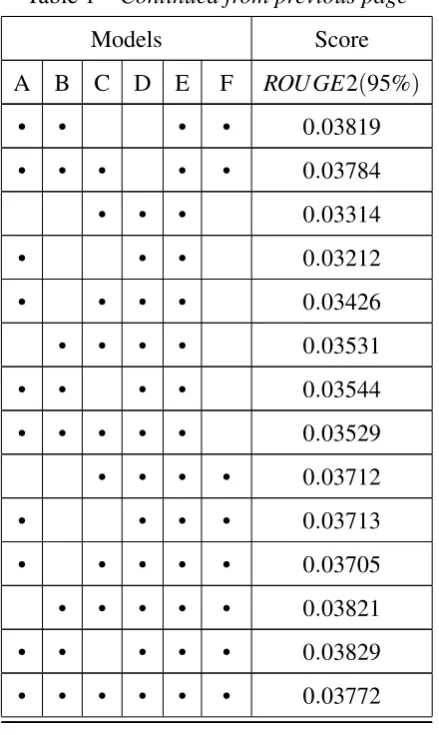
Table 1 –Continued from previous page
Models Score
A B C D E F ROU GE2(95%)
• • • • 0.03819
• • • • • 0.03784
• • • 0.03314
• • • 0.03212
• • • • 0.03426
• • • • 0.03531
• • • • 0.03544
• • • • • 0.03529
• • • • 0.03712
• • • • 0.03713
• • • • • 0.03705
• • • • • 0.03821
• • • • • 0.03829
• • • • • • 0.03772
We evaluate our approaches on 2004 DUC(Document Understanding Conferences)
dataset(https://duc.nist.gov/). The Dataset has 5 Tasks in total. We work on Task
2. It (Task 2) contains 50 news documents cluster for multi-document summarization. Only
665-character summaries are provided for each cluster. For evaluation, we use ROGUE, an
automatic summary evaluation metric. It was firstly used for DUC 2004 data-set. Now, it has
become a benchmark for evaluation of automated summaries. ROUGE is a correlation metric
for fixed-length summaries populated using n-gram co-occurrence. For comparison between
model summary and to-be evaluated summary, separate scores for 1, 2, 3, and 4-gram
match-ing are kept. We use ROUGE-2, a bi-gram based matchmatch-ing technique for our task.
In theTable 1, we try different model pairs with weights trained on corpus for Task 2.
We have displayed mean ROUGE-2 scores for base Models. We have calculated final scores
taking into consideration all normalizations, stemming, lemmatizing and clustering techniques,
and the ones providing best results were used. We generally expected WordNet, Glove based
semantic models to perform better given they better capture crux of the sentence and compute
1A→Jaccard/Cosine Similarity MatrixB→TextRankC→TFIDFD→WordNet Based ModelE→Glove-vec
similarity using the same, but instead, they performed average. This is attributed to the fact they
assigned high similarity scores to not so semantically related sentences. We also observe that
combinations with TF/IDF and Similarity Matrices(Jaccard/Cosine) offer nearly same results.
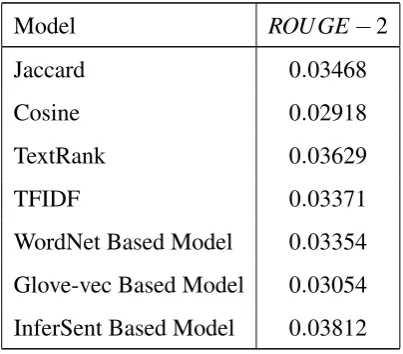
The InferSent based Summarizer performed exceptionally well. We initially used pre-trained
features to generate sentence vectors through InferSent.
Table 2: Average ROUGE-2 scores for base methods.
Model ROU GE−2
Jaccard 0.03468
Cosine 0.02918
TextRank 0.03629
TFIDF 0.03371
WordNet Based Model 0.03354
Glove-vec Based Model 0.03054
InferSent Based Model 0.03812
3.9. Conclusion/Future Work
We can see that using a mixture of Semantic and Statistical models offers an improvement over
stand-alone models. Given better training data, results can be further improved. Using
domain-specific labeled data can provide a further increase in performances of Glove and WordNet
Models.
Some easy additions that can be worked on are:
1. Unnecessary parts of the sentence can be trimmed to improve summary further.
2. Using better algorithm to capture sentence vector through Glove Model can improve
results.
3. Query specific summarizer can be implemented with little additions.
4. For generating summary through model overlaps, we can also try Graph-based methods
or different Clustering techniques.
References
[1] D. Bahdanau, K. Cho, and Y. Bengio, “Neural machine translation by jointly learning to align
and translate,”arXiv preprint arXiv:1409.0473, 2014.
[2] A. Barrera and R. Verma, “Combining syntax and semantics for automatic extractive
single-document summarization,” inInternational Conference on Intelligent Text Processing and
[3] S. R. Bowman, G. Angeli, C. Potts, and C. D. Manning, “A large annotated corpus for learning
natural language inference,”arXiv preprint arXiv:1508.05326, 2015.
[4] A. Conneau, D. Kiela, H. Schwenk, L. Barrault, and A. Bordes, “Supervised learning of
universal sentence representations from natural language inference data,”arXiv preprint
arXiv:1705.02364, 2017.
[5] T. N. Dao and T. Simpson, “Measuring similarity between sentences,”The Code Project, 2005.
[6] P. Gupta, V. S. Pendluri, and I. Vats, “Summarizing text by ranking text units according to
shallow linguistic features,” inAdvanced communication technology (ICACT), 2011 13th
international conference on. IEEE, 2011, pp. 1620–1625.
[7] T. Kiss and J. Strunk, “Unsupervised multilingual sentence boundary detection,”
Computa-tional Linguistics, vol. 32, no. 4, pp. 485–525, 2006.
[8] H. W. Kuhn, “The hungarian method for the assignment problem,” Naval Research Logistics
(NRL), vol. 2, no. 1-2, pp. 83–97, 1955.
[9] M. Lesk, “Automatic sense disambiguation using machine readable dictionaries: how to tell
a pine cone from an ice cream cone,” in Proceedings of the 5th annual international
conference on Systems documentation. ACM, 1986, pp. 24–26.
[10] C.-Y. Lin and E. Hovy, “The automated acquisition of topic signatures for text summarization,”
inProceedings of the 18th conference on Computational linguistics-Volume 1.
Associa-tion for ComputaAssocia-tional Linguistics, 2000, pp. 495–501.
[11] R. Mihalcea and P. Tarau, “Textrank: Bringing order into text,” in Proceedings of the 2004
conference on empirical methods in natural language processing, 2004.
[12] G. A. Miller, R. Beckwith, C. Fellbaum, D. Gross, and K. J. Miller, “Introduction to wordnet:
An on-line lexical database,”International journal of lexicography, vol. 3, no. 4, pp. 235–
244, 1990.
[13] V. G. Murdock, “Aspects of sentence retrieval,” MASSACHUSETTS UNIV AMHERST DEPT
OF COMPUTER SCIENCE, Tech. Rep., 2006.
[14] A. Nenkova, L. Vanderwende, and K. McKeown, “A compositional context sensitive
multi-document summarizer: exploring the factors that influence summarization,” in
Proceed-ings of the 29th annual international ACM SIGIR conference on Research and
develop-ment in information retrieval. ACM, 2006, pp. 573–580.
[15] L. Page, S. Brin, R. Motwani, and T. Winograd, “The pagerank citation ranking: Bringing order
[16] T. Pedersen, S. Patwardhan, and J. Michelizzi, “Wordnet:: Similarity: measuring the
relat-edness of concepts,” inDemonstration papers at HLT-NAACL 2004. Association for
Computational Linguistics, 2004, pp. 38–41.
[17] J. Pennington, R. Socher, and C. Manning, “Glove: Global vectors for word representation,” in
Proceedings of the 2014 conference on empirical methods in natural language processing
(EMNLP), 2014, pp. 1532–1543.
[18] D. M. Powers, “Evaluation: from precision, recall and f-measure to roc, informedness,
marked-ness and correlation,” 2011.
[19] D. R. Radev, H. Jing, M. Sty´s, and D. Tam, “Centroid-based summarization of multiple
docu-ments,”Information Processing & Management, vol. 40, no. 6, pp. 919–938, 2004.
[20] T. Rockt¨aschel, E. Grefenstette, K. M. Hermann, T. Kocisk´y, and P. Blunsom, “Reasoning
about entailment with neural attention,” CoRR, vol. abs/1509.06664, 2015. [Online].
Available: http://arxiv.org/abs/1509.06664
[21] B. Santorini, “Part-of-speech tagging guidelines for the penn treebank project (3rd revision),”
Technical Reports (CIS), p. 570, 1990.
[22] W. J. Wilbur and K. Sirotkin, “The automatic identification of stop words,”Journal of
informa-tion science, vol. 18, no. 1, pp. 45–55, 1992.
[23] K.-F. Wong, M. Wu, and W. Li, “Extractive summarization using supervised and
semi-supervised learning,” in Proceedings of the 22nd International Conference on
Compu-tational Linguistics-Volume 1. Association for Computational Linguistics, 2008, pp.
985–992.
[24] Z. Yang, D. Yang, C. Dyer, X. He, A. Smola, and E. Hovy, “Hierarchical attention networks for
document classification,” inProceedings of the 2016 Conference of the North American
Chapter of the Association for Computational Linguistics: Human Language
Technolo-gies, 2016, pp. 1480–1489.
[25] W. Zeng, W. Luo, S. Fidler, and R. Urtasun, “Efficient summarization with
read-again and copy mechanism,” CoRR, vol. abs/1611.03382, 2016. [Online]. Available: