On the practice of error analysis for machine translation evaluation
Sara Stymne, Lars Ahrenberg
Link¨oping University Link¨oping, Sweden
{sara.stymne,lars.ahrenberg}@liu.se
Abstract
Error analysis is a means to assess machine translation output in qualitative terms, which can be used as a basis for the generation of error profiles for different systems. As for other subjective approaches to evaluation it runs the risk of low inter-annotator agreement, but very often in papers applying error analysis to MT, this aspect is not even discussed. In this paper, we report results from a comparative evaluation of two systems where agreement initially was low, and discuss the different ways we used to improve it. We compared the effects of using more or less fine-grained taxonomies, and the possibility to restrict analysis to short sentences only. We report results on inter-annotator agreement before and after measures were taken, on error categories that are most likely to be confused, and on the possibility to establish error profiles also in the absence of a high inter-annotator agreement.
Keywords:Error analysis, Inter-annotator agreement, Machine translation evaluation
1.
Introduction
Error analysis is the identification and classification of in-dividual errors in a machine translated text. Such an evalu-ation can point to specific strengths and problem areas for a machine translation system, which is hard to do using stan-dard automatic evaluation metrics like Bleu (Papineni et al., 2002) or human ranking of sentences (Callison-Burch et al., 2007). It thus provides a better foundation for decision-making, whether relating to system development, purchase, or use. By tabulating the distribution of errors that a system makes over the different error categories, we obtain an error profile.
Virtually all approaches to human evaluation of machine translation output suffer from the weakness of low inter-annotator reliability. However, in papers applying error tax-onomies to machine translation output, we rarely find dis-cussions of this issue, or reports of agreement metrics. In this paper we want to do just this, using data from a study aiming at profiling two versions of the same system. In par-ticular we want to answer the following questions:
• What levels of inter-annotator reliability can be ex-pected, and how do the levels depend on the properties of the error taxonomy?
• What measures can be taken to improve inter-annotator reliability?
• Can we distinguish two versions of the same system qualitatively using an error profile, and if so how?
• Can we draw any conclusions about the performance of the two systems, even if inter-annotator reliability is low, and, if so, how?
• Can we draw the same conclusions from a sample of short sentences, which are easier to annotate, as from a random sample of sentences?
2.
Related work
There have been several suggestions of taxonomies for MT error analysis (Flanagan, 1994; Elliott et al., 2004; Vilar
et al., 2006; Farr´us et al., 2010). Especially the taxonomy by Vilar et al. (2006) has been used by several other re-searchers, e.g. Avramidis and Koehn (2008) and Popovi´c and Burchardt (2011).
We have not been able to find any work that report inter-annotator agreement when using such taxonomies, how-ever, though Elliott et al. (2004) mentions it as future work. Popovi´c and Burchardt (2011) notes that “human er-ror classification is definitely not unambiguous” and men-tions some categories even at top level that tend to get con-fused. There are also several error taxonomies for classifi-cation of human translation errors, see Secar˘a (2005) for a summary.
For many other aspects of MT evaluation, inter-annotator agreement has been discussed extensively. Callison-Burch et al. (2007) found that inter-annotator was low for sev-eral tasks; they reported kappa figures of .25 for fluency judgments, .23 for adequacy judgments and .37 for rank-ing of full sentences. When only considerrank-ing rankrank-ing of high-lighted constituents, kappa went up to .54. They also found inconsistencies when the same annotator was pre-sented the same sentences several times, the kappa scores for this ranged between .47–.76 for the tasks mentioned.
Another problem with human evaluation is that it takes time and human resources. Popovi´c and Burchardt (2011) showed that automatic error classification measures can be developed that correlate well with human classification. They investigated two types of human annotations, one that strictly compared a system translation with a reference sen-tence, and one flexible annotation type where differences from the reference sentences were allowed if they were syn-tactically and semantically correct. The automatic error classification had both a high precision and recall on the strict annotations, but a low precision for the flexible hu-man annotation. No comparison between different huhu-man flexible annotations were made, and thus the influence of specific human choices are not known. This study applied only to a short list of coarse categories.
rela-Label Description Relation to previous work
ER Error-rate based categories: Missing, Extra, Wrong and Word Order
The basis of error rates such as TER (Snover et al., 2006) and the top level in Vilar et al. (2006) and Popovi´c and Burchardt (2011)
Ling Linguistic categories, such as orthographic, semantic (sense) and syntactic
Similar to Farr´us et al. (2010)
GF Distinction between grammatical and function words Used to some extent in Vilar et al. (2006)
Form Subcategories for morphological categories
POS+ Classifications of which category the error concerns, mainly part-of-speech based, but also contains other categories such as punctuation
Basis of Flanagan (1994), Elliott et al. (2004)
FA Judgments of whether the error concerns fluency, adequacy, both or neither
Common distinction in MT evaluation in gen-eral
Ser Judgments of the seriousness of an error on a 4-step scale from insignificant (0) to serious (3)
Reo Cause of reordering
Other Other distinctions
Index The position an error has in the sentence. For most errors the position is marked in the system output, but for errors such as Missing words, the position is marked in the source sentence.
Table 2: Distinctions annotated for in the taxonomy
4.
Results
In this section we present the results from our study as con-cerns inter-annotator agreement, category confusion, and the comparability of error profiles.
4.1. Inter-annotator agreement
It is not clear how to calculate inter-annotator agreement for the error analysis task, since both the number of identified errors and the classifications and positions of the errors can differ. In this analysis we have focused on how the anno-tated errors co-occur in each sentence, calculated by
Agreement= 2∗A
agree
A1all+A2all
where superscriptallis the total number of annotations by each annotator, and superscriptagreeis the number of an-notations on which the annotators agreed. The analysis is made using different combinations from the error taxon-omy.
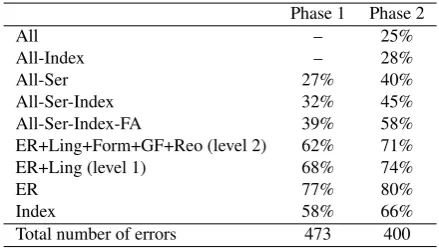
Table 3 summarizes the agreement between the two an-notators in both phases. There is a consistently higher agreement in phase 2, when guidelines were used, com-pared to phase 1. The gap between the phases is larger when more complex annotations were used than for sim-pler annotation schemes. The classification into ade-quacy/fluency and for seriousness was difficult, as shown by the big gap between the level of details that included and excluded this. The gap of 6–9 percentage points in the agreement between level 1 and ER, shows that the sub-classification for incorrect words into linguistic categories, are not unproblematic for the annotators. Adding the fur-ther categories used at level 2, led to a furfur-ther reduction of agreement. It can be noted that the agreement at level 2 in phase 2 is higher than for level 1 in phase 1.
4.2. Category confusion
We further investigated which types of distinctions between error types that were easy or hard to make, by analysing
Phase 1 Phase 2
All – 25%
All-Index – 28%
All-Ser 27% 40%
All-Ser-Index 32% 45% All-Ser-Index-FA 39% 58% ER+Ling+Form+GF+Reo (level 2) 62% 71% ER+Ling (level 1) 68% 74%
ER 77% 80%
Index 58% 66%
Total number of errors 473 400
Table 3: Inter-annotator agreement in the two annotation phases. Percentage of marked errors that both annotators agreed on, at different levels of annotation (labels refer to those in Table 2)
both the errors that the annotators agreed on, and those which they disagreed on. All the data in this subsection is based on phase 2, where we used guidelines.
Confusion matrices for Level 2 errors, excluding distinc-tions between word order, are shown in Table 4, for the errors for which the annotators marked the same indices. For a large majority of errors the annotators either agree on the classification, 266 cases, or the error is only identified by one annotator, 287 cases.
Eco Egr Mco Mgr O Wfw Wfo Wor Wse Wst Wsx Eco 2
Egr 1 5
Mco – – 10
Mgr – – 3 7
O – – – – 17
Wfw – – – – – 14
Wfo – – – – – – 93
Wor – – – 1 – 1 1 61
Wse – – – – 3 – 4 – 25
Wst – – – – 1 – 2 – 2 2
Wsx – 1 – – 1 2 4 1 16 – 30
None 6 6 36 22 20 – 42 16 65 31 43
Table 4: Confusion matrix for the categories at Level 2, excluding word order subclassifications. The abbreviations of category names, refer to the categories in Table 7.
Eco Egr Mco Mgr O Wfw Wfo Wor Wse Wst Wsx Tot Same index 2 5 10 7 17 14 93 61 25 2 30 266 Different index 2 5 22 11 21 14 102 62 40 5 38 322
Table 5: Number of errors for which the annotators agree when the index of the error is taken into account, and when it is not.
choice and missing or extra words is “especially difficult”. This is not the case in our evaluation where there is no con-fusion between Wrong sense, which roughly corresponds to incorrect lexical choice, and Missing or Extra words.
The fact that there are a large number of errors only iden-tified by one annotator can to some extent be explained by the fact that the annotators could have marked different in-dices. Table 5 shows a comparison of the errors both an-notators agreed on when we also count matches with dif-ferent indices. The number of errors the annotators agreed on increases by over 20% by allowing agreement when the indices do not match. The change is different for different categories, however. For extra words, foreign words and orthographical errors there is hardly any difference, which means it was easy to identify on which words the error occured. For Missing content words and Wrong style er-rors the indices are mis-matching in more than half of the occurences. In this case our findings are consistent with the discussion in Popovi´c and Burchardt (2011), who also found it hard to decide which words that are part of a re-ordering, even though this is not the most problematic cat-egory in our study. We think it is important to add better guidelines for the placement of indices for the problematic categories.
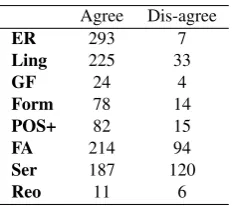
We also wanted to investigate the difficulty of the dif-ferent distinctions shown in Table 2 that were made in the error taxonomy. Table 6 shows a summary of how many times the annotators agreed and disagreed for each type of distinction on the errors for which they had marked the same indices. There are some errors for all types of dis-tinctions, but the most problematic distinctions were for adequacy/fluency and seriousness. For the 94 errors for classification between fluency and adequacy, most of them, 76.6% confused either adequacy or fluency with the both classification; it was relatively rare that adequacy and flu-ency were confused, 9.6%. For seriousness there were no
Agree Dis-agree
ER 293 7
Ling 225 33
GF 24 4
Form 78 14
POS+ 82 15
FA 214 94
Ser 187 120
Reo 11 6
Table 6: Number of times that the annotators agreed and dis-agreed on a classification for a subcategory (labels refer to those in Table 2)
explicit guidelines, and thus the annotators were not espe-cially consistent. In only 6.7% of these errors were the dif-ference more than one step on the 4-step scale, however. For the other categories, the errors were mostly spread out between categories, and there were no clear patterns. The only cases where a specific mismatch stood out was for the linguistic categories, where the distinction between syntax and sense was most common, with 48.5% of the instances.
4.3. Error profiles
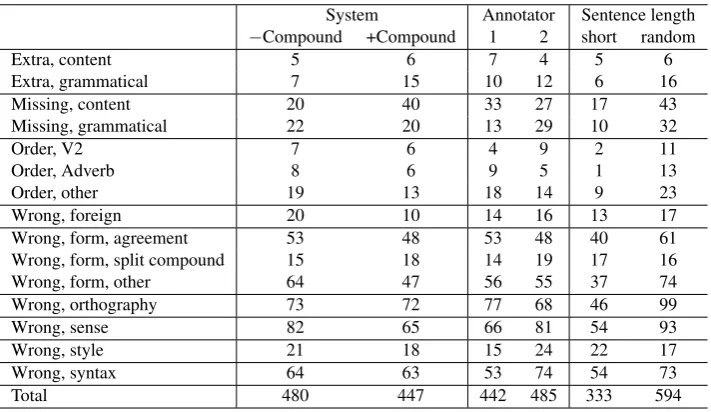
We also wanted to see if we could say anything about the error profiles of the two different systems, even though the inter-annotator agreement was relatively low. In these anal-yses we used details at level 1 and 2, see Table 3. In Table 7 we show the error profiles from phase 2, for comparisons between translation systems, annotators and sentence sets. To investigate whether the error profiles were significantly different we applied chi-square tests to each pair of profiles in both phases; the critical values for these tests are shown in Table 8.
System Annotator Sentence length
−Compound +Compound 1 2 short random
Extra, content 5 6 7 4 5 6
Extra, grammatical 7 15 10 12 6 16
Missing, content 20 40 33 27 17 43
Missing, grammatical 22 20 13 29 10 32
Order, V2 7 6 4 9 2 11
Order, Adverb 8 6 9 5 1 13
Order, other 19 13 18 14 9 23
Wrong, foreign 20 10 14 16 13 17
Wrong, form, agreement 53 48 53 48 40 61 Wrong, form, split compound 15 18 14 19 17 16 Wrong, form, other 64 47 56 55 37 74 Wrong, orthography 73 72 77 68 46 99
Wrong, sense 82 65 66 81 54 93
Wrong, style 21 18 15 24 22 17
Wrong, syntax 64 63 53 74 54 73
Total 480 447 442 485 333 594
Table 7: Error profiles for phase 2, level 2 annotations. Level 1 counts are available by merging counts between each pair of vertical lines.
Phase 1 Phase 2 level 1 level 2 level 1 level 2 System, A1+A2 .27 .28 .12 .43 System, A1 .64 .59 .17 .29 System, A2 .0005 .0005 .0005 .0005
Annotator .0005 .005 .54 .07 Sentence length .03 .04 .0004 .01
Table 8: Chi-square critical values for the chance of error profiles being different. Significant differences at the 5%-level are marked with bold text.
the two translation systems is always insignificant for an-notator 1 and when the two anan-notators are grouped. For annotator 2, on the other hand, the two systems are signif-icantly different, showing that there is an annotator effect. There are some interesting overall differences in the error profiles, for instance the −Compound system has double the amount of untranslated words as the +Compound sys-tem, and many more instances of the category Wrong. It also has more errors in total, and while this difference is not significant, it is still substantial,p= 0.08on a binomial test.
The difference between short and random sentences are always significant, which tells us that the errors on short sentences are not representative for the errors on a standard data set. The difference between the annotators is signifi-cant in phase 1, but insignifisignifi-cant in phase 2, again showing the need of guidelines for annotation. In phase 2, the two annotators were more in agreement at level 1, using fewer error categories, than at the more detailed level 2, where it is close to the 5%-level of significance.
5.
Conclusion
We have performed a MT error analysis study aimed at in-vestigating the inter-annotator agreement of the task and the statistical significance of the resulting error profiles of sys-tems. We have shown that it is possible to get a reasonable
inter-annotator agreement either when using a simple error taxonomy, or when using a more detailed taxonomy and a set of guidelines for the annotators. The use of guidelines in phase 2 improved the error analyses compared to phase 1. Our study thus confirmed the findings of Bayerl and Paul (2011) that inter-annotator agreement is increased for ty-pologies with fewer categories and when more training is received, in our case the use of guidelines.
There were still differences in the significance of error profiles for the two annotators, however. We think that it is important that agreement is further improved by mea-sures such as more joint discussion of examples and more detailed guidelines. With such measures we believe that the rates now obtained, 80% for the top level categories, and 74% with added linguistic sub-classification can be im-proved substantially.
We have also found that differences in error categoriza-tion are often caused by different views on how the error should minimally be corrected. This speaks in favour of developing guidelines in terms of minimal corrections and, perhaps also, explicitly storing the intended target hypoth-esis, as has been done in connection with learner corpora (L¨udeling, 2011).
We have also shown that sets of short sentences can yield different results than randomly chosen sets. This was a rather disappointing result, but one which we think is sig-nificant. We thus must be careful about drawing conclu-sions on sets of short sentences, which are easier to anno-tate.
While the current data do not reveal consistent significant qualitative differences between the two systems, the error profiles have some definite tendencies, which can be tested further by taking more data into account, and focusing the annotation on the relevant categories.
6.
References
Eleftherios Avramidis and Philipp Koehn. 2008. Enrich-ing morphologically poor languages for statistical ma-chine translation. In Proceedings of ACL, pages 763– 770, Columbus, Ohio, USA.
Petra Saskia Bayerl and Karsten Ingmar Paul. 2011. What determines inter-coder agreement in manual annota-tions? A meta-analytic investigation. Computational Linguistics, 37(4):727–752.
Chris Callison-Burch, Cameron Fordyce, Philipp Koehn, Christof Monz, and Josh Schroeder. 2007. (Meta-) eval-uation of machine translation. InProceedings of the Sec-ond Workshop on Statistical Machine Translation, pages 136–158, Prague, Czech Republic.
Debbie Elliott, Anthony Hartley, and Eric Atwell. 2004. A fluency error categorization scheme to guide auto-mated machine translation evaluation. InProceedings of AMTA, pages 64–73, Washington, DC, USA.
Mireia Farr´us, Marta R. Costa-juss`a, Jos´e B. Mari˜no, and Jos´e A. R. Fonollosa. 2010. Linguistic-based evaluation criteria to identify statistical machine translation errors. In Proceedings of EAMT, pages 52–57, Saint Rapha¨el, France.
Mary Flanagan. 1994. Error classification for MT evalua-tion. InProceedings of AMTA, pages 65–72, Columbia, Maryland, USA.
Philipp Koehn, Hieu Hoang, Alexandra Birch, Chris Callison-Burch, Marcello Federico, Nicola Bertoldi, Brooke Cowan, Wade Shen, Christine Moran, Richard Zens, Chris Dyer, Ondrej Bojar, Alexandra Constantin, and Evan Herbst. 2007. Moses: Open source toolkit for statistical machine translation. In Proceedings of ACL, demonstration session, pages 177–180, Prague, Czech Republic.
Philipp Koehn. 2005. Europarl: A parallel corpus for sta-tistical machine translation. InProceedings of MT Sum-mit X, pages 79–86, Phuket, Thailand.
Anke L¨udeling. 2011. Corpora in linguistics: Sampling and annotations. In Karl Grandin, editor, Going Digi-tal, Evolutionary and Revolutionary Aspects of Digitiza-tion, Nobel Symposium 147, pages 220–243. The Nobel Foundation.
Kishore Papineni, Salim Roukos, Todd Ward, and Wei-Jing Zhu. 2002. BLEU: A method for automatic evaluation of machine translation. In Proceedings of ACL, pages 311–318, Philadelphia, Pennsylvania, USA.
Maja Popovi´c and Aljoscha Burchardt. 2011. From human to automatic error classification for machine translation output. InProceedings of EAMT, pages 265–272, Leu-ven, Belgium.
Stefan Riezler and John T. Maxwell. 2005. On some pit-falls in automatic evaluation and significance testing for MT. In Proceedings of the Workshop on Intrinsic and Extrinsic Evaluation Measures for MT and/or Summa-rization at ACL’05, pages 57–64, Ann Arbor, Michigan, USA.
Alina Secar˘a. 2005. Translation evaluation – a state of the art survey. InProceedings of the eCoLoRe/MeLLANGE Workshop, pages 39–44, Leeds, UK.
Matthew Snover, Bonnie Dorr, Richard Schwartz, Linnea Micciulla, and John Makhoul. 2006. A study of trans-lation edit rate with targeted human notation. In Pro-ceedings of AMTA, pages 223–231, Cambridge, Mas-sachusetts, USA.
Sara Stymne and Maria Holmqvist. 2008. Processing of Swedish compounds for phrase-based statistical machine translation. In Proceedings of EAMT, pages 180–189, Hamburg, Germany.
Sara Stymne. 2011. Blast: A tool for error analysis of ma-chine translation output. InProceedings of ACL, demon-stration session, Portland, Oregon, USA.