Available Online atwww.ijcsmc.com
International Journal of Computer Science and Mobile Computing
A Monthly Journal of Computer Science and Information Technology
ISSN 2320–088X
IMPACT FACTOR: 5.258
IJCSMC, Vol. 5, Issue. 6, June 2016, pg.288 – 295
Efficient Transmission of Traffic in Wireless
Access Network Using Orthogonal Frequency
Division Multiple Access Relay Networks
Shraddha Bangade
1, Leena H. Patil
2, Uma K. Thakur
31
M-Tech Student, Department of CSE, PIET, Nagpur University, Nagpur, Maharashtra, India
2
Assistant Professor, Department of CSE, PIET, Nagpur University, Nagpur, Maharashtra, India
3
Assistant Professor, Department of CSE, PIET, Nagpur University, Nagpur, Maharashtra, India
1
[email protected];2 [email protected]; 3 [email protected]
ABSTRACT: With the next-generation wireless network moving towards smaller cells, two-hop orthogonal frequency division multiple accesses (OFDMA) relay networks have become a mandatory component in the 4G networks. While unicast flows have received reasonable attention in two-hop OFDMA relay networks, but not much has been shed on the design of efficient scheduling algorithm for multicast flows. In this paper, we show that while relay cooperation is critical for improving the multicast flows, it should be carefully balanced to multiplex multicast sessions and hence maximize aggregate multicast performance. Also highlight strategies that carefully group relays for cooperation. Then solve the multicast scheduling problem under two models. Evaluation of proposed method reveals the efficiency of scheduling algorithm and significant benefits obtained from the multicast strategy.
1. INTRODUCTION
The next-generation wireless networks moving towards micro cells for providing higher data rates, there is revived
interest in multi-hop wireless networks from the sight of integrating them with cellular networks. With a smaller in
cell size, relay stations (RS) are now needed to provide extended coverage. In this work, two-hop relay enabled
wireless network have become a mandatory component in 4G networks (3GPP LTE-Adv).
The design of efficient scheduling algorithm forms a very important component of MBMS and forms the focus of
this paper. Multicasting in two-hop relay enabled wireless networks is significantly different from the conventional
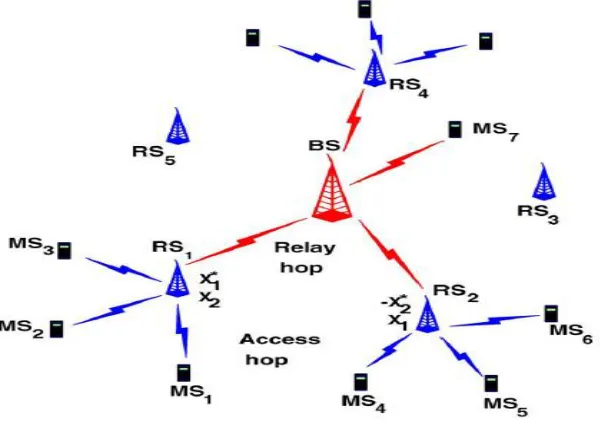
cellular multicast: The broadcast advantage of multicast data is significantly reduce on access (second) hop which is
shown in [fig.1], where they become similar to multiple unicast transmissions from multiple relay station (RS) to
mobile station (MS), thereby requiring more transmission resources. On the other hand, relay cooperation
mechanism allow multiple relay station (RS) to transmit the multicast data on the same transmission channel. This
helps to maintain the broadcast nature of traffic on access hop, making cooperation a critical component in
enhancing the multicast performance.
Figure 1: System model
2. RELATED WORK
Several work focus on to secure multi-hop routing in wireless sensor networks against attackers exploiting the reply
of routing information, we propose [1] TARF, a trust aware routing framework for wireless sensor networks. TARF
significantly reduce the negative impact from these intruders and it also energy-efficient with overhead.
between the physical layer and the media access control (MAC) layer and to balance the efficiency and fairness of
wireless resource allocation. We formulate the cross-layer optimization problem as one that maximizes the average
utility of all active users subject to certain conditions, which are determined by adaptive resource allocation
schemes. We present necessary and sufficient conditions for utility-based optimal subcarrier assignment and power
allocation and discuss the convergence properties of optimization.
In distributed dynamic spectrum protocol [3], ad-hoc D2D (device-to-device) users opportunistically access the
spectrum actively in use by cellular users. Interference management is major part in designing these schemes as it is
dangerous that licensed users maintain their quality of service. Then network information is dispersed by route
discovery packets in a random access manner to help establish either a single-hop or multi-ho route between two
D2D users.
Cooperative networks with multi-node amplify-and-forward (AF) full-duplex relays (FDRs) are proposed. In
particular [4], researchers propose a new concept of transmission protocol to achieve the spatial diversity in a
distributed manner. In this paper, we propose delayed FDRs prepared with two transmit and receive side antennas.
3. PROPOSED SYSTEM
Execution of the proposed solutions reveals the efficiency of scheduling algorithms as well as the significant
benefits obtained from the multicast strategy that addresses the difference between cooperation gain and session
multiplexing. The advantage of proposed system is that there is multicast scheduling and multiuser diversity.
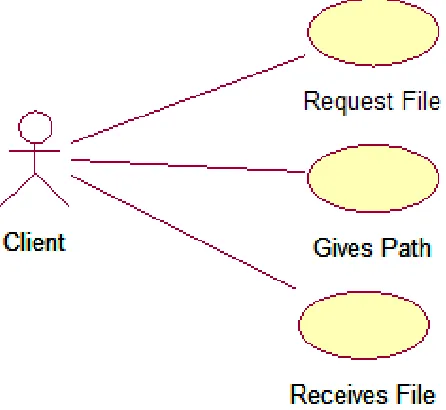
Here user will select one file to send it to the corresponding destination which is shown in fig.2. Before send it to the
destination we need server should be start and create a folder where you want to download the files which is shown
in fig.3. And we need to split the file into number of part before sent it to.
Figure 3: Use case diagram for server
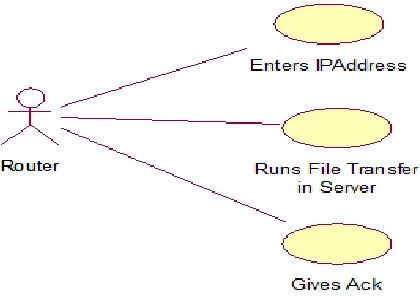
Here file will be downloaded on the corresponded location maintain by the user due to we split the file into number
of packet it will make less Burdon on the server. Here we use router to runs the file transfer in server and gives
acknowledge which is shown in fig.4.
Figure 4: Use case diagram for router
4. IMPLEMENTATION
Implementation is the most crucial stage in achieving a successful system and giving the user’s confidence that the
new system is workable and effective. Implementation of a modified application to replace an existing one, this type
of conversation is relatively easy to handle, provide there are no major changes in the system. Each program is
tested individually at the time of development using the data and has verified that this program linked together in the
way specified in the programs specification, the computer system and its environment is tested to the satisfaction of
server machine which is accessible to the entire user and the server is to be connected to a network. The final stage
is to document the entire system which provides components and the operating procedures of the system.
Implementation is the stage of the project when the theoretical design is turned out into a working system. The
implementation stage involves careful planning, investigation of the existing system and it’s constraints on
implementation, designing of methods to achieve changeover and evaluation of changeover methods. The important
factor that should be considered here is that the conversion should not disrupt the functioning of the organization.
Here itself we use socket programming as most. For that purpose we use a socket listener class which will listen the
request comes from the client to make communication in between. Before sending the request to the server we
stream the data by using a stream function. After that we need to break the data into number of part by using a split
function. After that split data need to send to the corresponding.
At the end point we need to implement a buffer which needs to be collecting the split packet in a list having address
field and data field. Value field store the data and address field store the address of next split. If one split in the order we don’t get means some negative acknowledge signal need to send. For that purpose once again we need to call
socket listener class and create object for that class and send the request in a form of stream. And client need to
resend that corresponding packet once again .This process is repeated process for that purpose we need some loop.
5. EXPERIMENTAL RESULTS
1. Client Registration: 2. Client Login:
3
. Server login page: 4. After server login save files:5.
After Select receiving path: 6. Selects file to open:
7. After selecting file: 8. Router login:
9. Select one router: 10. Transfer the file:
13. Click on Analysis button: 14. Graphical Reorientation:
6. CONCLUSION
The recent rapid growth in research, design and manufacture of wireless network has been largely initiated by the
demand for wireless system. Users of wireless applications now depend on technologies that provide real time high
data rate transmission. If technologies are meet the requirements and expectation of users, then the design objective
is high quality of service.
In this paper, a method to get better data rate over multiple channels for reliable communication system is proposed.
We designed efficient scheduling algorithm to address the difference and maximize aggregate multicast flow and
also show multicast retransmissions.
REFERENCES
1. G. Zhan, W. Shi, and J. Deng, “Tarf: A trust-aware routing framework for wireless sensor
networks,” in Proceeding of the 7thEuropean Conference on Wireless Sensor Networks (EWSN’10),
2010.
2. T. Zahariadis, H. Leligou, P. Karkazis, P. Trakadas, I. Papaefstathiou, C. Vangelatos, and L. Besson,
“Design and implementation of a trust-aware routing protocol for large WSNs,” International
Journal of Network Security & Its Applications (IJNSA), vol. 2, no. 3, Jul. 2011
3. B. Kaufman, J. Lilleberg, B. Aazhang, “Spectrum sharing scheme between cellular users and ad-hoc
device-to-device users”. IEEE Transaction on Wireless Communication. 12(3), 1038–1049 (2013).
4. Jae-Shin Han, Jong-Seob, Sungho Jeon, and Jong-Soo Seo “Full-Duplex Multiple Relays: A High
Data Rate Cooperative Communications over Rayleigh Fading Channels”, IEEE Transaction on
Wireless Communication (June 2013).
5. P. Li, S. Guo, W. Zhuang, B. Ye, “On efficient resource allocation for cognitive and cooperative
6. T.-C. Shih, C.-C. Kao, S.-R. Yang,” A cooperative MAC protocol in multi-channel wireless ad-hoc
networks”, in Proceeding Wireless Communications and Mobile Computing Conference (IWCMC),
7th International, pp. 1831–1836, 2011.
7. M. Andrews and L. Zhang, “Scheduling algorithms for multi-carrier wireless data systems,” in
Proceeding of ACM Mobile Communication, Sep. 2014, pp. 3–14.
8. Peng Liu and Andreas Springer “Impact of Mobile Antenna Mismatch on Receive Antenna
Diversity in Frequency-Flat Rayleigh Fading Channels” in IEEE Transaction on Wireless
Communication. (2013).
9. Jatin M. Chakravarti and Y. N. Trivedi “Performance Analysis of Alamouti Transmit Diversity with
A Sub-Optimum Joint Transmit-Receive Antenna Selection Scheme”, in IEEE Transaction Wireless
Communication. (2013).
10. H. Safa, H. Artail, and D. Tabet, “A cluster-based trust-aware routing protocol for mobile ad hoc
networks,” IEEE Transaction onWireless Network., vol. 16, no. 4, pp. 969–984, 2010.
11. D.Yang, X. Fang, G. Xue, “Hera: an optimal relay assignment scheme for cooperative networks”.
IEEE J. Select. Area. Communication. 30(2), 245–253 (2012)
12. G. Song and Y. Li, “Cross-layer optimization for OFDM wireless networks-Part-I: Theoretical