Scholarship@Western
Scholarship@Western
Electronic Thesis and Dissertation Repository
2-15-2018 2:15 PM
The Addition of Alkynes to Low-Valent Silicon Compounds: A
The Addition of Alkynes to Low-Valent Silicon Compounds: A
Mechanistic Study
Mechanistic Study
Andrew T. Henry
The University of Western Ontario
Supervisor Baines, Kim M.
The University of Western Ontario Graduate Program in Chemistry
A thesis submitted in partial fulfillment of the requirements for the degree in Master of Science © Andrew T. Henry 2018
Follow this and additional works at: https://ir.lib.uwo.ca/etd
Part of the Inorganic Chemistry Commons
Recommended Citation Recommended Citation
Henry, Andrew T., "The Addition of Alkynes to Low-Valent Silicon Compounds: A Mechanistic Study" (2018). Electronic Thesis and Dissertation Repository. 5202.
https://ir.lib.uwo.ca/etd/5202
This Dissertation/Thesis is brought to you for free and open access by Scholarship@Western. It has been accepted for inclusion in Electronic Thesis and Dissertation Repository by an authorized administrator of
i
Abstract
The mechanism for the addition of alkynes to low-valent silicon compounds was
investigated in this thesis using a cyclopropyl alkyne mechanistic probe 1.31
((2-ethynyl-3-methoxy-1-methylcyclopropyl)benzene). The addition of alkyne 1.31 to the
asymmetrically-substituted disilene 1.37 (Tip2Si=SiTipPh) was investigated. The structures of the products
obtained indicate the reaction proceeds through a stepwise mechanism with a biradical
intermediate and the dipole moment of the disilene bond was not sufficient to alter the
reaction mechanism.
The addition of alkyne 1.31 to the NHC-stabilized silylene 1.38 (tBu3Si(H)Si←NHC)
was also investigated. The structure of the product formed in the reaction lead to two
conclusions: that silylene 1.38 acts as a nucleophile in the reaction with alkyne 1.31, and the
cyclopropyl ring of alkyne 1.31 regioselectively opens toward the phenyl substituent in the
presence of an α-anion.
Keywords: low-valent, silicon, disilene, silylene, alkyne, cycloaddition, mechanistic probe,
ii
Acknowledgments
First and foremost, big thanks to my supervisor, Dr. Kim Baines. She has provided guidance
throughout my time in her research group. Her knowledge has helped me overcome several
obstacles in my research project. She has also provided me various skills to become a better
researcher. She always pushed me to “see the big picture” with my research and helped me
regain confidence when my projects were not working out. Her numerous edits to my thesis
were done in a manner not only to correct my work but have me learn to properly
communicate my thoughts in my writing. I can’t wait to continue my time in your research
group for my Ph.D.
Secondly, I would like to thank Jeremy, Mike, Bahar, and Nada who mentored me
during the course of my thesis. You always listened to my stupid questions and provided
guidance in my research when I needed it. You provided an outlet to discuss our chemistry
and I learned so much from you guys. Next, I need to thank the remaining members, Sarah
and Maissa, aka the “Lit Squad”. You, along with the undergrads (Robert, Curtis and
Courtney), really connected the Baines group together. From reading our horoscopes in the
Tim’s line, to the Sporcle quizzes during our lunch breaks, to all the celebrations in the
office, you guys continue to trigger me bring a smile to my face. I look forward to continuing
my chemistry journey with you guys in May.
I’d also like to thank the staff at Western. There’s so many of you to thank for
keeping this department running. Special thanks go to Mat Willans and Doug Hairsine for
iii
Finally, thanks to all the friends I’ve made at Western over my time here. All the
parties and times at the grad club have been a blast. Special shout outs to my lunch “support
group”, Hendrick Chan and Scott Hendrix (and James, Cam, Ben, and Jonathan on occasion)
who provided a space to vent about any problems, whether it was chemistry related or not.
iv
Table of Contents
Abstract ... i
Acknowledgments... ii
Table of Contents ... iv
List of Tables ... vi
List of Figures ... vii
List of Schemes ... ix
List of Charts... xiii
List of Appendices ... xiv
List of Abbreviations ... xv
Chapter 1 ... 1
1 General Introduction ... 1
1.1 History of Alkyne Cycloaddition to Disilenes and Silylenes ... 1
1.2 Applications of Alkyne Cycloaddition Reactions in Disilene and Silylene Chemistry ... 7
1.3 Mechanistic Overview ... 11
1.4 Project Overview ... 20
1.5 References ... 23
Chapter 2 ... 28
2 Investigation into the Mechanism of the Addition of a Cyclopropyl Alkyne to an Asymmetrical Disilene ... 28
2.1 Introduction ... 28
2.2 Results and Discussion ... 33
2.2.1 Structure Elucidation ... 33
2.2.2 Mechanistic Insights ... 54
v
2.4 Experimental ... 60
2.4.1 General Procedure ... 60
2.4.2 Addition of Probe 1.31 to Asymmetric Disilene 1.37 ... 60
2.5 References ... 68
Chapter 3 ... 70
3 Investigation into the Mechanism of the Addition Alkynes to an NHC-Stabilized Silylene ... 70
3.1 Introduction ... 70
3.2 Results and Discussion ... 79
3.2.1 Structure Elucidation ... 79
3.2.2 Mechanistic Insights ... 86
3.3 Conclusions ... 91
3.4 Experimental ... 92
3.4.1 General Procedure ... 92
3.4.2 Addition of Alkyne 1.31 to Silylene 1.38 ... 93
3.5 References ... 95
Chapter 4 ... 98
4 Conclusions and Future Work ... 98
4.1 Summary and Conclusions ... 98
4.2 Future Work ... 103
4.3 References ... 105
Appendices ... 106
vi
List of Tables
Table 1.1: Summary of mechanistic pathways of the reactions between (di)tetrelenes with
alkyne 1.31. ... 17
Table 2.1: 1H NMR and 13C NMR chemical shifts of 2.5, 2.6, 2.10, and 2.11. ... 35
Table 2.2: 1H NMR and 13C NMR chemical shifts of 2.7, 2.12, and 2.13. ... 48
Table 2.3: 3JSi-H coupling constants for known disilacyclobutene compounds ... 52
Table 2.4: Literature reported nucleophile-specific parameters for various alkynes and NHC compounds. ... 56
Table 2.5: Summary of Structural Parameters for 2.10. ... 63
Table 3.1: 13C-1H HMBC correlations utilized in elucidating the core structure of 3.20. ... 83
vii
List of Figures
Figure 1.1: The two different orientations of orbital overlap between silylene and the
π-orbitals of an alkyne 19
Figure 2.1: a) 1H NMR spectrum (600 MHz, C6D6) of 2.10; b) Expansion from 6.70 – 7.12
ppm; c) Expansion from 3.8-5.0 ppm. ... 36
Figure 2.2: Expansion of the 13C-1H gHMBC NMR spectrum of 2.10 (600 MHz, C6D6) with 1H ranges of: a) 4.40-5.00 ppm; b) 3.85-4.75 ppm; c) 4.85-5.05 ppm; d) 2.12-2.26 ppm. .... 37
Figure 2.3: Expansion of the 29Si-1H gHMBC NMR spectrum of 2.10 (600 MHz, C6D6). The
signals at -32 and -12 ppm in the 29Si dimension are noted as Si(1) and Si(2) respectively. . 39
Figure 2.4: Ellipsoid plot of 2.10 showing naming and numbering scheme. Ellipsoids are at
the 50% probability level, all ligand-based hydrogen atoms and Tip groups (except the i
-carbon) were omitted for clarity. Selected bond lengths (Å) and angles (°): Si1-Si2 =
2.4795(10), C4-C5 = 1.345(4), C3-C13 = 1.340(4), Si1-Si2-C5 = 97.21(8), Si2-C5-C4 =
136.4(2), C5-C4-C3 = 129.9(3), C4-C3-C2 = 120.8(2), C3-C2-C1 = 115.1(2), C2-C1-Si1 =
117.05(16), C1-Si1-Si2 = 102.07(7). ... 41
Figure 2.5: a) 1H NMR spectrum of 2.11 (600 MHz, C6D6); b) Expansion from 6.69 – 6.71
ppm; c) Expansion from 3.6 – 4.1 ppm; d) Expansion from 1.30 – 1.35 ppm. ... 42
Figure 2.6: Expansion of the 13C-1H gHMBC NMR spectrum of 2.11 (600 MHz, C6D6) with 1H ranges of: a) 3.00-4.10 ppm; b) 3.60-3.80 ppm (13C range of 17.5-18.0 ppm); c) 3.60-3.80
ppm (13C range of 218.0-218.6 ppm); ... 43
Figure 2.7: Expansion of the 29Si-1H gHMBC NMR spectrum of 2.11 (600 MHz, C6D6). The
signals at -31 and -28 ppm in the 29Si dimension are noted as Si(1) and Si(2), respectively. 45
Figure 2.8: a) 1H NMR spectrum of 2.12 (600 MHz, C6D6); b) Expansion from 3.56 – 3.64
viii
Figure 2.9: Expansion of the 13C-1H gHMBC NMR spectrum of 2.12 (600 MHz, C
6D6) with 1H ranges of: a) 7.38-7.50 ppm (13C range of 36.5-37.5 ppm); b) 1.17-1.31 ppm (13C range of
36.5-37.5 ppm); c) 1.0-7.5 ppm (13C range of 176.0-178.0 ppm); ... 49
Figure 2.10: Expansion of the 29Si-1H gHMBC NMR spectrum of 2.12 (600 MHz, C6D6).
The signals at -16 and -12 ppm in the 29Si dimension are noted as Si(1) and Si(2),
respectively. ... 50
Figure 3.1: 1H NMR spectrum of 3.20 (C6D6, 600 MHz). Expansions from a) 1.9-6.9 ppm b)
5.31-5.43 ppm c) 2.98-3.06 ppm d) 2.39-2.45 ppm e) 6.75-6.89 ppm. ... 80
Figure 3.2: Expansion of the 29Si-1H gHMBC NMR spectrum of 3.20 (600 MHz, C6D6) with 1H ranges of: a) 5.25-5.60 ppm; b) 2.00-3.40 ppm; c) 6.65-6.90 ppm; d) 0.8-1.4 ppm. ... 81
ix
List of Schemes
Scheme 1.1: General reactions of trapping agents with a transient disilene and the observed
products ... 2
Scheme 1.2: Reaction of transient disilene 1.2 with diphenylacetylene and phenyltrimethylsilylacetylene. ... 2
Scheme 1.3: Addition of alkynes to tetramesityldisilene 1.4. ... 3
Scheme 1.4: Addition of phenylacetylene to disilene 1.5. ... 3
Scheme 1.5: Products observed in the addition of acetylenes to transient silylenes. ... 4
Scheme 1.6: Formation of the transient silylene 1.6 and reaction with diphenylacetylene and 3,3,6,6-tetramethyl-1-thia-4-cycloheptyne. ... 4
Scheme 1.7: Thermolysis of 1.8 to give 1.9 and 1.10. ... 5
Scheme 1.8: Thermolysis of 1.11 yielding disilacyclobutenes 1.12 and siloles 1.13 and 1.14. 5 Scheme 1.9: Addition of phenylacetylene and diphenylacetylene to silylene 1.15. ... 6
Scheme 1.10: Cycloaddition of NHC-stabilized silylene 1.17 with bis(dimethylamino)acetylene and bis(diethylamino)acetylene to form silole 1.16. ... 7
Scheme 1.11: Formation of the surface adduct between the Si(100) 2x1 surface and buta-1,3-diyne ... 8
Scheme 1.12: Oligomerization by cycloaddition between bifunctional monomers containing disilene and alkyne moieties. ... 9
Scheme 1.13: Nitrile insertion into a silacyclopropene. ... 9
x
Scheme 1.15: Stepwise addition of diphenylacetylene to 1.22. ... 12
Scheme 1.16: Reaction of disilene 1.25 with phenylacetylene and ethoxyacetylene. ... 13
Scheme 1.17: Reaction of disilene 1.4 with various alkynes. ... 14
Scheme 1.18: Stepwise addition of various polar acetylenes forming a zwitterionic
intermediate... 14
Scheme 1.19: Reactivity of 1.31, under radical and cationic conditions. ... 15
Scheme 1.20: Formation of disilacyclobutene 1.33 and disilacyclohepta-3,4-diene 1.32 from
the reaction of disilenes with alkyne 1.31. ... 16
Scheme 1.21: Potential pathways for the formation of 1,4-disilahexadiene 1.35... 18
Scheme 1.22: Generation of transient silylene 1.36 and subsequent addition of various
acetylenes. ... 20
Scheme 1.23: Addition of phenylacetylene to 1.5 and 1.37. Chapter 2 examines the addition
of 1.31 to 1.37. ... 21
Scheme 1.24: Addition of diphenylacetylene to silylene 1.38. Chapter 3 examines the
addition of 1.31 to 1.38. ... 22
Scheme 2.1: Polymerization of the linker bridged tetrasiladiene 1.18 with 1,4-diethynyl
benzene. ... 28
Scheme 2.2: Cycloaddition of phenylacetylene to asymmetrically-substituted disilenes 1.37
and 1.5, and the symmetrically substituted 1.4. ... 29
Scheme 2.3: Reaction of a donor NHC with the asymmetric disilene moiety in 2.3. ... 30
Scheme 2.4: Regioselective ring opening of cyclopropyl alkyne probe 1.31 upon addition of
a radical or a cation. ... 31
xi
Scheme 2.6: Mechanism for the addition of probe 1.31 to tetramesityldisilene 1.4... 32
Scheme 2.7: The addition of alkyne 1.31 to 1.37 yielding two stereoisomers. ... 53
Scheme 2.8: The reaction of disilene 1.31 with alkyne 1.37. ... 54
Scheme 2.9: Mechanism of the reaction between cyclopropyl alkyne probe 1.31 and 1.37. . 55
Scheme 2.10: Addition of phenylacetylene and ethoxyacetylene to silene 2.16. ... 57
Scheme 2.11: Addition of phenylacetylene and ethoxyacetylene to germene 2.19. ... 58
Scheme 3.1: Synthesis of stable Lewis base-stabilized silylenes 3.3. ... 71
Scheme 3.2: Synthesis of the first NHC-stabilized silylenes 3.5 and 3.6. ... 72
Scheme 3.3: Generation of transient silylene 1.36 and subsequent addition of various acetylenes. ... 73
Scheme 3.4: Addition of diphenylacetylene to NHC-stabilized silylene 3.7. ... 73
Scheme 3.5: The reaction between bis(amino)acetylenes and silylene 3.9. ... 74
Scheme 3.6: Proposed mechanisms for the formation of 3.10. ... 74
Scheme 3.7: Reaction of phenylacetylene and diphenylacetylene with silylene 1.38. ... 75
Scheme 3.8: The favoured pathway to silole 1.39. ... 76
Scheme 3.9: Addition of phenylacetylene to silylene 3.15 and the proposed zwitterionic intermediate... 76
Scheme 3.10: Addition of an internal alkyne to silylene 3.15. ... 77
Scheme 3.11: The regioselectivity of cyclopropyl ring opening. ... 78
Scheme 3.12: The reaction of silylene 1.38 with alkyne 1.31. ... 86
xii
Scheme 3.14: Reaction of 3.25 with butyllithium. ... 89
Scheme 3.15: Mechanism for the addition of cyclopropyl probe 1.31 to tetramesityldigermene 3.28. ... 90
Scheme 3.16: Addition of methanol to a silene. ... 90
Scheme 4.1: Reaction of disilene 1.37 with 1.31. ... 99
Scheme 4.2: Mechanism of the reaction between cyclopropyl alkyne 1.31 and disilene 1.37. ... 100
Scheme 4.3: Reaction of 1.38 with 1.31. ... 101
Scheme 4.4: The proposed mechanism for the formation of 3.20. ... 102
Scheme 4.5: The proposed reactivity between the polar disilene 4.1 and alkyne 1.31. ... 104
xiii
List of Charts
Chart 1.1: 1.20, a silole that exhibits AIE. 10
Chart 2.1: Fragments of 2.10 highlighting key 1H signals in blue. ... 37
Chart 2.2: Elucidated structure for 2.10 highlighting key 1H signals in blue. ... 40
Chart 2.3: Fragments of 2.11 highlighting key 1H signals in blue and key 13C signals in red. ... 44
Chart 2.4: Elucidated structure of 2.11 highlighting key 29Si signals in green. ... 46
Chart 2.5: Elucidated structure for 2.12. ... 52
Chart 3.1: Representation of a Lewis-base stabilized silylene. ... 71
Chart 3.2: Fragment of 3.20 based on correlations in the 29Si-1H gHMBC and 1H-1H gCOSY NMR spectra. ... 82
Chart 3.3: Fragment of 3.20 with silole ring 1H and 13C chemical shifts listed... 84
Chart 3.4: The final elucidated structure for 3.20. ... 86
xiv
List of Appendices
Appendix A1.1: 13C NMR spectrum (119 MHz, C6D6) of 2.10. ... 106
Appendix A1.2: 13C NMR spectrum (119 MHz, C6D6) of 2.11. ... 106
Appendix A1.3: 13C NMR spectrum (119 MHz, C6D6) of 2.12. ... 107
Appendix A1.4: 1H NMR spectrum (600 MHz, C6D6) of 2.13. ... 107
Appendix A1.5: 13C NMR spectrum (119 MHz, C6D6) of 2.13. ... 108
xv
List of Abbreviations
° degrees
Å Ångström
AIE aggregation-induced emission
Ar Aryl group
br broad
Bu butyl
calcd calculated
Cp* 1,2,3,4,5-Pentamethylcyclopentadiene
d doublet
DCM dichloromethane
DFT density functional theory
Dip 2,6-diisopropylphenyl
ESI electrospray ionization
Et ethyl
EtOAc ethyl acetate
gCOSY correlation spectroscopy
gHMBC gradient heteronuclear multiple bond coherence
gHSQC gradient heteronuclear multiple quantum coherence
h hour
HOMO highest occupied molecular orbital
iPr Iso-propyl
LUMO lowest occupied molecular orbital
m/z mass to charge ratio
xvi
m meta
Me methyl
Mes 2,4,6-trimethylphenyl
Mes* 2,4,6-tritertbutylphenyl
mg milligram
MHz megahertz
mL millilitre
mmol millimols
NHC N-heterocyclic carbene
NMR nuclear magnetic resonance
o ortho
p para
Ph phenyl
ppm parts per million
q quartet
R organic substituent
RT room temperature
s singlet
sept septet
t triplet
tBu tert-butyl
Tbt 2,4,6-tris[bis(trimethylsilyl)methyl]phenyl
THF tetrahydrofuran
Tip 2,4,6-triisopropylphenyl
xvii
TMOP 2,4,6-trimethoxyphenyl
TOF time of flight
Chapter 1
1
General Introduction
1.1
History of Alkyne Cycloaddition to Disilenes and
Silylenes
For the past half century, the chemistry of low-valent silicon compounds has been
extensively studied.1 Specifically, disilenes and silylenes, the silicon analogues of alkenes
and carbenes respectively, have been shown to undergo many cycloaddition reactions
under ambient conditions. When disilenes and silylenes are reacted with alkynes, they
yield a complex ring system in a clean, high-yielding one pot reaction. As such, the
reactivity of low-valent silicon compounds with alkynes has been a key focus of research.
One of the common methods for providing evidence for the formation of transient
disilene and silylene species is to react the transient species with a trapping agent, a
species that reacts cleanly and in high yield with the unsaturated silicon species. While
typical trapping agents such as water,methanol, and ketones are often utilized2 (Scheme
1.1), alkynes are also commonly employed to provide indirect evidence for the transient
Scheme 1.1: General reactions of trapping agents with a transient disilene and the
observed products
For example, when the bicycle 1.1 was heated, decomposition was observed.3 One of the
decomposition products was proposed to result from oligomerization of disilene 1.2.
Upon co-pyrolysis of 1.1 with phenyltrimethylsilylacetylene or diphenylacetylene,
disilacyclobutenes 1.3 were formed (Scheme 1.2).4
Scheme 1.2: Reaction of transient disilene 1.2 with diphenylacetylene and
phenyltrimethylsilylacetylene.
With the discovery of stable, isolable disilenes5 and silylenes,6 the reaction with
these compounds. The first stable, isolable disilene, tetramesityldisilene 1.4, was reacted
with various alkynes yielding disilacyclobutenes (Scheme 1.3).7 This study confirmed
that the addition of alkynes to disilenes provides a reliable, clean route to
disilacyclobutenes under mild conditions.
Scheme 1.3: Addition of alkynes to tetramesityldisilene 1.4.
The cycloaddition of alkynes continues to be a key reaction examined upon the synthesis
of a new disilene. For example, in 2013, Scheschkewitz reported the synthesis of disilene
1.5, with three triisopropylphenyl (Tip) substituents and the novel
2,4,6-trimethoxyphenyl (TMOP) protecting group.8 One of the first reactions examined was the
reaction of 1.5 with phenylacetylene which afforded a disilacyclobutene. Interestingly,
the addition of phenylacetylene was regioselective to the less hindered silicon.
Scheme 1.4: Addition of phenylacetylene to disilene 1.5.
While disilenes typically afford a disilacyclobutene as the only product upon
Specifically, the addition of alkynes to transient silylenes afford silacyclopropenes,
disilacyclobutenes, 1,4-disila-2,5-dienes, and/or siloles (Scheme 1.5).10
Scheme 1.5: Products observed in the addition of acetylenes to transient silylenes.
For example, the transient silylene 1.6,generated by thermolysis of disilene 1.7 at
70 ºC, reacted with 1,2-diphenylacetylene or 3,3,6,6-tetramethyl-1-thia-4-cycloheptyne to
give, in both cases, a silacyclopropene (Scheme 1.6).11
Scheme 1.6: Formation of the transient silylene 1.6 and reaction with diphenylacetylene
In cases where the silacyclopropenes are not stabilized by the steric bulk of the ligands
they can react further. For example, thermolysis of silacyclopropene 1.8 at 250 ºC
afforded the dimerized 1,4-disilacyclohex-2,5-enes 1.9 and 1.10 (Scheme 1.7).12
Scheme 1.7: Thermolysis of 1.8 to give 1.9 and 1.10.
Thermolysis of 1.11 gave three products: disilacyclobutene 1.12 and two isomers of a
silole, 1.13 and 1.14 (Scheme 1.8).13 Presumably, thermal decomposition of
silacyclopropene 1.11 produces an equivalent of dimethylsilylene and
1-(dimethylphenylsilyl)propyne. The silylene then inserts into another equivalent of
silacyclopropene 1.11 to form 1.12 or insert into another equivalent of the alkyne to
afford the isomeric 1.13 and 1.14.
Scheme 1.8: Thermolysis of 1.11 yielding disilacyclobutenes 1.12 and siloles 1.13 and
While the addition of an alkyne to a silylene generates a silacyclopropene, the previous
two examples illustrate that the secondary products, disilacyclobutenes, siloles, and
1,4-disilacyclohex-2,5-enes are derived from further reactivity of the silacyclopropene.
The types of products formed upon the reaction of stable silylenes with alkynes is
less varied in comparison to the more reactive transient species, giving, in general,
silacyclopropenes. For example, Power reported that the stable silylene, 1.15, reacts with
phenylacetylene and diphenylacetylene to afford a silacyclopropene (Scheme 1.9).14
Scheme 1.9: Addition of phenylacetylene and diphenylacetylene to silylene 1.15.
Silylenes can also be stabilized by the coordination of Lewis bases. While there
are limited studies of the reactivity of Lewis base stabilized silylenes, the reaction with
alkynes does not, in general, give a silacyclopropene. Instead, a silole is the most
commonly observed product from the reaction. An example is silole 1.16 synthesized
from the reaction of bis(dimethylamino)acetylene and the diethylamino derivative with
the N-hetereocyclic carbene (NHC) stabilized silylene 1.17, as reported by Filippou
Scheme 1.10: Cycloaddition of NHC-stabilized silylene 1.17 with
bis(dimethylamino)acetylene and bis(diethylamino)acetylene to form silole 1.16.
1.2
Applications of Alkyne Cycloaddition Reactions in
Disilene and Silylene Chemistry
The cycloaddition of alkynes to disilenes and silylenes features prominently in a
variety of applications. The addition of alkynes to disilenes has been utilized to
functionalize silicon dimers on surfaces and in the synthesis of organic-inorganic silicon
hybrid polymers. Silacyclopropenes, derived from the reaction of alkynes with silylenes,
are utilized as building blocks in the synthesis of a variety of silicon-containing
heterocycles. The electronic properties of siloles make them promising components of
solar cells and other electronic devices. Herein, the applications are described.
There is much interest in the organic functionalization of silicon surfaces for
applications in electronics.16 As such, understanding the reactivity of these silicon
which are separated by trenches and react similarly to the molecular dimeric analogues.
One approach to understand the reactivity of the silicon surface dimers is to employ a
molecular disilene as a model system. Multiple studies on the functionalization of the
reconstructed surfaces have been conducted.17 For example, the addition of acetylene to
the Si(100) 2×1 surface generates a disilacyclobutene similar to the molecular system.18
Buta-1,3-diyne also reacts with the Si(100) 2×1 surface (Scheme 1.11);19 albeit through
only one alkyne unit. The remaining alkynyl group potentially enables the addition of a
secondary organic layer to the silicon surface by the reaction with the alkyne moiety.
Scheme 1.11: Formation of the surface adduct between the Si(100) 2x1 surface and
buta-1,3-diyne
The cycloaddition of alkynes to disilenes has also been utilized as the key
bond-forming reaction in the synthesis of organic-inorganic silicon hybrid polymers.20
The reaction between the bifunctional phenylene-bridged (bis)disilene 1.18 and
1,4-diethynyl benzene leads to the formation of the organic-inorganic hybrid polymer 1.19
Scheme 1.12: Oligomerization by cycloaddition between bifunctional monomers
containing disilene and alkyne moieties.
Silacyclopropenes, the product of the reaction between silylenes and alkynes,
have been shown to undergo various insertion reactions, making silacyclopropenes a
good precursor to many silicon-containing heterocycles.21 Transition metals have often
been utilized to catalyze silacyclopropene insertion reactions. For example, the
copper-catalyzed insertion of aldehydes22 or nitriles (Scheme 1.13)23 are high-yielding routes to
oxasilacyclopentenes and azasilacyclopentadienes, respectively. The former can be
converted into 1,2,4-triols, while the latter can be converted to allylic amines which are
useful building blocks for organic synthesis.24
In another example, the palladium-catalyzed insertion of alkynes into the Si-C bond of a
silacyclopropene is a high-yielding, selective route to siloles.25 Siloles, due to their
conjugated electronic structures, have been utilized as luminogenic materials. While the
photoemission of most conventional chromophores is quenched upon aggregation,
hampering their practical applications, siloles exhibit aggregation-induced emission
(AIE), fluorescing strongly in the aggregated state.26 AIE, combined with their stability
and good solubility in organic solvents, make siloles such as 1.20, interesting
photoelectronic materials (Chart 1.1).
Chart 1.1: 1.20, a silole that exhibits AIE.
Similarly, 1,4-disilacyclohex-2,5-enes, the dimers of silacyclopropenes, exhibit
cross-hyperconjugation which can be tuned to influence their optical and electronic properties
1.3
Mechanistic Overview
Given the importance of the cycloaddition of alkynes to low-valent silicon
compounds, it is critical that the mechanism of the reaction be understood. The [2πs+2πs]
cycloaddition of alkynes and alkenes is forbidden by symmetry (Scheme 1.14),28 and
thus, the facile reactivity of disilenes with alkynes is in stark contrast to their lighter
congeners.
Scheme 1.14: Illustration of the symmetry forbidden [2πs+2πs] cycloaddition of two
alkenes.
The mechanism of the addition of alkynes to disilenes has been debated since its
discovery. In 1985, Sakurai provided the first mechanistic insight into this reaction.29
Pyrolysis of the bicyclic compound 1.21, with the substituents at silicon in the trans
orientation, is known to produce the trans disilene 1.22 stereoselectively.30 The
stereochemistry of the substituents at silicon in disilacyclobutenes 1.23, derived from the
reaction with diphenylacetylene, was inferred after stereoselective oxidation to 1.24. A
layer chromatography (TLC). The same reaction was also performed with the cis isomer
of 1.21 and yielded a 38:62 ratio of trans and cis stereoisomers of 1.24, respectively,
demonstrating the reaction was stereoselective, but not stereospecific. Sakurai proposed
that the reaction proceeds by a stepwise mechanism involving a biradical intermediate
where the stereochemistry can be altered by Si-Si bond rotation or inversion of the silyl
radical center (Scheme 1.15). The stereoselectivity of the reaction suggests that the
scrambling of the stereochemistry, while competitive, is slower than ring closure forming
the disilacyclobutene ring.
Scheme 1.15: Stepwise addition of diphenylacetylene to 1.22.
A year later, West reported the addition of acetylenes to two stable disilenes,
tetramesityldisilene 1.4 and trans-l,2-di-t-butyl-l,2-dimesityldisilene 1.25.31 The latter
reacted with phenylacetylene and ethoxyacetylene, to afford both the cis and trans
disilacyclobutenes 1.26 and 1.27 in approximately equal amounts (Scheme 1.16). West
intermediate. However, unlike Sakurai’s study, the reaction did not proceed
stereoselectively. It was concluded that the lifetime of the putative biradical intermediate
is longer than that of the biradical intermediate proposed by Sakurai, allowing more time
to scramble the stereochemistry of the substituents before ring closure.
Scheme 1.16: Reaction of disilene 1.25 with phenylacetylene and ethoxyacetylene.
In the case of disilene 1.4, reaction with phenylacetylene, ethoxyacetylene,
carbomethoxyacetylene and trimethylsilylacetylene afforded the corresponding
disilacyclobutenes 1.28 (Scheme 1.17). 1-hexyne, 1-phenyl-2-trimethylsilylacetylene,
propyne, acetylene, diphenylacetylene, and 3-hexyne-2,5-dione did not react with the
Scheme 1.17: Reaction of disilene 1.4 with various alkynes.
The reactivity pattern observed led West to the conclusion that a zwitterionic
intermediate may be involved in the reaction of 1.4 with polarized alkynes. West
proposed that the alkyne reacts as the nucleophile in the reaction (Scheme 1.18). Notably
West stated: “Further studies will be needed to elucidate the mechanism of alkyne
cycloaddition to stable disilenes.”31
Scheme 1.18: Stepwise addition of various polar acetylenes forming a zwitterionic
intermediate.
Almost a decade later, the mechanism of the addition of alkynes to disilenes was
examined utilizing a mechanistic probe. The rapid ring opening reaction of cyclopropyl
carbinyl radicals has effectively been utilized to determine if a radical is present during
rearrangement must be greater than the rate constant for any other competitive process.
The incorporation of a phenyl substituent on the cyclopropyl ring increases the rate
constant for rearrangement of cyclopropyl carbinyl radicals by orders of magnitude.33
Newcomb reported a cyclopropyl probe with an alkoxy substituent present on the
cyclopropyl ring, in addition to the phenyl substituent. This cyclopropyl ring opens
regioselectively depending on whether a cation or a radical is located on the carbinyl
carbon.34 If a radical is generated adjacent to the cyclopropyl ring, the ring opens
regioselectively towards the phenyl group. However, if a cation is generated adjacent to
the cyclopropyl ring, the ring opens towards the alkoxy group. By identifying the location
of the phenyl and alkoxy substituents in the final product, the nature of the intermediate
can be determined. Based on Newcomb’s research,33,34 cyclopropyl alkyne 1.31 was
designed and synthesized.35 The cyclopropyl ring of 1.31 regioselectively opens in the
presence of a vinylic cation or radical with rate constants in the range of 1010 – 1012 s-1
(Scheme 1.19).36
Cyclopropyl alkyne 1.31 was used to study the mechanism of the addition of
alkynes to disilenes 1.437 and 1.29.38 In both cases, a disilacyclohepta-3,4-diene was
formed as well as a disilacyclobutene (Scheme 1.20). The regiochemistry of the phenyl
and methoxy substituents in 1.32 confirms that a biradical intermediate is formed along
the reaction pathway. The formation of 1.33 illustrates that ring closure of the biradical
intermediate, to give disilacyclobutenes 1.33, competes with the ring opening
rearrangement of the cyclopropyl ring.
Scheme 1.20: Formation of disilacyclobutene 1.33 and disilacyclohepta-3,4-diene 1.32
from the reaction of disilenes with alkyne 1.31.
Cyclopropyl alkyne 1.31 has been used to study the mechanism of the addition of
alkynes to a variety of (di)tetrelenes. The experimental studies have been complemented
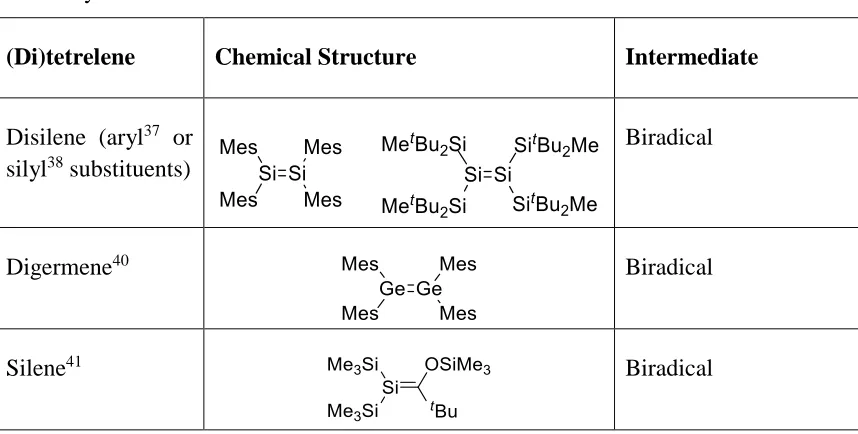
polarized silenes and germenes.39 A summary of the experimental mechanistic studies is
presented in Table 1.1.
Table 1.1: Summary of mechanistic pathways of the reactions between (di)tetrelenes
with alkyne 1.31.
(Di)tetrelene Chemical Structure Intermediate
Disilene (aryl37 or silyl38 substituents)
Biradical
Digermene40 Biradical
Silene41 Biradical
Understanding the mechanism of the cycloaddition of alkynes to silylenes is
equally as critical for the development of this area of chemistry. Silylenes exist in the
singlet ground state and have a lone pair of electrons and an empty p-orbital. As a
consequence, they can behave as either a nucleophile or an electrophile. Early
mechanistic studies were undertaken on the reactivity of transient silylenes. The reaction
of transient silylene 1.34, generated from either the reaction of dimethylchlorosilane and
sodium or thermal cleavage of the silicon-silicon bonds in polydimethylsilane, with
alkynes has been extensively studied. Multiple pathways for the formation of
which include pathways involving disilene, silacyclopropene, and disilacyclobutene
intermediates (Scheme 1.21).42
Scheme 1.21: Potential pathways for the formation of 1,4-disilahexadiene 1.35.
While the multiple ways to generate the transient silylene 1.34 and the varying
substituents on the alkynes makes it difficult to compare all the reports, the overlying
conclusion is that the transient silylene 1.34 can dimerize and then react with the alkyne
or add the alkyne to form a silacyclopropene which then undergoes further reactions.
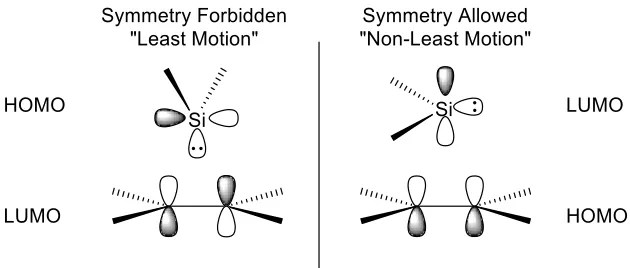
The cycloaddition of silylenes with alkynes has been studied computationally
using density functional theory methods. Two different reaction pathways were
examined: the least motion pathway where the silylene acts as a nucleophile, and the
Figure 1.1: The two different orientations of orbital overlap between silylene and the
π-orbitals of an alkyne
In the “least motion” pathway, the interaction between the lone pair of the silylene and
the LUMO of the alkyne is forbidden by symmetry, whereas, the “non-least motion”
pathway is symmetry-allowed where the filled π-orbitals of the alkyne (HOMO) can
overlap with the empty p-orbital of the silylene (LUMO). The results indicated that the
cycloaddition of alkynes to silylenes proceeds through the symmetry allowed “non-least
motion” pathway where the silylene acts as an electrophile.
As is well-recognized, the nature of the substituents can greatly influence the
reaction mechanism. The reactivity of the bis(aryl)silylene 1.36 with a variety of
Scheme 1.22: Generation of transient silylene 1.36 and subsequent addition of various
acetylenes.
A Hammett study provided insight into the philicity of silylene 1.36. The positive
reaction constant (ρ = +0.85 ± 0.21) was comparable to that of the reaction of
cycloheptatrienylidene, a nucleophilic carbene, and styrene suggesting that the silylene
acts as a nucleophile in contrast to previous studies where the silylene acts as the
electrophile. The nucleophilic character of silylene 1.36 is attributed to coordination of
the ortho-NMe2 groups with the silicon centre reducing the electrophilicity of the
silylene.
1.4
Project Overview
Scheschkewitz examined the addition of phenylacetylene to two disilenes, 1.5 and
1.37 (Scheme 1.23). In each case, disilacyclobutenes were obtained regioselectively. To
a zwitterionic intermediate during the course of the reaction because of the expected
polarization of the unsymmetrically-substituted silicon-silicon double bond. The Baines
group has previously reported that tetramesityldisilene 1.4, a tetraryl-substituted disilene,
in the reaction with alkynes proceeds through a reaction pathway involving a biradical
intermediate. Given that 1.5 and 1.37 are also tetraaryldisilenes, it is reasonable that the
mechanism of the reaction be the same. Chapter 2 describes the addition of
cyclopropylalkyne 1.31 to disilene 1.37 in an effort to determine the nature of the
reaction intermediate.
Scheme 1.23: Addition of phenylacetylene to 1.5 and 1.37. Chapter 2 examines the
addition of 1.31 to 1.37.
The coordination of Lewis bases is an effective method for the stabilization of
silylenes. While simple alkyl- and aryl-substituted silylenes react with alkynes to form a
variety of products derived from silacyclopropenes, base-stabilized silylenes typically
yield a silole upon reaction with an alkyne. For example, Inoue synthesized the
diphenylacetylene (Scheme 1.24).45 On the basis of a computational study, Inoue
proposed that the reaction proceeds through a zwitterionic intermediate where the
silylene acts as a nucleophile. In Chapter 3, the reaction of silylene 1.38 with alkyne 1.31
was investigated in an effort to determine the nature of the reaction intermediate.
Scheme 1.24: Addition of diphenylacetylene to silylene 1.38. Chapter 3 examines the
1.5
References
1. a) Okazaki, R.; West, R.; Adv. Organomet. Chem., 1996, 39, 231; b) Weidenbruch, M.;
Coord. Chem. Rev., 1994, 130, 275; c) Raabe, G.; Michl, J.; Chem. Rev., 1985, 85, 419;
d) Ottosson, H.; Steel, P. G.; Chem. Eur. J.,2006, 12, 1576.
2. a) Masamune, S.; Murakami, S.; Tobita, H.; Organometallics1983, 2, 1464; b)
Schäfer, A.; Weidenbruch, M.; J. Organomet. Chem.1985, 282, 305.
3. Roark, D. N.; Peddle, G. J. D.; J. Am. Chem. Soc., 1972, 94, 5837.
4. Sakurai, H.; Kobayashi, T.; Nakadaira, Y.; J. Org. Chem., 1978, 162, C43.
5. West, R.; Fink, M. J.; Michl, J.; Science, 1981, 214, 1343.
6. Denk, M.; Lennon, R.; Hayashi, R.; West, R.; Belyakov, A. V.; Verne, H. P.; Haaland,
A.; Wagner, M.; Metzler, N.; J. Am. Chem. Soc., 1994, 116, 2691.
7. a) De Young, D. J.; Fink, M. J.; West, R.; Main Group Met. Chem., 1987, 10, 19;
b) Fink, M. J.; De Young, D. J.; West, R.; Michl, J.; J. Am. Chem. Soc., 1983, 105, 1070.
8. Meltzer, A.; Majumdar, M.; White, A. J. P.; Huch, V.; Scheschkewitz, D.;
Organometallics, 2013, 32, 6844.
9. Iwamoto, T.; Sakurai, H.; Kira, M.; Bull. Chem. Soc. Jpn.,1998, 71, 2741.
11. Suzuki, H.; Tokitoh, N.; Okazaki, R.; Bull. Chem. Soc. Jpn.,1995, 68, 2471.
12. Ishikami, M.; Sugisawa, H.; Kumada, M.; J. Organomet. Chem.,1977, 142, C45.
13. Ishikawa, M.; Sugisawa, H.; Kumada, M.; Kawakami, H.; Yamabe, T.;
Organometallics,1983, 2, 974.
14. Lips, F.; Mansikkamaki, A.; Fettinger, J. C.; Tuononen, H. M.; Power, P. P.;
Organometallics, 2014, 33, 6253.
15. Lebedev, Y. N.; Das, U.; Chernov, O.; Schnakenburg, G.; Filippou, A. C.; Chem.
Eur. J., 2014, 20, 9280.
16. a) Duke, C. B.; Chem. Rev., 1996, 96, 1237; b) Buriak, J. M.; Chem. Rev.,2002, 102,
1271; c) Wolkow, R. A.; Annu. Rev. Phys. Chem., 1999, 50, 413.
17. a) Yates, J. T., Jr. Science, 1998, 279, 335; b) Hamers R. J.; Coulter, S. K.; Ellison,
M. D.; Hovis, J. S.; Padowitz, D. F.; Schwartz, M. P.; Acc. Chem. Res., 2000, 33, 617; c)
Bent, S. F.; Surf. Sci., 2002, 500, 879.
18. Liu, Q.; Hoffmann, R.; J. Am. Chem. Soc.,1995, 117, 4082.
19. Lu, X.; Zhu, M.; Wang, X.; Zhang, Q.; J. Phys. Chem. B,2004, 108, 4478.
20. Majumdar, M.; Bejan, I.; Huch, V.; White, A. J. P.; Whittell, G. R.; Schäfer, A.;
Manners, I.; Scheschkewitz, D.; Chem. Eur. J.,2014, 20, 9225.
22. Clark, T. B.; Woerpel, K. A.; Org. Lett.,2006, 8, 4109.
23. Anderson, L. L.; Woerpel, K. A.; Org. Lett., 2009, 11, 425.
24. a) Johannsen, M.; Jørgensen, K. A.; Chem. Rev.,1998, 98, 1698. b) Trost, B. M.;
Crawley, M. L.; Chem. Rev.,2003, 103, 2921.
25. Palmer, S. P; Woerpel, K. A.; Organometallics, 1997, 16, 4824.
26. a) Zhao, Z.; He, B.; Tang, B. Z.; Chem. Sci., 2015, 6, 5347; b) Chen, B.; Jiang, Y.;
Chen, L.; Nie, H.; He, B.; Lu, P.; Sung, H. H. Y.; Williams, I. D.; Kwok, H. S.; Qin, A.;
Zhao, Z.; Tang, B. Z.; Chem. Eur. J., 2014, 20, 1931.
27. a) Emanuelsson, R.; Denisova, A. V.; Baumgartner, J.; Ottosson, H.;
Organometallics, 2014, 33, 2997; b) Tibbelin, J.; Wallner, A.; Emnuelsson, R.;
Heijkenskjöld, F.; Rosenberg, M.; Yamazaki, K.; Nauroozi, D.; Karlsson, L.; Feifel, R.;
Pettersson, R.; Baumgartner, J.; Ott, S.; Ottosson, H.; Chem. Sci.,2014, 5, 360.
28. a) Hoffmann, R.; Woodward, R. B.; Acc. Chem. Res., 1968, 1, 17; b) Woodward, R.
B.; Hoffmann, R.; Angew. Chem. Int. Ed., 1969, 8, 781.
29. Nakadaira, Y.; Sato, R.; Sakurai, H.; Chem. Lett., 1985, 14, 643.
30. Sakurai, H.; Kobayashi, T.; Nakadaira, Y.; J. Am. Chem. Soc., 1979, 101, 487.
32. a) Cooksy, A. L.; King, H. K.; Richardson, W. H.; J. Org. Chem.,2003, 68, 9441; b)
Tanko, J. M.; Blackert, J. F.; J. Chem. Soc., Perkin Trans. 2,1996, 1775.
33. Newcomb M.; Tetrahedron, 1993, 49, 1151.
34. Le Tadic-Biadatti, M.-H.; Newcomb, M. J. Chem. Soc., Perkin Trans. 2,1996, 1467.
35. Gottschling, S. E.; Grant, T. N.; Milnes, K. K.; Jennings, M. C.; Baines, K. M.; J.
Org. Chem.,2005, 70, 2686.
36. Milnes, K. K.; Gottschling, S. E.; Baines, K. M.; Org. Biomol. Chem.,2004, 2, 3530.
37. Gottschling, S. E.; Milnes, K. K.; Jennings, M. C.; Baines, K. M.; Organometallics,
2005, 24, 3811.
38. Gottschling, S. E.; Jennings, M. C.; Baines, K. M.; Can. J. Chem., 2005, 83, 1568.
39. Pavelka, L. C.; Hanson, M. A.; Staroverov, V. N.; Baines, K. M.; Can. J. Chem.,
2015, 93, 134.
40. Hurni, K. L.; Baines, K. M.; Chem. Commun., 2011, 47, 8382.
41. a) Milnes, K. K.; Jennings, M. C.; Baines, K. M.; J. Am. Chem. Soc., 2006, 128,
2491.; b) Milnes, K. K.; Baines, K. M.; Can. J. Chem., 2009, 87, 307.
43. a) Koch, R.; Bruhn, T.; Weidenbruch, M.; Organometallics, 2004, 23, 1570; b)
Tanaka, H.; Kondo, Y.; Shoita, Y.; Naka, A.; Ishikawa, M.; Yoshizawa, K.;
Organometallics, 2011, 30, 3160.
44. Belzner, J.; Dehnert, U.; Ihmels, H.; Tetrahedron, 2001, 57, 511.
Chapter 2
2
Investigation into the Mechanism of the Addition of a
Cyclopropyl Alkyne to an Asymmetrical Disilene
2.1
Introduction
The chemistry of disilenes has been studied extensively over the past 40 years.
The cycloaddition reactions with disilenes have remained a focus of research due to the
ability to form complex ring structures cleanly and rapidly.1 The cycloaddition of alkynes
to disilenes has been shown to generate a disilacyclobutene. Due to the favourable
characteristics of the reaction, it has been used in a variety of applications. For example,
an organosilicon polymer was synthesized where the cycloaddition between an
phenylene-bridged bis(disilene) and a phenylene-bridged dialkyne was the key
oligomerization step (Scheme 2.1).3
Scheme 2.1: Polymerization of the linker bridged tetrasiladiene 1.18with 1,4-diethynyl
Mechanistic studies of the addition of alkynes to disilenes have focused on the
chemistry of disilenes with four identical substituents, while minimal work has been done
on polarized silicon-silicon double bonds from asymmetrically-substituted disilenes. In
2007, Scheschkewitz reported the synthesis of disilenes 1.5 and 1.37, which feature three
2,4,6-triisopropylphenyl substituents and one different aryl substituent.2 The synthesis of
asymmetrically-substituted disilenes allowed an examination of the regiochemistry of the
addition reactions of a variety of reagents. Addition of a terminal alkyne to disilene 1.5
and 1.37 resulted in the regioselective formation of disilacyclobutene 2.1 and 2.2.3,4
When compared to the disilene 1.4, the same reactivity is observed (Scheme 2.2).5
Scheme 2.2: Cycloaddition of phenylacetylene to asymmetrically-substituted disilenes
1.37 and 1.5, and the symmetrically substituted 1.4.
The regioselectivity of the cycloaddition reaction suggests the selective formation
of an intermediate. Although Scheschkewitz recognized that symmetrically-substituted
proposed that disilene 1.37, due to the polarization of the silicon-silicon double bond,
would favour the formation of a zwitterionic intermediate.3 The reversible coordination
of an N-heterocyclic carbene to cyclotrisilene 2.3 was provided as evidence in support of
a zwitterionic intermediate in the addition of alkynes to 1.37 (Scheme 2.3).6 Adduct 2.4
was formed regioselectively with the NHC adding to the less hindered Cp*-substituted
silicon atom of the disilene.
Scheme 2.3: Reaction of a donor NHC with the asymmetric disilene moiety in2.3.
The mechanism of the addition of alkynes to a disilene with four identical aryl
substituents, 1.4, was examined utilizing the cyclopropyl alkynyl probe 1.31.7 Probe 1.31
is able to distinguish between the formation of a cyclopropyl vinyl radical or cation by
undergoing regioselective ring opening towards the phenyl or methoxy group,
Scheme 2.4: Regioselective ring opening of cyclopropyl alkyne probe 1.31 upon addition
of a radical or a cation.
Thus, by examination of the regiochemistry of the products, one can determine the nature
of the intermediate formed along the pathway. The addition of alkyne 1.31 to disilene 1.4
resulted in the formation of three compounds: 2.5 – 2.7 (Scheme 2.5).7
Scheme 2.5: Reaction of tetramesityldisilene 1.4 with alkyne 1.31.
The placement of the phenyl and methoxy substituents in the seven-membered
cyclic allenes, 2.5 and 2.6, leads to the conclusion that a biradical intermediate was
tetrasilyl-substituted disilene 1.29 and, as such, was also shown to proceed through a biradical
intermediate.9 The mechanism for the formation of 2.5 – 2.7 is illustrated in Scheme 2.6.
The addition of the alkyne to the disilene results in the formation of the biradical 2.8.
Closure of the biradical gives the disilacyclobutene, 2.7. Alternatively, the cyclopropyl
ring opens to give biradical 2.9 which upon closure gives the allenes 2.5 and 2.6.
Scheme 2.6: Mechanism for the addition of probe 1.31 to tetramesityldisilene 1.4.
While mechanistic studies have been done on the addition of alkynes to disilenes
with four identical substituents, the mechanism of the addition of an alkyne to a disilene
with a dipole moment has yet to be explored. We hypothesize that a tetraaryl disilene will
react by the same mechanism with an alkyne despite variations in the nature of the
substituents on the aryl group. To provide evidence in support of this hypothesis, the
2.2
Results and Discussion
Cyclopropyl alkyne 1.31 was added to an equimolar yellow hexanes solution of
disilene 1.37 at room temperature to give a red-orange solution and a light-yellow
precipitate. After separation of the light-yellow precipitate by centrifugation, the solvent
was removed to yield a red residue. Upon dissolution in DCM and exposure of the
solution to air, the red colour of the solution disappeared to yield a clear and colourless
solution. The products were separated by preparative thin layer chromatography. Four
compounds were isolated, 2.10 -2.13; each compound was determined to be a 1:1 adduct
between disilene 1.37 and probe 1.31 by mass spectrometry. All compounds were
characterized by 1H, 13C, 1H-1H gCOSY, 13C-1H gHSQC, 13C-1H gHMBC and 29Si-1H
gHMBC NMR spectroscopy as well as by ESI-mass spectrometry. Due to the complexity
of the spectrum in the 0-2 ppm and 6.5-8.5 ppm regions, the analysis focused on the
region between 2.5 – 6 ppm in the 1H NMR spectra as well as the region between 40 –
110 ppm in the 13C NMR spectra of the products.
2.2.1
Structure Elucidation
The ESI mass spectrum of compound 2.10 revealed a signal at m/z 951.627 which is
consistent with the mass expected for a 1:1 adduct between 1.37 and 1.31 (plus a sodium
ion). The region from 3.5-5.0 ppm in the 1H NMR spectrum of 2.10 is shown in Figure
in the crude mixture and is hypothesized to have formed during chromatography. The
spectrum contains two doublets at 4.93 and 4.08 ppm which were assigned to the CH-Ph
and CH-OMe hydrogens, respectively, on the basis of the observed correlations to signals
at 42.69 ppm and 91.38 ppm in the 13C dimension of the 13C-1H gHSQC NMR spectrum
of 2.10, respectively. Since disilene 1.37 is a tetraaryl-substituted disilene, a comparison
of the chemical shifts of the products derived from the addition of alkyne 1.31 to
tetramesityldisilene 1.4, 2.5 and 2.6, and 2.10 is useful.7 Diagnostic chemical shifts are
highlighted in Table 2.1. The chemical shifts assigned to the CH-OMe and CH-Ph of
2.10 are comparable to the analogous shifts in compounds 2.5 and 2.6 (Table 2.1).
Accordingly, a correlation was observed between the two doublets in the 1H-1H gCOSY
NMR spectrum of 2.10. The value of the coupling constant for the doublet was
determined to be 10 Hz which is close in magnitude to the corresponding coupling
constants of 10 - 12 Hz for the analogous signals in the 1H NMR spectra of 2.5 and 2.6.
The 1H chemical shift of CH-Ph at 4.92 ppm is similar to the chemical shifts of
analogous hydrogens in the 7-membered ring compounds, 2.5 and 2.6, and very different
compared to the chemical shifts of the analogous hydrogen in compound 2.7, suggesting
Table 2.1:1H NMR and 13C NMR chemical shifts of 2.5, 2.6, 2.10, and 2.11.
1H NMR Chemical Shifts
HCPh 4.54
[J = 12 Hz]
4.49
[J = 10 Hz]
4.93
[J = 10 Hz]
4.01
HCOCH3 4.60
[J = 12 Hz]
4.17
[J = 10 Hz]
4.08
[J = 10 Hz]
3.70
CH3 1.80 1.32 - 1.33
OCH3 3.00 2.93 2.20 3.02
C=C=CH 5.50 6.22 - 6.71
13C NMR Chemical Shifts
HCPh 52.42 44.1 42.69 54.08
HCOCH3 77.07 84.4 91.38 92.23
OCH3 56.62 51.9 57.10 56.80
Figure 2.1: a) 1H NMR spectrum (600 MHz, C6D6) of 2.10; b) Expansion from 6.70 –
7.12 ppm; c) Expansion from 3.8-5.0 ppm.
Correlations in the 13C-1H gHMBC and 13C-1H gHSQC NMR spectra of 2.10
were utilized to construct the core fragment (Figure 2.2). While the doublet assigned to
the CH-Ph moiety correlated to signals in the aromatic region of the 13C dimension of the
13C-1H HMBC spectrum of 2.10, the signal assigned to the CH-OMe group only
correlated to two singlets in the 1H dimension in the 13C-1H gHMBC NMR spectrum of
2.10 at 4.65 and 4.48 ppm. The two singlets both correlated to the same 13C at 123.76
ppm in the 13C dimension of the 13C-1H HSQC NMR spectrum of 2.10.10 Together, the
Figure 2.2: Expansion of the 13C-1H gHMBC NMR spectrum of 2.10 (600 MHz, C6D6)
with 1H ranges of: a) 4.40-5.00 ppm; b) 3.85-4.75 ppm; c) 4.85-5.05 ppm; d) 2.12-2.26 ppm.
A correlation between the signals at 4.65 ppm and 4.48 ppm in the 1H dimension
and a signal at 145.16 ppm in the 13C dimension of the 13C-1H gHMBC NMR spectrum
of 2.10 was observed and assigned to an alkenyl carbon. The signal assigned to this
carbon correlates to a doublet at 6.73 ppm in the 1H dimension of the 13C-1H gHSQC
NMR spectrum. Furthermore, the doublet at 6.73 ppm correlates to a signal at 133.29
ppm in the 13C dimension of the 13C-1H gHMBC NMR spectrum, and this signal
correlates to a doublet in the 1H dimension at 7.11 ppm in the 13C-1H gHSQC NMR
spectrum. While the doublets at 6.73 and 7.11 ppm in the 1H NMR spectrum of 2.10 are
masked by other signals in benzene-d6, using acetone-d6 as the solvent, allowed for the
determination of the coupling constant of the doublet (16 Hz). Together, the assignments
Figure 2.3: Expansion of the 29Si-1H gHMBC NMR spectrum of 2.10 (600 MHz, C 6D6).
The signals at -32 and -12 ppm in the 29Si dimension are noted as Si(1) and Si(2)
respectively.
Notably, the signals at -12 ppm and -32 ppm in the 29Si dimension of the 29Si-1H
gHMBC NMR spectrum of 2.10, both correlated to the same signal at 4.93 ppm in the 1H
dimension which was assigned to the CH-Ph moiety. However, only the signal at -12
ppm in the 29Si dimension correlated to the signal at 4.07 ppm in the 1H dimension which
was assigned to the CH-OMe moiety. These correlations, plus the chemical shift of CH
-Ph, provides convincing evidence that the CH-Ph group is bound directly to the Si atom
with a chemical shift of -12 ppm. Similarly, both 29Si signals correlated to the signal at
the signal at -32 ppm correlated to the signal at 6.73 ppm in the 1H dimension which was
also assigned to an alkenyl hydrogen. This leads to the conclusion that the alkenyl moiety
is bound directly to the Si atom with a chemical shift at -32 ppm. Furthermore, the signal
in the 29Si dimension at -32 ppm correlates to a doublet at 8.15 ppm in the 1H dimension
which was assigned to an o-Ph-H on the basis of its splitting pattern, chemical shift, and
correlations to other signals in the aromatic region of the 13C dimension of the 13C-1H
gHMBC spectrum of 2.10. Thus, the phenyl group is attached to the Si with a chemical
shift of -32 ppm (Chart 2.2).
Chart 2.2: Elucidated structure for 2.10 highlighting key 1H signals in blue.
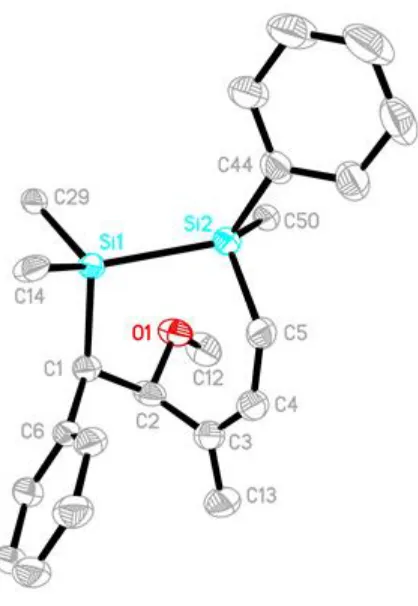
Recrystallization from a minimal amount of acetone yielded single crystals of 2.10 giving
the molecular structure shown in Figure 2.4 confirming the structure elucidated by NMR
Figure 2.4: Ellipsoid plot of 2.10 showing naming and numbering scheme. Ellipsoids are
at the 50% probability level, all ligand-based hydrogen atoms and Tip groups (except the
i-carbon) were omitted for clarity. Selected bond lengths (Å) and angles (°): Si1-Si2 =
2.4795(10), C4-C5 = 1.345(4), C3-C13 = 1.340(4), Si1-Si2-C5 = 97.21(8), Si2-C5-C4 =
136.4(2), C5-C4-C3 = 129.9(3), C4-C3-C2 = 120.8(2), C3-C2-C1 = 115.1(2), C2-C1-Si1
= 117.05(16), C1-Si1-Si2 = 102.07(7).
The molecular structure confirms the regiochemistry of the phenyl and methoxy
substituents in 2.10. The phenyl substituent on Si2 and the phenyl substituent on C1 are
cis to each other, whereas the phenyl and methoxy substituents on C1 and C2,
respectively, are trans reducing steric interactions. The C4-C5 and C3-C13, bond lengths
The 1H NMR spectrum, of 2.11 is illustrated in Figure 2.5. The ESI mass
spectrum of 2.11 revealed a signal at m/z 951.627 indicative of a 1:1 adduct between
alkyne 1.31 and disilene 1.37. A similar strategy to that used in the identification of 2.10
was applied to elucidate the structure of 2.11.
Figure 2.5: a) 1H NMR spectrum of 2.11 (600 MHz, C6D6); b) Expansion from 6.69 –
6.71 ppm; c) Expansion from 3.6 – 4.1 ppm; d) Expansion from 1.30 – 1.35 ppm.
Two singlets were observed at 3.70 and 4.01 ppm in the 1H NMR spectrum of
2.11. The two singlets correlated to signals at 92.23 and 54.08 ppm in the 13C dimension
the two 1H signals was also observed in the 1H-1H gCOSY NMR spectrum. On the basis
of the 13C chemical shifts, as well as the strong correlation observed in the 1H-1H gCOSY
NMR spectrum, the singlets at 3.70 and 4.01 ppm were assigned to the CH-OMe and
CH-Ph moieties, respectively. A correlation between the signal at 3.70 ppm in the 1H
dimension and signals at 17.59 ppm and 56.80 ppm in the 13C dimension of the 13C-1H
gHMBC NMR spectrum of 2.11 were observed (Figure 2.6).
Figure 2.6: Expansion of the 13C-1H gHMBC NMR spectrum of 2.11 (600 MHz, C6D6)
The signal at 17.59 ppm correlated to a masked signal at 1.35 ppm in the 1H dimension of
the 13C-1H gHSQC NMR spectrum while the 13C signal at 56.80 ppm correlated to a 1H
singlet at 3.02 ppm. As such, the singlet at 1.33 ppm in the 1H NMR spectrum was
assigned to the methyl substituent derived from 1.31, while the singlet at 3.02 ppm was
assigned to the methoxy group on the basis of the chemical shifts and observed
correlations in the 13C-1H gHMBC NMR spectrum of 2.11. The correlation critical to the
elucidation of the structure of 2.11 was observed in the 13C-1H gHMBC NMR spectrum
between the signal at 3.70 ppm in the 1H dimension and the signal at 218.32 ppm of the
13C dimension. The signal at 218.32 ppm was assigned to an allenic carbon on the basis
of the chemical shift and by comparison to the chemical shifts of the allenic carbon in 2.5
and 2.6 at 213.1 ppm and 210.2 ppm, respectively (Table 2.1). A correlation in the 1H-1H
gCOSY NMR spectrum of 2.11 between the signals at 1.33 ppm, assigned to the methyl
substituent and 6.70 ppm was observed. The signal at 6.70 ppm also correlated to a signal
at 92.32 ppm in the 13C dimension of the 13C-1H gHSQC NMR spectrum of 2.11. By
comparison of the correlations observed, as well as the analogous chemical shifts of 2.5
and 2.6, the signals at 6.70 ppm and 92.32 ppm in the 1H and 13C NMR spectra,
respectively, were assigned to the allenic moiety. These assignments led to the fragment
presented in Chart 2.3.
Chart 2.3: Fragments of 2.11 highlighting key 1H signals in blue and key 13C signals in
Figure 2.7: Expansion of the 29Si-1H gHMBC NMR spectrum of 2.11 (600 MHz, C6D6).
The signals at -31 and -28 ppm in the 29Si dimension are noted as Si(1) and Si(2), respectively.
To determine the regiochemistry of the phenyl and methoxy substituents the 29Si-1H
gHMBC NMR spectrum of 2.11 was recorded. The resulting spectrum is illustrated in
Figure 2.7. Similar correlations were observed in the 29Si-1H gHMBC NMR spectra of
2.10 and 2.11. The signal at -31 ppm in the 29Si dimension of the 29Si-1H gHMBC NMR
spectrum of 2.11 correlated with a doublet in the 1H dimension at 7.60 ppm, assigned to
-Ph moiety of the ring. The other signal in the 29Si dimension of the 29Si-1H gHMBC
NMR spectrum of 2.11, at -28 ppm, correlated to both the CH-Ph and CH-OMe signals at
4.01 and 3.70 ppm, respectively, in the 1H dimension. These correlations establish the
regiochemistry of the phenyl and methoxy substituents on the seven-membered ring and
the phenyl substituent of the disilane fragment to yield the final elucidated structure
shown in Chart 2.4.
Chart 2.4: Elucidated structure of 2.11 highlighting key 29Si signals in green.
Compound 2.12 was also identified and is the major compound in the 1H NMR
spectrum of the crude residue. The region from 2.5 – 4 ppm in the 1H NMR spectrum of
2.12 is shown in Figure 2.8. The ESI mass spectrum of 2.12 revealed a signal at m/z
Figure 2.8: a) 1H NMR spectrum of 2.12 (600 MHz, C
6D6); b) Expansion from 3.56 –
3.64 ppm; c) Expansion from 2.80 – 2.90 ppm.
Once again, two doublets, at 2.84 and 3.60 ppm, in the 1H NMR spectrum of 2.12
were found to correlate to signals at 41.24 ppm and 73.37 ppm in the 13C dimension of
the 13C-1H gHSQC NMR spectrum of 2.12, respectively, and thus, were assigned to CH
-Ph and CH-OMe moieties. The 1H-1H gCOSY NMR spectrum of 2.12 shows a
correlation between these two signals with a coupling constant 4 Hz. The coupling
constant is significantly different than the corresponding coupling constant in 2.10.
Furthermore, the chemical shifts of the signals at 2.84 and 3.60 ppm are similar to those
data, the structure of compound 2.12 is a disilacyclobutene with the cyclopropyl ring
intact.
Table 2.2: 1H NMR and 13C NMR chemical shifts of 2.7, 2.12, and 2.13.
1H NMR Chemical Shifts
HCPh 2.31
[J = 5 Hz]
2.84
[J = 4 Hz]
2.65
[J = 4 Hz]
HCOCH3 3.98
[J = 5 Hz]
3.60
[J = 4 Hz]
3.79
[J = 4 Hz]
CH3 1.60 1.25 1.59
OCH3 3.17 3.13 3.26
C=CH 6.88 7.46 7.00
13C NMR Chemical Shifts
HCPh 43.06 41.24 39.42
HCOCH3 73.06 73.37 72.76
OCH3 57.79 57.25 58.30
The signal at 37.08 ppm in the 13C NMR spectrum of 2.12was assigned to the
quaternary carbon of the cyclopropyl ring by comparison with the chemical shift of the
analogous carbon in compound 2.7 (37.32 ppm). The signal assigned to the quaternary
carbon showed correlations to singlets in the 1H dimension at 7.46 ppm and 1.25 ppm in
the 13C-1H gHMBC NMR spectrum of 2.12.
Figure 2.9: Expansion of the 13C-1H gHMBC NMR spectrum of 2.12 (600 MHz, C6D6)
with 1H ranges of: a) 7.38-7.50 ppm (13C range of 36.5-37.5 ppm); b) 1.17-1.31 ppm (13C range of 36.5-37.5 ppm); c) 1.0-7.5 ppm (13C range of 176.0-178.0 ppm);
The former correlated to a signal at 152.57 ppm in the 13C dimension of the 13C-1H