Cipher: an Attack on Every Block Cipher
Jialin Huang and Xuejia Lai Shanghai Jiaotong University
Abstract. Recently, several important block ciphers are considered to be broken by the bruteforce-like cryptanalysis, with a time complexity faster than exhaustive key search by going over the entire key space but performing less than a full encryption for each possible key. Motivated by this observation, we describe a meet-in-the-middle attack that can always be successfully mounted against any practical block ciphers with success probability one. The data complexity of this attack is the smallest according to the unicity distance. The time complexity can be written as 2k(1−) where >0 for all block ciphers. Previously, the security bound that is commonly accepted is the lengthkof the given master key. From our result we point out that actually thisk-bit security is always overestimated and can never be reached due to the inevitable key bits loss. No amount of clever design can prevent it, but increments of the number of rounds can reduce this key loss as much as possible. We give more insight in the problem of the upper bound of effective key bits in block ciphers, and show a more accurate bound. A suggestion about the relation between the key size and block size is given. That is, when the number of rounds is fixed, it is better to take a key size equal to the block size. Moreover, effective key bits of many well-known block ciphers are calculated and analyzed, which also confirm their lower security margin than thought before.
Keywords: block cipher, meet-in-the-middle, effective key length, ex-haustive search
1
Introduction
focuses on practical security, concerning that if any cryptanalytic attacks can be mounted successfully on a block cipher, such as differential attacks, linear at-tacks, meet-in-the-middle atat-tacks, related-key atat-tacks, as well as other existing cryptanalysis techniques. A block cipher is considered secure when it can resist against all known attacks. Traditionally the strength of a cryptanalytic attack is measured by comparing it to the exhaustive search over the entire key space. So the security of a block cipher mainly depends on the key length.
Recently the (full version of) AES has been called broken because of the biclique attack [4], which performs faster than the exhaustive search. In [9] the authors proposed a complex meet-in-the-middle attack on KASUMI using var-ious subtle weaknesses of the cipher. In [3], the authors proposed several tech-niques to speed up exhaustive key search on the Full IDEA (by combining the BD-relation), KASUMI, and GOST. All of above attacks have the following in common: by going over the entire key space with performing less than a ful-l encryption for each possibful-le key, the fuful-lful-l rounds of the ciphers are targeted with a time complexity slightly faster than exhaustive key search (for AES-256 is 2254.4, for KASUMI is 2125.8, for IDEA is 2126.8). These results are far from
being any threat for the use of the ciphers in practice. However, they motivate us to consider the realistic complexity that an attack should be compared to. That is, in a real world context, what should the time complexity of a valid attack at most be.
1.1 Related Work
In [3], Biham et al recalled two well known techniques to marginally reduce the time complexity of exhaustive key search for almost any block ciphers. One is the distributive technique, which extracts the key bits that are not used in the first (or last) few operations of the encryption process. Another is the early abort technique proposed by [11], which is to discard a wrong key before computing the full ciphertext. Assume that a subsetK(1) of the key bits is not used in the first few operations, and a (possibly different) subsetK(2) is not used in the last few operations. Then Biham et al proposed a more advanced algorithm using the meet-in-the-middle technique, as follows.
For each value of the bits in K\K(1)\K(2), perform the following:
1. For each value of the bits inK(2)\K(1), perform the first few operations of the encryption process for the given plaintext. Store the intermediate value and the corresponding value inK(2)\K(1) in a table.
2. For each value of the bits inK(1)\K(2), perform the last few operations in the decryption direction for the given ciphertext. Then guess the value of the remaining bits in K(2), and complete the rest computation up to the interme-diate value. Check the match with the values in the table.
structures and weaknesses of the key schedules, Biham et al showed the speedup for IDEA, GOST and KASUMI.
1.2 Our Contribution
Most block ciphers in common use are designed to have security equal to their key length (an exception is Triple-DES). Given that a key consists of k bits, the exhaustive search of the key space would take 2k encryption, with success
probability of one when the number of plaintext/ciphertext pairs satisfies the unicity distance.
In this paper, by giving a universal attack which has a time complexity of 2k(1−) where > 0, we point out that the previously thought bound of
the effective key size k can never be achieved for almost all practically used block ciphers. The data complexity of this attack is the smallest according to the unicity distance, and the success probability is about one. We present a formulated description, measuring the effective key length explicitly with some general parameters, such as block size, key size, and number of rounds. Moreover, our algorithm is applied to many well-known block ciphers and their effective key bits are calculated. As predicted, the effective key bits of these ciphers are all less than the master key sizek.
Compared with previous work, our analysis is basing on more general struc-tures and weaker assumptions, which have nothing to do with the specifics of key schedules. No matter how clever and secure the block cipher is, our algorithm is always available to the cryptanalyst. The data complexity of our algorithm reduces greatly. Only three instances are given for the splice-and-cut version of Biham’s algorithm: IDEA, KASUMI, and GOST. This indicates that weak key schedules (all these three ciphers have simply linear key schedules) and large amount of data complexity are required for the attacks. No instances are given for the basic Biham’s algorithm. We do a partial match in the middle, instead of using early abort technique in the ciphertext. More details about the algorithm such as the computational complexity are presented, not just a rough descrip-tion. By the explicit quantization of the real bound of effective key lengths, the relation between key size and block size and the effect of increasing the number of rounds can be considered from a new point.
1.3 Organizations
2
The Construction, Notations and Conventions
Based on Shannon’s conception of confusion and diffusion, most modern block ciphers have been designed to use many iterations of substitution (nonlinear layer) and permutation (linear layer) to obtain enough security (each iteration is referred to as one round). We give the following notations first.
– P: plaintext where nis the block size – C: ciphertext
– K: master key where kis the master key size – R: the number of rounds
– S: the non-linear layer – L: the linear layer
– Kr: the subkey used in roundr
– Xr: the input block to roundrwhere X0=P – Yr: the output block of the key mixing in roundr – Zr: the output block of the nonlinear layer in round r
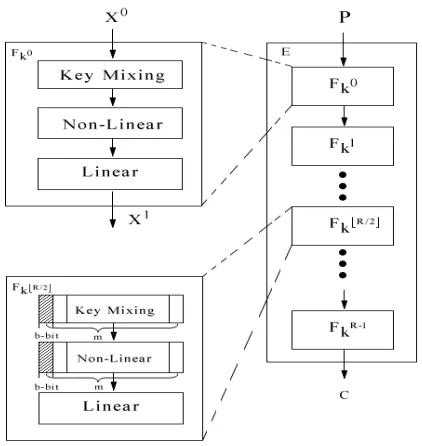
For almost all block ciphers used in practice, theirR-round generic structure is depicted in Fig. 1.
Fig. 1.Structure of anR-round block cipher E
state block using linear operations, such as XOR and modulo addition. This means that the subkeys affect the round transformation with a separable pattern between different sub-blocks. That is, parts of subkeys directly act on parts of the internal state. e.g. Kr
i is mixed with Xir. Note that a round function in
practice cannot be designed as random permutations, where the subkey can be regarded to act as a whole.
For a block cipher with key sizek, the easiest and universal attack an ad-versary can mount is to simply try and guess each possible key. The probability of correctly guessing the key at the first attempt is 2−k. Adding an additional
bit to the length of key halves the probability that the key is correctly guessed. The time required to exhaust the whole key space is proportional to the time required to perform 2k encryption operations.
3
A Generic Attack
We introduce a generic meet-in-the-middle attack that can be mounted on every practical block cipher. This attack is given in Algorithm 1.
Data:dk
ne+ 1 pairs of plaintext and ciphertext
Result: the output keyK
foreach value of the first k1 key bits do
ComputeS1 from P with thesek1 bits ;
foreach value of the remaining k−k1 key bits do
ComputeZb
R 2c
0 fromS1;
StoreZb
R 2c
0 in a table corresponding to the guessed key;
end end
foreach value of the last k1 key bits do
ComputeS2 from Cwith these k1 bits ;
foreach value of the remaining k−k1 key bits do
ComputeZb
R 2c
0 fromS2;
if ZbR2c
0 corresponding to the guessed key is in the table then
add the guessed key into the candidate list; move onto the next guess;
else
move onto the next guess;
end end end
Check keys in the candidate list with otherdk
neplaintext/ciphertext;
Algorithm 1:The generic meet-in-the-middle attack
S1 is the internal state that can be calculated from P only with k1 bits of
subkeys, wherek1is the maximum smaller thankthat can be obtained. Similarly,
subkeys. For any block cipher, the states of S1 and S2 certainly can be found.
This algorithm has two phases, the meet-in-the-middle phase that generates the candidate list containing 2k−M keys, and the check phase that examines the keys
in the list.
For further discussion, we make two assumptions that are reasonable for practical block ciphers. First, non-linear transformations are assumed to consume much more time than linear transformations, so only non-linear operations are counted. Second, key schedules are assumed as negligible, since they are usually simpler than the encryption function.
Now we discuss the time complexity, data complexity, memory complexity and success probability for Algorithm 1.
Time complexity
Based on above assumptions, the time complexity is considered as follows. For any block ciphers, it is always smaller than 2k.
Tcomp= 2k1(
NP→S1
Ntotal
+NC→S2
Ntotal
+ 2k−k1Ntotal−NP→S1−NC→S2−Nabort
Ntotal
)
+2k−M+ 2k−M−n+ 2k−M−2n... (1) ≈2k(Ntotal−NP→S1−NC→S2−Nabort
Ntotal
)
= 2k(1−NP→S1+NC→S2+Nabort
Ntotal
) (2)
whereNtotalmeans the total non-linear components required in a full encryption.
DenoteNP→S1 as the required non-linear components in the calculation fromP
to S1. DenoteNC→S2 as the required non-linear components in the calculation
from C to S2. Nabort is the number of non-linear components needn’t to be
computed when partial matching techniques are used in the middle. The partial matching can filter M bits information of the key after the meet-in-the-middle phase. If write NP→S1+NC→S2+Nabort
Ntotal as , then (2) is = 2
k(1−), where >0.
Equation (1) can be made more concrete for specific cipher structure. Usually there are two major structures for block ciphers, SPN and Feistel structure, as well as their generalized variants and combinations. Each n-bit internal state Wr = (Wr
0, W1r,...,Wmr−1) is a concatenation of m b-bit words Wir where b is
the size of a non-linear sub-block (e.g. one S-box). For most SPN ciphers, every non-linear sub-block is keyed, and we match ab-bit word in the middle. So the time complexity is written as:
Tcomp= 2k1(2
(kb −1) Rm +2
k−k1Rm−(m−1 + 2( k b −1))
Rm )+2
k−b+2k−b−n+2k−b−2n...
≈2k(1−m−1 + 2(
k b −1)
Rm )
= 2k(1−1−
3b n +
2k n
wherem >1 in practical block ciphers due to limit of the size of one non-linear operation, as well as k > b. For an entire encryption, there areRmnon-linear operations. For the first (kb −1) operations, we always do not need to guess all k bits of the key. We can compute S1 by only searching the first (k−b) bits,
without guessing the remaining key bits. The time complexity of factor (kb −1) is saved here. The multiplication of 2 means that the computation from both the plaintext and the ciphertext should be considered. In the middle round, using the partial matching technique, we can only compute one non-linear operation to get ab-bit filter and save another (m−1) operations.
For the Feistel structure, time complexity can be derived in the same way and the resulted formula is very similar. Due to the half diffusion property, at least one round of computation can be saved when matching in the middle. For other more detailed structures, such as MISTY (note that it has different sizes for non-linear components, 7 to 7 bits and 9 to 9 bits S-boxes) and Lai-Massey structures, we give examples directly in Section 4.
Data complexity
The required number of pairs of plaintext/ciphertext here isU + 1, whereU = dk
neis the smallest data complexity according to the unicity distance. We use
the first pair of data to filter parts of the wrong keys and generate the candidate list. Then we require at most anotherU pairs of plaintext/ciphertext for finding the right key.
If we store the internal states before and after the meet state in the middle, we can use the first data pair for filtering anothern−M bits. Now the first data also can provide all itsn-bit information for checking, the same as other pairs of plaintext/ciphertext. So the data complexity can be reduce toU. Since the data complexity now isU+ 1, which is small enough, this tradeoff is unnecessary.
Memory Complexity
Algorithm 1 has a memory complexity of 2k ·M bits. If more memory can be sacrificed, the data complexity can be lowered as mentioned above. The time-memory tradeoff is not our concern here.
Success probability
In the meet-in-the-middle phase, a wrong key is eliminated with a probability of 1−2−M. When examined in the candidate list with the second data pair, a
wrong key is discarded with a probability of 1−2−(M+n). And when examined
with the third data pair (if needed), a wrong key is eliminated with a probability of 1−2−(M+2n), and so on. The success probability of Algorithm 1 is the product
of these probabilities for all 2k−1 wrong keys, which is approximately one.
An Upper Bound of the Effective Key Length
No matter how clever and secure the block cipher is, Algorithm 1 is always available to the cryptanalyst. This indicates that a more accurate effective key length can be considered by taking the logarithm of the time complexity for this universal algorithm. As mentioned before, we can focus on (3).
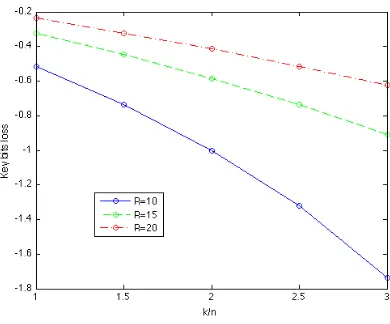
Fig. 2.The relation of key bits loss with key size, block size and number of rounds
The effective key size isk+log(1−1−3nb+ 2k
n)
R ), which is always smaller thank
for any block ciphers. Usually the size of non-linear sub-blockbis much smaller thannandk, and only takes a few fixed values. For conventional block ciphers, the routine size of S-boxe is 4, 8, or 16 bits (for MISTY and KASUMI this is 7 or 9 bits). And for lightweight block ciphers, the routine size is 3 or 4 bits. 1−3b
n+
2k
n is always larger than zero, solog(1−
1−3b n+
2k n)
R is smaller than zero. The
previously accepted security bound ofkkey bits actually cannot be achieved. Denotelog(1−1−3nb+2nk)
R ) as the loss of effective key bits. We ignore the factor
of 3nb and draw the function oflog(1−1+2nk
R ) with fixed differentR. See Fig. 2.
WhenR is the same, the larger k
n is, the more key bits loss exists. When k n is
4
Effective Key Lengths for Block Ciphers
In this section, many practical block ciphers are analyzed for their actual effective key lengths. For a clear exhibition for (1), we consider conventional block ciphers and lightweight block ciphers respectively.
4.1 Conventional Block Ciphers
We take AES an an example, which is the most widely used block cipher now. It is selected as the new standard for replacing DES by NIST in 2000. As we assumed before, we count the computational complexity for S-boxes. This is also taken in [4]. For AES-128, the key sizekand block sizenare both 128 bits, the size of non-liner sub-blocks (S-box) b is 8, and the number of rounds R is 10. There are 16 sub-blocks in the state, that ism= 16. Refer to [6] for more details about AES. Note that the whitening keyK0should also be considered here. The
detailed application of Algorithm 1 is as follows.Z5
0 is the intermediate value for
meeting. Choose (Z1
0, Z11,...,Z141 ) asS1. Compute S1 from P by guessing (K00,
K0
1,...,K140 ), 120 bits totally. Then for each guess of K150, the last 8 bits of the
master keyK, complete the encryption operations fromS1toZ05. This requires
a calculation ofZ151 ,Z2,Z3,Z4,Z05, 50 S-boxes totally. StoreZ05in a hash table corresponding to the guessed key. Choose (X110,X210,...,X1510) asS2. ComputeS2
from C by guessing (K110, K210,...,K1510), 120 bits again. Then for each guess of
K010, the last 8 bits of a mapping of the master keyK, complete the decryption
operations from S2 to Z05. This needs a computation of X010,X9,X8, X7,X6,
65 S-boxes totally. There are 10×16 = 160 S-boxes for the full AES-128. So for each guess of 128-bit ofK, only 115 S-boxes need to compute. This means 115
160 of
one full 10-round encryption for each guess. The time complexity of Algorithm 1 here is about 2128×115
160 = 2
127.5(this value also can directly derive from (3)), so
the effective key length can be regarded as 127.5 bits. We consider a little more about the structure of AES, that is, its branch number in the diffusion layer. Only four bytes knowledge of Z4 is needed for computing Z5
0, and four bytes
knowledge of X6 is needed. This can save additional 24 S-boxes, and the time
complexity of Algorithm 1 is reduced to 2127.2. Similarly, the time complexity of
Algorithm 1 for AES-256 is 2255.1. Compared with our upper bound of key bits,
the best attack result so far on AES-256 with a time complexity of 2254.4 has much less gain than expected, since the effective key bits of AES-256 is actually only 255.1-bit.
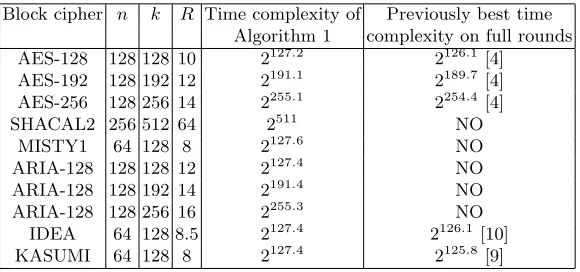
We compute effective key lengths for other well-known block ciphers, listing in Table. 1.
We briefly explain for KASUMI [2]. Assume that the most time consuming sub-functions are three F I in each round for KASUMI. Only 7 16-bit words of the key require to be guessed before going to the thirdF I of round 1. Also, there is no need to guess all 128 bits of the key when the threeF I operations are completed in round 8. Besides, the Feistel struture saves one more round in the middle, so there are 16F I calculated for each guessed key. The time complexity is 2128×16
Table 1. Time complexity of Algorithm 1 for conventional block ciphers, which also indicates effective key lengths
Block cipher n k R Time complexity of Previously best time Algorithm 1 complexity on full rounds AES-128 128 128 10 2127.2 2126.1 [4] AES-192 128 192 12 2191.1 2189.7 [4] AES-256 128 256 14 2255.1 2254.4 [4]
SHACAL2 256 512 64 2511 NO
MISTY1 64 128 8 2127.6 NO
ARIA-128 128 128 12 2127.4 NO
ARIA-128 128 192 14 2191.4 NO
ARIA-128 128 256 16 2255.3 NO
IDEA 64 128 8.5 2127.4 2126.1 [10]
KASUMI 64 128 8 2127.4 2125.8 [9]
Above ciphers are all recommended as standards or used by the industry for secure communications. According to our analysis, their security margin needs to be reconsidered. e.g. If an attack on SHACAL2 has a time complexity larger than 2511, then this attack should be regarded as invalid. The best attack on full IDEA that was thought to optimize 1.9 bits now should be regarded as only 1.3 bits optimization.
4.2 Lightweight Block Ciphers
Most recently, secure communication on extremely constrained devices have been developing, such as RFID tags and sensor nodes. The constraints are mainly driv-en by cost and result in highly limited computing power, chip area and/or power supply, which mean that we must leave behind much of our conventional block ciphers. So the development of lightweight block ciphers is progressing great-ly, resulting in more and more aggressive designs that often show two features. First, innovative techniques are used to improve existing ciphers. Second, the security margins that block ciphers are traditionally equipped with are reduced as much as possible in order to optimize the cipher performance. Due to these differences to conventional block ciphers, we discuss Algorithm 1 on lightweight block ciphers separately.
Take GOST as an example. GOST is known as the former Soviet encryption standard GOST 28147-89 which was standardized as the Russian encryption standard in 1989. It is well suitable for compact hardware implementations due to the simple structure, and the most compact implementation requires only 651 GE [13]. Therefore, GOST is considered as ultra lightweight. GOST has a 32-round Feistel structure with 64-bit block sizenand 256-bit key sizek. TheF -function consists of eight S-boxes. Refer to [1] for more details. The application of Algorithm 1 is as follows. Due to the Feistel structure, we can check if R15
equals to L16. Compute P to S
1 by guessing the 7 32-bit subkeys in the first
bits totally. Then for each guess of the most significant 4 bits of the subkey in round 8, complete the encryption fromS1toR15. This requires a calculation of
6 rounds and the last S-box in round 8, 49 S-boxes totally. Store the first 4 bits ofR15in a hash table corresponding to the guessed key. Similarly, computeCto
S2 by guessing the 7 32-bit subkeys in the last seven rounds, as well as the least
significant 28 bits of the subkey in round 25, 252 bits totally. Then for each guess of the most significant 4 bits of the subkey in round 25, complete the decryption operations from S2 to L16. This needs a computation from round 16 to round
24, and the last S-box in round 25, 73 S-boxes totally. So for each guess of the 256-bit master key, 122 S-boxes require to be computed, which is 122256 of a full 32 rounds encryption (There are 8×32 = 256 S-boxes for the full GOST). The time complexity of Algorithm 1 is about 2256×122
256 = 2
254.9. So the effective key
length is 254.9-bit. Moreover, we can only match part of R15 with part of L16, e.g. their least significant 4 bits. In order to compute these 4 bits of R15, only
two S-boxes require to be calculated in round 14. Similarly, only two S-boxes are needed in round 16 for the matched 4 bits ofL16. 12 S-boxes are saved now,
so the time complexity is slightly reduced to 2254.8. Note that, previous attacks
on full GOST take use of its self-similarity property and relatively simple key schedule. We only consider the basic structure, which means that even the key schedule is much more complicated, Algorithm 1 still cannot be avoided.
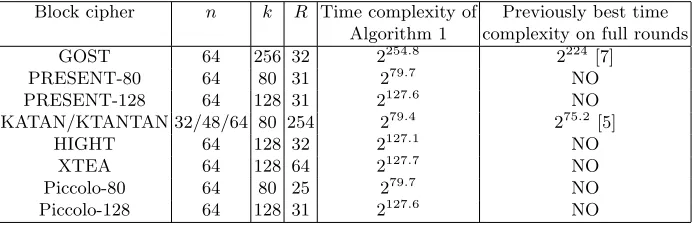
Other results of lightweight block ciphers are summarized in Table 2. Some lightweight block ciphers have no non-linear components, e.g. XTEA. In this situation, different linear operations in the round function are considered to cost the same time, or we can simply take the round function as a unit when computing the time complexity.
Table 2. Time complexity of Algorithm 1 for lightweight block ciphers, which also indicates effective key lengths
Block cipher n k R Time complexity of Previously best time Algorithm 1 complexity on full rounds
GOST 64 256 32 2254.8 2224 [7]
PRESENT-80 64 80 31 279.7 NO
PRESENT-128 64 128 31 2127.6 NO
KATAN/KTANTAN 32/48/64 80 254 279.4 275.2 [5]
HIGHT 64 128 32 2127.1 NO
XTEA 64 128 64 2127.7 NO
Piccolo-80 64 80 25 279.7 NO
Piccolo-128 64 128 31 2127.6 NO
5
Discussion and Conclusion
attack on all block ciphers, except the traditional exhaustive search method. In a practical cryptographic primitive, there are always some independent sub-modules. Computing these sub-modules with a independent pattern, instead of a combinational pattern, will save the overall time complexity. We describe a generic meet-in-the-middle attack that can always be mounted against any practical block ciphers. No amount of clever design can prevent it, no matter how many rounds or how complicated key schedule the cipher has. Note that having a sufficiently many rounds is still an important and expedient way to protect against it, since a larger number of rounds brings a higher complexity for Algorithm 1. We indicate a more accurate upper bound of effective key lengths for practical block ciphers, and claim that no these ciphers can reach their expected security margin, the given length of their master keys. Previously, exhaustive key search is generally considered as the benchmark with which other attacks are measured. A theoretical break (or academic break) against a block cipher is an attack with time complexity less than that of exhaustive key search, i.e. 2k. Our analysis shows that tiny sacrifice of key bits is inevitable. So if
an attack has the computational complexity larger than Algorithm 1 (even still faster than exhaustive search), it cannot be regarded as a valid attack. Algorithm 1 is also used to many well-known block ciphers and their effective key lengths are calculated. As predicted, the effective key bits of these ciphers are all less than the master key sizek. However, our attack will not create a real threat for existing block ciphers, due to its limit caused by having to perform at least one operation for each possible key.
Another interesting discussion is about the relation between the block size with the master key size. Shannon’s work on information theory shows that to achieve the perfect secrecy, it is necessary for the key size to be at least as large as the block size. That is,k>n. According to our analysis in Section 3, when the number of rounds is fixed, the larger k
n is, the more loss of effective key bits
there is. Sok=nis the best solution in the block cipher design in this context. In the exhaustive key search, having to go through the entire key space before finding the correct key would be very unlucky, while being correct on the first guess would be very lucky. So the expected time to recover a k-bit key is 2k−1
encryptions. Note that most of the effective key lengths we calculate for existing block ciphers are larger than this average case, although some are still smaller. Given that the time complexity of Algorithm 1 in this paper is for the worst case, considering the average case and then comparing the result with 2k−1can
be the further work.
References
1. National soviet bureau of standards. information processing system - cryptographic protection - cryptographic algorithm gost 28147-89. 1989.
3. E. Biham, O. Dunkelman, N. Keller, and A. Shamir. New data-efficient attacks on reduced-round idea. Cryptology ePrint Archive, Report 2011/417, 2011.
4. A. Bogdanov, D. Khovratovich, and C. Rechberger. Biclique cryptanalysis of the full aes. In Proceedings of the 17th international conference on The Theory and Application of Cryptology and Information Security, ASIACRYPT’11, pages 344– 371, Berlin, Heidelberg, 2011. Springer-Verlag.
5. A. Bogdanov and C. Rechberger. A 3-subset meet-in-the-middle attack: Crypt-analysis of the lightweight block cipher KTANTAN. In A. Biryukov, G. Gong, and D. R. Stinson, editors,Selected Areas in Cryptography, volume 6544 ofLecture Notes in Computer Science, pages 229–240. Springer, 2010.
6. J. Daemen and V. Rijmen. Aes proposal: Rijndael. InFirst Advanced Encryption Standard (AES) Conference, 1998.
7. I. Dinur, O. Dunkelman, and A. Shamir. Improved attacks on full gost. In A. Can-teaut, editor,Fast Software Encryption, volume 7549 ofLecture Notes in Computer Science, pages 9–28. Springer Berlin Heidelberg, 2012.
8. S. Even and Y. Mansour. A construction of a cipher from a single pseudorandom permutation. In H. Imai, R. Rivest, and T. Matsumoto, editors, Advances in Cryptology ASIACRYPT ’91, volume 739 ofLecture Notes in Computer Science, pages 210–224. Springer Berlin Heidelberg, 1993.
9. K. Jia, H. Yu, and X. Wang. A meet-in-the-middle attack on the full kasumi. Cryptology ePrint Archive, Report 2011/466, 2011.
10. D. Khovratovich, G. Leurent, and C. Rechberger. Narrow-bicliques: Cryptanalysis of full idea. In D. Pointcheval and T. Johansson, editors,Advances in Cryptology C EUROCRYPT 2012, volume 7237 ofLecture Notes in Computer Science, pages 392–410. Springer Berlin Heidelberg, 2012.
11. J. Lu, Y. Wei, J. Kim, and P. Fouque. Cryptanalysis of reduced versions of the camellia block cipher. InSelected Areas in Cryptography, 2011.
12. M. Luby and C. Rackoff. How to construct pseudo-random permutations from pseudo-random functions. In H. Williams, editor,Advances in Cryptology CRYP-TO 85 Proceedings, volume 218 ofLecture Notes in Computer Science, pages 447– 447. Springer Berlin Heidelberg, 1986.