full GOST block cipher with zero time and memory”
Vladimir Rudskoy†
†Lomonosov Moscow State University,
Faculty of Computational Mathematics and Cybernetics.
rudskoy [email protected]
Abstract
In this paper we show that the related key boomerang attack by E. Fleischmann et al. from the paper mentioned in the title does not allow to recover the master key of the GOST block cipher with complexity less than the complexity of the exhaustive search. Next we present modified attacks. Finally we argue that these attacks and the related key approach itself are of extremely limited practical applications and do not represent a fundamental obstacle to practical usage of the block ciphers such as GOST, AES and Kasumi.
1
Introduction
Recently there was a host of papers devoted to methods of cryptanalysis, which make use of related keys. In particular, related-key attacks were devel-oped for block ciphers GOST [3], AES [1] and Kasumi [2]. These methods have complexity essentially smaller than the exhaustive search. At the same time, they use very strong assumption of possibilities of the attacker. For practical im-plementations of the ciphers one can consider such an assumption as extremely improbable.
presented. The authors claim their algorithm allows to recover 8 bits of a master key of the cipher, other bits are recovered by the exhaustive search.
In the present work we investigate in detail the attack from [3]. We show that this attack does not allow to recover the master key of the key of the GOST block cipher with complexity less than the complexity of the exhaustive search. More precisely, we prove it is equivalent to the exhaustive search. Moreover, in [3] the fixed set of S-boxes is considered, and the attack is applicable not to all sets of S-boxes. At the same time, we show how to change the algorithm from [3] in such a way that it will recover 31 bits of a master key regardless of a choice of S-boxes. Then the generalised algorithm will be presented, which allows to recover more bits of a key, and in certain cases fully recover master key, with complexity essentially smaller than the exhaustive search, provided that there are enough related keys.
2
Notations and the description of the GOST block
ci-pher
In this paper the following notations are used. For a natural t a set of bit words of length t is denoted by Vt. ⊕ denotes bitwise XOR of words. Bits are
numbered 0 through t−1 from right to left: X = (xt−1, ..., x0) ∈ Vt, xi ∈ {0,1},
i = 0, t−1. High order bits have greater numbers.
Let X[i ∼ j] denote a word consisting of bits of X in positions from i-th to j-th.
Each word in V32 corresponds to a natural number
X = (x31, ..., x0) 7→ 31
X
i=0
xi2i.
denotes addition modulo 232 of two words considered as natural numbers. L : V32 7→V32 denotes bit rotation of x ∈ V32 by 11 positions to the left.
Nonlinear transformation Π : V32 7→ V32 consists of 8 parallel 4-bit wide
bijective S-boxes Π = (π0, ...π7), πk : V4 7→ V4, k = 0,7. The first S-box (π0) is
applied to the most significant bits, the last S-box (π7) is applied to the least
significant bits:
Π(x) = (π0(x31, x30, x29, x28), ..., π7(x3, x2, x1, x0))
In GOST 28147-89 S-boxes are not specified and may be used as a long-term key.
GOST is a block 32-round Feistel cipher. It uses a 64-bit information block and a 256-bit master key. Plaintext block is divided into 32-bit left and right parts P0 = L0||R0. The corresponding ciphertext P32 = L32||R32. Round
func-tion is computed according to
Li = Ri−1
Ri = Li−1 ⊕L(Π(Ri−1 ki))
for i = 1,31 and
R32 = R31
L32 = L31 ⊕L(Π(R31k32)),
where ki denotes the i-th round subkey. Master key K is divided into 32-bit
subkeys K = (K1, ..., K8). The key schedule produces round keys as follows:
ki = K(i−1) mod 8+1, i ∈ 1,24;
ki = K32−i+1, i ∈ 25,32.
for encryption and
ki = Ki, i ∈ 1,8;
ki = K(32−i) mod 8+1, i ∈ 9,32.
for decryption.
E(P0, K) denotes an encryption of P0 under key K, E−1(P32, K) denotes a
3
The related-key boomerang attack
The boomerang attack was first published in [4]. The attack is an extension to differential cryptanalysis that uses adaptive chosen plaintexts and ciphertexts. To describe this attack we need some definitions.
Let F : Vn →Vn denote some non-linear transformation of Vn.
Definition 1 α → β, α, β ∈ Vn is called a differential for F if there exist an input pair (P, P0) with difference α: P⊕P0 = α, such that β is the output difference,i.e. F(P)⊕F(P0) = β. The probability pFα,β is related to a differential,
pFα,β = P{F(x)⊕F(x⊕α) = β}, assuming x being randomly and independently distributed over Vn.
Definition 2 A pair (P, P0 = P⊕α) is called a correct pair for the differential
α → β, if it satisfies F(P)⊕F(P0) =β and is called a wrong pair otherwise.
We will also need the following proposition [4].
Proposition 3 Let F be a bijective transformation, and let α →β be a differ-ential for F with probability p. Then, for the inverse transformation F−1 the differential β →α also has probability p.
Consider a block cipher E(X, K) =Y, where X ∈ Vn is a plain text, Y ∈ Vn
is a ciphertext, K ∈ Vk is a secret key. With fixed key, the encryption function
is a bijective transformation over Vn, therefore statement 3 holds for it.
Suppose E may be represented as a composition of two subciphers E0 and
E1, E = E0 ◦E1.
Let α → β be a differential for E0 with probability p and γ → δ be a
differential for E1 with probability q. According to statment 3, the backward
differentials β → α for E0−1 and γ → δ for E1−1 have the same probabilities p and q respectively.
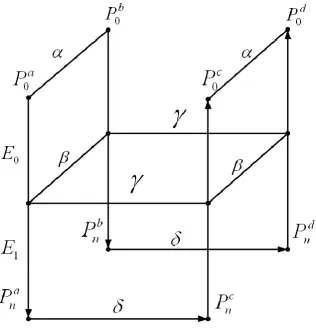
Figure 1: The boomerang attack
afterwards in key recovery step, where one tries to exploit known relations between input and output differences and values of found correct pairs in order to recover some key bits.
The boomerang distinguisher step works as follows (see fig. 1).
• Choose P0a and P0b = P0a ⊕α.
• Encrypt the texts: Pna = E(P0a, K) and Pnb = E(P0b, K).
• Compute the new ciphertexts Pnc = Pna ⊕δ, Pnd = Pnb ⊕δ.
• Decrypt the new ciphertexts P0c = E−1(Pnc, K), P0d = E−1(Pnd, K).
• If P0c ⊕ P0d = α store the quartet (P0a, P0b, P0c, P0d) in set Θ. We will call these “boomerang quartets”.
ciphertext.
The boomerang key recovery step works as follows. For each found boomerang quartet we suppose that
• (P0a, P0b) is a correct pair for the differential α →β,
• (P0c, P0d) is a correct pair for the differential α →β,
• (Pna, Pnc) is a correct pair for the differential δ → γ,
• (Pnb, Pnd) is a correct pair for the differential δ → γ,
and then exploit these assumptions to recover some bits of the master key. Note that one (or more) pair may not be correct but the quartet still satisfies the condition P0c ⊕P0d = α. We will call this a false boomerang quartet. Note also that the probability of finding a correct quartet is (pq)2 and the probability Pf alse of finding a false quartet can be estimated considering the encryption
algorithm as a random substitution. With well-chosen differentials for E0 and
E1 one can obtain the probability of finding a correct quartet being much greater
than of finding a false one.
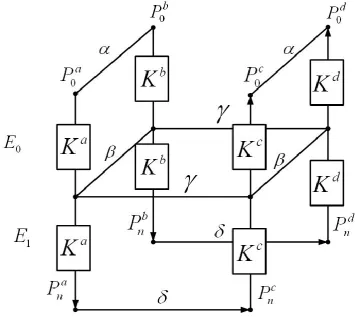
In the related-key boomerang attack we suppose that the attacker can en-crypt and deen-crypt each Pji, i ∈ {a, b, c, d} under the corresponding key Ki, where all the keys Ki are unknown to the attacker and related with fixed differ-ences, i.e. Ki⊕Kj = ∆Ki,j where the differences ∆Ki,j are set by the attacker (or are known).
Formally, in order to mount a boomerang attack under such assumptions we have to consider the bijective transformation F∗ : Vn×Vk 7→ Vn ×Vk, defined
asF∗(X, K) = (E(X, K), K). Here and further, saying “related-key differential α → β under related keys K1 and K2 = K1 ⊕∆K” we mean the differential
Figure 2: The related-key boomerang attack
4
Known results on related-key boomerang attack on
the GOST block cipher.
A related-key boomerang attack on the full GOST block cipher was presented in [3]. Here we describe this attack.
GOST block cipher is treated as a composition of two subciphers E0 and
E1, E = E0 ◦E1, where E0 represents the first 24 rounds and E1 — the last 8
rounds.
Consider four related keys Ki ∈ V256, Ki = (k1i, . . . , k8i), kij ∈ V32, i ∈
{a, b, c, d}, j ∈ 1,8, such that
∆K∗ = Ka⊕Kb = Kc ⊕Kd = (e31,0, e31,0, e31,0, e31,0),
∆K0 = Ka ⊕Kc = Kb ⊕Kd = (e31,0,0,0,0,0,0,0).
Here ei ∈ V32 denotes a word with all bits excepting i-th are zeroes.
Consider a related-key differential α → β = (0, e31) → (0, e31) for E0 and
the related-key boomerang distinguisher for GOST according to the description given above:
• Choose a plaintext pair P0a and P0b = P0a ⊕α.
• Encrypt P0a and P0b under related keys Ka and Kb respectively and obtain ciphertexts P32a = E(P0a, Ka) and P32b = E(P0b, Kb).
• Compute new ciphertexts P32c = P32a ⊕δ, P32d = P32b ⊕δ
• Decrypt P32c and P32d under respective related keys Kc and Kd.
• Obtain plaintexts P0c = E−1(P32c , Kc), P0d = E−1(P32d, Kd).
• Check if P0c⊕P0d = α. If true, (P0a, P0b, P0c, P0d) is said to form a related-key boomerang quartet.
For each related-key boomerang quartet one can make an assumption: Assumption 4
• (P0a, P0b) is a correct pair for the related-key differential α →β of E0.
• (P0c, P0d) is a correct pair for the related-key differential α →β of E0.
• (P32a, P32c ) is a correct pair for the related-key differential δ → γ of E1−1
• (P32b , P32d) is a correct pair for the related-key differential δ → γ of E1−1 Just as for the boomerang attack, we can find a false related-key boomerang quartet, which passes the distinguisher filtering condition, but the assumptions above are false.
Note that the paper [3] considers only one set of S-boxes, a so-called “set of Central Bank of Russian Federation”, which is equal to the set of S-boxes from the test case for Russian standard for cryptographic hash function (GOST R 34.11-94). For other sets of S-boxes this attack cannot be applied directly (in some cases). Later we will show that the attack may be applied to any set with a modification depending on S-boxes.
Algorithm 1
1. Choose 25.5 plaintext pairs P0a P0b = P0a ⊕(0, e31).
2. With a chosen plaintext attack scenario, encrypt the plaintexts under
re-lated keys and obtain the ciphertexts P32a = E(P0a, Ka), P32b = E(P0b, Kb). 3. Compute the new ciphertexts P32c = P32a ⊕(e7,0), P32d = P32b ⊕(e7,0)
4. With a chosen ciphertext attack scenario, decrypt the new ciphertext under
respective related keys P0c = E−1(P32c , Kc), P0d = E−1(P32d, Kd)
5. If P0c ⊕P0d = (0, e31). then store (P0a, P0b, P0c, P0d) in Θ.
6. Guess subkey ka1 at the bit positions 12 to 19. Set the corresponding related subkeys kc1 = k1a⊕e31, k1b = k1a, kd1 = k1b ⊕e31. Initialize a counter for each bit combination with zero.
(a) For each quartet in Θ partially decrypt Pa31, P31b , Pc31, Pd31.
(b) Check if Pa31 ⊕Pc31 = (0,0) and Pb31⊕Pd31 = (0,0).
(c) If true increase the counter for the used key bits by 1.
7. Record the round keys k1a, k1b, k1c, k1d with the largest counter value.
8. For a suggested ka1 do the exhaustive search for the remaining256−8 = 248. If the true 256-bit master key is suggested, output the master key. Otherwise
restart the exhaustive search with another k1a.
5
Analysis of the Attack
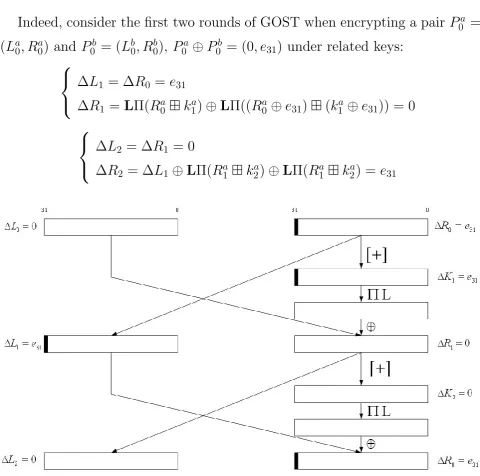
Indeed, consider the first two rounds of GOST when encrypting a pair P0a = (La0, Ra0) and P0b = (Lb0, R0b), P0a ⊕P0b = (0, e31) under related keys:
∆L1 = ∆R0 = e31
∆R1 = LΠ(R0ak1a)⊕LΠ((Ra0 ⊕e31)(k1a⊕e31)) = 0
∆L2 = ∆R1 = 0
∆R2 = ∆L1 ⊕LΠ(Ra1 k2a)⊕LΠ(Ra1 k2a) = e31
Figure 3: Related-key differential for E0
Fig. 3 explains the related-key differential for E0. Here rectangles represent
corresponding data blocks step-by-step. Filled regions mark bit positions with non-zero differences.
Thus, the probability of the related-key differential (0, e31) → (0, e31) for two
rounds of GOST is 1. Obviously, the probability of this differential remains the same for 8 rounds and consequently for 24 rounds.
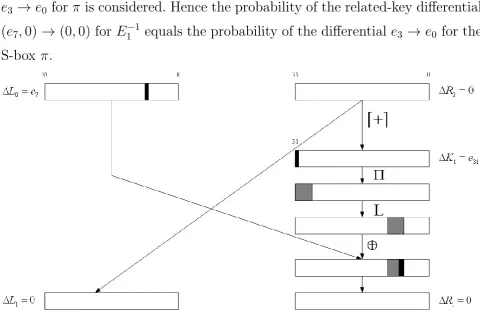
Now we move on to related-key differential (e7,0) → (0,0) for E1−1. In [3] it
In [3] the mentioned differential is supposed to take place in the first round ofE1−1 passing the zero output difference through the remaining 7 rounds. With a correct input pair we have
La32 ⊕LΠ(Ra32k1a) = Lc32 ⊕LΠ(Rc32kc1).
Taking into account that Lc32 = La32 ⊕ e7, Ra32 = Rc32, k1c = k1a ⊕ e31 this is
equivalent to
LΠ(Ra32ka1)⊕LΠ(Ra32 (k1a⊕e31)) = La32⊕L
a
32 = e7,
or, just the same
Π(R32a k1a)⊕Π((R32a k1a)⊕e31) =e28.
Let π : V4 → V4 denotes the S-box on high order bits, X denotes high
or-der 4-bit subword of X, Using this notation the last equation is equivalent to π(Ra32 k1a) ⊕π((Ra32k1a) ⊕ e3) = e0, so, in other words, the differential
e3 →e0 for π is considered. Hence the probability of the related-key differential
(e7,0) →(0,0) for E1−1 equals the probability of the differential e3 →e0 for the
S-box π.
Figure 4: Related-key differential forE1−1
positions with non-zero differences, and regions filled grey mark bit positions with possibly non-zero differences.
First we note that, in contradiction to [3], the probability of the differential for the S-box is not 2−2 but 2−3.
Secondly, the attack described above depends on S-boxes. In cases when different S-box set is used, the probability may vary. Moreover, it can be equal to zero or one, and in this case the attack is not applicable.
In the former case there aren’t any true boomerang quartets. For some S-boxes this problem can be solved. In order to do this, we have to explore the probabilities of differentials of a sort e3 →ω and choose one with non-zero (and
not equal to one) probability among them. After that we should consider the related-key differential (L[ω,0, ...,0],0) →(0,0) for E1−1.
The latter case is the worst one: the input difference e3 always produces
the same output difference and hence all key bit combinations will pass the filtering conditions. Therefore the attack will be equivalent to exhaustive key search. However such S-boxes have bad cryptographic properties, making the whole cipher vulnerable to differential and linear attacks and hence such S-boxes are unlikely to be used in practice.
In the rest of the paper we consider the same S-box set as in [3] for simplicity sake. For other S-box sets the attack can be easily adjusted (if possible), using the previous discussion, and will have the same complexity.
So, the probability of finding a boomerang quartet is (pq)2 = (1·2−3)2 = 2−6, the probability of finding a false quartet is supposed to be severely less.
Now we move to the analysis of the algorithm.
19] = kj1[12 ∼ 19] and Ri32[12 ∼ 19] = Rj32[12 ∼ 19] for all i, j ∈ {a, b, c, d}. Hence, the condition of the step 6(b) holds for all guessed bit combinations. So in step 7 we choose all bit combinations and in step 8 we find the master key by full 256 bit exhaustive search. Fig. 5 explains the discussion above. As
Figure 5: Partial decryption
before, regions filled black mark bit positions with non-zero differences and regions filled grey mark bit positions with possibly non-zero differences. Dash patterned regions mark bits which values we are able to compute by partial encryption.
6
Subkey recovery related-key boomerang attack on the
GOST block cipher
In the previous section we have shown that the “attack” presented by [3] in fact is equivalent to the exhaustive search. Still, with proper modifications the introduced related-key differentials are worth being concerned. In this section we introduce a related-key boomerang attack on GOST, which exploits these related-key differentials and recovers up to 31 bits of a master key.
Let k1i denote a true subkey and kbi
subkey filtering conditions: P31a ⊕P31c =(0,? 0) and P31b ⊕P31d =(0,? 0). Obviously, both equations hold for the true subkey (simply by a boomerang quartet con-struction). A non-zero difference can appear only if two inputs of the high order S-box form a wrong pair for the differential e3 → e0, i.e.
π((P32a k1a)[28 ∼31])⊕π((P32a ka1)[28 ∼ 31]⊕e3) =e0, (1)
but
π((P32a kb1a)[28 ∼31])⊕π((P32a kba1)[28 ∼ 31]⊕e3) 6= e0. (2) In other words, the last condition means that the high order 4-bit subword of the sum of the ciphertext and the true key differs from that of the sum of the ciphertext and the false key. It is possible if 4 high order bits of the true and false keys differ and also when the carry bits upcoming to the 28-th position of the sum differ for the true and false keys. Hence, the partial encryption must be performed on high order bits.
Note, that the keys k and k⊕e31 cannot be distinguished by this condition.
The next algorithm, which is actually a modification of algorithm 1, recovers 3 bits of k1a.
Algorithm 2
1. Choose 210 plaintext pairs P0a and P0b = P0a ⊕(0, e31).
2. Encrypt under related keys and obtain the ciphertexts P32a = E(P0a, Ka),
P32b = E(P0b, Kb).
3. Compute the new ciphertexts P32c = P32a ⊕(e7,0), P32d = P32b ⊕(e7,0) 4. Decrypt under related keys P0c = E−1(P32c , Kc), P0d = E−1(P32d, Kd)
5. If P0c ⊕P0d = (0, e31) store the quartet (P0a, P0b, P0c, P0d) in Θ.
6. Guess subkey k1a at positions 28 to 31. For each guessed bit combination initialize a counter with zero. Compute related subkeys k1c = k1a⊕e31, k1b =
(a) For each quartet in Θ compute Pa31, P31b , Pc31, Pd31 at corresponding bit positions
(b) Check if Pa31 ⊕Pc31=(0,? 0) and Pb31 ⊕Pd31=(0,? 0).
(c) If true, increase the counter by 1.
7. Record bit combinations k1a with the highest counter.
Remark 5 For each recorded k1a recover the remaining 256 −4 = 252 bits by the exhaustive search or using any other attack. If the right key is found then
stop. Otherwise choose another k1a and repeat the exhaustive search or attack.
Remark 6 The algorithm discards all but two bit combinations, since the
sub-keys k and k⊕e31 are indistinguishable by conditions (1) and (2).
Remark 7 The number of plaintext pairs to be chosen (210) is dictated by the tendency to provide the high rate of success. See section 8 for details.
The attack can be improved to recover 31 bits of k1a. Indeed, suppose that for some m ≤ 27 we have k1i[m + 1∼ 31] = ˆk1i[m+ 1 ∼ 31] and k1i[m] 6= ˆk1i[m]. If there exists such a related-key boomerang quartet that the plaintext P32a = (La32, Ra32,m) with an arbitrary La32 and
Ra32,m[j] =
{0,1}R, j = 28,31;
k1a[j]⊕1, j = m+ 1,27;
1, j = m;
0, j = 0, m−1;
then 4 high order bits of the sum of k1a and ˆk1a with this plaintext are differ-ent. Here {0,1}R denotes a random element of {0,1}, so there are 24 possible
different values of R32a ,m.
It follows from the previous statement that we have to, informally speaking, “throw a boomerang” backwards, starting not with chosen plaintexts, but with chosen ciphertexts (see fig. 6).
Figure 6: The inverse related-key boomerang attack.
Algorithm 3
1. Recover k1a[28 ∼30], using algorithm 2. Set k1a[31] = 0. 2. Initialize a counter ξ with 27.
3. Choose 210 ciphertext pairs P32a P32c = P32a ⊕ (e7,0), with all 24 possible values of Ra32 of a kind Ra32,ξ, defined above, and La32 takes 26 different arbitrary values.
4. Decrypt under related keys to obtain P0a = E−1(P32a, Ka), P0c = E−1(P32c , Kc).
5. Compute the new plaintexts P0b = P0a⊕(0, e31), P0d = P0c ⊕(0, e31).
6. Encrypt under related keys to obtain P32b = E(P0b, Kb), P32d = E(P0d, Kd). 7. Check if P32b ⊕P32d = (e? 7,0). If true, store the quartet (P32a, P32b , P32c , P32d) in
8. Consider two subkeys ka,1(0), ka,1(1)
ka,1 (l)[j] =
k1a[j], j = ξ + 1,31; l, j = ξ;
0, j = 0, ξ−1; .
9. Compute the related keys k1c,(l) = k1a,(l)⊕e31.
10. For each subkey ka,1 (l) initialize a counter with zero and
(a) For each quartet in Θ decrypt P31a, P31b .
(b) If P31a ⊕P31c = (0,? 0) increase the counter by 1.
11. Choose one of the k1a,(0), k1a,(1) with the largest counter value.
12. Set k1a[ξ] = k1a,(l)[ξ], for the chosen l.
13. If ξ = 0, then the subkey is recovered. Otherwise decrease counter ξ by 1 and go to step 3.
Remark 8 With found k1a recover the remaining 256− 32 = 224 bits by the exhaustive search or any other attack. If the right key is recovered output the
master key. Otherwise set k1a = k1a⊕e31 and recover the remaining bits.
Remark 9 As before, the number of plaintext pairs to be chosen (210) is dic-tated by the tendency to provide the high rate of success. See section 8 for
details.
7
Generalization of the attack
Now we present a generalized attack. Once the subkeyk1a is recovered, GOST is reduced to 30 rounds, since we are able to perform transformations of the first and the last round using the recovered subkey. In order to recover subsequent subkeys we will use different quartet of related keys, namely, to recover kta+1 assuming the subkeys k1a, ..., kta are known, we use the following quartet:
∆K0 = Ka ⊕Kc = Kb ⊕Kd = (0, ..., e31
t+1
,0, ...,0) (3) (In (3) all the 32-bit subwords of ∆K0 are zero except (t+ 1)-th that is equal to e31).
Using these subkeys we set up attacks similar to the algorithms 2 and 3:
Algorithm 4
1. Choose 210 plaintext pairs P0a and P0b = P0a ⊕(0, e31).
2. Encrypt under related keys and obtain the ciphertexts P32a = E(P0a, Ka),
P32b = E(P0b, Kb).
3. With known kij, j ∈ {a, b, c, d}, i∈ 1, t compute P32a−t, P32b −t
4. Compute the new intermediate texts P32c −t = P32a−t⊕(e7,0), P32d−t = P32b −t⊕
(e7,0)
5. With known kij, j ∈ {a, b, c, d}, i∈ 1, t compute P32c , P32d
6. Decrypt under related keys: P0c = E−1(P32c , Kc), P0d = E−1(P32d, Kd)
7. If P0c ⊕P0d = (0, e31) store the quartet (P0a, P0b, P0c, P0d) in Θ.
8. Guess subkey kta+1 at positions 28 to 31. For each guessed bit combination initialize a counter with zero. Compute related subkeys ktc+1 = kat+1 ⊕e31,
ktb+1 = kta+1, ktd+1 = kbt+1 ⊕e31 at the same positions.
(a) For each quartet in Θ using kij, j ∈ {a, b, c, d}, i ∈ 1, t compute
P32a−t, P32b −t
(b) Compute Pa32−t−1, Pb32−t−1, Pc32−t−1, Pd32−t−1 at corresponding positions (c) Check if Pa32−t−1 ⊕Pc32−t−1=(0,? 0) and Pb32−t−1 ⊕Pd32−t−1=(0,? 0).
(d) If true, increase the counter by 1.
Define Ra32−t,m as
R32a −t,m[j] =
{0,1}R, j = 28,31;
kta+1[j]⊕1, j = m+ 1,27;
1, j = m;
0, j = 0, m−1; Algorithm 5
1. Recover kta+1[28 ∼31] using algorithm 4. Set kta+1[31] = 0. 2. Initialize a counter ξ with 27.
3. Choose 210 intermediate text pairs P32a−t P32c −t = P32a−t ⊕(e7,0), with all
24 possible values of Ra32−t of a kind R32a −t,ξ, and La32−t takes 26 different arbitrary values.
4. Using kij, j ∈ {a, b, c, d}, i ∈ 1, t compute P32a, P32c
5. Decrypt under related keys to obtain P0a = E−1(P32a, Ka), P0c = E−1(P32c , Kc).
6. Compute the new plaintexts P0b = P0a⊕(0, e31), P0d = P0c ⊕(0, e31).
7. Encrypt under related keys to obtain P32b = E(P0b, Kb), P32d = E(P0d, Kd). 8. Using kij, j ∈ {a, b, c, d}, i ∈ 1, t compute P32b −t, P32d−t
9. Check if P32b −t ⊕P32d−t= (e? 7,0). If true, store (P32a−t, P32b −t, P32c −t, P32d−t) in
Θ.
10. Consider two subkeys ka,t+1(0), ka,t+1(1):
kta,+1(l)[j] =
kta+1[j], j = ξ + 1,31; l, j = ξ;
0, j = 0, ξ−1; .
12. For each key kta,+1(l) initialize a counter with zero and
(a) For each quartet in Θ using kij, j ∈ {a, b, c, d}, i ∈ 1, t compute
P32a−t, P32b −t
(b) Compute P32a−t−1, P32b −t−1
(c) Check if P32a−t−1 ⊕P32c −t−1=(0,? 0)
(d) If true, increase the counter by 1.
13. Choose one of the kta,+1(0), kta,+1(1) with the highest counter.
14. Set kta+1[i] = kta,+1(l)[i], for the chosen l.
15. If ξ = 0, then output the subkey. Otherwise decrease counter ξ by 1 and go to step 3.
There are two important observations regarding the generalized attacks. The first one deals with the false quartets. Algorithms 2-5 find the correct keys if, roughly speaking, the true quartets outnumber the false ones. Com-puter simulations show that true quartets appear with probability of about 2−6, as predicted. At the same time, the number of false quartets increases as the number of rounds reduces. Experiments show that differential trails for all found false quartets follow the boomerang structure, with the same trails for E0 (α → β = (0, e31) →(0, e31)), but different trails for E1−1.
As discussed above, the differential for E1−1 used in true quartets splits into 1R characteristic (e7,0) → (0,0) with probability 2−3 and (0,0) → (0,0)
char-acteristic the for remaining rounds with probability 1 and therefore the overall probability does not depend on the number of rounds in E1−1.
Differentials for E1−1 used in false quartets can as well be split into 1R char-acteristic (e7,0)→ ξ and ξ →χ for remaining rounds with some nonzero ξ and
algorithms 4 and 5 recover the subkey properly. Unfurtunately, further reduc-tion dramatically increases the number of false quartets which in turn makes the algorithms as “effective” as simple guessing.
The second observation is that algorithms 3 and 5 recover two possible subkey values: kta+1 and kta+1⊕e31, assuming that kai, i ∈ 1, t are chosen correctly.
Hence, we can build a binary subkey tree of height 6 and width 26. Each node at layer t corresponds to kta or kta⊕e31, where the value of kat is computed by
algorithm 3 or 5, assuming the keys kia, i ∈ 1, t−1, corresponding to the nodes in path from this node to the root, are determined correctly. Each path from a leaf to the root of the constructed tree corresponds to a set of six subkeys, one of which is the true set. Total number of such sets is 26. For each of the sets one can bruteforce the two remaining subkeys or use other cryptanalytic attacks to recover them.
8
Complexity and success rate of the presented attack
Here we explain our choice of data quantity and estimate time complexity and success rate of the algorithms.
Claim the success rate of our attack being near 1, namely τ = 1−10−4. We say that the algorithm 2,3,4 or 5 executed successfully, if it output only two possible bit combinations for algorithms 2 and 4 and only two possible subkeys for algorithms 3 and 5.
Let n denote the number of chosen plain- or ciphertext pairs given on input. We estimate the success rate of the algorithms 2 and 4 as
P1(n) = 1−(1−(pq)2)n
·(1−2−n) = 1−(1−2−6)n·(1−2−n). The success rate of the algorithms 3 and 5 is estimated as follows:
P2(n) = 1−(1−(pq)2)n
28
= 1−(1−2−6)n28.
six subkeys is (P1(n)P2(n))6. One can check that given n= N = 210 implies
(P1(N)P2(N))6 > τ.
That is why we chose data quantity of N = 210 pairs of text for algorithms 2, 3, 4, 5.
Time complexity of algorithm 2 isC1 = 210·(4+324 ) encryptions/decryptions.
The complexity of algorithm 3 is C2 = 28 · 210 · (4 + 322 ) + C1
encryp-tions/decryptions. Time complexity of algorithms 4 and 5 is C3(t) = 210 ·2t ·
(4 + 324 +t324 ) and C4(t) = 28·210 ·2t ·(4 + 322 +t324 ) +C3(t) respectively. Note
that C1 = C3(0) and C2 = C4(0).
Thus, we recover 192 bits of the master key with the presented related-key boomerang attack with time complexity
5
X
t=0
2t ·C4(t) ≈228
encryptions with success rate over τ = 1 − 10−4. The attack uses 14 related keys with fixed pairwise differences set by an attacker.
Using bruteforce attack for remaining subkeys results in total time complex-ity of
228+ 26 ·232 ·232 ≈271 encryptions.
Remark 10 One can easy see, that probability of any differential for any
bijec-tive 4-bit wide S-box is either equal to zero or is grater or equal to 2−3. Thus, for an arbitrary S-box set, time and data complexity of the modified attack is
the same, while the success rate can be equal or higher.
We suppose that the attacker can encrypt and decrypt some texts under four arbitrary and independently chosen secret keys. The probability that these four keys form a quartet suitable for applying the partial key recovery related-key boomerang attack (algorithms 2 and 3) is
P = 1· 1
2256 ·
1 2256 ·
1
2256 = 2
−256·3
= 2−768.
At the same time, one can simply “guess” a key with probability 2−256 2−768. The probability that 14 arbitrary and independently chosen keys form a specific set suitable for applying the general attack is
P = 2−256·13 = 2−3328.
One can study different attack scenarios, but in general, given the assumption of zero-knowledge about the keys for the attacker, the practical application of the related-key boomerang attack is doubtful, since it is based on a extremely rare event, often, as in previous example, much more infrequent than successful key-guessing.
9
Conclusion
In this paper we present the full key recovery attack on GOST block cipher that uses related-key boomerang technique. Previously, such kind of attack was presented in [3]. It considered a fixed set of S-boxes and recovered 8 bits of the master key. We show that, due to an error, the attack from [3] actually reduces to the exhaustive search.
the most problematic aspect of these attacks is the reliance on related keys, which is not universally accepted as a practical attack model. Certainly, the possibility of such attacks has to be examined in each specific implementation and mode of operation of a cipher, and new block ciphers have to be designed to resist such attacks. However, any related-key attack on a block cipher does not represent a fundamental obstacle to practical usage of the cipher.
References
[1] Biryukov A., Khovratovich D. Related-key Cryptanalysis of the Full AES-192 and AES-256. — Cryptology ePrint Archive, Report 2009/317, http://eprint.iacr.org/2009/317.pdf. — 2009.
[2] Dunkelman O., Keller N., Shamir A. A Practial-Time Attack on the A5/3 Cryptosystem Used in Third Generation GSM Telephony. — Cryptology ePrint Archive, Report 2010/013, http://eprint.iacr.org/2010/013.pdf. — 2010.
[3] Fleischmann Ewan, Gorski Michael, Huehne Jan-Hendrik, Lucks Stefan. Key recovery attack on full GOST block cipher with zero time and memory. — Published as ISO/IEC JTC 1/SC 27 N8229. — 2009.