AN ALGORITHMIC-BASED SOFTWARE CHANGE EFFORT PREDICTION MODEL USING CHANGE IMPACT ANALYSIS FOR SOFTWARE
DEVELOPMENT
MUHAMMAD SUFYAN BIN BASRI
A thesis submitted in fulfilment of the requirements for the award of the degree of Doctor of Philosophy (Software Engineering)
Advanced Informatics School Universiti Teknologi Malaysia
DEDICATION
ALHAMDULILLAH…
To Allah (SWT)
For my beloved mother and father
My dearest wife, Faizura Haneem Mohamed Ali
and children…
Luqman, Sakina, Hannah and Faheem
ACKNOWLEDGEMENT
Firstly, I would like to express my sincere gratitude and appreciation to my supervisors, Dr Mohd Nazri Kama and Dr Roslina Ibrahim, for the continuous support of my PhD study and related research, their patience, motivation, and immense knowledge. Their guidance helped me in all the time of research and writing of this thesis. I could not have imagined having a better advisors and mentors for my PhD study. I would like to thank them for encouraging my research and for allowing me to grow as a researcher.
Secondly, a special thanks to both my parents and my parents-in-law for all the sacrifices that you’ve made on my behalf. They have taught me the value of perseverance and always prayed for my success, in my study and my career. I would also like to thank my beloved wife and kids for their patience during the course of my PhD. Without my wife’s support, I would not have a dearest companion who spent sleepless nights with and was always my support in the moments when there was no one to answer my queries.
ABSTRACT
ABSTRAK
TABLE OF CONTENTS
CHAPTER TITLE PAGE
DECLARATION ii
DEDICATION iii
ACKNOWLEDGEMENT iv
ABSTRACT v
ABSTRAK vi
TABLE OF CONTENTS vii
LIST OF TABLES xi
LIST OF FIGURES xiii
LIST OF ABBREVIATIONS xv
LIST OF SYMBOLS xvii
LIST OF APPENDICES xix
1 INTRODUCTION 1
1.1 Background of the Research 2
1.2 Statement of the Problem 4
1.3 Research Questions 7
1.4 Research Objectives 8
1.5 Scopes of Research 8
1.5.1 Research Context 9
1.5.2 Research Challenges 9
1.6 Significance of the Research 10
1.7 Operational Definition 11
1.8 Organisation of the Thesis 13
2 LITERATURE REVIEW 15
2.2 Software Development Life Cycle (SDLC) 15 2.2.1 Traditional Methodology Software Development 16
2.2.1.1 Waterfall Model 17
2.2.1.2 Spiral Model 18
2.2.1.3 Rapid Application Development 19 2.2.1.4 Rational Unified Process (RUP) 20 2.2.2 Agile Methodology Software Development 22
2.2.2.1 Extreme Programming (XP) 23
2.2.2.2 Scrum 23
2.2.2.3 Agile Unified Process (AUP) 24
2.3 Software Change Management Process 25
2.3.1 Software Change Management in Traditional Software
Development 26
2.3.2 Software Change Management in Agile Software
Development 30
2.4 Change Impact Analysis 30
2.4.1 Change Impact Analysis Types 31
2.4.2 Integrated Change Impact Analysis 35
2.4.3 Change Impact Analysis in Agile Methodology
Software Development 38
2.5 Change Impact Analysis for Software Development Phase 39 2.6 Algorithmic and Non Algorithmic Software Effort Prediction
Model 43
2.6.1 Effort Prediction in Traditional Software Development 45 2.6.2 Effort Prediction in Agile Software Development 50
2.6.3 Software Change Effort Prediction 53
2.7 Integrating Change Impact Analysis with Effort Prediction 55
2.8 Summary 59
3 RESEARCH METHODOLOGY 60
3.1 Introduction 60
3.2 Research Design 60
3.3 Operational Framework 64
3.3.3 Model Development 70
3.3.3.1 Conceptual Model 71
3.3.3.2 Model Construction 74
3.3.4 Prototype Tool Development 75
3.3.5 Data Collection and Analysis 76
3.3.5.1 Software Projects 76
3.3.5.2 Traditional Methodology Software Projects 77 3.3.5.3 Agile Methodology Software Projects 78
3.3.6 Findings and Evaluation 78
3.3.6.1 Evaluation Discussion and Final Findings 79
3.3.6.2 Write Final Report 80
3.4 Summary 80
4 PROPOSED CHANGE EFFORT PREDICTION MODEL 81
4.1 Introduction 81
4.2 Proposed Change Effort Prediction Model 81
4.2.1 Step 1: Change Request Evaluation 84
4.2.2 Step 2: Change Impact Analysis 84
4.2.3 Step 3: Change Effort Estimation 88
4.3 Software Change Effort Prediction Prototype 95 4.3.1 Step 1: Import Class Interactions Prediction (CIP) 96 4.3.2 Step 2: Acquire Change Request (CR) 97
4.3.3 Step 3: Perform Impact Analysis 98
4.3.4 Step 4: Estimating Change Effort 103
4.3.5 Step 5: Analyse Results 104
4.4 The Model and Prototype Relationship 105
4.5 Summary 106
5 RESULTS AND DISCUSSIONS 107
5.1 Introduction 107
5.2.1 Subjects and Case Selections 108
5.2.2 Data Collection 108
5.2.3 Evaluation Metrics 109
5.2.4 Evaluation Design 110
5.2.4.1 First Experiment - Applicability of CEPM 111 5.2.4.2 Second Experiment – Effort Prediction
Accuracy Improvement by CEPM 114
5.3 Threats to Validity 116
5.3.1 Construct Validity 116
5.3.2 External Validity 117
5.4 First Experimental Analysis Results - Applicability of CEPM 117 5.5 Second Experimental Analysis Results – Effort Prediction
Accuracy Improvement by CEPM 126
5.5.1 Set 1: Traditional methodology effort estimation model accuracy comparison for change implementation 127 5.5.2 Set 2: Agile methodology effort estimation model
accuracy comparison for change implementation 133
5.6 Discussion 141
5.6.1 Applicability of CEPM in Traditional and Agile
Methodology Software Projects 141
5.6.2 Effort Prediction Accuracy Improvement by CEPM as compared to the existing effort estimation models
(algorithmic and non-algorithmic) 144
5.7 Summary 145
6 CONCLUSION AND RECOMMENDATIONS 147
6.1 Research Summary 147
6.2 Research Contribution 151
6.3 Future Works 152
REFERENCES 154
LIST OF TABLES
TABLE NO TITLE PAGE
2.1 Agile Unified Process (AUP) Discplines (Ambler, 2006) 24 2.2 Change Request Specification (Sommerville, 2010) 28
2.3 Change Impact Analysis Comparison 34
2.4 Integrated Techniques of Change Impact Analysis 37
2.5 Summary of current impact analysis technique 42
2.6 COCOMO II Scale Factor (Boehm, 2000) 46
2.7 COCOMO II Cost Driver (Boehm, 2000) 46
2.8 COCOMO II Calibrated Value 49
2.9 Algorithmic Model of effort estimation in agile software
development 53
2.10 Change Effort Prediction Attributes by Chua and Verner
(2010) 54
2.11 Change Type Values 58
3.1 Research Design Decision (Wohlin and Aurum, 2014) 62
3.2 Details of Operational Framework for Phase 1 66
3.3 Details of Operational Framework for Phase 2 67
3.4 Experimental Design Characteristics applied in this research 69
3.5 Details of Operational Framework for Phase 3 71
3.6 Details of Operational Framework for Phase 4 75
3.7 Details of Operational Framework for Phase 5 76
3.8 Case Selection of Traditional Software Projects 77
3.9 Case Selection of Agile Software Projects 78
4.3 Waterfall-Based Phase Weight Distribution (Yang et al.,
2008) 94
4.4 Estimated Values for the Multipliers for Waterfall-Based
SDLC 94
4.5 Regular Expression Table 101
4.6 The Model and Prototype Mapping 106
5.1 Analysis Items Description 113
5.2 Traditional Methodology Software Projects Experiment
Result 118
5.3 Agile Methodology Software Projects Experiment Result 121
5.4 Overall MMRE and PRED value 124
5.5 Traditional Methodology Effort Prediction Model
Comparison 127
5.6 Shapiro-Wilk Test for Second Experiment (Traditional
methodology) 131
5.7 Independent Samples Mann Whitney U Test for Traditional
methodology 132
5.8 Agile Methodology Effort Prediction Model Comparison 134 5.9 Shapiro-Wilk Test for Second Experiment (Agile
methodology) 138
5.10 Independent Samples Mann-Whitney U Test for Agile
LIST OF FIGURES
FIGURE NO TITLE PAGE
1.1 Research Context 9
2.1 Waterfall model with feedback loops by Royce’s (Royce,
1987) 17
2.2 Boehm's spiral life-cycle (Boehm, 1986) 18
2.3 Prototyping approach used by RAD (Martin, 1991) 20 2.4 RUP model (Jacobson et al., 1999; Khan and Beg, 2013) 21
2.5 Agile Life Cycle (Popli and Chauhan, 2014) 22
2.6 Agile Unified Process (AUP) Lifecycle (Ambler, 2006) 25 2.7 Change Management Process (Small and Downey, 2001) 26
2.8 Change management process (Sommerville, 2010) 27
2.9 Structure of impact analysis process (Arnold and Bohner,
1993) 31
2.10 General Structure of SDP-CIAF (Kama and Azli, 2012) 42 2.11 Change Effort Prediction Model (CEPM) Conceptual Model 56 3.1 Decision points introduced by Wohlin and Aurum (2014) 61
3.2 Research Design adapted from Creswell (2003) 63
3.3 Operational Framework 65
3.4 Software Change Effort Prediction Conceptual Model 72
4.1 Change Effort Prediction Model (CEPM) 83
4.2 CEPM Step 1: Change Request Evaluation 84
4.3 CEPM Step 2: Change Impact Analysis 85
4.4 CEPM Step 3: Change Effort Estimation 89
4.5 Change Effort Prediction Prototype Main Form 95
4.6 Import CIP 96
4.8 Static Change Impact Analysis 98
4.9 Impacted Class Purification Concept 99
4.10 Impacted Class Purification Result 99
4.11 Change Impact Analysis Result 102
4.12 Change Effort Prediction 104
4.13 Change Effort Prediction Result Analysis 105
5.1 Bar Chart of Mean MRE produced by CEPM vs. Change
Type 125
5.2 Histogram of MRE value produced by CEPM 130
5.3 Histogram of MRE value produced by COCOMO II 130
5.4 Boxplot Graph of CEPM and COCOMO II 133
5.5 Histogram of CEPM MRE value for Agile software projects 137 5.6 Histogram of Expert Based MRE value for Agile software
projects 137
LIST OF ABBREVIATIONS
AUP - Agile Unified Process
CASE - Computer-aided Software Engineering CEPM - Change Effort Prediction Model CDF - Class Dependency Filtration CIA - Change Impact Analysis CIP - Class Interaction Prediction
CIP-IPF - Class Interaction Prediction – Impact Prediction Filter CISE - Change Impact Size Estimation
COCOMO II - Constructive Cost Model II DAG - Directed Acyclic Graph
FP - Function Point
FPA - Function Point Analysis ICP - Impacted Class Purification JAD - Joint Application Development
LOC - Line of Codes
MDA - Method Dependency Addition MDF - Method Dependency Filtration MMRE - Mean Magnitude Relative Error MRE - Magnitude Relative Error PRED - Percentage of Prediction
RAD - Rapid Application Development
RE - Relative Error
RUP - Rational Unified Process SCM - Software Change Management SDLC - Software Development Life Cycle
SLOC - Single Line of Codes
UCM - Use Case Maps
UCP - Use Case Point
UML - Unified Modelling Language
LIST OF SYMBOLS
CISIC - Change impact size of the impact class
rIC - Any related requirement that map to the impact class R - Requirement’s quantity that related to the impact class AT - Affection type of the change impact, either direct or indirect CT - Change type of the change request
DS - Development status of the project
PM - Original estimated effort using COCOMO II in man per month IE - Initial effort prediction using COCOMO II. It is equivalent to
PM in man per month
UE - Updated effort prediction after change implementation in man per month
CP - Change priority multiplier or change request priority E - Relative effort value
S - Original size prediction of the code
CS - Predicted code size after change implementation A - COCOMO II multiplicative constant
B - COCOMO II constant variables SF - COCOMO II scale driver values SIC - Size of the impacted class IC
TDEV - Calendar time in months
C - COCOMO II constant
SCED - COCOMO II scheduling factor SE - COCOMO II schedule equation
D - COCOMO II constant
LIST OF APPENDICES
APPENDIX TITLE PAGE
A CIP File Sample 166
B Change Request Sample 181
C Expert Based Estimation for Agile Software Project 183
CHAPTER 1
INTRODUCTION
Software process consists of several defined activities which separated into distinct stages during software development project in order to deliver a software product with better quality and management. This process is also known as Software Development Life Cycle (SDLC) which usually starts from planning, requirement gathering, analysis, design, implementation, testing and ends with deployment. Foundational to this, there are two types of SDLC methodology mostly adopted; Traditional methodology and Agile methodology. Traditional methodology practices emphasize on detailed planning, comprehensive documentation and extensive design (Awad, 2005). On the contrary, Agile methodology practices customer collaboration over detailed planning, emphasizes on the working software over the comprehensive documentation and values individual interactions over extensive processes and design (Beck et al., 2001). Regardless of any methodology adopted, the software project management is required with the intent of better planning, monitoring and control for the software development efforts. Software development efforts planning or estimation in a software process is one of the important criteria to deliver a successful software development project (Lehtinen et al., 2014).
software effort estimation techniques to date. However, most of the techniques were proposed to estimate the development work at the beginning of software development phase based on pre-defined requirements. However, during development phase, the requirement might change due to the dynamic nature of any software projects. These changes will give an impact to the software project management in controlling the software development effort. Therefore, effort estimation for the requirement changes is critical to software project management in providing the final deliverables of software project. At present, there is lack of evidence of the current effort estimation model especially for requirement changes during software development phase.
This thesis presents a new change effort prediction model that can be used in both Traditional and Agile methodologies software projects. The new model identifies and considers the related factors that contribute to the effort estimation for requirement changes during software development phase.
This chapter describes the background of the research, problem statement, research questions, objectives, scope of research, significance of the study and thesis organization.
1.1 Background of the Research
Kaur and Sengupta (2013) states that the most common reasons for project failure are rooted in the project management process itself which include identified estimation mistakes, unclear project goals and objectives, and project requirement changing during the project. In any software development project, the software project manager is the main role who is responsible towards the software project success or failure. One of the main criteria of a successful software project manager is, responsible in managing the software requirement changes and hence justifies the change acceptance decisions made.
Change request may occur at any point in SDLC (Chen and Chen, 2009; Nurmuliani et al., 2006). It is important to manage the changes in the software to meet the evolving needs of the customer and hence, satisfy them (Bennett and Rajlich, 2000; Brooks Jr, 1956; Finkelsteiin and Kramer, 2000; Kotonya and Sommerville, 1998; Pfleeger and Bohner, 1990). Introducing software changes during software development phase may need to identify the impacts to the software artifacts and consequences to the efforts due to the software change. Accepting too many changes might lead to project cost overrun and delay. Rejecting too many changes may cause customer dissatisfaction.
While this is the case of Traditional methodology, where software project manager has the option to accept or reject the change request, it is the opposite in the case of modern SDLC such as Agile methodology. In view of the change request, Agile methodology gives high priority on accepting changes at any point of time throughout the software development process compared to the Traditional methodology (Beck et al., 2001). Henceforth, an efficient software project management and change management in Agile methodology are more crucial, and accurate effort estimation are not the second option in ensuring a software project success.
predicting the processes and activities required in terms of work, resources and time in implementing the changes (Asl and Kama, 2013; Bee Bee, 2010; Chua and Verner, 2010).
Verner et al. (2007) highlighted it is important to software project manager to obtain enough information during estimation process in order to ensure the project success. In the context of requirement changes, the impacts to the software artifacts is one of the required information. Software artifacts include documents, data and source code or class are subjected to impact due to the changes. During software development phase, some documents may subject to update and review process which requires resources effort. In case of source code or class, some classes may still be under development state or not developed at all. Software project manager has the difficulties to make the decision whether to implement or discard the changes due to inconsistent states of software artifacts during software development phase.
Another essential point, the change effort prediction for software development phase also need to consider is the effort distribution of SDLC methodology adopted for a software project. Few earlier studies highlighted the importance of phase wise effort estimation to achieve more accurate results (Chatzipetrou et al., 2015; Choudhari and Suman, 2012; Yang et al., 2008). For instance, during requirement phase in the Traditional methodology i.e. Waterfall model, the effort allocation for coding might be zero, but in the Agile methodology, coding effort must be allocated accordingly. Additionally, effort estimation for requirement changes also needs to consider the inconsistent states of the artifacts during software development phase.
1.2 Statement of the Problem
usually recorded a low rate of changes acceptance due its detailed planning, comprehensive documentation and extensive design (Awad, 2005). Meanwhile, Agile methodology gives high priority on accepting changes at any point of time throughout the development process due to its environment of incremental elaboration to fulfil the customer satisfaction (Awad, 2005; Stålhane et al., 2014). Regardless the SDLC models adopted by the software development projects, either Traditional or Agile methodology, it is crucial in managing the changes during software development phase in order to meet and satisfy the requirements volatility of the customer (Bennett and Rajlich, 2000; Brooks Jr, 1956; Finkelsteiin and Kramer, 2000; Kotonya and Sommerville, 1998; Pfleeger and Bohner, 1990). Nevertheless, accepting too many changes can drag the project timeline and increase project cost while declining the change request from the customer may trigger dissapointment. Hence, it is a very crucial needs for a software project manager to manage the ever changing requirements as well as make the best decision for the software projects success. One of the input that can assist and support the software project manager to make the best decision is the change effort prediction during software development phase.
methodology software projects (Keaveney and Conboy, 2006; Popli and Chauhan, 2014) due to the easiness and simplicity in producing effort estimation result without the need of specific tools or techniques (Huang et al., 2008). Although several extensions have been developed based on the current effort estimation models (Ahmed et al., 2012; Lazić and Mastorakis, 2009; Merlo–Schett et al.; Yang et al., 2006), but those extensions are still lacking in considering the change effort prediction during software development phase.
The integration of change impact analysis and effort estimation may improve the accuracy of change effort prediction. According to Nurmuliani et al. (2006), some change request attributes such as change request type and change requirements have direct effect on the predicted effort to implement that change. Furthermore, Nurmuliani et al. (2006) stated that his biggest challenges in his study were that there is no formal impact analysis method to support the change effort prediction, and there are no traceability models for the relations between requirements and classes. Nevertheless, there is at present, no satisfactory explanation of change impact analysis and software effort estimation integration has been provided. Furthermore, most of the current researches only focus on the change impact analysis for software maintenance phase and less attention had been given in software development phase (Kama, 2013a). Hence, it also implied that little attention has been paid to change effort prediction during software development phase.
one class to another class, yet the approach still did not consider the inconsistence states of the class artifacts. The failure to acknowledge the existence of these type of artifacts will lead to inaccurate estimate and hence, contribute to either project failure or customer dissapointment.
Thus, this research was inspired by the research works of Asl and Kama (2013); Kama and Azli (2012) in which they consider the existence of the inconsistence states of the software artifacts in their change impact analysis approach. This research presents a new algorithmic change effort prediction model by including the principal of the change impact analysis approach that consider the inconsistence states of software artifacts to one of the established effort estimation model for software development phase. This new algorithmic change effort prediction is expected to be applicable in Traditional and Agile methodology software projects and may improve the accuracy of change effort prediction as compared to current effort estimation models.
1.3 Research Questions
This research deals with the main question of “How to improve the accuracy of software change effort prediction for software development by including a change impact analysis into an effort estimation model that applicable for both Traditional and Agile methodologies?”
To provide an effective solution for the main research question, several sub-questions are constructed:
i. What are the existing software change effort prediction and change impact analysis techniques used for software development?
methodology software development?
1.4 Research Objectives
The aim of this research is to propose a new algorithmic-based software change effort prediction model using change impact analysis which could be used to improve the accuracy of the change effort prediction in the Traditional and Agile methodology software projects and to evaluate the applicability and accuracy improvement of the proposed model. Hence to achieve the aim, three objectives are identified as follow:
i. To propose an algorithmic-based software change effort prediction model using a change impact analysis technique for software development.
ii. To build a software change effort prediction prototype that implements the algorithmic-based software change effort prediction model for software development.
iii. To evaluate the applicability and accuracy improvement of the algorithmic-based software change effort prediction model for Traditional and Agile methodology software development as compared to the existing effort prediction model.
1.5 Scopes of Research
1.5.1 Research Context
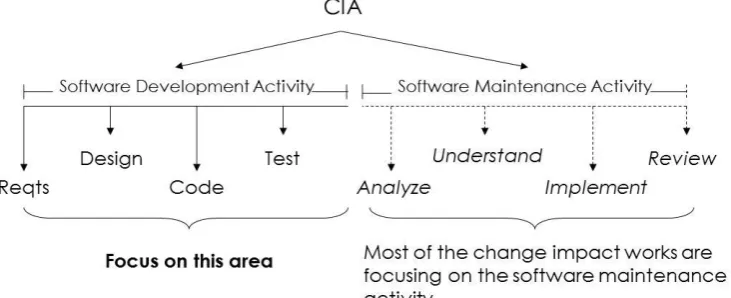
The research aims to produce a software change effort prediction model using existing change impact analysis for software development phase as in Figure 1.1.
Figure 1.1 Research Context
Most of change impact analysis techniques were developed to support software evolution or requirement changes during maintenance phase. However, this research only focuses on impact analysis techniques that suitable for software development phase. In general, software development phase differs from software maintenance phase due to the existence of inconsistent states of software artifacts such as partially developed classes.
1.5.2 Research Challenges
Real software projects – Real software projects require participation from business organization or industry. Since this research might not be able to benefit them directly, it is difficult to capture and collect relevant data for this study. However, based on experiences of the author, who had involved in the software industry for more than 10 years, access to real software projects is unpretentious.
Sufficient documentation – Generally, documentation involves include the change request form, software requirements and software design documentation, source code and progress report. Meanwhile, in the case for Agile methodology the documentation involves may include the product backlogs and sprint backlogs.
Platform / Language – Software development might be created using certain programming platform and language. Since this research involves dynamic analysis process which involves the dynamic artifacts at class level, it is difficult to develop a prototype that will be able to handle all types of programming platform and language. Thus this research only focuses on a single or two programming platform and language that the author familiar with, to develop a prototype and produce the evaluation results to demonstrate the proposed model.
1.6 Significance of the Research
(1) Traditional methodology; and (2) Agile methodology. The effort to implement the requirement changes need to be assessed precisely in order to support the change acceptance decision during software development phase. Additionally, it will support for better planning and prioritization of the requirements implementation during the Traditional and Agile methodology software development.
Next, most change acceptance decision assessment during software development phase is based on change impact analysis techniques. The change impact analysis examines the potential impacts by assessing current state of software artifacts such as requirement specifications and source code during software development phase. By realizing the significance of the change impact analysis, the effectiveness of the development work prediction will be expected to be improved by including the current change impact analysis into the new change effort prediction model during software development phase.
1.7 Operational Definition
The operational definitions of terminologies used in this research are presented below:
Traditional methodology
: Describe one of the process to develop a software that practices detailed planning, comprehensive documentation and extensive design
development software or in short software process. Sometimes also known as Software Development Lifecycle (SDLC)
Software
development phase
: Identify the stages of the software process in developing a software. The stages may start from requirement, analysis, design, implementation, testing until deployment.
Algorithmic model : A formal technique that apply algorithms and formulas in order to derive a result of the estimation calculation.
Non-algorithmic model
: An informal technique that are not using any algorithms or formal methods and / or formulas in deriving the estimation result.
Change : The modification or adjustment that occurs during software development phase, which may involve the requirement or the software being developed.
Effort prediction or estimation
: A process of predicting the amount of work and task required to develop a software that usually described in the form of man/days or man/hours.
Change impact analysis
Change effort prediction or estimation
: A process of predicting the amount of work or task required in implementing the modification that occurred.
Magnitude Relative Error (MRE)
: An absolute value that was derived from the difference between the estimated value as compared to the actual value.
Applicability : The degree of how much the new model is relevant to the Traditional and Agile methodology
Accuracy : The degree of precision of the estimated effort as compared to the actual effort
1.8 Organisation of the Thesis
This thesis comprises of six chapters. This chapter gives an overview of the research area. It also includes the research background, problem statement, research questions, objectives of the research, and the scope of the research. Then it is followed
by the significance of the research and finally it outlines the organisation of this thesis.
Chapter Two discusses the comprehensive review of the literature.
Chapter Three describes the research methodology used in conducting this research.
REFERENCES
Agarwal, N., and Rathod, U. (2006). Defining ‘success’ for software projects: An exploratory revelation. International Journal of Project Management, 24(4), 358-370.
Ahmed, N., Asim, M. R., and Qureshi, M. (2012). A step forward to component-based software cost estimation in object-oriented environment. arXiv preprint arXiv:1202.2511.
Ambler, S. W. (2006, 13/5/2006). The Agile Unified Process (AUP). v1.1.
Retrieved 25/1/2016, 2016, from
http://www.ambysoft.com/unifiedprocess/agileUP.html
Anandhi, V., and Chezian, R. M. (2014, 6-7 March 2014). Regression Techniques in Software Effort Estimation Using COCOMO Dataset. Paper presented at the
Intelligent Computing Applications (ICICA), 2014 International Conference on, 353-357.
Ani, Z. C., and Basri, S. (2013). A Case Study of Effort Estimation in Agile Software Development Using Use Case Points. Science International, 25(4). Arnold, R. S., and Bohner, S. A. (1993, 27-30 Sep 1993). Impact analysis-Towards a
framework for comparison. Paper presented at the Software Maintenance
,1993. CSM-93, Proceedings., Conference on, 292-301.
Asl, M. H., and Kama, N. (2013, 4-7 June 2013). A Change Impact Size Estimation Approach during the Software Development. Paper presented at the Software
Engineering Conference (ASWEC), 2013 22nd Australian, 68-77.
Attarzadeh, I., Mehranzadeh, A., and Barati, A. (2012, 24-26 July 2012). Proposing an Enhanced Artificial Neural Network Prediction Model to Improve the
Accuracy in Software Effort Estimation. Paper presented at the
Awad, M. (2005). A comparison between agile and traditional software development methodologies. University of Western Australia.
Bardsiri, V. K., Jawawi, D. N. A., Bardsiri, A. K., and Khatibi, E. (2013). LMES: A localized multi-estimator model to estimate software development effort. Engineering Applications of Artificial Intelligence(0).
Beck, K. (2000). Extreme programming explained: embrace change: Addison-Wesley Longman Publishing Co., Inc.
Beck, K., Beedle, M., Bennekum, A. v., Cockburn, A., Cunningham, W., Fowler, M., et al. (2001). Manifesto for Agile Software Development. from http://www.agilemanifesto.org/
Bee Bee, C. (2010, 22-27 Aug. 2010). Rework Requirement Changes in Software Maintenance. Paper presented at the Software Engineering Advances
(ICSEA), 2010 Fifth International Conference on, 252-258.
Benington, H. D. (1987). Production of large computer programs. Paper presented at the Proceedings of the 9th international conference on Software Engineering.
Bennett, K. H., and Rajlich, T. (2000). Software maintenance and evolution: a roadmap. Paper presented at the Proceedings of the Conference on The
Future of Software Engineering.
Bhalerao, S., and Ingle, M. (2009). Agile estimation using CAEA: A comparative study of agile projects. Paper presented at the Proceedings of International
Conference on Computer Engineering and Applications (ICCEA 2009). Boehm, B. (1986). A spiral model of software development and enhancement.
SIGSOFT Softw. Eng. Notes, 11(4), 14-24.
Boehm, B., Clark, B., Horowitz, E., Westland, C., Madachy, R., and Selby, R. (1995). Cost models for future software life cycle processes: COCOMO 2.0. Annals of Software Engineering, 1(1), 57-94.
Boehm, B. W. (1981). Software Engineering Economics: Prentice Hall PTR. Boehm, B. W. (2000). Software Cost Estimation with Cocomo II: Prentice Hall. Bohner, S. A. (2002a, 5-6 Dec. 2002). Extending software change impact analysis
into COTS components. Paper presented at the Software Engineering
International Conference on, 263-272.
Bolar, K., and Dastidar, S. G. (2008). Estimating Effort in Agile Software Development Using FPA and COCOMO II. ICFAI Journal of Systems Management, 6(4), 17.
Breech, B., Tegtmeyer, M., and Pollock, L. (2006, 24-27 Sept. 2006). Integrating Influence Mechanisms into Impact Analysis for Increased Precision. Paper
presented at the Software Maintenance, 2006. ICSM '06. 22nd IEEE International Conference on, 55-65.
Brooks Jr, F. (1956). No Silver Bullet - Essence and Accident in Software Engineering.
Cai, H., Santelices, R., and Xu, T. (2014, June 30 2014-July 2 2014). Estimating the Accuracy of Dynamic Change-Impact Analysis Using Sensitivity Analysis.
Paper presented at the Software Security and Reliability (SERE), 2014 Eighth International Conference on, 48-57.
Chatzipetrou, P., Papatheocharous, E., Angelis, L., and Andreou, A. S. (2015). A multivariate statistical framework for the analysis of software effort phase distribution. Information and Software Technology, 59, 149-169.
Chen, C.-Y., and Chen, P.-C. (2009). A holistic approach to managing software change impact. Journal of Systems and Software, 82(12), 2051-2067.
Choudhari, J., and Suman, U. (2012). Phase wise effort estimation for software maintenance: an extended SMEEM model. Paper presented at the
Proceedings of the CUBE International Information Technology Conference. Chua, B. B., and Verner, J. (2010). Examining Requirements Change Rework Effort:
A Study. arXiv preprint arXiv:1007.5126.
Chua, Y. P. (2006). Asas Statistik Penyelidikan (2 ed.): McGrraw-Hill (Malaysia). Cleland-Huang, J. (2012). Traceability in Agile Projects. In J. Cleland-Huang, O.
Gotel and A. Zisman (Eds.), Software and Systems Traceability (pp. 265-275): Springer London.
Cockburn, A. (2002). Agile software development: Addison-Wesley Longman Publishing Co., Inc.
Creswell, J. W. (2003). Research Design: Qualitative, Quantitative, and Mixed Methods Approaches: SAGE Publications.
Creswell, J. W. (2011). Educational Research: Planning, Conducting, and Evaluating Quantitative and Qualitative Research: Pearson.
Creswell, J. W. (2013). Research design: Qualitative, quantitative, and mixed methods approaches: Sage.
Danhua, S., Khurshid, S., and Perry, D. E. (2009, 14-17 April 2009). Semantic Impact and Faults in Source Code Changes: An Empirical Study. Paper
presented at the Software Engineering Conference, 2009. ASWEC '09. Australian, 131-141.
Dieste, O., Juristo, N., Moreno, A. M., Pazos, J., and Sierra, A. (2001). Conceptual Modeling in Software Engineering and Knowledge Engineering: Concepts, Technqiues and Trends. In Handbook of Software Engineering and Knowledge Engineering (pp. 733-766).
Drew Procaccino, J., Verner, J. M., Overmyer, S. P., and Darter, M. E. (2002). Case study: factors for early prediction of software development success. Information and software technology, 44(1), 53-62.
Faria, P., and Miranda, E. (2012, 17-19 Oct. 2012). Expert Judgment in Software Estimation During the Bid Phase of a Project -- An Exploratory Survey.
Paper presented at the Software Measurement and the 2012 Seventh International Conference on Software Process and Product Measurement (IWSM-MENSURA), 2012 Joint Conference of the 22nd International Workshop on, 126-131.
Farr, L., and Zagorski, H. J. (1964). Factors that Affect the Cost of Computer Programming. Volume Ii. a Quantitative Analysis: DTIC Documento.
Document Number)
Fasolino, A. R., and Visaggio, G. (1999). Improving software comprehension through an automated dependency tracer. Paper presented at the Program
Comprehension, 1999. Proceedings. Seventh International Workshop on, 58-65.
Febbraro, N., and Rajlich, V. (2007, 13-17 Aug. 2007). The Role of Incremental Change in Agile Software Processes. Paper presented at the Agile
Eng., 29(5), 925-945.
Finkelsteiin, A., and Kramer, J. (2000). Software engineering: a roadmap. Paper presented at the Proceedings of the conference on The future of Software Engineering, 3-22.
Fojtik, R. (2011). Extreme Programming in development of specific software. Procedia Computer Science, 3(0), 1464-1468.
Garcia, C. A. L., and Hirata, C. M. (2008). Integrating functional metrics, COCOMO II and earned value analysis for software projects using PMBoK.
Paper presented at the Proceedings of the 2008 ACM symposium on Applied computing.
Ghazarian, A. (2008). Traceability patterns: an approach to requirement-component traceability in agile software development. Paper presented at the
Proceedings of the 8th conference on Applied computer scince.
Hall, N. (2007). R. A. Fisher and his advocacy of randomization. Journal of the History of Biology, 40(2), 295-325.
Hassine, J. (2015). Early modeling and validation of timed system requirements using Timed Use Case Maps. Requirements Engineering, 20(2), 181-211. Hassine, J., Rilling, J., Hewitt, J., and Dssouli, R. (2005, 5-6 Sept. 2005). Change
impact analysis for requirement evolution using use case maps. Paper
presented at the Principles of Software Evolution, Eighth International Workshop on, 81-90.
Haugen, N. C. (2006, 23-28 July 2006). An empirical study of using planning poker for user story estimation. Paper presented at the Agile Conference, 2006, 9
pp.-34.
Huang, S.-J., Chiu, N.-H., and Chen, L.-W. (2008). Integration of the grey relational analysis with genetic algorithm for software effort estimation. European Journal of Operational Research, 188(3), 898-909.
Humayun, M., and Gang, C. (2012). Estimating Effort in Global Software Development Projects Using Machine Learning Techniques International Journal of Information and Education Technology, Vol. 2, No. 3.
Paper presented at the IASTED Conf. on Software Engineering, Austria, 124-131.
Ibrahim, S., Idris, N. B., Munro, M., and Deraman, A. (2005b). Integrating Software Traceability for Change Impact Analysis. Arab International Journal of International Technology, 2(4), 301-308.
Ibrahim, S., Idris, N. B., Munro, M., and Deraman, A. (2006, June 26-29). A Software Traceability Validation For Change Impact Analysis of Object
Oriented Software. Paper presented at the Software Engineering Research
and Practice, Las Vegas, 453-459.
IEEE Standard for Software Configuration Management Plans. (2005). IEEE Std 828-2005 (Revision of IEEE Std 828-1998), 1-30.
Jacobson, I., Booch, G., Rumbaugh, J., Rumbaugh, J., and Booch, G. (1999). The unified software development process (Vol. 1): Addison-Wesley Reading.
Jorgensen, M. (2005). Practical guidelines for expert-judgment-based software effort estimation. Software, IEEE, 22(3), 57-63.
Jørgensen, M. (2013). The influence of selection bias on effort overruns in software development projects. Information and Software Technology, 55(9), 1640-1650.
Jorgensen, M., and Molokken-Ostvold, K. (2004). Reasons for software effort estimation error: impact of respondent role, information collection approach, and data analysis method. Software Engineering, IEEE Transactions on, 30(12), 993-1007.
Jorgensen, M., and Shepperd, M. (2007). A Systematic Review of Software Development Cost Estimation Studies. Software Engineering, IEEE Transactions on, 33(1), 33-53.
Jørgensen, M., and Sjøberg, D. I. K. (2004). The impact of customer expectation on software development effort estimates. International Journal of Project Management, 22(4), 317-325.
Kama, N. (2013a). Change Impact Analysis for the Software Development Phase: State-of-the-art. International Journal of Software Engineering and Its Applications, 7(2), 10.
Asia-Pacific Software Engineering Conference - Volume 01.
Kama, N., French, T., and Reynolds, M. (2010). Impact Analysis using Class Interaction Prediction Approach. Paper presented at the Proceedings of the
2010 conference on New Trends in Software Methodologies, Tools and Techniques: Proceedings of the 9th SoMeT_10.
Kama, N., and Halimi, M. (2013). Extending Change Impact Analysis Approach for Change Effort Estimation in the Software Development Phase. Paper
presented at the WSEAS International Conference. Proceedings. Recent Advances in Computer Engineering Series.
Kama, N., and Ridzab, F. A. A. (2012). Requirement level impact analysis with impact prediction filter. Paper presented at the International Conference on
Software Technology and Engineering (ICSTE 2012).
Kaur, R., and Sengupta, J. (2013). Software Process Models and Analysis on Failure of Software Development Projects. CoRR, abs/1306.1068.
Keaveney, S., and Conboy, K. (2006). Cost estimation in agile development projects. Khan, P. M., and Beg, M. M. S. S. (2013, 6-7 April 2013). Extended Decision Support Matrix for Selection of SDLC-Models on Traditional and Agile
Software Development Projects. Paper presented at the Advanced Computing
and Communication Technologies (ACCT), 2013 Third International Conference on, 8-15.
Khatibi, V., and Jawawi, D. N. (2011). Software cost estimation methods: A review. Journal of Emerging Trends in Computing and Information Sciences, 2(1),
21-29.
Khurana, P., Tripathi, A., and Kushwaha, D. S. (2013, 22-23 Feb. 2013). Change impact analysis and its regression test effort estimation. Paper presented at
the Advance Computing Conference (IACC), 2013 IEEE 3rd International, 1420-1424.
Kotonya, G., and Sommerville, I. (1998). Requirements engineering: processes and techniques: J. Wiley.
Kumar, R. (2014). Research Methodology: A Step-by-Step Guide for Beginners: SAGE Publications.
Law, J., and Rothermel, G. (2003, 3-10 May 2003). Whole program path-based dynamic impact analysis. Paper presented at the Software Engineering, 2003.
Proceedings. 25th International Conference on, 308-318.
Lazić, L., and Mastorakis, N. (2009). The COTECOMO: COnstractive Test Effort COst MOdel. In N. Mastorakis, V. Mladenov and T. V. Kontargyri (Eds.), Proceedings of the European Computing Conference: Volume 2 (pp. 89-110).
Boston, MA: Springer US.
Lee, A. S. (1989). A scientific methodology for MIS case studies. MIS Q., 13(1), 33-50.
Lehtinen, T. O. A., Mäntylä, M. V., Vanhanen, J., Itkonen, J., and Lassenius, C. (2014). Perceived causes of software project failures – An analysis of their relationships. Information and Software Technology, 56(6), 623-643.
Li, B., Sun, X., Leung, H., and Zhang, S. (2013). A survey of code-based change impact analysis techniques. Software Testing, Verification and Reliability, 23(8), 613-646.
Li, J., Ruhe, G., Al-Emran, A., and Richter, M. (2007). A flexible method for software effort estimation by analogy. Empirical Software Engineering, 12(1), 65-106.
Litoriya, R., and Kothari, A. (2013). An Efficient Approach for Agile Web Based Project Estimation: AgileMOW. Journal of Software Engineering and Applications, 6(06), 297.
Lubashevsky, A. (1996, 15-19 Apr 1996). Living with function points. Paper presented at the Network Operations and Management Symposium, 1996., IEEE, 632-635 vol.632.
Martin, J. (1991). Rapid application development: Macmillan Publishing Co., Inc. Mauro Gasparini, M. P. R. (2008). 7 Design of Experiments. Handbook of
Probability: Theory and Applications. SAGE Publications, Inc. Thousand
Oaks, CA: SAGE Publications, Inc.
and Software, 81(12), 2106-2117.
Nelson, E. A. (1967). Management handbook for the estimation of computer programming costs: DTIC Documento. Document Number)
Nguyen, V., Steece, B., and Boehm, B. (2008). A constrained regression technique for cocomo calibration. Paper presented at the Proceedings of the Second
ACM-IEEE international symposium on Empirical software engineering and measurement.
Nurmuliani, N., Zowghi, D., and Williams, S. P. (2006). Requirements volatility and its impact on change effort: evidence-based research in software
development projects. Paper presented at the Proceedings of the Eleventh
Australian Workshop on Requirements Engineering.
Ochodek, M., Nawrocki, J., and Kwarciak, K. (2011). Simplifying effort estimation based on Use Case Points. Information and Software Technology, 53(3), 200-213.
Oliver, P., and Jupp, V. (2006). Purposive sampling. In V. Jupp (Ed.), The SAGE dictionary of social research methods (pp. 244-245): Sage.
Ott, R. L., and Longnecker, M. T. (2008). An Introduction to Statistical Methods and Data Analysis: Cengage Learning.
Pfleeger, S. L. (1995). Experimental design and analysis in software engineering. Annals of Software Engineering, 1(1), 219-253.
Pfleeger, S. L., and Bohner, S. A. (1990). A framework for software maintenance metrics. Paper presented at the Software Maintenance, 1990, Proceedings.,
Conference on, 320-327.
Popli, R., and Chauhan, N. (2014, 6-8 Feb. 2014). Cost and effort estimation in agile software development. Paper presented at the Optimization, Reliabilty, and
Information Technology (ICROIT), 2014 International Conference on, 57-61. Popli, R., Chauhan, N., and Sharma, H. (2014, 7-8 Feb. 2014). Prioritising user stories in agile environment. Paper presented at the Issues and Challenges in
Popovic, J., and Bojic, D. (2012). A comparative evaluation of effort estimation methods in the software life cycle. Computer Science and Information Systems, 9(1), 455-484.
Royce, W. W. (1987). Managing the development of large software systems: concepts and techniques. Paper presented at the Proceedings of the 9th
international conference on Software Engineering.
Runeson, P., and Höst, M. (2009). Guidelines for conducting and reporting case study research in software engineering. Empirical Software Engineering, 14(2), 131-164.
Schwaber, K. (1997). Scrum development process. In Business Object Design and Implementation (pp. 117-134): Springer.
Schwaber, K., and Beedle, M. (2001). Agile Software Development with Scrum: Prentice Hall PTR.
Seo, Y.-S., Bae, D.-H., and Jeffery, R. (2013). AREION: Software effort estimation based on multiple regressions with adaptive recursive data partitioning. Information and Software Technology, 55(10), 1710-1725.
Shahid, M., and Ibrahim, S. (2016, 12-16 Jan. 2016). Change impact analysis with a software traceability approach to support software maintenance. Paper
presented at the 2016 13th International Bhurban Conference on Applied Sciences and Technology (IBCAST), 391-396.
Shanks, G. G., and Parr, A. N. (2003). Positivist single case study research in information systems: a critical analysis. Paper presented at the ECIS,
1760-1774.
Sharafat, A. R., and Tahvildari, L. (2008). Change Prediction in Object-Oriented Software Systems: A Probabilistic Approach (Vol. 3).
Sharif, B., Khan, S. A., and Bhatti, M. W. (2012). Measuring the Impact of Changing Requirements on Software Project Cost: An Empirical Investigation. International Journal of Computer Science Issues (IJCSI), 9(3), 170-174.
Shepperd, M., Schofield, C., and Kitchenham, B. (1996). Effort estimation using analogy. Paper presented at the Proceedings of the 18th international
Empirical Software Engineering (pp. 337-364): Springer London.
Singh, M., and Vyas, R. (2012). Requirements Volatility in Software Development Process. International Journal of Soft Computing, 2.
Small, A. W., and Downey, E. A. (2001, 2001). Managing change: some important aspects. Paper presented at the Change Management and the New Industrial
Revolution, 2001. IEMC '01 Proceedings., 50-57.
Sommerville, I. (2010). Software Engineering (9 ed.). Harlow, England: Addison-Wesley.
Stålhane, T., Katta, V., and Myklebust, T. (2014). Change Impact Analysis in Agile Development. EHPG Røros.
Stammel, J., and Trifu, M. (2011). Tool-supported estimation of software evolution effort in service-oriented systems. Paper presented at the First International
Workshop on Model-Driven Software Migration (MDSM 2011), 56.
Suri, P. K., and Ranjan, P. (2012). Comparative Analysis of Software Effort Estimation Techniques. International Journal of Computer Applications (0975–8887), 48(21).
Usman, M., Mendes, E., Weidt, F., and Britto, R. (2014). Effort estimation in agile software development: a systematic literature review. Paper presented at the
Proceedings of the 10th International Conference on Predictive Models in Software Engineering.
Valerdi, R. (2011). Convergence of expert opinion via the wideband delphi method: An application in cost estimation models.
Verner, J. M., Evanco, W. M., and Cerpa, N. (2007). State of the practice: An exploratory analysis of schedule estimation and software project success prediction. Information and Software Technology, 49(2), 181-193.
Wohlin, C., and Aurum, A. (2014). Towards a decision-making structure for selecting a research design in empirical software engineering. Empirical Software Engineering, 1-29.
Yang, D., Wan, Y., Tang, Z., Wu, S., He, M., and Li, M. (2006). COCOMO-U: An Extension of COCOMO II for Cost Estimation with Uncertainty. In Q. Wang, D. Pfahl, D. Raffo and P. Wernick (Eds.), Software Process Change (Vol. 3966, pp. 132-141): Springer Berlin Heidelberg.
Yang, Y., He, M., Li, M., Wang, Q., and Boehm, B. (2008). Phase distribution of software development effort. Paper presented at the Proceedings of the
Second ACM-IEEE international symposium on Empirical software engineering and measurement, 61-69.
Yin, R. K. (2003). Case Study Research: Design and Methods: SAGE Publications. Yin, R. K. (2013). Case Study Research: Design and Methods: SAGE Publications. Yinhuan, Z., Beizhan, W., Yilong, Z., and Liang, S. (2009, 25-28 July 2009).
Estimation of software projects effort based on function point. Paper
presented at the Computer Science & Education, 2009. ICCSE '09. 4th International Conference on, 941-943.