ISSN: 2319-8753
I
nternational
J
ournal of
I
nnovative
R
esearch in
S
cience,
E
ngineering and
T
echnology
(An ISO 3297: 2007 Certified Organization) Vol. 3, Issue 11, November 2014
Development of Fuzzy Type-2 Reliability Models
for Power System Reliability Evaluation Problems
and Preventive Maintenance Suggestions
Sharma Anurag
1, Jha Manoj
2, Qureshi M.F.
3Ph.D. Research Scholar, Department of Computer Science & Engineering, Dr.C.V.R.U. Bilaspur, India1 Associate Professor, Department of Applied Mathematics, Rungta Engineering College, Raipur, India2 Associate Professor, Department of Electrical Engineering, Govt. Polytechnic College, Dhamtari, India3
ABSTRACT: System reliability modeling in terms of fuzzy set theory is basically utilizing the type-1 fuzzy sets, where the fuzzy membership is assumed as point-wise positive function ranging on [0,1]. Such a practice might not be practical because an interval valued membership may reflect the vagueness of system better according to human thinking patterns. The type-2 fuzzy set is more capable to handle the uncertainty of system using type-1 fuzzy set. The concept of type-2 fuzzy set (T2FS) was introduced by Zadeh (1965) as an extension of type-1 fuzzy set (ordinary fuzzy sets) to identify the uncertainties present in fuzzy systems. With fuzzy sets of higher type (e.g. type-2), the fuzziness of the relations is increased to handle inexact information. The interval type-2 fuzzy sets characterized with lower and upper membership function is recommended to use in reliability evaluation problems as it is easy for handling calculations in fuzzy planes.
In this work, we explore the basics of the interval type-2 fuzzy sets theory and illustrate its application in terms of development of reliability models for Power system reliability evaluation problems and Preventive Maintenance (PM) suggestions with example.
KEYWORDS: Interval type-2 fuzzy set (IT2FS), Footprint-of Uncertainty (FOU), Reliability Evaluation, Preventive Maintenance (PM).
I.INTRODUCTION
System operating and maintenance data are often imprecise and vague. Therefore fuzzy sets theory (Zadeh 1988) opened the way for facilitating the modeling fuzziness aspect of system reliability. A fundamental issue is the treatment of membership function because fuzzy set as an extension of classical set in terms of extending the [0,1] two-valued indicator function characterizing a crisp set into a membership function ranging on interval [0,1] which characterizes a fuzzy set. Most of the fuzzy reliability modeling efforts is assuming a membership function, which could be regarded as a point estimate of the degree of belief of belongingness relation, for the reflection of vague nature of system operating and maintenance data. However, it may be more logical and practical to assume an interval-valued membership grade, which could be regarded as an interval valued estimate of the degree of belief of the subordination relation because as a general and natural human thinking pattern, the degree of fuzziness appears as an interval-valued number on [0,1]. In other words, it is natural to use a special class of type-2 fuzzy sets – interval type-2 fuzzy set (IT2FS) to describe the fuzzy aspect of system reliability.
ISSN: 2319-8753
I
nternational
J
ournal of
I
nnovative
R
esearch in
S
cience,
E
ngineering and
T
echnology
(An ISO 3297: 2007 Certified Organization) Vol. 3, Issue 11, November 2014
or uncertain to determine the exact MF of a fuzzy set, primary MFs, viz., they are useful for incorporating uncertainties. Interval T2FS are simplified forms of T2FS, where the secondary MFs are unified, e.g., equal to 1. Interval T2FS identify footprint-of uncertainty (FOU) as depicted in Fig.1.
Fig.1 MFs where base-end-points have uncertainty intervals. The insert represents secondary MF of x′.
FOU of a T2FS A is the uncertainty region (2D-region) specified by lower and upper MFs, LMF (A ), UMF (A ). For each data point, x′, there can be nm=2,.., ∞ different MFs within this interval. Hence, T2FSs have secondary grades, which sit on top of FOU to form the 3D-region. During the past few years many researchers around the world have begun publishing papers about interval type-2 fuzzy logic systems (controllers). One of the difficulties in doing this is to provide sufficient background material in the paper so that readers will be able to follow the details of the paper. This is not so easy to do, because there is a lot of background material that is needed. Many authors seem to be having difficulties in providing either enough of the background materials or providing them in a way that is understandable. Here fundamental information is being provided.
II.RELATED WORK
The reliability of a system can be determined on the basis of tests or the acquisition of operational data. However, due to the uncertainty and inaccuracy of this data, the estimation of precise values of probabilities is very difficult in many systems (e.g. power system, electrical machine, hardware etc., Hammer (2001), El-Hawary (2000)).
The basis for this approach is constituted by the fundamental works on fuzzy set theory of Zadeh (1978), Dubois and Prade (1980), Zimmerman (1986) and other. The theory of fuzzy reliability was proposed and development by several authors, Cai, Wen and Zhang (1991, 1993); Cai (1996); Chen, Mon (1993); Hammer (2001); El-Hawary (2000), Onisawa, Kacprzyk (1995); Utkin, Gurov (1995). The recent collection of papers by Onisawa and Kacprzyk (1995), gave 654 I.M. ALIEV, Z. KARA many different approach for fuzzy reliability. According to Cai, Wen and Zhang (1991, 1993); Cai (1996) various form of fuzzy reliability theories, including profust reliability theory Dobois, Prade (1980); Cai, Wen and Zhang (1993); Cai (1996); Chen, Mon (1993); Hammer (2001); El-Hawary (2000); Utkin, Gurov(1995), posbist reliability theory, Cai, Wen and Zhang (1991, 1993) and posfust reliability theory, can be considered by taking new assumptions, such as the possibility assumption, or the fuzzy state assumption, in place of the probability assumption or the binary state assumption. Chen [14] analyzed the fuzzy system reliability using vague set theory. The values of the membership and non-membership of an element, in a vague set, are represented by a real number in [0, 1]. Cai, Wen and Zhang (1993) presented a fuzzy set based approach to failure rate and reliability analysis, where profust failure rate is defined in the context of statistics. El-Nawary (2000) presented models for fuzzy power system reliability analysis, where the failure rate of a system is represented by a triangular fuzzy number.
ISSN: 2319-8753
I
nternational
J
ournal of
I
nnovative
R
esearch in
S
cience,
E
ngineering and
T
echnology
(An ISO 3297: 2007 Certified Organization) Vol. 3, Issue 11, November 2014
Logic for Intelligent Control Applications. Also Jerry M. Mendel and Robert I.Bob John (2002) presented, how Type-2 Fuzzy Sets Made Simple. Mamdani ( 1974) developed the method to apply the fuzzy algorithm for simple control of dynamic plant. Qureshi (2003) published his work on power system reliability problems, control problems and protection problems. Qureshi (2004) in his Ph.D. thesis took the project work of Reliability of nuclear plants using fuzzy logic transformation. R.R.Yager(2000) reported a valuable information on fuzzy subsets of type-2 in decision. N.N.Karnik and J.M. Mendel worked on interval type-2 fuzzy logic systems and reported his findings in IEEE Transactions, fuzzy systems.
III. TYPE-2 FUZZY SETS
DEFINITION
Imagine blurring the type-1 membership function depicted in Fig. 1(a) by shifting the points on the triangle either to the left or to the right and not necessarily by the same amounts, as in Fig. 1(b). Then, at a specific value of x, say x’, there no longer is a single value for the membership function (u’); instead, the membership function takes on values wherever the vertical line intersects the blur. Those values need not all is weighted the same; hence, we can assign an amplitude distribution to all of those points. Doing this for all, x∈ X a three-dimensional membership function is created as a type-2 membership function that characterizes a type-2 fuzzy set.
Fig.1 (a) Type-1 membership function and (b) blurred type-1 membership function, including discretization at x = x’.
INTERVAL TYPE-2 FUZZY SETS
An interval type-2 fuzzy set (IT2 FS) A is characterized as:
A = ∫ ∫J 1 x, u
y⊆ 0,1
x∈X = ∫x∈X ∫Jy⊆ 0,1 1 u /x (1)
Where x, the primary variable, has domain X; u ∈U , the secondary variable, has domain Jx at each x ∈ X ; Jx is called the primary membership of x and is defined in (5); and, the secondary grades of A’ all equal 1. Note that (1) means: A’: X{[a,b] : 0 ≤a ≤ b ≤ 1} . Uncertainty about A! is conveyed by the union of all the primary memberships, which is called the footprint of uncertainty (FOU) of A’ (see Fig.1), i.e.
ISSN: 2319-8753
I
nternational
J
ournal of
I
nnovative
R
esearch in
S
cience,
E
ngineering and
T
echnology
(An ISO 3297: 2007 Certified Organization) Vol. 3, Issue 11, November 2014
Fig.2 FOU (shaded), LMF (dashed), UMF (solid) and an embedded FS (wavy line) for IT2 FS A’.
The upper membership function (UMF) and lower membership function (LMF) of A’ are two type-1 MFs that bound the FOU (Fig.2). The UMF is associated with the upper bound of FOU (A’) and is denoted
μA (x )∀x∈ X
and the LMF is associated with the lower bound of FOU (A’) and is denoted μA (x )∀x∈ X
i.e.
μA x ≡ FOU A ∀ x ∈ X (3)
μA x ≡ FOU A ∀ x ∈ X (4)
Note that Jx is an interval set, i.e.
Jx = x, u : u ∈ μA x , μA x (5)
so that FOU( A’) in (2) can also be expressed as
FOU A = ∀x∈X μA x , μA x (6)
For continuous universes of discourse X and U, an embedded IT2 FS Ae is
Ae = ∫ 1 u
x u ∈ Jx
x∈X (7)
Note that (7) means: Ae→{u:0≤u≤1}. The set Ae is embedded in A such that at each x it only has one secondary
variable (i.e., one primary membership whose secondary grade equals 1). Examples of Ae: are 1 μ A x
and 1 μ
A x ,
∀x∈ X
[For discrete universes of discourse X and U, in which x has been discretized into N values and at each of these values u has been discretized into Mi values, an embedded IT2 FS Ae has N elements, where Ae contains exactly one element
from Jx1, Jx2,…and Jxn and namely u1,u2,…and uN each with a secondary grade equal to 1, i.e.
Ae = 1 u /xi i N
i=1
Where ui ∈ Jxi Set Ae is embedded in Ã, and, there are a total of Ni=1MiAe
Associated with each Ae is an embedded T1 FS Ae where Ae= ∫x∈Xu x, u ∈ Jx (8)
Note that (8) means: Ae→ {u:0≤u≤1}.The set Ae, which acts as the domain for Ae, is the union of all the primary
ISSN: 2319-8753
I
nternational
J
ournal of
I
nnovative
R
esearch in
S
cience,
E
ngineering and
T
echnology
(An ISO 3297: 2007 Certified Organization) Vol. 3, Issue 11, November 2014
are continuous then there is an uncountable number of embedded IT2 FSs (Ae) and embedded T1 FSs (Ae ) in A.
Because such sets are only used for theoretical purposes and are not used for computational purposes, this poses no problem. In this notation it is understood that the secondary grade equals 1 at all elements in μA (x ) and μA (x ).
Similarly for discrete universes of discourse X and U, an embedded T1 FS Ae has N elements, one each from Jx1,Jx2,… and JxN namely u1,u2,…and uN i.e.,Ae= N ui/xi
i=1 where iui∈ Jxi. Set Ae is the union of all the primary
memberships of set Ãe and there are a total of N Mi Ae
i=1 .
For discrete universes of discourse X and U, a new Representation Theorem was derived in (2) in which a general T2 FS A is expressed as the union of all of its embedded T2 FSs, i.e.
A= nA Aje
i=1 where nA= Ni=1Mi . This Representation Theorem is applicable to IT2 FSs, since they are a special case of
the more general T2 FS, and is also applicable to continuous universes of discourse.
THEOREM 1
T2 FS REPRESENTATION THEOREM SPECIALIZED TO AN IT2 FS
For an IT2 FS, for which X and U are discrete, the domain of à is equal to the union of all of its embedded T1 FSs, so that à can be expressed as
A = 1
FOU A = 1 Ae
j NA j=1
where Ae j
= uij/xi N
i=1
The set theory operations of union, intersection and complement, which are widely used in applications of fuzzy sets, are especially easy to compute for IT2 FSs. Given the IT2 FSs
A = 1
FOU A = 1 μ
A x , μA x ∀x∈X
B = 1
FOU B = 1 ∀x∈X μB x , μB x
A ∪ B = 1
μA x ∨ μB x , μA x ∨ μB x ∀x∈X
(9)
A ∩ B = 1
μA x ∗ μB x , μA x ∗ μB x ∀x∈X
(10)
A = 1
1 − μA x , 1 − μA x ∀x∈X
(11)
ISSN: 2319-8753
I
nternational
J
ournal of
I
nnovative
R
esearch in
S
cience,
E
ngineering and
T
echnology
(An ISO 3297: 2007 Certified Organization) Vol. 3, Issue 11, November 2014
Example: Calculation with Graphical Representations
Fig.3 Example of a type-2 membership function. Fig.4 Example of a vertical slice for the type-2 The shaded area is the FOU membership function depicted in Fig. 2.
.
The first restriction that∀u ∈ Jx⊆ 0,1 is consistent with the type-1 constraint that, 0 ≤ μA x ≤ 1 i.e., when
uncertainties disappear a type-2 membership function must reduce to a type-1 membership function, in which case the variable u equals μA x and 0 ≤ μA x ≤ 1 . The second restriction that 0 ≤ μA x, u ≤ 1 is consistent with the fact
that the amplitudes of a membership function should lie between or be equal to 0 and 1. Fig.3 depicts for and discrete. In particular, X = 1,2,3,4,5 and U = 0,0.2,0.4,0.6,0.8 The type-2 membership function that is depicted in Fig.3 has five vertical slices associated with it. The one at x=2 is depicted in Fig.4. The secondary membership function at
𝑥 = 2 𝑖𝑠 𝜇
𝐴2 = 0.5 0
+ 0.35 0.2
+ 0.35 0.4
+ 0.2 0.6
+ 0.5 0.8
In Fig.2, the union of the five secondary membership functions at x = 1,2,3,4,5 is μA x, u Observe that the primary
memberships areJ1= J2= J4= J5= 0,0.2,0.4,0.6,0.8 and J3= 0.6,0.8 , we have only included values in J3 for
which μA x, u ≠ 0. Each of the spikes in Fig.1 represents μA x, u at a specific x, u -pair, and its amplitude is a
secondary grade. For Interval Type-2 FS u=1(unity).
The shaded region in Fig.1 is the FOU. Other examples of FOUs are given in Fig.5. The term footprint of uncertainty is very useful, because it not only focuses our attention on the un certainties inherent in a specific type-2 membership function, whose shape is a direct consequence of the nature of these uncertainties, but it also provides a very convenient verbal description of the entire domain of support for all the secondary grades of a type-2 membership function. It also lets
Fig.5 FOUs.(a) GaussianMFwith uncertain standard deviation.(b) Gaussian MF with uncertain mean.
ISSN: 2319-8753
I
nternational
J
ournal of
I
nnovative
R
esearch in
S
cience,
E
ngineering and
T
echnology
(An ISO 3297: 2007 Certified Organization) Vol. 3, Issue 11, November 2014
draw. The shaded FOUs imply that there is a distribution that sits on top of it—the new third dimension of type-2 fuzzy sets. What that distribution looks like depends on the specific choice made for the secondary grades. When they all equal one, the resulting 2 fuzzy sets are called interval 2 fuzzy sets. Such sets are the most widely used type-2 fuzzy sets to date.
Observe that the embedded type-1 set that is associated with this embedded type-2 set is
𝐴𝑒= 0 1 + 0.4 2 + 0.8 3 + 0.8 4 + 0.4 5
Fig.6 Example of an embedded type-2 set associated with the type-2 membership function depicted in Fig.3 and Fig.5 depicts one of the possible 1250 embedded type-2 sets for the type-2 membership function that is depicted
in Fig.3.
A type-1 fuzzy set can also be expressed as a type-2 fuzzy set. Its type-2 representation is 1/μF x /x or 1
μF x , ∀ x ∈ Xfor short. The notation 1
μF x means that the secondary membership function has only one value in its domain, namely
the primary membershipμF x , at which the secondary grade equals 1.
Fig.7 (a) Vertical-slice representation for 𝐀 . (b) Six embedded type-2 fuzzy sets, each connected by a line from x1 to x2.
A union of simpler type-2 fuzzy sets is expressed by Ae j
. They are simpler because their secondary membership functions are singletons. Whereas A is a vertical slice representation of
A = Ae
J n
J=1 where n = Ni=1Mi is a wavy slice representation of A.
Consider the following type-2 fuzzy set:
A = 0.5 0.9 x1
+ 0.2 0.7
x1
+ 0.9 0.2
x1
+ 0.6 0.6
x2
+ 0.1 0.4
ISSN: 2319-8753
I
nternational
J
ournal of
I
nnovative
R
esearch in
S
cience,
E
ngineering and
T
echnology
(An ISO 3297: 2007 Certified Organization) Vol. 3, Issue 11, November 2014
The vertical-slice representation of Ai is depicted in Fig.7 Observe that,M1A= 3, M2A= 2 and NA= M1AM2A= 6. Hence,
there are six embedded type-2 sets, namely
A1e = 0.5 0.9x
1 +
0.6 0.6 x2
A2e = 0.5 0.9x
1 +
0.1 0.4 x2
A3e = 0.2 0.7x
1 +
0.6 0.6 x2 A4e = 0.2 0.7x
1 +
0.1 0.4 x2 A5e = 0.9 0.2x
1 +
0.6 0.6 x2
A6e = 0.9 0.2x
1 +
0.1 0.4 x2
It is very easy to see (refer to footnote 3) thatA = Ae j 6 j=1
This equation involves summations and union signs. As in the type-1 case, where this mixed notation is used, the summation sign is simply shorthand for lots of + signs. The + indicates the union between members of a set, whereas the union sign represents the union of the sets themselves. Hence, by using both the summation and union signs, we are able to distinguish between the union of sets versus the union of members within a set.
DEFUZZIFICATION
Before generating a crisp output, the outputs of the inference engine should be type-reduced and then defuzzified. Unfortunately, there is no direct theoretical solution (closed-form formula) for calculation of yL and yR in (8). However, they can be calculated using the iterative Karnik-Mendel (KM) procedure for type reduction (transferring a T2 FS into a T1 FS using the concept of center of sets). In the KM algorithm, y l/L are reordered in ascending order. A switch point, L, is iteratively found that minimizes the value of yL. The same procedure can be applied for calculation of yR, where a switch point, R, is determined for maximizing yR. yL and yR are given below,
yL= filyLl
L
l=1 + Ml=L +1filyLl
fil
L
l=1 + Ml=L +1fil
(12)
yR = filyRl
R
l=1 + Ml=K R +1filyRl
fil
R
l=1 + Ml=K R +1fil
(13)
fl x = μ
F1l x1 ∗ μF2l x2 ∗ … . . μFpl xp (14)
fl x = μF
1
l x1 ∗ μF2l x2 ∗ … . . μFpl xp (15)
Finally, the defuzzified crisp value of the IT2 TS is the mean of yL and yR
y =yL+yR
2 (16)
IV. PROBABILITY OF AN INTERVAL TYPE-2 FUZZY SYSTEM IT2FS
Interval type-2 fuzzy sets are the most widely used type-2 fuzzy sets because they are simple to use and because, at present, it is very difficult to justify the use of any other kind (e.g., there is no best choice for a type -1 fuzzy set, so to compound this non-uniqueness by leaving the choice of the secondary membership functions arbitrary is hardly justifiable 9). When the type-2 fuzzy sets are interval type-2 fuzzy sets, all secondary grades (flags) equal 1 [e.g.
∀fx1 ul
i= 1 and ),∀g x1 wl
i= 1 In this case we can treat embedded type-2 fuzzy sets as embedded type-1 fuzzy sets,
ISSN: 2319-8753
I
nternational
J
ournal of
I
nnovative
R
esearch in
S
cience,
E
ngineering and
T
echnology
(An ISO 3297: 2007 Certified Organization) Vol. 3, Issue 11, November 2014
The key concept to extend the classical probability calculus toward the fuzzy probability calculus is the indicator function of a random event A∈ ϑ, a σ-field of Ω.
ϑA w = 0 if ω ≠ A1 if ω ∈ A
One fundamental fact is that
Pr A = ∫ ϑΩ A ω dP (17)
the right hand is an abstract Lebegue integral. Classical probability calculus requires random event A is a common subset, i.e., for all ω∈A, such a belonging relation is definite: it either belongs to A or it does not, there is no middle ground. Therefore classical probability calculus is short of the capability to describe fuzzy random events. Zedeh (1965) defined fuzzy set in terms of the extension to indicator function of a normal subset into membership function of a subset into membership function of a fuzzy set A is mapping fromΩ onto [0,1]
μA: Ω → 0,1 .
This mapping is called the membership function of A, which is a Borel measurable function representing the degree of element ω belonging to fuzzy set. Thus the probability of fuzzy event is defined as
Pr A = ∫ μΩ A ω dP (18)
Given a probability space (Ω, ϑ,P), let φ be the collection of all the fuzzy event on Ω, then (Ω, φ,P) is called the induced fuzzy probability space from (Ω, ϑ,P). Therefore, the fuzzy probability calculus can be established naturally as the extension to the classical probability calculus except the membership of the interception of two fuzzy events
μA∩B≅ μA, μB
for maintaining the classical formality of independence, conditional probability, law of total probability as well as Bayes formula.
THE PROBABILITY OF (TYPE-2) FUZZY EVENT
Pr[Ae] = Ep[ ∀x∈XμA (x),μA(x)] = Ep[FOU(A)] = ∫ 1 u /x
x∈X u∈ Jx
Ae = ∫x∈X 1 u /x, u ∈ Jx (19)
Jx = x, u : u ∈ μA x , μA x (20)
FOU A = ∀x∈X μA x , μA x (21)
μA x ≡ FOU A ∀x ∈ X (22)
μA x ≡ FOU A ∀x ∈ X (23)
In the context of IT2FS, the relation between the interval type-2 membership and the probability of the interval type-2 fuzzy set will maintain a similar form:
Pr A = Ep μA x , μA x ∀x∈X
= μCa
v
t , μCa t P t = Pr A , Pr A = pA, pA
This expression will give a probability interval for the IT2FS Ã.
V. AN IT2FS RELIABILITY MODEL OF REPAIRABLE SYSTEMS
A VIRTUAL ALLOWABLE CAPACITY MODEL FOR REPAIRABLE SYSTEM
ISSN: 2319-8753
I
nternational
J
ournal of
I
nnovative
R
esearch in
S
cience,
E
ngineering and
T
echnology
(An ISO 3297: 2007 Certified Organization) Vol. 3, Issue 11, November 2014
The limiting state equation of the reliability of functioning power system is:
Z = Pav − Pun (24) Furthermore it is assume that the limiting state Z is normally distributed random variable. It is intuitive to say that both Pav and Pun are random and fuzzy in nature. The failure of the system is assumed to be an interval Type2 fuzzy event with membership function
μÃ(z)=FOU à = ∀ z ∈ Z μÃ(z)=FOU(Ã) = ∀ z ∈ Z
VI. THE POWER SYSTEM RELIABILITY EXAMPLE
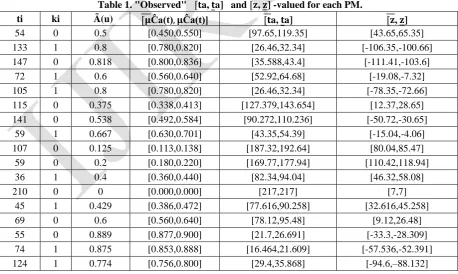
A set of operating data of power system extracted from a Power plant is used. A fuzzy analysis was performed on the same data in terms of interval fuzzy type-2 set for obtaining the point-wise relative membership grades µA u . For
illustration purpose, we convert µA u into interval type-2 membership grades [ μĈa(ta), μĈa(ta)] by assigning the
depth of vagueness π=0.1 at µÃ(u) =0.5and π=0 at µÃ(u) =0 or 1.0.Here into interval type-2 membership grades [
μĈa(ta), μĈa(ta)] are around µÃ(u) in table 1.
For a recorded failure time or Preventive Maintenance (PM) time, the corresponding the allowable time satisfies
μCa t = 1 − ta/tmax μCa t = 1 − ta/tmax
that is, the allowable time ta = tmax 1 − μCa t ta= tmax 1 − μCa t
Therefore the virtual system state: z = ta− t z = ta− t
For failure times, tmax = max t1k1, … . , t31k31 = 147, while for the censoring (PM) times, tmax = max t1 1 − k1,….,t311−k31=217,ThenμCat,μCat,ta,ta, and z,z, interval values are calculated and listed in Table 1.
Table 1. "Observed" [𝐭a, 𝐭a] and [𝐳, 𝐳] -valued for each PM.
ti ki µÃ(u) [𝛍Ĉa(t), 𝛍Ĉa(t)] [𝐭a, 𝐭a] [𝐳, 𝐳]
54 0 0.5 [0.450,0.550] [97.65,119.35] [43.65,65.35] 133 1 0.8 [0.780,0.820] [26.46,32.34] [-106.35,-100.66] 147 0 0.818 [0.800,0.836] [35.588,43.4] [-111.41,-103.6]
72 1 0.6 [0.560,0.640] [52.92,64.68] [-19.08,-7.32] 105 1 0.8 [0.780,0.820] [26.46,32.34] [-78.35,-72.66] 115 0 0.375 [0.338,0.413] [127.379,143.654] [12.37,28.65] 141 0 0.538 [0.492,0.584] [90.272,110.236] [-50.72,-30.65]
59 1 0.667 [0.630,0.701] [43.35,54.39] [-15.04,-4.06] 107 0 0.125 [0.113,0.138] [187.32,192.64] [80.04,85.47] 59 0 0.2 [0.180,0.220] [169.77,177.94] [110.42,118.94] 36 1 0.4 [0.360,0.440] [82.34,94.04] [46.32,58.08] 210 0 0 [0.000,0.000] [217,217] [7,7]
ISSN: 2319-8753
I
nternational
J
ournal of
I
nnovative
R
esearch in
S
cience,
E
ngineering and
T
echnology
(An ISO 3297: 2007 Certified Organization) Vol. 3, Issue 11, November 2014
147 1 0.667 [0.630,0.701] [43.953,54.39] [-102.9,-93.345] 171 0 0.375 [0.338,0.413] [127.379,143.65] [-43.621,-27.346]
40 1 0.667 [0.630,0.701] [43.654,54.39] [3.953,14.39] 77 1 0.778 [0.756,0.800] [29.4,35.868] [-47.6,-41.132] 98 1 0.6 [0.560,0.640] [52.92,64.68] [-45.08,-33.32] 108 1 0.6 [0.560,0.640] [52.92,64.68] [-45.08,-33.32] 110 0 0.667 [0.630,0.701] [64.883,80.29] [-45.117,-29.71]
85 1 1 [1.000,1.00] [0,0] [-85,-85] 100 1 0.556 [0.512,0.600] [58.8,71.34] [-41.2,-28.264] 115 1 0.8 [0.780,0.820] [26.46,32.34] [-88.54,-82.66] 217 0 0.2 [0.18,0.220] [169.26,177.94] [-47.74,-39.06] 25 1 0.429 [0.386,0.472] [77.616,90.258] [52.616,65.258] 50 1 0.429 [0.386,0.472] [77.616,90.258] [27.616,40.258]
From the table, it is easy to notice that most of the failure cases (κi=1), the z, z –values observed are negative, which indicates the system falls in ―failure‖ and ―power unavailable‖ state, while quite a few of the censoring cases, the z, z -values observed are positive, which indicates the system is still in "reliable" and "power available" state. The signs of these "observed" z, z -values confirm that the membership degree of the allowable capacity, μCa t , μCa t make sense.
The mean and standard deviation of the interval-valued normal random variable z, z can be accordingly estimated as
m, m = [-18.744,-8.853] and σ, σ =[65.886,66.458] respectively. The fact that m, m ≤ 0 clearly indicates the system requires preventive maintenance (PM). Power System data ta, ta can be used to fit Weibull distributions for
further conventional reliability analysis.
VII.CONCLUSION
The concept of IT2FS is briefly discussed in this work and argues its necessity to use IT2FS idea for the modeling power system reliability. The method of IT2FS can be used to conduct fuzzy inference on the power system reliability directly. However, the virtual operational state of an power system gives another inside of the power system reliability status. Using IT2FS to analyze the power system reliability status and preventive maintenance suggestions seems more meaningful. As a matter of fact, it is more realistic to calculate the interval type-2 membership grades and then use the logical function idea to have the IT2FS membership grades for the power system reliability status.
REFERENCES
1. Singer, D. (1990). ―A fuzzy set approach to fault tree and reliability analysis‖. Fuzzy Sets and Systems, 34, 2: 145-155.
2. Cai, K. Y., Wen, C. Y., and Zhang, M. L. (1991). ―Fuzzy variables as a basis for a theory of fuzzy reliability in the possibi lity context‖. Fuzzy Sets and Systems, 42, 2: 145-172.
3. Cai, K. Y., Wen, C.Y., and Zhang, M. L. (1991). ―Posbist reliability behavior of typical systems with two types of failures‖. Fuzz y Sets and Systems , 43, 1: 17-32.
4. Cai, K. Y., Wen, C. Y., and Zhang, M. L. (1991). ―Fuzzy reliability modeling of gracefully degradable computing system‖. Reliability Engineering and System Safety, 33, 1: 141-157.
5. Cheng, C. H., and Mon, D. L. (1993). ―Fuzzy system reliability analysis by interval of confidence‖. Fuzzy Sets and Systems, 56, 1: 29-35. 6. Chen, S. M. (1994). ―Fuzzy system reliability analysis using fuzzy number arithmetic operations‖. Fuzzy Sets and Systems, 64, 1: 31-38. 7. Chen, S. M. (1996). ―New method for fuzzy system reliability analysis‖. Cybernetics and Systems: An International Journal, 27: 385-401. 8. Chen, S. M. (2003). ―Analyzing fuzzy system reliability using interval valued vague set theory‖. International Journal of Applied Science and
Engineering, l, 1: 82-88.
9. Kumar, A., Yadav, S. P., and Kumar, S. (2005). ―Fuzzy reliability of a marine power plant using vague set theory‖. Proc. Int. Conference on Reliability and Safety Engineering, 281-294.
ISSN: 2319-8753
I
nternational
J
ournal of
I
nnovative
R
esearch in
S
cience,
E
ngineering and
T
echnology
(An ISO 3297: 2007 Certified Organization) Vol. 3, Issue 11, November 2014
11. Haofu, Y., (2004), ―Fuzzy set theory in reliability demonstration testing‖, Ph.D. thesis, 10-12.
12. Pereguda, A.I. (2001). ―Calculation of the Reliability Indicators of the System Protected Object Control and Protection System‖. Atomic Energy 90: 460-468.
13. Verma, A.K. et al. (2007). ―Fuzzy-Reliability Engineering: Concepts and Applications‖. Narosa Publishing House.
14. Ascher, H. E. and Kobbacy, K.A.H.(1995) ―Modelling Preventive Maintenance for Deterirating Repairable System‖. IMA Journal of Mathematics Applied in Business & Industry 6, 85-99,Oxford University Press,
15. Baxter, L.A., Kijima, M., and Tortorella, M. (1996) ―A Point Process Model for the Reliability of a Maintained System Subject to General Repair‖. Communications in Statistics-Stochatistic Models 1, 37-65.
16. Guo, R. and Love, C.E.(1995) ―Bad-As-Old Modelling of Complex Systems with Imperfectly Repaired Subsystems‖. Proceedings of the International Conference on Statistical Methods and Statistical Computing for Quality and Productivity Improvement, August 17 -19, Seoul, Korea, 131-140.
17. Kumar, D. and Westberg, U. (1997) ―Maintenance Scheduling under Age Replacement Policy Using Proportional Hazards Model and TTT-plotting‖. European Journal of Operational Research 99, 493-506.
18. Love, C.E. and Guo, R.(1991)―Using Proportional Hazard Modelling in Plant Maintenance‖. Quality and Reliability Engineering International Vol. 7, 7-17.
19. Zadeh, A. (1965) Fuzzy sets, Information and Control 8, 338-353.
20. J. M. Mendel and R. I. Bob John, ―Type-2 fuzzy sets made simple,‖ IEEE Trans. on Fuzzy Systems, vol. 10, pp. 117-127, April 2002. 21. Q. Liang and J. M. Mendel, ―Interval type-2 fuzzy logic systems: theory and design.‖ IEEE Trans. on Fuzzy Systems, Vol. 8, pp. 535-550,
Oct. 2000.