OPTIMIZATION OF BIODIESEL BLEND RATIO FOR COMPRESSION IGNITION ENGINE
Kallu. Raja Sekhar
Associate Professor, Department of Mechanical Engineering Kuppam Engineering College, Kuppam, Chittoor ( dt.), A.P-517425, India.
G.V.N.B.Prabhakar
Assistant Professor & HOD, Department of Mechanical Engineering
VKR,VNB@AGK College of Engineering, Gudivada, Krishna (dt.), Andhra Pradesh, India
ABSTRACT
History has witnessed the mad run for gold; now it’s time for the world to run mad behind oil. Bio fuels derived from renewable plant sources (tree borne vegetable oil) hold immense potential for meeting world’s future energy needs. This paper focuses on selecting the optimum blend ratio of Jatropha based Biodiesel with pure diesel to get the best output characteristics of a compression ignition engine. The Biodiesel, blended in different proportions with pure diesel is subjected to performance tests to evaluate its suitability in a 5HP single cylinder Compression Ignition engine. The data generated are compared with base line data obtained for pure diesel and the optimum blend ratio is selected.
KEYWORDS
Bio-diesel, emission
INTRODUCTION
The Compression Ignition engine plays a vital role in transportation and agricultural sectors because of their superior thermal efficiency and durability characteristics. The major portion of imported oil is consumed only by these sectors. Alternative fuels for diesel engines are becoming increasingly important due to diminishing petroleum reserves and the environmental consequences of exhaust gases from petroleum-fuelled engines. This situation has stimulated active research in low-emission and non-petroleum fuels, particularly for the transportation and agricultural sectors. It is highly necessary that alternative fuels, in particular of renewable kind such as vegetable oil, hydrogen, etc., are developed for Compression Ignition engines. Biofuels like Pongamia, Jatropha, Neem, or other vegetable oil-based fuels are the excellent available alternatives.
Biodiesel
Properties of Biodiesel
Biodiesel molecules are very simple hydrocarbon chains, containing no sulphur, ring molecules or aromatics associated with fossil fuel. Biodiesel is made up of 10% oxygen, making it a naturally “oxygenated” fuel. It’s use in a conventional Compression Ignition engine results in sustainable reduction of unburnt hydrocarbons, carbon monoxide, particulate matter, solid carbon fraction, and eliminates sulphur dioxide emissions.
Biodiesel is simple to use, biodegradable, nontoxic, and essentially free of sulphur and aromatics. Also,
No engine conversion required.
Horsepower, torque, and fuel economy are similar to those of diesel fuel. Cetane number is significantly higher than that of conventional diesel fuel.
Biodiesel reduces Carbon Dioxide emissions, the primary cause of the Greenhouse Effect, by up to 100%.
Biodiesel is safe to transport. It has a high flash point, or ignition temperature, of about 149°C compared to petroleum diesel fuel, which has a flash point of 52°C. Biodiesel can be used alone or mixed in any amount with petroleum diesel fuel.
Biodiesel is more lubricating than diesel fuel, it increases the engine life and it can be used to replace sulphur, a lubricating agent, when burnt, produces sulphur dioxide - the primary component in acid rain.
EXPERIMENTAL SETUP
Test Fuel
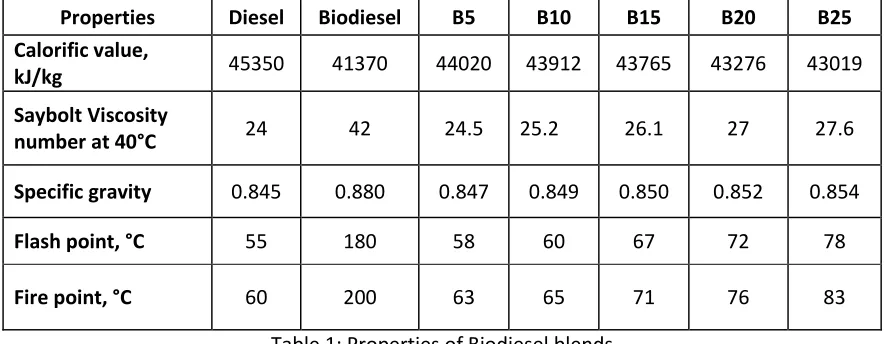
Transesterified Jatropha oil was selected for this study. The Biodiesel blended with diesel in 5% (B5), 10% (B10), 15% (B15), 20% (B20) 25% (B25) and 100% diesel were evaluated under this study. A bomb calorimeter was used for determining the Calorific value of the test fuel in terms of kJ/kg. Saybolt’s viscometer was used for the determination of Saybolt Viscosity Number at 40°C. Flash point, Fire point and Specific gravity of the test fuel were evaluated using the standard procedure. The values obtained are tabulated in Table 1.
Properties Diesel Biodiesel B5 B10 B15 B20 B25 Calorific value,
kJ/kg 45350 41370 44020 43912 43765 43276 43019
Saybolt Viscosity
number at 40°C 24 42 24.5 25.2 26.1 27 27.6
Specific gravity 0.845 0.880 0.847 0.849 0.850 0.852 0.854
Flash point, °C 55 180 58 60 67 72 78
Fire point, °C 60 200 63 65 71 76 83
Engine Setup
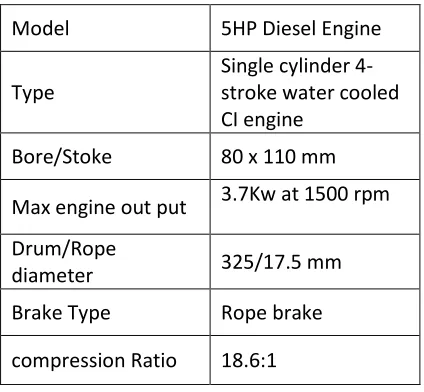
The setup consists of a single cylinder water-cooled compression ignition engine connected to a rope brake dynamometer as shown in Photo 1. Table 2 gives the specification of the engine used. The engine is provided with chromel -alumel thermocouples for the measurement of the jacket water inlet, outlet temperatures and exhaust gas outlet temperature. Provision is also made for air and liquid fuel flow measurement. Fuel consumption was volumetrically measured using burette. Air Flow was measured using an orifice flow meter. Under steady state condition, the fuel consumption rate, air consumption rate, exhaust gas temperature, coolant flow rate and coolant temperatures are measured with suitable apparatus.
Table 2: Specification of CI Engine
PROCEDURE
Constant speed engine tests were carried out using pure diesel and Biodiesel blends and the performance of the engine was evaluated. Necessary instrumentation was provided for measuring exhaust gas temperature, air consumption and fuel consumption.
1. A rope brake dynamometer was directly coupled with the engine. 2. The loading of the engine was done by adding weights in the load pan.
3. The Brake Power developed by the engine was calculated from the engine rpm and the net load acting on the engine.
4. Fuel line from fuel tank was disconnected and the fuel was supplied through the burette. 5. The time taken for 10cc of fuel consumption was noted down for each load conditions
and to minimize the errors the experiment was conducted twice for each load condition. 6. The engine was sufficiently warmed up at every stage and the cooling water temperature
was maintained as per engine specification.
7. The performance of the engine run with Biodiesel was evaluated in term of fuel economy and power.
8. Fuel economy and power were measured in constant speed load test modes at steady speed of 1500 rpm.
Model 5HP Diesel Engine
Type
Single cylinder 4-stroke water cooled CI engine
Bore/Stoke 80 x 110 mm
Max engine out put 3.7Kw at 1500 rpm
Drum/Rope
diameter 325/17.5 mm
Brake Type Rope brake
9. The Engine was run sufficiently for thermal stabilization of engine before conducting Fuel economy and Power test with test fuels.
10. The data thus generated were used for calculations of brake power, brake specific fuel consumption, thermal efficiency, and fuel economy.
SELECTION OF OPTIMUM BLEND
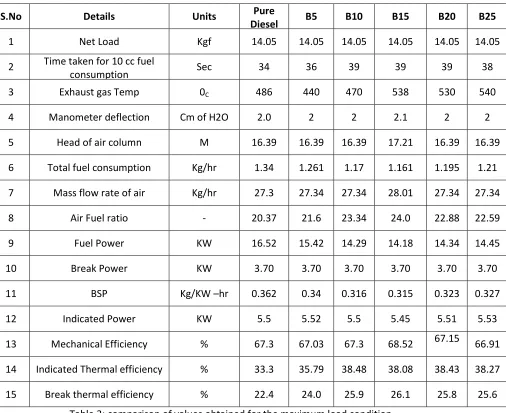
Table 3 shows the experimental values obtained after running the engine with the test fuels. The experiment was performed for various load conditions namely 0%, 20%, 40%, 60%, 80% and 100% of maximum load (14.05 kgf, calculated from the rated rpm).
Experiments were conducted initially on diesel and the observations were recorded. The tests were carried out on the engine, which has already been subjected to a preliminary run.
S.No Details Units Pure
Diesel B5 B10 B15 B20 B25
1 Net Load Kgf 14.05 14.05 14.05 14.05 14.05 14.05
2 Time taken for 10 cc fuel
consumption Sec 34 36 39 39 39 38
3 Exhaust gas Temp 0C 486 440 470 538 530 540
4 Manometer deflection Cm of H2O 2.0 2 2 2.1 2 2
5 Head of air column M 16.39 16.39 16.39 17.21 16.39 16.39
6 Total fuel consumption Kg/hr 1.34 1.261 1.17 1.161 1.195 1.21
7 Mass flow rate of air Kg/hr 27.3 27.34 27.34 28.01 27.34 27.34
8 Air Fuel ratio - 20.37 21.6 23.34 24.0 22.88 22.59
9 Fuel Power KW 16.52 15.42 14.29 14.18 14.34 14.45
10 Break Power KW 3.70 3.70 3.70 3.70 3.70 3.70
11 BSP Kg/KW –hr 0.362 0.34 0.316 0.315 0.323 0.327
12 Indicated Power KW 5.5 5.52 5.5 5.45 5.51 5.53
13 Mechanical Efficiency % 67.3 67.03 67.3 68.52 67.15 66.91
14 Indicated Thermal efficiency % 33.3 35.79 38.48 38.08 38.43 38.27
15 Break thermal efficiency % 22.4 24.0 25.9 26.1 25.8 25.6
This test is aimed at optimizing the percentage of Biodiesel blend. To achieve this, several blends of varying concentrations were prepared ranging from 0 to 25 percent of Biodiesel. These blends were subjected to performance tests on the engine. The performance data were then analyzed from the graphs recording power output, specific fuel consumption and thermal efficiency etc., for all the blends of Biodiesel. By comparing the thermal efficiencies, brake specific fuel consumption and emissions of various blends, the optimum blend concentration was determined. The curves were compared to base line diesel data in order to select an optimum blend.
Thermal efficiency
Fig. 1 shows the variation of Brake Thermal Efficiency of the engine with different test fuels compared with the brake thermal efficiency obtained with diesel fuel. From the test result it is observed that the blends have a higher thermal efficiency than the base line data of diesel fuel. The thermal efficiencies of the Jatropha Biodiesel blends and diesel were increased and the maximum thermal efficiencies were obtained at a Brake Power of 3.7 kW. The maximum
Thermal efficiency of neat diesel, B5, B10, B15, B20 and B25 are in the order of 22.4, 24, 25.9, 26.1, 25.8 and 25.6% respectively. It can be seen from the figure that there is an improvement in thermal efficiency while using B15 because; the molecules of Jatropha oil methyl ester (Biodiesel) contains some amount of oxygen that takes part in combustion and this may be a possible reason for more complete combustion. The oxygen molecule present in Biodiesel molecule structure may be readily available for combustion.
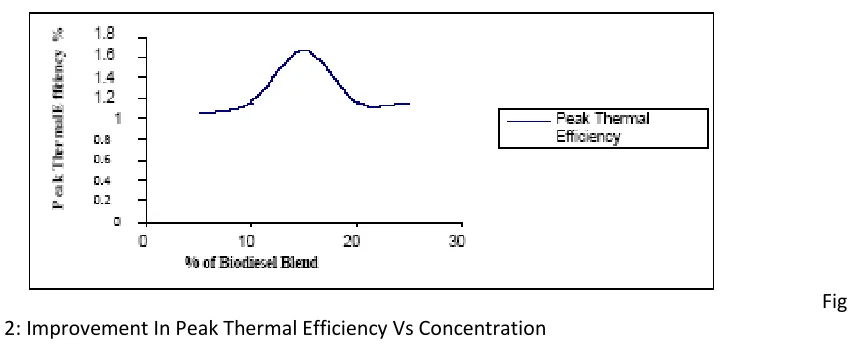
Improvement in peak thermal efficiency
Agraph between the Biodiesel blends and improvement in peak thermal efficiency for various Biodiesel blends is plotted in Fig. 2. B15 was found to be the optimum blend from the graph based on maximum thermal efficiency. The graph reflects that the Biodiesel blend with 15% gave maximum improvement in peak thermal efficiency.
Brake specific fuel consumption
Fig 3 compares the specific fuel consumption of diesel and various blends of Jatropha Biodiesel and diesel at varying brake power in the range 0-4.0 kW. It could be observed that the BSFC of the blends as well as the diesel were decreasing with increasing load from 0.73 to 3.7 kW. It can be seen form the figure that as a percentage of Biodiesel increases with diesel, the BSFC trend decreases up to 15% Biodiesel blend. Further increasing Biodiesel to 20 and 25% in diesel blend shows that there is an increase in fuel consumption.
This could be mainly due to the combined effect of the relative fuel density, viscosity and heating value of the blends. Since the gross heating value of the blended fuel is low on volumetric basis than the neat diesel and higher density of blends containing a higher percentage of Jatropha oil, Biodiesel has led to more discharge of fuel for the same displacement of the plunger in the fuel injection pump, and thus increase in BSFC.
Fuel economy
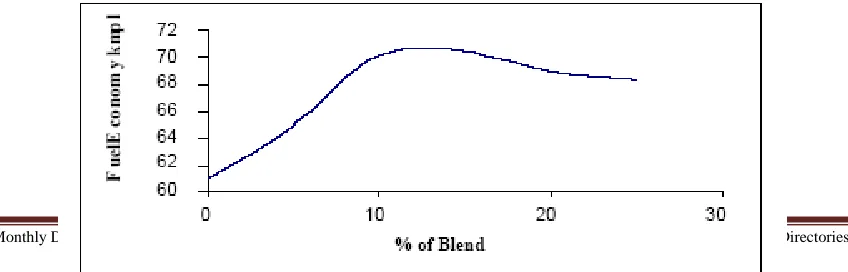
The best fuel economy is observed with B15. Increase of Biodiesel proportion even though cetane number is expected to be higher, the energy content of the fuel tends to decrease. This consequently affects the fuel economy.
Exhaust gas temperature
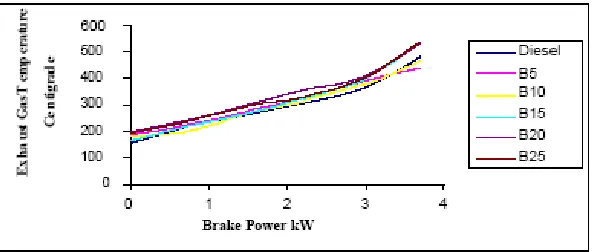
Fig 5 shows the variation of the exhaust gas temperature with load range of 0 – 4.0 kW for Biesel and Biodiesel blends. The result shows that the exhaust gas temperature increases with the increase in brake power in all the cases.
The exhaust gas temperature declines with increasing the percentage of Biodiesel in diesel. It could also be seen that the decline in exhaust gas temperature is only up to 15% Biodiesel blend and further increasing the blend ratio, the temperature slightly increases. This attributes towards the lower calorific value of Biodiesel and complete combustion processes that prevail in the engine.
DISCUSSION OF TEST RESULTS
The diesel engine performed satisfactorily on Biodiesel fuel without any ardware modifications. B15 improves the thermal efficiency of the engine by 1.17 percent and its brake specific fuel
consumption (BSFC) is the least.
B15 is the most economical blend within its class as it exhibits a superior mileage of 70.5 kmpl. Based on the experiments conducted, finally it can be concluded that B15 i.e., 15%
REFERENCES
[1] He, Y; Bao, Y.D; Study on rapeseed oil as alternative fuel for a single cylinder diesel engine, Renewable Energy, (2003), Vol. 28, pp1447–1453.
[2] Altin, R; Cetinkaya, S; Yucesu, H.S; The potential of using vegetable oils as fuel for diesel engine, Energy Conversion and Management, (2001), Vol.42, pp529–538.
[3] Agarwal, AK; Das, L.M; Biodiesel development and characterization for use as a fuel in compression ignition engine, Transactions of ASME, (2001), Vol. 123, pp 440–447.
[4] Nwafor, O.M.I; Emission characteristics of diesel engine operating on rapeseed methyl ester, Renewable Energy, (2004), Vol.29, pp 119–129.
[5] Kalligeros, S; Zannikos, F; Stournas, S; Lois, E; Anastopoulos, G; Chteas Sakellaropoulos, F; An investigation of using biodiesel/marine diesel blends on the performance of a stationary diesel engine, Biomass and Bioenergy, (2003), Vol.24, pp141–149.
[6] Crookes, R.J; Comparative Bio fuel performance in Internal combustion Engines, Biomass and Bioenergy; Vol.30, issue 5, (2006), pp 461-468.
[7] Agarwal, A.K; Bio fuels (alcohols and bio-diesel) applications as fuels for internal combustion
engines, Progress in Energy and Combustion Science,(2006) pp 1-39.
[8] Yecesu, H.S; Sozen, A; Topgul, T; Arcaklioglu, E; Comparative study of Mathematical and Experimental analysis of spark ignition engine performance using ethanol-gasoline blend fuel, Applied Thermal Engineering, Vol.27; (2007); pp 358-368
[9] Topgul, T; Yecesu, H.S; Cinar, C; Koca, A; Effect of ethanol-unleaded gasoline blends and ignition timing on engine performance and exhaust emissions; Renewable Energy; Vol.31,( 2006); pp 2534-2542.
[10] Yecesu, H.S; Topgul, T; Cinar, C; Okur, M; Effect of ethanol-gasoline blends on engine performance in different compression ratios, Applied Thermal Engineering Vol.26; (2006); pp 2272-2278.
[11] Mustafi, N.N; Miraglia, Y.C; Raine, R.R; Bansal, P.K; Elder, S.T; Spark ignition engine performance with power gas fuel (mixture of Co/H2) a comparison with gasoline and natural gas, Fuel Journal, Fuel 85, (2006), pp 1605-1612
[12]. Ravikumar,P; Srinivas, P.N; Nelson, J.E.B; Rao, S.S; Experimental studies on energy appropriation in a single cylinder diesel engine, Journal of The Institution of Mechanical Engineers (India); Vol. 85, (2004), pp 45-49.