University of South Carolina
Scholar Commons
Theses and Dissertations
2015
Modification of Nanoparticles for Designed
Interfaces
Tony Lee Neely, Jr.
University of South Carolina
Follow this and additional works at:https://scholarcommons.sc.edu/etd
Part of theChemistry Commons
This Open Access Dissertation is brought to you by Scholar Commons. It has been accepted for inclusion in Theses and Dissertations by an authorized administrator of Scholar Commons. For more information, please [email protected].
Recommended Citation
Neely,, T. L.(2015).Modification of Nanoparticles for Designed Interfaces.(Doctoral dissertation). Retrieved from
Modification of Nanoparticles for Designed Interfaces
by
Tony Lee Neely, Jr.
Bachelor of Science Furman University 2006
Master of Science Furman University 2008
Submitted in Partial Fulfillment of the Requirements
for the Degree of Doctor of Philosophy in
Chemistry
College of Arts and Sciences
University of South Carolina
2015
Accepted by:
Brian Benicewicz, Major Professor
Chuanbing Tang, Committee Chair
Thomas Vogt, Committee Member
Harry Ploehn, Committee Member
c
Copyright by Tony Lee Neely, Jr., 2015
Acknowledgments
I would like to thank Dr. Brian Benicewicz for his guidance and mentorship
through-out my Ph.D. work, whether it pertained to chemistry or otherwise. His expertise and
support was invaluable in the completion of this research. I would also like to thank
my doctoral committee members - Prof. Chuanbing Tang, Prof. Tom Vogt, and Prof.
Harry Ploehn for their encouragement and assistance during graduate school.
I would like to thank my collaborators Prof. Linda Schadler (Rensselaer
Poly-technic Institute) and her graduate students Bharath Natarajan and Ying Li for
their invaluable contributions towards this work as well as Prof. Sanat Kumar of
Columbia University.
I am extremely thankful for the support and work environment provided by
cur-rent and former Benicewicz group members. Even through difficulties in lab, work
never became a chore mostly due to them. Special thanks to Atri Rungta for being
a great mentor.
Finally I would like to thank my entire family, especially my wife Lauren, for
their continued support during these years. I would also like to dedicate this work to
my grandmother Jewel Stackley and my grandfather George Neely. Although they
were always some of my loudest supporters, they weren’t able to see me through this
Abstract
The work contained herein, is focused on the design, synthesis, and characterization of
polymer nanocomposite interfaces and the property enhancement afforded from said
interface design. Through the use of reversible addition fragmentation chain transfer
(RAFT) polymerization for the grafting of polymer chains to silica nanoparticles,
the surface of silica nanoparticles can be manipulated to tune the properties of the
nanocomposite as a whole.
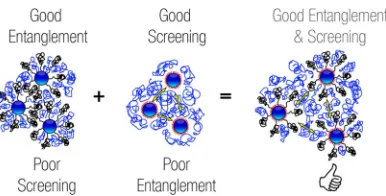
In the first part of this work, heterogeneity is introduced onto the surface of silica
nanoparticles via a sequential RAFT polymerization to afford a bimodal brush
sys-tem. A densely grafted, short brush population is polymerized from the surface in
order to provide screening for the enthalpic core-core attraction of the nanoparticles
that can lead to agglomeration. Afterwards a second sparsely grafted, long brush
population is polymerized to enable the nanoparticle to entangle with the polymer
matrix overcoming the entropic preference of the grafted chains dewetting from the
matrix chains. These two populations and all their respective molecular variables
(graft density, chemistry, end-group chemistry, polydispersity, etc) can be controlled
with this approach. With this control in place, the molecular variables were used
to produce both bimodal and monomodal samples for comparison of their resulting
properties when dispersed in a polymer matrix. It was found that not only do the
bimodal samples improve dispersion when compared to monomodal brushes, but that
the thermomechanical properties are enhanced as well. Tuning of the long chain graft
density determined that very low graft densities were better for improving
polymerization can still be obtained using RAFT even when a dense brush is already
in place.
Secondly, following the information gained from our first bimodal samples, it was
ascertained that with our bimodal system the enthalpic attraction of the particles
and the entropic dewetting of the grafted chains were decoupled. This allowed us
to pursue the synthesis of mixed bimodal samples. In a mixed bimodal sample the
chemistries of the brush populations are distinct. If the long chains are the only
population entangling with the matrix, then it can remain matrix compatible while
the short brush can be varied to improve other desired properties of the
nanocompos-ite. In order to test whether monomer/polymer incompatibility would allow for the
diffusion of a monomer past a short but dense brush of polymer it phase separates
with to the surface, a simple poly(methyl)methacrylate/polystyrene mixed bimodal
brush was made. With both variations of either chemistries short or long, bimodal
samples were possible with control of all previously mentioned molecular variables. In
order to push that testing further, bimodal samples of poly(1H,1H-heptafluorobutyl
methacrylate) short brushes and polystyrene long brushes were made. A film of
these nanoparticles were drop cast onto various substrates showing increased water
contact angle measurements when compared with untreated samples. The drop
cast-ing of this film onto a sheet of polystyrene followed by annealcast-ing shows that the long
polystyrene chains of the mixed bimodal brush can still entangle with the polystyrene
of the substrate.
For the third section, further work was performed to develop new approaches to
the synthesis of bimodal brushes. Taking cues from our testing that showed lower graft
densities improved entanglement, it was decided to pursue a one-pot bimodal brush
synthesis using a grafting-to approach. While grafting-to is incapable of producing
high graft density brushes, this was not needed for our improvement in dispersion and
end chemistry, the efficiency of post-polymerization modification was compared to
using a modified/activated RAFT agent. The activated RAFT agent showed higher
graft densities while still allowing the use of a thermally initiated, bulk polymerization
without decomposing at the higher temperatures required for it. This allows for
decreased solvent use and therefore easier scale-up. Both long and short chains were
attached in a one-pot approach. While not having the control of the sequential RAFT
polymerization process, it is much simpler, more efficient, and more modular than
the multi-stepped procedure. In addition to overcome issues with characterization
of bimodal brushes produced via a one-pot procedure, a new anthracene-containing
initiator was created and used to end-label one population of chains via a radical
cross coupling mechanism. This allows for characterization of each chain population
independently using a combination of UV-Vis and TGA.
Finally, new synthetic strategies towards the modification of the silica nanoparticle
surface via different ligands while also focusing on improving efficiency. Previous
approaches used a linear aminosilane for the coupling of the RAFT agent to the
surface. While successful, the reactions take hours to complete. In a new approach,
an amine-containing cyclic azosilane was used for the modification of the silica surface
in under five minutes. This new ligand has the same ability as our previous method
to be varied in loading in order to vary the graft density. RAFT polymerizations of
poly(methyl)methacrylate and polystyrene were performed at various graft densities
Table of Contents
Acknowledgments . . . iii
Abstract . . . iv
List of Tables . . . x
List of Figures . . . xi
Chapter 1 Introduction . . . 1
1.1 Nanocomposites . . . 1
1.2 Grafting Methods . . . 3
1.3 Surface and Attachment Chemistries . . . 5
1.4 Polymerization Methods . . . 10
1.5 Properties and Applications . . . 13
1.6 Dissertation Outline . . . 18
1.7 References . . . 21
Chapter 2 Synthesis of Bimodal Brush Grafted Nanoparti-cles and Thermomechanical Properties of Bimodal Brush Modified Nanoparticle Composites . . . 32
2.1 Introduction . . . 32
2.3 Results and Discussion . . . 39
2.4 Summary . . . 62
2.5 References . . . 63
Chapter 3 Synthesis of Mixed Bimodal Grafted Nanoparticles. 67 3.1 Introduction . . . 67
3.2 Experimental . . . 73
3.3 Results and Discussion . . . 77
3.4 Summary . . . 87
3.5 References . . . 87
Chapter 4 One-Pot Synthesis of Bimodal Brush Grafted Nanopar-ticles via Thermally Initiated, Bulk RAFT Poly-merization. . . 91
4.1 Introduction . . . 91
4.2 Experimental . . . 97
4.3 Results and Discussion . . . 102
4.4 Summary . . . 110
4.5 References . . . 111
Chapter 5 Modification of Silica Nanoparticles via Cyclic Azasilanes: From Hours to Minutes . . . 116
5.1 Introduction . . . 116
5.2 Experimental . . . 118
5.3 Results and Discussion . . . 122
5.5 References . . . 126
Summary and Conclusions . . . 129
Future Work . . . 133
List of Tables
Table 2.1 Various Bimodal/Mixed Bimodal Brush-Anchored Silica
Nanopar-ticles Synthesized Using Sequential RAFT Polymerization. All
weights reported as g/mol and graft densities as chains/nm2 . . . . 40
Table 2.2 Matrix Properties, Silica Content, and Polymer Content of
Var-ious Nanocomposite Samples Prepared Using NP-5 and NP-6
Brush Grafted Silica Nanoparticles . . . 46
Table 2.3 Brush Properties of Various Composites Prepared and Their
Re-spective Labels . . . 52
Table 3.1 Various Mixed Bimodal Brush-Anchored Silica Nanoparticles
Synthesized Using Sequential RAFT Polymerization. All weights
reported as g/mol and graft densities as chains/nm2 . . . . 77
Table 3.2 Comparison of water contact angles of surfaces that are treated
with NP-4 film and those left untreated. . . 85
Table 5.1 Variation of Feed Ratio of Cyclic Azasilane and Control Over
Graft Density . . . 124
List of Figures
Figure 1.1 Nanocomposite morphology map showing the different
nanopar-ticle dispersion states possible with a variation in graft density (y-axis) and ratio of matrix chain length to grafted chain length (x-axis). N is defined as the number of repeat units in the
poly-mer chain. . . 2
Figure 1.2 Grafting methods: (a) physisoprtion (b) to (c)
grafting-from. . . 4
Figure 1.3 Mechanism of RAFT Polymerization . . . 12
Figure 2.1 Controlling Dispersion and Entanglment via Bimodal Brushes . . 37
Figure 2.2 Sequential RAFT Polymerization for Synthesis of Bimodal Brushes 40
Figure 2.3 UV absorption spectra of (1) SiO2-g-PS1 with cleaved CPDB
(solid line) and (2) SiO2-g-PS1 with 2nd CPDB immobilized on
silica surface (dashed line). . . 42
Figure 2.4 GPC trace of short and bimodal PS chains cleaved from silica
nanoparticle . . . 44
Figure 2.5 Kinetic plot for polymerization of second population of polystyrene at 0.11 chains/nm2. First population of polystrene graft
den-sity of 0.20 chains/nm2 with molecular weight of 7200 g/mol
and PDI of 1.04. . . 44
Figure 2.6 TEM micrographs (at 200,000x magnification) of (a) 5% silica
loading of NP-5 in 96,000 g/mol matrix and (b) 5% silica load-ing of NP-6 in 96,000 g/mol matrix. (c) Plots of skewness and (d) nearest neighbor index obtained from TEM micrographs (at 100,000x magnification) for various loading of bimodal (filled circle) and monomodal (unfilled circle) brush grafted silica in the 96,000 g/mol matrix. (e) 5% silica loading of NP-5 in a
Figure 2.7 Change in glass transition temperature, Tg, for bimodal grafted NP-5 nanocomposites in 96,000 g/mol (filled circle) and 190,000
g/mol (filled square) PS matrices. . . 49
Figure 2.8 (a) Comparative plot of storage modulus (E’) vs log frequency
(Hz) for 5% core loadings of bimodal (filled circle) and monomodal (unfilled circle) brush grafted silica in the 96,000 g/mol matrix. The plots are shifted to align Tgto obtrain a true comparision of rheological response near the glass transition temperature. (b) Reduced elastic modulus for monomodal (unfilled circle) and bi-modal (filled circle) grafted nanoparticle composites measured
by indentation, also showing Halpin-Tsai precidtions (–). . . 51
Figure 2.9 TEM micrographs of silica loadings of 5 wt % (except when
otherwise noted) of various systems at 100,000x magnification
(20,000x for MS-25-95 systems). . . 53
Figure 2.10 (a) Skewness vs silica weight % and (b) average number of par-ticles per cell (Qmean) vs silica wt %, for systems under our
purview. Lines are merely as illustration of trends . . . 55
Figure 2.11 Parametric phase diagram of the homopolymer PS-silica: (a) monomodal and (b) bimodal systems under our purview, show-ing the dispersed and strshow-ing-like agglomerate regions. The ex-perimental micrographs of 5 wgt % silica loading of the samples are shown to demonstrate the validity of predictions. The open and filled stars correspond to graft densities of 0.10 ch/nm2and
0.05 ch/nm2. The monomodal 190 kg/mol boundary is shown
purely to illustrate the shift in phase boundaries with varying
matrix molecular weight. . . 56
Figure 2.12 (a) Storage modulus E’ (GPa) vs log(shifted frequency(Hz)) for 5 wgt % silica loadings of various systems compared with neat
96 kg/mol PS. (b) Normalized storage modulus E’/E’max vs
log(shifted freqency(Hz)) for 5 wgt % silica loadings of varous
systems compared with neat 96 kg/mol PS. . . 58
Figure 2.13 The elastic modulus normalized by pure polymer modulus E/Eneat
vs silica concentration (wt %) for various systems compared with the Halpin-Tsai and Guth predictions for silica in the 96
Figure 2.14 (a) Elastic modulus normalized by pure polymer modulus E/Eneat vs silica concentration (wgt %) for bimodal systems, compared
with the Halpin-Tsai and Guth predictions. (b) 4Tg (◦C) vs
silica weight % for bimodal systems. (c and d) Normalized loss modulus curves in BM-10-96 and BM-10-190, respectively, showing a shift in loss modulus peak to higher frequencies with increased loading. A positive frequency shift in glass transition is equivalent to a negative shift in Tg. (e) Plot of normalized elastic modulus vs4Tg at 5 wt % silica loading of the various
systems . . . 61
Figure 3.1 Controlling Dispersion and Entanglment via Bimodal Brushes . . 69
Figure 3.2 Sequential RAFT Polymerization for Synthesis of Bimodal Brushes 70
Figure 3.3 Parametric phase diagram of the homopolymer PS-silica: (a)
monomodal and (b) bimodal systems under our purview, show-ing the dispersed and strshow-ing-like agglomerate regions. The ex-perimental micrographs of 5 wgt % silica loading of the samples are shown to demonstrate the validity of predictions. The open and filled stars correspond to graft densities of 0.10 ch/nm2and
0.05 ch/nm2. The monomodal 190 kg/mol boundary is shown
purely to illustrate the shift in phase boundaries with varying
matrix molecular weight. . . 72
Figure 3.4 TEM micrographs of 1 wt% (left column) and 5 wt% (right
col-umn) of NP-3 dispersed in (a-b) 100k PS, (c-d) 100k PMMA, and (e-f) 300k PMMA matrices. Cartoon to left of TEM mi-crographs used to illustrate chain conformation at nanoparti-cle/matrix interface in composites. Blue chains are polystyrene
and red chains are poly(methyl) methacrylate . . . 78
Figure 3.5 TEM micrographs of 1 wt% of NP-2 dispersed in (a) 100k
PMMA and (b) 100k PS. Cartoons to the left of TEM micro-graphs are used to illustrate chain conformation at the nanopar-ticle/matrix interface in composites. Blue chains are polystyrene
and red chains are poly(methyl) methacrylate . . . 80
Figure 3.6 Loss Modulus (E”) vs. Log Frequency for NP-3/PMMA systems . 81
Figure 3.7 Hardness vs silica loading for NP-3/PMMA systems. . . 81
Figure 3.9 Kinetic plot for polymerization of HFBMA from surface of NPs
via RAFT. . . 83
Figure 3.10 Relationship of conversion vs molecular weight for
polymeriza-tion of HFBMA from the surface of silica NPs via RAFT. . . 84
Figure 3.11 Comparison of IR specra from HFBMA NPs (red), HFBMA/PS
bimodal NPs (black), and mixed bimodal treated PS surface (blue) 85
Figure 3.12 Water contact angle measurements for an untreated glass slide (top left), glass slide with drop cast NP-4 film (top right), un-treated PS sheet (bottom left), and PS sheet with NP-4 film
(bottom right) . . . 86
Figure 4.1 Sequential RAFT Polymerization for Synthesis of Bimodal Brushes 95
Figure 4.2 Silicone Composites of (a) Monomodal and (b) Bimodal Brushes
via Sequential Grafting-to57 . . . 96
Figure 4.3 One Pot Synthesis of Bimodal Brushes via Grafting-to . . . 102
Figure 4.4 Comparison of Post-Polymerization Modification (a) and
Pre-Polymerization Modification (b) . . . 104
Figure 4.5 GPC of PS Using Thermally Initiated CPDB RAFT Agent
(PDI of 1.09) . . . 104
Figure 4.6 GPC of PS Using Thermally Initiated Activated CPDB (PDI
of 1.07) . . . 104
Figure 4.7 TGA of Monomodal Using Post-Polymerization Modification
(0.04 chains/nm2) . . . . 105
Figure 4.8 TGA of Monomodal Using Pre-Polymerization Modification (0.08
chains/nm2) . . . . 105
Figure 4.9 GPC of One Pot Modification of Silica NPs . . . 106
Figure 4.10 Method For Labeling One Population of Chains in a Bimodal Brush107
Figure 4.11 Synthesis of Anthracene Containing Initiator via DCC Coupling . 107
Figure 4.13 UV-Vis of 90k PS containing Anthracene Chain End . . . 108
Figure 4.14 UV-Vis of Bimodal Brush With Anthracene-Containing PS Short
Chains and 36k CPDB-Containing PS Long Chains . . . 109
Figure 4.15 Bimodal Chain Densities With Variation in Short and Long
Molar Fractions . . . 109
Figure 5.1 Synthesis and Attachment of Activated CPDB to Cyclic
Azasi-lane Modified Silica Nanoparticles . . . 122
Figure 5.2 UV-Vis absorption spectrum of SiO2-g-CPDB nanoparticles in THF124
Chapter 1
Introduction
1.1 Nanocomposites
It is now well known that the incorporation of nanoparticles (NPs) into a polymer
ma-trix can appreciably improve the optical, electrical, and thermomechanical properties
of the resulting polymer nanocomposites, (PNCs)1–14 even over what is obtainable
with micrometer sized fillers.3 Even though this idea has been established, specific
dispersion states of the NPs within the PNC can affect the desired property.
There-fore, the study of the factors that affect NP distribution within the matrix, along with
how this distribution affects the resulting properties, is central to the development of
future materials and imperative to the field.15These elements continue to be a hurdle
to the more universal use of these materials.
It has been shown on micrometer particles that with a high graft density of chains,
the particles are miscible within a polymer matrix of the same chemistry so long as
the polymer chains of the matrix have a lower molecular weight than those of the
brush.16 However, when the polymer chains of the matrix are of a higher
molec-ular weight than those of the brush, they become immiscible. This immiscibility
is attributable to brush autophobicity and is entropic in nature due to the shared
chemical composition.4,17–21 By developing these ideas to incorporate nanoparticles
(diameter<100nm) one can control NP polymer matrix miscibility and therefore NP
dispersion.16,22–40 A more recent development is that using these same techniques one
as sheets, clusters, strings, etc. while improving a host of properties.41–46 These new
structures are formed when low graft density NPs are incorporated into a polymer
matrix, acting like microphase-separated block copolymers and can assemble into an
array of differing morphologies.21,42,46–53
Figure 1.1 Nanocomposite morphology map showing the different nanoparticle
dispersion states possible with a variation in graft density (y-axis) and ratio of matrix chain length to grafted chain length (x-axis). N is defined as the number of repeat units in the polymer chain.
While the study of the previously stated factors affecting distributions,
morpholo-gies, and the resulting properties is imperative to a more ubiquitous incorporation of
methodolo-gies of polymer and organic chemistry. The ability of the polymer chemist to control
multiple facets of the PNCs (whether it is NP graft density, polymer composition,
polydispersity, molecular weight, and/or architecture) allows for the study of these
effects. More comprehensive reviews can be found in literature.54–56
These organic and polymer methods allow for the fine-tuning of the substrate
surface. Because of this focus on the substrate surface/interface, this introduction
is organized with such a focus. First, grafting methods will be discussed, followed
by a more detailed view of differing surface chemistries and their resulting
attach-ment/modification chemistries. Then a brief discussion is included of surface
poly-merization methods with an emphasis on reversible addition fragmentation chain
transfer (RAFT) polymerization. This discussion culminates in the properties and
applications this tunability allows and an outline for the remainder of this
disserta-tion.
1.2 Grafting Methods
Two broad synthetic strategies exist for the creation of polymer-grafted nanoparticles.
These are grafting-to and grafting-from. The grafting-to method involves the
attach-ment of a preformed and end-functionalized polymer chain. The attachattach-ment occurs
through either physisorption, where the forces involved are intermolecular between
the chain and the substrate surface, or chemisorption where a covalent bond is formed
between the chain end moiety and the surface. Grafting-to offers the chemist a simple
and modular method for the creation of polymer-grafted nanoparticles. Monomers
that traditionally cannot be polymerized via a surface initiated (SI) or controlled
radical polymerization (CRP) technique can be premade via the required method
and then attached. However, this approach restricts the ability to create brushes
with high graft density.57 The diffusion of a polymer chain to a functionalized surface
at-tached. This effect can become even more pronounced with higher molecular weight
polymer chains.
With a grafting-from strategy, the surface is functionalized with the appropriate
initiator or chain transfer agent. The polymer chain is then grown from the surface in
a surface initiated polymerization. Small molecules, such as an initiator or monomer,
do not suffer from the same steric repulsion as a diffusing polymer chain. This allows
for a much higher graft density. However, not all polymer chemistries can be made via
a grafting-from strategy. Ultimately the application will determine the appropriate
synthetic strategy as factors such as scale, monomer choice, polymerization method,
and required graft density will influence the needed method. The variation in graft
density can result in a difference in polymer brush height due to the steric interaction
between grafted chains. These various methods and their effect on chain density can
be seen in Figure 1.255
1.3 Surface and Attachment Chemistries
A wide variety of substrates have been modified to graft polymer chains by grafting-to
or grafting-from techniques. The functional groups on substrates can be initiator or
chain transfer agent (CTA) that allow surface-initiated atom transfer polymerization
(ATRP), nitroxide-mediated polymerization (NMP), reversible-addition
fragmenta-tion chain transfer (RAFT); or other groups required to couple with free polymer
chain end groups in a grafting-to method. This section will discuss the different
surface and attachment chemistries among silica, metal oxides, gold, carbon, and
polymer nanomaterials.
Silica
Silica substrates, such as nanoparticles, silica gel, glass, and quartz have been widely
used for grafting of polymer chains. A general strategy to functionalize silica
sub-strates is using an organosilane to incorporate functional groups onto surfaces,
in-cluding amino, carboxylic acid, and halogen groups. Further post-functionalization
can introduce initiator or CTAs to mediate SI CRP. In this method, a condensation
reaction between silanol groups (Si-OH) on silica substrates and alkoxysilane or
halo-gensilane molecules occurs resulting in the formation of a Si-O-Si bond.46,58–61A series
of mono- and tri-functional silanes have been widely employed, such as RSi(Me2)OEt,
RSi(OMe)3, and RSi(OEt)3.
Trifunctional organosilanes have been reported to polymerize with unreacted
func-tional silane moieties in water, restricting the formation of a monolayer of surface
functionalized groups.60As a different approach, silane-containing initiators or CTAs was employed to directly modify silica surfaces. Benicewicz et al. developed a
silane-containing RAFT agent by a multistep synthesis to react with silanol groups on the
from issues of low yield due to the silane’s affinity for silica gel during column
chro-matography purification. In order to counteract this, the role of silane coupling and
RAFT agent attachment were separated using an aminosilane for modification of the
silica surface and an activated RAFT agent for CTA attachment.59 This has allowed
for a range of graft densitites from 0.01 - 0.7 chains/nm2. Other attachment methods
have been employed towards increasing graft density. During a condensation
reac-tion with an alkoxysilane, the alcohol byproduct could also condense onto the surface
effectively decreasing the available graft density. Brittain et al. employed the use of
an allyl silane whose byproduct would be volatile enough to escape the reaction flask
without attaching to the surface.62Even though an increase in graft density was seen
in some substrates, it was not seen in colloidal silica.
Metal Oxides
Nanocomposites with metal oxide (MO) nanomaterials impart properties unique to
the specfic type of metal oxide, such as transpareny, high refractive-index, fracture
toughness, etc. Ideally, the property required can be enhanced even at very low
load-ing of the metal oxide. Typically, the majority of metal oxides used in nanocomposites
include iron, indium tin, aluminum, and titanium oxides. For these substrates, the
most common functional groups used include silanes, carboxylic acids, and
phospho-nic acids. Carboxylic acids are routinely used to stabilize metal oxide nanoparticles
upon their synthesis, with oleic acid being the most commonly used ligand. The oleic
acid prevents surface oxidation of the metal oxide and due to its long alkyl chain,
improves the solubility of the nanoparticles in nonpolar solvents. However, carboxylic
acids are not strong binders, and many procedures use ligand exchange reactions to
replace oleic acids with silanes or phosphonic acids. Larsen and coworkers
synthe-sized iron oxide nanoparticles with oleic acid groups, and subsequently modified them
et al. have used a similar method to strip oleic acid from iron oxide nanoparticles to
attach phosphate functional ATRP initiators on the surface.64In this case, the ATRP
initiator can polymerize from the surface, as opposed to prefunctionalized polymer
as exemplified in the silane modified PEG.
Other carboxylic acids are also used to functionalize metal oxides, for example
Hojjati et al. have attached carboxylic acid functionalized RAFT agents to
tita-nia nanoparticles.65,66 Subsequently, polymers including poly(methyl methacrylate)
(PMMA) and poly(acrylic acid) (PAA) were demonstrated to have grafted from the
surface to obtain dispersed titania nanocomposites. Herein, the carboxylic acid
em-ploys multiple types of binding modes to coordinate with the titania surface, including
monodentate, chelated, or bridging bidentate architectures.
Small molecule silanes are also important in improving the dispersions of metal
oxide nanoparticles in polymer matrices. Truong et al. has demonstrated the effect
of octyl triethoxysilane on Al2O3 nanoparticles where silane modificed particles
dis-played superior dispersion quality in polypropylene.67Additionally, functional silanes
can facilitate reactions with matrix polymers for improved dispersions in polymer
films. Gupta and coworkers functionalized Al2O3 nanoparticles with
aminopropylsi-lane and crosslinked the nanoparticles with epoxy resins for encapsulant materials.68
Similarly, functional silanes can also be used to attach initiators on the surface for
polymerizations such as ATRP,69,70 NMP,71and RAFT72to grow polymers from the
surface for MO nanocomposites.
Recently, the trend in functionalizing MOs has shifted towards the use of
phos-phonic acids. This is mainly attributed to the enhanced hydrolytic stability of
the P-O-C and M-O-P bonds as well as the lack of homocondensation between
P-OH groups, leading to a robust linkage with the metal oxide.73–75 Functional
phosphonic acids/phosphates with azide functionalities have been anchored to TiO2
pro-duce nanocomposites with excellent dispersions.76–78 Alternatively, phosphate
func-tionalized PDMS has been used to graft polymers to TiO2, where the dispersion
of the nanocomposite can be tailored with fine-tuning the enthalpic and entropic
factors through bimodal populations of the PDMS brush.79 Controlled radical
poly-merizations have also been facilitated from metal oxide surfaces through the use of
phosphonic acid functional initiators via RAFT,80 NMP, and ATRP.81
Gold
The general strategy to functionalize gold nanoparticles is forming an Au-S bond on
the surface. The first strategy is preparing gold nanoparticles in situ under the
stabi-lization of polymers containing thiol end groups. Lowe and coworkers reduced several
RAFT end group-containing polymers and a gold precursor complex simultaneously
in water resulting in a variety of polymer stabilized gold nanoparticles.82 The
sec-ond strategy is preparing initiator or RAFT agent coated gold nanoparticles followed
by SI-CRP. Fukuda et al. reduced HAuCl4-4H2O and ATRP initiator containing
disulfide simultaneously to prepare ATRP initiator functionalized gold nanoparticles
followed by SI-ATRP.83 Dithioesters or trithiocarbonates have been reported to
di-rectly attach to gold substrates.84 This straightforward strategy provides a simple tool to prepare polymer grafted gold nanoparticles by SI-RAFT.
Carbon
Generally, there is no functional group on carbon nanotubes or nanoparticles. Thus
the modification of the carbon nanomaterial needs an oxidative activation with HNO3
or H2SO4 to introduce carboxylic acid moieties on the surface. The further
conver-sion of carboxylic acids with initiator-containing groups via an esterification reaction
resulted in ATRP initiator modified nanotubes85 or nanoparticles86. Alternatively,
attachment, fullerene can be modified and then attached to repeat units in a polymer
chain, increasing loading of C60.87
Polymer Surfaces
The surface functionalization of polymer nanomaterials varies depending on the
na-ture of the substrates. Generally, there are two categories of the substrate polymer
surfaces, namely functional group containing and inert polymer nanomaterials. The
strategy to modify functional group containing polymer substrates is either converting
these groups into initiators followed by SI-CRP or coupling with other free functional
group containing polymers. Naturally occurring cellulose with hydroxyl groups, for
example, can be coupled with ATRP initiators by condensation reactions.88
Halo-gen and epoxide containing polymer substrates can be treated with sodium
N,N-diethyldithiocarbonate and carboxylic acid containing ATRP initiators respectively
to incorporate initiators and/or RAFT agents onto surfaces.89
The inert polymer substrates need to be prepared to incorporate functional groups
on the surface followed by above-mentioned strategies or directly used as a
plat-form for growing polymers via irradiation or plasma procedures. The pretreatment
method varies depending on the polymer substrate. For example, polypropylene,
poly(tetrafluoroethylene) (PTFE), and various rubbers were selected and treated with
ozone,90 hydrogen plasma/ozone,89 and NaOH/KMnO
491 respectively. The newly
generated -OH groups on the polymer substrates can be postfunctionalized with
ini-tiators or RAFT agents followed by SI-CRP. An alternative strategy to grow polymers
on inert polymer substrates is employing irradiation or plasma techniques. UV, γ
-radiation, and plasma have been widely used to generate radicals on poly(vinylidene
fluoride), polyethylene, and PTFE surfaces followed by SI-RAFT or SI-ATRP to grow
1.4 Polymerization Methods
Controlled or "living" polymerization techniques allow for control of the polymer
composition, molecular weight, architecture, and polydispersity. However, controlled
radical polymerizations (CRP) offer certain advantages over other methods such
as anionic, cationic, and ring-opening polymerizations. Radical polymerizations are
generally less restrictive in terms of reaction media and compatible functional groups
while still allowing for control of the previously mentioned molecular variables. The
principle CRP methods are nitroxide-mediated polymerization (NMP), atom transfer
radical polymerization (ATRP), and reversible-addition fragmentation chain transfer
(RAFT).
NMP
Nitroxide mediated polymerization elicits control via a reversible activation
mecha-nism of the polymer chain. This is based on a nitroxide radical that "end-caps" the
polymer chain, allowing for a persistent radical effect without the need for a separate
initiator or catalyst.95,96Husseman et al. performed the first work with surfaces using this technique.97Polystyrene brushes were grown using
2,2,6,6-tetramethylpiperidinyl-oxy (TEMPO) functionalized silicon wafers. More recently Chevigny and coworkers
have used NMP to produce polystyrene on silica nanoparticles.98 First, an
aminosi-lane reagent was condensed onto the surface and then a modified ester was reacted
with the available amino groups. While the ability to control the polymerization
without added reagents such as initiator, chain transfer agent (CTA), or catalyst is
advantageous, NMP is not without its drawbacks. The nitroxide must be
meticu-lously chosen to ensure proper control as most NMP reactions show best results with
styrenic monomers. Also, while the addition of other reagents is unnecessary,
for the formation of polymer chains in solution which can be difficult to remove and
separate from modified substrates. Finally, the required high temperatures for the
formation of nitroxide radicals can eliminate the use of monomers with thermally
sensitive functional groups.
ATRP
The most popular method for the synthesis of polymer brushes is ATRP. First
de-scribed in 1995, ATRP also controls the polymerization through an equilibrium of
active and dormant species.99,100 The mechanism of control is through the reversible
redox activation of a dormant alkyl halide/polymer species. This is done via
ho-molytic transfer of the halide to a transition metal/ligand complex, allowing for the
propagation of the radically active polymer species and then quickly reversed to revert
the polymer chain back to its dormant state, once again end-capped with the halide.
A much more flexible method than NMP due to its ability to polymerize a wider range
of monomers under a wider range of reaction conditions, ATRP also has the
flexibil-ity of its own variations. Due to the abilflexibil-ity in variation of transition metals, their
oxidation states, the attached ligands, the halide initiator, etc., there has been an
expansion of ATRP techniques. These include, but aren’t limited to, reverse ATRP,
activators generated by electron transfer (AGET), initiators for continuous activator
regeneration, and activators regenerated by electron transfer (ARGET); but their
discussion is outside the scope of this review.101 The first surface initiated ATRP was
performed by Huang and Wirth.102. Using silica particles that were functionalized
with benzyl chloride, brushes of poly(acrylamide) were grown from the surface. Since
then, ATRP has become increasingly popular for the synthesis of polymer brushes,
including the use of reverse ATRP103 and ARGET ATRP.104 However, the
variabil-ity of ATRP can prove to be an impediment. When a complex system contains an
together, there are many variables to coincide correctly for the successful design of a
synthetic system. Also, removal of the catalyst in the final product can eliminate its
use from certain biomedical or electronic applications.
RAFT
The versatility of choice in monomer functionality, lack of catalyst, and mild reaction
conditions of RAFT has made its continued growth of use in the last decade possible.
Discovered at CSIRO and first published in 1998, RAFT controls the
polymeriza-tion through a different mechanism than NMP and ATRP.105 Instead of a reversible
termination, RAFT is based on a reversible chain transfer. With a suitable chain
transfer agent (CTA), the growing chains reach equilibrium between active
propa-gating radical species and the CTA as the active radical is shuffled between them.
The RAFT agent contains a stabilizing Z group and a reactivating R group that are
selected based upon monomer choice.
Figure 1.3 Mechanism of RAFT Polymerization
An added benefit of RAFT polymerization is once a suitable RAFT agent is
The other parameters such as solvent, initiator, and temperature can remain the same.
For surface initiated (SI) RAFT polymerizations, there are two attachment methods
of the RAFT agent. Both the Z and R group (when modified accordingly) can
become the attachment point for the growing polymer chain. Due to the mechanism
of RAFT, the R group approach is most popular due to the R group’s role as the
propagating species. When the Z group is attached to the surface, the propagating
chain has to then detach, propagate, and then reattach. This, in effect, is very
similar to the grafting-to method and has its limitations on graft density.106 In early
reports of RAFT for grafting polystyrene chains on nanoparticles by Tjujii et al.,
some shouldering of GPC traces were seen and was attributed to a surface radical
migration effect.107 However, with advances in RAFT and coupling agents, we can
now control the graft density from 0.01 to 0.7 chains/nm2 while growing polymer
brushes of molecular weights over 200 kg/mol with a polydispersity index below
1.15.58,59,108
1.5 Properties and Applications
Polymer brush grafted nanoparticles have found use in a range of applications, for
example switchable response, biosensing, localized heating, drug delivery, metal ion
recovery, catalysis, etc. More detailed coverage of these topics can be found
else-where.109,110 In nanocomposites, grafted particles act as filler materials. The indi-vidual properties of the particle and the matrix polymer determine the application.
Based on the properties offered by the particle, enhacements can be made in optical,
electrical, and mechanical properties of the composite as a whole.47,79,111,112
Signifi-cant enhancements are usually greatest when the properties of the filler are different
than that of the matrix. This, however, leads to incompatibility. The grafting of
poly-mer chains allows for the tuning of the interface and therefore compatibility between
the nanoparticles, interphase characteristics, and properties of the nanocomposite.
The synergistic role of the particle interface on relevant interphase polymer
char-acteristics remains an open problem. This is due in part to the difficulty in probing
nanoscale properties. Nanoparticle dispersion, however, is fairly well understood. In
homopolymer matrices, monomodal brush grafted nanoparticles are found to display
distinctly different dispersion behavior in the high (autophobic) and low (allophobic)
graft density regimes.113 High graft density brushes can screen core-core attractions, however, they can also cause the expulsion of matrix chains from the brush layer
lead-ing to mean field entropic surface tension. This can lead to an attractive potential
well at intermediate distances16 and this attraction leads to nanoparticle
aggrega-tion.114 When particle surfaces become exposed with decreasing graft density, there
is an increased domination of enthalpic core-core attractions on the dispersion. This
low graft density regime has generated the most interest in literature thus far, due to
the previously mentioned issues. This balance between enthalpic core-core attractions
and entropic excluded volume repulsion results in the formation of a set of dispersion
morphologies such as spherical aggregates, sheets, strings, and individually dispersed
particles.46 Morphology plots of these various dispersion states, taking into account
graft density versus matrix/brush molecular weight ratios guided this early research.
In order to predictably tune dispersion for a wide range of chemistries, however, a
different approach was used. Kumar et al. presented simulation studies that
em-ployed a mean-field energetic balance between core attractions and brush repulsions
to identify phase boundaries between the various morphologies. This approach was
then modified by Benicewicz and Schadler to develop phase diagrams that accurately
predict dispersion morphologies for a range of filler-matrix chemistries for monomodal
Mechanical Properties
It has been established that the linear and non-linear elastic/viscoelastic properties
are dependent upon dispersion state, loading, and the interfacial binding.4 This com-plexity arises out of the co-dependence of dispersion and interphase properties on the
linked enthalpic and entropic effects in monomodal brush grafted nanocomposites
(lower graft densities favor entanglement but increase particle attraction). This is
in addition to findings showing dispersion to play different roles in glassy and liquid
states of the composite system.117
Glassy State
The glassy/solid state properties of brush grafted composites are normally enhanced
by superior dispersion and interfacial binding. While great enhancements in elastic
moduli have been demonstrated at very low filler loadings (<5 wt%) of well-dispersed
polymer grafted graphene, PVA paper, and nanotube composites,79,118–121 most
in-vestigations have been carried out on spherical silica nanoparticles in homopolymer
matrices.46,47,116,117 This is because of the ease of surface modification of silica, the
isotropic interactions of spherical particles, and the absence of a net enthalpic
interac-tion between the chemically identical brush and matrix. In monomodal brush grafted
systems, strong matrix brush entanglement favors a uniformly dispersed morphology.
Therefore, in situations where the brush is wetted the best enhancements in glassy
state mechanical properties are realized.117 This is due to the strongly bound
inter-phase polymer (better load transfer), whose contribution to bulk properties is further
enhanced by superior surface area to volume ratio offered by the well-dispersed
par-ticles.116 McEwan et al. have shown through USAXS measurements that increased
brush stretching causes increased interparticle repulsions and therefore a larger glassy
state storage modulus.122 Additionally, Kumar et al. observed the elastic modulus to
How-ever, since wetting requires the brush to be significantly larger than the matrix, it
is often a difficult task to obtain dispersed particles while still optimizing particle
loading.46,123
As a solution to this problem, we have suggested the use of a second densely
grafted brush in addition to the first low graft density long chain population.115,116
The short brush is used to screen core-core attractions while the low density long
brush creates favorable excluded volume repulsions by entangling with the matrix.
The bimodal particles have shown superior dispersion over corresponding monomodal
brush systems. They were also found to cause an enhanced glassy state storage
modulus (measured by dynamic mechanical analysis) and elastic modulus (measured
by nanoindentation).116 We note that since the high graft density plays a purely
enthalpic role it may be synthesized of a different chemistry. This is an additional
parameter that can be varied to preditably tune dispersions as well as to add surface
functionalities for other applications. Further discussion of bimodal brushes, their
synthesis, and property enhancement is discussed in Chapter 2.
Liquid/Rubbery State
In monomodal brush grafted systems, dewetting that leads to the formation of
con-nected percolating assemblies causes the best mechanical reinforcements in the
rub-bery regime. Hasegawa et al. were the first to identify this interesting behavior.
They found a plateau in the low frequency storage modulus to increase in height
with increasing anisotropy in filler dispersion state.16 Ackora et al. obtained similar
results in polystyrene grafted silica/polystyrene matrix systems and corresponding
poly(methyl)methacrylate systems.46,52 This reinforcement was attributed to the
for-mation of particle networks, bridged by interdigitated polymer brushes. These
perco-lating particle-polymer structures channel stress effectively throughout the
aggregates, the inferfacial binding, glassy bridges, and deagglomeration participate
negligibly in this mechanism.124–126 These observations were further supported by
the findings of Kumar et al. who found start-up overshoots in stress-strain curves
in steady shear experiments to increase with increasing percolation.47 They also
ob-served analogous solid-state mechanical property of yield stress to be best enhanced
in a fractally aggregated system.117
Optical Properties
There is considerable interest in enhancing the optical properties of industrial
poly-mers by the addition of fillers that display fascinating nanoscale optical behavior.
One optical property that has received substantial attention is the refractive index
of LED encapsulant materials. An enhanced refractive index is expected to increase
the total internal reflection within the encapsulant, thereby leading to enhanced light
extraction efficiency from the LED.127 High refractive index metal oxide fillers, such
as titania (∼2.5) and zirconia (∼2.2), have been added to traditional encapsulants
such as epoxies and silicones for this purpose.127,128 These materials, however, suffer
from a loss in transparency attributed to scattering from aggregated nanoparticles.
Benicewicz and Schadler adopted the bimodal brush idea in conjunction with the
modified phase diagram approach to predictably achieve well-dispersed morphologies
of high refractive index fillers that show remarkable improvements in refractive index
over monomodal brush grafted particle while still retaining the transparency of the
neat polymer matrix.
Another often explored application in LED encapsulants is color conversion. Tao
et al. used bimodal PDMS grafted quantum dots (CdSe) to obtain transparent
photo-luminescent silicone based composites.128 The uniformly dispersed bimodal particles also led to enhanced stability over the poorly dispersed monomodal brush grafted
in-dium tin oxide was found to have homogenous particle dispersions. These composites
displayed 90% optical transparency in the visible range and increasing UV absorption
with increasing ITO loading.78
1.6 Dissertation Outline
This dissertation will focus on the design, synthesis, and characterization of polymer
nanocomposite interfaces and the property enhancement afforded from said interface
design. Through the use of reversible addition fragmentation chain transfer (RAFT)
polymerization for the grafting of polymer chains to silica nanoparticles, the surface of
silica nanoparticles can be manipulated to tune the properties of the nanocomposite
as a whole.
In Chapter 2, heterogeneity is introduced onto the surface of silica nanoparticles
via a sequential RAFT polymerization to afford a bimodal brush system. A densely
grafted, short brush population is polymerized from the surface in order to provide
screening for the enthalpic core-core attraction of the nanoparticles that can lead to
agglomeration. Afterwards a second sparsely grafted, long brush population is
poly-merized to enable the nanoparticle to entangle with the polymer matrix overcoming
the entropic preference of the grafted chains dewetting from the matrix chains. These
two populations and all their respective molecular variables (graft density, chemistry,
end-group chemistry, polydispersity, etc) can be controlled with this approach. With
this control in place, the molecular variables were used to produce both bimodal and
monomodal samples for comparison of their dispersion state and resulting
proper-ties when mixed in a polymer matrix. The bimodal brush samples had a greater
dispersion compared to their monomodal counterparts, even in a matrix that has a
higher molecular weight than that of the attached brush. It was found that not only
do the bimodal samples improve dispersion when compared to monomodal brushes,
chain graft density determined that very low graft densities were better for improving
entanglement, while resulting in an increase in modulus and Tg. The first bimodal
kinetic study was performed to prove that control over the polymerization can still
be obtained using RAFT even when a dense brush is already in place.
In Chapter 3, following the information gained from our first bimodal samples, it
was ascertained that with our bimodal system the enthalpic attraction of the
parti-cles and the entropic dewetting of the grafted chains were decoupled. This allowed
us to pursue the synthesis of mixed bimodal samples. In a mixed bimodal sample the
chemistries of the brush populations are distinct. If the long chains are the only
pop-ulation entangling with the matrix, then it can remain matrix compatible while the
short brush can be varied to improve other desired properties of the nanocomposite.
In order to test whether monomer/polymer incompatibility would allow for the
dif-fusion of an incompatible monomer past a short, dense brush to the surface, a simple
poly(methyl)methacrylate/polystyrene mixed bimodal brush was made. While
vary-ing the chemistries of both short and long brushes, bimodal samples were created
with control of all previously mentioned molecular variables. These mixed bimodal
samples were then mixed with both PMMA and PS matrices. We found that as
long as the long brush remained matrix compatible, the short brush can be of a
dif-ferent and incompatible chemistry and still remain entangled with the matrix and
well dispersed even in a matrix of molecular weight higher than the long brush. In
order to push that testing further, bimodal samples of poly(1H,1H-heptafluorobutyl
methacrylate) short brushes and polystyrene long brushes were made. A film of these
nanoparticles were drop cast onto various substrates showing increased water contact
angle measurements when compared with untreated samples. These tests prove the
effective decoupling of the roles of short and long brushes: the sole role of the long
brush is that of entanglement and the sole role of the short brush is that of screening
For Chapter 4, further work was performed to develop new approaches to the
synthesis of bimodal brushes. Taking cues from our testing that showed lower graft
densities improved entanglement, it was decided to pursue a one-pot bimodal brush
synthesis using a grafting-to approach. While grafting-to is incapable of producing
high graft density brushes, we have shown previously that very high graft densities
are not required for dispersion. Since RAFT polymerization allows for control of
the polymer chain end chemistry, the efficiency of post-polymerization modification
was compared to the use of a modified/activated RAFT agent for attachment to the
silica surface. The activated RAFT agent showed higher graft densities while still
allowing the use of a thermally initiated, bulk polymerization without decomposition
of the CTA at the higher temperatures required. This allows for decreased solvent
and monomer use and therefore easier scale-up. Both long and short chains were
attached in a one-pot approach. While not having the control of the sequential
RAFT polymerization process, it is much simpler, more efficient, and more modular
than the multi-stepped procedure. While decreasing the complexity of the process,
it increased the difficulty in characterization. If both populations are attached in
one step, the analysis of each population’s chain density independent from the other
becomes difficult. To solve this problem, a new anthracene-containing initiator was
created and used to exchange the Z group of the short brush polymer chain end via a
radical cross coupling mechanism. Since each population then absorbs in a different
region of UV-Vis, the graft densities can be calculated independently.
Finally, in Chapter 5 new synthetic strategies were developed towards the
mod-ification of the silica nanoparticle surface via a different ligand while also focusing
on improving efficiency. Previous approaches used a linear aminosilane for the
cou-pling of the RAFT agent to the surface. While successful, the reactions take hours
to complete. In a new approach, an amine-containing cyclic azasilane was used for
same ability as the previous method to be varied in loading in order to vary the graft
density. The RAFT polymerization of poly(methyl)methacrylate and polystyrene
were performed to show that the attached RAFT agent retained its viability after
attachment while still maintaining control of the polymerization.
1.7 References
[1] Zhu, Z. Y.; Thompson, T.; Wang, S. Q.; von Meerwall, E. D.; Halasa, A.
Macromolecules 2005, 38, 8816–8824.
[2] Winey, K. I.; Vaia, R. A. MRS Bulletin 2007, 32, 314–319.
[3] Vaia, R. A.; Maguire, J. F. Chemistry of Materials 2007,19, 2736–2751.
[4] Schadler, L. S.; Kumar, S. K.; Benicewicz, B. C.; Lewis, S. L.; Harton, S. E.
MRS Bulletin 2007,32, 335–340.
[5] Payne, A. R. Journal of Applied Polymer Science 1965,9, 2273–&.
[6] Oberdisse, J. Soft Matter 2006, 2, 29–36.
[7] Moniruzzaman, M.; Winey, K. I.Macromolecules 2006,39, 5194–5205.
[8] Lin, Y.; Boker, A.; He, J. B.; Sill, K.; Xiang, H. Q.; Abetz, C.; Li, X. F.;
Wang, J.; Emrick, T.; Long, S.; Wang, Q.; Balazs, A.; Russell, T. P. Nature
2005, 434, 55–59.
[9] LeBaron, P. C.; Wang, Z.; Pinnavaia, T. J. Applied Clay Science 1999, 15,
11–29.
[10] Krishnamoorti, R.; Vaia, R. A.; Giannelis, E. P.Chemistry of Materials 1996,
8, 1728–1734.
[12] Kluppel, M.Kautschuk Gummi Kunststoffe 1997, 50, 282–291.
[13] Gilman, J. W.; Kashiwagi, T.; Lichtenhan, J. D. SAMPE Journal 1997, 33,
40–46.
[14] Bockstaller, M. R.; Mickiewicz, R. A.; Thomas, E. L.Advanced Materials 2005,
17, 1331–1349.
[15] Kumar, S. K.; Jouault, N.; Benicewicz, B.; Neely, T.Macromolecules 2013,46,
3199–3214.
[16] Hasegawa, R.; Aoki, Y.; Doi, M.Macromolecules 1996, 29, 6656–6662.
[17] Zhao, L.; Li, Y. G.; Zhong, C. L. Journal of Chemical Physics 2007, 127,
154909.
[18] Xu, C.; Ohno, K.; Ladmiral, V.; Composto, R. J.Polymer 2008,49, 3568–3577.
[19] Meli, L.; Arceo, A.; Green, P. F. Soft Matter 2009,5, 533–537.
[20] Iacovella, C. R.; Horsch, M. A.; Glotzer, S. C. Journal of Chemical Physics
2008, 129, 044902.
[21] Harton, S. E.; Kumar, S. K. Journal of Polymer Science Part B-Polymer
Physics 2008, 46, 351–358.
[22] Yezek, L.; Schartl, W.; Chen, Y. M.; Gohr, K.; Schmidt, M. Macromolecules
2003, 36, 4226–4235.
[23] Wang, X. R.; Foltz, V. J.; Rackaitis, M.; Bohm, G. G. A. Polymer 2008, 49,
5683–5691.
[24] Voudouris, P.; Choi, J.; Gomopoulos, N.; Sainidou, R.; Dong, H. C.;
[25] Sunday, D.; Ilavsky, J.; Green, D. L.Macromolecules 2012,45, 4007–4011.
[26] Sunday, D.; Curras-Medina, S.; Green, D. L. Macromolecules 2010, 43, 4871–
4878.
[27] Shull, K. R. Macromolecules 1996, 29, 2659–2666.
[28] Reiter, G.; Auroy, P.; Auvray, L.Macromolecules 1996, 29, 2150–2157.
[29] Ojha, S.; Beppler, B.; Dong, H. C.; Matyjaszewski, K.; Garoff, S.;
Bock-staller, M. R. Langmuir 2010, 26, 13210–13215.
[30] McEwan, M. E.; Egorov, S. A.; Ilavsky, J.; Green, D. L.; Yang, Y. Soft Matter
2011, 7, 2725–2733.
[31] Lindenblatt, G.; Schartl, W.; Pakula, T.; Schmidt, M. Macromolecules 2001,
34, 1730–1736.
[32] Lindenblatt, G.; Schartl, W.; Pakula, T.; Schmidt, M. Macromolecules 2000,
33, 9340–9347.
[33] Jia, X. L.; Listak, J.; Witherspoon, V.; Kalu, E. E.; Yang, X. P.;
Bock-staller, M. R. Langmuir 2010, 26, 12190–12197.
[34] Huang, C. L.; Tassone, T.; Woodberry, K.; Sunday, D.; Green, D. L.Langmuir
2009, 25, 13351–13360.
[35] Green, D. L.; Mewis, J. Langmuir 2006,22, 9546–9553.
[36] Ferreira, P. G.; Ajdari, A.; Leibler, L.Macromolecules 1998, 31, 3994–4003.
[37] Clarke, C. J.; Jones, R. A. L.; Edwards, J. L.; Shull, K. R.; Penfold, J.
Macro-molecules 1995, 28, 2042–2049.
[38] Choi, J.; Hui, C. M.; Pietrasik, J.; Dong, H. C.; Matyjaszewski, K.;
[39] Borukhov, I.; Leibler, L.Macromolecules 2002, 35, 5171–5182.
[40] Borukhov, I.; Leibler, L.Physical Review E 2000, 62, R41–R44.
[41] Putnam, S. A.; Cahill, D. G.; Ash, B. J.; Schadler, L. S. Journal of Applied
Physics 2003, 94, 6785–6788.
[42] Nie, Z. H.; Fava, D.; Rubinstein, M.; Kumacheva, E. Journal of the American
Chemical Society 2008, 130, 3683–3689.
[43] Nie, Z. H.; Fava, D.; Kumacheva, E.; Zou, S.; Walker, G. C.; Rubinstein, M.
Nature Materials 2007,6, 609–614.
[44] Nie, Z. H.; Petukhova, A.; Kumacheva, E. Nature Nanotechnology 2010, 5,
15–25.
[45] Merkel, T. C.; Freeman, B. D.; Spontak, R. J.; He, Z.; Pinnau, I.; Meakin, P.;
Hill, A. J. Science 2002, 296, 519–522.
[46] Akcora, P.; Liu, H.; Kumar, S. K.; Moll, J.; Li, Y.; Benicewicz, B. C.;
Schadler, L. S.; Acehan, D.; Panagiotopoulos, A. Z.; Pryamitsyn, V.;
Gane-san, V.; Ilavsky, J.; Thiyagarajan, P.; Colby, R. H.; Douglas, J. F. Nature
Materials 2009,8, 354–U121.
[47] Moll, J. F.; Akcora, P.; Rungta, A.; Gong, S. S.; Colby, R. H.; Benicewicz, B. C.;
Kumar, S. K. Macromolecules 2011, 44, 7473–7477.
[48] Maillard, D.; Kumar, S. K.; Rungta, A.; Benicewicz, B. C.; Prud’homme, R. E.
Nano Letters 2011, 11, 4569–4573.
[49] Liu, K.; Nie, Z. H.; Zhao, N. N.; Li, W.; Rubinstein, M.; Kumacheva, E.Science
[50] Lin, Y. L.; Chiou, C. S.; Kumar, S. K.; Lin, J. J.; Sheng, Y. J.; Tsao, H. K.
Journal of Physical Chemistry C 2011, 115, 5566–5577.
[51] Fava, D.; Nie, Z.; Winnik, M. A.; Kumacheva, E. Advanced Materials 2008,
20, 4318–4322.
[52] Akcora, P.; Kumar, S. K.; Sakai, V. G.; Li, Y.; Benicewicz, B. C.; Schadler, L. S.
Macromolecules 2010, 43, 8275–8281.
[53] Akcora, P.; Kumar, S. K.; Moll, J.; Lewis, S.; Schadler, L. S.; Li, Y.;
Benicewicz, B. C.; Sandy, A.; Narayanan, S.; Illavsky, J.; Thiyagarajan, P.;
Colby, R. H.; Douglas, J. F.Macromolecules 2010,43, 1003–1010.
[54] Zhao, B.; Brittain, W. J. Progress in Polymer Science 2000,25, 677–710.
[55] Barbey, R.; Lavanant, L.; Paripovic, D.; Schüwer, N.; Sugnaux, C.; Tugulu, S.;
Klok, H.-A. Chemical Reviews 2009, 109, 5437–5527.
[56] Zou, H.; Wu, S.; Shen, J. Chemical Reviews 2008, 108, 3893–3957.
[57] Ligoure, C.; Leibler, L. Journal De Physique 1990, 51, 1313–1328.
[58] Li, C. Z.; Benicewicz, B. C. Macromolecules 2005, 38, 5929–5936.
[59] Li, C.; Han, J.; Ryu, C. Y.; Benicewicz, B. C. Macromolecules 2006, 39, 3175–
3183.
[60] Fadeev, A. Y.; McCarthy, T. J. Langmuir 2000, 16, 7268–7274.
[61] Cash, B. M.; Wang, L.; Benicewicz, B. C.Journal of Polymer Science Part A:
Polymer Chemistry 2012, 50, 2533–2540.
[63] Larsen, E. K. U.; Nielsen, T.; Wittenborn, T.; Birkedal, H.;
Vorup-Jensen, T.; Jakobsen, M. H.; Ostergaard, L.; Horsman, M. R.; Besenbacher, F.;
Howard, K. A.; Kjems, J. ACS nano 2009,3, 1947–1951.
[64] White, M. A.; Johnson, J. A.; Koberstein, J. T.; Turro, N. J. Journal of the
American Chemical Society 2006,128, 11356–7.
[65] Hojjati, B.; Charpentier, P. A. Journal of Polymer Science Part aPolymer
Chemistry 2008, 46, 3926–3937.
[66] Hojjati, B.; Sui, R.; Charpentier, P. A.Polymer 2007, 48, 5850–5858.
[67] Truong, L. T.; Larsen, Å.; Holme, B.; Diplas, S.; Hansen, F. K.; Roots, J.;
Jørgensen, S.Surface and Interface Analysis 2010, 42, 1046–1049.
[68] Gupta, S.; Ramamurthy, P. C.; Madras, G.Polymer Chemistry 2011,2, 221.
[69] Xiong, L.; Liang, H.; Wang, R.; Chen, L. Journal of Polymer Research 2010,
18, 1017–1021.
[70] Liu, X.; Ye, Q.; Yu, B.; Liang, Y.; Liu, W.; Zhou, F. Langmuir : The ACS
Journal of Surfaces and Colloids 2010, 26, 12377–82.
[71] Robbes, A.-S.; Cousin, F.; Meneau, F.; Chevigny, C.; Gigmes, D.; Fresnais, J.;
Schweins, R.; Jestin, J. Soft Matter 2012,8, 3407.
[72] Ngo, V. G.; Bressy, C.; Leroux, C.; Margaillan, A. Polymer 2009, 50, 3095–
3102.
[73] Demmer, C. S.; Krogsgaard-Larsen, N.; Bunch, L.Chemical Reviews2011,111,
7981–8006.
[74] Mutin, P. H.; Guerrero, G.; Vioux, A. Journal of Materials Chemistry 2005,
[75] Queffélec, C.; Petit, M.; Janvier, P.; Knight, D. A.; Bujoli, B.Chemical reviews
2012, 112, 3777–807.
[76] Tchoul, M. N.; Fillery, S. P.; Koerner, H.; Drummy, L. F.; Oyerokun, F. T.;
Mirau, P. A.; Durstock, M. F.; Vaia, R. A. Chemistry of Materials 2010, 22,
1749–1759.
[77] Tao, P.; Li, Y.; Rungta, A.; Viswanath, A.; Gao, J. N.; Benicewicz, B. C.;
Siegel, R. W.; Schadler, L. S.Journal of Materials Chemistry 2011,21, 18623–
18629.
[78] Tao, P.; Viswanath, A.; Schadler, L. S.; Benicewicz, B. C.; Siegel, R. W. ACS
Applied Materials & Interfaces 2011, 3, 3638–3645.
[79] Li, Y.; Tao, P.; Viswanath, A.; Benicewicz, B. C.; Schadler, L. S. Langmuir
2013, 29, 1211–1220.
[80] Boyer, C.; Bulmus, V.; Priyanto, P.; Teoh, W. Y.; Amal, R.; Davis, T. P.
Journal of Materials Chemistry 2009,19, 111.
[81] Dong, H.; Huang, J.; Koepsel, R. R.; Ye, P.; Russell, A. J.; Matyjaszewski, K.
Biomacromolecules 2011, 12, 1305–11.
[82] Lowe, A. B.; Sumerlin, B. S.; Donovan, M. S.; McCormick, C. L.Journal of the
American Chemical Society 2002,124, 11562–11563.
[83] Ohno, K.; Koh, K.-m.; Tsujii, Y.; Fukuda, T. Macromolecules 2002, 35, 8989–
8993.
[84] Duwez, A.-S.; Guillet, P.; Colard, C.; Gohy, J.-F.; Fustin, C.-A.Macromolecules
2006, 39, 2729–2731.
[85] Qin, S.; Qin, D.; Ford, W. T.; Resasco, D. E.; Herrera, J. E. Journal of the
[86] Yang, Q.; Wang, L.; Xiang, W.-d.; Zhou, J.-f.; Tan, Q.-h. Journal of Polymer
Science Part A: Polymer Chemistry 2007, 45, 3451–3459.
[87] Li, J.; Benicewicz, B. C.Journal of Polymer Science Part A: Polymer Chemistry
2013, 3572–3582.
[88] Carlmark, A.; Malmström, E.Journal of the American Chemical Society 2002,
124, 900–901.
[89] Liu, Y.; Klep, V.; Zdyrko, B.; Luzinov, I. Langmuir 2005, 21, 11806–11813.
[90] Yao, F.; Fu, G.-D.; Zhao, J.; Kang, E.-T.; Neoh, K. G. Journal of Membrane
Science 2008, 319, 149–157.
[91] Coiai, S.; Passaglia, E.; Ciardelli, F. Macromolecular Chemistry and Physics
2006, 207, 2289–2298.
[92] Yu, W. H.; Kang, E. T.; Neoh, K. G.Langmuir 2004,21, 450–456.
[93] Chen, Y.; Deng, Q.; Xiao, J.; Nie, H.; Wu, L.; Zhou, W.; Huang, B. Polymer
2007, 48, 7604–7613.
[94] Barner, L.; Zwaneveld, N.; Perera, S.; Pham, Y.; Davis, T. P. Journal of
Poly-mer Science Part A: PolyPoly-mer Chemistry 2002, 40, 4180–4192.
[95] Rizzardo, E.; Serelis, A.; Solomon, D. Australian Journal of Chemistry 1982,
35, 2013–2024.
[96] Moad, G.; Rizzardo, E.Macromolecules 1995,28, 8722–8728.
[97] Husseman, M.; Malmström, E. E.; McNamara, M.; Mate, M.; Mecerreyes, D.;
Benoit, D. G.; Hedrick, J. L.; Mansky, P.; Huang, E.; Russell, T. P.;
[98] Chevigny, C.; Gigmes, D.; Bertin, D.; Jestin, J.; Boue, F.Soft Matter 2009,5,
3741–3753.
[99] Wang, J.-S.; Matyjaszewski, K. Journal of the American Chemical Society
1995, 117, 5614–5615.
[100] Kato, M.; Kamigaito, M.; Sawamoto, M.; Higashimura, T. Macromolecules
1995, 28, 1721–1723.
[101] Matyjaszewski, K. Macromolecules 2012, 45, 4015–4039.
[102] Huang, X.; Wirth, M. J. Analytical Chemistry 1997,69, 4577–4580.
[103] Wang, Y.-P.; Pei, X.-W.; He, X.-Y.; Yuan, K.European Polymer Journal 2005,
41, 1326–1332.
[104] Matyjaszewski, K.; Dong, H.; Jakubowski, W.; Pietrasik, J.; Kusumo, A.
Lang-muir 2007, 23, 4528–4531.
[105] Chiefari, J.; Chong, Y. K.; Ercole, F.; Krstina, J.; Jeffery, J.; Le, T. P. T.;
Mayadunne, R. T. A.; Meijs, G. F.; Moad, C. L.; Moad, G.; Rizzardo, E.;
Thang, S. H. Macromolecules 1998, 31, 5559–5562.
[106] Li, Y.; Schadler, L.; Benicewicz, B. In Handbook of RAFT Polymerization;
Barner-Kowollik, C., Ed.; Wiley-VCH: Weinheim: Germany, 2008; pp 423–453.
[107] Tsujii, Y.; Ejaz, M.; Sato, K.; Goto, A.; Fukuda, T.Macromolecules 2001, 34,
8872–8878.
[108] Wang, L.; Benicewicz, B. C. ACS Macro Letters 2013,2, 173–176.
[109] Takafuji, M.; Ide, S.; Ihara, H.; Xu, Z.Chemistry of Materials 2004,16, 1977–