ISSN (Print) : 2320 – 3765 ISSN (Online): 2278 – 8875
I
nternational
J
ournal of
A
dvanced
R
esearch in
E
lectrical,
E
lectronics and
I
nstrumentation
E
ngineering
(An ISO 3297: 2007 Certified Organization)
Vol. 5, Issue 10, October 2016
Face Detection and Recognition using
Local
Binary Patterns
Amit Kumar Chanchal1, Dr. Maitreyee Dutta 2
ME Scholar, Dept. of Electronics and Communication, NITTTR, Chandigarh, India1
Professor and Head, Dept. of Electronics and Communication, NITTTR, Chandigarh, India2
ABSTRACT: Now a days, applications in the field of surveillance, banking and multimedia equipment are becoming more important, but since each application related to face analysis demands different requirements on the analysis process, almost all algorithms and approaches for face analysis are application dependent and a standardization or generalization is quite difficult. For that reason and since many key problems are still not completely solved, the face analysis research community is still trying to cope with face detection and recognition challenges. Local Binary Patterns were first used in order to describe ordinary textures[1] and, since a face can be seen as a composition of micro textures depending on the local situation, it is also useful for face description. The LBP descriptor consists of a global texture and a local texture representation calculated by dividing the image into blocks and computing the texture histogram for each one. The global is used for discriminating the most non-face objects (blocks), whereas the second provides specific and detailed face information which can be used not only to select faces, but also to provide face information for recognition[2].The results will be concatenated in a general descriptor vector, that will be later used to feed an adequate classifier or discriminative scheme to decide the face likeness of the input image or the identity of the input face in case of face recognition.
KEYWORDS: Emotion classification , LBP, Texture Feature, face detection, PCA.
I. INTRODUCTION
ISSN (Print) : 2320 – 3765 ISSN (Online): 2278 – 8875
I
nternational
J
ournal of
A
dvanced
R
esearch in
E
lectrical,
E
lectronics and
I
nstrumentation
E
ngineering
(An ISO 3297: 2007 Certified Organization)
Vol. 5, Issue 10, October 2016
II. FACE DETECTION AND RECOGNITION
In most cases, these research areas presume that faces in an image or video sequence have been already identified and localized. Therefore, in order to build a fully automated system a robust and efficient face detection method is required, being an essential step for having success in any face processing application. Face detection is a specific case of object-class detection, which main task is to find the position and size of objects in an image belonging to a given object-class. Face detection algorithms were firstly focused in the detection of frontal human faces, but nowadays[6] they attempt to be more general trying to solve face multi-view detection: in-plane rotation and out-of-plane rotation. However, face detection is still a very difficult challenge due to the high variability in size, shape, color and texture of human faces. Generally, face detection algorithms implement face detection as a binary pattern classification task. That means, that given an input image, it is divided in blocks and each block is transformed into a feature. Features from class face and non face are used to train a certain classifier. Then given a new input image, the classifier will be able to decide if the sample is a face or not. Face detection methods can be classified in the following categories
Knowledge-based methods: these techniques are based in rules that codify human knowledge about the relationship between facial features.
Feature invariant techniques :( texture and multiple features): they consist of finding structural features that remain invariant regardless of pose variations and lighting condition.
Template matching methods (e.g. predefined templates and deformable templates): these approaches are based in the use of a standard face pattern that can be either manually predefined or parameterized by means of a function. Then, face detection consists of computing the correlations between the input image and the pattern.
Appearance-based methods (e.g. Neural Networks , Support VectorMachine , Hidden Markov Models ): contrary to models searching techniques,appearancebased models or templates are generated training a collection of images containing the representative variations of face class.
Color-based methods: these techniques are based on the detection of pixels which have similar color to human skin. For this propose, different color spaces can be used etc.
AdaBoost face detector: the Adaptive Boosting ) method consists of creating a strong face detector by forming an ensemble of weak classifiers for local contrast features found in specific positions of the face.
Video-based approaches (e.g. color-based, edge-based, feature-based, optical flow-based , template-based and Kalman filtering-based face tracking): this kind of face detectors exploits the temporal relationship between frames by integrating detection and tracking in a unified framework. Then, human faces are detected in the video sequence, instead of using a frame-by-frame detection.
III..LOCAL BINARY PATTERNS
ISSN (Print) : 2320 – 3765 ISSN (Online): 2278 – 8875
I
nternational
J
ournal of
A
dvanced
R
esearch in
E
lectrical,
E
lectronics and
I
nstrumentation
E
ngineering
(An ISO 3297: 2007 Certified Organization)
Vol. 5, Issue 10, October 2016
Fig. 1 LBP labeling: binary label is read clockwise starting from top left neighbour.
In order to treat textures at different scales, the LBP operator was extended to make use of neighborhoods at different sizes. Using circular neighbourhoods[9] and bilinear interpolation of the pixel values, any radius and number of samples in the neighborhood can be handled. Therefore, the following notation is defined:
(P, R) which means P sampling points on a circle of R radius. The following figure shows some examples of different sampling points and radius:
Fig. 2 LBP different sampling point and radius examples
In LBP(4,1) case, the reason why the four points selected correspond to vertical and horizontal ones, is that faces contain more horizontal and vertical edges than diagonal ones.When computing pixel operations taking into account NxN neighborhoods at the boundary of an image, a portion of the NxN mask is off the edge of the image. In such situations, different padding techniques are typically used such as zero-padding, repeating border elements or applying a mirror reflection to define the image boarders. Nevertheless, in LBP operator case, the critical boundary, defined by the radius R of the circular operation, is not solved by using a padding technique[8], instead of that, the operation is started at image pixel (R, R). The advantage is that the final LBP labels histogram will be not influenced by the borders, although the resulting LBP labels image size will be reduced to (Width-R)x(Height-R) pixels.
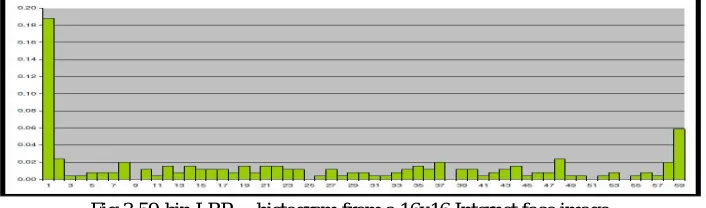
Fig.3 59-bin LBP(8,1)histogram from a 16x16 Internet face image
Local Binary Patterns applied to FaceDetection:
ISSN (Print) : 2320 – 3765 ISSN (Online): 2278 – 8875
I
nternational
J
ournal of
A
dvanced
R
esearch in
E
lectrical,
E
lectronics and
I
nstrumentation
E
ngineering
(An ISO 3297: 2007 Certified Organization)
Vol. 5, Issue 10, October 2016
Facial Features Extraction: Feature value extraction subsystem is to extract 18 feature points from facial image, and
calculate 16 feature values from those points. At first, from a color image image taken by CCD camera, the
background is excluded and the facial image is extracted. Then the facial organs such as brows, eyes and mouth are extracted. After processing facial organs’ image into binary image, feature points are extracted and feature values are calculated.
(a) Face sample (b) 1st Stage LBP(8,1) labels image
(c) 2nd Stage LBP(4,1) labels histogram
Fig.4 Face image - Labels histogram example
(a) Non-face sample (b) 1st Stage LBP2 (8,1) labels image
(c) 2nd Stage LBP(4,1) labels histogram
Fig. 5 Non-face image - Labels histogram example
IV. APPLICATIONS
ISSN (Print) : 2320 – 3765 ISSN (Online): 2278 – 8875
I
nternational
J
ournal of
A
dvanced
R
esearch in
E
lectrical,
E
lectronics and
I
nstrumentation
E
ngineering
(An ISO 3297: 2007 Certified Organization)
Vol. 5, Issue 10, October 2016
Industrial Visual Inspection:
Although many potential application areas for texture analysis exist in industry, only a limited number of successful exploitations have been reported. One of the major problems is the non-uniformness of real-world textures, which is caused by changes in orientation, illumination, scale, etc. In addition, the computational requirements of many proposed texture features are high. One of the first industrial applications of the LBP was metal surface inspection. Later, in a system in which a subset of the LBP codes was used in characterizing defects in automobile engine valves. They compared different feature extraction schemes in a segmentation process[11] needed for the analysis of laundry detergents. One of the most commonly reported applications of the LBP is wood inspection, with which the operator has been used with color measures. A common approach has been to use color and texture features with non-supervised clustering methods. Color and texture features, including the LBP, have been used in a demanding real-time parquet inspection problem. Paper inspection has been a successful application area with the LBP.
Image Retrieval:
A number of researchers have used LBP as part of their image retrieval systems. Lew presented a system called “Imagescape”, which used distribution-based texture features[12] as texture models. These features included the LBP, LBP/C, and “Trigrams”, which was a variant of the LBP calculated from an edge image. Also Berman and Shapiro have used LBP as a texture feature in their “Flexible Image Database System”. Schaefer in turn applied the operator to JPEG-compressed images for image retrieval. He found that with compressed images, sub-sampling does not decrease indexing accuracy. LBP has also appeared as a texture feature in studies.
Scene Analysis:
Recent findings from human psychophysics, neurophysiology and computer vision provide evidence for a framework in which objects and scenes are represented as collections of viewpoint-specific features rather than 2D templates or 3D models. This approach has been utilized in recognizing real-world textures with the LBP. In these works, representative models for textures were found with feature self-organization[14]. It was shown that it is possible to learn a small subset of texture samples that can reliably work as representatives in classifying textures. Promising results were reported in classifying textures and in the segmentation of outdoor scene images.
Face Analysis :
Face analysis is among the most intriguing, and perhaps surprising, applications of the LBP. Here both shape and texture information is used in representing face images. The face area is first divided into small regions from which LBP histograms are extracted. The histograms are concatenated into a single, spatially enhanced feature histogram efficiently representing the face image. Experiments clearly show that the proposed method is superior to all the state-of-the art methods it was compared to (PCA, Bayesian Intra/extrapersonal Classifier and Elastic Bunch Graph Matching). The evaluation was performed with the FERET database, which includes different facial expressions, lighting and aging of the subjects. LBP as a powerful feature for face detection and recognition. The same facial representation is used in both tasks, which is seen as an important property: a unified feature space makes it possible to combine detection and recognition into one framework in which both tasks support each other. In xperiments, the LBP performed equally well or better than any reference method in face detection. In recognizing faces from low-resolution images, the LBP was found to be superior to the reference methods. The study indicates that LBP-based methodology can be used in recognizing facial expressions[13]. In experiments, LBP features combined with the linear programming classification technique yielded better results than other methods with the JAFFE database.
V. CONCLUSIONS
ISSN (Print) : 2320 – 3765 ISSN (Online): 2278 – 8875
I
nternational
J
ournal of
A
dvanced
R
esearch in
E
lectrical,
E
lectronics and
I
nstrumentation
E
ngineering
(An ISO 3297: 2007 Certified Organization)
Vol. 5, Issue 10, October 2016
that have not previously been considered texture analysis problems. Perhaps the most important property of the LBP operator in real-world applications is its tolerance against illumination changes. Equally important is its computational simplicity, which makes it possible to analyze images in challenging real time settings. To help researchers and application developers, C++ and Matlab implementations of the operator are provided free of charge.
REFERENCES
[1] Usman Tariq, Kai-Hsiang Lin, Zhen Li, Xi Zhou, Zhaowen Wang, Vuong Le,Thomas S. Huang, Xutao Lv, Tony X. Han ,”Recognizing Emotions From an Ensemble of Features” IEEE Transactions on Systems, Man, and Cybernetics—part b: cybernetics, Vol.42, No.4,pp.1017-1026, August 2012.
[2] Aruna Chakraborty, Amit Konar,Uday Kumar Chakraborty, and Amita Chatterjee,” Emotion Recognition From Facial Expressions and Its Control Using Fuzzy Logic’, IEEE Transactions on Systems, Man, and Cybernetics—part a: systems and humans, Vol.39, No.4,pp.726-743, July 2009.
[3] Yongqiang Li, Shangfei Wang,Yongping Zhao, and Qiang Ji,” Simultaneous Facial Feature Tracking and Facial Expression Recognition” IEEE Transactions on Image Processing, Vol.22, No.7,pp.2559-2573, July 2013.
[4]. Shangfei Wang, , Zhilei Liu, Siliang Lv, Yanpeng Lv, Guobing Wu, Peng Peng, Fei Chen, and Xufa Wang ,” A Natural Visible and Infrared Facial Expression Database for Expression Recognition and Emotion Inference”, IEEE Transactions On Multimedia, Vol.12, No.7, pp.683-991,November 2010.
[5]. A. Punitha, M. Kalaiselvi Geetha,”Texture based Emotion Recognition from Facial Expressions using Support Vector Machine” International Journal of Computer Applications (0975 - 8887) Vol.80 , No.5, pp.1-5,October 2013.
[6]. Jingjie Yan, Wenming ZhengQinyu Xu, Guanming Lu, Haibo Li, and Bei Wang,” Sparse Kernel Reduced-Rank Regression for Bimodal Emotion Recognition From Facial Expression and Speech”, IEEE Transactions On Multimedia, Vol.18, No.7,pp.1319-1329, July 2016.
[7]. Guoying Zhao and Matti Pietik ainen,” Dynamic Texture Recognition Using Local Binary Patterns with an Application to Facial Expressions” IEEE Transactions on pattern analysis and machine intelligence,Vol.18, No.7, August 2007.
[8]. Faisal Ahmed, Hossain Bari, and Emam Hossain,” Person-Independent Facial Expression Recognition Based on Compound Local Binary Pattern (CLBP)”The International Arab Journal of Information Technology, Vol.11, No.2,pp.195-203, March 2014.
[9]. Chung-Hsien Wu, Wen-Li Wei, Jen-Chun Lin, and Wei-Yu Lee,” Speaking Effect Removal on Emotion Recognition From Facial Expressions Based on Eigenface Conversion”, IEEE Transactions On Multimedia, Vol.15, No.8,pp.1732-1744, December 2013.
[10]. Kusuma Kumari B.M,” Real Time Facial Feature Point Extraction”, IJCAT - International Journal of Computing and Technology, Vol.1, Issue 8,pp.409-412, September 2014.
[11]. M. Sultan Zia1 and M. Arfan Jaffar,” Cross-Cultural Emotion Classification based on Incremental Learning and LBP-Features” Applied Mathematics & Information Sciences,Vol.9, No.5, 2651-2656 (2015).
[12] Giampaolo L. Libralon and Roseli A. F. Romero, “Geometrical Facial Modeling for Emotion Recognition,”IEEE 18thInt.Conf. on Image Processing(ICIP), pp.3093-3096,2013 .
[13] Kevin Tang, Yun Tie, Truman Yang, Ling Guan, “Multimodal Emotion Recognition (MER) System,” International Journal of Computer Applications 978-1-4799-3010-9/14 CCECE 2014 –IEEE Toronto, Canada
[14] Urvashi Agrawal, Shubhangi Giripunjeand Dr. Preeti Bajaj, “ Emotion and Gesture Recognition with Soft Computing Tool for Drivers Assistance System in Human Centered Transportation,” 2013 IEEE International Conference on Systems, Man, and Cybernetics , pp. 4612-4616, August 2013
[15] S L Happy, Priyadarshi Patnaik, Aurobinda Routray, and Rajlakshmi Guha, “The Indian Spontaneous Expression Database for Emotion Recognition” IEEE Transactions On Affective Computing, , Vol.34, No.4 pp.1-13,Sep. 2015 .
[16] Abu Sayeed Md. Sohail, and Prabir Bhattacharya,”Classifying Facial Expressions Using Point-Based Analytic Face Model and Support Vector Machines” IEEE Transactions on Image Processing, Vol.20, pp.1008-1013, 2007.
[17]. Retno Kusumaningrum and Aniati Murni Arymurthy,” Color and Texture Feature for Remote Sensing – Image Retrieval System: A Comparative Study”, IJCSI International Journal of Computer Science Issues, Vol.8, Issue 5, No.2,pp.125-135, September 2011.
[18]. Haibin Yan, Marcelo H. Ang Jr, and Aun Neow Poo,” Cross-Dataset Facial Expression Recognition”, 2011 IEEE International Conference on Robotics and Automation Shanghai International Conference Center May 9-13, pp.2651-2656, 2011, Shanghai, China.
ISSN (Print) : 2320 – 3765 ISSN (Online): 2278 – 8875
I
nternational
J
ournal of
A
dvanced
R
esearch in
E
lectrical,
E
lectronics and
I
nstrumentation
E
ngineering
(An ISO 3297: 2007 Certified Organization)
Vol. 5, Issue 10, October 2016