R E S E A R C H
Open Access
Diffusion-controlled interface kinetics-inclusive
system-theoretic propagation models for molecular
communication systems
Uche A. K. Chude-Okonkwo
*, Reza Malekian and B. T. Maharaj
Abstract
Inspired by biological systems, molecular communication has been proposed as a new communication paradigm that uses biochemical signals to transfer information from one nano device to another over a short distance. The biochemical nature of the information transfer process implies that for molecular communication purposes, the development of molecular channel models should take into consideration diffusion phenomenon as well as the physical/biochemical kinetic possibilities of the process. The physical and biochemical kinetics arise at the interfaces between the diffusion channel and the transmitter/receiver units. These interfaces are herein termedmolecular antennas. In this paper, we present the deterministic propagation model of the molecular communication between an immobilized nanotransmitter and nanoreceiver, where the emission and reception kinetics are taken into consideration. Specifically, we derived closed-form system-theoretic models and expressions for configurations that represent different communication systems based on the type of molecular antennas used. The antennas
considered are the nanopores at the transmitter and the surface receptor proteins/enzymes at the receiver. The developed models are simulated to show the influence of parameters such as the receiver radius, surface receptor protein/enzyme concentration, and various reaction rate constants. Results show that the effective receiver surface area and the rate constants are important to the system’s output performance. Assuming high rate of catalysis, the analysis of the frequency behavior of the developed propagation channels in the form of transfer functions shows significant difference introduce by the inclusion of the molecular antennas into the diffusion-only model. It is also shown that fort> > 0 and with the information molecules’concentration greater than the Michaelis-Menten kinetic constant of the systems, the inclusion of surface receptors proteins and enzymes in the models makes the system act like a band-stop filter over an infinite frequency range.
Keywords:Molecular communication, System-theoretic model, Enzyme-catalyzed reaction kinetics, Ligand-receptor binding, Transfer function, Molecular antenna
1 Introduction
There has been increasing interest in the field of nano-technology in the recent times, a trend that is evident from the volume of accessible literature on this subject. Nanotechnology emerged as a promising technology with contributions from diverse science fields and with potential applications in wide range of areas. On the basic, this technology dwells on novel concepts, tech-niques, tool, and devices that can be employed to probe and manipulate materials at the particulate and molecular
levels. These novel concepts, techniques, tools, and de-vices are envisioned to be used to substantially improve existing technologies as well as introduce entirely new technological innovations.
An aspect of nanotechnology that is receiving much attention recently is the subject of nanocommunication. Nanocommunication is a new research area that aims at realizing communications between nano-scale computing devices or nanomachines [1]. Essentially, the communica-tions among nanomachines can be realized by means of molecular, electromagnetic, or quantum information exchange. This paper focuses on nanocommunication by means of molecular communication. Molecular
* Correspondence:[email protected]
Department of Electrical, Electronic & Computer Engineering, University of Pretoria, Pretoria, South Africa
communication (MC) is realized through the trans-mission and reception of biochemical information encoded in the concentration and type of molecules. The emergence of MC has found potential applica-tions in fields that include bioengineering [2, 3],
nanomedicine [4–10], and environmental safety [11].
Readers shall refer to [1, 12–16] and the references
therein for reviews of recent work in MC as well as some potential applications.
Just like in every communication among entities, the reliability of information exchange between nanoma-chines depends on the characteristics of the communica-tion medium. The ability to integrate the knowledge of the medium characteristics into the design and analysis of the nanomachines is dependent on the appropriate-ness of the model that is used to mimic the propagation behavior. Popular molecular propagation mechanisms
include the use of molecular motors [17–19], bacteria
[20, 21], and molecular diffusion [22, 23]. The focus of this paper is on the molecular diffusion technique for information exchange among nanomachines. In mo-lecular diffusion technique, information in the form of molecular concentration or type is broadcasted and received by a nanoreceiver, which processes and decodes the information based on predefined bio-chemical algorithms.
Over the past years, different diffusion models have been developed. Some of these models include those based on the theories of turbulent diffusion [24], electro-diffusion [25], and Fick’s diffusion [26, 27]. In this work, we are concern with Fick’s diffusion technique because of its generality. In the context of molecular communication, limited research efforts have addressed the problem of modeling the MC channel. In [28], Eck-ford presented a model of molecular communication based on the Brownian motion. And in [29, 30], MC channel models for the scenarios where the diffusion medium is in motion are presented. However, the models presented in [28–30] do not incorporate any bio-chemical reaction possibilities. It should be noted that the aim of molecular communication is to develop com-munication systems using underlying biological commu-nication components [31]. For instance, the reception mechanism and information decoding of an MC system can be modeled using some known cell signaling path-ways. An example is the case of the popular ligand-receptor binding action on the cell membrane [32]. The mechanism can be employed as the reception mechan-ism in nanoreceivers and modeled as a biochemical reac-tion. Molecular receiver reception models that consider the ligand-receptor binding mechanism can be found in
[33–37]. Hence, while one can compute the
concentra-tion of a molecule at a given space around a receiver, the mechanism of coupling the molecular information into
the receiver biological circuit will definitely define how much information it actually transferred. Therefore, the reaction rate of say the ligand-receptor binding action and other factors of influence have to be incorporated into the channel model. Pierobon and Akyldiz [38] de-veloped an interesting mathematical framework that aims at an interpretation of the diffusion-based MC with consideration to the use of ligand-receptor binding ac-tion at the receiver. However, this model does not in-clude the actual biochemical reaction kinetics. The model in [38] is used in [34] to model and analyze the noise in a typical MC system. A molecular diffusion model that considers the ligand-receptor binding kinet-ics in a moving propagation medium is presented in [39]; however, the biochemical kinetics of the reception process is not accounted for in the overall model.
In this paper, we present a deterministic system-theoretic molecular communication diffusion model that incorporates the physical/biochemical kinetics of the interfacing units between communicating nanomachines. These interfacing units such as the surface receptors
protein/enzymes and nanopores are termed molecular
antennas. The term kinetics is a generic term that is used in this work to describe the biochemical and phys-ical characteristics, attributes, and behaviors of the mo-lecular antennas. The transmitter momo-lecular antenna in this work is the nanopores, and the receiver antennas are modeled as surface receptors proteins and surface receptor enzymes. Hence, the reception mechanism of the receiver is modeled separately as ligand-receptor binding kinetics and as enzyme-catalyzed biochemical reaction kinetics. For the rest of this paper, we shall refer to the surface receptors proteins and surface receptor enzymes simple as surface receptors and surface en-zymes, respectively. In summary, the contributions of this work are as follows.
1. A nanotransmitter-diffusion channel model is presented, which takes into account the effect of the use of nanopores as the medium through which synthesized molecular signals leave the transmitter space. This model introduces a diffusion coefficient that accounts for the randomness in the density of the emitted molecules.
2. Based on the kinetic possibilities that arise due to the use of nanopores to emit molecular signals at the transmitter, and the reception at the receiver using surface receptor and surface enzymes, we derive explicit analytical expressions for the output
3. We also derived system-theoretic propagation models for the different transmit-receive configurations. The arising transfer function-based models typifies the channel models for the scenarios where the influence of the molecular antennas are taken into consideration.
For the derived propagation models, the time and fre-quency responses of the systems to variation in designs and kinetic parameters and pulsatile signals are evalu-ated. We note that the idea of the system-theoretic ap-proach is to circumvent the detailed characterization and description of the entire MC system, by making an analogy with linear time invariant systems. In this mode, the different transition states of the input molecular sig-nal can be followed through the communication net-work in both time and frequency. However, just like many biological systems, the MC system is not linear, but there is a subtle analogy with linear systems which drives analytical tractability. We also point out that an interesting seminal work on system-theoretic model for MC is presented in [32]. However, unlike the approach in this present work, [32] does not include the transmit-ter antenna model and the use of enzymatic circuit at the receiver interface, and the frequency analysis is re-stricted to the signal attenuation.
The context and organization of this paper are made in such a way that make it easy for experienced and new researchers in the field of MC to follow and familiarize with the basics that underlay the MC concepts. The rest of this paper is organized as follows. In“Related works,” existing works that are related to the ideas in this paper are discussed. The system model and problem definition are presented in“System model and problem definition.” Preliminary assumptions that are considered in the development of the models in this work are discussed in “Preliminaries to molecular propagation model.”In“ Dif-fusion-only molecular propagation model”and“Interface
kinetic-diffusion molecular propagation model,” the
diffusion-only and the diffusion-controlled interface kinetic-inclusive propagation models are presented, re-spectively. Simulation results and discussion are pro-vided in “Illustrative examples, simulation results and discussion”.
2 Related works
To the best of our knowledge, existing works that consid-ered system-theoretic approach to MC analysis are pre-sented in [32, 41]. In [32], this approach is used to model the MC network as a biological circuit. The transmitter is modeled as comprising of an enzyme encoder that synthe-sizes the acts of some substrates concentration to produce the information molecules. The information molecules diffuse through the intercellular environment and are
received by means of ligand-receptor binding process. The transfer function of the entire communication stages are provided, and analytical results of signal attenuation as a function of transmission radius and frequency are pre-sented. Unlike our work, the transfer function and results in [32] do not take the transmitter antenna and receiver radius into consideration. More also, the pattern of the re-ceived signal as well as the use of surface enzymatic circuit for reception is not addressed in [32]. In [41], without incorporating any biochemical possibility, the system-theoretic approach is used to develop end-to-end concen-tration propagation model based on microfluidic channel configurations. Using the developed model, the design of microfluidic channels is performed based on the least-squares finite impulse response filtering to achieve the desired end-to-end transfer function. Other works that support or relate to some of the various concepts used in this work can be grouped into the ones that employ the assumption of linear models, surface receptor models, and diffusion models.
The assumption of linear time invariance model for the MC system as is made in this work has been used in [32, 40]. The transfer function model for diffusion-only and that of ligand-receptor reception model can be found in [32, 39] [42] and are used as reference and comparison to our work. We note that the MC system, just like many biological systems, is a nonlinear system. Hence, to apply linearity assumption, we shall restrict our analysis to behaviors near nominal operating range within which nonlinearity approximates linearity [43]. While the use of surface receptor proteins as the re-ceiver molecular antenna and discussions of the ensuing
biochemical kinetics can be found in [33–37], the
in-corporation of the transmitter antenna is not addressed. A detailed discussion on the ligand-receptor binding, trafficking and signaling is presented in [44], where the explicit expression for ligand-receptor binding action in the case of uniformly distributed ligands around the re-ceptor location is provided.
Our work involves the use of enzymes as surface re-ceptors and the derivation of explicit response expres-sions for this type of receiver molecular antenna. While enzyme-catalyzed reactions are ubiquitous in
biochem-ical systems [45–50], in the context of MC only few
works [35, 51–54] exist. In [52], an enzyme circuit is used to decode frequency coded signal in MC networks. In that regard, enzyme-catalyzed reaction that is modeled
after the oscillatory behavior of
derived closed-form expression of the mean receiver output is simplified only up to the differentials. In [53], the mitigation of intersymbol interference in MC systems using enzymes that freely diffuse in the propa-gation environment is presented. While our model con-siders enzymes that are immobilized at the receiver membrane, in [53], the enzymes diffuse freely along with the transmitted information molecules. More also, [53] does not provide any explicit close-form expressions for the output concentrations of the MC system. In [54], Nakano et al., also considered enzyme-catalyzed kinet-ics for the application of MC to targeted drug delivery but used the popular Michaelis-Menten equation for evaluation and also did not provide any explicit expres-sions for the output signals. An MC-based diffusion-controlled enzyme-catalyzed architecture for targeted drug delivery is presented in [51] where enzyme cataly-sis is considered in deriving analytical expressions for information transfer. However, [51] does not address system-theoretic concern, transfers functions, and does not consider the transmitter antenna in the model.
In relation to molecular diffusion channel models, more recent works such as [55] presented a 3D channel model of a molecular communications and analyzed its attenu-ation and propagattenu-ation delay characteristics for an absorb-ing receiver. An end-to-end analysis of propagation noise and memory for molecular communication over microflui-dic channels is presented in [56]. In [57], a realistic channel model for a table-top molecular communication platform that is capable for transmitting short text messages across a room is proposed based on an experimental platform presented in [58]. We note that [55–58] do not consider any biochemical possibilities in the respective models.
3 System model and problem definition
Before proceeding with the system model and defini-tions, some notation used in the rest of this work are ex-plained below.
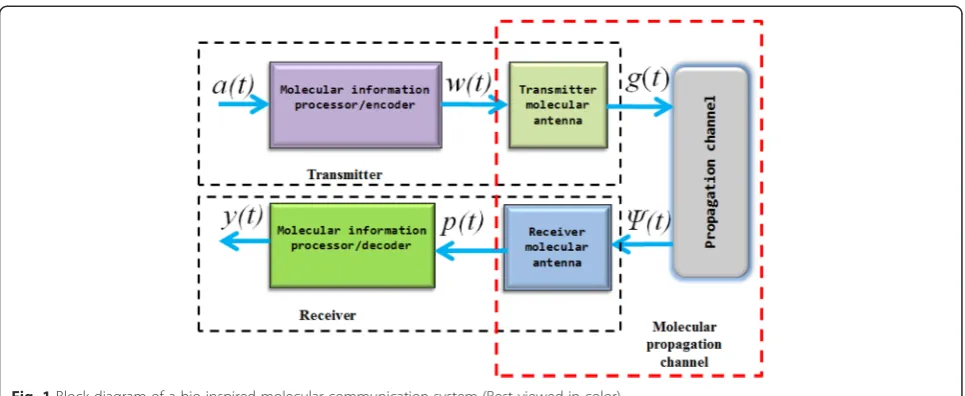
The schematic diagram of a typical molecular commu-nication system is shown in Fig. 1, in which we have dif-ferentiated the diffusion channel from the propagation channel. We employ the term molecular propagation channel to include the channel that consists of the diffu-sion channel and the molecular antenna. Here, the term molecular antenna represents the coupling interface between the transmitter and the diffusion channel and between the diffusion channel and the receiver
bio-circuit. The examples of nature’s molecular
an-tenna include the protein receptor on the surface of the biological cell membrane, the cell membrane it-self, and the gated ion channels. The focus of this paper is to model the molecular propagation channel illustrated in Fig. 1 (enclosed in red dotted lines). In
Fig. 1, a(t) represents the molecular concentration
that triggers information processing/encoding at the transmitter. The output of this information/encoding
process w(t) is then transmitted using the transmitter
molecular antenna. We denote the molecular
concen-tration at the output of the transmit antenna by g(t).
The function g(t) is conceptually the concentration of
an arbitrary molecule G present at the output of the
transmit antenna and the input of the diffusion channel. The molecular concentration observable at the output of the diffusion channel and which serves as the input to the receiver antenna is represented asψC(t). The receiver
an-tenna picks up this signal and outputsp(t). The molecular concentration p(t) is decoded and processed to yield the desired system outputy(t).
Let us consider the representation of the molecular propagation channel as a cascade of the responses given as hi(t,Ki), i= 1, 2, 3 and shown in Fig. 2, where
hi(t,Ki), represents the impulse responses of each of
the ith unit. The term Ki represents the vector of all
other parameters associated with each block. These parameters include the diffusion coefficients and rate constants. Also, let Fig. 2 be a linear system, hence, its transfer function is
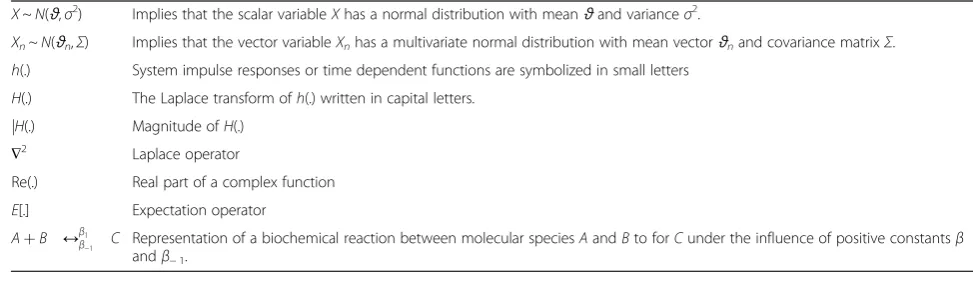
X~N(ϑ,σ2) Implies that the scalar variableXhas a normal distribution with mean
ϑand varianceσ2.
Xn~N(ϑn,Σ) Implies that the vector variableXnhas a multivariate normal distribution with mean vectorϑnand covariance matrixΣ. h(.) System impulse responses or time dependent functions are symbolized in small letters
H(.) The Laplace transform ofh(.) written in capital letters. |H(.) Magnitude ofH(.)
∇2 Laplace operator
Re(.) Real part of a complex function
Ε[.] Expectation operator AþB ↔β1
H123ðs;K1;K2;K3Þ ¼H1ðs;K1ÞH2ðs;K2ÞH3ðs;K3Þ
ð1Þ
This implies that
H123ðs;K1;K2;K3Þ ¼ P sð Þ
W sð Þ ð2Þ
whereW(s) andP(s) are the Laplace domain versions of
w(t) and p(t), respectively, and s =σ+ jω is the Laplace variable.
Depending on the task at hand and the design architec-ture of the transmitter and receiver,H123(s,K1,K2,K3) will
differ from one type of molecular antenna to another. For instance, H3(s, K3) may be a membrane receptor in one
design and a cell membrane itself in another. Hence, while H3(s, K3) for the former depends on the ligand-receptor
kinetics, the latter depends on the rate of endocytosis. This difference will significantly impact on the total sys-tem response as will be shown in this work.
In this work, we model the transmitter as a spherical nanoporous structure with a relative point source inside it. The nanopores are formed by perforating the surface of the transmitter, and through these nanopores, the molecules
emitted from the point source transude as shown in Fig. 3. Existing methods and techniques for forming nanopores can be found in [59–63]. We designate the transfer func-tion of the nanopores as HN(s, KN). The dynamics of the
molecules from the transmitter to the receiver space is modeled using Fick’s diffusion theory. In this sense, the transfer function of the classical diffusion medium is repre-sented asHC(s,KC). At the receiver, we consider two
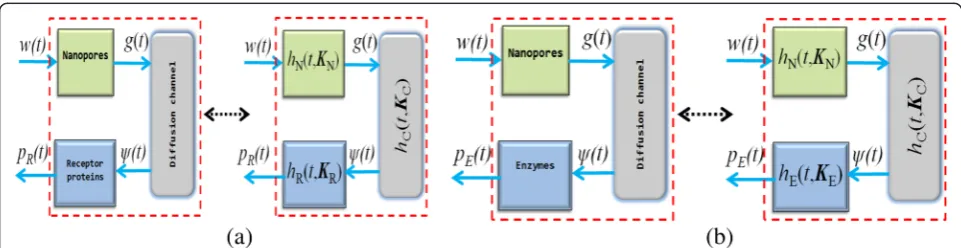
differ-ent configurations of molecular antenna kinetics, the surface receptor-ligand binding kinetics, and the enzyme-catalyzed reaction kinetics. The transfer functions of the surface receptor and enzyme receptor systems are given as HR(s,KR) andHE(s,KE), respectively. The schematic of
mo-lecular communication that involves the two scenarios are shown in Fig. 4, with their corresponding transfer function given in relation to (1) as
HN CRðs;KN;KC;KRÞ ¼HNðs;KNÞHCðs;KCÞHRðs;KRÞ ð3Þ
HN CEðs;KN;KC;KEÞ ¼HNðs;KNÞHCðs;KCÞHEðs;KEÞ ð4Þ
In the preceding sections, we shall provide the system-theoretic model for the diffusion-only molecular propa-gation model and models that include the transmitter/ Fig. 1Block diagram of a bio-inspired molecular communication system (Best viewed in color)
receiver molecular antenna kinetics. The derivations of the analytical expressions of the various input and output signals in time and frequency domain are also provided. However, before doing that, we first present the preliminaries and generalize assumptions employed in the rest of this work.
4 Preliminaries to molecular propagation model Before we proceed with the model development and der-ivation of expressions, we make the following simplifying assumptions in addition to those made in [51].
1. The nanopores and surface receptors/enzymes are assumed to be immobile and evenly distributed on the membrane of a spherical transmitter and receiver, respectively.
2. All the surface receptors/enzymes are equally active. 3. The process of surface receptors/enzyme
immobilization has not altered the structure of the surface receptors/enzymes and the reaction rate coefficients.
4. The charge and hydrophobicity of the immobilized surface receptors/enzyme surface are not taken into consideration; hence, the influence of the surface receptors/enzyme surface net charge on the system is neglected.
5. Constant temperature and pH, as well as the homogeneity of the diffusion medium, are assumed. 6. The influence of medium velocity is not considered.
Hence, the molecular motion is purely Brownian. 7. Both the transmitter and the receivers are stationary 8. The information molecules have spherical shape
so that the diffusion coefficient due to rotation is neglected.
9. The receptors and enzymes on the receivers’surface are of the same kind and specificity.
10.This model assumes that there are only one
transmitter and one receiver, and there are no other competing molecules in the medium.
By making these assumptions, the overall output concentration and system-theoretic models are deter-mined by mass transfer (diffusion) of the information molecules and the surface nanopores/receptors/en-zyme kinetics.
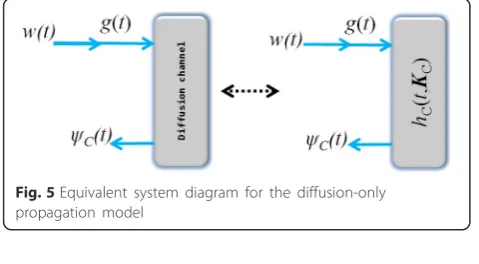
5 Diffusion-only molecular propagation model In relation to Fig. 4, the system-theoretic model for the diffusion-only phenomena is depicted in Fig. 5 and expressed as
Fig. 3An illustration of diffusion-controlled interface kinetics-inclusive molecular communication between two nano devices
HCðs;KCÞ ¼ΨC s
ð Þ
G sð Þ ð5Þ
where ΨC(s) and G (s) are the Laplace transforms of
ψC(t) andg(t), respectively.
The expression in (5) does not take into account the influence of the molecular antennas, hence, g(t) =w(t). The molecular signalg(t) can be expressed as the
molecu-lar concentration at a reference distance r0 about the
transmitter and reference time t0, hence g(t)≡g0(t0, r0).
We modelhC(t,KC) as the classical diffusion process using
Fick’s diffusion law, whereKC= {D, r, θ, ϕ}. In this case,
the molecular signalg0(t0, r0) that is initially at the input
of the channel with diffusion coefficient D can be
evaluated at any coordinate (r, θ, ϕ) and time t using the expression
∂gcðt;r;θ;φÞ
∂t ¼D∇ 2g
cðt;r;θ;φÞ þf tð Þ;r ð6Þ
where ∇2¼ 1
r2 ∂rðr2∂rÞ þsinθ1 ∂θðsinθ ∂θÞ þsin12θ∂2φ
and gc(t,r,θ,φ) are the concentration of the molecule at
any spatial distance defined by the coordinate (r,θ,φ) at time t. The function f(t,r) is the source of the informa-tion molecules, whose characteristics influence the
solu-tion to (6). We shall henceforth assume that D is
independent of g(t), and hence of (r,θ,φ), which implies the homogeneity of the diffusion medium.
For g0(t0, r0) =f(t,r) =NAδ(r-r0), the solution to (6) is
the fundamental solution
gcð Þ ¼t;r NA
4πDt
ð Þ1=2 exp − r−r0
ð Þ
j j2
4Dt !
ð7Þ
The expression in (7) is a point concentration at a dis-tancer[64] and does not take into consideration the re-ceiver configuration and parameters. To model the portion ofgc(t,r) that is received without recourse to the
molecular antenna, but is comparable to what is received using the molecular antennas, letvass+be a hypothetical
volume termed reception space. This concept of
recep-tion space has been employed in [40] and is illustrated in Fig. 6, where the transmitter is located at the distance
r∈Rfrom the center of vass+. The sphere of radiusrass+
that encompasses vass+ is concentric with that of the
spherical receiver volume of radiusrR. We consider that
any molecule that diffuses into this volume is assumed to have been received.
LetYndenote some arbitrary continuous random
vari-able and suppose that the probability density of Yn
eval-uated at yn is the function fn(yn). The probability of Yn
falling into some arbitrary interval [a b] can be expressed by a multivariate spherically symmetric distribution.
Pϑ½a≤Yn≤b ¼Εϑ ðYn−ϑÞ′fnða≤Yn≤bÞ
h i
ð8Þ
where (Yn−ϑn)′is essentially the derivative of (Yn−ϑn),
ϑn is the unknown mean number ofYn having a normal
distribution, and fn(a≤Yn≤b) is a smooth function. In
relation to estimating the mean of a multivariate normal distribution, it was shown in [65] that if Yn~ N (ϑn,Σ),
then
Εϑ ðYn−ϑnÞ′fnða≤Yn≤bÞ
h i
¼Σ Εϑ ∇′fnða≤Yn≤bÞ
ð9Þ
Relating (6) to (9) and bearing in mind that variance is proportional to diffusion coefficient, it can be shown that
r∂gcð Þt;r
∂t ¼rD ∇ 2g
cð Þt;r
ð10Þ
To obtain the radial solution to (10), let us assume that the distance between the transmitter and the re-ceiver is large enough so that we can consider the Fig. 5Equivalent system diagram for the diffusion-only
propagation model
diffusing information molecules from the transmitter as being equally distributed around the receiver at time t. With this assumption, we can express the initial condi-tion for (10) as the radial source
gcð0;rÞ ¼NAδðr−r0Þ
4πr2 ð11Þ
The solution to (10) that includes the reception space parameter is given by [66]
gcðt;r;rassþÞ ¼ NA
The concentration that is received in the space vass+= (4π/3)(rass+−rR)3 for rass+≈rR is given by
Therefore, using Laplace transform, it can be shown that
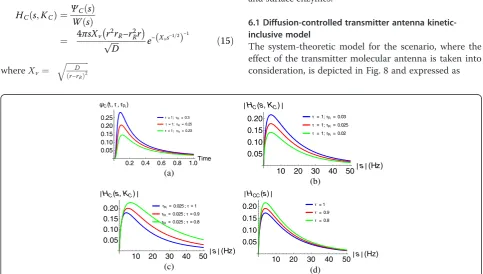
The result in (15) is validated by a related Fourier do-main result presented in [67] where the transfer function of the diffusion channel is given as
HCCðω;KCÞ ¼Re
The graph of (15) and (16) are separately shown in Fig. 7. It can be seen that the diffusion channel be-have like a low-pass filter. However, we note that un-like (15), (16) does not take the receiver parameters into consideration.
6 Interface kinetic-diffusion molecular propagation model
While the diffusion-only model provides one with func-tions for quantifying the molecular information available within a space at some distance away from the transmit-ter, it does not avail us with the actual expression of the molecular information coupled into the receiver with re-spect to the molecular antenna used. To address this challenge, we consider the inclusion of the effects of the transmitter molecular antenna and the receiver molecular antenna into the diffusion-only model. We shall consider the effect of incorporating these antennas on the system response, where the transmitter molecular antenna is a nanopore, and the receiver antennas are surface receptors and surface enzymes.
6.1 Diffusion-controlled transmitter antenna kinetic-inclusive model
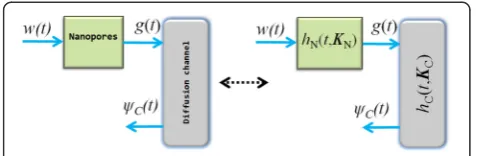
The system-theoretic model for the scenario, where the effect of the transmitter molecular antenna is taken into consideration, is depicted in Fig. 8 and expressed as
(a)
HNCðs;KN CÞ ¼HNðs;KNÞHCðs;KCÞ
¼ΨN Cð Þs
W sð Þ ð17Þ
In this case,G(s)≠W(s), hence,HNC(s,KNC)≠HC(s,KC).
As stated earlier, the transmitter in this work is modeled as a spherical structure with a point source insider it and nanopores perforated on its surface through which mole-cules transude. The expressions (5)–(15) do not take the presence of the nanopores into account. To appreciate the effect of integrating the influence of the nanopores, we consider the illustrative model shown in Fig. 9. In Fig. 9a, there is one single pore whose kinetic implies that the source cannot be simply modeled as a point source since the emission through the pore is a function of time. When the number of nanopores is increased as depicted in Fig. 9b, and depending on the ration of the nanopores to the initial source concentration, the emission can be modeled as a distributed point source at various locations on the trans-mitter surface. In Fig. 9c, there are many nanopores, in
which case, the emission can be approximated to the diffusion-only case depicted in Fig. 9d. The difference in scenarios Fig. 9c, d can be related to the diffusion coeffi-cient of the medium and that of the interface, that is, the nanopores. In the case of Fig. 9d, the diffusion coefficient Din (5)–(15) can be expressed as that of the homogeneous case for which [68]
D¼ KBT
6πηrM ð
18Þ
where KB is the Boltzmann constant,T is the absolute
temperature of the system,ηis the viscosity of the
diffu-sion medium, and rM is the radius of the spherically
shaped diffusing particle.
However, in the case of Fig. 9c, certain factors need to
be taken into consideration in computing D. These
fac-tors include the influence of the nanopores size rN, the
distributionfNof the nanopores over transmitter surface
∂Ω, and the ratio of the nanopores footprint to∂Ω. For Fig. 9c to be approximated to Fig. 9d, rM< <rN must
hold. More also, the ratio of the nanopores footprint∂N
to transmitter surface area∂Ωshould be unity. Since the practicality of ∂Ω/∂N= 1 is technically unrealistic in this
case, we have to include in the model the possibility of some of the diffusing molecules at an arbitrary timet be-ing reflected back at some boundary points on the
trans-mitter surface. The expression for the diffusion
coefficient that accounts for the ratio of the nanopore radius to that of diffusing molecules can be found in Fig. 8System diagram of diffusion-controlled transmitter
nanopores-only inclusive propagation model
(a)
(b)
(c)
(d)
[69]. In this present work, we consider the case where rM< <rN, and the ratio of ∂Ω to ∂N tends to unity, but
not exactly unity, which is the scenario that is related to Fig. 9c. The condition ∂Ω/∂N ➔ 1 indirectly addresses
the symmetric distribution concern of the pores for iso-tropic diffusion. LetPdbe the probability that a diffusing
molecule at an arbitrary timetis reflected back. A more generalized diffusion coefficient is given by
Deq ¼ KBT 6πηrM
Pd nN;∂∂Ω N;
fN
ð19Þ
where nN is the number of the pores of equal
dimen-sions. We define the probability function in (19) by
Pdð Þ ¼nN 1− 1
nN
Nμ;σ2 ð20Þ
whereμis the mean andσ2is the variance ofnN. As nN
tends to infinity,Deq=D. Therefore, for the transmitter
interface kinetic-diffusion model, Deqreplaces Din (14),
thus
ψNCðt;r;rRÞ ¼
DeqNA rRr−r2R
2π1=2 D eqt
3=2
re
−ðrR−rÞ2
4Deq t ð21Þ
Accordingly,
HNCðs;KN CÞ ¼
4πsXv;eq r2rR−r2Rr
ffiffiffiffiffiffiffi Deq
p e−ðXv;eqs−1=2Þ−
1
Xv;eq¼
ffiffiffiffiffiffiffiffiffiffiffiffiffiffiffi Deq r−rR ð Þ2 s
ð22Þ
whereKNC= {Deq,r,rR}. For zero-mean unit variance, the
effect of variation innNand invariably∂Ω/∂Nis illustrated
in Fig. 10. It can be observed that Deqproduces a noisy
version ofHNC(s,KNC), and asnNtends to infinity, Fig. 10d
approximates Fig. 10c. This noise can be regarded as a fluctuation in the concentration of the information mole-cules. Since it is this concentration that is detected by the receiver antennas, implicitly, the random fluctuation (noise) in the information molecule concentration may re-sult in deviations in the number of bound receptors from the mean behavior predicted by deterministic models [44]. Hence, the lesser nN is the more the effect of molecule
random fluctuation is felt and the more the deterministic model assumption pursued in this work is violated.
6.2 Diffusion-controlled receiver antenna kinetic-inclusive model
6.2.1 Surface receptor kinetic-diffusion model
We shall now consider the inclusion of the influence of the surface receptor as the receiver molecular antenna
to the HNC(s,KNC) model. We consider the scenario
where the result of the information reception by the sur-face receptor initiates a signal transduction cascade in the receiver biological circuit. We term molecular anten-nas that produce this type of effectenzyme-linked recep-torssince in actual sense, these surface receptors are not necessarily enzymes but possess intracellular domains that are associated with an enzyme. In this case, after a ligand binds to the extracellular domain of the receptor, the receptor undergoes conformational change, which subsequently activates the intracellular enzymes thereby triggering various activities in the biological circuit of the receiver. An example of this type of molecular antenna is the tyrosine kinase receptor, which is a high-affinity cell surface receptor for many polypep-tide growth factors, hormones, and cytokines. This form of ligand-receptor binding reaction kinetics can be modeled as
(a)
(b)
(c) (d)
ΨMþQ ↔ ξ1
ξ−1
PR ð23Þ
where ΨM is the information carrying molecule or
re-ceived ligand present inside vass+, Q is the surface
re-ceptor, and PR is the ligand-receptor complex. The
terms ξ1 and ξ-1 are positive rate reaction constants.
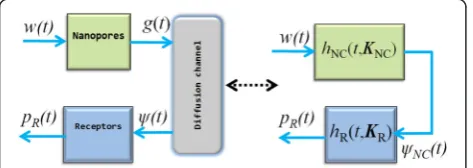
The system-theoretic model for the scenario where the effect of the surface receptor is taken into consid-eration is depicted in Fig. 11 and expressed as
HNCRðs;KN;KC;KRÞ
¼H sð;KN CÞHRðs;KRÞR¼ PRð Þs
ΨNCð Þs
ð24Þ
wherePR(s) is the Laplace transform ofpR(t).
To obtain HNCR(s,KN,KC,KR), we apply the law of
mass action to obtain the following differential equation model for (23)
dpRðt;r;rRÞ
dt ¼ξ1ψNCðt;r;rRÞq tð;r;rRÞ−ξ−1pRðt;r;rRÞ
ð25Þ
where pR (t,r,rR), ψNC(t,r,rR), and q(t) are the
concentra-tions ofPR,ΨM, andQ, respectively. If we assume that the
concentrations ofΨMandQare independent ofrandrR,
that is, of the diffusion process, and q(t,r,rR) is constant,
then the transfer function can be written as [32, 39]
HRRð Þs RRRR∝ ξ1
sþξ−1 ð
26Þ
However, the rate of complex formation, that is the formation ofPR, is proportional to the rate at whichΨM
andQencounter themselves, as well as the rate at which the encounter is broken. The rate of encounter is in it-self proportional to the joint probability of finding ΨM
andQin the same space,vass+. The probability of finding
a number ofΨMinvass+is dependent onr,rR, andrass+.
Assuming that once a received molecule dissociated from bonding with a receptor it diffuses away, the prob-ability that aΨMobserved invass+at a timet1is still
in-side vass+ at time t2 and have not diffused away also
defines the rate of encounter. Obviously, as is illustrated
in Fig. 12, the larger x= (rass+ −rR) is the longer a ΨM
stays in vass+ and the more the probability of rebinding
and viz a viz. Hence, to ensure that theno-rebinding as-sumption holds, it is desirable that x is very small. The rate at which the encounter is broken depends on the af-finity constant ξa of the binding [70], which can be
cal-culated as ξa=ξ1/ξ−1. A high ξa implies that the
received molecules stay long in the bonding; hence, more molecules may have diffused away within the
bonding timetbond and not get the opportunity to bond
with the receptors. Recall that we have assumed in the derivation of (14) that rass+≈rR; hence x= (rass+ −rR) is
very small. Let us express td=t2−t1 and tbond=t1/2=
0.693/ξ−1[70]. If we assume the same time scale for the
binding and diffusion processes, then considering the scenario wheretbond≤td, we can write that
ξ−1≥1:386 D
x2 ð27Þ
This implies that the larger the value of reception
space x, the higher the probability that many molecules
may have diffused away from the space without getting the opportunity to bond with the receptors. In this case, a more accurate model must include the probability of escape from the space as a function of time. Such model has been presented in [71, 72]. On the other hand, the
smaller the value of reception space x, the lower the
probability that some molecules may have diffused away from the space without getting the opportunity to bond with the receptors. In this case, a deterministic model can be pursued results in which the rate of complex for-mation will now depend only on the concentration of re-ceptors andΨMat each point in time.
Hence, if we assume thatψNC(t,r,rR) > >q(t) and with
no consideration to the effect of receptor clustering [73], then for pR(t, r, rR) =q0−q(t), where q0 is the total
Fig. 11System diagram of diffusion-controlled transmitter nanopores/ surface receptor-inclusive propagation model
concentration of the receptors, the rate of complex
for-Hence, it can be shown that
pRðt;r;rRÞ ¼ ξ1
We note that a related result is presented in (2–12), [44]), but without considering the influence of the diffu-sion channel.
Hence, while the received molecular signal within the space x→0 is expressed by (14), the actual information concentration detected by the surface receptor antenna is expressed in (29).
Applying Laplace transform method to (28) yield
sPRðs;r;rRÞ ¼ξ1q0Ψðs;r;rRÞ−ðξ1q0ΨN Cðs;r;rRÞ
It can be seen that (30) is not a linear system; hence, its transfer function cannot be generalized but has to be defined for a specific input. In this case, a specific trans-fer function for (30) in the case of a delta input can be obtained from the ratio of the Laplace transform of (29) to that of (21). Thus,
is a Meijer-G function. Therefore
HRðs;KRÞR¼
It can be observed that for the range of frequency consid-ered, and bearing in mind the assumptions made in arriv-ing at (26), (32), and (33), the plot of (33) as compared to (26) indicates that theonly-receptorsystem tends towards the system in (26) where the diffusion process is not taken into account. However, with the inclusion of the diffusion process, the response significantly deviates from the no diffusion state.
6.2.2 Surface enzyme kinetic-diffusion model
We have considered the scenario where the information reception is achieved using surface receptors. In that case, the reception process initiates a signal transduction cascade in the biological circuit located inside the re-ceiver. In another scenario of concern in this work, in-stead of surface receptors, we have surface enzymes. These enzymes act as receptors on the surface of the re-ceiver. However, instead of causing a signal transduction, these enzymes catalyzes the production of product cules from their interaction with the information mole-cules. In this sense, the enzyme-ΨMinteraction forms a
biological circuit at the surface instead of the inside. This type of receiver has been presented in [51] for the
(a) (b)
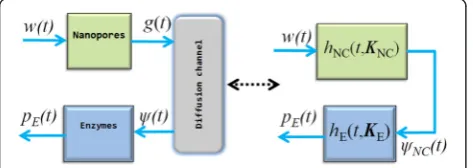
purpose of targeted drug delivery. The system-theoretic model for the scenario where the effect on the surface enzymes is taken into consideration is depicted in Fig. 14 and expressed as
LetErepresent the enzyme receptor, we can represent
the enzyme-ΨM binding action by the popular
enzyme-catalyzed kinetic model expressed as
ΨMþE ↔
k1
k−1
C →k2 PEþE ð35Þ
wherek1,k−1, andk2are positive rate constants,Cis the
enzyme-ΨM complex, and PE is the product molecule.
Lete(t),c(t), andpE(t) be the concentrations ofE,C, and
PE, respectively. Since the number of the immobilized
enzymes on the membrane of the receiver are fixed, the total enzyme e0 at any instant of time is such that
c(t) =e0−e(t). Applying the law of mass action, the
following differential equations arise from (35)
dψNCðt;r;rRÞ
expression for c(t) can be obtained from (37) by
assum-ing as previously done in the case of the surface receptor thatψNC(t,r,rR) > >e(t); hence, (37) simplifies to a pseudo
first-order equation. This implies that
Z
Integrating both sides of (39) yields
loge ½k1ψN Cðt;r;rRÞe0−½k1ψNCðt;r;rRÞ þk−1þk2c tð Þ
Having obtained c(t), we simply plug it into (38) and
integrate, thus
Solving (45) as a pseudo first-order equation yields
pEð Þ ¼t ψNCðt;r;rRÞe0k2 Fig. 14System diagram of diffusion-controlled transmitter nanopores/
pEðt;r;rRÞ ¼k2
main analytical expression for pE(t, r, rR) is required.
This expression can be obtained by making the simplify-ing assumption that the rate of catalysis is high so that ψNC(t,r,rR) > >kM. Hence,
consider the case where t> 0, then we can approximate e−ðr0−rRÞ2=ð4DtÞ≈1 in both (21) and (46). Therefore,
is again a Meijer-G function. Hence, for a dirac input,
HN CEðs;KN;KC;KEÞ ¼
the analysis made in the surface receptor case, Fig. 15
indicates that the receptor-only system, which can be
considered as a system where the diffusion process is not taken into account, deviates significantly from the no diffusion plus receptor scenario.
7 Illustrative examples, simulation results and discussion
In this section, we present the time and frequency ana-lysis of the system-theoretic models and expressions pre-sented in this work. Firstly, a comparison between the
reception space-only model and the antenna-inclusive model is presented so as to quantify how much informa-tion it actually received. Secondly, we evaluate the effect on the system output of the geometric parameters associated with the receiver and the medium and the effect of the reaction parameters associated with the surface receptor-based receiver model and the enzyme receptor-receptor-based re-ceiver model. Thirdly, we extend the parameter evaluation to the state of equilibrium when the rate of reactants asso-ciation is equal to the rate of dissoasso-ciation. Finally, we pro-vide illustrative examples that are channeled towards evaluating the frequency characteristics of the various propagation models presented to different pulsatile inputs.
In all the evaluations and simulations, we use D=
0.85 mPa s−1, which is the average values for a typical cere-brospinal fluid at 37 °C [74]. For clarity,ψC (t,r, rR) and
ψCC (t, r) represent the concentration of the molecules
received in the reception space with and without consider-ation to the receiver radius, respectively. The quantitiespR
(t,r,rR) andpE(t,r, rR) represent the concentration of the
information molecules couples into the receiver by the sur-face receptor and sursur-face enzymes, respectively.
7.1 Comparison between reception space-only model and antenna-inclusive model
deterministic model can be pursued in which the rate of complex formation depends only on the concentration of receptors and information molecules at each point in time. Based on this explanation and in pursuit of one of the objectives of this paper, comparison between the reception space-only model and the model that is inclusive of the molecular antennas is presented as shown in Fig. 16. The distance between molecular transmitter and receiver as well as the receiver radius is fixed in all the simulations in Fig. 16. For simplicity, all the values used are kept dimen-sionless. The values of the transmitter/receiver distance and the receiver radius are kept at unity and 0.3, respect-ively, and the value ofNAis unity.
In Fig. 16a, c, the comparison between the concentrations of the reception space-only model and the models that in-clude the surface receptor and surface enzymes are made, respectively, with respect to variation in the concentrations of the antennas. In obtaining Fig. 16a,ξ1=ξ−1= 10, and for
Fig. 16c,k1=k2= 1 andk−1= 0. It can be observed that the
actual information molecule concentration that is captured by the antenna is less than that defined within the recep-tion space. And as anticipated, the received concentrarecep-tion decreases with decrease in the concentration of the receiver antennas. In Fig. 16b, d, the comparison between the concentrations of the reception space-only model and the models that include the surface receptor and surface enzymes are made, respectively, with respect to variation in the reaction parameters. In obtaining Fig. 16b, d, the concentrations of the antennas are kept at 0.9 and 0.5, respectively. The affinity constant is kept at unity such that ξ1/ξ−1= 1 and k−1kþ1k2¼1 . It can be observed that
varying the values of the reaction parameters results in change in the antenna output concentration.
7.2 Time evolution of the output functions
Let us consider the communication between a molecular transmitter and a receiver placed less than 400 nm apart. As pointed out in [51], it is important to maintain a constant ratioρofr2R to the square of the enzyme base radiusr2E or receptor base radius r2
Q in other to get a linear response.
Hence, we define the effective concentrations of the surface enzymes and receptors aseeff=e0=bnEρandqeff=q0=bnRρ,
respectively, where nE and nRare the molar masses of an
enzyme and receptor, respectively. The termb is the active enzyme factor used to keepeeff/qeffconstant asrRis varied.
The following values are used in the simulation, rE=rQ=
5 nm,b= 1,nE=nR= 0.002μM, andnN= 1000. For different
receiver radius as well as different values of the reaction con-stantsk1,k−1,k2,ξ1, andξ−1, the output signalspR(t,r,rR) and
pE(t,r,rR), are plotted in Fig. 17. For good visual, the
parame-tersrE,rQ,nE, andnRare scaled up by × 106.
Observation on Fig. 17a, b indicates that as we increase
rR, the output concentration increases as envisaged.
Fig. 17c, d indicates that ask1andξ1decrease, and keeping
k−1 (or ξ−1) and k2 constant, the outputs decrease
accordingly. The point it peaks varies depending on the ra-tio ofk2tok−1. Considering Fig. 17e, f, it can be observed
that ask−1(orξ−1) increases, the output signal
understand-ably reduces. This is so since the rate of successful complex formation is reduced with increase in the reverse rate con-stants. In Fig. 17g, h, the variation in the enzyme-catalyzed receiver process is observed. As expected, at k−1= 50 and
k−1= 0, the output concentration increases with increase in
k2. Hence, aside increasing the concentrations of the
infor-mation molecules, increase in output concentration can be obtained by increasing the effective receiver radius, {k1, ξ1, k2}, and decreasing {k−1, ξ−1}.
(a)
(b)
(c) (d)
Let us consider the scenarios where the systems are in equilibrium. In this state, the rate of complex formation is expected to be equally to the rate of complex dissociation. This condition arises when in the case of the surface recep-tor kinetics, ξ1=ξ−1. The results for the surface receptor
kinetics are shown in Fig. 18. It can be observe that though the ratioξ−1/ξ1= 1 is the same in all cases, significant
vari-ation in output can be observed especially at low values of ξ1=ξ−1. This variation comes from the exponential term
in (29). The value of this term is more significant at lower values ofξ1=ξ−1than at higher values.
In the case of the enzyme receptor, the state of equilib-rium is also defined by the zero state of the rate of change of the enzyme-ligand complex. It is important to point out that the presence of the enzymes does not alter the equilib-rium position of the reaction, rather it only lowers the energy required to speed up the reaction. Since, the interest here is not on the concentration of the complexes formed,
(a) (b)
Fig. 18Variation of surface receptor MC system output signal with rate constants at equilibrium for (a) low value of rate constants (b) high value of rate constants
(a) (b)
(c) (d)
(e) (f)
(g) (h)
we assume that k−1= 0, and consider equilibrium as the
case wherekM¼k−1kþ1k2¼1. Figure 19 shows the results for different values of kMwhere again significant variation
in output can be observed especially at low values of k1=k2 due to the exponential term in (47).
We note that the values of the reaction rate constants k1, k−1, k2, ξ1, and ξ−1 are typically associated with the
type of reactions and are influenced by temperature vari-ation. Hence, for applications in which environmental temperature change is a factor, the above analysis should be taken into consideration while keeping in mind that temperature variation also affects the D [75]. The rela-tionship between the rate at which a reaction occurs and the reaction temperature are determined by the Arrhenius equation [76].
7.2.1 Frequency analysis of the propagation models
The ideas of frequency and frequency response are well developed in the context of wireless communication and macroengineering. However, in the context of MC, the notions of frequency and frequency response are not yet well defined; hence, there is knowledge gap that needs to be filled before well-articulated frequency do-main analyses of MC systems can be made in the general literature. In this subsection, we shall attempt to provide some verifiable frequency and frequency response con-cepts in MC systems.
Typically, frequency is related to rate. And“rate”is, of course, a description of how frequently something hap-pens. A unimolecular rate describes how fast one mol-ecule does something, and relatively, a multimolecular rate describes how fast a group of molecules does
some-thing. The “something” may be the underlying process/
event that defines a phenomenon or an abstraction of the phenomena. In this context, these processes or events include any biological or biophysical process in the MC system. One may be interested in the rate at which molecules traverse a given distance to reach a destination if observed repeatedly. In this case, we may
resort to the use of quantum physics concepts [77–79]
or Brownian trajectories that follow detailed geometrical structure [80] to quantify the behavior of the motion
process and develop a classical model of the diffusing molecule dynamics. From this point of view, the fre-quency of the system of interest may be given as being inversely proportional to the period it takes signaling molecules to traverse a given distance. This rate is dependent on the square root of the diffusion coefficient of the system, and distance. The diffusion coefficient is defined by the size and mass of the diffusing molecules, as well as the viscosity of the diffusion medium. The period it takes for a signaling molecule to traverse a dis-tance can subsequently be used to define the bandwidth of the medium or channel. Examples of documented sig-naling periods and their associated bandwidth are given in Table 1. While it may look like it will take a molecule a very long time to cover a distance and effect informa-tion interchange/computainforma-tion, in nanocommunicainforma-tion, the distance of interest is always very small. In fact, if you release a typical protein inside a bacterial cell, within one-hundredth of a second, it is equally likely to be found anywhere in the cell [81].
On the other hand, we may be interested in the rate at which biological processes occur. Such processes include enzymatic process, mitosis, meiosis, ligand-receptor as-sociation, metabolic/catabolic processes, and the rate of molecular reactions in the interior of a cell. The rate at which these processes occur depends on the rate at which constituent molecules encounter themselves and the rate at which reactions occur, the latter being dependent on temperature and concentration. The fre-quency of such biological system may be expressed as being inversely proportional to the period it takes the
(a) (b)
Fig. 19Variation of surface enzyme MC system output signal with rate constants at equilibrium for (a) low value of rate constants (b) high value of rate constants
Table 1Examples of frequencies of some biophysical signaling
Signaling type Period ( over 1 m) Bandwidth (Hz) Reference Protein diffusion 317 years 1 × 10⁻¹⁰ [95] K+ ion diffusion 12 min to traverse
5 nm ion channel
1.4 × 10⁻³
Proton diffusion 3.4 years 9.3 × 10⁻¹⁰ [96] Calcium wave 20 h 1.4 × 10⁻⁵ [97] Hormones (arterial
blood flow)
event to occur. The period ranges from few seconds to years and in some cases infinity. The frequencies of some biological events are given in Table 2.
In typical MC system, the phenomena of molecule dynamics and biological processes are coupled. This is so since molecules dynamically traverse a distance to deliver information to the receiver, where biological processes take place with some influences again from molecular dynamics in the interior of the receiver. Hence, to obtain the know-ledge of the rate at which an entire communication takes place depends on detailed model of the molecular dynam-ics and the biochemical kinetdynam-ics of every path in the en-tire communication sequence. At this juncture, one is compelled to ask the following question. Of what im-portance is the knowledge of the frequency of occur-rence of the biological/biophysical processes and events in the MC system? To answer this question, it is important to point out that due to the nano nature and limited computation capability of nanomachines, a number of
them need to work in a cooperative manner to execute a task. Hence, the knowledge of the rate at which com-munication takes place between any two nodes is cru-cial to the synchronization of nanodevices in a given MC network. Obtaining such knowledge accurately is a challenging and complex task, which this present work does not address. In some situation, rather than seeking the knowledge of the rate of the entire process, one may be interested in having an understanding of how the rate at which an event or process occurs in one en-tity influences the behavior of another system. This is the case in where a dynamic analysis of system re-sponse is crucial. This brings us to another interpret-ation of frequency with respect to the MC system. This form on interpretation is in consideration to the repre-sentation of a biophysical activity in the form of a mathematically amenable analytical expression. In this sense, the output of a biophysical process/system or a phenomenon is approximately modeled as some com-posite or elementary signals such as sine wave, pulses and spikes, or even a combination of all. An example is the representation of Ca2+ concentrations at the apical and basal membrane as sine waves [82]. Another ex-ample is the modeling of insulin secretion by beta-cells and artificial injection as train of Gaussian pulse [83, 84]. The different elementary molecular signals have different properties, which can be in terms of shape, concentration, and rate of repetition. The rate of repeti-tion of these signals can be related to their frequency. However, a more insightful interpretation of frequency in this case will be to relate the characteristics of these signals to the well-explored frequency interpretation in the domain of conventional signal processing. From this perspective, given that we have an analytical model of a biophysical system, we can evaluate the response of the system to some excitations that are abstractions of
Table 2Examples of frequencies of some biological processes
Event/ process
System Period Frequency (Hz)
Reference Mitosis Bacteria 20 min 8.3 × 10⁻⁴ [99]
Human skin 20–24 h 1.2 × 10⁻⁵ Fly embryo 8 min 21 × 10−3 Yeast 2 h 1.4 × 10⁻³ Human nerves Never 0 Human liver
cells
1 year or more
3.2 × 10⁻⁸ Meiosis Human sperm
cells
About 64 days
1.8 × 10⁻⁷ Human egg
cells
40 year or more
8 × 10⁻¹⁰
Oogenesis Menstruation 24 days 4.8 × 10⁻⁷ [100]
another system. This approach is often termedfrequency response analysisand is a handy tool in the case where the frequency behavior of the exciting system is analytically tractable. We shall pursue this approach in evaluating the frequency behavior of the diffusion-controlled interface kinetics-inclusive system-theoretic propagation models presented in this work. The response can be evaluated in time and frequency domain. However, the ease of compu-tation in the frequency domain endears it to the analysis of complex systems such as biophysical systems.
Consider the overall model of the diffusion-controlled interface kinetics-inclusive system-theoretic propaga-tion system presented in this work and depicted in Fig. 20. Let the system (molecular propagation channel)
in Fig. 20 be excitable by some signal w(t), whose
Laplace transform isW(s). Let {HNCR(s,r,rR),HNCE(s,r,rR),
HR(s, r,rR), HE(s, r,rR) }⊂H(s, r,rR), the comparison
between the diffusion-controlled surface receptor kinetics-inclusive system-theoretic propagation system to diffusion-controlled surface enzyme kinetics-inclusive system-theoretic propagation system is shown in Fig. 21. It can be seen that unlike the low-pass filter behavior of the diffusion-only channel shown in Fig. 7, the inclu-sion of molecular antenna added a band-stop effect to the overall system response. This assertion is made bearing in mind the various simplifying assumptions made in arriving at the expressions of the propagation
models. The consequence or practical application of this type of response in MC paradigm is not clear. However, since the frequency range of interest in most biological signaling systems is in the lower frequency range (see Tables 1 and 2), the idea of low-pass filter suffices.
Let us go further in evaluating the response of the sys-tem to an exemplary input signal. The input signal of con-cern in this analysis is a pulsatile signal [85], which is a signal representation of a molecular flow with periodic variations. Our interest in this type of signaling is due to the findings in the literature that in many biological sig-naling systems, oscillations or rhythmic pulses can be more efficient in evoking responses than the same input dose given at a constant level [86]. For instance, calcium oscillations can evoke enhanced gene expression com-pared to fixed level in lymphocytes [87]. It has also been shown that during ovarian cycle in women, a pulsatile re-lease pattern of the gonadotropin-releasing hormone within an appropriate frequency range supports repro-ductive function, while the release of the equivalent con-stant level of the hormone is ineffective [88, 89]. In the context of MC, the pulsatile signal can be obtained by transmitter modulation of molecule concentration. Our objective is to model three different pulsatile signals con-centration, all having the same total molecular concentra-tion. In relation to (11), we express the pulsatile signal as
(a) (b)
(c) (d)
HNC s,r,rR
HNCRs,r,rR
1 2 3 4 5 s Hz
0.02 0.04 0.06 0.08 H s,r,rR
HNCs,r,rR
HNCRs,r,rR
100200300400500600700s Hz 20
40 60 80 100
H s,r,rR
H s,r,rR
HRs,r,rR
1 2 3 4 5 s Hz
0.01 0.02 0.03 0.04 0.05 H s,r,rR
HNs,r,rR
HRs,r,rR
100200300400500600700s Hz 100 000
200 000 300 000 400 000
H s,r,rR
Fig. 21Frequency characteristics ofHNCR(s,rR),HNCE(s,rR),HR(s,rR), andHE(s,rR) ata–clow frequency range andb–dhigh frequency range
(a) (b) (c)
wNð Þ∝t
XN
i¼1
αiδðr−ir0Þ ð52Þ
whereαis the amplitude of the pulse andr0is the
repe-tition interval. For practical purpose, instead of the dirac
function, a Gaussian function ℘(r) approximation is
used. In this present paper, we model the inputs as pul-satile signals of different characteristics. The three pulsa-tile signals are plotted in Fig. 22 and expressed as
w1ð Þ ¼t X
ferent widths, and r0,1,r0,2, and r0,3 are their different
repetition intervals. The following condition applies X
The spectrograms of the three signals are shown in Fig. 23. It can be observed that frequency ofw3(t) is the
largest followed byw2(t) and lastlyw1(t). In practice,w1(t)
can be achieved by the stimuli-triggered instantaneously
releases of information molecules encapsulated in a lipo-some, which acts as a molecular transmitter. Such instant-aneous release for liposome has been achieved in [90] for laser-triggered partially polymerized liposome, where about 70 % content release was achieved. Timed sequen-tial liposomes content release can be employed to obtain the signals byw2(t) and lastlyw3(t).
Based on the analytical representation of these input signals, we excite the system in Fig. 20 with these inputs to obtain the corresponding output responses shown in Fig. 22. It can be observed from Fig. 24 that the diffusion channel behaves like a frequency selective channel espe-cially, which is evident from the effect on the various in-puts. More also, the use of higher frequency signals evoke higher response in terms of the peak of the output concentration. This assertion may be related to the re-sult in [91] where it is observed that the deliverable in-formation in an MC system of genetically engineered bacteria increases with clock frequency.
It is important to note that the receiver model pre-sented in this work is a non-absorbing receiver model that arises from the inherent characteristics of the par-ticular molecular antenna under consideration. The mo-lecular antennas of interest within the scope addressed in this work are the surface enzymes and surface recep-tors. Such model can find application in scenarios that are related to the activation of prodrugs by enzymes at targeted drug delivery sites [51] and any reception mechanism that mimics the ligand-receptor binding
0. 25.25 50.5 75.75 101.
0.5
0. 25.25 50.5 75.75 101.
0.5
0. 25.25 50.5 75.75 101.
mechanisms such as those presented in [34, 92, 93]. However, for absorbing receivers [94], which in relation to cellular activities mimic information transfer through membrane diffusion and endocytosis/exocytosis pro-cesses, the model has to be modified to account for in-formation molecules detection and removal from the propagation environment.
8 Conclusions
In this work, we have presented and investigated mo-lecular propagation models that incorporate both diffu-sion and molecular antenna kinetics possibilities for molecular communications. Specifically, we have derived time and frequency system-theoretic analytical expres-sions for the diffusion-controlled interface (antenna) kinetics-inclusive propagation models. The influence of the geometric and reaction parameters on the derived propagation models was investigated. Our investigation shows that the performance of such system depends cru-cially on the effective enzyme concentration at the re-ceiver, as well as the rate constants of the reaction. The dependency of the propagation model characteristics on the reaction constants implies that for cases where the temperature of the operating environment significantly varies with time, the influence of temperature on the system may be significant and should be taken care of. We have also provided some insight into the notion of frequency in molecular communication and used such notions to analyze the frequency behavior of the MC propagation models. The frequency analysis indicates that based on the simplifying assumptions made in deriv-ing the analytical expressions, while the diffusion-only channel acts as a low-pass filter, the diffusion-controlled interface (antenna) kinetics-inclusive propagation models is a band-stop filter. We have also shown that the models show signs of frequency selectivity for repetitive pulse sig-nals with varying frequencies.
Competing interests
The authors declare that they have no competing interests.
Acknowledgements
This research work was funded by the Sentech Chair in Broadband Wireless Multimedia Communications (BWMC) at the University of Pretoria and the Department of Trade and Industry (DTI) THRIP Program.
Received: 6 March 2015 Accepted: 10 October 2015
References
1. I Akyildiz, F Brunetti, C Blázquez, Nanonetworks: a new communication paradigm. Comput. Netw.52(12) 2260–2279 (2008)
2. LG Griffith, G Naughton, Tissue engineering—current challenges and expanding opportunities. Science295(5557) 1009–1014 (2002)
3. J Clausen, Man, machine and in between. Nature457(7233) 1080–1081 (2009) 4. RA Freitas, Current status of nanomedicine and medical nanorobotics.
J Comp. Theo. Nanosc.2(1) 1–25 (2005)
5. N Kumar, Handbook of particulate drug delivery, inNanotechnology Book Series, vol. 1(American Scientific Publishers, Valencia, CA, USA, 2008)
6. B Atakan, OB Akan, S Balasubramaniam, Body area nanonetworks with molecular communications in nanomedicine. IEEE Commun. Mag.50(1) 28–34 (2012) 7. L Felicetti, M Femminella, G Reali, Establishing digital molecular communications
in blood vessels, inFirst IEEE International Black Sea Conference on Communications and Networking (BlackSeaCom), 2013, pp. 54–58
8. Y Chahibi, M Pierobon, SO Song, IF Akyildiz, A molecular communication system model for particulate drug delivery systems. IEEE Trans. Biomed. Eng.60(12) 3468–3483 (2013)
9. S de Albuquerque, T Antonio, MC Chung, LF Castro, C Guido, V Rafael, and EI Ferreira, Advances in prodrug design. Mini Rev. Med. Chem.5(10) 893–914 (2005). 10. D Malak, OB Akan, Molecular communication nanonetworks inside human
body. Nano Commun. Netw.3(1) 19–35 (2012)
11. R Byrne, D Diamond, Chemo/bio-sensor networks. Nat. Mater.5, 421–424 (2006) 12. T Nakano, MJ Moore, F Wei, AV Vasilakos, J Shuai, Molecular communication
and networking: opportunities and challenges. IEEE Trans. NanoBio11(2) 135–148 (2012)
13. S Hiyama, Y Moritani, Molecular communication: harnessing biochemical materials to engineer biomimetic communication systems. Nano Commun. Netw.1(1) 20–30 (2010)
14. T Nakano, AW Eckford, T Haraguchi,Molecular Communication(Cambridge University Press, Cambridge, 2013)
15. T Nakano, T Suda, Y Okaie, M Moore, A Vasilakos, Molecular communication among biological nanomachines: a layered architecture and research issues. IEEE Trans. Bioscience13(3) 169–97 (2014)
16. C Jiang, Y Chen, KJR Liu, Nanoscale molecular communication networks: a game-theoretic perspective. EURASIP J. Adv. Signal Process.2015(5) 1–15 (2015) 17. M Moore, A Enomoto, T Nakano, R Egashira, T Suda, A Kayasuga, H Kojima,
H Sakakibara, K Oiwa, A design of a molecular communication system for nanomachines using molecular motors, inProc 4th Ann. IEEE Int. Conf. Pervas. Comput. Commun. Workshops, March, 2006, 2006, p. 6
18. Y Moritani, S Hiyama, T Suda, Molecular communication among nanomachines using vesicles, inProceedings of NSTI Nanotechnology Conference, 2006 19. R Vale, The molecular motor toolbox for intracellular transport. Cell112,
467–480 (2003)
20. M Gregori, IF Akyildiz, A new nanonetwork architecture using flagellated bacteria and catalytic nanomotors. IEEE J. Sel. Areas Commun.28(4) 612,619 (2010) 21. S Balasubramaniam, P Lio, Multi-hop conjugation based bacteria
nanonetworks. IEEE Trans. Nanobioscience12(1) 47–59 (2013)
22. PJ Thomas, JD Spencer, SK Hampton, P Park, JP Zurkus, The diffusion-limited biochemical signal-relay channel, inAdvances in Neural Information Processing Systems, 2003
23. T Nakano, T Suda, M Moore, R Egashira, A Enomoto, K Arima, Molecular communication for nanomachines using intercellular calcium signaling, in 5th IEEE Conference on Nanotechnology, July 2005, vol. 2, 2005, pp. 478–481 24. PJW Roberts, DR Webster, Turbulent diffusion, inEnvironmental Fluid
Mechanics—Theories and Applications, 2002, pp. 7–45
25. I Rubinstein,Electro-Diffusion of Ions, ser. SIAM Studies in Applied Mathematics, vol. 11(SIAM, Philadelphia, PA, 1990)
26. J Philibert, One and a half century of diffusion: Fick, Einstein, before and beyond. Diffusion Fundam.4, 6.1–6.19 (2006)
27. EL Cussler, Diffusion, inMass Transfer in Fluid Systems, 2nd edn. (Cambridge Univ. Press, Cambridge, U.K., 1997)
28. AW Eckford, Nanoscale communication with Brownian motion, inProc 41st IEEE Annual Conference on Information Sciences and Systems, 2007, pp. 160–165
29. S Kadloor, SR Adve, AW Eckford, Molecular communication using Brownian motion with drift. IEEE Trans. Nanobioscience11(2) 89–99 (2012) 30. AO Bicen, IF Akyildiz, Molecular transport in microfluidic channels for
flow-induced molecular communication, inProc. IEEE International Conference on Communications Workshops (ICC), 2013, pp. 766–770
31. S Balasubramaniam, S Ben-Yehuda, S Pautot, A Jesorka, and Y Koucheryavy, "A review of experimental opportunities for molecular communication," Nano Commun. Netw,4(2) 43–52 (2013).
32. M Pierobon, A systems-theoretic model of a biological circuit for molecular communication in nanonetworks. Nano Communication Networks5, 25–34 (2014)
33. J Rautio, K Laine, M Gynther, J Savolainen, Prodrug approaches for CNS delivery. AAPS J.10(1) 92–102 (2008)
34. M Pierobon, IF Akyildiz, Noise analysis in ligand-binding reception for molecular communication in nanonetworks. IEEE Trans. Signal Process.