University of South Carolina
Scholar Commons
Theses and Dissertations
2018
Economic Feasibility And Social Consideration For
Jamaica Expanding Its Renewable Portfolio Mix
Upon A Microgrid System
Caliphor Jameel FaganFollow this and additional works at:https://scholarcommons.sc.edu/etd
This Open Access Thesis is brought to you by Scholar Commons. It has been accepted for inclusion in Theses and Dissertations by an authorized administrator of Scholar Commons. For more information, please [email protected].
Recommended Citation
E
CONOMICF
EASIBILITY ANDS
OCIALC
ONSIDERATION FORJ
AMAICAE
XPANDINGI
TSR
ENEWABLEP
ORTFOLIOM
IXU
PONA
M
ICROGRIDS
YSTEMby
Caliphor Jameel Fagan
Bachelor of Education
University of Technology, Jamaica, 2012
Submitted in Partial Fulfilment of the Requirements
For the Degree of Master of Science in
Engineering Management
College of Engineering and Computing
University of South Carolina
2018
Accepted by:
Stephen McNeill, Director of Thesis
Herbert Ginn, Reader
DEDICATION
I dedicate this thesis work to my dearest wife Shavel Fagan who was
instrumental in me pursuing this degree. To my parents Dudley and Adelle
Fagan and my siblings, Kenrick and Oral who taught me, provided for me
throughout my educational pursuits and always pushed me to achieve the
highest academically.
Finally, to my dearest darling gift from our heavenly Father above, my
daughter Calleigh Johannah Fagan. I hope this paper will be an example for you
to show you that anything is possible if you endeavor for the greatest that life
ACKNOWLEDGEMENTS
I would like to acknowledge first and foremost the Creator and the
Almighty Heavenly Father God for giving me the opportunity, strength,
knowledge, and ability to undertake this study and complete it satisfactorily.
Without his blessings, this achievement would not have been possible.
Secondly, I would like to acknowledge my advisors, Professors Stephen
McNeill and Herbert Ginn of the Mechanical and Electrical Department
respectively at the University of South Carolina. Professor McNeill, afforded me
his time, knowledge and research experience and guided me through this thesis
paper. Professor Ginn was the only person from the Electrical Department that
bequeathed me his time and expertise by joining my thesis board and afforded
me valuable insights and guidance. They both steered me in the right direction
and without them, I would not have been able to initiate and complete this
paper.
Finally, I would also like to thank the subject matter experts O’Neil
Morgan of ICF, a global consultant firm, and Professor Andrew Sabalowsky of
the Mechanical Department at University of South Carolina. They were called
upon in the 11th hour and provided passionate and invaluable recommendations,
along with timely literature and resources which enhanced my overall research
paper. This accomplishment would not have been possible without each
ABSTRACT
According to Lund (2007), energy sources can be divided into three main
categories: fossil fuels, nuclear resources, and renewable energy sources.
Renewable energy technologies are on the upward trend both residentially and
commercially, with many studies being conducted to optimize its use. There are
many opportunities that exists for Jamaica to utilize renewable sources as energy
for generating electricity.
Several sources, including the Ministry of Science, Technology, Energy,
and Mining of Jamaica, states that the country sources just over 90 percent (90%)
of its electricity capacity from petroleum-based power plants. Along with a high
petroleum fuel source power-generation, the method used to distribute power
across the country is the high-voltage transmission system which is the
traditional method of electrification. The current oil reserves around the world
are finite and as they are depleted, prices for petroleum will inadvertently affect
the prices for everything else from products to services.
This study seeks to identify whether the implementation of a higher mix
of renewable-source-powered microgrid system would be economically
sustainable, in comparison to Jamaica’s natural gas and petroleum based fuel
mix. It is hoped that this evaluation on implementing renewable energy as power
source utilizing a microgrid system, will contribute to existing body of
TABLE OF CONTENTS
DEDICATION ... iii
ACKNOWLEDGEMENTS ... iv
ABSTRACT ... v
LIST OF TABLES ... viii
LIST OF FIGURES ... ix
LIST OF ABBREVIATIONS ... x
CHAPTER I: INTRODUCTION ... 1
Background ...1
Problem Statement ...2
Purpose of Study ...3
Significance of Study ...3
Limitations of the Study ...4
Delimitations of the Study ...4
Definition of Key Terms ...4
CHAPTER II: LITERATURE REVIEW ... 10
Brief History on the Trends of Energy Sources, Storage and Safety ...10
Achieving Electrification-Decentralization Using Microgrid Systems ...10
Available Renewable Energy Sources: Current and Potential Portfolio Mix ...12
CHAPTER III: METHODOLOGY... 23
Research Design ...23
Population ...24
Data Collection ...25
Data Analysis ...26
CHAPTER IV: RESULTS AND ANALYSES OF DATA ... 31
CHAPTER V: FINDINGS, CONCLUSION AND RECOMMENDATIONS ... 42
Discussion ...42
Conclusion ...43
Limitation ...44
Recommendations ...44
LIST OF TABLES
Table 1.1 Showing Installed Power Capacity and Share of Renewables in
CARICOM Member States ...6
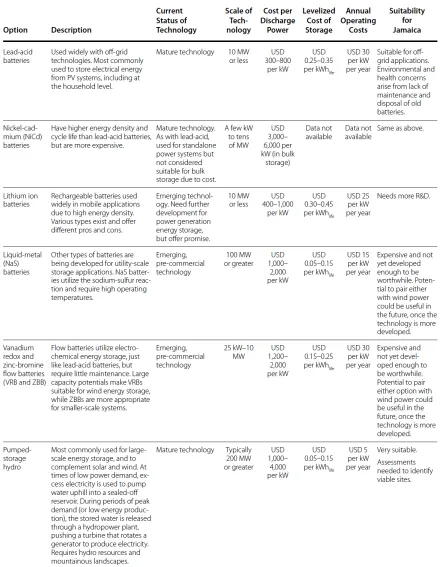
Table 3.1 Estimates of Power Plants Capital and Operating Cost ...28
Table 3.2 Energy Storage Technology Options ...29
Table 4.1 Collected Data for each of the Selected Alternative Power System ...40
Table 4.2 Summed Amount for Each Cost for the Different Alternatives ...40
LIST OF FIGURES
Figure 1.1 Current Setup of Jamaica’s Traditional Power Transmission System ....7
Figure 1.2 Diagram Showing the Flow of Power in the Traditional System ...7
Figure 1.3 Energy Production and Consumption of Selected CARICOM States ....8
Figure 1.4 Existing Capacity and Projected Capacity Needs in 2027 ...8
Figure 1.5 Estimated Technical and Non-Technical Electricity Losses in Selected CARICOM Member States. ...9
Figure 1.6 Jamaica Energy Matrix 2008 – 2030 Strategy ...9
Figure 2.1 Typical Microgrid Structure Including Loads and DER Units ...19
Figure 2.2 Jamaica’s Conceivable Energy Matrix Goal 2018 to 2030 Strategy ...20
Figure 2.3 The Operating Principle of a Flywheel Energy Storage System ...20
Figure 2.4 The Principle Operation of a Compressed Air Energy Storage System ...21
Figure 2.5 Thermal Energy System Used for Energy Storage ...21
Figure 2.6 56 MW Lithium Nickel Manganese Cobalt Energy Storage System ...22
Figure 2.7 Illustration of Lithium Chemical Properties Along with Their Advantages and Disavantages ...22
LIST OF ABBREVIATIONS
CARICOM ... Caribbean Community
CSERS ... Caribbean Sustainable Energy Roadmap and Strategy
DER ... Distributed Energy Resources
GDP ... Gross Domestic Product
GHI ... Global Horizontal Irradiance
JPS ... Jamaica Public Service Limited
MSW ... Municipal Solid Waste
PV ... Photovoltaic
RE ... Renewable Energy
RMGs ... Reconfigurable Microgrids
CHAPTER I
INTRODUCTION
Background
As stated by Anjorin (2014), economic development and a nation’s
maintainability is supported by energy sufficiency. He also highlighted that
access to sustainable sources of energy is directly proportional to economic
growth. According to Auth, Killeen, Konold, Musolino, and Ochs (C-SERMS)
(2015), every CARICOM member state exhibits significant and largely
unexploited potential for developing renewable energy resources. If fully
developed, these resources could transform many states into net energy
exporters.
The country of Jamaica, as of 2016, sources just over 90 percent (90%) of its
electricity use from petroleum-based power plants based on data received from
CIA: World Fact Book. Because Jamaica lacks domestic petroleum resources, it
depends entirely on imports, resulting in significant economic and
environmental costs for the country. Along with a high petroleum fuel source
power-generation, the method used to distribute power across the country is the
high-voltage transmission system which is the traditional method of
electrification. Figure 1.1 and Figure 1.2 shows the current setup of Jamaica’s
traditional power transmission system and a simple diagram of the flow of
According to Ahmed, Konold, Lucky, Makhijani, Ochs, and Weber (2013),
the current grid has high transmission and distribution losses, at 22.3% in 2011;
this is down from a high of 24.7% in 2008 but is still significantly higher than the
national target of 17.5%. Yet even Jamaica’s target share is high by international
standards: in the United States, total transmission and distribution losses average
only about 7% annually (Ahmed, et al., 2013).
With all the factors mentioned earlier in play, the current electrification
and economic situation for the country of Jamaica is not sustainable. As
illustrated in Figure 1.3 and 1.4, Jamaica is a long way from meeting its electricity
needs and experiences more losses than efficiency according to Figure 1.5. The
Jamaican government however has taken steps to reduce the demand on the
main power supplier, Jamaica Public Service Company (JPS), by implementing
an energy policy which makes it easier for private companies to start power
plants. The Jamaica Energy Policy report also outlined a realistic strategy for
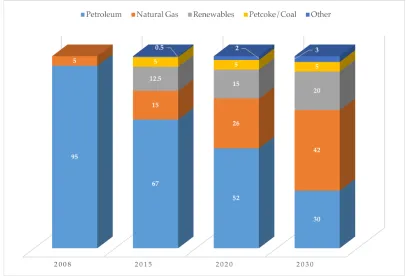
improving the energy matrix to the year 2030, see Figure 1.6.
When the territories of the Caribbean are mentioned in a discussion, the
first thoughts are not often of how much oil reserves they have, but often times
of how thriving their beaches are. This is due to the fact that there are currently
not many Caribbean countries drilling for oil whether inland or offshore.
Problem Statement
According to Zaremba (2017), only three Caribbean countries have oil
reserves Cuba, Barbados, and Trinidad and Tobago, the latter of which is the
only major exporter of oil from the Caribbean. Oil, often times referred to as
petroleum, is processed into fuel for combustion or heat. The current oil reserves
inadvertently affect the prices for everything else from products to services.
Electricity prices for Jamaican residents are among the highest in the world, at
around 40 U.S. cents per kilowatt-hour, having more than doubled between 2005
and 2011 as a result of rising global oil prices and electricity grid losses (Ahmed
et al., 2013). Ahmed et al., 2013, based on their studies, highlighted that the high
price of electricity is a major barrier to Jamaica’s economic development and a
leading cause of business failure in the country (p. 11).
Energy efficiency improvements can result in significant cost savings for
the country, especially for large and energy-intense sectors. Jamaica has one of
the highest rates of both duration and frequency of electricity service
interruptions in the Latin America and Caribbean region, with 27 interruptions
totaling 50 hours of outages in 2008 (Ahmed et al., 2013, p. 63). If Jamaica is to
continue on its current electrification path, with its fuel source and distributing
process, the country would remain stagnant and eventually decline financially as
world prices are affected by oil shortage.
Purpose of Study
This study seeks to identify whether the implementation of a higher mix
of renewable-source-powered microgrid system would be superior in both
sustainability and power output, in comparison to Jamaica’s natural gas and
petroleum based fuel mix. An official report from C-SERMS (2015) showed
Jamaica’s power capacity having only 7.8 % of installed renewable energy power
source (see Table 1.1).
Significance of Study
It is hoped that this evaluation on increasing the portfolio mix of
existing body of knowledge. This would be beneficial to the Ministry of Energy
and by extension, the entire country of Jamaica on a whole, as they seek to
improve energy sustainability and security.
Limitations of the Study
The two major limitations of this study is 1) the researcher’s temporary
inability to travel to the country of study, and 2) the time constraint to gather
additional information to afford a more detailed study.
Delimitations of the Study
The researcher narrowed down the scope of this research by focusing on
only two of the power generating technologies that currently exists, Advanced
Natural Gas Combined Cycle (ANGCC) and Solar Photovoltaic ‘Tracking’. In
addition, only two energy storage systems, battery energy storage system (BESS)
and air compressed storage (AE) will be analyzed.
Definition of Key Terms
Biomass: This is any organic material that comes from plants and animals, and it
is a renewable source of energy. Biomass contains stored energy from the sun.
Plants absorb the sun's energy in a process called photosynthesis. When biomass
is burned, the chemical energy in biomass is released as heat.
Electrification: This refers to the process of generating and transmitting electrical
power for consumption.
Loads: This refers to an electrical component or portion of a circuit that consumes
(active) electric power.
Microgrid: This refers to a localized group of electricity sources and loads that
normally operates connected to and in synchronicity with the traditional
Photovoltaics (PV): This refers to devices that generate electricity directly from
sunlight via an electronic process that occurs naturally in certain types of
material called semiconductors. PV gets its name from the process of converting
light (photons) to electricity (voltage), which is called the PV effect.
Organization of Thesis
The thesis paper is organized by five chapters. Firstly, in Chapter One, a
brief history along with the current conditions of Jamaica’s electrification system
is discussed; additionally, the problem statement, the purpose and significance of
the study are highlighted. Other aspects covered in this chapter include the
theoretical framework as well as the scope, the limitations and the definition of
the key terms of the study.
Secondly, Chapter Two underscores information obtained from an
extensive review of relevant literature on microgrid systems and renewable
energy sources. The chapter focuses on key technologies that are current and can
foreseeable be an immediate an achievable means of improving Jamaica’s
electricity generation system. The next chapter, Chapter Three, goes on to
address the research methodology, discussing the procedures and approach used
in carrying out the study.
The chief objective of this study, which was an analysis of implementing
renewable energy source technology to the electrification portfolio, was recorded
in Chapter Four. The chapter presented tables and figures of the results obtained
in the study. The last and final chapter, Chapter Five, contains a discussion on
the overall study along with the conclusion. The chapter closes the study by
stating the limitations and presenting the recommendations based on the study
Table 1.1 Showing Installed Power Capacity and Share of Renewables in CARICOM Member States, as of 2015
Country Installed Power Capacity (MW)
Installed Renewable Power
Capacity (MW)
Renewable Share of Installed Power
Capacity (MW)
Antigua and Barbuda 113 0.8 0.7
The Bahamas 536 0 0
Barbados 240 5.5 2.3
Belize 141.8 82.5 58.2
Dominica 27.7 7.6 28.6
Grenada 48.6 0.7 1.4
Guyana 383 55.1 14.4
Haiti 390.0* 62.4 16
Jamaica 926.4 72 7.8
Montserrat 5.5 0 0
Saint Lucia 88.6 0.2 0.2
St. Kitts and Nevis 56.4 3.2 5.7
St. Vincent and the Grenadines 52.3 6.4 12.2
Suriname 410 189 46.1
Figure 1. 1 Current Setup of Jamaica’s Traditional Power Transmission System. Reprinted from https://www.jpsco.com/about-jps/how-we-serve-you/how-we-deliver-power-to-you/
Figure 1. 3 Primary Energy Production and Consumption of Selected CARICOM Member States, 2012. Reprinted from (C-SERMS, 2015).
Figure 1.5 Estimated Technical and Non-Technical Electricity Losses in Selected CARICOM Member States, 2012. Reprinted from (C-SERMS, 2015).
CHAPTER II
LITERATURE REVIEW
Brief History on the Trends of Energy Sources, Storage and Safety
According to Lund (2007), energy sources can be divided into three main
categories: fossil fuels, nuclear resources, and renewable energy sources.
Renewable energy technologies are on the upward trend commercially with
many studies being conducted to optimize its use.
Currently, in the residential (individual) area, accessibility to renewable
energy technologies is growing due to enhanced affordability and efficiency,
likewise does the possibilities and opportunities for its application. In contrast to
traditionally centralized electricity provision systems (such as fossil-fuel-based
electricity generation), renewable energy technologies allow for the
decentralization of energy generation. With this comes the opportunity not only
to address energy demand, but also decrease electricity costs for residents
(Broese van Groenoub, McCabea, and Pojania, 2018).
Achieving Electrification-Decentralization Using Microgrid Systems
A microgrid is defined as a group of interconnected loads and distributed
energy resources (DERs) within clearly defined electrical boundaries that can act
as a single controllable entity with respect to the grid and can operate in
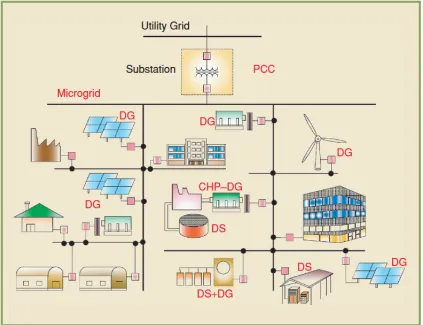
grid-connected or islanded modes (Khodaei, 2014). Figure 2.1 illustrates a microgrid
Lund (2007) notably acknowledged that for a sustainable energy system, three
major technological changes must be developed. These are; energy savings on
the demand side, efficiency improvements in the energy production, and
replacement of fossil fuels by various sources of renewable energy.
Fallahzadeh-Abarghouei, Hasanvand, Nayeripour, & Waffenschmidt
(2017), established that one problem of the traditional method of distributing and
generating power was related to optimal expansion of distribution system
facilities to meet the load growth as well as system constraints.
Fallahzadeh-Abarghouei et al. (2017) continued to state that, “In classical planning, the load
growth is typically met by adding a new substation or upgrading the existing
substation capacity along with their feeders.” The use of micro-grid systems to
generate and distribute electricity to both residential and commercial customers
is one of the most efficient and ever growing methods of electrification. When
implemented, micro-grid systems can aid in reduction of electricity bills and also
provide increased reliability during power consumption (Hatziargyriou et al.,
2008).
Due to smart switches, Bahramirad, Kavousi-Fard, and Khodaei (2016),
argued that the current generation of static microgrids is about to transition to a
new generation of reconfigurable microgrids (RMG). These researchers
highlighted that RMGs use remotely controlled switches to control and change
the microgrid topology to ensure that desired objectives can be achieved. RMGs
can provide customers with a greater degree of cost-effectiveness, efficiency,
Available Renewable Energy Sources: Current and Potential Portfolio Mix
There are many opportunities that exists for Jamaica to utilize renewable
sources as energy for generating electricity. According to Ahmed et al. (2013),
several past and ongoing studies have estimated renewable energy resource
potential in Jamaica. The report also went on to state that, “these assessments
provide an important overview of resource availability in the country, although
most studies are not detailed enough or are too site-specific for the purposes of a
general roadmap for the country” (pg. 37). The following are brief highlights on
the different potential renewable sources.
Hydro as an Energy Source
With it being the highest percentage of energy generation in the RE source
category, the hydropower has come up as the most competitive renewable
technology. The major disadvantage associated with hydropower however,
according to Arif, Aslam, and Hussein (2017), is the requirement of a suitable site
for the location of the plant.
Wind as an Energy Source
Outside of hydropower, wind has been by far the most successful
renewable electricity source worldwide, with 318 GW installed globally by the
end of 2013. The costs of wind power can be as low as 4 to 7 cents per kWh in
attractive locations, making it significantly cheaper than even the cheapest fossil
fuel alternative. According to a 2010 report from Nexant, wind has the potential
to be the fastest-growing renewable energy technology in the CARICOM region
over the next two decades. A few CARICOM member states have begun
installed wind power capacity in 2013 and, as of January 2015, had secured
financing for an additional 36 MW (C-SERMS, 2015).
Marine Energy as Sources for Renewable Energy
Marine technology consists of tidal and wave energy as sources for
renewable energy. Tidal energy utilizes the gravitational pull of the Earth and
Moon while wave energy utilizes the motion present on the surface of the ocean
to perform as energy source which in turns generate power. Unlike other
renewable technologies mentioned in this chapter, marine energy technologies
are far from commercially viable and still have prohibitively high costs (Ahmed
et al., 2013, p. 59).
Many tidal power systems use a design similar to wind turbines, except
the units are located underwater at the base of tidal bays and channels. Because
water is roughly 1,000 times denser than air, the systems are capable of
producing roughly 1,000 times more energy than wind using water moving with
the same flow speed as the air.
In 2011, before the current Jamaica Electricity Act (2015) which governs
the generation, distribution and sale of electricity, a wave-generated project was
commenced by the Ministry of Science Technology Energy & Mining (MSTEM)
and Renewable Energy and Energy Efficiency Department (REEED) to provide
two coastal communities electricity. This project was eventually abandoned
due to a violation of the JPS license (Ahmed et al., 2013).
Despite the current barriers, wave and tidal power may soon play an
important role in some locations, such as small-island states that have extensive
tidal generation could become cost-competitive in some coastal regions
(C-SERMS, 2015).
Biomass as a Renewable Source
Energy can be generated from a wide variety of organic materials,
including farming crop residues, forestry wastes (woody biomass), and even
municipal solid waste (MSW). Both crop residue and woody biomass can be
used for heat or electricity, or they can be gasified to have the same functionality
as oil and natural gas, but with lower net carbon emissions. Electricity generation
from biomass has the advantage of being storable, which enables electricity
production to be fired up and down and can help offset some of the
intermittency of wind and solar generation in an integrated electricity system.
Solar Energy as a Renewable Source
The sources of possible electricity from renewable energy category, vastly
outnumbers that of the conventional oil based source category. Arif, Aslam, and
Hussein (2017), stated that the renewable energy resource with the highest
potential is solar energy, considering only the surface land above the sea level.
This is to say, if countries utilize solar photovoltaic farms over sea areas, this may
increase the surface area which they use to capture the sun to generate electricity.
Domestic solar resources are particularly strong: average global horizontal
irradiance (GHI), the measure used to determine potential for solar photovoltaic
(PV) development, ranges from 5 to 7 kilowatt-hours per square meter per day
(kWh/m2/day) throughout most of the country, with some areas nearing 8
kWh/m2/day (C-SERMS, 2015). For perspective, Germany, which has nearly
half of the world’s installed solar PV capacity, has an average GHI of just 2.9
PV generation at the household and commercial levels can play an especially
important role in Jamaica’s energy mix (Ahmed et al, 2013).
Energy Storage Technology in Future Power Systems
According to IRENA (2017), future energy systems will rely on a large
array of services based on effective, economical electricity storage. This
overabundance of service needs, with varying performance requirements,
suggests an important role for many different storage technologies. The
following are the current list of energy storage technologies in no particular
order.
Flywheel Energy Storage
According to Yasmeen (2009), the operating principle of a flywheel energy
storage system (FESS) (Figure 2.2) is that electrical energy is converted to kinetic
energy and stored in the flywheel, and the kinetic energy can be converted back
to electrical energy when required later.
Pumped Hydro Energy Storage
IRENA (2017) states that pumped hydro (PHS) (Figure 2.3), stores energy
in the form of gravitational potential energy by pumping water between two
reservoirs located at different heights. When electricity demand is low, water is
pumped through the penstock from the lower end towards the upper water
reservoir, using external power.
Compressed Air Energy Storage
Yasmeen (2009) highlighted that compressed air energy storage systems
(CAES) (Figure 2.4), involve the use off-peak power to pressurize air into an
is then released during peak daytime hours to power a turbine/generator for
power production.
Thermal Energy Storage
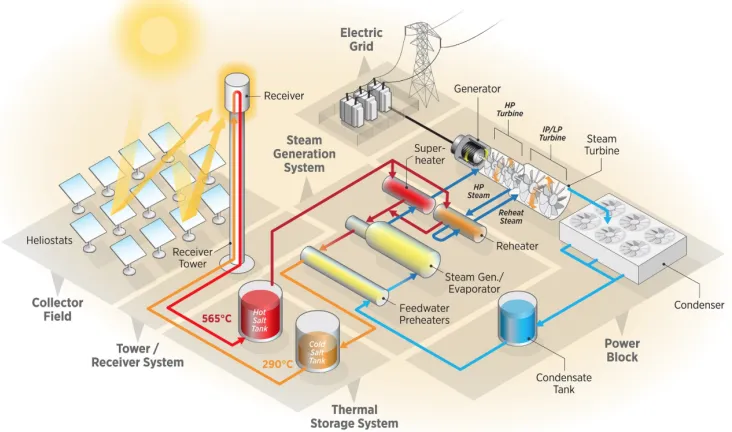
Thermal energy storage (TES) (Figure 2.5) is a technology that stocks
thermal energy by heating or cooling a storage medium so that the stored energy
can be used at a later time for heating and cooling applications and power
generation. TES systems are used particularly in buildings and in industrial
processes (Sarbu and Sebarchievici, 2018).
Battery Energy Storage
There are many battery technologies available, such as lithium-ion,
lead-acid, NiCd, Vanadium Redox-Flow, sodium-sulphur, among others currently
being researched (Yasmeen, 2009). Figure 2.6 shows a large Lithium NMC
battery bank while Figure 2.7 illustrates some characteristics of Lithium-ion
variations.
Battery energy storage systems are typically configured in one of two
ways: a power configuration or an energy configuration, depending on their
intended application (GE Renewable Energy, n.d.). In a power configuration, the
batteries are used to inject a large amount of power into the grid in a relatively
short period of time, which requires a high inverter-to-battery ratio. A typical
application would be to simulate a turbine ramp up for frequency regulation,
spinning reserve, or black start capacity. In an energy configuration, the batteries
are used to inject a steady amount of power into the grid for an extended amount
Renewable Energy Source Safety Considerations
All energy sources have some impact on our environment. Fossil fuels
such as coal, oil, and natural gas do substantially more harm than renewable
energy sources by most measures, including; air and water pollution, damage to
public health, wildlife and habitat loss, water use, land use, and global warming
emissions. However, this gives a promising opportunity for a reduction in
energy use; the aim must be to exclude standby usage, not only to decrease
energy use, but also for health and safety reasons (Mohamed, 2016).
The exact type and intensity of environmental impacts of RE, varies
depending on the specific technology used, the geographic location, and a
number of other factors. By understanding the current and potential
environmental issues associated with each renewable energy source, we can take
steps to effectively avoid or minimize these impacts as they become a larger
portion of our electric supply.
Summary of Literature Review
This chapter demonstrates the relevant literature to provide a synopsis of
the available renewable energy technologies to Jamaica; along with given a better
understanding on the emerging trend of microgrids systems. It covered the
following four sub-topics; The first sub-topic was achieving electricity through
the method of decentralized power generation, using microgrid systems. The
second sub-topic was the discussion of the available sources of renewable energy
that Jamaica can add or increase in its energy portfolio mix. Thirdly, the
sub-topic and importance of energy storage technology in future power generation
systems. This sub-topic went on to list several energy storage technologies and
The fourth and final sub-topic discussed the safety concerns using
renewable energy sources. As with every technology, disadvantages are present
in various aspects such as: cost, the time spent in set-up of system, scalability and
consistency of sources based on location and market. However, the international
performance of renewable energy is continuously positive and it is growing
rapidly in installed capacity in many countries, some countries have 100 percent
Figure 2.2 Displays the operating principle of a flywheel energy storage system (FESS). Reprinted from (Yasmeen, 2008).
Figure 2.4 Displays the principle operation of a “Compressed Air Energy Storage” (CAES). Reprinted from (Yasmeen, 2008)
Figure 2.6 A 56 MW Lithium Nickel Manganese Cobalt Energy Storage System. Reprinted from Energy Insider.
CHAPTER III
METHODOLOGY
This chapter details the research methods that were used in the study, as
they influence the validity and reliability of the findings. It is vital that the
research methods utilized be in line with the nature of the research problem. This
chapter covers the research design, target population, data collection procedures,
and data analysis.
The researcher’s objectives throughout this study are to:
1. Identify if a microgrid based network of power transmission would
have a more efficient power output versus the current traditional
transmission system;
2. Determine the socio-economic considerations for Jamaica to encounter
if and when these ventures are undertaken and;
3. Analyze the cost benefits of the implementation of a higher mix of
renewable portfolio, in comparison to Jamaica’s natural gas and
petroleum based fuel mix.
Research Design
The research methodology for this thesis paper is a descriptive
quantitative approach. Identifying the current available renewable energy
technologies along with its developments, required discussions through
Secondary sources such as international and local government reports and
researches found in scholarly databases, came to be the most valuable
component to this thesis paper, as there were numerous constraints during the
study. The literature search focused primarily on electrification technologies,
microgrid systems, and renewable energy literature published in the field from
1999 – 2018. Extensive analysis of “Jamaica’s National Energy Policy: 2009-2030”
and the Caribbean Sustainable Energy Roadmap and Strategy (C-SERMS), both
were national and internationally government funded studies conducted over
several years before being published respectively.
Notwithstanding such use of the qualitative method, quantitative
approaches were introduced later on in the study. After interviewing SMEs and
from findings of the literature review on cost benefit analysis, evaluation, and
effectiveness, industry standards and software were used to quantify the actual
economic feasibility of introducing RE as a larger energy portfolio mix for
electrification.
Population
The thesis study was focused on the island state of Jamaica with a
population sample of the municipal city of Portmore. Portmore is located in the
parish of St. Catherine south of the island and approximately 5 miles from the
country’s capital city, Kingston. It is the fastest growing municipal in the
Caribbean. Figure 3.1 shows the approximated location of the population area of
Data Collection
The researcher obtained data used in the study from interviews with
SMEs and interpretation of relevant secondary sources. Notwithstanding that
each project is unique and the fact that there are limited centralized information
on the various costs for the commissioning of a new power plant in the island
state of Jamaica; the researcher utilized the most current and relevant source at
the time of this study. Table 3.1 is a summarized table of information for capital
cost estimates for utility scale electricity generating plants; and it takes into
consideration capital investment cost which includes factors such as planning,
development, testing, etc. In addition, Table 3.2 which focused on energy storage
technologies was used to support further analyses in Chapter 4.
As mentioned above, the costs used to determine the capital investment,
operational and maintenance costs in the study, assumes that it is the same cost
that the island state of Jamaica will employ. The researcher focused on the utility
size cost for RE technology in order to associate like for like cost when
comparing the alternative fossil fuel technology.
Equally important were the assumptions made for the power and
transmission efficiency of the chosen power systems. Fossil fuel power system
are not one hundred percent (100%) efficient and the ANGCC system studied is
determined to be thirty-five percent (35%) efficient see chapter 4 paragraph 4 for
calculation. In addition to the power factor, Jamaica’s transmission system
typically experiences a twenty percent (23%) power loss after being transmitted
to the point of consumption. Notwithstanding these points, fossil fuel plants
typically have a longer useful life range and the selected technology presented a
The selected Solar PV Tracking technology had comparatively different
power generation and energy transmission efficiencies to ANGCC system
mentioned previously. When effectively installed and assuming decentralized
placements of electricity generation, the Solar PV tracking system can present a
power efficiency rate ranging from 85 – 95% (Penn State, n.d.).
Ultimately, assumptions were made on the data and values used in this
benefit cost analysis; from overnight cost of constructing the plants, to the
needed power capacity, to the mean useful life of the respective system and to
the emissions costs factor, all of which are conservative.
Data Analysis
Anjorin (2014), states that, a dollar’s worth today is more than a dollar’s
worth in the future, theoretically. The Microsoft Excel software was used
extensively to manipulate numerical values and to perform numerical
computation. A visual presentation of information was generated to show some
numerical relationship between several variables or quantities under certain
defined conditions. Data was carefully selected and organized into summary
tables and graphs that show the most relevant information. These types of data
analysis and management will show exactly how the findings relate to the
objective.
According to BusinessDictionary.com, economic feasibility is the analysis
of a project's costs and revenues in an effort to determine whether or not it is
logical and possible to complete. Benefit-Cost Analysis (BCA) estimates and
of projects to establish whether they are worthwhile; and therefore will be used
in the study to determine feasibility of the alternative power plant options.
BCA is commonly used to evaluate public projects. Benefits of a
nonmonetary nature need to be quantified in dollar terms as much as possible
and factored into the analysis. The following are the steps in the BCA process;
1) Identify all users’ benefits expected to arise from the project, 2) quantify these
benefits in dollar terms as much as possible, so that different benefits may be
compared against one another and against the costs of attaining them, 3) identify
sponsor’s or capital costs, 4) quantify these costs in dollar terms as much as
possible, to allow comparisons, 5) determine the equivalent benefits and costs
during the base period; use an interest rate appropriate for the project and 6)
accept the project if the equivalent users’ benefits exceed the equivalent capital
costs. These values contained in the Benefit-Cost Ratio can be expressed as
BC(i) = ! "
=
!
#$" , I + C’ > 0
where if the ratio is greater than 1, then the project is feasible.
In conducting the analysis, the assumed efficiency ratings were used to
determine the nominal power capacity of the individual power system. Just
under twenty-five megawatts (25MW) of power capacity is needed to supply the
municipal city of Portmore (K. Green, personal communication, June 7, 2018). In
the base case, a discount rate of 7% is selected for the analysis. This is due to the
recommendation of U.S. Energy Department (2018) when conducting pubic
CHAPTER IV
RESULTS AND ANALYSES OF DATA
The primary objective of this study, recorded in Chapter Three (3), is to
investigate whether it will be economically feasible for Jamaica, increasing its
renewable energy portfolio mix, upon a microgrid system in order to achieve
power efficiency.
This chapter presents the results of the research detailed in the previous
sections, the projected cost for capital investment and operating and maintenance
cost for the selected power plants systems. In addition to the previously
mentioned costs, emissions costs, efficiency and other assumed values are
summarized in this chapter. This chapter is essential in ensuring that the research
questions were adequately addressed and ultimately helps in determining the
degree of success of the study.
Table 4.1 Summary of Data Collected
The values for Fixed O&M cost, Variable O&M cost, Overnight cost, and
Battery Energy Storage cost were taken directly from Table 3.1 which was
reprinted from EIA, (2016). The selected power plants are Advanced Natural Gas
Combined Cycle and Solar Photovoltaic Tracking. In Chapter 3, paragraph 12 of
this document, it was mentioned that currently in the city of Portmore,
approximately twenty-five megawatts (25MW) is being used according to K.
Green (personal communication, June 7, 2018), a member of Jamaica’s public
When sizing a power system, it is often recommended to have power
capacity slightly above the expected usage in order to accommodate demand
surges and factors which may change due to conditions. The power capacity that
will be utilized in the analysis will be 30MW for both the Natural Gas and Solar
PV power plants. There is however a fuel cost associated with natural gas plants
and will be determined subsequently in the calculations to follow.
In the selected natural gas power plant, it assumes a power efficiency of
54% based on its heat rate of 6300 Btu which according to EIA (May, 2018) will
divide into the equivalent Btu content of a kWh of electricity (3412 Btu) to obtain
the generator’s efficiency. The Solar PV plant power efficiency in the same time
was determined differently. Assuming that each panel will generate its rated
output, the average conversion loss was used to determine the system’s
efficiency. Converting from DC to AC, Solar PV systems experiences an average
90% power efficiency. These calculations are shown below:
LNG plant efficiency = %&'()*+,-. !.' "0-.,-.1,*. 2*., = 34567388 = 0.542 = 54%
Solar PV plant efficiency = 9:$;:6 = 0.90 = 90%
The transmission and distribution efficiency of the PV power system is
assumed to be negligible due to decentralization of power generation which
results in power being used in a localized section, eliminating need for long
distance transmission and distribution. In contrast, from Chapter 1 paragraph 3
and Figure 1.5, it can be determined that Jamaica currently experiences a loss of
approximately 23.5% and can be calculated as follows:
Avg. Power Loss = <0=,> ?0@@,@6 = 66.3 $64.B6 = 23.5%
Chapter 3 discussed the useful life span of the two selected plants. These
ranges were averaged; an assumption of forty-five (45) useful life years was
determined for LNG power plant, in contrast the Solar power plant averaged a
useful life of thirty-five (33) years. These calculations are shown below:
Average Useful Life of LNG Plant = 48 $ :86 = 45
Average Useful Life of Solar Plant = 6: $ 486 = 32.5 = 33
Another factor that was taken into consideration was the social impact
cost of carbon dioxide emissions. According to Rechenberger (n.d.), natural gas
plants produces approximately 0.572 kg of carbon dioxide (CO2) per kWh of
electricity generated. In addition, it has been estimated that it cost two-hundred
and twenty dollars per ton ($220/ton) of carbon dioxide emitted on social impact
(Diaz and Moore, as sited in Than, 2015). This emission cost is calculated as
follows:
Electricity generated from plant = 30MW
Converting MW to kW = 30 x 1000 = 30,000kW
Accounting for daily runs and converting to kW to kWh
30,000kW x 16hrs (peak usage per day) x 365 days = 175,200,000 kWh
Converting carbon produced per kWh = 0.572 x 175,200,000
= 100,214,400 kg
Converting kg to ton = 100,214,400 x 0.001
Table 4.2 Calculation of Summed Costs
The values within Table 4.2 were calculated assuming an estimated
average peak of 16 hours per day for the year, the population consuming 25MW
will use 146,000 MW per year. The following items were calculated as follows:
LNG Plant Calculations
Capital Investment = Capacity in kW x Overnight Cost
= (30 MW x 1000) x $1,104
= $33,120,000.00
Fixed O & M Cost = kW x FOM Rate
= 30,000 kW x $10
= $300,000.00
Variable O & M Cost = MWh x VOM Rate
= 146,000 MWh x $2
= $292,000.00
Emission Cost = $220 x 100,214.4 ton
= $22,047,168.00
EIA (April 6, 2018), published that, fuel cost can be determined by
dividing the heat rate of the plant’s generator with the heat content of the fuel
(LNG). The lowest and highest heat rate that was circulated in the year 2017 were
990 and 1081 Btu respectively, the average of which is 1036 Btu. The current
published cost for LNG is $5.03/1000 cubic feet. Therefore, to supply 146,000
MWh for the year running the 30MW capacity plant, 175,200,000 KWh will be
Amount of fuel per kWh = 𝐻𝑒𝑎𝑡 𝑅𝑎𝑡𝑒 𝐻𝑒𝑎𝑡 𝐶𝑜𝑛𝑡𝑒𝑛𝑡 = 6300/1036
= 6.1 ft3/kWh
Fuel Used per year = Fuel used per kWh x Generated Power
= 6.1 x 175,200,000 = 1.06872 Billion Units
Fuel Cost per year = 1,068,720 x $5.03
= $5,375,662
According to The Gleaner, (June 2017), it was published that power
outages cost the Jamaican economy approximately JMD $340 million. Converting
for $US equivalent:
Blackout Cost = $340 million / 130 (exchange rate in 2017)
= $2,615,384.62
At a rate of $US 0.40/kWh, the estimated revenue is $58,400,000.00
Revenue = kWh usage per year x $0.40
= 146,000,000 kWh x $0.40
= $58,400,000
N.B. that the cost for fuel is not accounted for in either the fixed or variable
operating and maintenance costs. Moreover, the power company passes on the
costs of fuel to their registered customers. This cancels out additional expenses
Solar Plant Calculations
Capital Investment = Capacity x Overnight Cost
= (30 MW x 1000) x $2,534
= $76,020,000
Fixed O & M Cost = 30,000 kW x $21.8
= $654,000.00
Variable O & M Cost = 146,000 MWh x $0
= $0
Emission Cost is assumed to be negligible.
For the purpose of comparison, the rate of $US 0.40/kWh, will be assumed for
estimating the revenue for both ANGCC and Solar PV power plants. This
Energy Storage Cost
Lead-acid Batteries
Initial Cost = 146,000,000 kWh x ($0.25 + $0.35) 2) = $43.8 Million
Annual Cost = 30,000 kW x $30 = $900,000
Lithium ion Batteries
Initial Cost = 146,000,000 kWh x ($0.30 + $0.45) 2) = $54.75 Million
Annual Cost = 30,000 kWh x $25 = $750,000
Pumped Hydro Storage
Initial Cost = 146,000,000 kWh x ($0.05 + $0.15) 2) = $14.6 Million
Annual Cost = 30,000 kW x $5 = $150,000
Compressed Air Storage
Initial Cost = 146,000,000 kWh x ($0.10 + $0.20) 2) = $21.9 Million
Table 4.3 Cost Benefit Calculations
ANGCC Power Plant
Benefit (B) = Revenue – (O & M Expenses + Disbenefits)
= $58,400,000.00 – ($300,000.00 + $292,000.00 + $22,047,168.00.00
+ $2,615,384.62 + $5,375,662.00)
= $27,769,785.38
Net Present Value was determined by using the Excel software which is equal to
$353,105,060.31
Benefit-Cost Ratio = 𝐵 𝐶 = $353,105,060.31 $33,120,000.00
= 10.66
Solar Power Plant
To ensure reliability of the power system, energy storage systems are needed.
Benefit (B) = Revenue – (O & M Expenses + Disbenefits)
= $58,400,000.00 – ($654,000.00 + $900,000.00)
= $56,846,000.00
The Excel software was utilized again to determine NPV which is equal to
$677,571,913.36
Benefit-Cost Ratio = 𝐵 𝐶 = $677,571,913.36 $76,020,000.00 + $4,380,000.00
Further Analysis with Varying Scenarios
Hybrid Scenario
This setup involves the use of the Solar PV system in conjunction with the
ANGCC plant and no energy storage system integrated. Assuming 50% usage
for both systems each associated recurring expenses will be at halved.
Benefit (B) = Revenue – (O & M Expenses + Disbenefits)
= $58,400,000.00 – [(ANGCC Expenses and Disbenefits at 50%
+ (PV System Expenses at 50%)]
= $58,400,000.00 – ($15,315,107.31 + $327,000.00)
= $42,757,892.69
The Excel software was utilized to determine NPV which is equal to $509,649,705
Benefit-Cost Ratio = 𝐵 𝐶 = $509,649,705 $76,020,000.00 + $33,120,000.00
= 4.67
Scenario PV + PHS
This setup involves the use of the Solar PV system for power generation in
integrated with Pumped Hydro Storage as the energy storage system.
Benefit (B) = Revenue – (O & M Expenses + Disbenefits)
= $58,400,000.00 – ($654,000 + $150,000)
= $57,596,000
The Excel software was utilized to determine NPV which is equal to $601,287,561
Benefit-Cost Ratio = 𝐵 𝐶 = $601,287,561 $76,020,000.00 + $14,600,000.00
Results Obtained
Table 4.1 Showing the Collected Data for each of the Selected Alternative Power System.
Description LNG Power
Plant PV Power Plant
Power Capacity (MW) 30 30
Overnight Cost per kW($/kW) 1104 2534
O & M Fixed Cost ($US/kW-yr) 10 21.8
O & M Variable Cost ($US/MWh) 2 0
Power Efficiency (%) 54 90
Useful Life 45 33
Transmission & Distribution Efficiency (%) 76.5 -
Emission Cost $220/ton (tone) 117,250 -
Table 4.2 Showing the Summed Amount for Each Cost for the Different Alternatives.
Description ANGCC Plant Solar PV System
Capital Investment $33,120,000.00 $76,020,000.00
Fixed O & M Costs $300,000.00 $654,000.00
Variable O & M Costs $292,000.00 $0
Average Useful Life 45 Years 33 Years
Fuel Cost $5,375,662.00 $0
Emission Costs $47,768,864.00 $0
Blackout Costs $2,615,384.00 $0
Revenues $58,400,000.00 $58,400,000.00
Table 4.3 Cost Benefit Analysis of Each Individual Alternative Power System and Scenarios.
Description ANGCC Plant System with PV Power BESS
Hybrid
Scenario PV+PHS Scenario
Capital Investment
(C)
$33,120,000 $80,400,000 $147,780,000 $90,620,000
Net Annual
Profit (B)i $353,105,060 $677,571,913 $331,791,432 $601,287,561
CHAPTER V
FINDINGS, CONCLUSION AND RECOMMENDATIONS
Discussion
Jamaica had outlined an energy source portfolio mix which anticipated
over 12% renewable source by 2018. Jamaica exhibits significant and largely
unexploited potential for developing renewable energy resources. If fully
developed, these resources could transform the country into a net energy
exporter. Hydropower comprises the majority of renewable power generation in
Jamaica and worldwide. Regionally, the resource is ideal for states with hilly
topography and high rainfall rates. In member states with substantial
agricultural activity, biomass and municipal solid waste provide a flexible and
easily accessible entry point to renewable energy generation. (C-SERMS, 2015).
IRENA (20217) also went on to state the following, “Electricity storage
technologies are emerging as a critical part of the solution to increase access to
electricity, as well as providing stability services to mini-grids, improving the
power quality and increasing the potential share of variable renewables in such
remote grids” (p.12). However, after conducting the study and even with
economics of scale, where the larger the units the lower the cost, we can see that
energy storage, mainly BES and PHES, is quite expensive as a means of
supplying constant energy or finding suitable locations respectively. Nonetheless
if used in a power configuration, BES can aid in the power stability of a power
technology for energy storage if suitable location exists.
Conclusion
Returning to the aim of the study, the researcher had set out to find the
following; 1) If a microgrid-based network of power transmission would cause
better power output versus the current traditional transmission system, 2)
determine the socio-economic considerations for Jamaica to encounter if and
when these ventures are undertaken and 3) if the economic feasibility of Jamaica
increasing its renewable sources in the energy portfolio mix.
According to the findings of the study, we see that a good portion of
energy is generally lost during transmission and distribution inefficiencies.
Decentralizing the transmission and distribution of power by using microgrids
would reduce losses and with localized monitoring of the grids, utility plants can
examine and control power loss.
As with all power system, there are safety considerations that must
always be taken into account; and RE technology is no different. However, if
Jamaica seeks to venture into RE sources on a larger scale, there are massive
benefits in carbon dioxide (CO2) reductions that would occur.
Finally, the analysis of multiple scenarios shows that, at this point in time
Jamaica can implement Solar PV systems to offset the massive dependence on
fossil fuel and still be profitable. This would utilize the abundant source of solar
energy that exists in the country during peak production. Another scenario
shows where Solar PV can be supplemented by ANGCC systems where gaps
Limitation
One of the major limitations faced throughout the study was the lack of
data specific to the population. Furthermore, due to the researcher’s inability to
travel to the population of study, there was limited opportunity to obtain
additional information to make a more absolute conclusion. There were other
factors that could have be taken into consideration: socio-economic benefit cost
such as employment, quality of life, etc. and disbenefits such as the effects of
noise population due to decentralization of power generation.
Recommendations
In the year 2009, the government of Jamaica aimed to, by publishing
“Jamaica’s National Energy Policy 2009-2030, which envisioned a modern,
efficient, diversified and environmentally sustainable energy sector providing
affordable and accessible energy supplies with long-term energy security. It is
recommended that the following actions be done in order to support or improve
its goal:
1. Conduct studies to identify a detail list of the different
socioeconomic factors that would enhance the population, and the
disbenefits for continuing with fossil base power generation.
2. Develop a public-private-partnership plan to make it desirable for
home owners and company owners to invest in renewable energy.
This is order to reduce the direct capital cost on the government of
Jamaica needing to add to its budget.
3. Research and design unique hybrid system that are economically
4. This would be supplemented with a project management plan that
would enable the country to shift its power transmission into a
multi-microgrid system and thus laying the structure for renewable
energy technologies implementation, at which point should have
REFERENCE
Anjorin, A. (2014). Feasibility of Making Solar Energy Available in The Northern
Region of Nigeria. Dissertation (PhD). Colorado Technical University
Arif, S., Aslam, M, and Hussain, A. (2017). Emerging Renewable and Sustainable
Energy Technologies: State of The Art
Ahmed, A., Konold, M., Lucky, M., Makhijani, S., Ochs, A., and Weber, M. (2013)
Jamaica Sustainable Energy Roadmap: Pathways to an Affordable,
Reliable, Low-Emission Electricity System. Washington, DC: Worldwatch
Institute.
Auth, K., Killeen, P., Konold, M., Musolino, E., and Ochs, A. (2015) Caribbean
Sustainable Energy Roadmap and Strategy (C-SERMS): Baseline Report
and Assessment. Washington, DC: Worldwatch Institute.
Bahramirad, S., Kavousi-Farda, A., and Khodaei, A. (2016). Improved Efficiency,
Enhanced Reliability and Reduced Cost: The Transition from Static
Microgrids to Reconfigurable Microgrids. The Electricity Journal.
Broese van Groenoub, A., McCabea, A., and Pojania, D. (2018). Energy Policy.
The Application of Renewable Energy to Social Housing: A Systematic
Review. 114. Retrieved from https://doi.org/10.1016/j.enpol.2017.12.031
Dimeas, A., Katiraei, F., Hatziargyriou, N., and Iravani, R. (2008). Microgrid
Management: Controls and Operations Aspects of Microgrids. IEEE
Fallahzadeh-Abarghouei, H., Hasanvand, S., Nayeripour, M., and
Waffenschmidt, E. (2017). A New Approach to Transform an Existing
Distribution Network into A Set of Micro-Grids for Enhancing Reliability
and Sustainability.
Future Power System. (2016, March 4). Retrieved from
https://www.carbonbrief.org/uk-needs-a-smart-power-revolution-says-infrastructure-commission/www-gifcreator-me_r3xltb-1
GE Renewable Energy: Battery Energy Storage Solutions (Bess). Retrieved from
https://www.ge.com/renewableenergy/hybrid/battery-storage
Hatziargyriou, N., Ise, T., Kroposki, B., Lasseter, R., Morozumi, S., and
Papatlianassiou, S. (2008). A Look at Microgrid Technologies and Testing
Projects from Around the World. IEEE Power and Energy Magazine
IRENA (2017), Electricity Storage and Renewables: Costs and Markets to 2030,
International Renewable Energy Agency, Abu Dhabi
Jamaica. (2015). Retrieved from
https://www.cia.gov/library/publications/resources/the-world-factbook/geos/jm.html
Jamaica Public Service Company (JPSCo). How We Deliver Power to You.
Retrieved from
https://www.jpsco.com/about-jps/how-we-serve-you/how-we-deliver-power-to-you/
Lund, H. (2007). Renewable Energy Strategies for Sustainable Development
Mason, M. (2009). A Perspective on Partnership for Overcoming the Barriers to
the Implementation of Renewable Electricity Production. Thesis (MSc).
Mohamed, A. (2016). Investigation into the Feasibility of the Utilisation of
Renewable Energy Resources in Libya. (PhD). Nottingham Trent
University
National Renewable Energy Laboratory (NREL). (n.d.). Energy Analysis: Useful
Life. Retrieved from https://www.nrel.gov/analysis/tech-footprint.html
Penn State, (n.d.). Utility Solar Power and Concentration (EM812): Efficiency of
Inverters. Retrieved from
https://www.e-education.psu.edu/eme812/node/738
Rajput, G. (2017). Molten Salt Thermal Energy Storage Market Size to Witness
Significant Growth 2015 – 2023. CMFE News. Retrieved from
https://cmfenews.com/molten-salt-thermal-energy-storage-market-size-to-witness-significant-growth-2015-2023/
Rechenberger, D. (n.d.). Wingas. Retrieved from
https://www.wingas.com/fileadmin/Wingas/WINGAS-Studien/Energieversorgung_und_Energiewende_en.pdf
Sarbu, I., and Sebarchievici, C. (2018). Sustainability Review: A Comprehensive
Review of Thermal Energy Storage. Retrieved from
https://www.mdpi.com/2071-1050/10/1/191/pdf
The Gleaner, (2017, June 9). JPS Blackout Costs Country $340 Million. Retrieved
from
http://jamaica-gleaner.com/article/lead-stories/20170609/jps-blackout-costs-country-340-million
Than, K., (2015, January 12). Estimated Social Cost of Climate Change Not
Accurate. Stanford Times. Retrieved from
U.S. Energy Information Administration (EIA). May 2018. What is the efficiency
of different types of power plants? Retrieved from
https://www.eia.gov/tools/faqs/faq.php?id=107&t=3
U.S. Energy Information Administration (EIA). November 2016. Capital Cost
Estimates for Utility Scale Electricity Generating Plants. Retrieved from
https://www.eia.gov/analysis/studies/powerplants/capitalcost/pdf/ca
pcost_assumption.pdf
U.S. Department of Energy, (2018, March). 2018 Discount Rates. Retrieved from
https://www.energy.gov/sites/prod/files/2018/04/f50/2018discountrat
es.pdf
Yasmeen, F. (2009). Techno Economical Analysis of Solid Oxide Iron–Air Redox
Battery for Power Generation and Energy Storage. (MSc). University of
South Carolina
Zaremba, H. (2017). The Caribbean Is Poised to Become the Next Major Oil
Region. Retrieved from
https://oilprice.com/Energy/Crude-Oil/The-Caribbean-Is-Poised-To-Become-The-Next-Major-Oil-Region.html
https://www.eia.gov/KIDS/energy.cfm?page=biomass_home-basics