EFFICIENCY OF SVM AND PCA TO ENHANCE INTRUSION DETECTION
SYSTEM
Soukaena Hassan Hashem
Computer Science Department, University of Technology, Baghdad-Iraq
ABSTRACT
Intrusion detection system (IDS) is a system that gathers and analyzes information from various
areas within a computer or a network to identify attack s made against these components. This
research proposed an Intrusion Detection Model (IDM) for detection intrusion attempts, the
proposal is a hybrid IDM because it considers both features of network pack ets and host features
that are sensitive to most intrusions. The dataset used to build the hybrid IDM is the proposed
HybD (Hybrid Dataset) dataset which composed of the 10% KDD '99 dataset features (41) and
suggested host-based features (3). Two Data Mining DM classifiers (Support Vector Machine
(SVM)) classifier and Naïve Bayesian (NB) Classifier) are used to build and verify the validity of
the proposed model in term of accuracy rate. The proposal trying to ensure the detection speed of
the hybrid IDM, that by reducing the HybD dataset features used by considering the most critical
features in the detection but with saving of high accuracy rate without degradation that may be
caused by that reduction. Two different measures are used for selecting and rank ing HybD dataset
features; they are Principle Component Analysis (PCA) and Gain Ratio (GR). The sets of feat ures
that have been resulted from these two measures and the all features set will be the feeding of both
SVM and NB. The results obtained from executing the proposed model showing that SVM classifier
accuracy rate is generally higher than that of NB classifier with the three sets of features. With
SVM classifier the best accuracy rate resulted with set of features selected by PCA. The most
critical features obtained by PCA are ranging to (17) features from 44 features: three of the
suggested host features and (14) of the 10% KDD'99 features.
Keywords:
SVM, NB, PCA, IDS, GR.INTRODUCTION
An intrusion is a very common threat to computer systems. It is defined to be any unauthorized access attempt to manipulate, modify, or destroy information, or to render a system unreliable or unusable. With the increasing creativity of intrusions, the dev elopment of effective IDS is
Journal of Asian Scientific Research
becoming a greater challenge. ID is a set of techniques and methods that are used to detect suspicious activity in computer systems, both at network and host level. Therefore, the main goal of IDS is to identify unauthorized us e, misuse, and external penetrations (Mohammed, 2006).
DM-based ID techniques generally fall into two main categories: misuse detection and anomaly detection. In misuse detection systems, use patterns of well-known attacks to match and identify known intrusion. These techniques are able to automatically retrain ID models on different input data that include new types of attacks, as long as they have been labeled appropriately. Unlike signature-based IDSs, models of misuse are created automatically, and can be more sophisticated and precise than manually created signatures. A base stone of misuse detection techniques strength is their high degree of Precision in detecting known attacks and their variations. Misuse detection techniques in general are not effective contra new attacks that have no matched ru les or models yet. Anomaly detection, on the other hand, builds models of normal behavior, and flags observed activities that deviate significantly from the established normal usage profiles as anomalies, that is, possible intrusions. Anomaly detection techniques thus identify new types of intrusions as diversions from usual usage. Anomaly detection techniques can be effective contra unknown or new attacks since no a priori knowledge about fixed intrusions are required. However, anomaly -based IDSs tend to generate more false alarms than misuse--based IDSs because an anomaly can just be a new normal behavior. Some IDSs use both anomaly and misuse detection techniques (Moses et al., 2008).
Re lated Works
In (Risto, 2009), Risto Vaarandi, proposed a novel unsupervised DM based approach for IDS alert classification. With this strategy, knowledge is mined from IDS logs and processed in an automated way, in order to build an caution classifier. The classifier is then used in real-time for discerning important IDS warns from frequently occurring false positives and events of low significance. In (Risto and Karlis, 2010), Risto Vaarandi, and Karlis Podinš. extended their previous work on IDS alert classification, and present a novel unsupervised real time alert classification method which is based on frequent itemset mining and data clustering techniques. Their method first applies a frequent itemset mining algorithm to past IDS alert logs, in order to discover patterns that describe redundant alerts. After that, data clustering methods are used for finding detailed subpatterns for each detected pattern. Finally, the detected knowledge is explained and used for real time classification of IDS alerts, in order to characterize critical alerts from irrelevant ones. In (Muamer et al., 2011), Muamer N. Mohammad et al introduced an improved approach for IDS based on
behavior and finally reports the result to the manager in a comprehensible form. In (Zhang et al., 2011), the next generation Internet protocol IPv6 brings a new challenge to the information security. Zhang Guojun et al presented a cooperative IDS based on IPv6 to address this challenge. Such a system consists of four parts: data flow tracking and analysis, ca pturing packets and rules matching, disaster recovery, and blocking. The technique of cooperative ID is introduced into the system for realizing the coordination control among parts. The system has a perfect detection rating. In (Sufyan and Hadeel, 2011), Sufyan T. Al-Janabi and Hadeel A. Saeed proposed an anomaly based IDS that can promptly detect and classify various attacks. Anomaly -based IDSs need to be able to learn the unstable behavior of users or systems. The proposed IDS experimenting with packet behavior as parameters in anomaly ID. There are several methods to assist IDSs to learn system's behavior, the proposed IDS uses a back propagation artificial neural network (ANN) to learn system's behavior and uses the KDD CUP'99 dataset in its experiments and the obtained results satisfy the work objective. In (Hassina Bensefia, 2011), Hassina Bensefia and Nacira Ghoualmi proposed a new approach for IDS adaptability by oriented toward Evolving COnnectionist Systems (ECOS) and Learning Classifier Systems (LCS). These two learning machine approaches are actually suggested very suitable to build adaptive learning intelligent systems in a dynamic changing environment. This integration puts in relief an adaptive hybrid ID core that plants the adaptability as an intrinsic and native functionality in the IDS. In (Nur et al., 2012), Haldar N. et al presented an IDS which employs usage of classification methods to model
the usage patterns of authenticated users and uses it to detect intrusions in wireless networks. Th e key idea behind the proposed IDS is the identification of discriminative features from user's activity data and using them to identify intrusions in wireless networks. The detection module uses statistical methods to accumulate interested statistical variables and compares them with the thresholds derived from users activities data. When the variables exceed the predestined thresholds, an alarm is put forward to alert about a sensible intrusion in the network.
The Proposed Model of Intrusion Detection System
The proposed IDS is a "hybrid IDS" (NIDS and HIDS) that because it consider all features of data network packets and consider critical features of host that are directly affected by all attacks. The proposal is a DM-based IDS in which both the misuse and anomaly detection techniques depended in the detection of intrusion, where each instance in a dataset is labeled as "normal" or "intrusion" and a learning algorithm is trained over the labeled data. Misuse technique is able to automatically retrain ID models on different input data that include new types of attacks, as long as they have been labeled appropriately. While anomaly technique should first learn the characteristics of normal activities and abnormal activities of the system, and then the IDS detect traffic that deviate from normal activities.
on the data captured in DARPA’98 IDS evaluation program (KDD, 1999) Host-based features
combined with the KDD'99 dataset. This HybD dataset could be used in researches for designing NIDSs, HIDSs, and hybrid IDSs. This new features are related to host and are used in conjunction with the 41 features in order to be able to detect intrusion in host level as well as in network level. The design and the implementation of the proposed hybrid IDS explained in Fig.1.
Fig-1. Detailed Proposed hybrid IDS
DESCRIPTION OF PROPSED DATASET
The 10percent KDD'99 Dataset
DARPA'98 is about 4 gigabytes of compressed raw (binary) training data of 7 weeks of network traffic. The 2 weeks of test data have around 2 million connection records. KDD'99 training dataset consists of approximately 5 million connection records (a connection is a sequence of TCP packets starting and ending at some well-defined times, between which data flows to and from a source IP address to a destination IP address under some well-defined protocol) each of which contains 41 features and is labeled as either normal or an attack, with exactly one specific attack type. The simulated attacks fall in one of the following four categories: Denial of Service Attack (DoS), User to Root Attack (U2R), Remote to Local Attack (R2L), and Probing Attack. KDD'99 features can be classified into three groups: Basic features, Content features, and Traffic features (KDD, 1999).
The New Host-based Features
Preprocessing on the Proposed HybD Dataset
The following processes have been applied to the "proposed HybD dataset" before it being used in design of the proposed system:
1. Converting the original KDD'99 10percent dataset from a text file to SQL server.
2. Adding of new host-based features to construct the proposed HybD dataset and adding their values.
3. Since type of some of HybD dataset's features is continuous, t hus a process for normalization these features have been done in order to become of categorical type so it becomes more convenient with the used DM classification algorithms.
4. The resulted dataset from process three will be split into two distinct datase ts by using, one for classifiers' training which equal of resulted dataset from process three and the other for classifiers testing which equal of resulted dataset from process three.
Process of Feature Reduction
This is an essential process to reduce, if possible, number of features and select the most intrinsic of these features in the classification decision, and hence to minimize the computation time of implementing the classification algorithms and so of the proposed system. It has been accomplished with two techniques from different fields: Principle Component Analysis (PCA) is a useful statistical technique that has found application in fields such as face recognition and image compression, and is a common technique for finding patterns in data of high dimension. The complete subject of PCA statistics is based on the idea that you have this huge set of data, and you want to analyze that set expressions of the relationships between the single points in that set. PCA is applied to the training dataset to find the intrinsic features, see algorithm (1), and GR from information theory that selects features with the highest GR value, see algorithm (2). Thus two sets of features in addition to set of all features in the training dataset will be used in design (learning) of the proposed classifiers.
Algorithm (1): Customized_PCA
The goal of PCA is to minimize the dimensionality of the data while keeping as much as possible of the difference present in the original dataset. It is a way of characterize intrinsic features and theorize all of these features’ values.
Input: Proposed TrainD training dataset.
Output: PCAS set of most frequent and related features. Steps:
1. Obtain training KDD’99 transactions. 2. Represent every transaction Ii as a vector xi.
3. Compute the average transaction ……….…...(1)
5. Compute the covariance matrix =AAT………..……(3)
6. From C Compute eigenvectors ui of AAT: a. Consider matrix AAT as a matrix. b. Compute the eigenvectors vi of AAT such that:
ATAvi → iVi →AATAVi = iAvi → Cui = iui where i =Avi………..(4)
c. Compute the best eigenvectors of AAT: i= Avi ……….…(5) 7. Keep only K eigenvectors, (K features with their values).
Algorithm (2): Gain_Ratio
Input: Proposed TrainD training dataset
Output: GRS set of GR values for each feature in (D) Steps:
1. For each feature in (D) 2. Find feature’s InfoGain 3. Find its Split Information 4. If value of Split Information = 0
then set it to very small value(<0) 5. Find its GR and add it to GRS 6. End
Customized SVM and NB Classifiers
After the intrinsic features had been selected, the two popular DM classification algorithms: Support Vector Machine SVM from statistical field and Naïve Bayesian from Bayesian theorem field, used in the design of the proposed IDS.
A "Support Vector Machine Classifier" SVM is a useful technique for data classification. Even though it’s looked that Neural Networks are simpler to use than SVM, however, sometimes wrong results are gained. A classification task usually includes with training and testing data which consist of some data examples. Each example in the training set contains one base values and several attributes. The goal of SVM is to introduce a model which predicts base value of data example in the testing set which are given only the attributes. Classification in SVM is Supervised Learning. Known typecast help indicate whether the system is performing in a right way or not. This information points to a coveted response, validating the precise of the system, or be used to help the system learn to do correctly.
On the other hand, various empirical studies of "Bayesian classifier". In theory, Bayesian classifiers have the lower error rate in comparison to all other classifiers. Bayesian classifiers are also useful in that they supply a theoretical warrant for o ther classifiers that do not explicitly use Bayes’ theorem. For example, under certain assumptions, it can be shown that many ANN
assume that the effect of a feature value on a given class is independent of the values of the other features. This hypothesis is called class conditional independence. Both of SVM and NB classifiers will be used 3 times with each of these 3 sets of features to design the proposed class ifiers:
1. All 44 features of training dataset.
2. Subset of features in (1) according to the result of implementation of the PCA method. 3. Subset of features in (1) according to the result of implementation of the GR measure.
Thus, six classifiers will be obtained: three SVM classifiers and three NB classifiers. Then the classification of the testing dataset's records will be done with each one of these classifiers, and a comparison among their classification results will be done in to specify the most efficient feature selection method with the most accurate classifier.
SVM Classifiers in proposed IDM
SVM is a good technique for data classification. Now a set of training data {(x1,y1)... (xl,yl)} in Rn R sampled according to unknown probability distribution P(x,y), There are many linear classifiers (hyper planes) that separate the data. Only one of these achieves maximum separation. The reason we need it is because if use a hyper plane to classify, it might end up closer to one set of datasets compared to others and we do not want this to happen and thus we see that the concept of maximum margin classifier or hyper plane as an apparent solution. For calculating the SVM we see that the goal is to correctly classify all the data. For mathematical calculations have ,
If Yi= +1;
If Yi= -1; wxi + b ≤ 1 For all i; yi (wi + b) ≥ 1
In this equation x is a vector point and w is a vector weight. So to separate the data (6) should always be maximal than zero. Among all potential hyper planes, SVM selects the one where the distance of hyper plane is as max as possible. If the training data is reasonable and every test vector is located in radius r from training vector. Now if the chosen hyper plane is located at the outmost possible from the data . This coveted hyper plane which maximizes the margin also halves the lines between closest points on convex hull of the two datasets. Dista nce of closest point on hyper plane to origin can be discovered by maximizing the x as x is on the hyper plane. Similarly for the other side points we have a similar strategy. Thus fixing and subtracting the two distances we get the summed distance from the separating hyper plane to nearest points.
Getting Maximum Margin = MM = 2 / ||w||. ……… (9)
Really maximizing the margin is same as minimum.
………( 6)
1
b
wx
i………(7)
………(8)
w
w
w
t2
1
)
and for all points {(xi ,yi)}: yi (wTxi + b) ≥ 1, must optimize a quadratic function subject to linear constraints. The solution involves constructing a dual problem where a Lagrange multiplierαi is
associated with every constraint in the primary problem: Find α1…αNsuch that
Q(α) =Σαi - ½ΣΣαiαjyiyjxiTxj ………(11) is maximized and we calculate Σαiyi= 0 and αi ≥ 0 for all αi
The solution will has the form:
w =Σαiyixi and b= yk- wTxk for any xk such that αk 0
Each non-zero αi references that corresponding xi is a support vector. Then the classifying function will have the following form:
f(x) = ΣαiyixiTx + b ……… (12)
It relies on an inner product between the test point xand the support vectors xi. Solving the optimization problem involved caculating the inner products xiTxj between all pairs of training points. The old formulation: Find w and b such that Φ(w) =½ wTw is minimized and for all {(xi ,yi)} , yi (wTxi + b) ≥ 1.
Algorithm (3) explain SVM algorithm with Intrusion detection depending on proposed TrainD and TestD.
Algorithm (3): The SVM
Input: TrainD training dataset, TestD testing dataset that has not been classified Output: TestD testing dataset that has been classified
Steps:
1. Initialize all points in training dataset as (Xi, Yj) where X is a vector of data x1, ……, xn and Y is vector of classes.
2. Initialize vector of weight W.
3. Distribute all points (x, y) and extract the hyper plane separator.
4.If the hyper plane give optimal separation then depend hyper plane as classifier model to classify TestD testing dataset and go End else must do the following steps
5. Maximize the hyper plan using equation (9) and for minimum using equation (10) 6. Initialize Lagrange multiplierαi vector α1…αn using equation (11)
7. Apply classification function using equation (12)
8. Determine the support vectors xi with non-zero αi (support vectors are the points determine the
area of hyper plan)
9. Depend the hyper plan resulted after determining support vectors as the classifier model to classify TestD testing dataset
End
Naïve Bayesian Classifier in Proposed IDM
once time for the whole training dataset. Then the following computations will be performed for classifying each record in the testing dataset. The conditional probability P( | ) for every feature's value in the record of the testing dataset is estimated as the relative frequency of records having value as the jthfeature in class . Assuming conditional independence of features, the "conditional probabilities" P( ) of the testing record at each class is computed using equation (13). Finally, the "postpriori probability" P(h|X) of the testing record at each class computed using equation (14), the class with the maximum postpriori probability will be the label for the testing record according to equation (15).
P( ) ………. (13)
P(h|X) = ……… (14)
arg arg (15)
Algorithm(4) Naive Bayesian
Input: TrainD training dataset, TestD testing dataset that has not been classified Output: TestD testing dataset that has been classified
Steps:
1. Initialize MaxValue to a small value
2. For each class in TrainD find its a priori probability 3. For each record R in TestD do step 4 and 8
4. For each class in TrainD repeat steps 5-7
5. Find the conditional probability of R at using equation(13) 6. Find the postpriori probability of R using equation (14) 7. If value greater than MaxValue value
then MaxValue = and class_label = equation (15) 8. Assign class_label to the class of R
9. End
DISCUSSION AND EXPERIMENTS
The proposal had been implemented on the following platform: Windows 7 Ultimate Service Pack1 and 32-bit OS, 4GB RAM, and Intel® Core (TM) 2 Duo CPU with 2.00GHz; and by using Visual Basic 6.0 and SQL server.
behavior or new attack). Table 1 presenting the sets of selected features according to PCA and GR for Exp1, Exp2, and Exp3.
Table-1. Selected Features according to PCA and GR ( Exp1 (a), Exp2 (b), Exp3 (c))
A
PCA GR_F
protocol_type land
Service urgent
Flag num_failed_logins
src_byte root_shell
wrong_fragment su_attempted
logged_in num_root
count_ num_file_creations
srv_count num_outbound_cmds
same_srv_rate is_hot_login
dst_host_count wrong_fragment
dst_host_srv_count hot
dst_host_same_srv_rate num_compromised dst_host_diff_srv_rate logged_in dst_host_same_src_port_rate service
cpu_usage_rate srv_serror_rate
memory_space_rate flag
kernel_space_rate src_byte same_srv_rate
srv_count count_ protocol_type dst_host_srv_serror_rate
PCA_F GR_F
protocol_type land
service urgent
flag num_failed_logins
src_byte root_shell
wrong_fragment num_root
logged_in num_file_creations
count_ num_access_files
srv_count num_outbound_cmds same_srv_rate is_hot_login dst_host_count is_guest_login dst_host_srv_count wrong_fragment dst_host_same_srv_rate hot
B
C
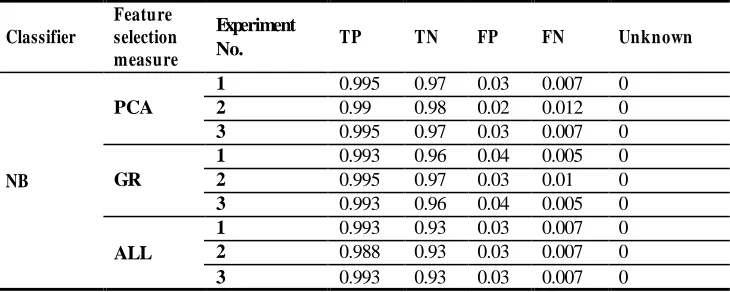
Table 2 and table 3 summarized values of classification results for the three experiments. Generally in the three experiments, TP and TN results of SVM classifiers with PCA_F and GR_F are always higher than that of SVM with ALL_F and NBclassifiers with PCA_F, GR_F also always higher than that of NB with ALL_F, FP and FN results of SVM classifiers with PCA_F and GR_F are always smaller than that of SVM with PCA_F and GR_F NB classifiers. In particular with SVM classifiers in the three experiments, TP and TN results with PCA_F and GR_F are almost higher
dst_host_same_src_port_rate logged_in cpu_usage_rate srv_serror_rate memory_space_rate src_byte
kernel_space_rate same_srv_rate
srv_count protocol_type
count_ diff_srv_rate dst_host_srv_rerror_rate
PCA_F GR_F
protocol_type land
service urgent
flag num_failed_logins
src_byte root_shell
wrong_fragment num_root
logged_in num_file_creations
count_ num_shells
srv_count num_access_files same_srv_rate num_outbound_cmds dst_host_count is_hot_login dst_host_srv_count is_guest_login dst_host_same_srv_rate wrong_fragment
dst_host_diff_srv_rate hot dst_host_same_src_port_rate num_compromised
cpu_usage_rate logged_in memory_space_rate src_byte
kernel_space_rate srv_serror_rate srv_count same_srv_rate protocol_type
(1) than with ALL_F, FP and FN results with PCA_F and GR_F are almost smaller (zero) than with ALL_F. Unknown results were always "zero" for both SVM and NB with the three sets of features.
Table-2. Classification Results of SVM Classifiers
Classifier
Feature selection measure
Experiment
No. TP TN FP FN Unknown
SVM
PCA
1 1 1 0 0 0
2 1 1 0 0 0
3 1 1 0 0 0
GR
1 1 0.99 0.01 0 0
2 1 1 0 0 0
3 1 1 0 0 0
ALL
1 0.995 0.97 0.03 0.005 0 2 0.998 0.99 0.01 0.002 0 3 0.995 0.93 0.07 0.005 0
Table-3. Classification Results of NB Classifiers
Classifier
Feature selection measure
Experiment
No. TP TN FP FN Unknown
NB
PCA
1 0.995 0.97 0.03 0.007 0
2 0.99 0.98 0.02 0.012 0
3 0.995 0.97 0.03 0.007 0
GR
1 0.993 0.96 0.04 0.005 0
2 0.995 0.97 0.03 0.01 0
3 0.993 0.96 0.04 0.005 0
ALL
1 0.993 0.93 0.03 0.007 0
2 0.988 0.93 0.03 0.007 0
3 0.993 0.93 0.03 0.007 0
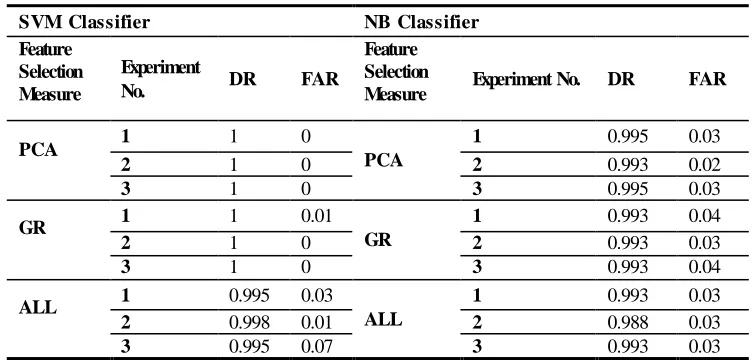
The detection rate (DR) of an IDM is the ratio between the number of TP and the total number of intrusion patterns presented in the testing dataset . It has been calculated using
DR = *100% ………(16)
, and the false alarm rate (FAR) of an IDM is the ratio between number of "normal" patterns classified as attacks (FP) and the total number of "normal" patterns presented in the testing dataset. It has been computed using
FAR = *100% ………(17)
Table-4. DRs and FARs of both of them SVM and NB Classifiers
SVM Classifier NB Classifier
Feature Selection Measure
Experiment
No. DR FAR
Feature Selection
Measure Experiment No. DR FAR
PCA 1 1 0
PCA
1 0.995 0.03
2 1 0 2 0.993 0.02
3 1 0 3 0.995 0.03
GR 1 1 0.01
GR
1 0.993 0.04
2 1 0 2 0.993 0.03
3 1 0 3 0.993 0.04
ALL 1 0.995 0.03
ALL
1 0.993 0.03
2 0.998 0.01 2 0.988 0.03
3 0.995 0.07 3 0.993 0.03
DR are higher with SVM classifiers (often greater than "0.995") than with NB classifiers that often did not exceed "0.995".And FAR often ranging between (0 - 0.07) with SVM classifiers while it is often ranging between the range of (0.02 - 0.04) with NB classifiers. It is very clear from these comparisons that SVM classifiers are better than NB. In particular, with SVM classifiers in the three experiments, DR with PCA_F and GR_F is always higher (1) than with ALL_F. And FAR is "zero" with PCA_F and GR_F, while it is ranging between the range of (0.01-0.07) with ALL_F .
Selection of the best classification model would be done significantly according to its classification accuracy, which is introduced as the ratio between the number of the correctly classified patterns (TP, TN) and the total number of patterns of the testing dataset. The accuracy (Accu) of each classifier has been calculated using
Accu = *100% ………. (18)
Table 5 summarizes Accu of both SVM and NB classifiers with PCA_F, GR_F, ALL_F in the three experiments. According to these results, the most accurate classifiers were SVM classifiers with PCA_F Accu equal 1 in Exp1, Exp2 and Exp3 followed by SVM classifier with GR_F with Accu equal 1 in Exp2 and Exp3, were SVM classifier with ALL_F with Accu equal to 0.996 in Exp2.
Table-5. Accuracy of SVM and NB Classifiers Classifier Experiment
No. PCA_F GR_F ALL_F
SVM
1 1 0.998 0.990
2 1 1 0.996
3 1 1 0.982
NB
1 0.988 0.988 0.988
2 0.986 0.986 0.988
3 0.988 0.988 0.988
CONCLUSIONS
This paper design and implement a hybrid IDM for detecting intrusions. The design of model relies on using of DM classification algorithms with a proposed dataset, named HybD, composed of the 10% KDD'99 dataset's features and suggested host-based features. Where these features related to host itself not to network traffic give a support for proposed hybrid IDS to detect attacks, since these features have clear affect on host resources performance.
The aim of considering two measures for feature selection is to get diversiform of subsets of features, to make comprehensive comparisons. PCA find the most strong attributes in dataset and GR selecting features that having greatest GR values. The "PCA" has given better results rather than results of GR measure when they used with SVM and NB classifier, see tables (2, 3). Accuracy of SVM classifier higher than NB in all cases of features (PCA, GR, ALL), see table (4, 5).