ISSN(Online): 2320-9801
ISSN (Print): 2320-9798
I
nternational
J
ournal of
I
nnovative
R
esearch in
C
omputer
and
C
ommunication
E
ngineering
(An ISO 3297: 2007 Certified Organization)
Vol. 3, Issue 8, August 2015
TFT-OFDM Systems in Long Delay Channels
Using LDPC Codes
Sheba Priya Roy, Saju A
PG Student, Dept. of ECE, Mahatma Gandhi University, CAARMEL Engineering College, Pathanamthitta, Kerala
India
Associate Professor & HOD, Mahatma Gandhi University, CAARMEL Engineering College, Pathanamthitta ,Kerala,
India
ABSTRACT: In this paper a very efficient compressive sensing technique is applied in a time frequency training
multiplexing (TFT-OFDM).From the channel information received from TFT OFDM we apply it to the auxillary subspace pursuit (A-SP) algorithm.This algorithm has lesser complexity and makes use of the PN coarse path delay estimation.The path delay estimation is done by making use of the most significant taps.We make use of the pilot carriers which should be sparse.The sparse signals are generated by using the theory of Compressive Sensing(CS).The performance evaluation was done for both low density parity check (LDPC) code.It was seen that the LDPC coded TFT OFDM showed better performance especially when the channel length is close to or even greater than the guard interval length for 256 quadrature amplitude modulation(QAM) in different channels .
KEYWORDS: Compressive Sensing, Auxillary Subspace Pursuit algorithm, path delays, LDPCcodes,most significant
tap(MST) detection
I. INTRODUCTION
In the previous year’s OFDM is being widely implemented in various wireless devices.Among the different multiplexing technique TFT –OFDM has gained wide acceptance because of its feature of making use of both the time and frequency.It has proved to be more progressive than the time domain synchronous (TDS) OFDM as the TDS OFDM can’t mitigate the interblock interference (IBI). The pseudo noise OFDM (DPN-OFDM) was used to overcome this disadvantage.But it had lesser spectral efficiency. There are many synchronization issues in a OFDM model such as the symbol timing synchronization, which is to determine the correct symbol start position The carrier frequency synchronization which is utilized to eliminate the carrier frequency offset caused by the mismatch. The sampling clock synchronization, which is to mitigate the sampling clock errors due to the mismatch of the crystal oscillators.The TFT-OFDM makes use of higher modulation schemes such as 256QAM and thus finds application in ultra high definition television(UHDTV).In long delay channels all the signals that are arriving from different direction need not be of maximum importance.Therefore the method of finding the most significant taps is used in which the signals found are the base.These signals are sparse in nature. The algorithm has two important characteristics: low computational complexity, comparable to that of orthogonal matching pursuit techniques and has priori knowledge as aswell when applied to very sparse signals, and accuracy with lesser complexity.
II. RELATED WORK
ISSN(Online): 2320-9801
ISSN (Print): 2320-9798
I
nternational
J
ournal of
I
nnovative
R
esearch in
C
omputer
and
C
ommunication
E
ngineering
(An ISO 3297: 2007 Certified Organization)
Vol. 3, Issue 8, August 2015
propose the auxillary subspace pursuit with lesser complexity.With this algorithm we do the CS based channel estimation(CE). .There are two properties:
1)incoherence 2)sparse nature
The incoherence is of two types that is the lower coherence and higher coherence.Lower incoherence means more difference and compressive sensing provides that.Thus the signals can be recovered with high probability.To implement this compressive sensing process in an OFDM we need to consider the following points:i)A channel model should be considered to estimate the sparse signalsii)We need to place the pilots in such a way that the interference from other pilots have to be observed and from other data symbols has to be also considered as noise.the main drawback of TDS-OFDM is that theTS and the OFDM block will cause mutual inter-block interferences (IBI) to each other. Thus, iterative interferencecancellation algorithm with high complexity has to beadopted for CE and channel equalization in TDS-OFDM systems. Unfortunately, this will result in an open problem of TDS-OFDM: Under the severely fading channels, it isdifficult for the iterative algorithm to perfectly remove the IBI when the maximum channel delay spread is large, whichis common in the single frequency network (SFN) environment.This will cause the degradation of the whole systemperformance and the difficulty to support the high-order modulations like 256 QAM to accommodate the emergingultra-high definition television (UHDTV) service requirement (DVB-T2 has claimed to support the 256QAM for UHDTVservices).
III. PROPOSED ALGORITHM
.
A. Overlap Add Method (OLA) algorithm
The overlapadd method is an efficient way to evaluate the discrete convolution of a very long signal with a finite impulse response (FIR) filter.We divide the problem into multiple convolutions of h[n] with short segments of x[n]. Because of this y[n] can be written as a sum of short convolutions of these short segments.The signal is first partitioned into non-overlapping sequences, then the discrete Fourier transforms of the sequences are evaluated by multiplying the FFT xk[n] of with the FFT of h[n]. After recovering of yk[n] by inverse FFT, the resulting output signal is reconstructed by overlapping and adding the yk[n]. The overlapping is done because linear convolution is always longer than the original sequences.In this step, the IBI caused by the PN sequence is obtained by computing the linear convolution between the local PN sequence and the estimated channel impulse response that can be obtained after the MST detection obtained.
Fig1:Cyclic Reconstruction of the OFDM block.
ISSN(Online): 2320-9801
ISSN (Print): 2320-9798
I
nternational
J
ournal of
I
nnovative
R
esearch in
C
omputer
and
C
ommunication
E
ngineering
(An ISO 3297: 2007 Certified Organization)
Vol. 3, Issue 8, August 2015
caused by the OFDM block towards the PN sequence but also the useless part that is the linear convolution between the PN sequence and channel. Hence, the useless part should be removed after the received PN sequence is added as shown in fig1.
B. Description of the Proposed Algorithm:
The most popular algorithms for the path delay estimation are the greedy algorithms, like Matching Pursuit (MP) or Orthogonal Matching Pursuit (OMP), that identify the nonzero elements of x in an iterative fashion.The nonzero element set is first set to zero.The observations are set as the residual, r = z.Correlate all columns of A with the residual and choose the largest element by magnitude and add it to the set of non-zero elements. We apply the condition that only elements of x are nonzero that have been added , this helps in finding an estimate that can minimize.Thus we can update the new residueˆ. Repeat steps until we get below a predetermined threshold.This type of algorithm has been popular mainly because it can be easily implemented and has low computational complexity. This has lead to renewed interest in dynamic, leading to new greedy pursuit algorithms like the priori aided compressive sensing sampling matching pursuit(PA-CoSaMP) algorithm. The input that is given are:
1) Initial path delay set D0, channel sparsity levelS, initial channel sparsity level S0;
2) Noisy measurements y, observation matrix Φ.The output that we get is S sparse estimate ĥof the channel impulse response(CIR).
Fig2:Auxilliary Subspace Pursuit(ASP) algorithm
Basically there are three steps for auxiliary subspace pursuit algorithm:
1) Coarse path delay estimation done using PN sequence.This can be done by the parity aided compressive sampling pursuit (PA-CoSaMP) algorithm. From this we get the path delay estimation.We do not consider the path gains.The path delays of the most significant taps are calculated.This is given as the auxillary information for the Auxillary Subspace Pursuit(ASP).The auxillary information is taken for the initial configuration of the ASP algorithm.The coarse channel estimate is found.We find the channel sparsity level S.Thus this will contain only the initial path delay 2)In the second step we have to reconstruct the OFDM block.This is done using the overlap add (OLA) algorithm.This helps in removing the IBI caused by the PN sequence.After using the OLA algorithm we also get the useless part that is formed by the linear convolution of PN sequence and OFDM block.This has to be removed so as to get cyclicity .
3)In the third step we make use of the ASP algorithm the exact channel impulse response (CIR) .The auxillary information received will reduce the complexity of the ASP algorithm.Here we have the initial value from the path delay and therefore it helps in providing initial configuration.In ASP we subtract after each iteration, the remaining most significant values are taken.
ISSN(Online): 2320-9801
ISSN (Print): 2320-9798
I
nternational
J
ournal of
I
nnovative
R
esearch in
C
omputer
and
C
ommunication
E
ngineering
(An ISO 3297: 2007 Certified Organization)
Vol. 3, Issue 8, August 2015
signals. The ratio of the output sample time to the input sample time is k/n. The input must be a real k×1 column vector signal.The output signal inherits the data type from the input signal, and the input must be binary-valued (0 or 1). Then transmission done using OFDM as shown in fig2 and we do mainly channel estimation and we find channel impulse response as well.The coarse channel estimation helps in reducing the complexity of the algorithm as we get an initial value that is needed for the auxiliary subspace pursuit algorithm.The decoding is done by LDPC decoding .
T
he LDPCDecoder decodes a binary low-density parity-check code.The decision type are of two types ie the hard decision and soft decision.The soft decision output gives the loglikelihood values.IV. TFT-OFDMSYSTEMMODEL
There are three types of OFDM-based block transmission like cyclic prefix OFDM (CP-OFDM), zero padding OFDM (ZP-OFDM), and time domain synchronous OFDM (TDS-OFDM). TDS-OFDM has the pseudorandom noise (PN) sequence, as the guard interval as and the training sequence (TS). The dual PN(DPN-OFDM) scheme uses the second received PN sequence which is immune from IBI as shown in Fig 3 .Thus, the IBI removal can be avoided, but there is loss in spectral efficiencyAs shown in Fig. 3 presents the system model of time domain synchronous (TDS) . Unlike the conventional TDS-OFDM or CP-OFDM where the training information only exists in either the time or frequency domain .Fig. 4 shows that TFT-OFDM has training information in both the time and frequency domains for every signal symbol, i.e., the time-domain TS and the frequency-domain pilots scattered over the signal bandwidth are jointly used in TFT-OFDM.
Fig3DPN-OFDM
Fig4TDS-OFDM
The ith TFT-OFDM signal symbol = , , … . , is composed of theknown PN sequence = , , … . , of length M and the OFDM block = = , , … . , of length N,
i.e =
In contrast to the conventional TDSOFDM, the OFDM block in TFT-OFDM contains not only the traffic data, but also a small number J of pilots.ɼ is the pilot location set and represented as ɼ= { , … . , } where 0 ≤P0 < P1 <・・< PJ−1 ≤N − 1 . By the use of CS the pilot number J could be reduced significantly and hence the spectral efficiency loss is negligible. The difference is that the pilots are equally spaced in exixting schemes, while the pilots are randomly located in the proposed scheme to ensure good CE performance based on CS.
So far it was assumed that y is available, and that one can simply apply the transform into the domain of {{ } to determine which are relevant (non-zero). Although this case does exist and is important for some forms of data compression, the real application of compressive sensing is the acquisition of the signal from m, possibly noisy, measurements z = y + for l= 1, . . . ,m, where here it is assumed that is zero-mean complex Gaussian distributed with variance N0 and the noiseless case is included for N0 → 0. The signal acquisition process can now be written using the m×n matrix A,
ISSN(Online): 2320-9801
ISSN (Print): 2320-9798
I
nternational
J
ournal of
I
nnovative
R
esearch in
C
omputer
and
C
ommunication
E
ngineering
(An ISO 3297: 2007 Certified Organization)
Vol. 3, Issue 8, August 2015
the channel is exactly known at the receiver, the IBI of thePN sequence on the OFDM block can be completely removed.Then, by using the idea of the classical overlap and add (OLA)algorithm , the cyclicity reconstruction of the OFDM block can be obtained and hence the CP effect can be restored.In the proposed scheme, the time-domain PN sequence and the frequency-domain pilots are jointly exploited to perform the CE.
V. SIMULATION RESULTS
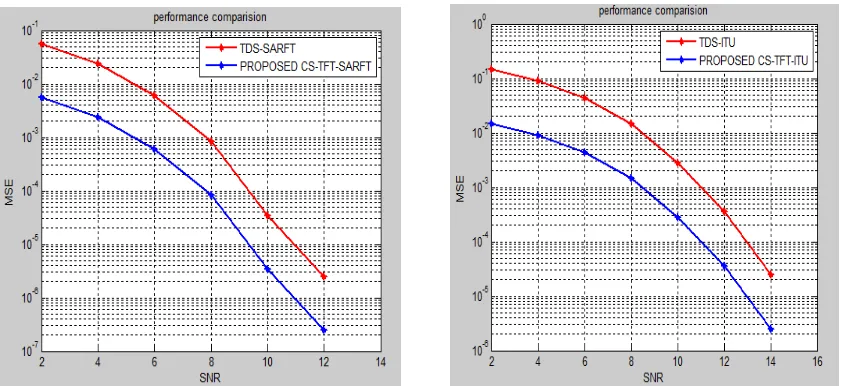
This section shows the performance evaluation of TFT-OFDM systems using LDPC codes under two different channel models.The performance evaluation is done for BER and MSE rate.It is seen that when channel length is greater than guard interval length that we see that the TFT-OFDM has better performance than TDS-OFDM.The turbo code is given at a rate of 1/3.The message length is 4096 and the training sequence is 64 in length.256QAM is the modulation scheme used.We have done this analysis for channel length greater than the GI(guard interval) length in an exteremely long interval delay.In the fig5, it shows the graph of BER vs SNR rate in different channel for the TDS-OFDM system and the proposed system.It is seen that the proposed system enjoys a performance of 10 than that of the proposed system.Thus better performance with lesser complexity.This is evaluated in a SARFT channel which supports the wireless standards.In fig6 the BER is evaluated in ITU-VB channel model for static environment.It is evaluated on the condition that the guard interval is greater than the channel length.This is for the extreme case.It is seen that the proposed TFT-OFDM system has a BER rate close to the theoretical value. The vehicular channel models are there for different power levels.The difference occurring because of randomness or because the estimation doesn't account for a value that could produce a accurate estimate is called mean square error (MSE). In fig7 the mean square error value is almost close to the theoretical value.Thus spectral efficiency is increased.It can be seen that under the State Administration of Radio, Film & Television (SARFT) channel which is responsible for controlling the access to satellite and cable networks as well as supervising their operations, the MSE performance of the proposed scheme enjoys a significant SNR gain.It is seen that the proposed system has a MSE performance of more than 10 in both the channels is shown in fig7 and fig8.The channel tabs used are 8.The MSE performance of the proposed scheme has better signal to noise ratio gain (SNR)of 6db which is measured in db.The ITU-Vehicular B has rake finger of 7.The rake finger helps against interferences.
Fig.5.BERvs SNR of TFT-OFDM using LDPC codes in SARFT channel Fig.6. BER vs SNR of TFT-OFDM using LDPC codes in ITU-VB
ISSN(Online): 2320-9801
ISSN (Print): 2320-9798
I
nternational
J
ournal of
I
nnovative
R
esearch in
C
omputer
and
C
ommunication
E
ngineering
(An ISO 3297: 2007 Certified Organization)
Vol. 3, Issue 8, August 2015
Fig. 7. MSE vs SNR of TFT-OFDM using LDPC codes in SARFT channel Fig 8. MSE vs SNR of TFT-OFDM using LDPC codes in ITU-VB
VI. CONCLUSION AND FUTURE WORK
Compressive sensing has made a great impression in the signal processing and broadcasting community, where besides an intriguing theory it offers versatile applicability to many challenging problems. Single frequency network (SFN) is an attractive scheme for the digital television terrestrial broadcasting (DTTB) coverage with efficient utilization of the spectral resources. In this paper, a method featuring low complexity and low workload is proposed to estimate the reception quality under the SFN environment with the maximum delay spread of the artificial multipath no longer than the guard interval. In the communications community the application of compressive sensing has been mainly on sparse channel estimation with MST’s, with extensions tomultiuser and cognitive radio systems. In this paper, we illustrated the application of the compressive sensing techniques in long delays by using the joint estimation. Based on the analysis
of error probability and channel capacity, this method supports an unambiguous prediction of the signal-to-noise ratio (SNR) threshold according to the parameters of received signals, which is thus meaningful for system evaluation.Every TFT-OFDM symbol has time-frequency training information composed of the time domain TS and a very small number of frequency- domain grouped pilots. With the joint time frequency channel estimation, the received TS is directly utilized to merely acquire the path delay information of the channel, while the path coefficients are estimated by the frequency-domain pilots.The present system has lesser complexity and since we use LDPC codes with decoding done by using belief propagation(BP). The MSE performance of this method outperforms the conventional schemes and is close to the CRLB by simultaneously exploiting the time-domain PN sequence and frequency-domain pilots. The proposed scheme has a good BER performance in both static and mobile scenarios and can well support the 256 QAM, especially when the maximum delay spread is greater than the guard interval length. By using the auxiliary channel information, the proposed A-SP algorithm has lower complexity than the conventional SP algorithm.
The MSE performance of this method outperforms the conventional schemes and is close to the CRLB by simultaneously exploiting the time-domain PN sequence and frequency-domain pilots.
The proposed scheme has a good BER performance in both static and mobile scenarios and can well support the 256 QAM, especially when the maximum delay spread is greater than the guard interval length.
By using the auxiliary channel information, the proposed A-SP algorithm has lower complexity than the conventional SP algorithm.
ISSN(Online): 2320-9801
ISSN (Print): 2320-9798
I
nternational
J
ournal of
I
nnovative
R
esearch in
C
omputer
and
C
ommunication
E
ngineering
(An ISO 3297: 2007 Certified Organization)
Vol. 3, Issue 8, August 2015
implementations that make use of parallelism.We can implement this same system models by using other codes like Turbo codes using puncturing and by replacing by other compressive sensing techniques instead of ASP algorithm.The ASP is approximated by using least squares.
REFERENCES
.
1. C. Berger, Z. Wang, J. Huang, and S. Zhou, Application of compressive sensing to sparse channel estimation, IEEE Commun Mag., vol.
48, no. 11, pp. 164174, Nov. 2010
2. L. Dai, Z. Wang, and Z. Yang, Compressive sensing based time domain synchronous OFDM transmission for vehicular communications,
IEEE J. Sel. Areas Commun., vol. 31, no. 9, pp. 460469, Sep. 2013.
3. Z. Tang, R. Cannizzaro, G. Leus, and P. Banelli, Pilot-assisted timevarying channel estimation for OFDM systems, IEEE Trans. Signal
Process., vol. 55, no. 5, pp. 22262238, May 2007.
4. B. Yang, K. Letaief, R. Cheng, and Z. Cao, Channel estimation for OFDM transmission in multipath fading channels based on parametric
channel modeling, IEEE Trans. Commun.,vol. 49, no. 3, pp. 467479, Mar. 2001.
5. Gopika Rani, G. SudhaSadasivam, R. M. Suresh Comparative Analysis of Turbo and LDPC Codes for Reduced Storage and Retrieval of
Data WSEAS transactions on computers , Volume 14,pp.142-151, 2015.