ISSN(Online): 2319-8753 ISSN (Print) : 2347-6710
International Journal of Innovative Research in Science,
Engineering and Technology
(A High Impact Factor, Monthly, Peer Reviewed Journal)
Visit: www.ijirset.com
Vol. 8, Issue 3, March 2019
Robust Multihop Localization Algorithm in
WSN: for Accurate and Robust Approach
Dr. D. Usha1, S.Kani Mozhi Devi2,
Assistant Professor, Mother Teresa Women’s University, Kodaikanal, Tamilnadu, India1
Research Scholar, Department of Computer Science, Mother Teresa Women’s University, Kodaikanal,
Tamilnadu, India 2
ABSTRACT: For Wireless sensor networks, an important research problem is to use a few anchor nodes with known locations to derive the locations of other nodes in the sensor field. The best solution for the addressed issue is the iterative localization. It combines the elements involved in a network in a logical order of sequence to locate them finally. In iterative trilateration, the network element varies from its definition. The network element can either be a single node or nodes in a group. For this addressed issue, a new method that is inflexible body merging is proposed. The inflexible body merging generates a larger element by combining two small elements of network. The existing methods, trilateration and patch stitching are widely spread but some alternative new methods can be preferred. The advantage of iterative approach is that it can help avoid local minima by a dimension reduction technique. Just imagine when merging two network elements, their relative position and orientation to fit their constraints is handled to tune. This means the manipulation of three free variables in 2-D space is to be computed, rather than handling the whole topology. In this work, an MWF based approach is presented for speech and noise scenarios, where an SDW-MWF based NR algorithm is combined with DRC. The proposed solution is based on modifying the SDW-MWF and the DRC to incorporate the conditional SPP in order to avoid residual noise amplification. The approach is analyzed to verify if there are any undesired interaction effects between the NR and the DRC. The work is evaluated by means of objective measures. The proposed methods are theoretically and experimentally proved and the results are presented in this paper.
KEYWORDS: Wireless Sensor Networks, MWF, SDM-MWF, DRC, NR
I. INTRODUCTION
In general, the wireless networking is defined as that this is a type of computer network. It makes use of the wireless data connections to connect network nodes. It paves a way to avoid cost in spending the cables into a building or for the connection purpose. The radio communication is used to implement the wireless telecommunications and it is initialized at the physical layer of OSI model. The wireless networks are mostly makes use of the IEEE 802.11 standards. The wireless networks broadcasts in the different frequencies such as 2.4GHz or 5GHz band. If there is any variation, it makes the communication to initialize in the range of 2.3GHz and 4.9GHz.
Wireless Networking
ISSN(Online): 2319-8753 ISSN (Print) : 2347-6710
International Journal of Innovative Research in Science,
Engineering and Technology
(A High Impact Factor, Monthly, Peer Reviewed Journal)
Visit: www.ijirset.com
Vol. 8, Issue 3, March 2019
Another wireless network is 802.11e which is used for the deployment of multimedia applications like streaming video and voice over IP (VoIP). The 802.11e has a predefined specification WME or WMM which is a subset of 802.11e and it can be used while waiting for final ratification. The traffic prioritization is enabled by these networks through the QoS protocol and some other media access protocols. The proper implementation increases the performance speed. Some of the types of wireless networks are Wireless PAN, Wireless LAN, Wireless Mesh Network, Wireless MAN, Wireless WAN, and Cellular Network.
LOCALIZATION IN WSN
The existence of diffusion is in wide range in the wireless networks because of low energy cost sensor microprocessor and radio frequency circuitry for information transmission. WSN has thousands of lower sensor nodes and implemented almost in all the fields or applications. Among many, localization is the main thing which makes use of the coverage, deployment, routing, location service, target tracking and rescue [1].
The vehicle robots or aircrafts are used to deploy the sensor nodes. GPS is accessible in a wide range due to the weakness of high cost and consumption of energy. The minimization in energy consumption and cost, the beacon nodes are used. Apart from beacon nodes, the localization method is used to obtain locations. Node self-localization is defined as to estimate the unknown node position within the network. The primary goal of the localization method is to obtain the target location. In earlier days, the distance/angle estimation is used to identify the location and the later techniques, the pattern matching is used. The categorizations of localization are Single-Target/Source Localization in Wireless Sensor Network, Single-Target/Source Localization in Wireless Binary Sensor Network, Node Self-Localization, Range-Based Localization, Range-Free Localization, Hop-Count-Based Localization.
PATTERN MATCHING METHOD
Pattern matching localization, also called map-based or Fingerprint algorithm, is one of the most viable solutions for range-free localization methods recently. The fingerprint localization involves two phases. During the first phase, the received signals at selected locations are recorded in an offline database called radio map. The second phase is considered to be the online phase. Pattern matching algorithm concludes the unknown location by matching with currently obtained signal features with the prerecorded values. The objectives are: Tolerate ranging noise when merging two network elements and adopting an optimization algorithm based on rigid body dynamics and relaxing springs. Detect the rough collinearity of nodes in the presence of ranging noise, and then enumerate flip ambiguities accordingly and indicate when we can apply this primitive to align two network elements.
The research paper is sectioned as follows. The section II presents the review related to the proposed work, section III is to explain the methodologies of proposed work, section IV detailed the results of proposed work and section V concludes the entire paper.
II. LITERATURE SURVEY
B. Xiao, L. Chen, Q. Xiao, and M. Li, Reliable anchor-based sensor localization in irregular areas
ISSN(Online): 2319-8753 ISSN (Print) : 2347-6710
International Journal of Innovative Research in Science,
Engineering and Technology
(A High Impact Factor, Monthly, Peer Reviewed Journal)
Visit: www.ijirset.com
Vol. 8, Issue 3, March 2019
L. Dimitrios, L. Quentin, and S. Andreas, An empirical characterization of radio signal strength variability in 3-D IEEE 802.15.4 networks using monopole antennas
The radio connectivity and the attenuation of radio signal with distance is implemented in many devices. The most commonly one in the low-power radios is Radio signal strength indicator (RSSI). To investigate RSSI and its factors, and to get a better understanding of the asymmetries that arise in 3-D schemarios, a detailed characterization of signal strength behaviors in an IEEE 802.15.4 sensor network with monopole antennas is presented. A collection of a large number of measurements from a 40-node tested, both in an indoor and an open-field environment. This characterization examines a new radio technology with less powerful radio transmissions. Though there is no existence of multipath effects, the relative antenna orientation between receiver-transmitter is considered to be a main factor. This suggests that many schemes using radio signal strength on similar radios should carefully consider these factors before going to actual deployments. The merits in the work are that it has high signal strength variability component and computational complexity is less. And the demerits are that the packets are not received accurately and in low power condition, the RSSI is difficult to set to the signal propagation model.
H. Lim and H. J. C. , Localization for anisotropic sensor networks
Driven by advances in MEMS micro-sensors, wireless networking, and embedded processing, ad-hoc networks of de- vices and sensors with (limited) sensing and wireless communication capabilities are becoming increasingly available for commercial and military applications such as environmental monitoring (e.g.. traffic, habitat, security), industrial sensing and diagnostics (e.g., factory, appliances), critical infrastructure protection (e.g., power grids, water distribution, waste disposal), and situational awareness for battlefield applications. Localization for wireless sensor networks has been intensively studied in recent years, A simple approach of having all the sensor nodes equipped with a global positioning system (GPS) does not suffice because of the size, cost, and power consumption constraints of sensor nodes. Instead, most localization methods determine the positions of sensor nodes under the assumption that a small portion of sensor nodes, called beacon nodes, are aware of their positions by means of manual configuration or GPS . In these methods, each sensor node estimates (based either ranging techniques or proximity measurements) its distances to beacon nodes, and calculates its position by triangulation flateration techniques. Refinement can be made to iteratively improve the accuracy of these localization methods. In this paper, we present a new technique to analyze the relationship between the geographic distance and the proximity between sensor nodes in anisotropic networks. Conceptually localization can be considered as an embedding problem that maps the set of objects into an embedding space. In Lipschitz embedding, a coordinate space is defined such that each axis corresponds to a reference se1 of objects and the coordinate values of an ohject o are the distances from o to the reference objects. Based on this concept, each sensor node has two coordinates in Lipschitz embedding spaces that correspond, respectively, to the proximity measure and the Euclidean distance between itself and beacon nodes. We derive an optimal linear transformation that projects one embedding space (that is built upon proximity measures) into the geographic distance space by using the singular value decomposition (SVD) technique. The advantages of this paper are that the characterization is accurate, the level of computational complexity is low and the protocol operations are simpler. The disadvantage of the paper is that is that the difficulty in extraction of geographic information and the power control in an excessive way.
X. Wang, J. Luo, S. Li, D. Dong, and W. Cheng, Component based localization in sparse wireless ad hoc and sensor networks
ISSN(Online): 2319-8753 ISSN (Print) : 2347-6710
International Journal of Innovative Research in Science,
Engineering and Technology
(A High Impact Factor, Monthly, Peer Reviewed Journal)
Visit: www.ijirset.com
Vol. 8, Issue 3, March 2019
be uniquely localized. In their research work, they have said as three conditions, RRT-3B. The approximation algorithm to RRT-3B is SWEEPS. It is used in both the trilateration and bilateration conditions effectively.
There are some issues with SWEEP algorithm, so CALL (Component-bAsed Localization) is taken over it. The improvement in sparse network can be done using it. The finite mergence is introduced to handle the component-based localization method. The component localization is handled by the anchor requirement conditions. The efficiency of CALL is tested with large scale simulations. The accuracy level of locating the nodes is 80% with an average of 7.5 by 5%. SWEEP provides only 20% by average. The merits of this paper are that it has no ambiguity and the higher network density makes the lower proportion. The demerits of the paper is analyzed that the performance of gain is not worthy, to compute distance, high network density is required and due to some restriction, the local maps is hard to make in the sparse networks.
III. PROPOSED SYSTEM
In this system, a robust multihop localization algorithm (RMLA) is implemented. Specially, the concepts of evidence theory are employed to deal with the uncertainty factors in trust evaluation. Also this system focused on fine-grained iterative localization of wireless sensor networks. The optimization algorithm is also implemented which adjusts the ranging noise while the alignment of two bodies. This algorithm is much generalized and can replace the traditional multilateration and patch stitching as the new primitive for network localization. To increase the rate of robustness of localization, the flip ambiguity algorithm is also proposed. This algorithm can discover the rough collinearity of constraints due to the interference of ranging noise. Our contribution is that our body merging condition DOC≥ DOF can achieve higher localization percentage than state-of-the-art SWEEPS and CALL. Our final demonstration shows that our IIBM localization algorithm can work well, even in concave networks with nonuniform network density. This system address the issue of using a weighting factor to trade-off between NR that is kept fixed for each frequency and for each frame which potentially can limit the spectral tracking of the non-stationarity of the noise. Combined with the fact that the correlation matrices are kept fixed at different time instants all together with a long averaging time the fixed weighting factor certainly does not help the spectral tracking. The merits of the proposed work is that multilateraion can be easily achieved using body merging optimization algorithm, reliability in correlation matrix and the communication is less. It paves way for the communication cost to be low.
IV. METHODOLOGY
Body Merging Optimization Algorithm
This algorithm revises the transformation function , recursively and finally outputs the optimal transformation , . Its basic idea is to model each constraint as an elastic spring (Fig. 1). Each spring casts its force on body ℬ∗due to
spring deformation. As directed by the multiple spring forces, body ℬ∗moves and rotates, which can be simulated by
the physical model of rigid body dynamics. In this process, body ℬ∗ moves step by step toward the equilibrium where
ISSN(Online): 2319-8753 ISSN (Print) : 2347-6710
International Journal of Innovative Research in Science,
Engineering and Technology
(A High Impact Factor, Monthly, Peer Reviewed Journal)
Visit: www.ijirset.com
Vol. 8, Issue 3, March 2019
Fig.1. Iterative optimization based on rigid body dynamics
Second, at lines 2–5, a loop is used to optimize the translation and rotation of body ℬ∗iteratively. At the beginning of
an iteration, the current time is assumed as2 . At line 3, the current translation and rotation ℛ at time 2 to – ,−ℛ at time 2 + 1 is optimized and then at line 4, optimize – ,−ℛ to ,ℛ at time 2 + 2. The loop terminates at line 5 if the changes from time 2 + 1 to time 2 + 2 are negligibly small. Note that both lines 3 and 4 need to optimize translation and rotation at time to the next time-slot, which is described below. Note that the translation ( ) by 3 × 1 vectors and represent rotation ℛ( ) by a 3 × 3 orthogonal matrix, for the ease of extension to 3-D spaces is represented.
Fig.2. Body merging optimization problem
1) Translation Optimization: Our equations in Fig. 1 can optimize the translation ( ) at time to translation ( + 1)at the next time. This optimization is directed by linear acceleration of body ℬ∗, which equals ( ), where is mass,
ISSN(Online): 2319-8753 ISSN (Print) : 2347-6710
International Journal of Innovative Research in Science,
Engineering and Technology
(A High Impact Factor, Monthly, Peer Reviewed Journal)
Visit: www.ijirset.com
Vol. 8, Issue 3, March 2019
( ), ( )( ∗). The magnitude of this force is the weighted error of this constraint. Here, weight within
( ), ( ) can be regarded as the spring constant to capture the different error characteristics in different
constraints. The parameter when calculating ( + )is the optimization step size. A rule of thumb is to con ∈
[0.5 , ] = /∑ ∈ figure it as to balance between convergence speed and potential oscillations.
2) Rotation Optimization: In Fig. 1, rotation ( ) at time is optimized to ( + 1) at the next time. This optimization is directed by angular acceleration of body ℬ∗, which equals ( ) = ( ) ℸ( ), where is ℸ( ) inertial tensor of body ℬ∗and ℸ( ) is torque acting on it. With this angular acceleration ( ), the next orientation ( + 1) can be calculated
by multiplying Rodrigues’ rotation formula. A mitigation is to replace by its nearest orthogonal matrix, e.g., for every 20 iterations. Another point that needs to take care of is that the denominators in Fig. 1 can equal to zero occasionally. Thus, the protection code for such boundary conditions needs to be added.
BODY MERGING WITH FINITE AMBIGUITIES
In sparse networks, the condition for unique body merging may not always be satisfied, i.e., rule of redundant constraints > . This section will relax this condition and considers non-underdetermined constraints
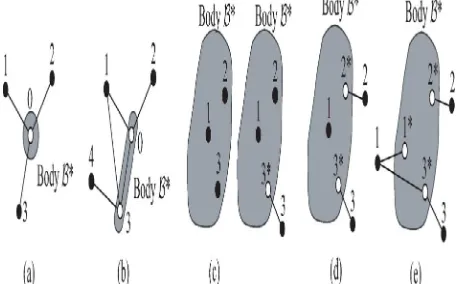
≥ . In such situations, there may exist multiple ambiguities to merge two bodies, which is shown in Fig. 4. In this section, there exist only finite ambiguities if given non-underdetermined constraints between two bodies is proved initially. Then it is presented as an algorithm to enumerate flip ambiguities, which works well in sparse networks and ensures location robustness. The localization algorithm Iterative Inflexible Body Merging (IIBM) is initialized, which permits finite ambiguities for body merging. Here, a body is called an “inflexible body” because it can have multiple but finite ambiguities. In contrast, a rigid body can have only one ambiguity, and a flexible body has a flexible part that can move and produce infinite ambiguities. The idea of finite ambiguities is also adopted by the state-ofthe- art SWEEPS and CALL. However, our algorithm still makes the following contributions.
1) Better robustness against collinear constraints: There are various cases of collinear geometry that can produce finite ambiguities.
2) Higher percentage of localizable nodes: All the cases are equally handled as shown in Figs. 3 and 4 to: The merging of a local body into the global body;
The merging of a local body into another local body. In contrast, CALL does not use the ambiguous cases in Fig. 4(c) and (d) for the merging of two local bodies.
3) Tighter upper bound for ambiguities: An upper bound for the number of ambiguities when the two bodies are connected by only three links is derived, as depicted in Fig. 4(e). The upper bound of 12 is derived (is much tighter than the bound of 24 provided by CALL.
ISSN(Online): 2319-8753 ISSN (Print) : 2347-6710
International Journal of Innovative Research in Science,
Engineering and Technology
(A High Impact Factor, Monthly, Peer Reviewed Journal)
Visit: www.ijirset.com
Vol. 8, Issue 3, March 2019
Fig.4. Ambiguous body merging with finite ambiguities due to nonredundant constraints that only satisfy (a) Node merging (b) Link merging (c) Patch merging I (d) Patch merging II (e) Patch merging III
Flip Ambiguity Enumeration
Motivation: For inflexible body merging, a key point is how to enumerate the finite ambiguities during merging of two bodies.
A method to enumerate ambiguities is presented, which however is a symbolic algorithm that solves polynomial equation systems. It is difficult to enumerate the flip ambiguities that are caused by the rough collinearity of constraint point set due to interferences of ranging noise. In this section, a numerical algorithm is implemented to enumerate flip ambiguities with the presence of ranging noise. Our observation is that a symmetry property exists for the flip ambiguities in Fig. 4(a)–(d). That is, if it is possible to obtain one ambiguity and flip it across the collinear nodes, then the remaining ambiguities is obtained. The most difficult case is in Fig. 4(d), where there are two flip lines ∅ ,∅ and four flip ambiguities. In this situation, the second ambiguity is obtained by flipping the first ambiguity across ∅ , the third ambiguity is obtained by flipping the first ambiguity across ∅ , and the fourth ambiguity is obtained by flipping the first ambiguity across ∅ then across ∅ . Algorithm 3 to enumerate flip ambiguities, which can improve the robustness against collinearity is presented. First, the collinearity of each constraint point set ( ) at lines 2–6 is tested. Our collinearity detection at line 6 can tolerate the presence of ranging noise, thanks to the ability of orthogonal regression in detecting rough collinearity of a constraint point set. Second, flip lines are detected to enumerate flip ambiguities at lines 7 and 8.
ISSN(Online): 2319-8753 ISSN (Print) : 2347-6710
International Journal of Innovative Research in Science,
Engineering and Technology
(A High Impact Factor, Monthly, Peer Reviewed Journal)
Visit: www.ijirset.com
Vol. 8, Issue 3, March 2019
Our localization algorithm invokes the body merging primitive iteratively. Its computational cost is difficult to express as a function of network size, because it is also affected by network sparsity level and specific network topology. For example, the network topology is deployed in Fig. 12 on a bridge to monitor structural health. In this special topology, the computational cost of our localization algorithm grows exponentially with the network scale. This is because the two bodies are merged (e.g., ABCD and CDEF), the number of ambiguities of the merged body will double due to the flip line CD. Since there are totally seven flip lines, the number of ambiguities will grow exponentially to 2 after that all the local bodies in the network are merged. Such a phenomenon is called “ambiguity explosion.” As described before, the computational cost of our merging primitive is proportional to the number of ambiguities. Thus, when ambiguity explosion exists, the cost of our localization algorithm can grow exponentially. However, the depicted topology is just an extreme case to have such a long chain of ambiguous body merging. In our experimental networks in rectangular field and in O-shaped field, the chain of exponential growth is frequently broken after three or four times of body merging. The subsequent redundant body merging can help reject parts of ambiguities accumulated. To mitigate ambiguity explosion problem, an additional rule to the merging order of iterative merging process is applied. When multiple pairs of bodies are available that can satisfy the merging condition ≥ , the body pair whose constraints have the largest − is preferred. The intuition for this rule to prefer − r large value is that the larger this value is, the smaller the chance for body merging to increase the number of ambiguities, and also the greater the chance to reject incorrect ambiguities. However, the above rule may collide with the previously mentioned rule that prefers the merging of global body with local body (call it embedding). The collision is resolved as follows. Name the rule that prefers embeddings as rule 1, and name the rule that prefers largest − value as rule 2.
First, rules 1 and 2 are applied jointly. It means that rule 1 is used to get a list of body embeddings, and apply rule 2 to this list to find the body embedding with the largest − value. If this body pair can satisfy the condition > of , then output it directly.
Otherwise, the rule 1 is abandoned and adopt rule 2 alone.
MODULES
1. Robust Multihop Localization Algorithm
In RMLA algorithm, each beacon evaluates the reliability of other beacons according to the multihop geometric relationship among them, which helps the normal nodes obtain the total trust degrees of their multihop communication beacons and further lays a foundation for robust localization of WSNs. In general, the RMLA algorithm includes three main phases: trust evaluation among beacons, calculation of integrated trust values and weighted estimation of node coordinates.
Trust Evaluation Framework. Trust is an evaluation behavior of a subject to an object. It specifies, evaluates, and sets up trust relationship among entities. Due to the subjectivity of trust evaluation, the evaluation results usually suffer from certain uncertainties. In order to bring the uncertainty factor into the trust evaluation among nodes and make it more reasonable, the concepts of evidence theory to construct the trust evaluation framework in RMLA are presented. Trust Evaluation among Beacons. The ideal condition is considered initially, where the declared positions of beacons are accurate. According to the declared coordinates of Nj, the beacon Ni can compute the calculated distance to Nj, denoted by Dij. The multihop estimative distance and multihop count between Ni and Nj are di j = dia + dab + db j and Hi j = 3, respectively. For Ni and Nj are not adjacent (i.e., Nj is out of Ni’s one-hop communication range), the Euclidean distance (equal to the calculated distance under the ideal condition) between them is bigger than their communication radius R, that is, Di j > R. Based on the results of (dia, dab, db j) ≤ R, di j ≤ 3R is concluded. Based on the idea of beeline distance, we can further infer that Di j ≤ di j . Therefore, the ideal multihop geometric relationship between Ni and Nj should satisfy R < Di j ≤ di j ≤ Hi jR.
ISSN(Online): 2319-8753 ISSN (Print) : 2347-6710
International Journal of Innovative Research in Science,
Engineering and Technology
(A High Impact Factor, Monthly, Peer Reviewed Journal)
Visit: www.ijirset.com
Vol. 8, Issue 3, March 2019
2. Iterative Localization Module
The research problem can be solved by the iterative localization approach,which is composed of two phases: 1) divide the network topology into a set of small bodies, each of which has its own coordinate frame; 2) merge these bodies recursively to minimize the number of local coordinate frames.
3. Body Merging Optimization Problem
Merging two bodies is essentially to find a transformation function between their two coordinate frames. This transformation contains two subcomponents: translation and rotation. The transformation can be found due to the presence of constraints that confine the two bodies’ relative moving and rotating. The constraints can be either shared nodes or links with known lengths to connect them. For example, the two bodies share one node and are connected by two links. How- ever, the challenge is, when given a set of constraints, how to calculate the optimal transformation that can tolerate the ranging noises within the constraints. This paper probably is the first to identify the generalized optimization problem of accurately merging body into body. Trilateration can be regarded a special case of our problem, in which body is a single node and body is a patch. Patch stitching is also a special case that aligns two patches when they share at least three nodes.
4. Body Merging With Finite Ambiguities
In sparse networks, the condition for unique body merging may not always be satisfied, i.e., rule of redundant constraints. This section will relax this condition and considers non-underdetermined constraints. In such situations, there may exist multiple ambiguities to merge two bodies. In this section, there exist only finite ambiguities is proved initially if given non-underdetermined constraints between two bodies. Then an algorithm to enumerate flip ambiguities is presented, which works well in sparse networks and ensures location robustness. The localization algorithm Iterative Inflexible Body Merging (IIBM) is initialized, which permits finite ambiguities for body merging. Here, a body is called an “inflexible body” because it can have multiple but finite ambiguities. In contrast, a rigid body can have only one ambiguity, and a flexible body has a flexible part that can move and produce infinite ambiguities. The idea of finite ambiguities are also adopted by the state-of- the-art SWEEPS and CALL.
5. Body Merging Accuracy by Tolerating Ranging Noise using DW-WMF
In this work the two main extensions of the MWF is focused mainly which have shown to have certain interesting features but at the same time there is still room for improvements is shown. The first extension of the MWF is based on introducing a weighting factor that allows for a trade-off between NR referred to as the distortion weighted MWF (DW-MWF). This is an interesting approach however it is not clear how to actually select this weighting factor and therefore in the past this weighting factor has simply been a scalar value that is fixed for all frequencies and for all frames. The second extension is based on a rank-1 formulation of the DW-MWF which has been shown to be more robust against estimation errors in the correlation matrices. The interesting feature of the rank-1 formulation is that the DW-MWF is now decomposed into a spatial filter and a single-channel postfilter. However it still remains an open problem if the single-channel postfilter is optimal in terms of spectral tracking since it is based on correlation matrices that are adapted slowly over time.
V. RESULTS AND DISCUSSION
ISSN(Online): 2319-8753 ISSN (Print) : 2347-6710
International Journal of Innovative Research in Science,
Engineering and Technology
(A High Impact Factor, Monthly, Peer Reviewed Journal)
Visit: www.ijirset.com
Vol. 8, Issue 3, March 2019
VI. CONCLUSION AND FUTURE WORK
The main concept of this paper is to focus on fine-grained iterative localization of wireless sensor networks. The optimization algorithm is proposed which adjusts the ranging noise while the alignment of two bodies. To increase the robustness of localization, the flip ambiguity enumeration algorithm is also proposed. In this paper, the problem of node multihop localization in large-scale wireless sensor networks with unreliable beacons is addressed. Based on trust evaluation and evidence theory, a robust multihop localization algorithm, called RMLA is proposed, which is shown to be able to effectively mitigate the influence of UBs on the position estimation of normal nodes and improve WSN localization accuracy. In the phase of evidence combination, both the average method and the enhanced D-S combination method can be utilized to calculate the integrated trust values of beacons. The average method is simple and requires less computation cost, it is very suitable to sensor nodes with low computing power. As the D-S method makes full use of the uncertainty information in trust evaluation values, it produces more accurate results than the average method, especially there are more UBs in WSNs. In practice, the reasonable tradeoff between localization accuracy and computation cost to determine which method to be adopted is to be checked. Through simulations, it is proved that RMLA performs much better than some existing localization solutions. In isotropic networks, RMLA could achieve robust multihop localization even if 40% of beacons are unreliable. In anisotropic networks, the ratio can also reach more than 30%. Additionally, RMLA has the advantages in resistance against uncertainties in both multihop estimative distances and direct ranging results. In our future work, a more accurate BPA function related to specific network environment and implements the RMLA algorithm on experimental WSN prototypes to verify its practicability is planned to execute.
REFERENCES
[1] C. Wang and L. Xiao, “Sensor localization in concave environments,” ACM Transactions on Sensor Networks, vol. 4, no. 1, article 3, 2008. View at Publisher · View at Google Scholar ·
[2] L. M. Kaplan, Q. Le, and P. Molnar, “Maximum likelihood methods for bearings-only target localization,” in Proceedings of IEEE International Conference on Acoustics, Speech, and Signal Processing, vol. 5, pp. 3001–3004, Salt Lake City, Utah, USA, May 2001.
[3] Y. Weng, W. Xiao, and L. Xie, “Total least squares method for robust source localization in sensor networks using TDOA measurements,” International Journal of Distributed Sensor Networks, vol. 2011, Article ID 172902, 8 pages, 2011.
[4] X. Qu and L. Xie, “Source localization by TDOA with random sensor position errors—part I: static sensors,” in Proceedings of the 15th International Conference on Information Fusion, pp. 48–53, Singapore, July 2012.
[5] X. Qu and L. Xie, “Source localization by TDOA with random sensor position errors—part II: mobile sensors,” in Proceedings of the 15th International Conference on Information Fusion, pp. 54–59, Singapore, July 2012.
[6] K. C. Ho, “Bias reduction for an explicit solution of source localization using TDOA,” IEEE Transactions on Signal Processing, vol. 60, no. 5, pp. 2101–2114, 2012.
[7] D. Blatt and A. O. Hero, “Energy-based sensor network source localization via projection onto convex sets,” IEEE Transactions on Signal Processing, vol. 54, no. 9, pp. 3614–3619, 2006.
[8] K. Deng and Z. Liu, “Weighted least-squares solutions of energy-based collaborative source localization using acoustic array,” International Journal of Computer Science and Network Security, vol. 7, no. 1, pp. 159–165, 2007.
[9] Q. Shi and C. He, “A new incremental optimization algorithm for ML-based source localization in sensor networks,” IEEE Signal Processing Letters, vol. 15, pp. 45–48, 2008.