
A Survey of Energy Aware Scientific
Workflows Execution Techniques in Cloud
Vishal Sharma
1, Rohit Kumar
2Research Scholar, Dept. of CSE, U.I.E.T., Panjab Un iversity, Chandigarh, India1
Assistant Professor, Dept. of CSE, U.I.E.T., Pan jab Un iversity, Chandigarh, India2
ABSTRACT: Cloud Computing is being used widely all overthe world by many IT co mpanies as it provides various
benefits to the users like cost saving and ease of use. But with the growing demands of users for computing services, cloud providers are encouraged to deploy large datacenters which consume very high a mount of energy. High energy consumption increases the total cost of ownership (TCO) for service provider. Due to advantages and properties of cloud computing it is becoming a cost and performance effic ient platform for e xecuting scientific workflows. This paper reviews energy efficient approaches in cloud datacenters using virtualizat ion and energy aware execution of scientific workflows.
KEYWORDS: Ene rgy efficiency, scientific workflows, VM consolidation, VM mig ration,
I. IN TRO DUC TION
Cloud computing now a day is paradig m shifting technology. Cloud computing platforms a re used as the infrastructure for fle xib ility allowing business to scale according to user demands [1]. It changes the way an IT company operates these days. Cloud co mputing is consumer-service delivery model in which IT services, which includes storage space, computing or processing power, network are p rovided to the users/organizations through internet. The services are billed based on the amount of their usage and users /organizations are charged accordingly to the pre dec ided norms and conditions which are settled between the two parties known as SLA (Se rvice Leve l Agree ment). Cloud computing gives organizations the freedom to concentrate on their business goals and cust omers rather on hardware technology or computing devices. A start up with a innovative idea can now easily e xperiment it s business by lending resources from cloud service providers and if their business expands they can easily scale up the resources needed . Cloud computing has many inherent qualities and all we can use the services using a internet connection from anytime anywhere. Cloud computing leverages IT services to the users as scalable and metered service
.
Virtualization in the cloud datacenters provide opens up enormous way to save energy by consolidating virtual machines effic iently in order to use resources optima lly. A datacenter consists of many components and energy can be saved by applying techniques and policies at each component level. CPU and me mory are recognized as ma in components that consume most amount of energy. Cooling is also energy consuming and different techniques by which it can be addressed are using local or green source of electric ity, establishment of datacenters in cold climate, therma l manage ment etc. CPU energy consumption is reduced by using virtualization and consolidating large amount workload on single physical machine. But this can give performance degradation and SLA violations if not used properly. VM migration is us ed to handle VMs optima lly. Using VM migration underloaded host can be switched off or put to sleep mode after migrat ing VMs running on that host and hence, saves energy. VM migration is of 2 types Precopy migration and Postcopy mig ration. Research work showed that Postcopy VM migrat ion technique is effic ient and thus is used over Precopy VM migration. VM migration itself has some energy overheads hence a mig ration condition is used by researchers to reduce number of mig rations. Workflows is defined as many coarse-grained parallel tasks that are processed or executed in a specific order to accomplish a real application. Many scientific analysis can be expressed easily as a workflo w. In Scientific workflows, heavy volume of data processing is required and workflows with fe w million tasks are not unusual.
Cloud computing gives a new approach on how to deploy and execute diffe rent scientific workflo ws in cloud and becomes a platform for cost and time effective e xecution.
Edges signify dependency between the tasks that pressure the order in wh ich the tasks are performed. A simple DA G with four tasks is shown in figure 1 below.
Figure 1: Directed Acyclic Graph
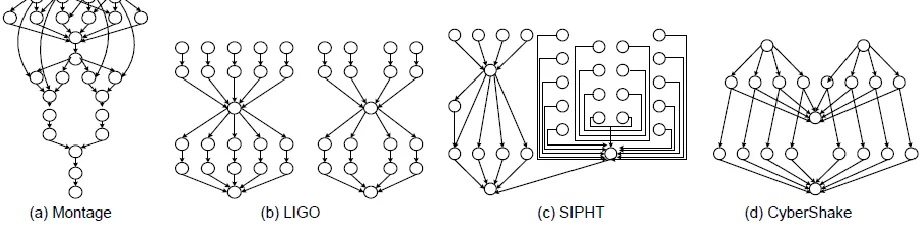
CloudSim is used to simulate the cloud environment and to test the proposed approaches. For workflow scheduling an e xtension of CloudSim is used named Workflo wSim. WorkflowSim is an open source toolkit which simu lates workflow e xecution in virtualizes cloud datacenter environment. All energy effic ient techniques like DVFS, virtual mach ine migrat ion are us ed to save energy while maintain ing the deadline constraint of workflows. Diffe rent real time workflows used by researchers and each has a particular structure. Figure 2 shows the structures of four scientific workflows Montage, LIGO, SPIHT and CyberShake .
Figure 2: Structure of workflows
II. RELA TED WORK
In this section we will d iscuss the ma in energy effic ient algorith ms and polic ies presented by different researchers firstly in virtualized c loud and then specially for energy effic ient workflow scheduling in c loud datacenters.
In [2], authors address the problem energy effic ient resource management in large sacale virtualized data centers. Nathuji et.a l. are to first to study power management in context of v irtualized datacenters. In 1 authors presents an approach called VirtualPowe r. In his approach both hardware power scaling and software based methods are used to control the power consumption of the underlying platform. They also consolidate the virtual machines using migration to achieve energy effic iency. Both Soft and hard actions are combined to decrease power utilization. Soft
actions are
global leve l energy effic ient polic ies are imp le mented at physical machines and at hardware infrastructure. Results of their approach is very promising and they reduce the power consumption by 34% by using VirtualPower.
Song et. al. studied the problem of energy effic iency in mult i application virtualized datacenters. In [3], authors proposed a mult i tie r resource scheduling scheme that provides on demand services to clients requests through the resources acquired among VMs. When competition a mong resources occur, critical services are given preferences over other low priority services. Authors proposed a prototype RAINBOW which wo rks at three levels. First is the application level scheduler second is local level scheduler and t hird is global level scheduler. During resource utilizat ion decisions CPU and RAM utilizations are taken into considerations. Experimental results shows that using RAINBOW 9-16% improve ments was achieved in performance of c rit ical services.
In [4] authors work was focused on the effort to coordinate all the solutions that are available at hardware and software level and policies at local and global level to achieve required energy effic iency at datacenters. Authors proposed a system where they combine five diffe rent power management techniques and coordinate among those. Authors formulate this proble m as control theory coordinate among these using feedback control loops. Five controllers are used which are (i) effic iency controller (ii) server manager (iii) enclosure manager (iv) group manager (v) VM controller. Efficiency controller optimizes power consumption for individual server by adjusting P states of CPU. Server manager applies power strategies at server level. Enclosure manager and group manager Impr oves power efficiency at enclosure and datacenter level respectively. Authors simulated their coordinated approach and achieved 64% power reduction when compared to non coordinated approaches.
In [5], authors investigate the problem of dynamic p lace ment of application in v irtualized systems, while minimizing the energy losses and SLA violations. Authors also take migrat ion costs and power utilization into account for calculating overall results. Authors presented a pMapper architecture uses placement algorith ms to solve the problem of minimizing power consumption under fixed performance require ments. pMapper consists of three managers and an arbitrator wh ich coordinates the actions of these managers. These are performance manager, power manager and migrat ion manager. Powe r manager adjusts hardware power states and apply DVFS. Performance manager monitors the workload and resize VMs accordingly. M igration manager handles and issues instructions for live migrat ion of virtual machines. This method is a continuous optimization approach in which at each t ime fra me VM place ments we re optimized to min imize power consumption and ma ximized performance.
The algorithm proposed in [6], focused on min imizing energy consumption by scheduling virtual mach ines in the system effic iently. The ma in parameters that had been focused were DVFS and active cooling. Another features like shutdown of underutilized machines and migrat ions of workloads fro m the mach ines that are operating below a specific threshold were also used. Authors give each node an energy efficiency priority based on the ratio of mips and energy utilized by it. The algorith m was capable of performing the scheduling of VMs in non federated, homogeneous and heterogeneous datacenters. The algorithm was able to imp rove power consumption in c louds significantly when used in heterogeneous datacenters.
In [7], anton et.al. investigates the problem of high energy consumption in large v irtualized data centers. Authors use virtual machine mig ration and switching idle nodes to sleep mode to conserve energy. Their objective was to give QoS the users and reducing the total cost of ownership for the providers. They tried to reduce the number of mig rations due to migration overheads. Authors presented online algorith m for energy and performance effic ient VM p lace ment in cloud data center. Algorith ms are presented which we re heuristic based are p resented. First algorithm determines which host is overloaded and which host is underloaded. They used thresholding technique for this. Overloaded hosts causes performance degradation hence, VMs are mig rated fro m overloaded hosts. Underloaded hosts are switched to sleep mode after migrating their VMs. Second algorith m finds a energy effic ient and suitable placement for these VMs. The algorith ms can work for any type of workload. simu lation is done using cloudsim simu lator and e xperimental results showed that they reduced the energy and carbon dioxide e mission and also follow the strict SLA.
servers which can be put in sleep mode. It used bin packing proble m approach and it was compared with best fit algorith m. The authors had proposed that by using this approach of combining the allocation algorith m with migrat ion algorith m in a linear integer progra m, a significant amount of energy can be saved depending upon system loads. Expe rimental results show that by using exact allocation and migration algorith m 10-50% servers were idle depending on the workload that can put to sleep mode. At low loads results were quite significant.
In [9], authors worked on the problem of energy effic ient virtual machine management in v irtualized cloud data centers. authors worked on the VM allocation and reallocation in cloud to effic iently utilize the resources while reducing the number of migrations and overhead incurred by them. The objective of their work was to reduce energy consumption, reducing the migrat ion number, ma intaining the QoS and to complete their solution in computational time. Authors used OpenNebula platform and studied the migration behavio ur on that platform and imp le mented host management strategy to effectively consolidate the VMs. Authors proposed a VM manage ment approach named SOPVP. Two lists are ma intained for each host one for the hosts that have more CPU than me mory and other for the hosts that have more me mo ry than CPU. VMs are allocated to the applications based on their CPU or me mory require ments. Proposed algorith m SOPVP was compared with other default algorithm provided in OpenNebula and results showed that their algorith m saved significant energy while ma intain ing the QoS.
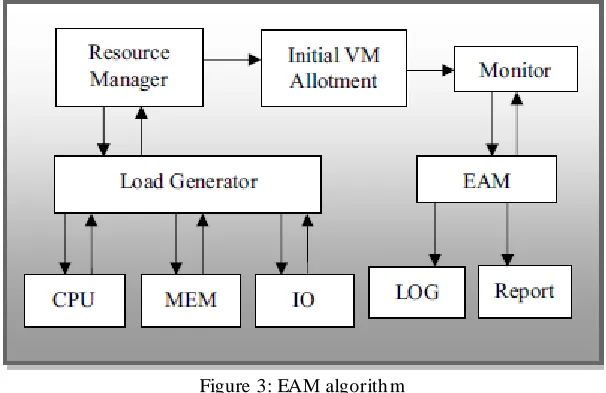
Mohammad et. al. in [10] proposed an energy aware virtual mach ine migration algorith m wh ich migrates the virtual mach ine on the criteria o f load on the servers, number of VMs, hit count and other important factors. Firstly a victim server underutilized server is selected based on the above factor and then target server is selected to place the VMs in such a way so as to reduce migrat ion oscillation. They also used a global threshold for datacenter after which mo re servers were made active to accumulate workload. They proposed EAM algorithm and simu lated it on the presented below:
Figure 3: EAM algorith m
Continuous monitoring was used to ma ke good decisions on migrat ion of VMs. Experimental results showed that about 20% energy is reduced using EAM in both static and dynamic load scenarios.
Figure 4: pSc iMapper scheme
In [12], authors proposed two algorithms for scheduling of scientific workflo ws in cloud environment to achieve time and energy effic iency. First algorithm they proposed is EHEFT (Enhancing Heterogeneous Earlies t Finish Time) wh ich finds the set of processors that were executing the tasks ineffic iently and shut them down to reduce energy consumption. EHEFT had three phases task scheduling phase, discovering ineffic ient processors phase and rescheduling phase. Second algorithm proposed was ECPOP (Enhancing Critica l Path On Processor) which reduce the power consumption by increasing the utilization of task execution while ma intaining the makespan. It also had three phases task scheduling phase, discovering non -critica l processor phase and rescheduling phase. Experimental results showed that enhanced algorithms gave better results than the base algorithms.
In [13] authors presented an energy efficient task scheduling algorith m fo r scientific workflows using frequency scaling and strictly follo wing user deadline. Their work focused on heterogeneous machines with diffe rent task runtime and frequency capabilit ies. Initia lly tasks of the workflows re mapped to available machines. Energy Aware Stepwise Frequency Scaling (ESFS) algorith m determines the processor frequency to be used for the execution of each task taking into account its deadline and ensure that deadline was not violated. The proposed algorithm works iterative lyto gradually scale the processor frequency used for each task for as long as overall energy savings are increased. The next available frequency mode for each processor is used as a lower bound in each iteration to scale the frequency of the tasks. ESFS a lgorith m is imp le mented on LIGO,SPIHT and Montage workflows and results showed that energy consumed is reduced when compared with baseline algorithms HEFT and EES.
In [14] authors studied the studied the problem of energy consumption and carbon dioxide e mission at data center level while e xecuting scientific workflows. They proposed an algorithm wh ich uses DVFS and limiting the number of VM migrat ions to reduce energy consumption and high resource utilizat ion rate. They used five step workflow scheduling algorith m. The five steps they used are in step 1 earliest completion time estimation phase . Step 2 is the DVFS phase . Step 3 is data center selection phase which selects the data center fro m the list of data centers selected in first step. Step 4 is the forwa rd workflo w scheduling phase and step 5 is the backward workflow scheduling phase. Experimental results showed that they achieve upto 30% energy saving which gives hig h profit and less CO2 emission.
In [16] authors addressed the problem of energy consumption during workflow e xecution in cloud environment. They proposed a multiple procedure scheduling algorithm with objectives to ma ximize the resource utilizat ion, reducing energy consumption and guarantee the deadlines of scientific wo rkflo ws. Algorith m designed by authors focused on the three factors that consume energy in cloud i.e. VM power to execute job modules, the overhead of instantiating and tearing down VMs and communication cost in task migrat ion. Their heuristic scientific workflo w scheduling algorithm consists of three procedures. First procedure was eTime Bound which estimates the execution t ime of running a workflow in selected data centers. Second procedure was ForwadMapping which selects the highest priority task from the workflo w based on critical path of the workflow. Third procedure was backward mapping which enforces the e xecution in such a way so that energy is minimized and workflo w tasks also execute under their deadlines. CPU usage was restricted between two thresholds to min imize the energy consumption. Authors simulated a datacenter with 100 servers and compared their proposed algorithm with three e xisting algorith ms. Results obtained showed that they achieved better resource utilizat ion and lowest energy consumption.
III.CO NCLUSION AND FUTURE WO RK
In this paper, we have conducted the survey on algorithms and polic ies for reducing e nergy consumption in virtualized cloud datacenters . Starting from the first work by nathuji et.al. Virtual machine consolidation and migration is the main technique to reduce energy consumption. At node level DVFS is also used by most of the researchers as it uses dynamic scaling fo r energy consumption reduction. Presently cloud platform is best platform for e xecuting scientific workflo ws due to its inherent characteristics like auto scaling, on demand access and resource pooling. Workflows contains large amount of paralle l tasks and can consume huge amount of time and energy if they are not scheduled effic iently. Diffe rent techniques are presented here and discussed in brief.
In the future, we will propose an energy efficient algorith m for real scientific workflow scheduling in cloud. That will present a VM migration c riteria based on energy consumption of each VM and nu mber of tasks a VM is e xecuting presently.
REFER ENC ES
1. Borgetto, Damien, and Patricia Stolf. "An energy efficient approach to virtual machines management in cloud computing." Cloud Networking (CloudNet), 2014 IEEE 3rd International Conference on. IEEE, 2014.
2. Nathuji, Ripal, and Karsten Schwan. "VirtualPower: coordinated power management in virtualized enterprise systems." In ACM SIGOPS Operating Systems Review, vol. 41, no. 6, pp. 265-278. ACM, 2007.
3. Song, Ying, Hui Wang, Yaqiong Li, Binquan Feng, and Yuzhong Sun. "Multi-tiered on-demand resource scheduling for VM-based data center." InProceedings of the 2009 9th IEEE/ACM International Sy mposium on Cluster Computing and the Grid, pp. 148-155. IEEE Computer Society, 2009.
4. Raghavendra, Ramya, Parthasarathy Ranganathan, Vanish Talwar, Zhikui Wang, and Xiaoyun Zhu. "No power struggles: Coordinated multi-level power management for the data cent er." In ACM SIGARCH Computer Architecture News, vol. 36, no. 1, pp. 48-59. ACM, 2008.
5. Verma, Akshat, Puneet Ahuja, and Anindya Neogi. "pMapper: power and migration cost aware application placement in virtualized systems." InMiddleware 2008, pp. 243-264. Springer Berlin Heidelberg, 2008.
6. Lago, Daniel Guimaraes do, Edmundo RM Madeira, and Luiz Fernando Bittencourt. "Power-aware virtual machine scheduling on clouds using active cooling control and DVFS." In Proceedings of the 9th International Workshop on Middleware for Grids, Clouds and e-Science, p. 2. ACM, 2011.
7. Beloglazov, Anton, and Rajkumar Buyya. "Optimal online deterministic algorithms and adaptive heuristics for energy and performance efficient dynamic consolidation of virtual machines in cloud dat a centers." Concurrency and Computation: Practice and Experience 24, no. 13 (2012): 1397-1420.
8. Ghribi, Chaima, Makhlouf Hadji, and Djamal Zeghlache. "Energy efficient vm scheduling for cloud data centers: Exact allocation and migration algorithms." In Cluster, Cloud and Grid Computing (CCGrid), 2013 13th IEEE/ACM International Symposium on , pp. 671-678. IEEE, 2013.
9. Borgetto, Damien, and Patricia Stolf. "An energy efficient approach to virtual machines management in cloud computing." Cloud Networking (CloudNet), 2014 IEEE 3rd International Conference on. IEEE, 2014.
10. Al Shayeji, Mohammad H., and M. D. Samrajesh. "An energy -aware virtual machine migration algorithm." In Advances in Computing and Communications (ICACC), 2012 International Conference on , pp. 242-246. IEEE, 2012.
11. Zhu, Qian, Jiedan Zhu, and Gagan Agrawal. "Power-aware consolidation of scientific workflows in virtualized environments." In Proceedings of the 2010 ACM/IEEE International Conference for High Performance Computing, Networking, Storage and Analysis, pp. 1-12. IEEE Computer Society, 2010.
13. Pietri, Ilia, and Rizos Sakellariou. "Energy-aware workflow scheduling using frequency scaling." In Parallel Processing Workshops (ICCPW), 2014 43rd International Conference on, pp. 104-113. IEEE, 2014.
14. Cao, Fei, and Michelle M. Zhu. "Energy Efficient Workflow Job Scheduling for Green Cloud." In Parallel and Distributed Processing Symposium Workshops & PhD Forum (IPDPSW), 2013 IEEE 27th International, pp. 2218-2221. IEEE, 2013.
15. Xu, Xiaolong, Wanchun Dou, Xuyun Zhang, and Jinjun Chen. "EnReal: An Energy -Aware Resource Allocation Method for Scientific Workflow Executions in Cloud Environment."
![Figure 4: pSciMapper scheme In [12], authors proposed two algorithms for scheduling of scientific workflows in cloud environment to achieve time](https://thumb-us.123doks.com/thumbv2/123dok_us/1475336.1180646/5.596.114.467.185.397/figure-pscimapper-proposed-algorithms-scheduling-scientific-workflows-environment.webp)
